cooling BUICK PARK AVENUE 1996 Owners Manual
[x] Cancel search | Manufacturer: BUICK, Model Year: 1996, Model line: PARK AVENUE, Model: BUICK PARK AVENUE 1996Pages: 388, PDF Size: 20.04 MB
Page 70 of 388
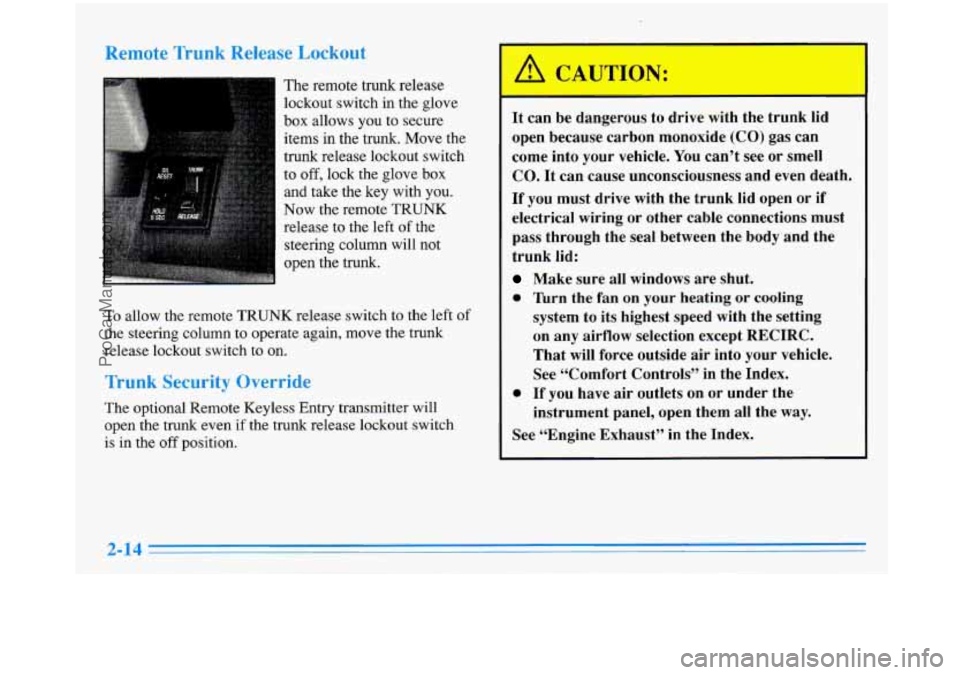
Remote Trunk Release Lockout
The remote trunk release
lockout switch in the glove
box allows you to secure
items
in the trunk. Move the
trunk release lockout switch
to off, lock the glove
box
and take the key with you.
Now the remote TRUNK
release to the left
of the
steering column will not
open the trunk.
To allow the remote TRUNK release switch to the left of
the steering column to operate again, move the trunk
release lockout switch
to on.
Trunk Security Override
The optional Remote Keyless Entry transmitter will
open the trunk even if the trunk release lockout switch
is in the off position. It can
be dangerous to drive with the trunk lid
open because carbon monoxide (CO) gas can
come into your vehicle. You can’t see
or smell
CO.
It can cause unconsciousness and even death.
If you must drive with the trunk lid open or if
electrical wiring or other cable connections must
pass through the seal between the body and the
trunk lid:
Make sure all windows are shut.
0 Wrn the fan on your heating or cooling
system to its highest speed with the setting
on any airflow selection except RECIRC.
That will force outside air into your vehicle.
See “Comfort Controls” in the Index.
0 If you have air outlets on or under the
instrument panel, open them all the way.
See “Engine Exhaust” in the Index.
ProCarManuals.com
Page 130 of 388
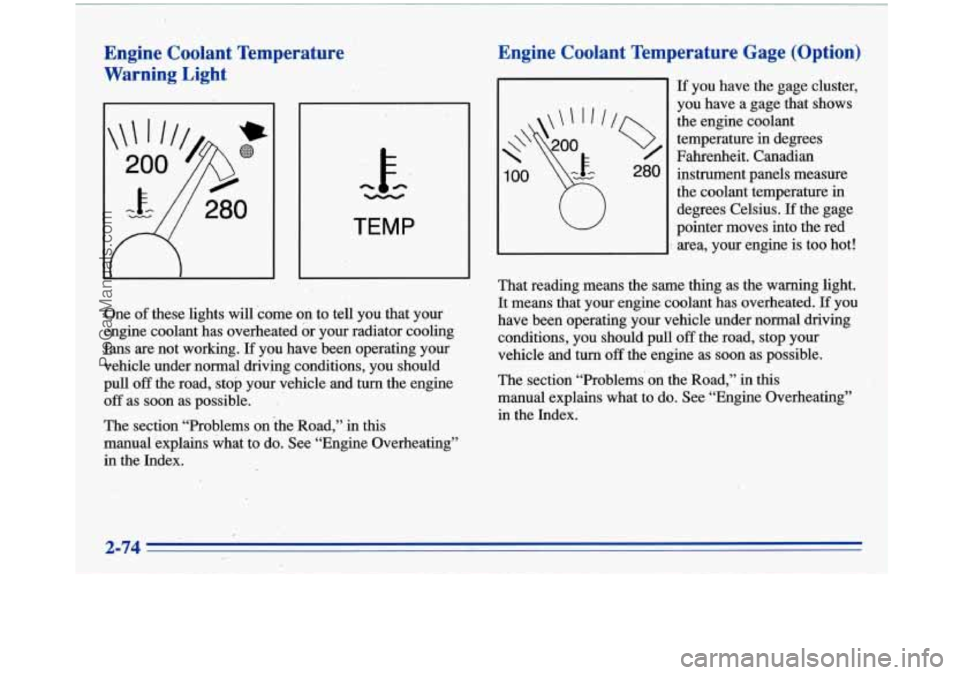
Engine Coolant Temperature
Warning Light
h -
TEMP
One of these lights will come on to tell you that your
engine coolant has overheated or your radiator cooling
fans are not working.
If you have been operating your
,vehicle under normal driving conditions, you should
pull
off the road, stop your vehicle and turn the engine
off as soon as possible. I
The section “Problems on the Road,” in this
manual explains what to
do. See “Engine Overheating”
in the Index.
Engine Coolant Temperature Gage (Option)
If’ you have the gage cluster,
you have a gage that shows
the engine coolant
temperature
in degrees
Fahrenheit. Canadian
instrument panels measure
the coolant temperature in
degrees Celsius.
-If the gage
pointer moves into the red
area, your engine is too hot!
That reading means ,the same thing as the warning light.
It means that your engine coolant has overheated. If you
have been operating.your vehicle under normal driving
conditions, you should pull
off the road, stop your
vehicle and turn
off the engine as soon as possible.
The section “Problems’ on the Road,” in
this
manual explains what to do. See “Engine Overheating”
in the Index.
2-74
ProCarManuals.com
Page 131 of 388
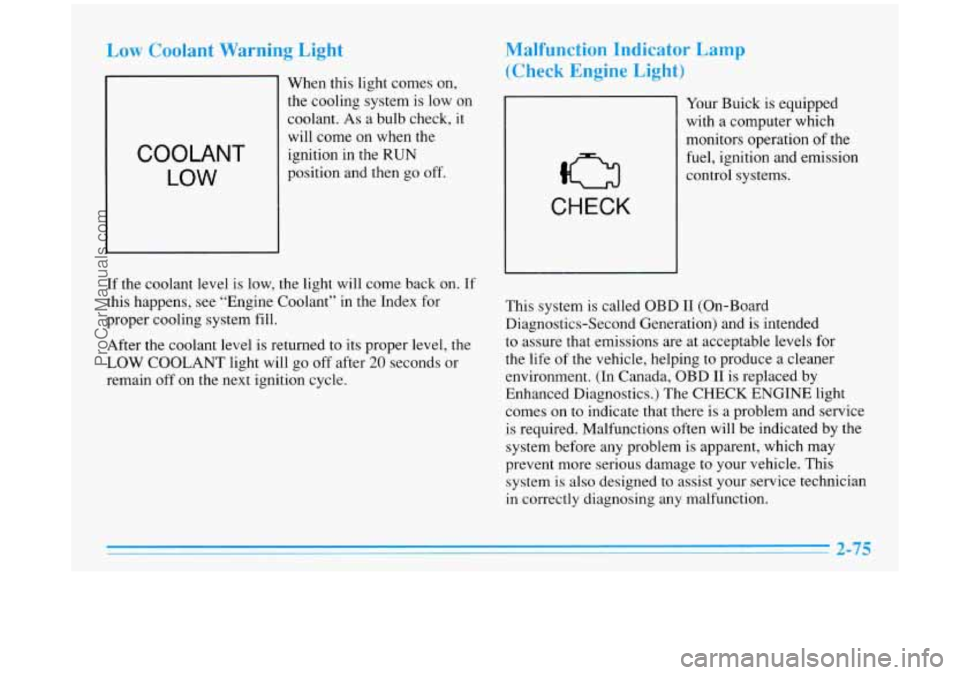
Low Coolant Warning Light
COOLANT
LOW
When this light comes on,
the cooling system is
low on
coolant. As a bulb check, it
will come on when the
ignition in the
RUN
position and then go off.
Malfunction Indicator Lamp
(Check Engine Light)
CHECK
Your Buick is equipped
with a computer which
monitors operation
of the
fuel, ignition and emission
control systems.
If the coolant level is low, the light will come back on. If
this happens, see “Engine Coolant” in the Index for
proper cooling system fill.
After the coolant level
is returned to its proper level, the
LOW COOLANT light will go off after
20 seconds or
remain
off on the next ignition cycle. This system
is called OBD I1 (On-Board
Diagnostics-Second Generation) and is intended
to assure that emissions are at acceptable levels for
the life of the vehicle, helping to produce a cleaner
environment. (In Canada, OBD I1 is replaced by
Enhanced Diagnostics.) The CHECK ENGINE light
comes on to indicate that there is a problem and service
is required. Malfunctions often will be indicated by the
system before any problem is apparent, which may
prevent more serious damage to your vehicle. This
system is also designed to assist your service technician
in correctly diagnosing any malfunction.
2-75
ProCarManuals.com
Page 141 of 388
Section 3 Comfort Controls and Audio Systems
In this section you’ll find out how to operate the comfort
control systems and audio systems offered with your
Buick.
Be sure to read about the particular system
supplied with your vehicle.
Comfort Controls
This section tells you how to operate your comfort
controls. Your comfort control system uses
ozone-friendly
R- 134a refrigerant.
With these systems, you can control the heating,
cooling and ventilation in your Buick.
Your vehicle
also has
a flow-through ventilation system described
later in this section.
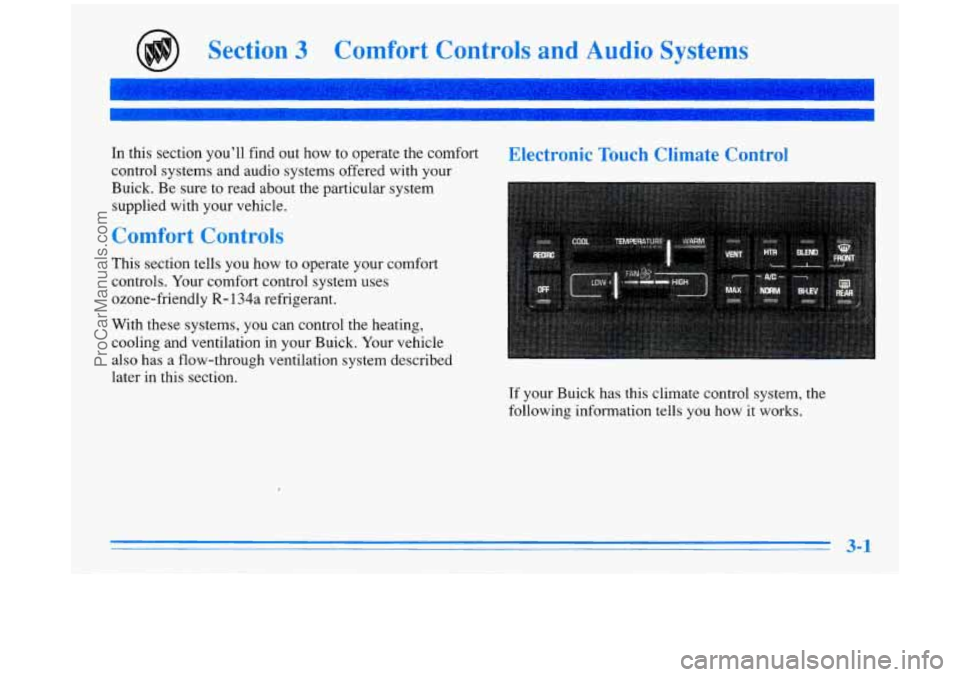
Electronic Touch Climate Control
If your Buick has this climate control system, the
following information tells you how it works.
ProCarManuals.com
Page 146 of 388
FRONT This selection is used to defrost the
windshield by directing the airflow toward the windshield.
If
FRONT is selected while in the AUTO mode, the fan
speed and the air temperature from the front defroster will
vary. If a manual
fan speed setting is selected, the fan
speed will remain at that selection until another fan speed
selection is made or the AUTO mode
is selected. To turn
off FRONT, press the AUTO or AIR FLOW button.
FRONT defrost will work better if any ice or snow is
cleared from the hood and the air inlet area between the
base
of the windshield and the hood.
Air Condi,,.
On hot days, open the windows long enough to let hot
inside air escape. This reduces the time it takes for your
vehicle to cool down. Then keep your windows closed
for the air conditioner to work its best.
If you have the electronic touch system, for quick
cool-down on very
hot days, use MAX with the
temperature and fan speed adjusted to COOL and
HIGH.
For normal cooling on hot days, use NORM and adjust the
temperature and fan speed for your comfort. If REClRC is
selected while
in the NORM air conditioning mode, the
system works like
MAX and recirculates the air. Use
BI-LEV to deliver warm air to the floor and cooler air to
the middle instrument panel outlets.
If you have the dual automatic comfortemp system and
on very hot days using the AUTO mode, the system will
automatically enter the RECIRC mode and the
temperature door will be positioned at the full cold
position for maximum cooling. If the system
is not in
the AUTO mode, RECIRC should be selected to provide
maximum cooling. You can choose the extreme comfort
setting of
60°F (16"C), but the system will not cool any
faster by choosing the extreme comfort setting.
When the air conditioner is on, you may sometimes notice
slight changes in your vehicle's engine speed and power.
This is normal because
the system is designed to cycle the
compressor on and
off to keep the desired temperature.
ProCarManuals.com
Page 147 of 388
Heating
If you have the electronic touch system, on cold days,
use HTR with the TEMPERATURE lever toward
WARM. If you have the dual automatic comfortemp
system, press
AUTO and adjust the temperature by
pressing the TEMP up or down arrow. You may also
adjust the dual automatic comfortemp system manually
by pressing the AIR FLOW button until FLOOR
appears. Again, adjust the temperature by pressing the
TEMP up or down arrow.
With each system, outside air will be brought in and sent
through the floor outlets. The heater works best if you
keep your windows closed.
Ventilation System
For mild outside temperatures when little heating or
cooling is needed, use
VENT (on the electronic touch
system or manual operation of the dual automatic
cornfortemp system) to direct outside air through
your
vehicle. Air will flow through the middle instrument
panel outlets.
Your vehicle’s flow-through ventilation system supplies
outside air into the vehicle when it’s moving. When the
vehicle is not moving, you can get outside air to flow
through by selecting any air choice (except the rear
window defogger) and any fan speed.
3-7
ProCarManuals.com
Page 197 of 388
If you drive regularly in steep country, or if you’re
planning to visit there, here are some tips that can make
your trips safer and more enjoyable.
0 Keep your vehicle in good shape. Check all fluid
levels and
also the brakes, tires, cooling system
and transaxle. These parts can work hard on
mountain roads.
0 Know how to go down hills. The most important
thing to know is this: let your engine do some
of the
slowing down. Shift
to a lower gear when you go
down a steep or long hill.
A CAUTION:
If you don’t shift down, your brakes could get
so hot that they wouldn’t work well. You would
then have poor braking or even none going
down
a hill. You could crash. Shift down to let
your engine assist your brakes on
a steep
downhill slope. Coasting
downhill in
NEUTRAL (N) or with the
ignition
off is dangerous. Your brakes will have to
do all the work
of slowing down. They could get so
hot that they wouldn’t work well. You would then
have poor braking or even none going down a hill.
You could crash. Always have your engine running
and your vehicle in gear when you go downhill.
0
0
0
0
Know how to go uphill. Shift down to THIRD (3).
This will help cool your engine and transaxle, and
you can climb the hill better.
Stay in your own lane when driving on two-lane
roads in hills or mountains. Don’t swing wide or cut
across the center
of the road. Drive at speeds that let
you stay in your own lane.
As you go over the top of a hill, be alert. There could be
something in your lane, like a stalled car or an accident.
You may see highway
signs on mountains that warn of
special problems. Examples are long grades, passing or
no-passing zones, a falling rocks area or winding
roads. Be alert
to these and take appropriate action.
4-23
ProCarManuals.com
Page 211 of 388
When You Are Ready to Leave After
Parking on a Hill
1. Apply your regular brakes and hold the pedal down
while you:
Start your engine;
Shift into a gear; and
e Release the parking brake.
2. Let up on the brake pedal.
3. Drive slowly until the trailer is clear of the chocks.
4. Stop and have someone pick up and store the chocks.
Maintenance When Trailer Towing
Your vehicle will need service more often when you’re
pulling a trailer. See the Maintenance Schedule for more
on this. Things that are especially important in trailer
operation are automatic transaxle fluid (don’t overfill),
engine oil, belts, cooling system and brake adjustment.
Each
of these is covered in this manual, and the Index
will help
you find them quickly. If you’re trailering, it’s
a good idea to review these sections before you start
your trip.
Check periodically to see that all hitch nuts and bolts
are tight.
ProCarManuals.com
Page 227 of 388
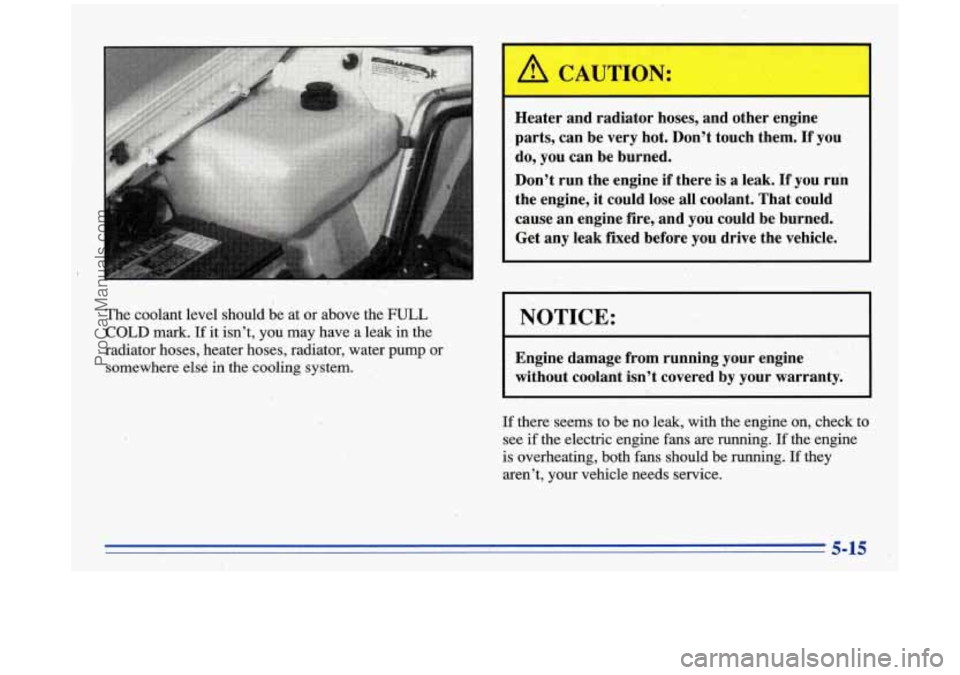
The coolant level should be at or above the FULL
COLD mark. If it isn't, you may have a leak in the
radiator hoses, heater hoses, radiator, water
purnp or
somewhere elsC
in the-cooling system..
I A CAUTION:
I
Heater and radiator hoses, and other engine
parts, can be very hot. Don't touch them.
If you
do, you can be burned.
Don't run the engine
if there is a leak. If you run
the engine, it could lose all coolant. That could
cause an' engine fire, -and you could be burned.
Get any leak fixed before you drive the vehicle.
I NOTICE:
Engine damage from running your engine
without coolant isn't covered
by your warranty.
If there seems to be no leak, with the engine on, check to
see if the electric engine fans are running.
If the engine
is overheating, both fans should be running.
If they
aren't, your vehicle needs service.
5-15 ,
ProCarManuals.com
Page 228 of 388
How to Add Coolant to the Coolant
Recovery Tank
If you haven’t found a problem yet, but the coolant
level isn’t at or above the FULL COLD
mark, add a
50/50 mixture of clean water (preferably distilled) and
DEX-COOL
TM (orange-colored, silicate-free) antifreeze
at the coolant recovery tank.
(See “Engine Coolant” in
the Index for more information.)
Adding only plain water to your cooling system can be dangerous. Plain water, or some other
liquid like alcohol, can boil before the proper
coolant
mix will. Your vehicle’s coolant warning
system
is set for the proper coolant mix. With
plain water or the wrong mix, your engine could
get
too hot but you wouldn’t get the overheat
warning. Your engine could catch fire and you
or
others could be burned. Use a 50/50 mix of clean
water and
DEX-COOL TM antifreeze.
I NOTICE:
In cold weather, water can freeze and crack the
engine, radiator, heater core and other parts.
Use the recommended coolant and the proper
coolant mix.
5-16
ProCarManuals.com