engine BUICK PARK AVENUE 1996 Owners Manual
[x] Cancel search | Manufacturer: BUICK, Model Year: 1996, Model line: PARK AVENUE, Model: BUICK PARK AVENUE 1996Pages: 388, PDF Size: 20.04 MB
Page 3 of 388
The 1996 Buick Park Avenue Owner’s Manual
Seats and Restraint Systems ............................................................. 1-1
Features and Controls .................................................................. 2-1
Comfort Controls and Audio Systems ..................................................... 3-1
This section tells you how to use your seats and safety belts properly. It also explains “SRS” system.
This section explains how to start and operate your Buick.
This section tells you how to adjust the ventilation and comfort controls and how to operate your
audio system.
Here you’ll find helpful information and tips about the road and how to drive under different conditions.
YourDrivingandtheRoad .............................................................. 4-1
ProblemsontheRoad .................................................................. 5-1
This section tells you what to do if you have a problem while driving, such as a flat tire or
overheated engine, etc.
Here the manual tells you how to keep your Buick’ running properly
and looking good.
This section tells you when to perform vehicle maintenance and what fluids and lubricants to use.
ServiceandAppearanceCare ............................................................ 6-1
Maintenanceschedule .................................................................. 7-1
Customer Assistance Information ........................................................ 8-1
This section tells you how to contact Buick for assistance and how to get service publications. It also
gives you information
on “Reporting Safety Defects” on page 8-7.
Index ........................................................................\
........ 9-1
Here’s an alphabetical listing of almost every subject in this manual. You can use it to quickly find
something you want
to read.
i
ProCarManuals.com
Page 6 of 388
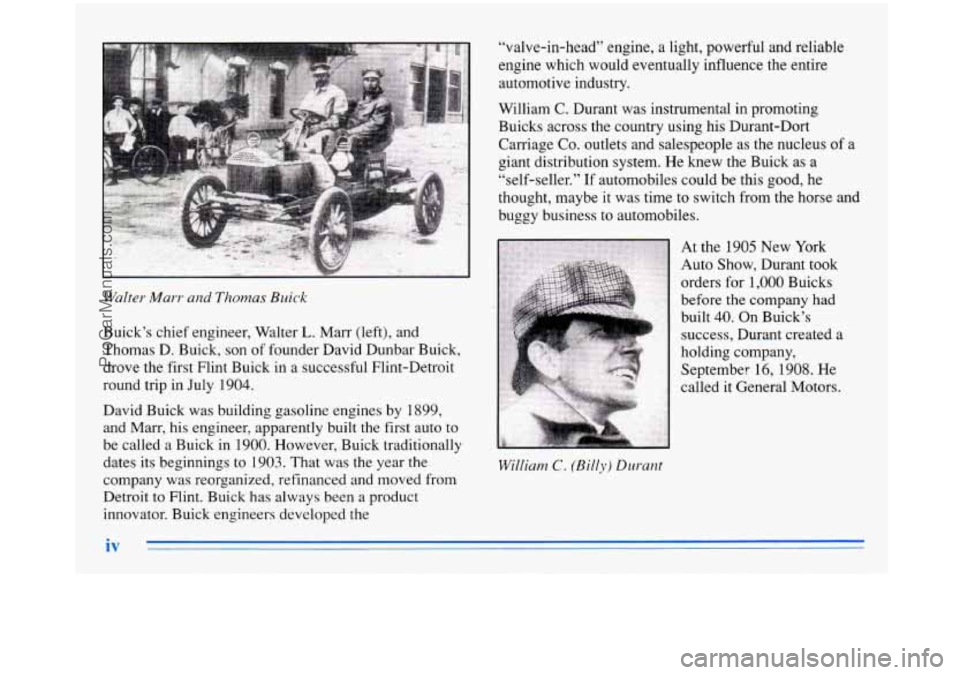
Walter Maur and Thomas Buick
Buick’s chief engineer, Walter L. Marr (left), and
Thomas D. Buick, son of founder David Dunbar Buick,
drove the first Flint Buick in a successful Flint-Detroit
round trip in July 1904.
David Buick was building gasoline engines by 1899,
and Marr, his engineer, apparently built the first auto to
be called a Buick in 1900. However, Buick traditionally
dates its beginnings to 1903. That was the year the
company was reorganized, refinanced and moved from
Detroit to Flint. Buick has always been a product
innovator. Buick engineers developed the “valve-in-head” engine, a
light, powerful and reliable
engine which would eventually influence the entire
automotive industry.
William C. Durant was instrumental in promoting
Buicks across the country using his Durant-Dort
Carriage
Co. outlets and salespeople as the nucleus or a
giant distribution system. He knew the Buick as a
“self-seller.”
If automobiles could be this good, he
thought, maybe
it was time to switch from the horse and
buggy business to automobiles.
1.
At the 1905 New York
Auto Show, Durant took
orders for 1,000 Buicks
before the company had
built
40. On Buick’s
success, Durant created
a
holding company,
September 16, 1908. He
called it General Motors.
William C. (Billy) Duvant
ProCarManuals.com
Page 7 of 388
Durant also created a racing team that won 500 racing
trophies in 1909 and 19
10, including successes at
Indianapolis two years before the Indy
500 began.
The success of Buick engines was visible not only on
the race track, but in endurance tests across the country
and around the world. Buick was the only car to
complete a 1,000-mile Chicago-to-New York race in
1906. And
a Buick was the first car to travel across
South America, driven from Buenos Aires, Argentina,
over the Andes to Santiago, Chile in 1914.
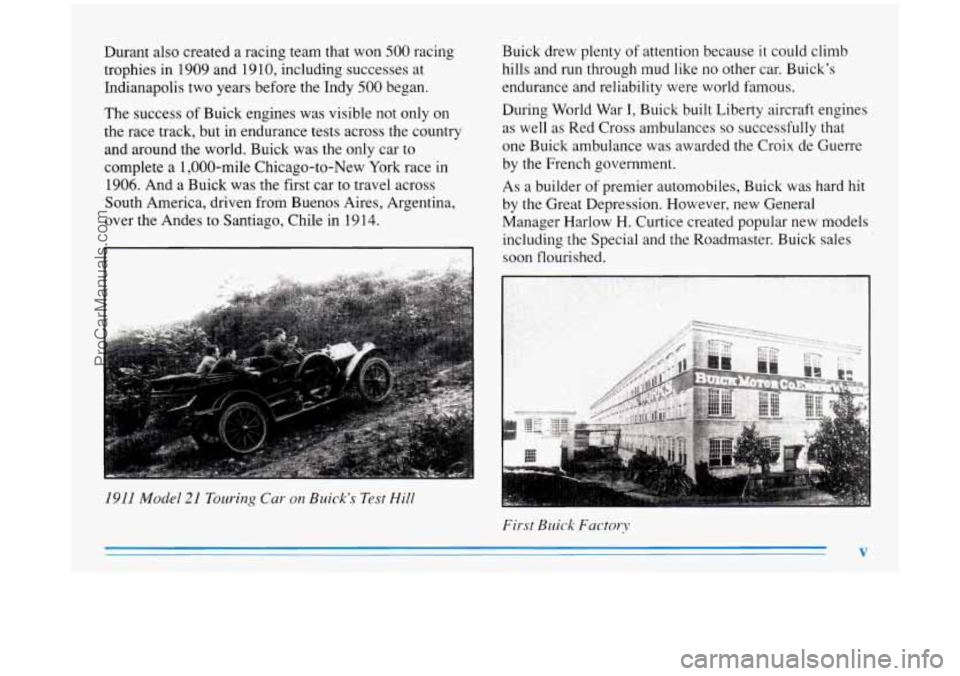
I9II Model 21 Touring Car on Buick’s Test Hill
Buick drew plenty of attention because it could climb
hills and run through mud like
no other car. Buick’s
endurance and reliability were world famous.
During World War I, Buick built Liberty aircraft engines
as well as Red Cross ambulances so successfully that
one Buick ambulance was awarded the Croix de Guerre
by the French government.
As a builder of premier automobiles, Buick was hard hit
by the Great Depression. However, new General
Manager Harlow
H. Curtice created popular new models
including the Special and the Roadmaster. Buick sales
soon flourished.
I :
First Buick Factory
V
ProCarManuals.com
Page 8 of 388
In World War 11, Buick built aircraft engines, tanks and
other military hardware. This post-war period brought
great styling and engineering changes which resulted in
increased sales. The torque converter automatic
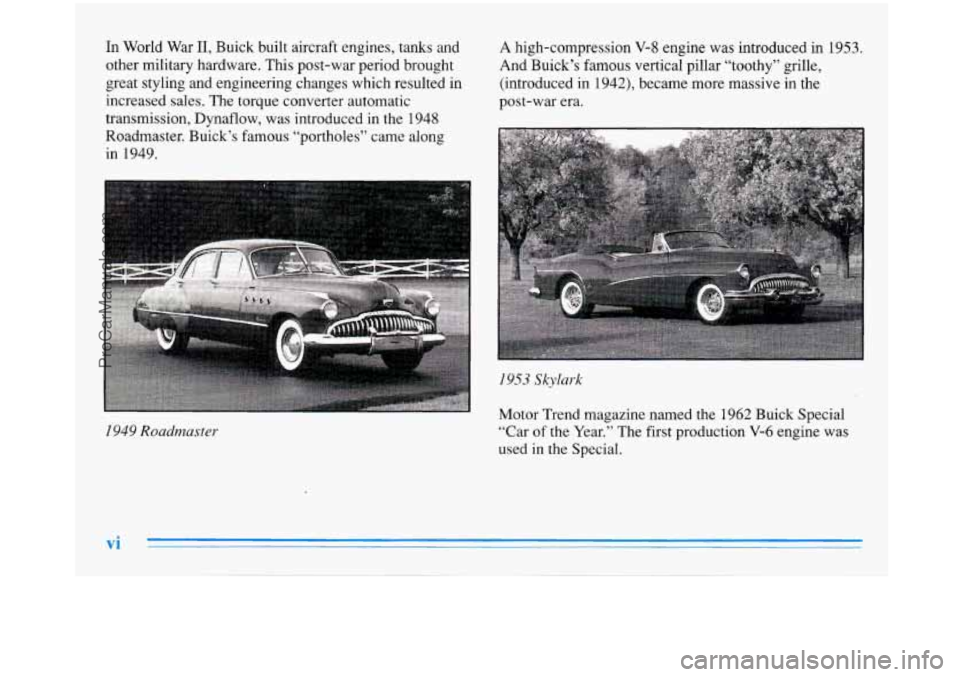
transmission, Dynaflow, was introduced in the 1948
Roadmaster. Buick’s famous “portholes” came along
in 1949.
1949 Roadmaster
vi
A high-compression V-8 engine was introduced in 1953.
And Buick’s famous vertical pillar “toothy” grille,
(introduced in
1942)’ became more massive in the
post-war
era.
I953 Skylark
Motor Trend magazine named the 1962 Buick Special
“Car
of the Year.” The first production V-6 engine was
used
in the Special.
ProCarManuals.com
Page 12 of 388
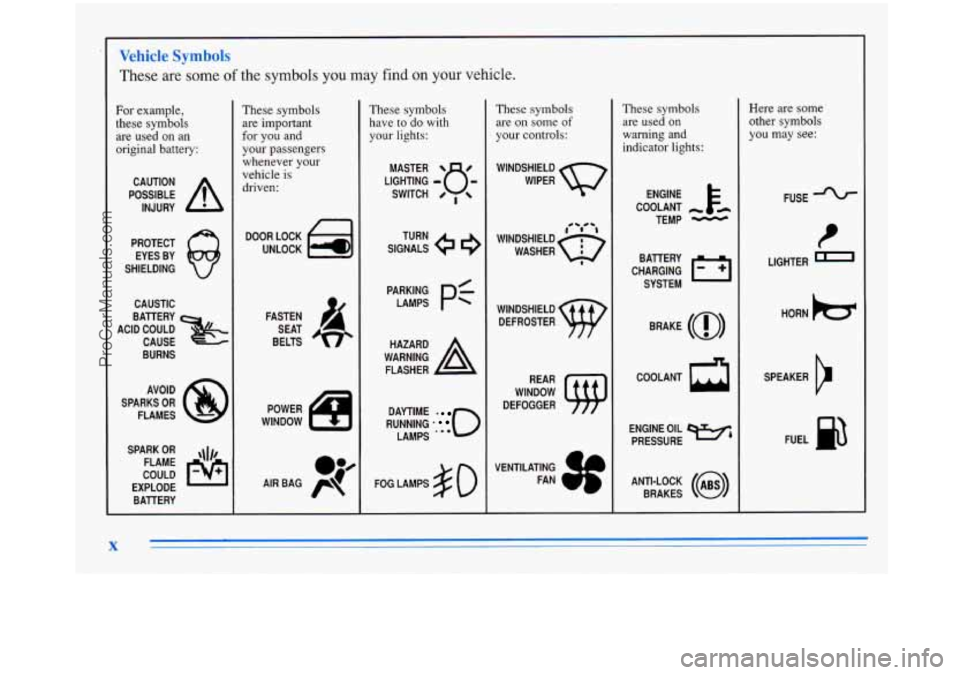
Vehicle Symbols
These are some of the symbols you may find on your vehicle.
For example,
these symbols
are used on an
original battery:
POSSIBLE A
CAUTION
INJURY
PROTECT EYES BY
SHIELDING
CAUSTIC
BURNS AVOID
SPARKS
OR
FLAMES
SPARK
OR ,\I/,
COULD FLAME
EXPLODE BATTERY
These symbols
are important
for you and
your passengers
whenever your
vehicle is driven:
DOOR LOCK
UNLOCK
FASTEN SEAT
BELTS
POWER
WINDOW
These symbols
have to do with
your lights:
SIGNALS e e
TURN
WARNING
A
HAZARD
FLASHER
RUNNING
0
DAYTIME -
LAMPS '**
FOG LAMPS $0
These symbols
are on
some of
your controls:
WINDSHIELD
WIPER
WINDSHIELD DEFROSTER
WINDOW
DEFOGGER
VENTILATING FAN
These symbols are used
on
warning and
indicator lights:
COOLANT
TEMP
-
CHARGING I-1
BATTERY
SYSTEM
BRAKE
(0)
ENGINE OIL e,
PRESSURE
ANTI-LOCK
(@)
BRAKES
Here are some
other symbols you may see:
FUSE
I
LIGHTER I
HORN h=r
SPEAKER
b
FUEL n3
X
ProCarManuals.com
Page 63 of 388
Lockout Protection
The power door locks will not work if the key is left in
the ignition with the driver’s door open. You can
override this feature by holding the power door lock
switch for more than three seconds, unless the engine
is running.
Leaving Your Vehicle
If you are leaving the vehicle, take your keys, open your
door and set the locks from inside, then get out and close
the door.
Remote Keyless Entry System
(Option)
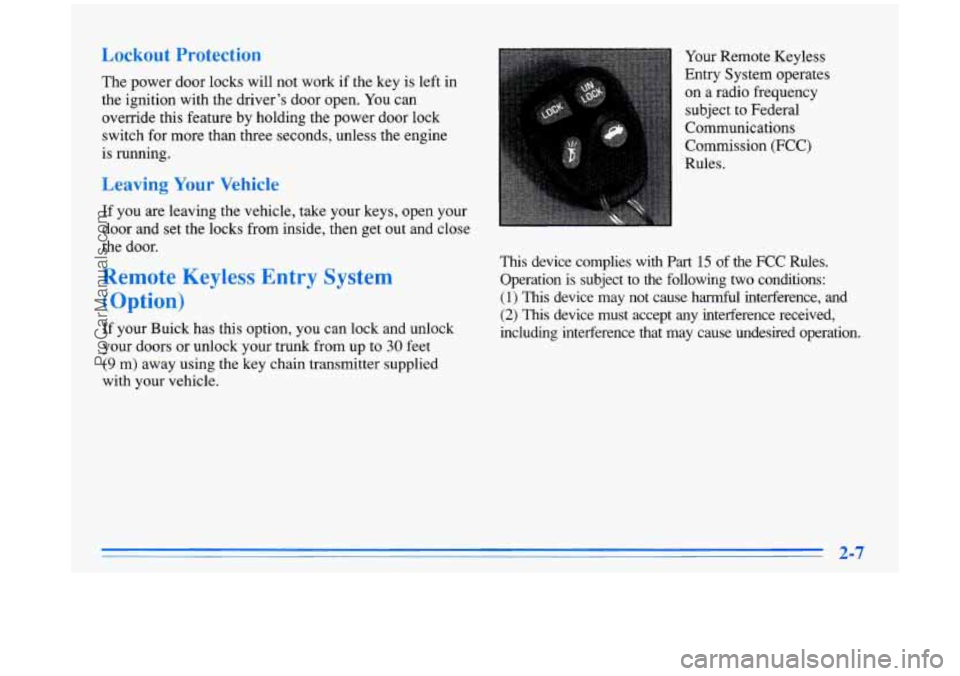
If your Buick has this option, you can lock and unlock
your doors or unlock your trunk from up to
30 feet
(9 m) away using the key chain transmitter supplied
with your vehicle. Your
Remote Keyless
Entry System operates
on a radio frequency
subject
to Federal
Communications
Commission (FCC)
Rules.
This device complies with Part 15 of the FCC Rules.
Operation is subject to the
following two conditions:
(1) This device may not cause harmful interference, and
(2) This device must accept any interference received,
including interference that may cause undesired operation.
2-7
ProCarManuals.com
Page 70 of 388
Remote Trunk Release Lockout
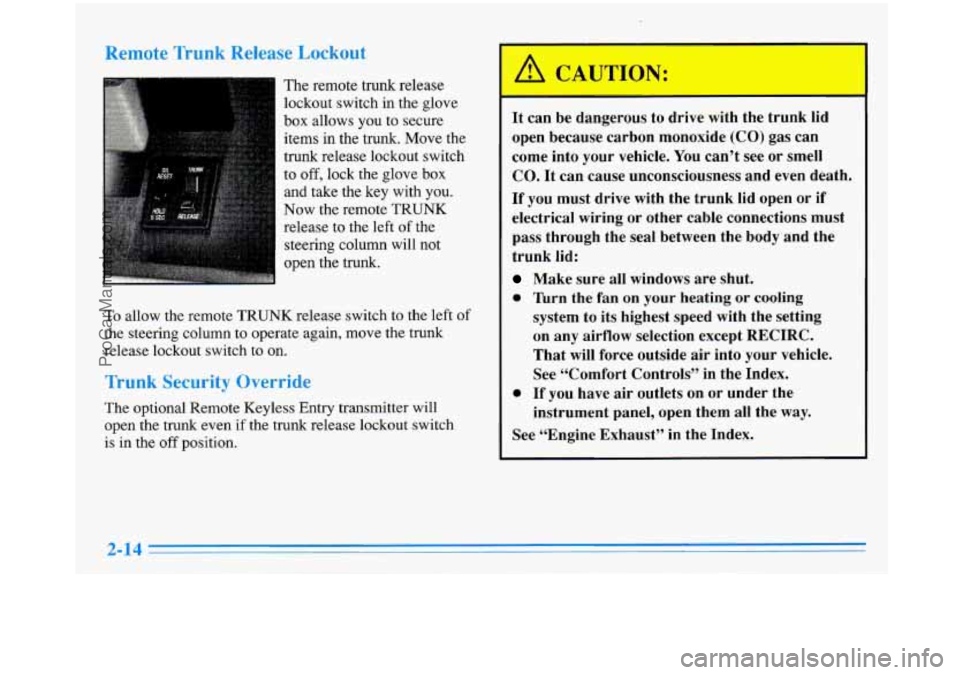
The remote trunk release
lockout switch in the glove
box allows you to secure
items
in the trunk. Move the
trunk release lockout switch
to off, lock the glove
box
and take the key with you.
Now the remote TRUNK
release to the left
of the
steering column will not
open the trunk.
To allow the remote TRUNK release switch to the left of
the steering column to operate again, move the trunk
release lockout switch
to on.
Trunk Security Override
The optional Remote Keyless Entry transmitter will
open the trunk even if the trunk release lockout switch
is in the off position. It can
be dangerous to drive with the trunk lid
open because carbon monoxide (CO) gas can
come into your vehicle. You can’t see
or smell
CO.
It can cause unconsciousness and even death.
If you must drive with the trunk lid open or if
electrical wiring or other cable connections must
pass through the seal between the body and the
trunk lid:
Make sure all windows are shut.
0 Wrn the fan on your heating or cooling
system to its highest speed with the setting
on any airflow selection except RECIRC.
That will force outside air into your vehicle.
See “Comfort Controls” in the Index.
0 If you have air outlets on or under the
instrument panel, open them all the way.
See “Engine Exhaust” in the Index.
ProCarManuals.com
Page 74 of 388
PAS7-Kej I
T
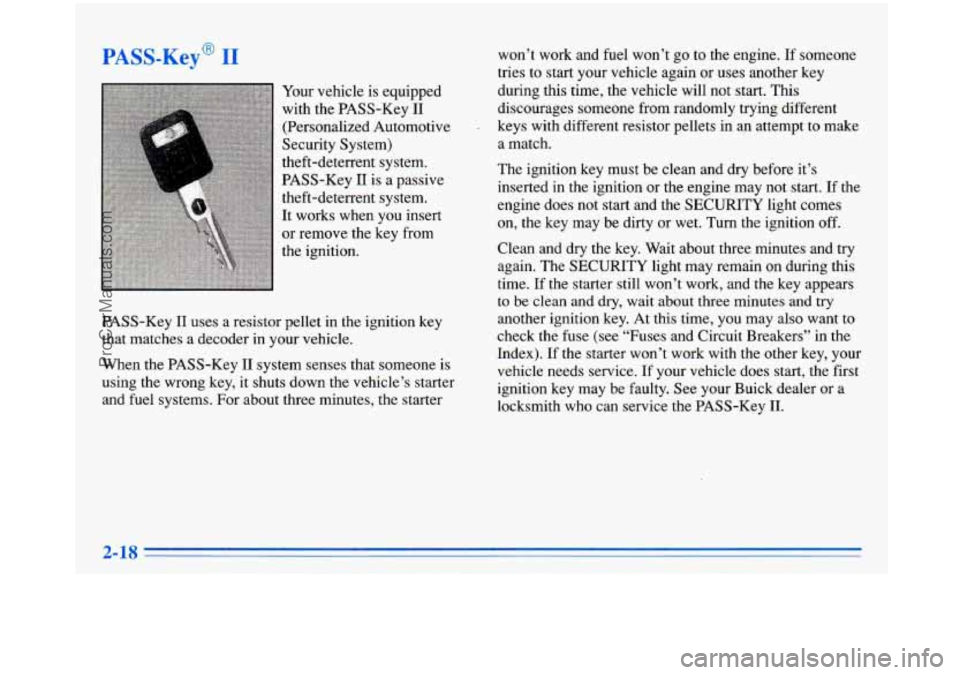
Your vehicle is equipped
with the PASS-Key
11
(Personalized Automotive
Security System)
theft-deterrent system.
PASS-Key
11 is a passive
theft-deterrent system.
It works when you insert
or remove the key from
the ignition.
PASS-Key
I1 uses a resistor pellet in the ignition key
that matches a decoder
in your vehicle.
When the PASS-Key I1 system senses that someone is
using the wrong key, it shuts down the vehicle’s starter
and fuel systems. For about three minutes, the starter won’t work and
fuel won’t go to the engine. If someone
tries to start your vehicle again or uses another key
during this time, the vehicle will not start. This
discourages someone from randomly trying different
keys with different resistor pellets in an attempt to make
a match.
The ignition key must be clean and dry before it’s
inserted in the ignition
or the engine may not start. If the
engine does not start and the SECURITY light comes
on,
the key may be dirty or wet. Turn the ignition off.
Clean and dry the key. Wait about three minutes and try
again. The SECURITY light may remain on during this
time. If the starter still won’t work, and the key appears
to
be clean and dry, wait about three minutes and try
another ignition key. At this time, you may also want to
check the fuse (see “Fuses and Circuit Breakers” in the
Index). If the starter won’t work with the other key, your
vehicle needs service. If your vehicle does start, the first
ignition key may be faulty. See your Buick dealer or a
locksmith who can service the PASS-Key
11.
ProCarManuals.com
Page 75 of 388
If you accidentally use a key that has a damaged or
missing resistor pellet, the starter won’t work and the
SECURITY light will flash. But you don’t have,to wait
three minutes before trying another ignition key.
See your Buick dealer or a locksmith who can service
the PASS-Key
11 to have a new key made.
If you’re ever driving and the SECURITY light comes
on and stays
on, you will be able to restart your engine if
you turn it off. Your PASS-Key 11 system, however, is
not working properly and must be serviced by your
Buick dealer. Your vehicle is not protected by the
PASS-Key
I1 system.
If you lose or damage a PASS-Key
11 ignition key, see
your Buick dealer or a lockskth who can service
PASS-Key
11 to have a new key made.
,
New Vehicle “Break-In”
NOTICE:
Your modern Buick doesn’t need an elaborate
“break-in.” But it will perform better in the long
run if you follow these guidelines:
Don’t drive at any one speed -- fast or
slow
-- for the first 500 miles (804 km).
Don’t make full-throttle starts.
200 miles (322 km) or so. During this time
your new brake linings aren’t yet broken
in. Hard stops with new linings can mean
premature wear and earlier replacement.
Follow this breaking-in guideline every
time
you get new brake linings.
Don’t tow a trailer during break-in. See
“Towing
a Trailer” in the Index for more
information.
Avoid making hard stops for the first
I
ProCarManuals.com
Page 76 of 388
I.
I
Ignition Positions
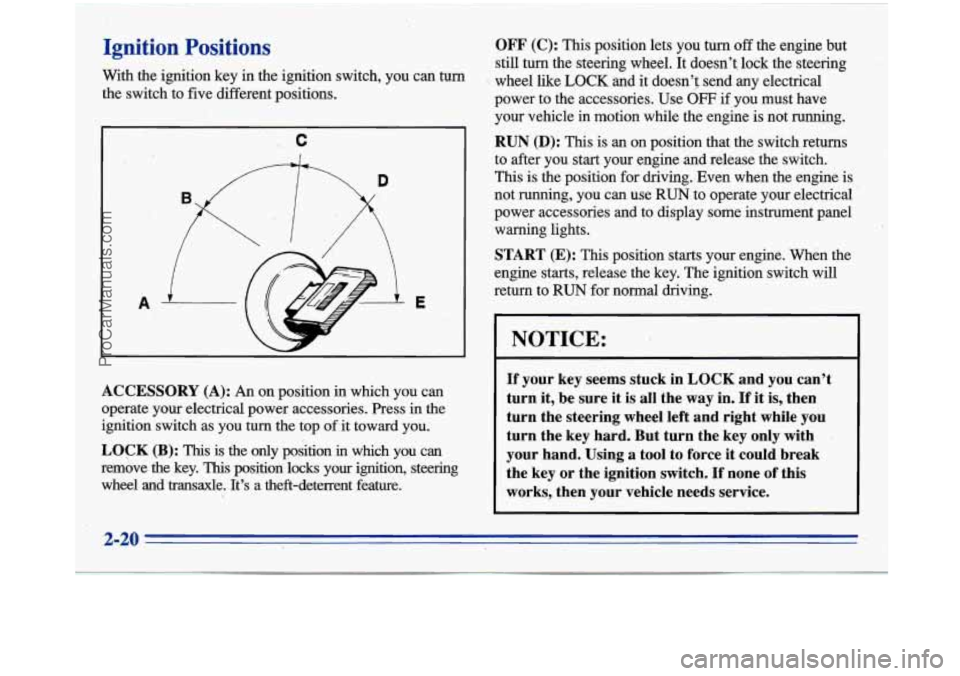
With the ignition key in the ignition switch, you can turn
the switch to five different positions.
.. c
I
A E
ACCESSORY (A): An on position in which you can
operate your electrical power accessories. Press in the
ignition switch as you
hun the top of it toward you.
LOCK
(B): This is the only position in which yqu can
remove
the key. This position locks your ignition, steering
wheel and transaxle. It’s a theft-deterrent feature.
.. ,
OFF (C): This position lets you turn off the engine but
still turn the steering wheel. It doesn’t lock the steering
-.
wheel like LOCK and it doesn’f send any electrical
power to the accessories. Use
OFF if you must have
your vehicle
in motion while the engine is not running.
RUN (D): This is- an on position that the switch returns
to after you start your engine and release the switch.
This is the position for driving.-Even when the engine is
not running, you can use RUN to operate your electrical ’
power accessories and to display some instrument panel
warning lights.
START (E): This position starts your engine. When the
engine starts, release the key. The ignition switch
will
return to RUN for normal driving.
NOTICE:
If your key seems stuck in LOCK and you can’t
turn it, be sure it is all the
way in. If it is, then
turn the steering wheel left and right while you
turn the key hard. But turn the key only with
your hand. Using
a tool to force it could break
the key or the ignition switch.
If none of this
works, then your vehicle needs service.
ProCarManuals.com