gas type BUICK PARK AVENUE 1996 Owners Manual
[x] Cancel search | Manufacturer: BUICK, Model Year: 1996, Model line: PARK AVENUE, Model: BUICK PARK AVENUE 1996Pages: 388, PDF Size: 20.04 MB
Page 251 of 388
Fuel
The 8th digit of your vehicle identification number
(VIN) shows the code letter for your engine. You will
find the
VIN at the top left of your instrument panel.
(See “Vehicle Identification Number” in the Index.)
If you don’t have the 3800 Supercharged engine (VIN
Code l), use regular unleaded gasoline rated at 87 octane
or higher.
If you have the 3800 Supercharged engine, use premium
unleaded gasoline rated at 91 octane or higher.
At a minimum, the gasoline you use should meet
specifications ASTM D4814 in the United States and
CGSB 3.5-M93 in Canada. Improved gasoline
specifications have- been developed by the American
Automobile Manufacturers Association (AAMA) for
’ better vehicle performance and engine protection.
Gasolines meeting ihe AAMA specification could
, ’ provide improved driveability and emission control
system protection compared to other gasolines.
Be sure the posted octane for premium is at least 91
(at least 89 for middle grade and
87 for regular). If the
i octane is, less than 87, you may get a heavy knocking
noise when you drive.
If it’s bad enough, it can damage
your engine.
,
If you have the 3800 Supercharged engine, in an
emergency, you may be able to use .a lower octane
-- as
low as 87
-- if heavy knocking does not occur. If you
are using 91 or higher octane unleaded gasoline and you
still heq heavy knocking, your engine needs service.
,
If you’re using fuel rated at the recommended octane or
higher and you still hear heavy knocking, your engine
needs service. But don’t worry
if you hear a little
pinging noise when you’re accelerating or driving up a
hill. That’s normal, and you don’t have to buy a higher
octane fuel to get rid of pinging. It’s the heavy, constant
knock that means you have a problem.
If your vehicle is certified to meet California Emission
Standards (indicated on the underhood tune-up label), it
is designed to operate’on fuels that meet California
specifications. If such fuels are not available in states
adopting California emissions standards, your vehicle
will operate satisfactorily on fuels meeting federal
specifications, but emission control system performance
may be affected. The malfunction indicator lamp on
your instrument panel may turn on and/or your vehicle
may fail a smog-check test.
If this occurs, return to your
authorized Buick dealer for diagnosis to determine,the
cause of failure.
In the event it is determined that the
cause of the condition is the type of
fuels used, repairs
may not be covered by your warranty.
6-3
ProCarManuals.com
Page 256 of 388
NOTICE:
If you need a new cap, be sure to get the right
type. Your dealer can get one for
you. If you get
the wrong type, it may not fit or have proper
venting, and your fuel tank and emissions system
might be damaged.
Checking Things Under the Hood
I
I
An electric fan under the hood can start up and
injure you even when the engine is not running.
Keep hands, clothing and tools away from
any
underhood electric fan.
I
Things that burn can get on hot engine parts and
start
a fire. These include liquids like gasoline,
oil, coolant, brake fluid, windshield washer and
other fluids, and plastic or rubber.
You or others
could be burned. Be careful not to drop or spill
things that will burn onto
a hot engine.
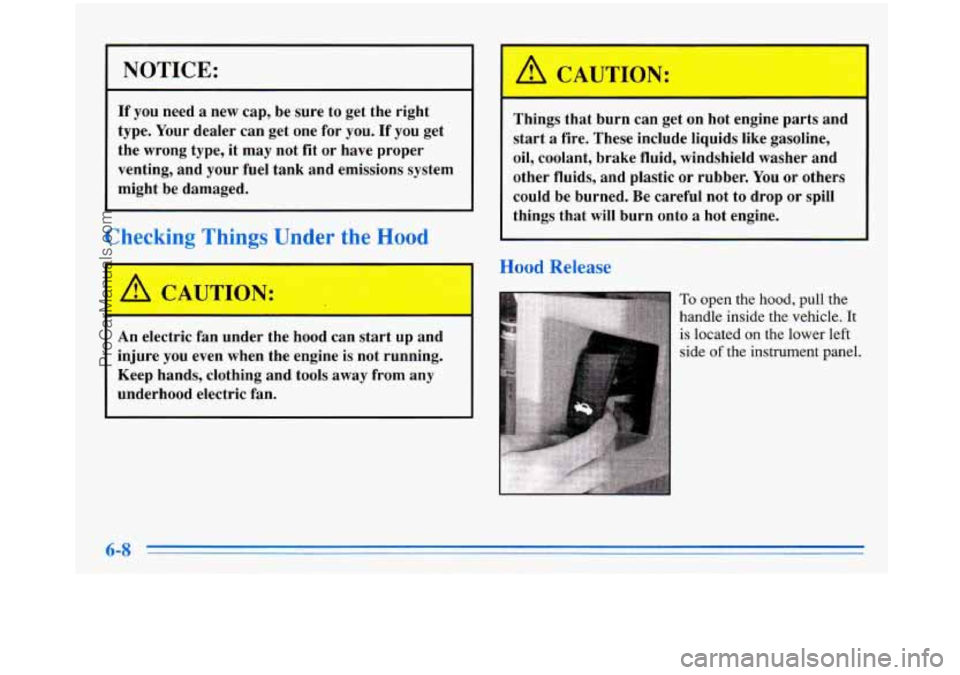
Hood Release
ProCarManuals.com
Page 295 of 388
Appearance Care
Remember, cleaning products can be hazardous. Some
are toxic. Others can burst into flame if you strike a
match
or get them on a hot part of the vehicle. Some are
dangerous if you breathe their fumes in a closed space.
When you use anything from a container to clean your
Buick, be sure to follow the manufacturer’s warnings
and instructions. And always open your doors or
windows when you’re cleaning the inside.
Never use these to clean your vehicle:
Gasoline
Benzene
0 Naphtha
Carbon Tetrachloride
Acetone
Paint Thinner
Turpentine
Lacquer Thinner
Nail Polish Remover
They can all be hazardous
-- some more than
others
-- and they can all damage your vehicle, too.
Don’t use any of these unless this manual says you can.
In many uses, these will damage your vehicle:
0 Alcohol
0 Laundry Soap
0 Bleach
Reducing Agents
Cleaning the Inside of Your Buick
Use a vacuum cleaner often to get rid of dust and loose
dirt. Wipe vinyl or leather with a clean, damp cloth.
Your Buick dealer has two
GM cleaners, a solvent-type
spot lifter and a foam-type powdered cleaner. They will
clean normal spots and stains very well.
Do not use
them on vinyl or leather.
Here are some cleaning tips:
0 Always read the instructions on the cleaner label.
Clean up stains as soon as you can -- before they set.
Use a clean cloth or sponge, and change to a clean area
often. A soft brush may be used if
stains are stubborn.
Use solvent-type cleaners in a well-ventilated area
only.
If you use them, don’t saturate the stained area.
If a ring forms after spot cleaning, clean the entire
area immediately or
it will set.
ProCarManuals.com