hood open BUICK PARK AVENUE 1996 Owners Manual
[x] Cancel search | Manufacturer: BUICK, Model Year: 1996, Model line: PARK AVENUE, Model: BUICK PARK AVENUE 1996Pages: 388, PDF Size: 20.04 MB
Page 78 of 388
I
3. If your engine still won’t start (or starts but then stops),
it could be flooded with too much gasoline.
Try
pushing your accelerator pedal all the way to the floor
and holding it there as you hold the key in
START for
about three seconds.
If the vehicle starts briefly but
then stops again, do the same thing, but
this time keep
the pedal
down for five or six seconds. This clears the
extra gasoline
fi-om the engine. After waiting about
15 seconds, repeat the normal starting procedure.
NOTICE:
Your engine is designed to work with the
electronics in your vehicle. If you
add electrical
parts or accessories, you could change the way
the engine operates. Before qdding electrical
equipment, check with your dealer. If you don’t,
your engine might not perform properly.
If you ever have to have your vehicle towed, see
the part
of this manual that tells how to do it
without damaging your vehicle. See “Towing
Your Vehicle” in the Index.
Engine Coolant Heater (Option)
In very cold weather, .Oo F (- 18 O C) or colder, the engine
coolant heater can help. You’ll get easier starting and
better fuel economy during engine warm-up. Usually,
the coolant heater should be plugged in a minimum
of
four hours prior to starting your vehicle.
To use the coolant heater:
1. Turn off the engine.
2. Open the hood and unwrap the electrical cord.
3. Plug it into a normal, grounded 1 10-volt AC outlet.
Plugging the cord’into an ungrounded outlet
could cause an electrical ,shock. Also, the wrong
kind of extension cord could overheat and cause
a fire. You could be seriously injured. Plug the
cord into
a properly grounded three-prong
110-volt AC outlet. If the cord won’t reach, use
a
heavy-duty three-prong extension cord rated for
at least 15 amps.
2-22
ProCarManuals.com
Page 146 of 388
FRONT This selection is used to defrost the
windshield by directing the airflow toward the windshield.
If
FRONT is selected while in the AUTO mode, the fan
speed and the air temperature from the front defroster will
vary. If a manual
fan speed setting is selected, the fan
speed will remain at that selection until another fan speed
selection is made or the AUTO mode
is selected. To turn
off FRONT, press the AUTO or AIR FLOW button.
FRONT defrost will work better if any ice or snow is
cleared from the hood and the air inlet area between the
base
of the windshield and the hood.
Air Condi,,.
On hot days, open the windows long enough to let hot
inside air escape. This reduces the time it takes for your
vehicle to cool down. Then keep your windows closed
for the air conditioner to work its best.
If you have the electronic touch system, for quick
cool-down on very
hot days, use MAX with the
temperature and fan speed adjusted to COOL and
HIGH.
For normal cooling on hot days, use NORM and adjust the
temperature and fan speed for your comfort. If REClRC is
selected while
in the NORM air conditioning mode, the
system works like
MAX and recirculates the air. Use
BI-LEV to deliver warm air to the floor and cooler air to
the middle instrument panel outlets.
If you have the dual automatic comfortemp system and
on very hot days using the AUTO mode, the system will
automatically enter the RECIRC mode and the
temperature door will be positioned at the full cold
position for maximum cooling. If the system
is not in
the AUTO mode, RECIRC should be selected to provide
maximum cooling. You can choose the extreme comfort
setting of
60°F (16"C), but the system will not cool any
faster by choosing the extreme comfort setting.
When the air conditioner is on, you may sometimes notice
slight changes in your vehicle's engine speed and power.
This is normal because
the system is designed to cycle the
compressor on and
off to keep the desired temperature.
ProCarManuals.com
Page 215 of 388
NOTICE: NOTICE: ~
If the other system isn’t a 12-volt system with a damaged. The repairs wouldn’t be covered by
negative ground, both vehicles can be damaged. If you leave your radio on, it could be badly
your warranty.
2. Get the vehicles close enough so the jumper cables
can reach, but be sure the vehicles aren’t touching
each other. If they are, it could cause a ground
connection you don’t want.
You wouldn’t be able to
start your Buick, and the bad grounding could
damage the electrical systems.
You could be injured if the vehicles roll. Set the
parking brake firmly on each vehicle. Put an
automatic transaxle in PARK
(P) or a manual
transaxle in NEUTRAL (N).
3. Turn off the ignition on both vehicles. Turn off the
radios and all lamps that aren’t needed. This will
avoid sparks and help save both batteries. It could
save your radio!
4. Open the hoods and locate the batteries.
I
An electric fan can start up even when the engine
is not running and can injure
you. Keep hands,
clothing and tools away from any underhood
electric fan.
5. Find the positive (+) and negative (-) terminals on
each battery.
ProCarManuals.com
Page 224 of 388
Engine Overheating
You will find a warning light about a hot engine on your
Buick instrument panel and
if you have the optional
gage cluster, a coolant temperature gage. You
will also
find a LOW COOLANT warning light.
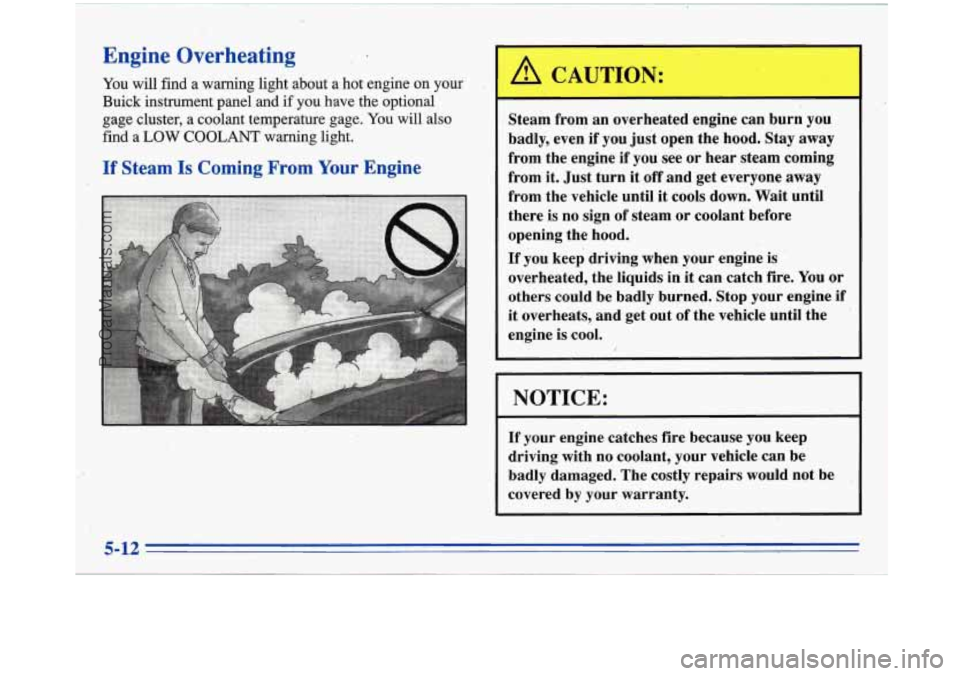
If Steam Is Coming From Your Engine
Steam from an overheated engine can burn you
badly, even if you just open the hood. Stay away
from the engine
if you see or hear steam coming
from it. Just turn it off and get everyone away
from the vehicle until it cools down. Wait until
there
is no sign of steam or coolant before
opening the hood.
If you keep driving when your engine is
overheated, the liquids in it can catch fire.
You or
others could be
badly burned. Stop your engine if
it overheats, and get out of the vehicle until the
engine is cool.
,
NOTICE:
If your engine catches fire because you keep
driving with no coolant, your vehicle can be
badly damaged. The costly repairs would not be
covered
by your warranty.
5-12
ProCarManuals.com
Page 225 of 388
If No Steam Is Coming From Your Engine
If you get the overheat warning but see or hear no
steam, the problem may not be too serious. Sometimes
the engine can get a little
too hot when you:
0 Climb a long hill on a hot day.
Stop after high-speed driving.
Idle for long periods in traffic.
@ Tow a trailer.
If you get the overheat warning with no sign of steam,
try this for a minute or
so:
1. Turn off your air conditioner.
2. Turn on your heater to full hot at the highest fan
speed and open
the window as necessary.
3. If you’re in a traffic jam, shift to NEUTRAL (N);
otherwise, shift to the highest gear while
driving
-- AUTOMATIC OVERDRIVE (a)
or THIRD (3).
If you no longer have the overheat warning, you
can drive. Just to be safe, drive slower for about
10 minutes. If the warning doesn’t come back on,
you can drive normally.
If the warning continues, pull over, stop, and park your
vehicle right away.
If there’s still no sign of steam, you can idle the engine
for two or three minutes while you’re parked, to see if
the warning stops. But then, if you still have the
warning,
turn off the engine and get evejyone out of the
vehicle
until it cools down.
You may decide not to lift the hood but to get service
help right away.
ProCarManuals.com
Page 258 of 388
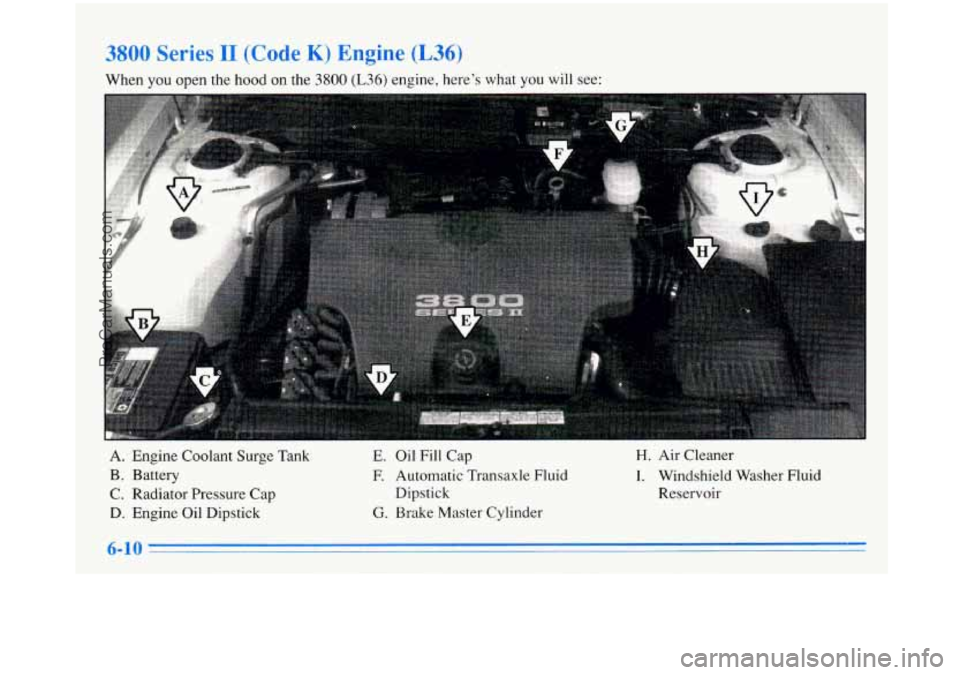
wv DCIIC~ II [~uut: n) u~gmc (L36)
When you open the hood on the 3800 (L36) engine, here’s what you will see:
A. Engine Coolant Surge Tank
B. Battery
C. Radiator Pressure Cap
D. Engine Oil Dipstick E.
Oil
Fill Cap
E Automatic Transaxle Fluid
Dipstick
G. Brake Master Cylinder
.. ,.
H. Air Cleaner
I. Windshield Washer Fluid
Reservoir
ProCarManuals.com
Page 259 of 388
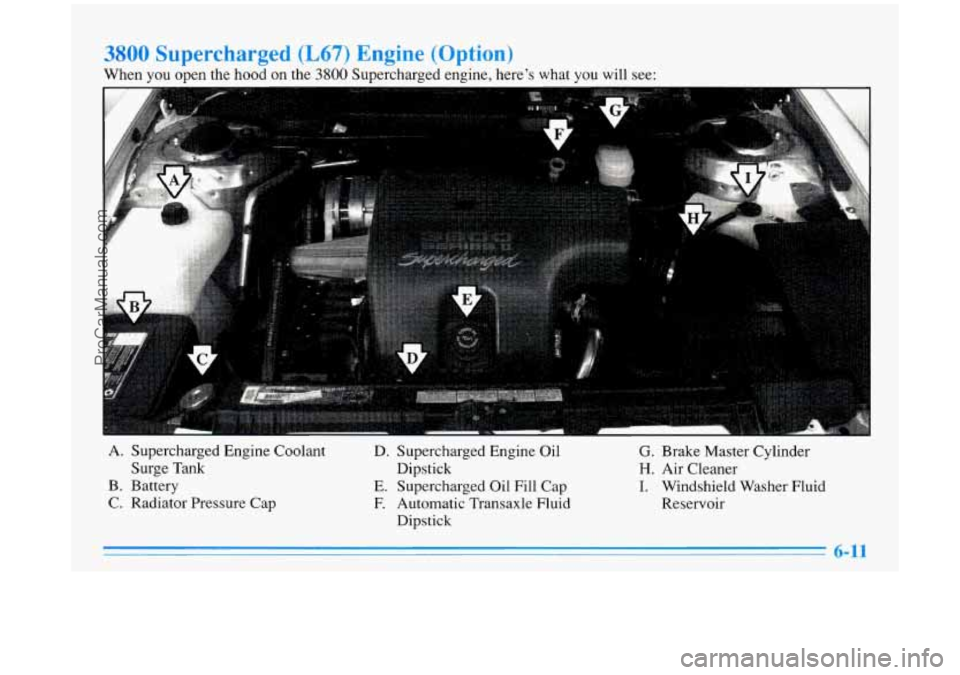
3800 Supercharged (L67) Engine (Option)
When you open the hood on the 3800 Supercharged engine, here's what you will see:
... . .
A. Supercharged Engine Coolant
B. Battery
C. Radiator Pressure Cap
Surge
Tank D. Supercharged
Engine Oil
E. Supercharged Oil Fill Cap
F. Automatic Transaxle Fluid
Dipstick
Dipstick
-.
G. Brake
Master Cylinder
H. Air Cleaner
I. Windshield Washer Fluid
Reservoir
6-11
ProCarManuals.com
Page 305 of 388
Electrical System Headlamp Wiring
Add-on Electrical Equipment
I NOTICE: I
Don’t add anything electrical to your Buick unless
you check with your dealer first. Some electrical
equipment can damage your vehicle and the
damage wouldn’t be covered by your warranty. Some add-on electrical equipment can keep other
components from working as they should.
Your vehicle has an air bag system. Before attempting to
add anything electrical to your Buick, see “Servicing
Your Air Bag-Equipped Buick” in the Index. The
headlamp wiring is protected by a circuit breaker in
the underhood fuse center. An electrical overload will
cause the lamps to go on and
off, or in some cases to
remain off. If this happens, have your headlamp wiring
checked right away.
Windshield Wipers
The windshield wiper motor is protected by a circuit
breaker and a fuse.
If the motor overheats due to heavy
snow, etc., the wiper will stop until the motor cools.
If
the overload is caused by some electrical problem and
not snow, etc., be sure
to get it fixed.
Power Windows and Other Power Options
Circuit breakers in the fuse panel protect the power
windows and other power accessories. When the current
load is too heavy, the circuit breaker opens and closes,
protecting the circuit until the problem is fixed or
goes away.
& 6-57
ProCarManuals.com
Page 357 of 388
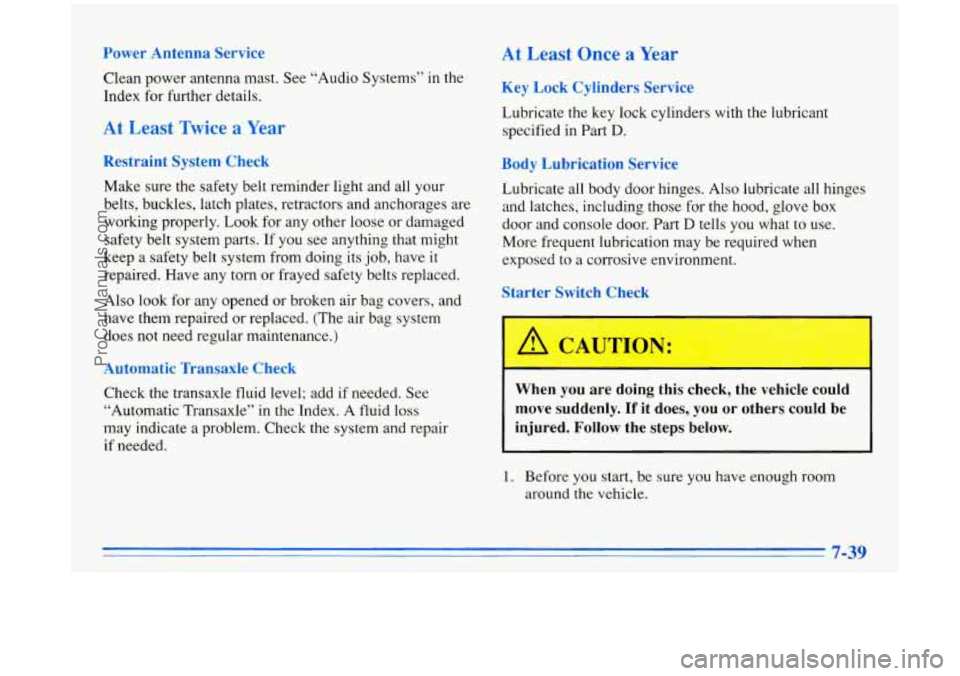
Power Antenna Service
Clean power antenna mast. See “Audio Systems” in the
Index for further details.
At Least Twice a Year
Restraint System Check
Make sure the safety belt reminder light and all your
belts, buckles, latch plates, retractors and anchorages are
working properly. Look for any other loose or damaged
safety belt system parts. If you see anything that might
keep a safety belt system from doing its job, have it
repaired. Have any tom or frayed safety belts replaced.
Also look for any opened or broken air bag covers, and
have them repaired or replaced. (The air bag system
does not need regular maintenance.)
Automatic Transaxle Check
Check the transaxle fluid level; add if needed. See
“Automatic Transaxle” in the Index. A fluid
loss
may indicate a problem. Check the system and repair
if needed.
At Least Once a Year
Key Lock Cylinders Service
Lubricate the key lock cylinders with the lubricant
specified in Part
D.
Body Lubrication Service
Lubricate all body door hinges. Also lubricate all hinges
and latches, including those for the hood, glove box
door and console door. Part
D tells you what to use.
More frequent lubrication may be required when
exposed to a corrosive environment.
Starter Switch Check
I I
When you are doing this check, the vehicle could
move suddenly.
If it does, you or others could be
injured.
Follow the steps below.
1. Before you start, be sure you have enough room
around the vehicle.
ProCarManuals.com
Page 379 of 388
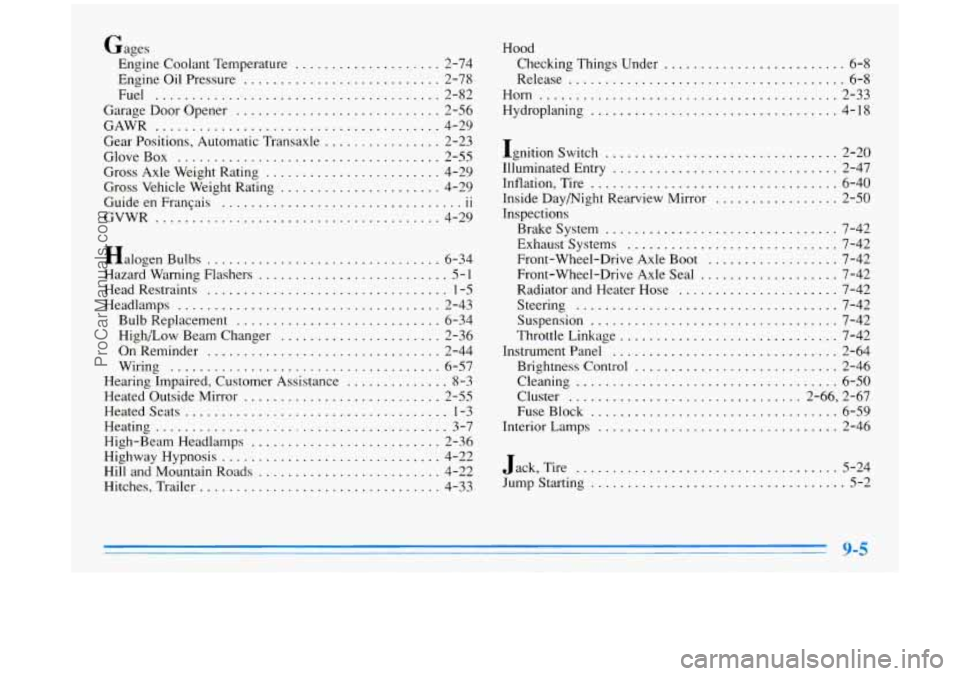
Gages Engine Coolant Temperature
.................... 2-74
Engine Oil Pressure
........................... 2-78
Fuel
....................................... 2-82
Garage Door Opener
............................ 2-56
GAWR
....................................... 4-29
Gear Positions. Automatic Transaxle
................ 2-23
GloveBox
.................................... 2-55
Gross Axle Weight Rating
........................ 4-29
Gross Vehicle Weight Rating
...................... 4-29
Guide en Franqais
11
GVWR ....................................... 4-29
.. .................................
Halogen Bulbs ................................ 6-34
Hazard Warning Flashers
.......................... 5-1
Head Restraints ................................. 1-5
Headlamps
.................................... 2-43
Bulb Replacement
............................ 6-34
High/'Low Beam Changer
...................... 2-36
On Reminder
................................ 2-44
Wiring
..................................... 6-57
Hearing Impaired. Customer Assistance
.............. 8-3
Heated Outside Mirror ........................... 2-55
Heatedseats
.................................... 1-3
Heating
........................................ 3-7
High-Beam Headlamps
.......................... 2-36
Highway Hypnosis
.............................. 4-22
Hill and Mountain Roads
......................... 4-22
Hitches. Trailer
................................. 4-33
Hood
Checking Things Under ......................... 6-8
Release
...................................... 6-8
Horn
......................................... 2-33
Hydroplaning
.................................. 4-18
Ignition Switch
................................ 2-20
Inflation. Tire
.................................. 6-40
Inside Day/Night Rearview Mirror
................. 2-50
Inspections
Brakesystem
................................ 7-42
Exhaust Systems
............................. 7-42
Front-Wheel-Drive Axle Boot
.................. 7-42
Front-Wheel-Drive Axle Seal
................... 7-42
Radiator and Heater Hose
...................... 7-42
Illuminated
Entry
............................... 2-47
Steering
.................................... 7-42
Suspension
.................................. 7-42
Throttle Linkage
......................... ... ... 7-42
Instrument Panel
............................... 2-64
Brightness Control
............................ 2-46
Cluster
................................ 2-66, 2-67
FuseBlock
.................................. 6-59
Interior Lamps
................................. 2-46
Cleaning
.................................... 6-50
Jack. Tire
.................................... 5-24
Jump Starting
................................... 5-2
.
....
ProCarManuals.com