tire type BUICK PARK AVENUE 1996 Owners Manual
[x] Cancel search | Manufacturer: BUICK, Model Year: 1996, Model line: PARK AVENUE, Model: BUICK PARK AVENUE 1996Pages: 388, PDF Size: 20.04 MB
Page 187 of 388
0 Check your mirrors, glance over your shoulder, and
start your left lane change signal before moving out
of the right lane to pass. When you are far enough
ahead
of the passed vehicle to see its front in your
inside mirror, activate your right lane change signal
and move back into the right lane. (Remember that
your right outside mirror is convex. The vehicle you
just passed may seem
to be farther away from you
than it really is.)
0 Try not to pass more than one vehicle at a time on
two-lane roads. Reconsider before passing the
next vehicle.
0 Don’t overtake a slowly moving vehicle too rapidly.
Even though the brake lamps are not flashing,
it may
be slowing down or starting to turn.
following driver to get ahead
of you. Perhaps you
can ease a little to the right.
0 If you’re being passed, make it easy for the
Loss of Control
Let’s review what driving experts say about what
happens when the three control systems (brakes, steering
and acceleration) don’t have enough friction where the
tires meet the road to do what the driver has asked.
In any emergency, don’t give up. Keep trying to steer and
constantly seek an escape route or area of less danger.
Skidding
In a skid, a driver can lose control of the vehicle.
Defensive drivers avoid most skids by taking reasonable
care suited to existing conditions, and by not “overdriving”\
those conditions. But skids are always possible.
The three types of skids correspond
to your Buick’s
three control systems. In the braking skid, your wheels
aren’t rolling. In the steering or cornering skid, too
much speed or steering in a curve causes tires to slip and
lose cornering force. And in the acceleration skid, too
much throttle causes the driving wheels to spin.
A cornering skid is best handled by easing your foot off
the accelerator pedal.
If you have the traction control system, remember: It
helps avoid only the acceleration skid.
If
you do not have traction control, or if the system is
off, then an acceleration skid is also best handled by
easing your foot off the accelerator pedal.
If your vehicle starts to slide, ease your foot off the
accelerator pedal and quickly steer the way you want the
vehicle
to go. If you start steering quickly enough, your
vehicle may straighten
out. Always be ready for a
second skid if it occurs.
ProCarManuals.com
Page 207 of 388
If you’re using a weight-carrying hitch, the trailer
tongue (A) should weigh 10 percent of the total loaded
trailer weight
(B). If you have a weight-distributing
hitch, the trailer tongue
(A) should weigh 12 percent
of the total loaded trailer weight
(B).
After you’ve loaded your trailer, weigh the trailer and
then the tongue, separately, to see if the weights are
proper.
If they aren’t, you may be able to get them right
simply by moving some items around in the trailer.
Total :’.’Eight on .xu---* Vehicle’s ’
Be sure your vehicle’s tires are inflated to the
recommended pressure for cold tires. You’ll find these
numbers on the Certification label at the rear edge of
the driver’s door or see “Loading Your Vehicle” in
the Index. Then be sure you don’t go over the
GVW
limit for your vehicle, including the weight of the
trailer tongue.
Hitches
It’s important to have the correct hitch equipment.
Crosswinds, large trucks going by and rough roads are a
few reasons why you’ll need the right hitch. Here are
some rules
to follow:
@ If you’ll be pulling a trailer that, when loaded, will
weigh more than
2,000 lbs. (900 kg), be sure to use a
properly mounted, weight-distributing hitch and
sway control of the proper size. This equipment is
very important for proper vehicle loading and good
handling when you’re driving.
Will you have to make any holes in the body of your
vehicle when you install a trailer hitch? If you do,
then be sure to seal the holes later when
you remove
the hitch. If you don’t seal them, deadly carbon
monoxide
(CO) from your exhaust can get into your
vehicle (see “Carbon Monoxide” in the Index). Dirt
and water can, too.
@ The bumpers on your vehicle are not intended for
hitches.
Do not attach rental hitches or other
bumper-type hitches to them. Use only a
frame-mounted hitch that does not attach to
the bumper.
ProCarManuals.com
Page 288 of 388
Inflation -- Tire Pressure
The Tire-Loading Information label, which is located on
the rear edge
of the driver’s door, shows the correct
inflation pressures for your tires when they’re cold.
“Cold” means your vehicle has been sittkg for at least
three hours or driven no more than
1 mile (1.6 km).
.NOTICE:
Don’t let anyone tell you that underinflation or
overinflation is all right. It’s not.
If your tires
don’t have enough air (underinflation), you can
get the following:
0 Too much flexing
0 Too much heat
0 Tire overloading
0 Bad wear
Bad handling
Bad fuel economy.
I
(Continued) NOTICE: (Continued)
If your tires have too much air (overinflation),
you can get the following:
Unusual wear
Bad handling
0 Rough ride
0 Needless damage from road hazards.
When to Check Check your tires once a month or more.
Don’t forget your compact spare tire. It should be
at
60 psi (420 Ea).
How to Check
Use a good quality pocket-type gage to check tire
pressure.
You can’t tell if your tires are properly inflated
simply by looking at them. Radial tires may look
properly inflated even when they’re underinflated.
Be sure to put the valve caps back on the valve stems.
They help prevent leaks by keeping out dik and moisture.
6-40
,
ProCarManuals.com
Page 290 of 388
0 The tire has a bump, bulge or split.
0 The tire has a puncture, cut or other darnage that
can’t be repaired well because of the size or location
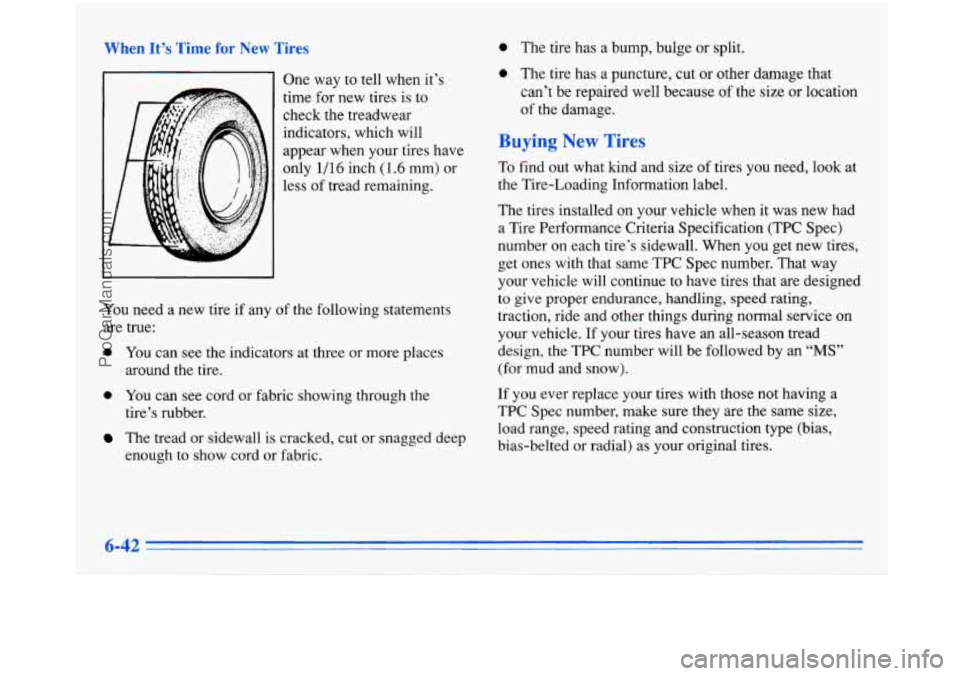
of the damage. 7 One way to tell when it’s
time for new tires is to
check the treadwear
indicators, which will
appear when your tires have
only
1/16 inch (1.6 mm) or
less of tread remaining.
You need a new tire if any of the following statements
are true:
0 You can see the indicators at three or more places
around the
tire.
0 You can see cord or fabric showing through the
tire’s rubber.
The tread or sidewall is cracked, cut or snagged deep
enough to show cord
or fabric.
uying New Til
To find out what kind and size of tires you need, look at
the Tire-Loading Information label.
The tires installed on your vehicle when it was new had
a Tire Performance Criteria Specification (TPC Spec)
number on each tire’s sidewall. When you get new tires,
get ones with that same TPC Spec number. That way
your vehicle will continue to have tires that are designed
to give proper endurance, handling, speed rating,
traction, ride and other things during normal service on
your vehicle. If your tires have an all-season tread
design, the TPC number will be followed by an
“MS”
(for mud and snow).
If you ever replace your tires with those not having
a
TPC Spec number, make sure they are the same size,
load range, speed rating and construction type (bias,
bias-belted or radial) as your original tires.
ProCarManuals.com
Page 291 of 388
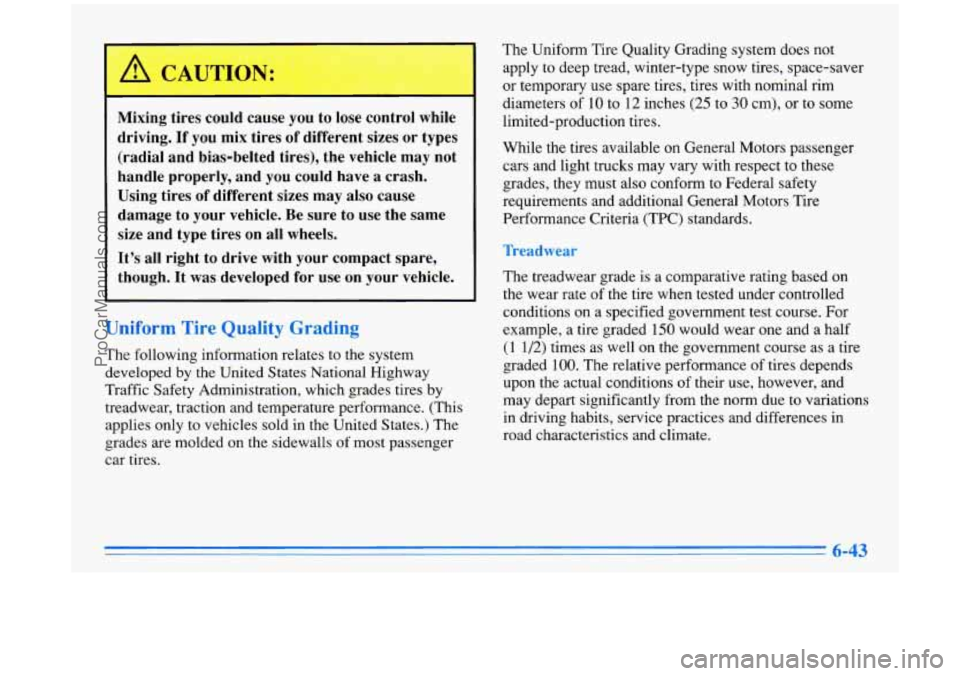
Mixing tires could cal ! you to lose control while
driving. If you mix tires of different sizes
or types
(radial and bias-belted tires), the vehicle may not
handle properly, and you could have
a crash.
Using tires of different sizes may also cause
damage
to your vehicle. Be sure to use the same
size and type tires on all wheels.
It’s all right to drive with your compact spare,
though. It was developed for use on your vehicle.
Uniform Tire Quality Grading
The following information relates to the system
developed by the United States National Highway
Traffic Safety Administration, which grades tires by
treadwear, traction and temperature performance. (This applies only to vehicles sold in the United States.) The
grades are molded on
the sidewalls of most passenger
car tires. The
Uniform Tire Quality Grading system does not
apply to deep tread, winter-type snow tires, space-saver
or temporary use spare tires, tires with nominal rim
diameters of
10 to 12 inches (25 to 30 cm), or to some
limited-production tires.
While the tires available on General Motors passenger
cars and light trucks may vary with respect to these
grades, they must also conform to Federal safety
requirements and additional General Motors Tire
Performance Criteria (TPC) standards.
Treadwear
The treadwear grade is a comparative rating based on
the wear rate of the tire when tested under controlled
conditions on a specified government test course. For
example, a
tire graded 150 would wear one and a half
(1 1/2) times as well on the government course as a tire
graded
100. The relative performance of tires depends
upon the actual conditions of their use, however, and
may depart significantly from the norm due to variations
in driving habits, service practices and differences in
road characteristics and climate.
ProCarManuals.com
Page 294 of 388
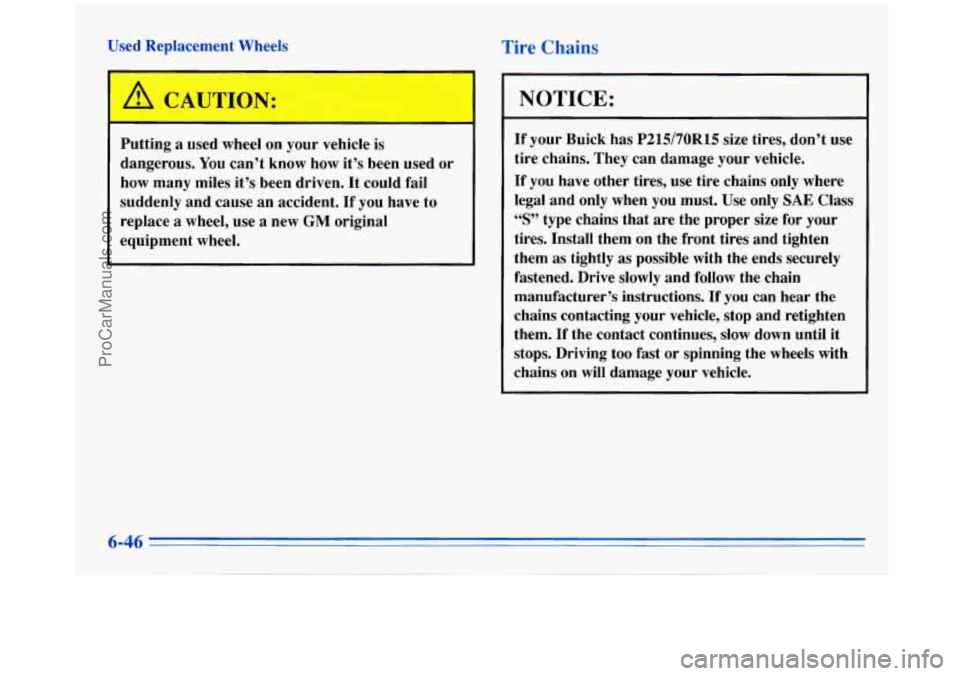
Used Replacement Wheels
A CAUTION:
Putting a used wheel on your vehicle is
dangerous.
You can’t know how it’s been used or
how many miles it’s been driven. It could fail
suddenly and cause an accident.
If you have to
replace
a wheel, use a new GM original
equipment wheel.
rire Pains
NOTICE:
If your Buick has P215/70R15 size tires, don’t use
tire chains. They can damage your vehicle.
If you have other tires, use tire chains only where
legal and only when you must. Use only
SAE Class
“S” type chains that are the proper size for your
tires. Install them on the front tires and tighten
them
as tightly as possible with the ends securely
fastened. Drive slowly and follow the chain
manufacturer’s instructions.
If you can hear the
chains contacting your vehicle, stop and retighten
them. If the contact continues, slow down until it
stops. Driving too
fast or spinning the wheels with
chains on will damage your vehicle.
ProCarManuals.com
Page 295 of 388
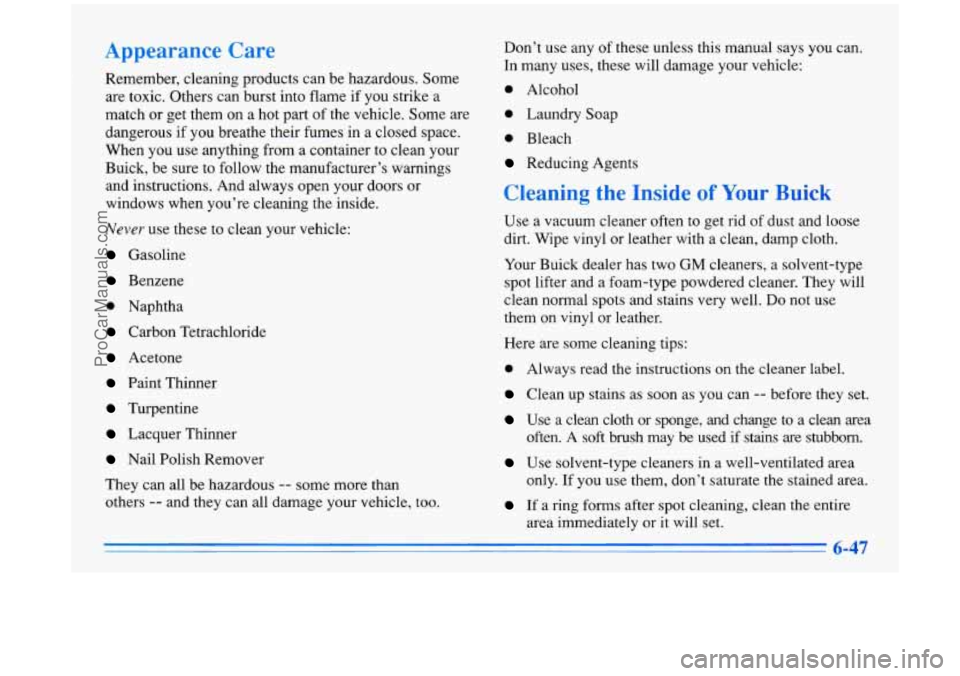
Appearance Care
Remember, cleaning products can be hazardous. Some
are toxic. Others can burst into flame if you strike a
match
or get them on a hot part of the vehicle. Some are
dangerous if you breathe their fumes in a closed space.
When you use anything from a container to clean your
Buick, be sure to follow the manufacturer’s warnings
and instructions. And always open your doors or
windows when you’re cleaning the inside.
Never use these to clean your vehicle:
Gasoline
Benzene
0 Naphtha
Carbon Tetrachloride
Acetone
Paint Thinner
Turpentine
Lacquer Thinner
Nail Polish Remover
They can all be hazardous
-- some more than
others
-- and they can all damage your vehicle, too.
Don’t use any of these unless this manual says you can.
In many uses, these will damage your vehicle:
0 Alcohol
0 Laundry Soap
0 Bleach
Reducing Agents
Cleaning the Inside of Your Buick
Use a vacuum cleaner often to get rid of dust and loose
dirt. Wipe vinyl or leather with a clean, damp cloth.
Your Buick dealer has two
GM cleaners, a solvent-type
spot lifter and a foam-type powdered cleaner. They will
clean normal spots and stains very well.
Do not use
them on vinyl or leather.
Here are some cleaning tips:
0 Always read the instructions on the cleaner label.
Clean up stains as soon as you can -- before they set.
Use a clean cloth or sponge, and change to a clean area
often. A soft brush may be used if
stains are stubborn.
Use solvent-type cleaners in a well-ventilated area
only.
If you use them, don’t saturate the stained area.
If a ring forms after spot cleaning, clean the entire
area immediately or
it will set.
ProCarManuals.com
Page 312 of 388
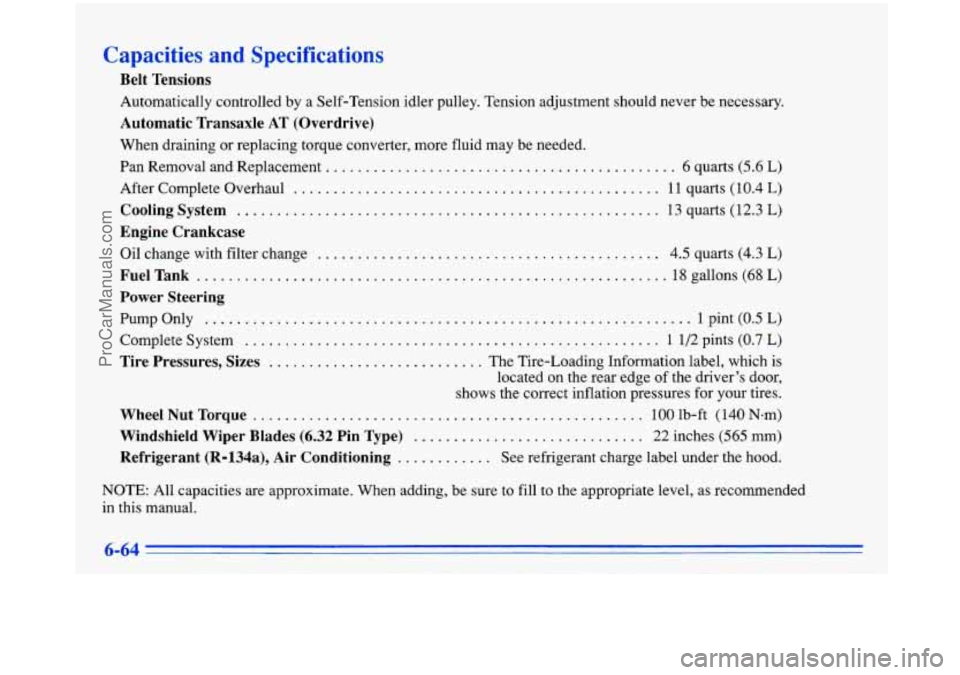
Capacities and Specifications
Belt Tensions
Automatically controlled by a Self-Tension idler pulley. Tension adjustment should never be necessary.
Automatic Transaxle AT (Overdrive)
When draining or replacing torque converter, more fluid may be needed.
Pan Removal and Replacement
............................................ 6 quarts (5.6 L)
After Complete Overhaul .............................................. 11 quarts (1 0.4 L)
Cooling System ..................................................... 13 quarts (12.3 L)
Oil change with filter change ........................................... 4.5 quarts (4.3 L)
Engine Crankcase
FuelTank
........................................................... 18gallons(68L)
Power Steering
Pump Only ............................................................. 1 pint (0.5 L)
Complete System .................................................... 1 1/2 pints (0.7 L)
Tire Pressures, Sizes ........................... The Tire-Loading Information label, which is
located on the rear edge of the driver’s door,
shows the correct inflation pressures for your tires.
Wheel Nut Torque ................................................. 100 lb-ft (140 N-rn)
Windshield Wiper Blades (6.32 Pin Type) ............................. 22 inches (565 mm)
Refrigerant (R=134a), Air Conditioning ............ See refrigerant charge label under the hood.
NOTE: All capacities are approximate. When adding, be sure to fill to the appropriate level, as recommended
in this manual.
6-64
ProCarManuals.com