lock BUICK PARK AVENUE 1997 Manual PDF
[x] Cancel search | Manufacturer: BUICK, Model Year: 1997, Model line: PARK AVENUE, Model: BUICK PARK AVENUE 1997Pages: 420, PDF Size: 21.93 MB
Page 250 of 420
If a Tire Goes Flat
It’s unusual for a tire to “blow out” while you’re driving,
especially if you maintain your tires properly. If air goes
out of a tire, it’s much more likely to leak out slowly.
But if you should ever have a “blowout,” here are a few
tips about what to expect and what to do:
If a front tire fails, the flat tire will create a drag that
pulls the vehicle toward that side. Take your foot
off the
accelerator pedal and grip the steering wheel firmly.
Steer to maintain lane position, and then gently brake to
a stop well out of the traffic lane.
A rear blowout, particularly on a curve, acts much like a
skid and may require the same correction you’d use in a
skid. In any rear blowout, remove your foot from the
accelerator pedal. Get the vehicle under control by
steering the way you want the vehicle to go. It may be
very bumpy and noisy, but you can still steer. Gently
brake to a stop
-- well off the road if possible.
If a tire goes flat, the next part shows
how to use your
jacking equipment to change a flat tire safely.
Changing a Flat Tire
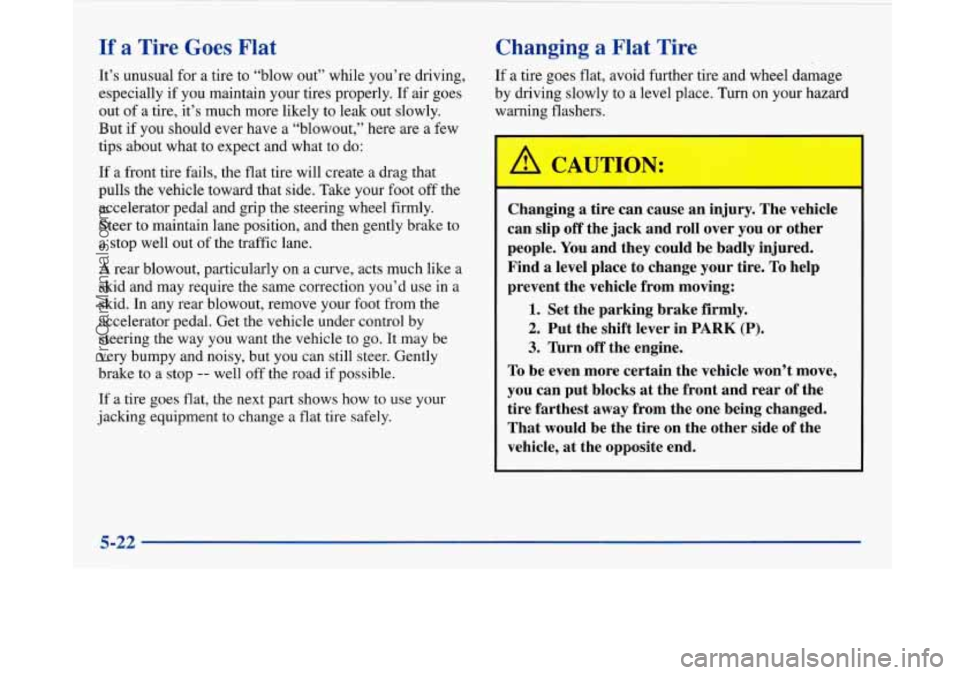
If a tire goes flat, avoid further tire and wheel damage
by driving slowly to a level place. Turn
on your hazard
warning flashers.
Changing a tire can cause an injury. The vehicle
can slip
off the jack and roll over you or other
people. You and they could be badly injured.
Find a level place to change your tire.
To help
prevent the vehicle from moving:
1. Set the parking brake firmly.
2. Put the shift lever in PARK (P).
3. Thrn off the engine.
To be even more certain the vehicle won’t move,
you can put blocks at the front and rear of the
tire farthest away from the one being changed.
That would be the tire on the other side of the
vehicle, at the opposite end.
5-22
ProCarManuals.com
Page 251 of 420
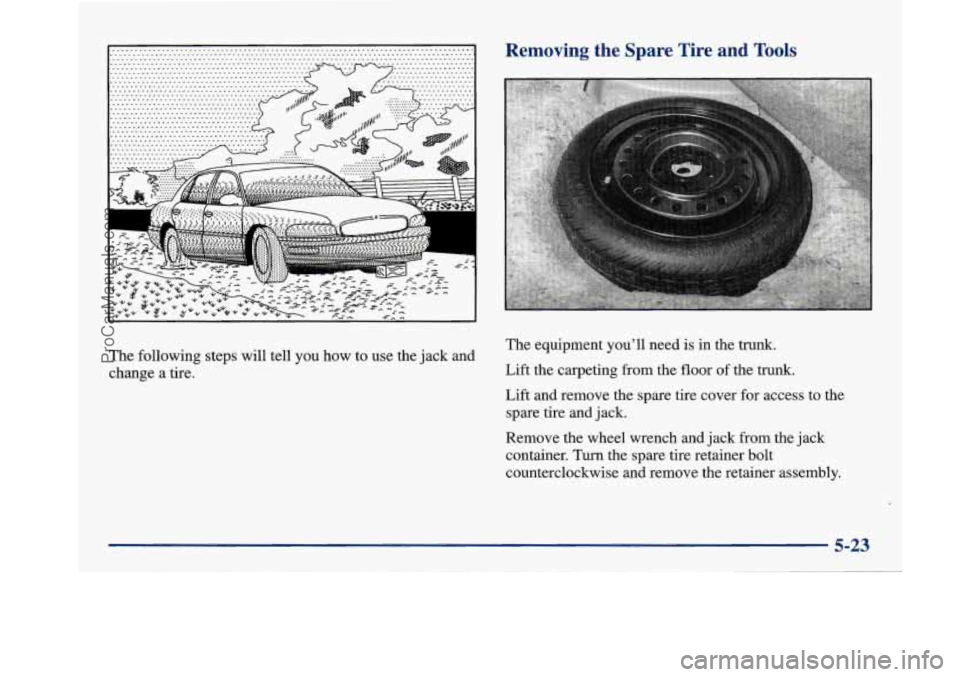
The following steps will tell you how to use the jack and
change a tire.
Removing the Spare Tire and Tools
The equipment you’ll need is in the trunk.
Lift the carpeting from the floor of the trunk.
Lift and remove the spare tire cover for access to the
spare tire and jack.
Remove the wheel wrench and jack from the jack
container. Turn the spare tire retainer bolt
counterclockwise and remove the retainer assembly.
5-23
ProCarManuals.com
Page 254 of 420
(28 CM) A I
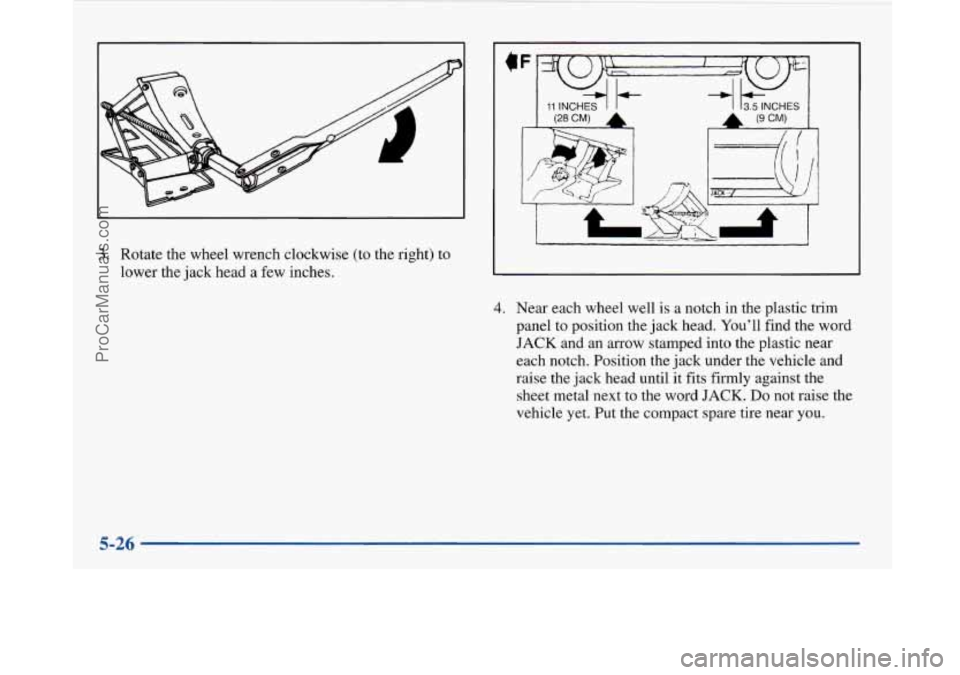
3. Rotate the wheel wrench clockwise (to the right) to
lower the jack head a few inches.
4. Near each wheel well is a notch in the plastic trim
panel to position the jack head. You’ll find the word
JACK and an arrow stamped into the plastic near
each notch. Position the jack under the vehicle and
raise the jack head until it fits firmly against the
sheet metal next to the word
JACK. Do not raise the
vehicle yet. Put the compact spare tire near
you.
5-26
ProCarManuals.com
Page 255 of 420
Getting under a vehicle when it is jacked up is
dangerous.
If the vehicle slips off the jack, you
could be badly injured
or killed. Never get under
a vehicle when it is supported only by a jack.
Raising
your vehicle with the jack improperly
positioned can damage the vehicle and even make
the vehicle fall.
To help avoid personal injury
and vehicle damage, be sure to
fit the jack lift
head into the proper location before raising
the vehicle.
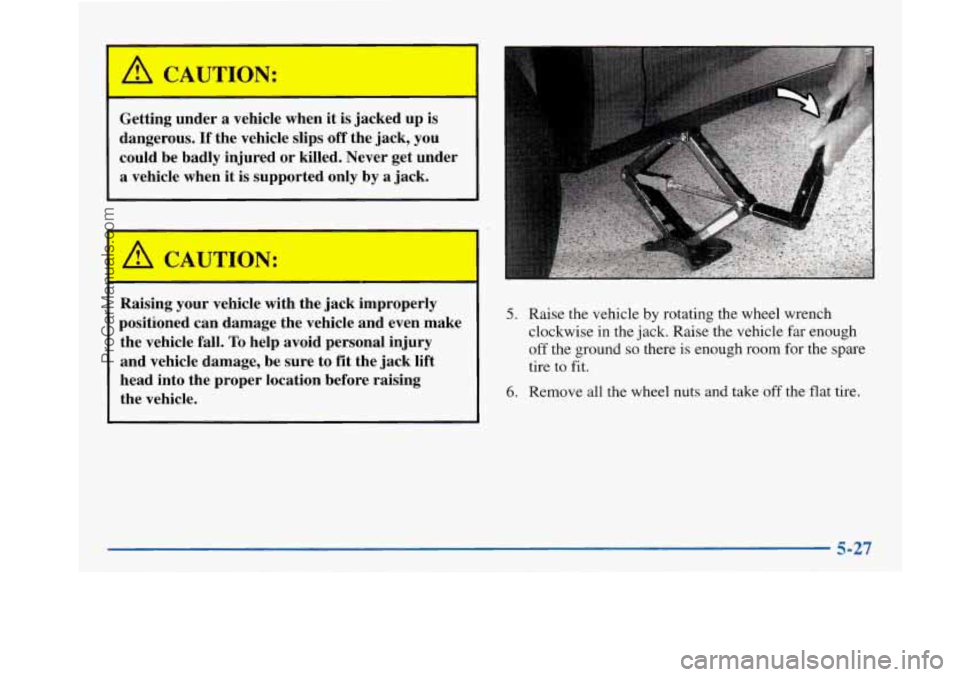
5. Raise the vehicle by rotating the wheel wrench
clockwise in the jack. Raise the vehicle
far enough
off the ground
so there is enough room for the spare
tire to fit.
6. Remove all the wheel nuts and take off the flat tire.
5-27
ProCarManuals.com
Page 257 of 420
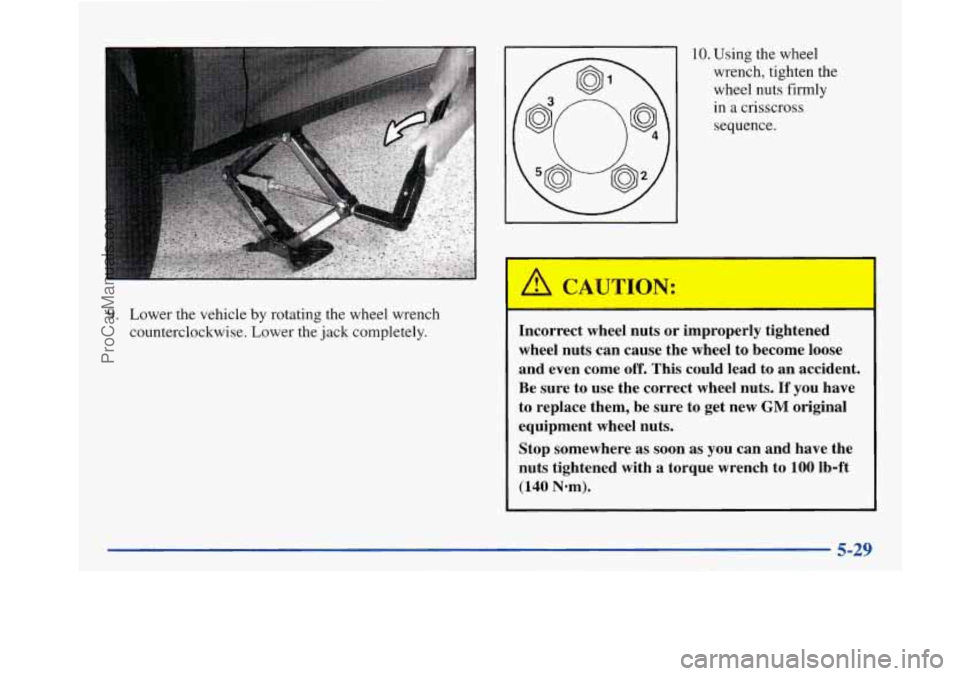
9. Lower the vehicle by rotating the wheel wrench
counterclockwise. Lower the jack completely.
10. Using the wheel
wrench, tighten the
wheel nuts firmly
in a crisscross
sequence.
A CAUTION:
- - I
Incorrect wheel nuts or improperly tightened
wheel nuts can cause the wheel to become loose
and even come off.
This could lead to an accident.
Be sure to use the correct wheel nuts.
If you have
to replace them, be sure to get new
GM original
equipment wheel nuts.
Stop somewhere as soon as you can and have the
nuts tightened with
a torque wrench to 100 lb-ft
(140 Nom).
5-29
ProCarManuals.com
Page 271 of 420
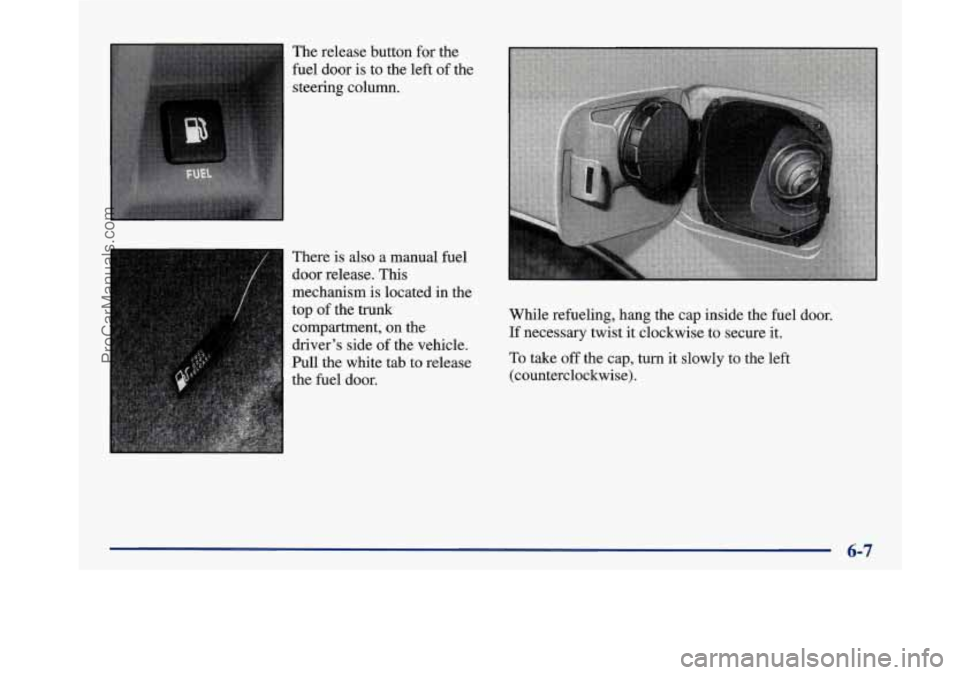
The release button for the
fuel door is to the left of the
steering column.
There is also a manual fuel
door release. This
mechanism
is located in the
top of the
tnxnk
compartment, on the
driver’s side of the vehicle.
Pull the white tab to release
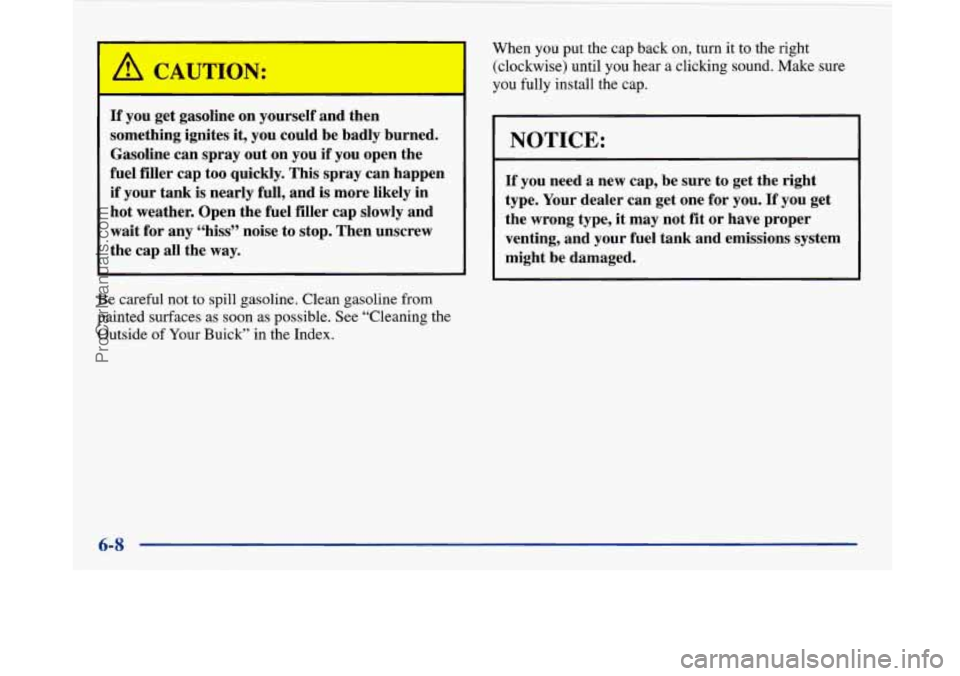
the fuel door. While
refueling, hang the cap inside the fuel door. If necessary twist it clockwise to secure it.
To take off the cap, turn it slowly to the left
(counterclockwise).
6-7
ProCarManuals.com
Page 272 of 420
If you get gasoline on yourself and then
something ignites it, you could be badly burned.
Gasoline can spray out on you
if you open the
fuel filler cap too quickly. This spray can happen
if your tank is nearly full, and is more likely in
hot weather. Open the fuel filler cap slowly and
wait for any “hiss” noise to stop. Then unscrew
the cap all the way.
Be careful not to spill gasoline. Clean gasoline from
painted surfaces as soon as possible. See “Cleaning the
Outside
of Your Buick” in the Index. When
you put the cap back on, turn it to the right
(clockwise) until you hear a clicking sound. Make sure
you fully install the cap.
NOTICE:
If you need a new cap, be sure to get the right
type. Your dealer can get one for you.
If you get
the wrong type,
it may not fit or have proper
venting, and your fuel tank and emissions system
might be damaged.
6-8
ProCarManuals.com
Page 276 of 420
Your Park Avenue Ultra has a 3800 Supercharged
engine. Buick chose supercharging rather than
turbocharging because Buick emphasizes smooth,
refined power.
The supercharger
is a device which is designed to pump
more air into the engine than it would normally use.
This air mixed with fuel creates increased engine power.
Since the supercharger is a pump and is driven from an
engine accessory drive belt, increased pressure is
available at all driving conditions.
The Powertrain Control Module (PCM) works with a
vacuum control to regulate the increased pressure
required during specific driving conditions. When this increased pressure or boost is not desired, such as during
idling and light throttle cruising, the excess air that the
supercharger is pumping is routed through a bypass. All
of these controls working together provide high
performance character and fuel efficiency in the
3800
V6 Supercharged Buick engine.
The power steering pump and reservoir are mounted on
the rear (driver’s side) of the engine block. See
“Maintenance Schedule” in the Index for when you
should check the fluid.
Engine Oil
3 \
c
.
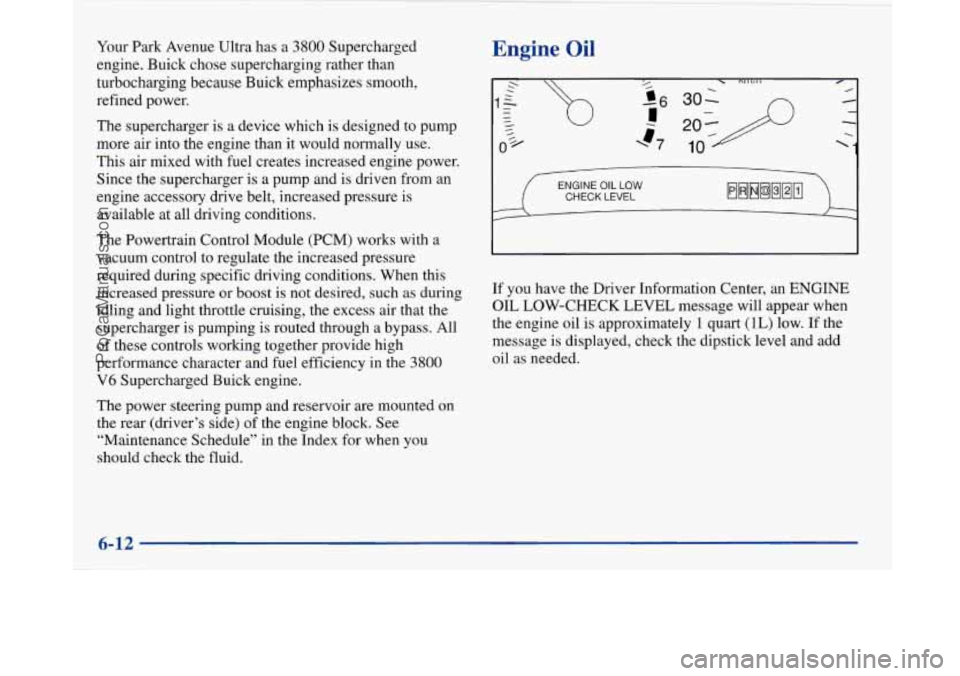
If you have the Driver Information Center, an ENGINE
OIL LOW-CHECK LEVEL message will appear when
the engine oil is approximately
1 quart (IL) low. If the
message is displayed, check the dipstick level and add
oil as needed.
6-12
ProCarManuals.com
Page 286 of 420
Checking the Fluid Level
Park your vehicle on a level place. Keep the engine
running.
With the parking brake applied, place the shift lever
in PARK (P).
With your foot on the brake pedal, move the shift
lever through each gear range, pausing for about
three seconds
in each range. Then, position the shift
lever
in PARK (P).
0 Let the engine run at idle for three to five minutes. Then,
without shutting
off the engine, follow
these steps:
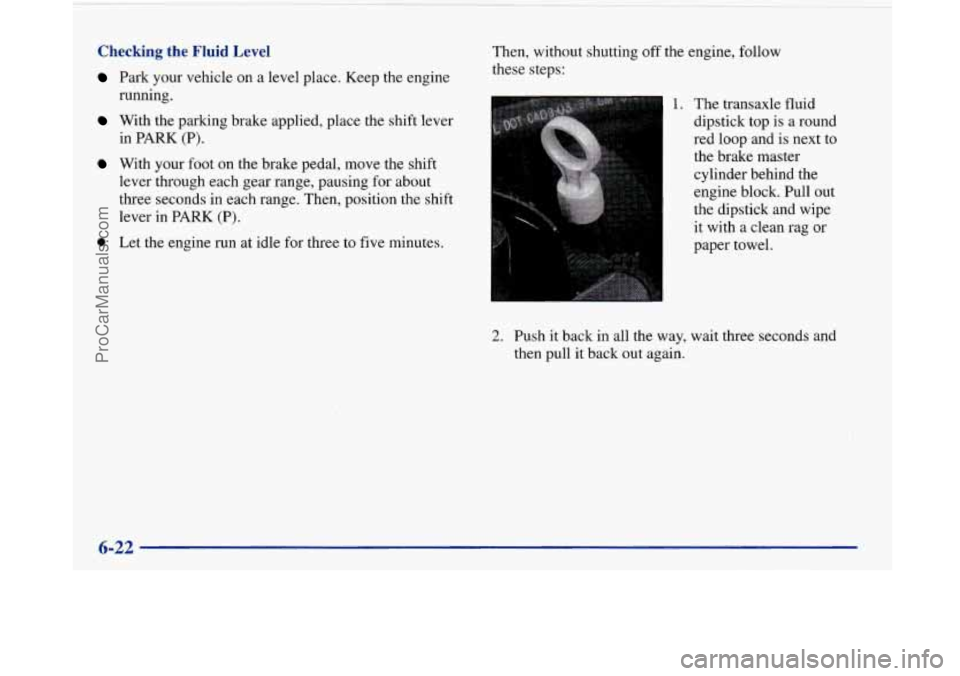
1. The transaxle fluid
dipstick top is a round
red loop and is next
to
the brake master
cylinder behind the
engine block. Pull out
the dipstick and wipe
it with a clean rag or
paper towel.
2. Push it back in all the way,
then pull it back out again. wait
three seconds and
6-2’
ProCarManuals.com
Page 299 of 420
Headlamps
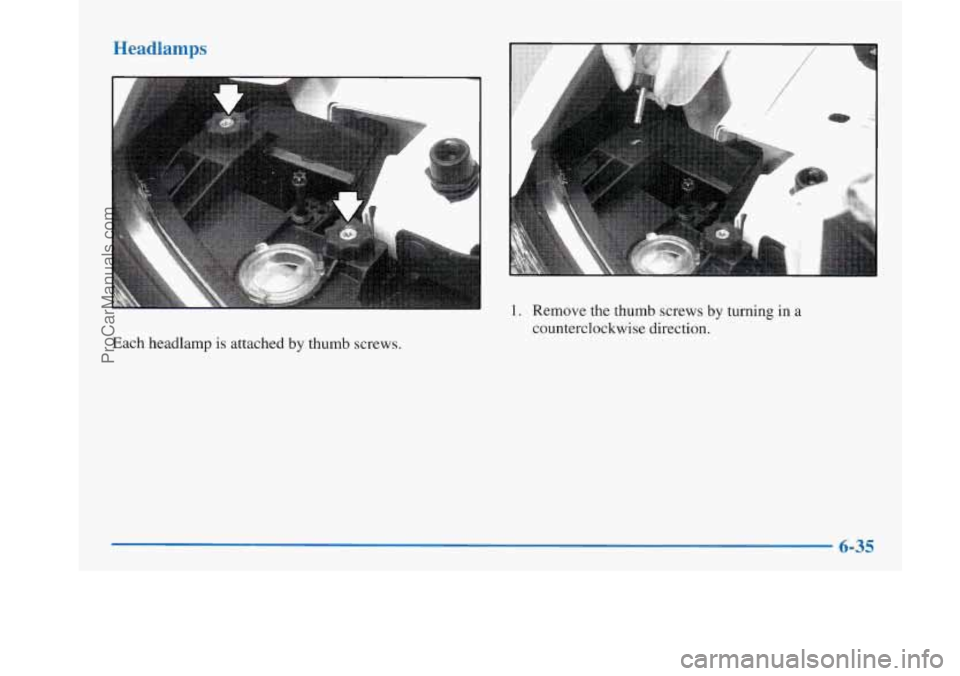
Each headlamp is attached by thumb screws.
1. Remove the thumb screws by turning in a
counterclockwise direction.
6-35
ProCarManuals.com