warning BUICK PARK AVENUE 1998 User Guide
[x] Cancel search | Manufacturer: BUICK, Model Year: 1998, Model line: PARK AVENUE, Model: BUICK PARK AVENUE 1998Pages: 426, PDF Size: 23.59 MB
Page 241 of 426
Mere YOLI’HH find what to do about some problems that can occur the road.
5-2
5-2
5-3
5-7
5- 12
Hazard Warning Flashers
Other Warning Devices
Towing Your Vehicle
Engine Overheating
sump Starting
ProCarManuals.com
Page 242 of 426
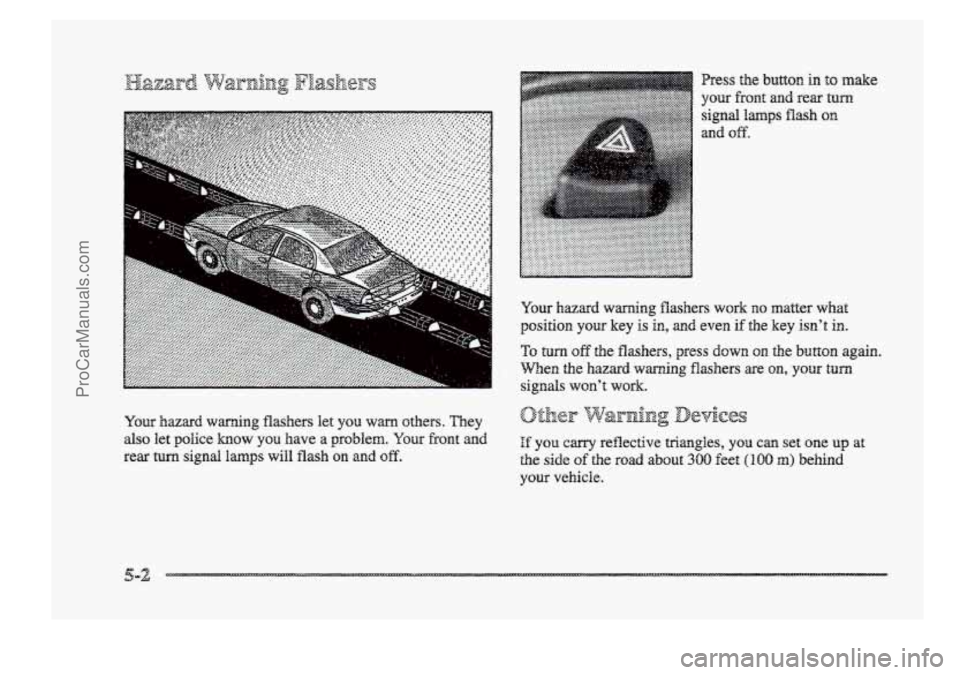
h..,, - . '
YQW hazard warning flashers work no matter what
position yow key is in, and even if the key isn't in.
To turn off the flashers, press down on the button again.
When the hazard warning flashers are CUI, your turn
signals won't work.
your vehicle.
ProCarManuals.com
Page 253 of 426
E you get the overheat wming but see or hear no
steam, the problem may not be too serious. Sometines
the engine can get a BittIe too hot when you:
@B Climb a long hill on a hot day.
8 Stop after high-speed driving.
Idle
for long periods in tra€€ic.
9 Tow a trailer.
If you get the overheat warning with sign of stem,
try this for a mimte or so:
I. Turn off your air conditioner.
2. Turn on your heater to full hot at the highest Fan
speed and opera the window as necessary.
otherwise, shift
to the highest gear while
driving
-- AUTOMATIC OVERDRIVE (a)
or THmD (3 1.
3. If you're Ira a tra€fic jam, shift to NEUTRAL (N);
If you 1'10 longer have the overheat wmimg, you
can drive. Just to be safe, drive slower for about
IO minutes. If the warning doesn't come back on,
you can drive normally.
If the warning continues, pull over, stop, and park your
vehicle right away.
If there's still no sign of steam, YOU can idle the engine
for two or three minutes while you're parked, to see if
the warning stops. But then, if you still have the
warning,
turn c$ftthe engine and get everyone out of the
a,chicke until it cools down.
You may decide not to lift the hood but to get service
help right away.
ProCarManuals.com
Page 256 of 426
CAUTION:
Adding only plain water to your cooling system
can be dangerous. Plain water,
OF some other
liquid like alcohol,
can boil before the proper
coolant mixture will.
Your vehicle’s coolant
warning system
is set for the proper coolant
mixture. With plain water or the wrong mixture,
your engine could get too hot but you wouldn’t
get the overheat warning. Your engine could
catch fire and you or others could
be burned.
Use a 50/50 mixture of clean water and
DEX-COOL@ coolant.
___~ __~ ~~ ___ __ __
In cold weather, water can freeze and crack the
engine, radiator, heater core and other parts.
Use the recommended cooisant and the proper
coolant mixture.
ProCarManuals.com
Page 290 of 426
If none of them is true, use the %ong triphighway
maintenance schedule. Change the oil and filter every
7,500 miles (12 500 km) or 12 months -- whichever
occurs
ht. Driving a vehicle with a fully warmed
engine
under highway conditions causes engine oil
to $re& down dower.
If any one of these is true for you, use the short tripkity
maintenance schedule:
8
Most trips are less than 5 to 13 miles (8 to I 6 km).
This is particularly important when outside
temperatures
are below freezing.
Most trips include extensive id1ir.g (such as frequent
$riving
in stop-and-go traffic).
Most
trips are though dusty areas.
You frequently tow a trailer or use a carrier on top of
your vehicle.
The vehicle is used for delivery service, police, taxi
or other
commercial application.
Driving under these conditions causes engine
oil to
break down
sooner. Hf any me of these is true for your
vehicle, then
YOU need to change your si1 and filter
every
3,000 miles (5 000 km) or 3 months -- whichever
occurs
kt. (See Engine Oil Life Monitor (Index) in
the Index.
1
Did you know that used engine oil contains certain
ekmer,ts that may
be unhealthy for your skin and csdd
even cause cancer? Don’t let used oil stay on your skin
for very iong. Clean your skin and nails with soap and
water, or a good hznd cleaner. Wash or properly throw
away clothing or rags containing used engine oil. (See
the manufacturer’s warnings about
the use and disposal
of oil products.)
Used oil can be a real t-heat to the environment. If you
change
your own oil, be sure to drain all free-flowing
oil
from the filter before disposal. Don’t ever dispose of
oil by putting it in the trash, pouring it on the ground,
into sewers, or into streams or bodies of water. Instead,
recycle it by taking it
to a place that coilects used oil. If
you have a problem properly disposing of your used oil,
ask your dealer,
a service station or a local recycling
center for kelp.
ProCarManuals.com
Page 297 of 426
Refer to the Maintenance Schedule to determine what
kind
of transaxle fluid to use. See “Recommended
Fluids
md Eubricmts” in the Index.
If the fluid level is low, add only enough of the proper
fluid
to bring the level into the cross-hatched area on
the dipstick.
I. Pull out the dipstick.
2. Using a long-neck funnel, add enough fluid at the
dipstick hole
to bring it to the proper level.
It doesn’t
take much fluid, generally less than one
pint
(0.5 L). Don’t ove@Zl.
3. After adding fluid, recheck the fluid level ips
4. When the correct fluid level is obt.ained, push the
described
under “How to Check.”
dipstick back in
dl the way.
The cooling s stem in your vehicle is filled with
DEX-COOL engine coolant. This coolant is designed
to remain in your vehicle for 5 years or 150,000 miles
(240 MI0 h) whichever occurs first, if you add only
DEX-COOL“ extended life coolant,
The following explains
your coding system and
how to add coolant when it is low. If YOU have a
problem with engine overheating, see “Engine
Overheating”
in the Index.
A 50/50 mixture of water and DEX-COOL’
coolant will:
J
Give freezing protection down to -34°F (-37°C).
Give boiling protection up to 265 OF 129 ” C).
Protect against rust and corrosion.
Help keep the proper engine temperature.
Let the warning lights and gages work as
they should.
ProCarManuals.com
Page 298 of 426

NOTICE:
When adding coolant, it is importrant that you use
O~Y DEX-CQOE~ (sficate-free) COQI~~.
If coolant other than DEX-COOL is added to the
system, premature engine, heater
core or
radiator corrosion may result.
Hw addition, the
engine coolant
will require change SQB~~F -- at
30,000 des (50 000 b) or 24 months,
whichever occurs
first. Damage caused by the
use of coolant other than DEX-COOL@ is not
c~vemdl by
your new vehicle warranty.
Use a mixture of one-half clean water (preferably
distilled)
and one-half DEX-COOL’ coolant which
won’t damage aluminum pats. If you use this mixture,
YOU don’t need to add anything else.
..
..
Adding only plain water to your cooling system
can be dangerous. Blain water, or some other
liquid like alcohol,
can boil before the proper
coolant mixture
will. Your vehicle’s CQO~~
warning system is set for the proper c~~lmt
mixture. With plain water or the wrong mixture,
your engine could get too
hot but you wouldn’t
get the overheat warning. Your engine could
catch fire and
yon or others could be burned.
Use a 50/50 mixture of clean water and
DEX-CBOL@ codant.
6-24
ProCarManuals.com
Page 304 of 426
So, it isn‘t a good idea to “top oft“ your brake fluid.
Adding brake fluid won’t correct a leak. If YOU add fluid
when your linings are worn, then you’ll have loo much
fluid when you get new brake linings. You shouki add
(or remove) brake fluid, as necessary, only when work is
done
on the brake hydraulic system.
When your Srake fluid falls to a low level, your brake
warning light will come on. A chime will sound if you
try to drive with this warning light on. See “Brake
System Waning Eight” in the Index.
When you do need brake fluid, use only DOT-3
brAe fluid -- such as Delco Supreme II@ (GM
Part No. 12377967). Use new brake fluid from a
sealed container only.
Always clean the brake fluid reservoir cap and the
mea
around the cap before removing it. This will help
keep dirt from entering the reservoir.
~~ ~~
With the wrong kind of fluid in your brake
system,
your brakes may not work well, or they
may not even work at all. This could cause a
I
1 crash. Always use the proper brake fluid.
1
ProCarManuals.com
Page 305 of 426
NOTICE:
Using the wrong fluid can badly damage
brake system
parts. For example, just a few
drops
of minerallbased oil, such as engine
oil, in your brake system can damage brake
system
parts so badly that they’ll have to be
replaced.
Don’t let someone gut in the
If you spill brake fluid OEI your vehicle’s
painted
surfaces, the paint finish can be
damaged. Be careful
not to spill brake fluid
on your vehicle. If you do, wash it off
immediately. See “Appearance Case” in
the Index. wrong
kind of fluid.
Your vehicle has four-wheel disc brakes.
Disc
brake pads have built-in wear inchcators &at make a
high-pitched warning sound when the brake pads are
worn and new pads are needed. The sound may come and
go or be heard all the time your vehicle is moving (except
when
you are pushing on the brake pedal firmly).
The brake wear warning sound means that soon
your brakes won’t work well. That could lead to
an accident. When you hear the brake wear
warning sound, have your vehicle serviced.
NOTICE:
Continuing to drive with worn-out brake pads
could result in costly brake repair.
ProCarManuals.com
Page 326 of 426
''I+he brcadwear grade is a comparative rating based Q~Z
t tze wcx rate of the tire when tested under controlled
conditions
on a specified government test course.
For example, a tire graded 150 would wear one md a
Mf (I U2) times as well on the government course
:H tire graded 100. The relative performance of tires
depends
upon the actual conditions of their use,
however, and may depart significantly from the norm
tErrc to variations in driving habits, service practices
and differences in road characteristics and climate.
'The traction grades, from highest
to !owest, are A, 3,
and C, and they represent the tire's ability to stop ora
wet pavement as measured mder controlled conditions
on specified government test surfaces of asphalt
2nd concrete. A tire marked &: may have poor
traction performance.
Warning: The traction grade assigned
to this tire is based
on
braking (straight alead) traction tests and does not
ifgcllude cornering (turning) traction. heat
and its ability to dissipate heat when tested under
controlled csndidsns on a specified indoor laboratory
test wheel. Sustained
high temperature can cause the
material of the tire to degenerate and reduce tire life, and
excessive ternperaFure can lead to sudden fire faifwe.
The grade C corresponds to a level of pedomance
which ail passenger cx tires must meet e~nder the
Federal
Motor Vehicle Safety Stmda-d No. i09. Grades
B asci A represent higher levels of perhmance an the
laboratory test wheel than the minimum required by law.
The wheels OR your vehicle were aligned and balanced
careEulIy at the factory to give you the longest tire life
acd best overall performance.
Scheduled wheel alignment
and wheel balancing are not
needed. However, if you notice unusual tire wear or
your vehicle pulling GR~ way OF the other, the akignment
may need
to be reset. If YOU notice your vehicle
vibrating
when driving on a smooth road, your wheels
may need
to be rebalaaaced.
ProCarManuals.com