key BUICK PARK AVENUE 1998 Owner's Manual
[x] Cancel search | Manufacturer: BUICK, Model Year: 1998, Model line: PARK AVENUE, Model: BUICK PARK AVENUE 1998Pages: 426, PDF Size: 23.59 MB
Page 87 of 426
I
LOCK @I: This is the only position from which
YOU can remove the key. This position locks YOU
igition, steering wheel and transaxle. It’s a
theft-deterrent feature.
OFF (C): This position lets YOU turn ofif the engine but
still turn the steering wheel. It doesn’t lock the steering
wrlhee1 like LOCK and it doesn’t send my electrical
power to
the accessories. The instrument panel cluster
will remain powered in OFF to illarminate the gear sWt
indicator. The cluster will also activate the parking brake
fight when the parking brake is set. Use OW if you must
have your vehicle in motion while the engine is
not mnanaing.
RUN (D): This is the position that the switch returns to
after you start YSUP engine and release the switch. This
is &e p~sisi~n for driving. Even when the engine is not
running, you can use RUN to operate your electrical
power accessories anad t~ display some instrument panel
START (E): This position starts your engine. When the
engine
starts, release the key. The ignition switch will
return to RUN for ~a~rrrnal driving.
wdng
lights.
Retained Acces§ory Power
After you turn the ignition off md even remove the key,
you
will still have electrical power to such accessories
as the radio, astroroof ad power windows for up to
10 minutes. Power is shut off if you open a door.
2-21
ProCarManuals.com
Page 88 of 426
Move your shift lever to BARK (B) or NEUTRAL (N).
Your engine won’t start in any other position -- that’s a
safety feature. To restart when you’re already moving,
use NEUTRAL (N) only.
1 NOTICE:
Don9t try to shift to PARK (a) if your hick is
moving. If YOU do, YOU could damage the
transaxle.
Shift to PARK (P) only when your
vehicfe is stopped.
8. Without pushing the accelerator pedal, turn your
ignition key to START. When the engine starts, let
go
of the key. The idle speed will go down as your
engine gets wann.
NOTICE:
Holding your key in START €or longer than
15 seconds at a time will cause your battery to be
drained much sooner.
And the excessive heat can
damage your starter motor.
2. if it doesn’t start right away, hold your key in
START for about three to five seconds at a time until
your engine starts. Wait about 15 seconds between
each
try to help avoid draining your battery or
damaging your starter.
3. If your engine still won’t start (or starts but then
stops), it could be flooded with too much gasoline.
Try pushing your accelerator pedal
all the way to the
floor
and holding it there as you hold the key in
START for about three seconds. If the vehicle starts
briefly but then stops again, do the same thing, but
this time keep the pedal down for five or
six seconds.
This clears the extra gasoline from the engine.
After waiting
about 15 seconds, repeat the normal
starting procedure.
ProCarManuals.com
Page 91 of 426
Ensure the shift lever is fuily in PARK (PI range before
starting the engine.
Your vehicle has a brake-transaxle
shift interlock.
You have to fully apply your regular
brzkes
before you can shift from PARK (P) when the
ignition key is in RUN. If you cannot shift out of
PARK (B), ease pressure on the shift lever -- push the
shift lever all the way into PARK (P) as you rnaintain
brake appiic~tion. Then move the shift lever into the
gear you wish. See “Shifting Out of PARK (E’)” in
the Index.
REVERSE (R): Use this gear to back up.
Shift to REVERSE (R) oanhy after vehicle
To rock your vehicle back and forth to get out of snow,
ice sand without damaging your transaxle, see
“Stuck:
In Sand, Mud, Ice or Snow” in the Index.
NEUTRAL (N): In this position, your engim
doesn’t connect with the wheels.
To restart when you’re
already
moving, use NEUTRAL (N) only. Also, use
NEUTRAL (N) when your vehicle is being towed.
Shifting out of PARK (P) or NEUTRAL fN) while
your engine is “racing” (running
at high speed) is
dangerous. Unless your foot is firmly on the
brake pedal, your vehicle could move very
rapidly. You could lose control and hit people
or
objects. Don’t shift out of PARK (P) or
NEUTRAL (N) while your engine is racing.
1 NOTICE:
Damage to your transaxle caused by shifting out
of PARK (P) or NEUTRAL (N) with the engine
racing isn’t covered by your warranty.
ProCarManuals.com
Page 93 of 426
FIRST (I): This position gives you even more power
(but lower fuel economy) than SECOND (2). You can
use it on very steep hills, or in deep snow or mud. If the
selector lever is put in FIRST ( I >, the transaxle won’t
shift into first gear until the vehicle is going
slowHy enough.
If your hplrt wheels can’t rotate, don’t try to
drive. This might happen if YOU were stuck in
very deep sand OF mud or were up against a solid
object. You could damage your transaxle.
Also, if you stop when going uphill, don’t hold
your vehicIe there with only the accelerator
pedal. This could overheat and damage the
transaxle. Use ysur brakes or shift into BARK (P)
Your vehicle has a PUSH
TO RELEASE parking
brake pedai. To set the
parking brake, hold the
regular brake pedal down
with your right foot. Push
down the papking brake
pedal with your left foot.
~~ ~~
Whether the ignition key is in RUN or OFF. the brake
system
wming light stays on while the parking brake
1s set.
The parhng brake uses the brakes the rear wheels.
To release the parking brake, hoki the regular brake
pedal down and push the parking brake pedal with your
left foot. This will unlock the pedal. When you lift your
left foot, the parking brzke pedal will foilow it to the
release position.
ProCarManuals.com
Page 95 of 426
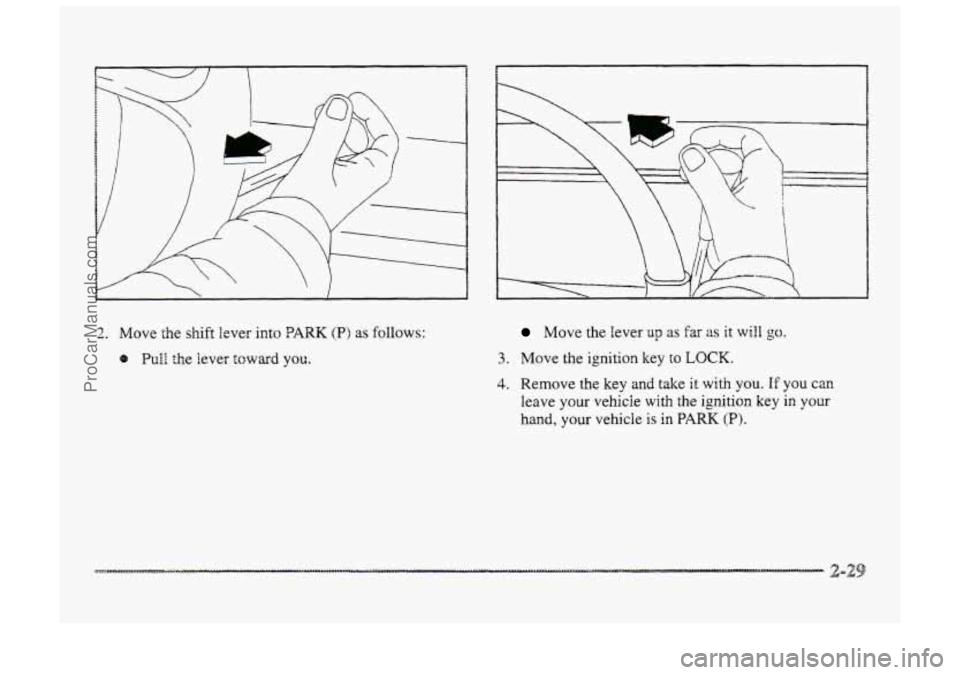
2. Move the shift lever into ?ARK (B) as follows:
8 Pull the iever toward you.
Move the lever up as far as it will go.
3. Move the ignition key to LOCK.
4. Remove the key and take it with you. If YOU can
leave
your vehicie with the ignition key in your
hand, your vehicle is in PARK (P).
ProCarManuals.com
Page 97 of 426
k;zgaA 'T:..:&pa: & LnP :V3;.,,t (.$ dL Bb* pFq- {p :.A AA &L \'& J
Your vehicle has a brake-transaxle shift interlock. You
have to fully apply your regular brake before you can
shift
from PARK (P) when the ignition is in RUN. See
"Automatic Transaxle" in the Index.
If you cannot shift out of PARK (PI, ease pressure on
the shift lever -- push the shift 'lever all the way into
PARK (PI as you maintain brake application. Then
move the shift lever into the gear
YOU want.
If you ever hold the brake pedal down but still can't
shift out of PARK (P), try this:
1.
2.
3.
4.
5.
Turn the key to OW. Open and close the driver's
door to turn
off the retained accessory power feature.
Apply
and hold the brake until the end of Step 4.
Shift to NEUTRAL (N).
Start the vehicle and then shift to the drive gear
you want.
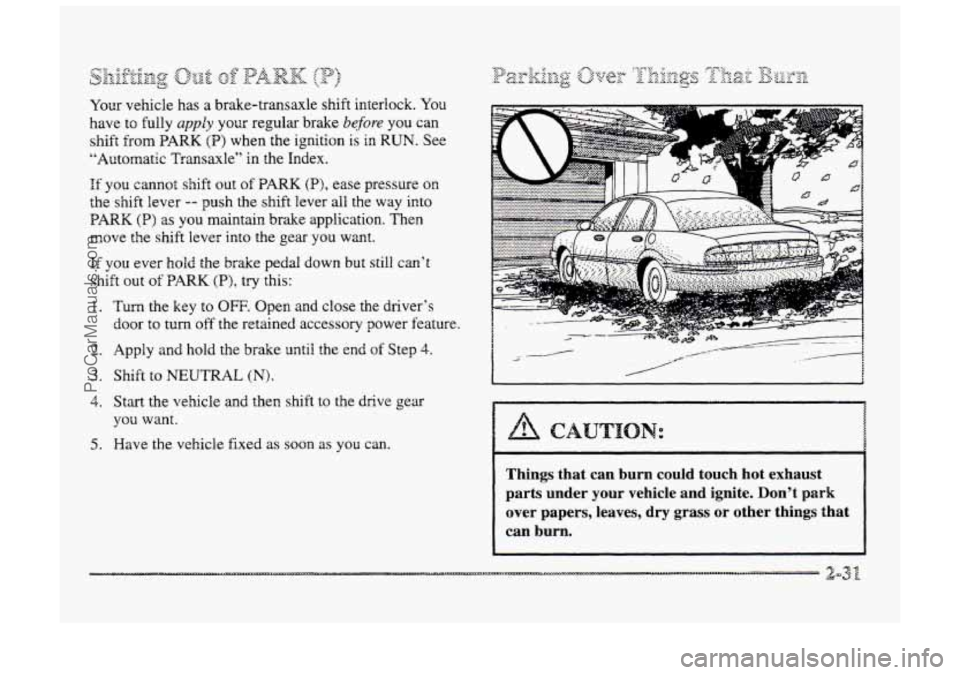
Have the vehicle fixed as soon as you can. CAUTION:
Things that can burn could touch hot exhaust
parts under your vehicle and ignite. Don't park
over papers, leaves,
dry grass or other things that
can burn.
.. . .. 3 32 drn-2
ProCarManuals.com
Page 114 of 426
This feature will only be activated when the security
feedback feature
is programmed to be in Modes 1,3 or 5
on the trmsmitter. Modes 0, 2 and 4 do not respond with
exterior lights Washing when uirlocking the vehicle so
perimeter lighting will nct be active.
This feature can be programmed
on or off for
each transmitter.
To turn the feature off:
1. Press and hold LOCK on the door lock switch QII the
door throughout this procedure. All doors will lock.
2. Press the instant dam button on the transmitter to
enter tihe programming mode. Perimeter lighting
remains
on at this time and the ~QIX will chirp
two times.
3. Press the instant alam button on fhe key transmitter
again. Perizneter lighting is disabled and the horn
wiEI chirp one time.
4. Release the door lock switch. The perimeter iighting
Pressing the UNLOCKbutton repeatedly may caw the
To turn the feature on:
feature is now off.
back-up lamps to turn on.
I.
2.
3.
4.
Press and hold LOCK on the door lock switch on the
door throughout this procedure. A11 doors will Bock.
Press the
instant alm button on the key transmieter
to enter the programming mode. Perimeter lighting
remains off at this time and the horn will chirp
one time.
Press the instant
alm button 0n the transmitter
again. Perimeter lighting is now enabled
and the
horn will chirp two times.
Release
the door lock switch. The perimeter lighting
feature
is ~QW on.
Perimeter iighting can also be activated through the
optional Driver Infomation Center
(DHC). See
“Personal Choice Features” or “Driver Infomation
Center” in the Index.
ProCarManuals.com
Page 141 of 426
This part describes the warning lights and gages that
may be
on your vehicle. The pictures will help YOU
locate them.
Warning lights
and gages can signal that something is
wrong before it becomes serious enough to cause an
expensive repair
or replacement. Paying attention to
your warning lights and gages coukl also save you or
others from injury.
Warning lights come on when there may be or is a
problem with one
of your vehicle’s hn~tions. As YOU
will see in the details 010. the next few pages, some
warning lights come on briefly when
you start the
engine
just to let you know they’re working. If you are
familiar with
tis section, YOU should not be alarmed
when this happens.
Cages can indicate when there may
be or is a problem
with of your vehicle’s functions. Often gages
and
warning lights work together to let you how when
there’s a problem
with your vehicle. When one
of the
warning lights comes QII and stays on
when you are driving, or when one of the gages shows
there may be a problem, check the section that tells you
what
to do about it. Please follow this manual’s advice.
Waiting to
d~ repairs can be costly -- and even
dangerous.
So please get to how your warning lights
and gages. They’re a big help.
Your vehicle may also have a driver information system
that works along with the warning lights and gages. See
“Driver Information System”
in the Index.
d Bel$ pj&&n(jgp Light
When eke key is turned to RUN or START, a chime will
come on
for about eight seconds to remind people to
fasten their safety belts, unless the driver’s safety belt is
already buckled.
The safety belt light will
also come on md stay on
for about 20 seconds, then it
will
flash for about
55 seconds. If the driver’s
belt is already buckled,
neither the chime nor the
light will come on.
ProCarManuals.com
Page 142 of 426
There is an air bag readiness light on the instrument
panel, which shows AIR
BAG. The system checks the
air bag’s electrical system for rna’rfunctions. The light
tells you
if there is an electrical problem. The system
check includes the air
bag sensors, the air bag modules,
the
wiring and the crash sensing and diagnostic module.
For more infomation on the air bag system, see “Air
Bag” in the Index.
This light will come on
when y~u start your engine,
and it will flash for a few
seconds.
Then the Eight
should go out. This means
the system is ready.
I€ the air bag readiness light stays on after you start the
engine or comes QIT when you are driving, your air bag
system may
not work p~operly. Have your vehicle
serviced right away.
The air bag readiness light should flash for a few
seconds when you
turn the ignition key to RUN. If the
light doesn’t come
on then, have it fixed so it will be
ready
to wm you if there is a problem.
VOLT
“‘en you turn the hey to
RUN, this light will come
on briefly, to show the
battery charging systeE
is
working.
When the light goes off and stays off, the charging
system
is working.
Hf the light stays on, a chime will sound indicating you
need service, and you should take your vehicle to the
dealer at once. To save your battery until yo3 get there,
turn off a%B accessories and turn off glow climate
control system.
When a luge number of electrical accessories me
operating ir, the vehicle and the engine is left at an idle
for aa extended period, the engine may idle at a higher
RPM than noma1 to ensure the battery does not mn
down. This may occur when several of the following are
on: parking lamps, high-beam headlamps, rear window
defogger, heated seats and engine cooling fans, etc. It
may take longer for the rear window defogger to dear
the glass, and the heated seats may not feel as warn
as normal.
ProCarManuals.com
Page 143 of 426
This light should come on
whera YOU turn the key to
RUN. If it doesn’t come ora
then, have it fixed so Et will
be ready to warn you if
there‘s 2 problem.
ProCarManuals.com