lock BUICK PARK AVENUE 1998 Owner's Manual
[x] Cancel search | Manufacturer: BUICK, Model Year: 1998, Model line: PARK AVENUE, Model: BUICK PARK AVENUE 1998Pages: 426, PDF Size: 23.59 MB
Page 81 of 426
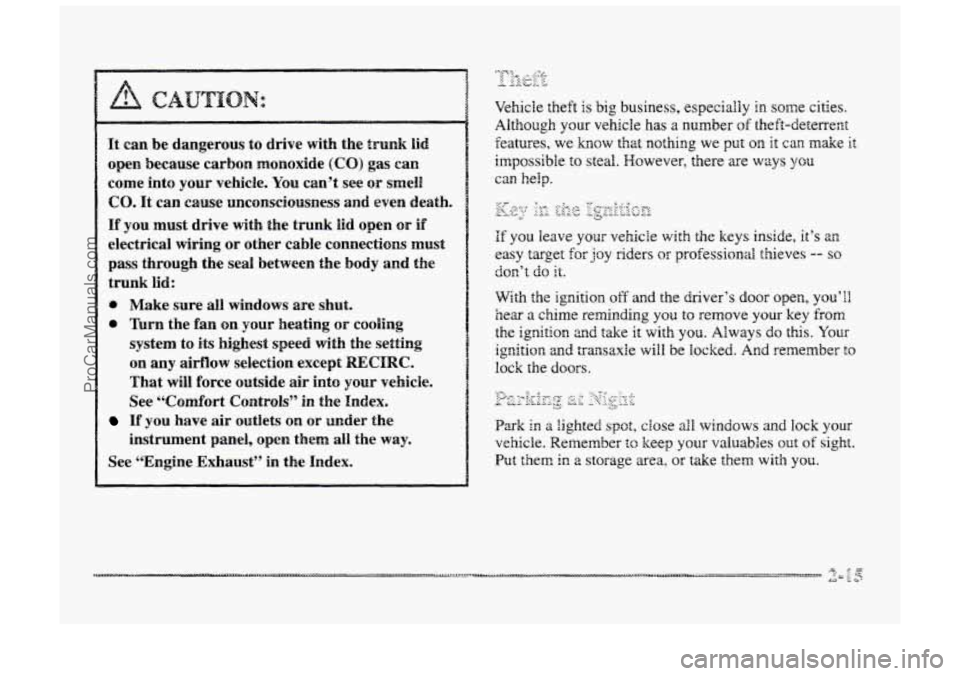
It can be dangerous to drive with the trunk lid
open because carbon monoxide (CO) gas can
come into your vehicle. YOU can’t see or smell1
CO. It can cause unconsciousness and even death.
If you must drive with the trunk lid open OF if
electrical wiring or other cable connections must
pass through the seal between the body and the
trunk lid:
0 Make sure all windows are shut.
Turn the
fan on your heating OF cding
system to its highest speed with the setting
on any airflow selection except RECHWC.
That will force outside air inkt your vehicle.
See
“Comfort Controls” in the Index.
If you have air outiets on or under the
instrument panel, open them all the way.
See “Engine Exhaust’’ in the Index.
.-p->:. . I. !< :. I 1.: ::::, .,,::.-<:. -- :,
Vehicie theft is big business, especiafly in some cities.
Although yaur vehicle has a number of theft-deterrent
features. we
know that nothing we put on kt can make it,
impossible to steal. However, there are wzys you
can help.
.... -
.LL;; , .:.L <,.c;;.;; &iLL&:.< ..I.:- :i4,’ .T”T$,T .:,..-. .?L. >- P .” ..<. :<.:,-.-.
If you leave YQUF vehicle with the keys inside, it’s m
easy target for joy riders or professional thieves -- so
don’t do it.
With the ignition off and the driver’s door open, YQU’IB
hear a chime reminding you to remove your key from
the ignition
md take it with you. Always do tk. Your
ignition and trmsaxie will be Hocked. And remember to
lock the doors.
:;c. 15 ;:,- < FA:. c: Fi, ;- 3;:: c,; ::-$ .:;-
Pa-k in a lighted spot, close all windows and lock your
vehicle. Remember to keep your valuables out of sight.
Put them in a storage area, or take them with you.
. .. . -~ -.&ZL
“7.:. - , ..._ 2 GA &nr2., _v : --;<. ..Ab v 3 .-
ProCarManuals.com
Page 82 of 426
: : :.;t~r.e purk in a lot where someone will be watchng
.I i w; vetticlc, it’s best to lock it up and take your keys.
iSfdB what if you have to leave your ignition key?
..
Q
Q
IF possible, park in a busy, well lit area.
Put your valuables in a storage area, like your
trunk or glove box. Be sure to close and lock the
storage area.
Close all windows.
Lock the glove box.
Lock all doors except the driver’s.
Give the valet key
to the valet. Then take the master
key and remote keyless entry transmitter with you. YQW
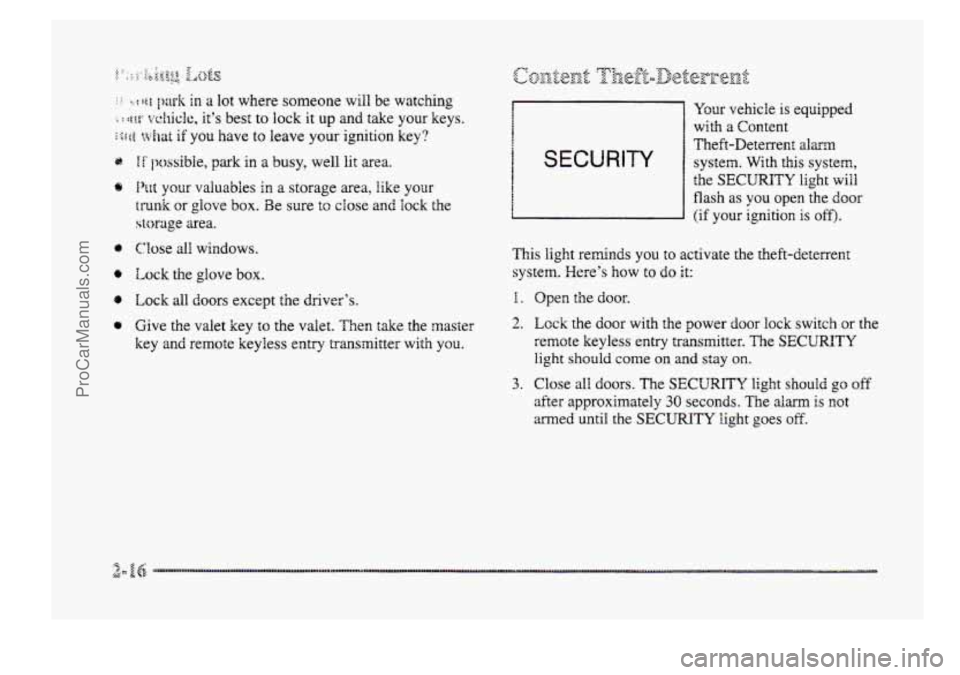
vehicle is equipped
with a Content
Theft-Deterrent alarm system. With this system,
the
SECURITY light will
flash as you open the door
(if your ignition is
off).
This light reminds you to activate the theft-deterrent
system. Here’s
how to do it:
I. Open the door.
2. Lock the door with the power door lock switch or the
remote keyless entry transmitter.
The SECURITY
light should come on and stay on.
3. Close all doors. The SECURITY light should go off
after approximately 30 seconds. The alarm is not
armed until the SECURITY light goes off.
ProCarManuals.com
Page 83 of 426
If a door is opened without the key OF the remote keyless
entry transmitter, the alm will
go off. Your vehicie‘s
lamps will flash and the
horn will sound for 30 seconds,
then
will turn of€ to save battery power.
Remember, the theft-deterrent system won’t activate if
you !ock the doors with a key or use the manual door
lock. kt activates only if you use a power door lock
switch with the
door open, or with the remote keyless
entry transmitter.
You should also remember that you
can start your vehicle with the correct ignition key if the
alm
has been set off.
Were’s how to avoid setting off the dam by accident:
I€ you don’t want to activate the theft-deterrent
system, the vehicle
should be locked with the door
key
after the doors are closed.
e Always U~IQC~ a door with a key, or use the remote
keyless entry transmitter. Unlocking
a door any other
way will set
of€ the alarm.
If you set off the alarm by accident, unlock any door
with your key. You can also turn off the alm by
pressing
UNLOCK on the remote keyless entry
transmitter. The
aim won’t stop if you try to unlock a
door any other way.
The aEm can be tested by following these steps:
1. From inside the vehicle, roll down foe driver’s
window and
open the driver’s door.
2. Activate the system by locking the doors with the
power
door lock switch while the door is open, or
with the remote keyless entry transmitter.
SECURITY light to go out.
3. Get out of the car, close the door and wait €or the
4. Then reach in through the window, unioclc the door
with the manual door lock and open the door. This
shouhd set off the altum.
If the alarm does not sound when it shdd but the
vehicle‘s
iiamps flash, check to see if the horn works.
The horn fuse may be blown. TQ replace the fuse, see
“Fuses and
Circrrit Breakers“ in the Index.
HE the alarm does not sound or the vehicle’s Bamps dc not
flash, the vehicle should be serviced by an authorized
service center.
ProCarManuals.com
Page 85 of 426
If the engine still does not start, and the key appears to
be undamaged, try mother ignition key. At this time,
you may also want to check the fuse (see “Fuses and
Circuit Breakers’‘
in the Index). If the engine still does
not start with the other key, your vehicle needs service.
If your vehicle does start, the €kt key may be faulty.
See your dealer or a
Iocksrnith who can service the
PASS-Key
IIH tc have a new key Bade.
It is possible for the PASS-Key IIP decoder to learn the
transponder value
of a new replacement key. Up to
ten additional keys may be programmed for the vehicle.
This procedure is €or learning additional keys only. If all
the currently programed keys are lost or do not
operate, you must see your dealer or a locksmith who
can service PASS-Key
HI1 to have keys made and
programmed
to the system.
See your dealer or 2 locksmith who can service
PASS-Key
III to get 2 new key blank that is a cut
exactly
as a current black colored driver’s key that
operztes the system.
Do not use 2 gray colored valet key
for this procedure.
To program the new key:
1.
2.
3.
4.
5.
Insert the cumrent driver’s key (black in color) i~* the
ignition
and start the engine. If the engine wiil not
start see your dealer for service.
After the engine has started,
turn the key to the off
position, and remove the key.
Insert the key
to be progrmmed and turn it to the
mn position within ten seconds of removing the
previous key.
The
SECURITY telltale iight will off once the
key
has been programmed. It may not be apparent
that the SECURITY light went on due to how
quickly
the key is programmed.
Repeat steps
1 through 4 if additional keys are to
be programmed.
ff you are ever driving and the SECURITY iight comes
or; and stays on, you will be able to restart your engine if
you turn it off. Your BASS-Key III system, however, is
not working properly and must be serviced by your
dealer.
You vehicle is not protected by the PASS-Key
III system at this time.
If you lose or damage a PASS-Key I11 key, see your
dealer or a locksmith who can service PASS-Key HIT to
have a new key made.
ProCarManuals.com
Page 87 of 426
I
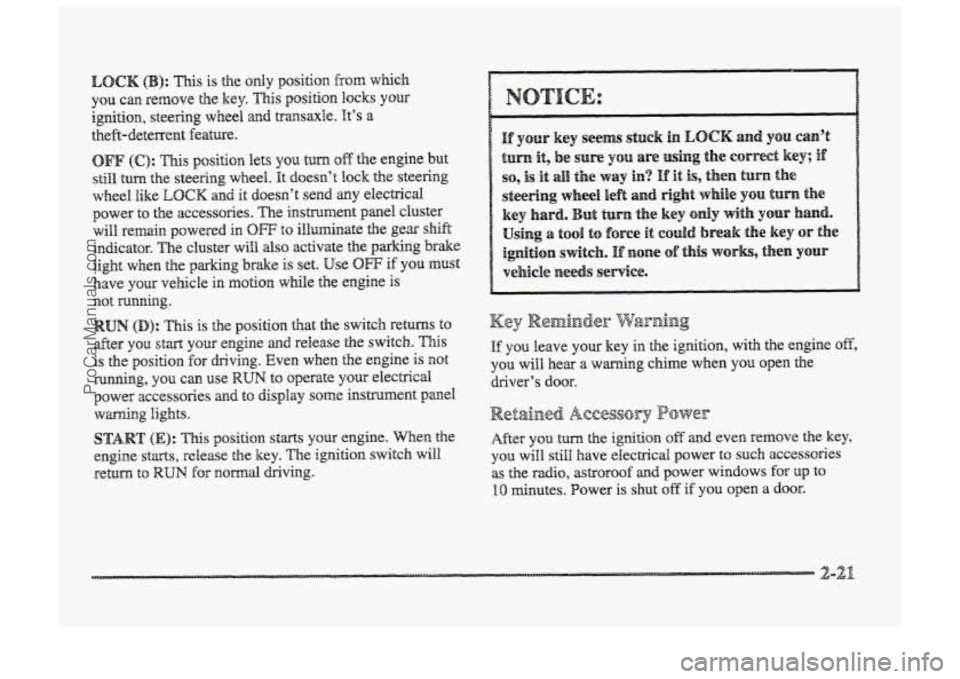
LOCK @I: This is the only position from which
YOU can remove the key. This position locks YOU
igition, steering wheel and transaxle. It’s a
theft-deterrent feature.
OFF (C): This position lets YOU turn ofif the engine but
still turn the steering wheel. It doesn’t lock the steering
wrlhee1 like LOCK and it doesn’t send my electrical
power to
the accessories. The instrument panel cluster
will remain powered in OFF to illarminate the gear sWt
indicator. The cluster will also activate the parking brake
fight when the parking brake is set. Use OW if you must
have your vehicle in motion while the engine is
not mnanaing.
RUN (D): This is the position that the switch returns to
after you start YSUP engine and release the switch. This
is &e p~sisi~n for driving. Even when the engine is not
running, you can use RUN to operate your electrical
power accessories anad t~ display some instrument panel
START (E): This position starts your engine. When the
engine
starts, release the key. The ignition switch will
return to RUN for ~a~rrrnal driving.
wdng
lights.
Retained Acces§ory Power
After you turn the ignition off md even remove the key,
you
will still have electrical power to such accessories
as the radio, astroroof ad power windows for up to
10 minutes. Power is shut off if you open a door.
2-21
ProCarManuals.com
Page 91 of 426
Ensure the shift lever is fuily in PARK (PI range before
starting the engine.
Your vehicle has a brake-transaxle
shift interlock.
You have to fully apply your regular
brzkes
before you can shift from PARK (P) when the
ignition key is in RUN. If you cannot shift out of
PARK (B), ease pressure on the shift lever -- push the
shift lever all the way into PARK (P) as you rnaintain
brake appiic~tion. Then move the shift lever into the
gear you wish. See “Shifting Out of PARK (E’)” in
the Index.
REVERSE (R): Use this gear to back up.
Shift to REVERSE (R) oanhy after vehicle
To rock your vehicle back and forth to get out of snow,
ice sand without damaging your transaxle, see
“Stuck:
In Sand, Mud, Ice or Snow” in the Index.
NEUTRAL (N): In this position, your engim
doesn’t connect with the wheels.
To restart when you’re
already
moving, use NEUTRAL (N) only. Also, use
NEUTRAL (N) when your vehicle is being towed.
Shifting out of PARK (P) or NEUTRAL fN) while
your engine is “racing” (running
at high speed) is
dangerous. Unless your foot is firmly on the
brake pedal, your vehicle could move very
rapidly. You could lose control and hit people
or
objects. Don’t shift out of PARK (P) or
NEUTRAL (N) while your engine is racing.
1 NOTICE:
Damage to your transaxle caused by shifting out
of PARK (P) or NEUTRAL (N) with the engine
racing isn’t covered by your warranty.
ProCarManuals.com
Page 93 of 426
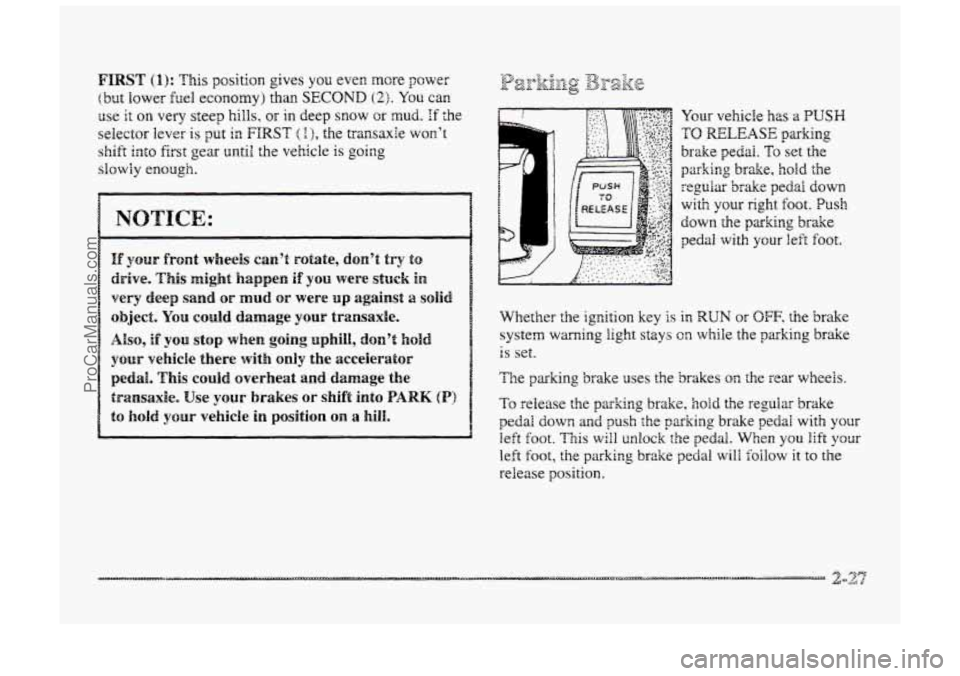
FIRST (I): This position gives you even more power
(but lower fuel economy) than SECOND (2). You can
use it on very steep hills, or in deep snow or mud. If the
selector lever is put in FIRST ( I >, the transaxle won’t
shift into first gear until the vehicle is going
slowHy enough.
If your hplrt wheels can’t rotate, don’t try to
drive. This might happen if YOU were stuck in
very deep sand OF mud or were up against a solid
object. You could damage your transaxle.
Also, if you stop when going uphill, don’t hold
your vehicIe there with only the accelerator
pedal. This could overheat and damage the
transaxle. Use ysur brakes or shift into BARK (P)
Your vehicle has a PUSH
TO RELEASE parking
brake pedai. To set the
parking brake, hold the
regular brake pedal down
with your right foot. Push
down the papking brake
pedal with your left foot.
~~ ~~
Whether the ignition key is in RUN or OFF. the brake
system
wming light stays on while the parking brake
1s set.
The parhng brake uses the brakes the rear wheels.
To release the parking brake, hoki the regular brake
pedal down and push the parking brake pedal with your
left foot. This will unlock the pedal. When you lift your
left foot, the parking brzke pedal will foilow it to the
release position.
ProCarManuals.com
Page 95 of 426
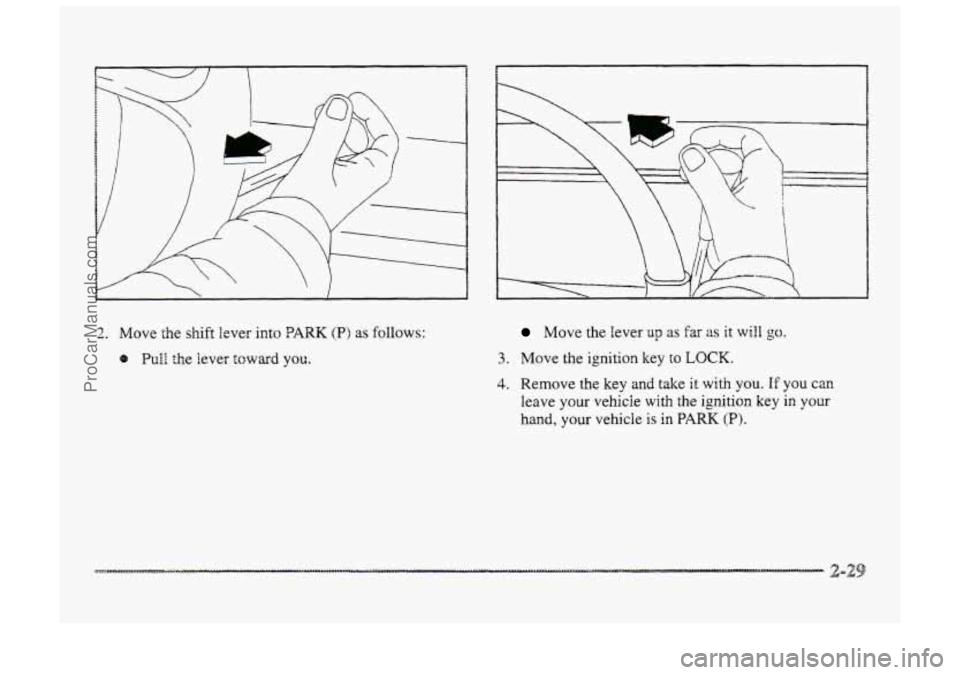
2. Move the shift lever into ?ARK (B) as follows:
8 Pull the iever toward you.
Move the lever up as far as it will go.
3. Move the ignition key to LOCK.
4. Remove the key and take it with you. If YOU can
leave
your vehicie with the ignition key in your
hand, your vehicle is in PARK (P).
ProCarManuals.com
Page 96 of 426
~ It can be dangerous to leave YQW vehicle with the
~ engine running. Your vehicle could move
i suddenly if the
shift lever is not hlPy in PARK (P)
with the parking brake firmly set. And, if you
leave the vehicle with the engine running, it couk.€
overheat and even catch fire. YQU or others could
be injured. Don’t leave YOUK- vehicle with the
engine running unless you have to.
I
Hf you have to leave your vehicle with the engine
running, be sure your vehick is in PARK (P) and your
parking brake is firmly set before you Ieave it. After
you’ve moved the shift lever into the ?ARK (P)
position, hold the regular brake pedal down. Then, see if
YOU can move the shift lever away from PARK (?)
without first pulling it toward you. If you can, it means
that the shift lever wasn’t fully locked into PARK (P).
r-m naqae Le!#& I
If you are parking on ;I hill and you don’t shift your
transaxle into PAKM (P) properly, the weight of the
vehicle may put too rntich force OD the parking pawl in
the transaxle. You may f’ind it difficult to pull the shift
lever out of PARK (P). This is called “torque lock.” To
prevent torque lock, set the parking brake and then shift
into PARK (P) pr~perfy before you leave the driver’s
seat.
TQ find out how, see “Shifting Into PARK (P)” in
the Index.
When you are ready to drive, move the shift lever out of
PARK (P) bejbre YOU retease the parking brake.
If torque lock does occur, you may need to have another
vehicle
push yours a little uphill to take some of the
pressure from the pxking pawl in the tramaxle, so you
can pull, the shiR lever out of PARK (P).
ProCarManuals.com
Page 97 of 426
k;zgaA 'T:..:&pa: & LnP :V3;.,,t (.$ dL Bb* pFq- {p :.A AA &L \'& J
Your vehicle has a brake-transaxle shift interlock. You
have to fully apply your regular brake before you can
shift
from PARK (P) when the ignition is in RUN. See
"Automatic Transaxle" in the Index.
If you cannot shift out of PARK (PI, ease pressure on
the shift lever -- push the shift 'lever all the way into
PARK (PI as you maintain brake application. Then
move the shift lever into the gear
YOU want.
If you ever hold the brake pedal down but still can't
shift out of PARK (P), try this:
1.
2.
3.
4.
5.
Turn the key to OW. Open and close the driver's
door to turn
off the retained accessory power feature.
Apply
and hold the brake until the end of Step 4.
Shift to NEUTRAL (N).
Start the vehicle and then shift to the drive gear
you want.
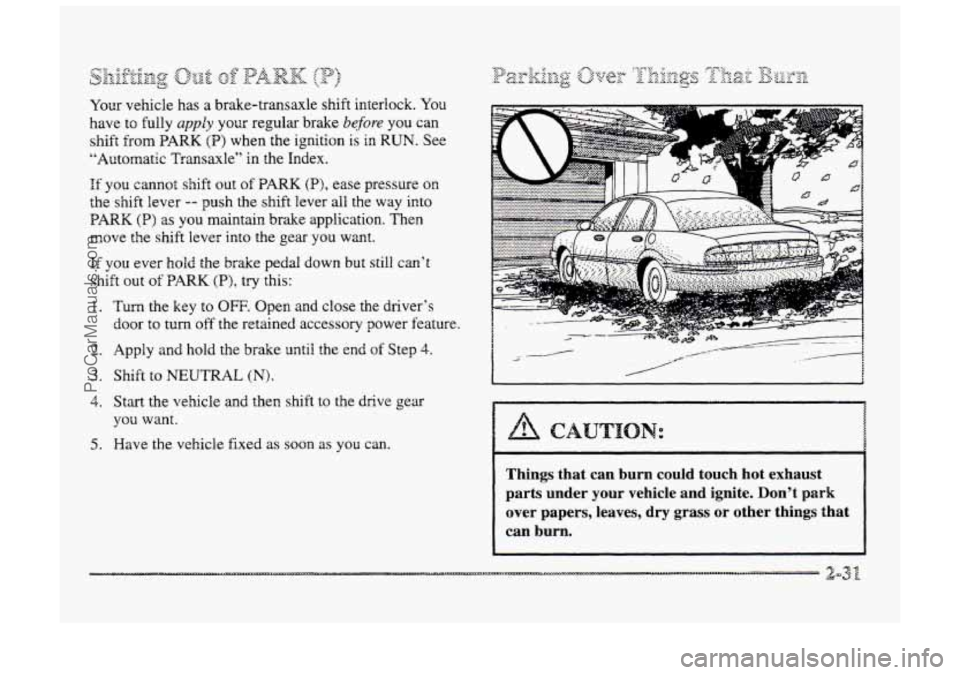
Have the vehicle fixed as soon as you can. CAUTION:
Things that can burn could touch hot exhaust
parts under your vehicle and ignite. Don't park
over papers, leaves,
dry grass or other things that
can burn.
.. . .. 3 32 drn-2
ProCarManuals.com