service BUICK PARK AVENUE 1998 Owner's Manual
[x] Cancel search | Manufacturer: BUICK, Model Year: 1998, Model line: PARK AVENUE, Model: BUICK PARK AVENUE 1998Pages: 426, PDF Size: 23.59 MB
Page 253 of 426
E you get the overheat wming but see or hear no
steam, the problem may not be too serious. Sometines
the engine can get a BittIe too hot when you:
@B Climb a long hill on a hot day.
8 Stop after high-speed driving.
Idle
for long periods in tra€€ic.
9 Tow a trailer.
If you get the overheat warning with sign of stem,
try this for a mimte or so:
I. Turn off your air conditioner.
2. Turn on your heater to full hot at the highest Fan
speed and opera the window as necessary.
otherwise, shift
to the highest gear while
driving
-- AUTOMATIC OVERDRIVE (a)
or THmD (3 1.
3. If you're Ira a tra€fic jam, shift to NEUTRAL (N);
If you 1'10 longer have the overheat wmimg, you
can drive. Just to be safe, drive slower for about
IO minutes. If the warning doesn't come back on,
you can drive normally.
If the warning continues, pull over, stop, and park your
vehicle right away.
If there's still no sign of steam, YOU can idle the engine
for two or three minutes while you're parked, to see if
the warning stops. But then, if you still have the
warning,
turn c$ftthe engine and get everyone out of the
a,chicke until it cools down.
You may decide not to lift the hood but to get service
help right away.
ProCarManuals.com
Page 255 of 426
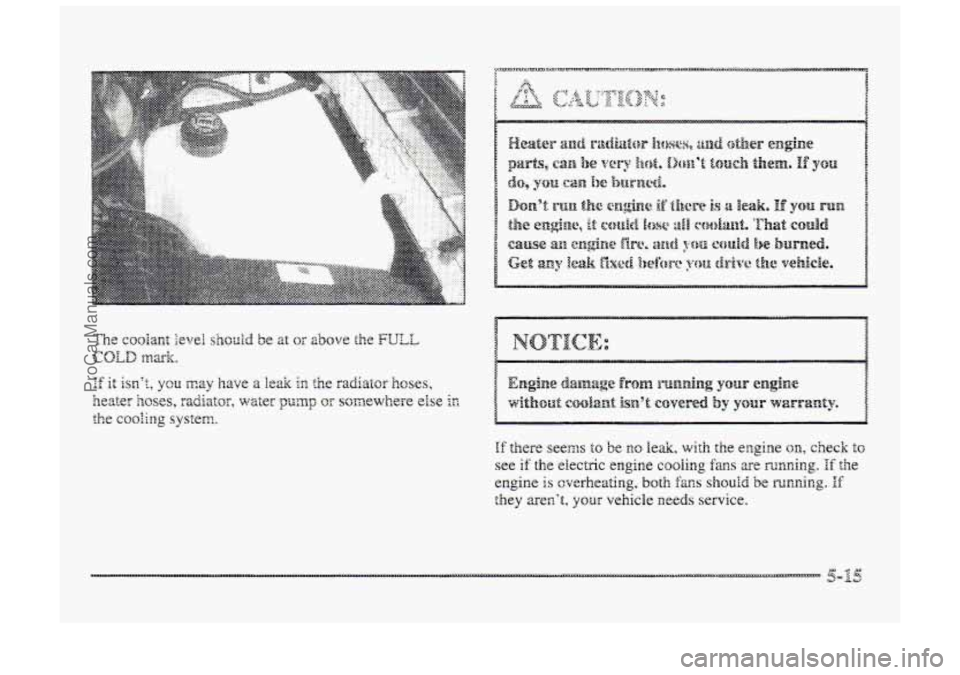
If there seem to be no leak, with the engine on, check io
see if the electric engiap,e cooling fans are mnning. If the
engine is cverkeating, both fm.s shouici be marning. If
they aren't, your vehicle needs service.
ProCarManuals.com
Page 275 of 426
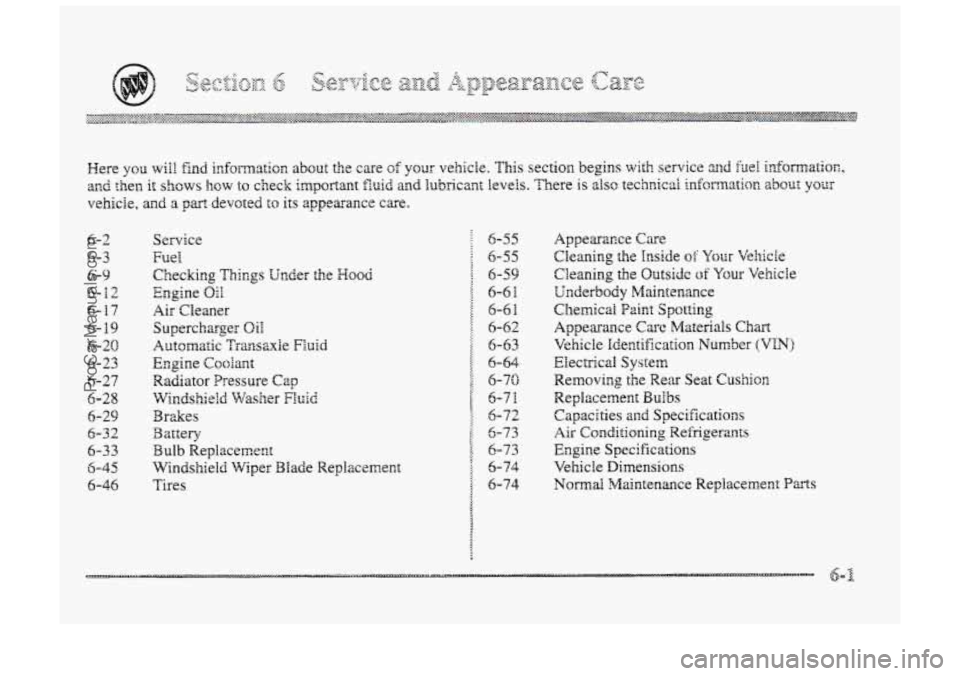
6-2
6- 3
4-9
6-12
4-17
6- 19
4-20
6-23
5-27
6-28
6-29
4-32
6-33
6-45
6-46
Service
Fuel
Checking Things Under the Hood
Engine Oil
Air Cleaner
Supercharger
Oil
Automatic Transaxle Fluid
Engine Coolant
Radiator Bressure Cap
VVindskieTd Washes Fluid
Br&es
3 attery
Bulb Replacement
Windshield Wiper Blade Replacement
Tires Appearance
Care
Cleaning the Inside QE Y(.w VehicEe
Cleaning
the Outside of Your Vehicle
Underbody Maintenance
Chemical
Paint Spotting
Appearance Care Materials Chart
Vehicle icientifkation Number (VIN)
Electrical System
Removing the Rear Seat Cushion
Replacement Bulbs
Capacities and Specifications
Air Conditioning Re€rigerants
Engine Specifications
Vehicle Dimensions
Normal Maintenance Replacement 'Parts
ProCarManuals.com
Page 276 of 426
Your dealer knows your vehicle best and wants you to
be happy with it. We hope you’II go to your dealer €or
all your service needs. You’ll get genuine GM parts and
GM-trained
and supported service people.
We hope you’ll want to keep your GM vehicle all GM.
Genuine GM parts have one of these marks:
Genuine
Your vehicle has an air bag system. Before attempting to
do your own service work, see “Servicing Your Air
Bag-Equipped Vehicle” in the Index.
You should keep a record with a111 parts receipts and list
the mileage and the date
of any service work you
perform. See “Maintenance Record” in the Index.
ProCarManuals.com
Page 277 of 426
Things you might add to the outside of your vehicle can
affect
the airdaow around it. This may cause wind noise
and affect windshield washer performance. Check with
your dealer before adding equipment to the outside
of
your vehicle. The
8th digit sf your vehicle
identification number
(Vm) shows the code lettee for your engine. You will
find the VIN at the top left of your instmment panel.
(See “Vehicle Identifkation Number’’ in the Endex.)
If you have the 3800 engine (VIN Code use regula
unleaded gasoline rated
at 87 octane or higher. If you’re
using fuel rated
at the recommended octane or higher
and
you hear heavy knocking, your engine needs
service. But don’t
worry if YOU hear a little pinging
noise when you’re accelerating or driving
up a hill.
That’s normal, and YOU don’t have to buy a higher
octane fuel
to get rid of pinging. It’s the heavy, constant
knock
that means you have a problem.
If you have the 3800 Supercharged engine (VHN
Code I), use premium unleaded gasoline rated at
91 octane or higher. With the 3800 Supercharged
engine, in
an emergency, you may be able to use a
lower QC~XE -- as low as 87 -- if heavy knocking does
not occur. If you are using 91 cx higher octane unleaded
gasoline and
YOU hear heavy knocking, your engine
needs service.
6-3
ProCarManuals.com
Page 290 of 426
If none of them is true, use the %ong triphighway
maintenance schedule. Change the oil and filter every
7,500 miles (12 500 km) or 12 months -- whichever
occurs
ht. Driving a vehicle with a fully warmed
engine
under highway conditions causes engine oil
to $re& down dower.
If any one of these is true for you, use the short tripkity
maintenance schedule:
8
Most trips are less than 5 to 13 miles (8 to I 6 km).
This is particularly important when outside
temperatures
are below freezing.
Most trips include extensive id1ir.g (such as frequent
$riving
in stop-and-go traffic).
Most
trips are though dusty areas.
You frequently tow a trailer or use a carrier on top of
your vehicle.
The vehicle is used for delivery service, police, taxi
or other
commercial application.
Driving under these conditions causes engine
oil to
break down
sooner. Hf any me of these is true for your
vehicle, then
YOU need to change your si1 and filter
every
3,000 miles (5 000 km) or 3 months -- whichever
occurs
kt. (See Engine Oil Life Monitor (Index) in
the Index.
1
Did you know that used engine oil contains certain
ekmer,ts that may
be unhealthy for your skin and csdd
even cause cancer? Don’t let used oil stay on your skin
for very iong. Clean your skin and nails with soap and
water, or a good hznd cleaner. Wash or properly throw
away clothing or rags containing used engine oil. (See
the manufacturer’s warnings about
the use and disposal
of oil products.)
Used oil can be a real t-heat to the environment. If you
change
your own oil, be sure to drain all free-flowing
oil
from the filter before disposal. Don’t ever dispose of
oil by putting it in the trash, pouring it on the ground,
into sewers, or into streams or bodies of water. Instead,
recycle it by taking it
to a place that coilects used oil. If
you have a problem properly disposing of your used oil,
ask your dealer,
a service station or a local recycling
center for kelp.
ProCarManuals.com
Page 292 of 426
... .. .. ..
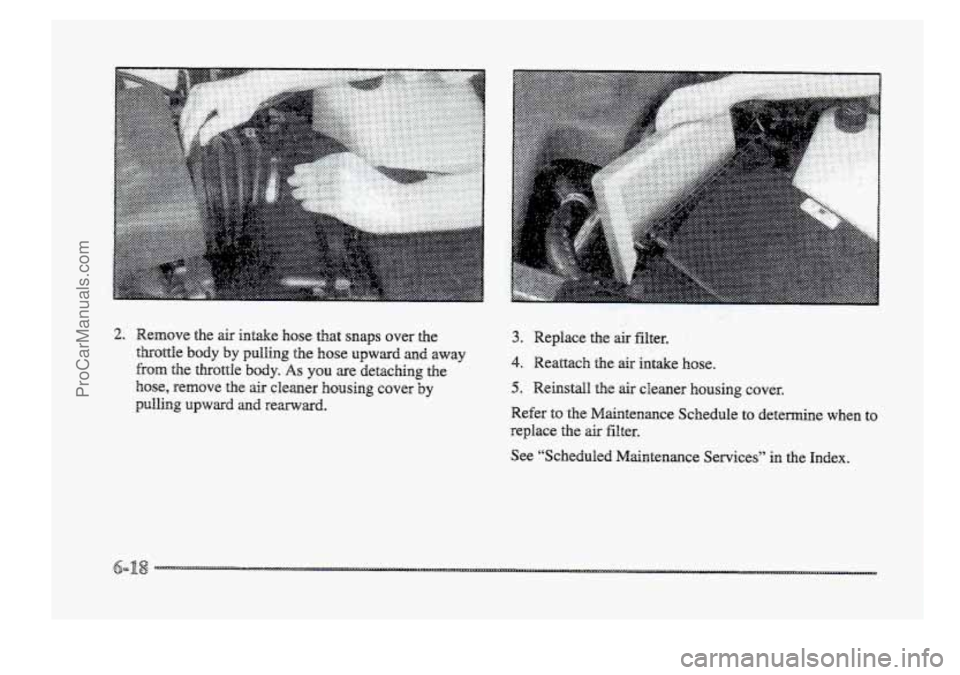
2. Remove the air intake hose that snaps over the
bottle
body by pulling the hose upward and away
from the throttle body. As YOU are detaching the
hose, remove ahe air cleaner housing cover by
pulling upward and remarc%.
3. Replace the air filter.
4. Reattach the air intake hose.
5. Reinstall the air cleaner housing cover.
Refer
to the Maintenance Schedule to determine when to
replace the
air filter.
See “Scheduled Maintenance Services” in the Index.
ProCarManuals.com
Page 294 of 426
Check oil only when the engine is cold. Allow the
engine
to cool two to three hours after running.
I. Clean tke area around the oil fill plug before
removing it.
2. Remove the G~H fill plug wing a 3/26 inch
Allen
wrench.
3. The oil level is correct when it just reaches efre
bottom of the threads of the inspection hole.
4. Replace the oil plug with the O-ring in place.
Torque
to 88 bin ( IO N-m).
A good time to check your automatic transaxle fluid
level is wherr the engine oil is changed.
Change
both the fluid a.nd filter every 50,000 miles
(83 080 Ian) if the vehicle is mainly driven rander one
or more of these conditions:
8 In heavy city traffic where the outside temperature
regularly reaches
90°F (32°C) or higher.
0 Uses such as found in taxi, police QT delivery service.
If you do not use your vehicle under any sf these
conditions, the fluid and filter do not reqwie changing.
See “Scheduled Maintenance Services” in the Index.
ProCarManuals.com
Page 295 of 426
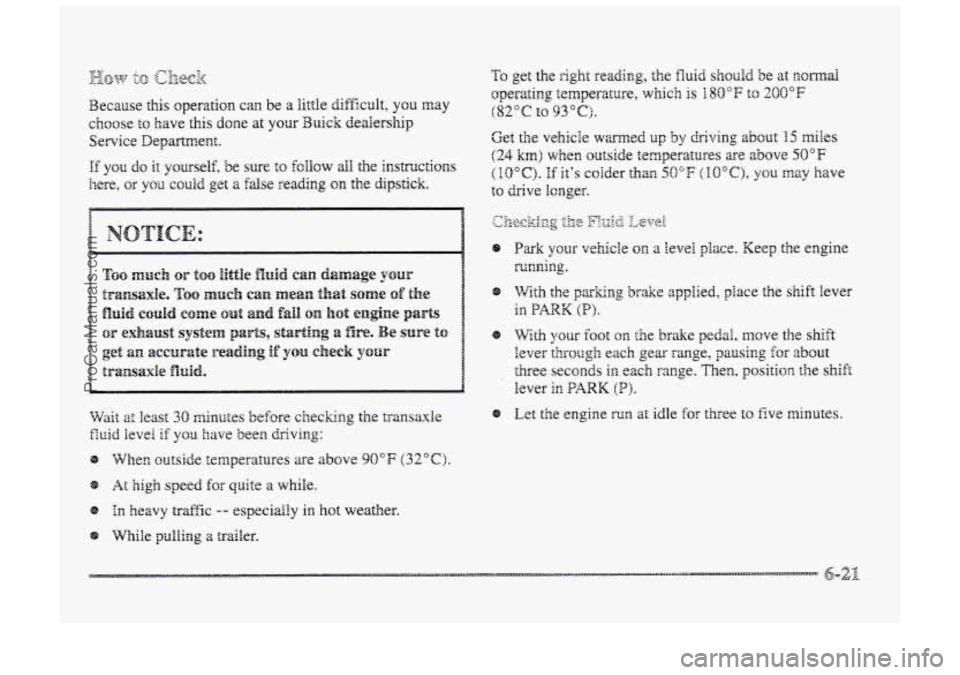
Because this operation can be a little difficult, you may
choose to have this done set your 3uick dealerslug
Service Department.
If you do it yourself, be sue to follow all the instructions
here,
OT you could get a false reading on the dipstick.
Wait at Beast 30 minutes before checking the transaxle
fhid lwei if you have been driving:
8 When outsiOe temperatures are above 90°F (3~ e>. m0-
@ At high speed for quite a while.
e In heavy traffic -- especiaily in hot weather.
8 While gulling a trailer.
ProCarManuals.com
Page 305 of 426
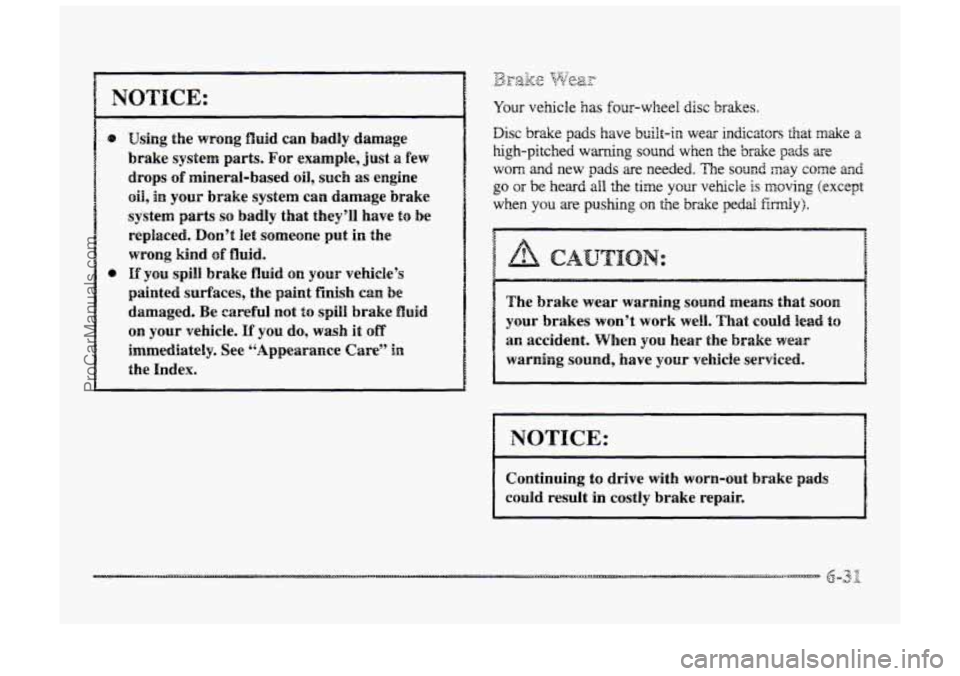
NOTICE:
Using the wrong fluid can badly damage
brake system
parts. For example, just a few
drops
of minerallbased oil, such as engine
oil, in your brake system can damage brake
system
parts so badly that they’ll have to be
replaced.
Don’t let someone gut in the
If you spill brake fluid OEI your vehicle’s
painted
surfaces, the paint finish can be
damaged. Be careful
not to spill brake fluid
on your vehicle. If you do, wash it off
immediately. See “Appearance Case” in
the Index. wrong
kind of fluid.
Your vehicle has four-wheel disc brakes.
Disc
brake pads have built-in wear inchcators &at make a
high-pitched warning sound when the brake pads are
worn and new pads are needed. The sound may come and
go or be heard all the time your vehicle is moving (except
when
you are pushing on the brake pedal firmly).
The brake wear warning sound means that soon
your brakes won’t work well. That could lead to
an accident. When you hear the brake wear
warning sound, have your vehicle serviced.
NOTICE:
Continuing to drive with worn-out brake pads
could result in costly brake repair.
ProCarManuals.com