tow BUICK PARK AVENUE 1998 Owner's Manual
[x] Cancel search | Manufacturer: BUICK, Model Year: 1998, Model line: PARK AVENUE, Model: BUICK PARK AVENUE 1998Pages: 426, PDF Size: 23.59 MB
Page 248 of 426
2
A vehicle can fall from a car carrier if it isn’t
adequately secured. This can cause a collision,
serious personal injury and vehicle damage. The
vehicle should be tightly secured with chains OF
steel cables before it is transported.
Don’t use substitutes (ropes, leather straps,
canvas webbing, etc.) that can be cut by sharp
edges underneath the towed vehicje. Always use
T-hooks inserted in the T-hook siob. Never use
J-hooks. They will damage drivetrain and
suspension components. When your vehicle
is being towed, have the ignition key
in OW. The steering wheel should be
clamped in a.
straight-ahead position, with a clamping device
designed for towing service. DQ not use the vehicle’s
steering
column iock for this. The transaxle should be in
NEUTRAL (N) and the parking brake released.
Don’t have your vehicle towed the front wheels,
unless you must. If the vehicle must be towed QII the
front wheels, be sure to fallow the speed and distance
restrictions later in this section or your transaxle will be
damaged. If these Limits must be exceeded, then the
front wheels have to be supported on a dolly.
ProCarManuals.com
Page 253 of 426
E you get the overheat wming but see or hear no
steam, the problem may not be too serious. Sometines
the engine can get a BittIe too hot when you:
@B Climb a long hill on a hot day.
8 Stop after high-speed driving.
Idle
for long periods in tra€€ic.
9 Tow a trailer.
If you get the overheat warning with sign of stem,
try this for a mimte or so:
I. Turn off your air conditioner.
2. Turn on your heater to full hot at the highest Fan
speed and opera the window as necessary.
otherwise, shift
to the highest gear while
driving
-- AUTOMATIC OVERDRIVE (a)
or THmD (3 1.
3. If you're Ira a tra€fic jam, shift to NEUTRAL (N);
If you 1'10 longer have the overheat wmimg, you
can drive. Just to be safe, drive slower for about
IO minutes. If the warning doesn't come back on,
you can drive normally.
If the warning continues, pull over, stop, and park your
vehicle right away.
If there's still no sign of steam, YOU can idle the engine
for two or three minutes while you're parked, to see if
the warning stops. But then, if you still have the
warning,
turn c$ftthe engine and get everyone out of the
a,chicke until it cools down.
You may decide not to lift the hood but to get service
help right away.
ProCarManuals.com
Page 261 of 426
0:. .. . .
If 8 Goes FE&
It’s unusual for a tire to “blow out” while you’re driving,
especially
if you maintain your tires properly. If air goes
i...
...
out of a &e, it’s much moie likely to leak out slowly.
But if you should ever have a “blowout,” here are
a few
tips about what to expect
and what to do: 1 ‘i
< 1 If a front tire fails, the flat tire will create a drag that
’, !! pulls the vehicle toward that side. Take YOLK foot off the g accelerator pedal and grip the steering wheel firmly.
P Steer to maintain lane position, and then gently brake to
-4 ,i a stop well out of the traffic lane.
.2? .
skid and may require the same correction you’d use in a
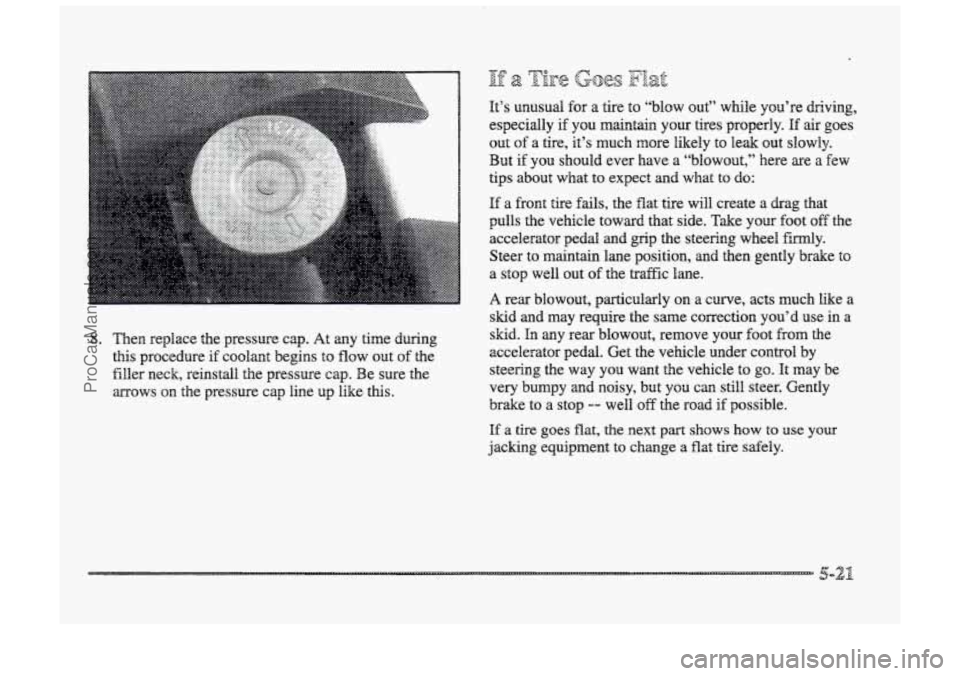
8. Then replace the pressure cap. At any time during
this procedure if
CQQ~EUI~ begins to flow out of the
filler neck, reinstall the pressure cap. Be sure the
mows
on the pressure cap line up like this.
s~. h any kearblowout, remove your foot kom the
accelerator pedal. Get the vehicle under control by
steering the
way you want the vehicle to go. It may be
very bumpy and noisy, but you can still steer. Gently
brake to
a stop -- well off the road if possible.
If a tire goes flat, the next part shows how to use your
jacking equipment to change a flat
tire safely.
ProCarManuals.com
Page 290 of 426
If none of them is true, use the %ong triphighway
maintenance schedule. Change the oil and filter every
7,500 miles (12 500 km) or 12 months -- whichever
occurs
ht. Driving a vehicle with a fully warmed
engine
under highway conditions causes engine oil
to $re& down dower.
If any one of these is true for you, use the short tripkity
maintenance schedule:
8
Most trips are less than 5 to 13 miles (8 to I 6 km).
This is particularly important when outside
temperatures
are below freezing.
Most trips include extensive id1ir.g (such as frequent
$riving
in stop-and-go traffic).
Most
trips are though dusty areas.
You frequently tow a trailer or use a carrier on top of
your vehicle.
The vehicle is used for delivery service, police, taxi
or other
commercial application.
Driving under these conditions causes engine
oil to
break down
sooner. Hf any me of these is true for your
vehicle, then
YOU need to change your si1 and filter
every
3,000 miles (5 000 km) or 3 months -- whichever
occurs
kt. (See Engine Oil Life Monitor (Index) in
the Index.
1
Did you know that used engine oil contains certain
ekmer,ts that may
be unhealthy for your skin and csdd
even cause cancer? Don’t let used oil stay on your skin
for very iong. Clean your skin and nails with soap and
water, or a good hznd cleaner. Wash or properly throw
away clothing or rags containing used engine oil. (See
the manufacturer’s warnings about
the use and disposal
of oil products.)
Used oil can be a real t-heat to the environment. If you
change
your own oil, be sure to drain all free-flowing
oil
from the filter before disposal. Don’t ever dispose of
oil by putting it in the trash, pouring it on the ground,
into sewers, or into streams or bodies of water. Instead,
recycle it by taking it
to a place that coilects used oil. If
you have a problem properly disposing of your used oil,
ask your dealer,
a service station or a local recycling
center for kelp.
ProCarManuals.com
Page 296 of 426
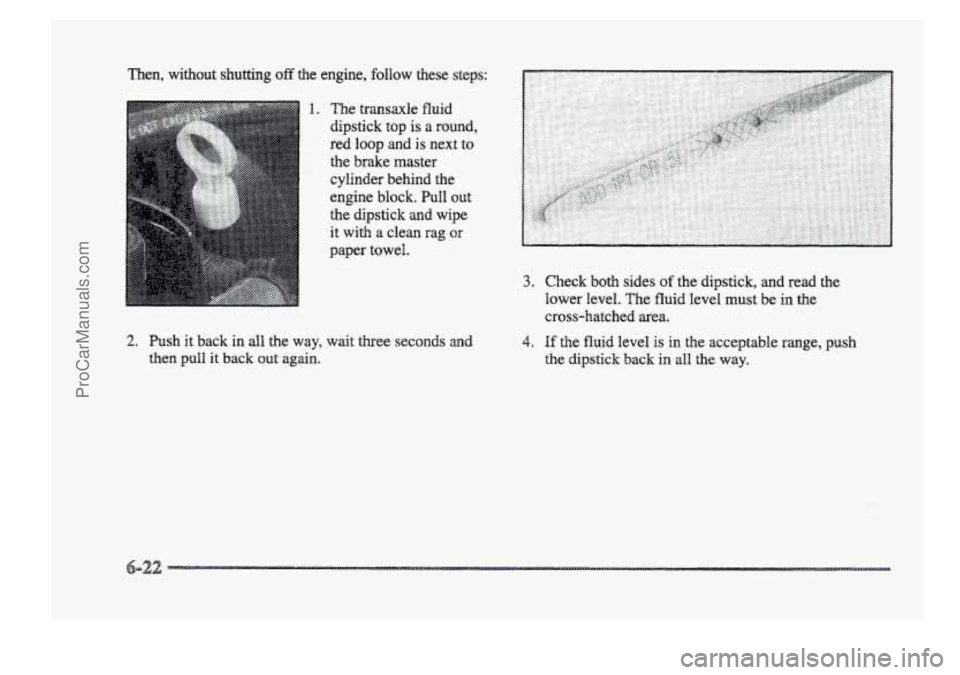
Then, without shutting off the engine, follow these steps:
1. The transaxle fluid
dipstick top is a round,
red
loop and is next to
............. ............. the brake master
cylinder behind
the
engine block. Pull out
the dipstick and wipe
it with a clean rag or
paper towel.
3. Check both sides of the dipstick, and read the
lower level. The fluid 'level
must be in the
cross-hatched area.
2. Push it back in all the way, wait thee seconds and 4. If the fluid level is in the acceptable range, push
then pull it back out again. the dipstick back in a11 the way.
ProCarManuals.com
Page 330 of 426
1 1.
2.
3.
4.
5.
6.
7.
Vacuum and brush the area to remove any loose dirt.
Always clean a whoie trim panel or section. Mask
surrounding trim along stitch or welt lines.
lwix powdered cleaner fobwing the directions on
the container label to f~m thick suds.
Use suds only and apply with a clean sponge. Don’t
saturate the material
and don’t nab it roughiy.
As SOQ~ as you’ve cleaned the section, use a sponge
*is remove the suds.
Wipe cleaned area with a clean, damp towel or cloth.
Wipe with a clean cloth and let dry.
I. Carefirlly scrape off excess stain, then sponge the
soiled area with CQOI water.
2. If a stain remains, folkow the multi-purpose interior
cleaner instructions described earlier.
3. If an odor lingers after cleaning vomit or urine, treat
the area with a waterbaking soda solution:
I teaspoon (5 ml) of baking soda to B cup (250 ml>
of lukewm water.
4. Let dry.
Stains caused by candy, ice cream, mayonnaise, chili
sauce and unknown stains can be removed
as follows:
I. Carefully scrape off excess stain.
2. First, clean with cool water and ailow to
dry completely.
3. If a stain remains, follow instructions €or
Multi-Purpose Interior Cleaner.
ProCarManuals.com
Page 333 of 426
Silicone grease on weatherstrips will make them last
longer, seal better, and not stick or squeak. Apply
silicone grease with a clean cloth
at least every
six m~ntias. During very cold, damp weather
more frequent application may be required. (See
“Reccmmended Fluids
and %ubricants” in the Index.)
The paint
finish on your vehicle provides beauty, depth
of color, gloss retention 2nd durability.
The best
way to preserve your vehicle’s finish is to
keep it dean by washing it sften with Imkewm cr
cold water.
Dor~’: wash your vehicle in the direct rays of the sun.
hn’t use strong soaps or chemical detergents. Use
liquid hand, dish cx car washing (mild detergent) soaps.
You can get GM-approved cleaning products from your
dealer. (See “Appearance Care
and Materials” in the
Index.) Don’t use cleaning agents that are petroleum
based, or
that contain acid or abrasives. ALE cleaning
agents shoer%d be ilushed promptly 2nd not ahwed to
dry on the surface, or they couid stain. Dry the finish
with
a soft, clean chamois or an AI-cotton towel to
avoid surface scratches and water spotting.
High pressure car washes may cause water to enter
your vehicle.
OccasicsnaI waxing or mild polishing of your vehicle
by hand may be necessary to remove residue from the
paint finish. You can get GtM-approved cleaning
products from
your dealer. (See “Appearance Care
and Materiais”
in the Index.)
Your Buick has a “basecoat/cEearcoat” paint finish.
The clearcoat gives more depth and gloss to the
colored basecoat. Always use waxes
and polishes
that are non-abrasive and made
for a basecoatklearcoat
paint finish.
ProCarManuals.com
Page 334 of 426
1 I rinsing thoroughly, dry with a soft dean towel. A
I NOTICE:
-
I wax may then be appied.
-I
The surface of these wheels is similar to the painted
Machine compounding or aggressive polishing on
abrasive cleaning brushes OR them because you could finish or leave swirl marks.
chemicals, abrasive polishes, abrasive cleaners or a basecoatklearcoat paint finish may dull the
surface of your vehicie. Don’t use strong soaps,
damage the surface.
You may use chrome polish on
chrome wheels, but avoid any painted surface
of the
Foreign materials such as calcium chloride and other wheel,
and buff off immediately after application.
salts, ice melting agents, road oil and tar, tree sap, bird
droppings, chemicals from industrial chimneys, etc., can
Don’t take your vehicle through an automatic car wash
damage your vehicle’s finish
if they remain on painted that has silicon carbide tire cleaning brushes. These
surfaces. Wash the vehicle as soon
as possible. If brushes can also damage the surface of these wheels.
necessary, use non-abrasive cleaners ihat
are marked
safe for painted surfaces
to remove foreign matter.
Exterior painted surfaces
are subject to aging, weather To clean your tires, use a stiff brush with a tire cleaner.
and chemical fallout that can take their toll over
a period I
of years. You can help to keep the paint finish looking
new by keeping your vehicle garaged or covered
whenever possible.
Keep your wheels clean using a soft clean cloth with
mild soap and water. Rinse with clean water. After I NOTICE:
When applying a tire dressing always take care
to wipe off any overspray or splash from all
painted surfaces
on the body or wheels of the
vehicle. Petroleum-based products
may damage
the paint finish.
ProCarManuals.com
Page 344 of 426
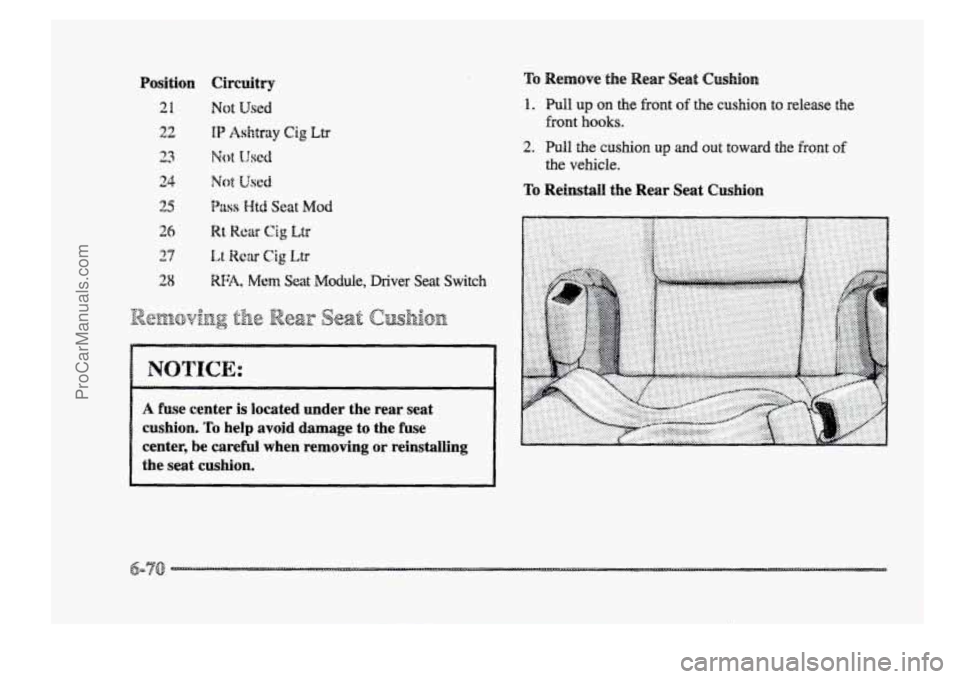
Position Circuitry
21 Not Used 1. Pull up on the front of the cushion to release the
front hooks.
2. Pull the cushion up and out toward the front of
To Reinst.4 the Rear Seat Cwhicban
the vehicle.
26
27
28
at .Rear cig Les
E& Rear Cig Ltr
RFA, Mem Seat Module, Driver Seat Switch
cushion. To help avoid damage to the fuse
center, be careful when removing
or reinstalling
the seat
cushion.
ProCarManuals.com
Page 355 of 426
i ~~
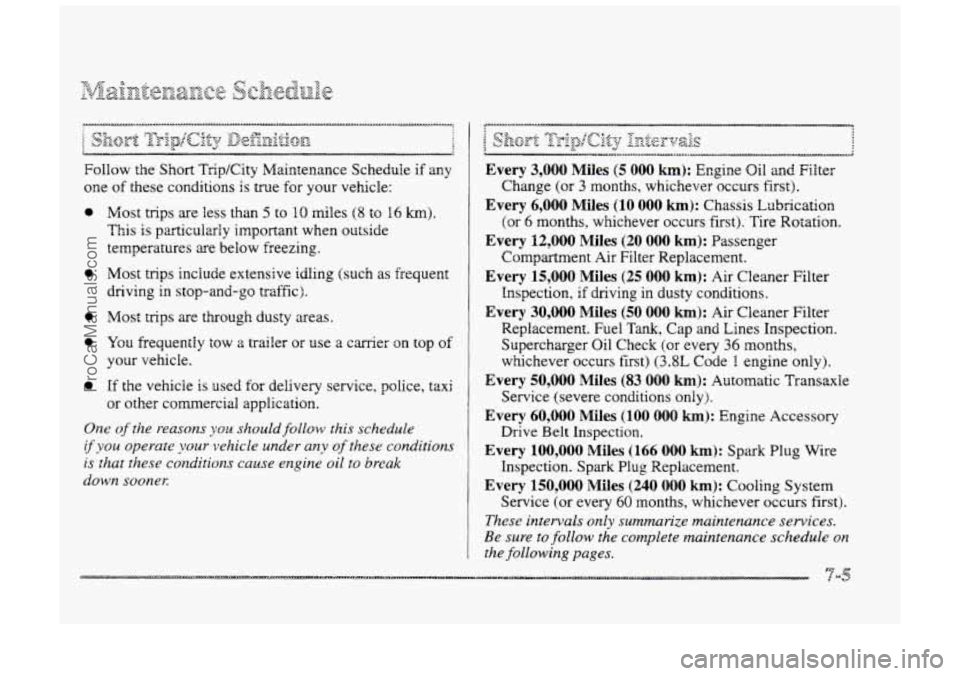
Follow the Short Trip/City Maintenance Schedule if any
one of these conditions
is true for your vehicle:
0
0
0
0
0
Most trips are less than 5 to 10 miles (8 to I6 km).
This is particularly important when outside
temperatures are below freezing.
Most
trips include extensive idling (such as frequent
driving
in stop-and-go traffic).
Most trips are through dusty areas.
You frequently tow a trailer or use a carrier on tog of
your vehicle.
If the vehicle
is used for delivery service, police, taxi
or other commercial application.
One of the reasons you should follow this schedule
if you operate your vehicle under any of these conditions
is that these conditions cause engine oil to break
down
soonep:
r---
ShQTt 7&+p/cigy &$-~~y& c .. 6 - I-
Every 3,000 Miles (5 000 km): Engine Oil md Filter
Every 6,000 Miles (10 000 km): Chassis Lubrication
Every 12,000 Miles (20 000 km): Passenger
Every 15,000 Miles (25 000 km): Air Cleaner Filter
Every 30,000 Miles (50 000 km): Air Cleaner Filter
Change (or
3 months, whichever
occurs first).
(or
6 mo-nth, whichever occurs first). Tire Rotation.
Compartment Air Filter Replacement.
Inspection,
if driving in dusty conditions.
Replacement. Fuel
Tank, Cap and Lines Inspection.
Supercharger
Oil Check (or every 36 months,
whichever occurs first)
(3.8L Code I engine only).
Every 50,000 Miles (83 080 km): Automatic Transaxle
Service (severe conditions only).
Every 60,000 Miles (100 000 km): Engine Accessory
Drive Belt Inspection.
Every 100,000 Miles (166 000 km): Spark Plug Wire
Inspection.
Spark Plug Replacement.
Every 150,000 Miles (240 000 km): Cooling System
Service
(or every 60 months, whichever occurs first).
These intervals only summarize maintenance services.
Be sure to follow the complete maintenance schedule on
the following pages.
RP I -3
ProCarManuals.com