wheel BUICK PARK AVENUE 1998 Owner's Manual
[x] Cancel search | Manufacturer: BUICK, Model Year: 1998, Model line: PARK AVENUE, Model: BUICK PARK AVENUE 1998Pages: 426, PDF Size: 23.59 MB
Page 229 of 426
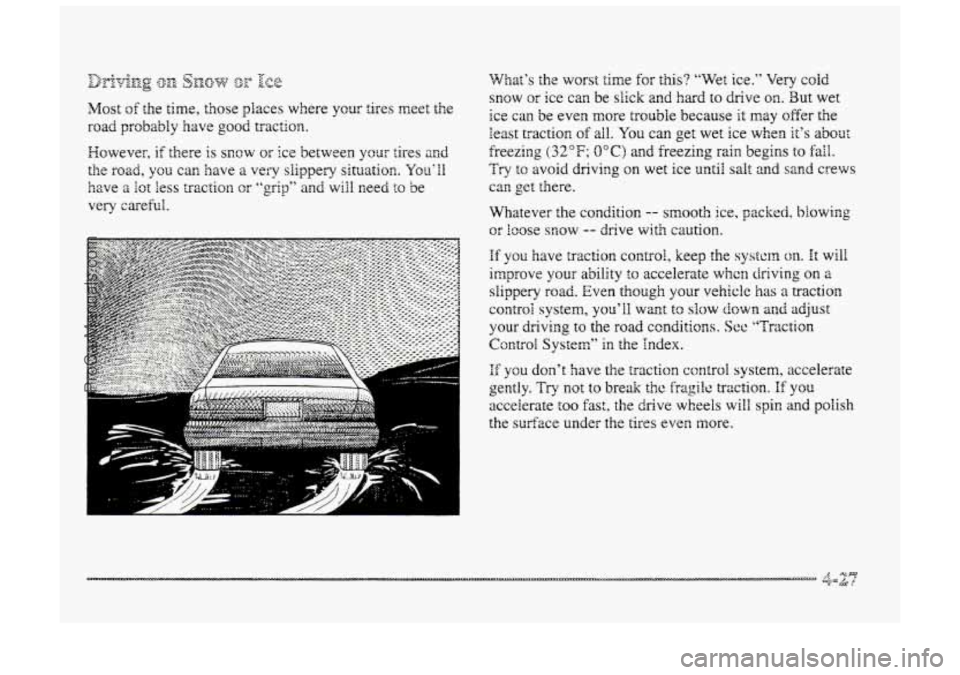
However, if there is snow OF ice between yorar tires and
the road, you can have a very slippery situation. You’ll
have a lot less traction cr “grip” and will need to be
very careful.
..........
..-- ... .. ‘ _._ , .....
What’s the worst time for this? “Wet ice.” Very cold
snow or ice can be slick 2nd hard to drive on. 3ut wet
ice can be even more trouble because
it may oEer the
least traction of all. You can get wet ice when it’s about
freezing
(,32”F; OOC) and freezing rain begins to fail.
Try to avoid driving on wet ice until salt 2nd sand crews
can get there.
Whatever the condition
-- smooth ice, packed, blowing
or hose snow -- drive with caution.
If you have traction control, keep the systcrn on. It will
improve your ability
to accelerate when driving on a
slippery road. Even though your vehicle has a traction
controi system,
you’ll want to slow down and adjust
your driving to the road conditions. Sec ‘‘Trrrctionr
Control
System” in the Index.
If you don’t have the traction control system, accelerate
gently.
Try not to break thc FragiEt: Fraction. If you
acceierate too fast, the drive wheels will spin and polish
the surface under the tires even more.
ProCarManuals.com
Page 235 of 426
Eszd-pulling components such as the engine, transaxle.
wheel assembiles and tires %e forced ea work harder
against the drag uf the added weight. The engine is
required to operate at reEativeIy higher speeds and gnder
grczter Isads, gecerating extra heat. What's more, the
trailer adds considerably to wid resistance, increasing
the pulling requirements.
If You Do Decide To PnlI A Railerr
If you do, here are some irqm-tana points:
There
are mmy different laws, inclndlng speed Zimit
restrictions, having to do with trailerkg Make sure
your
rig will be legal, not only where yolr live but
also where you'll be driving. A good source for this
infomation can be state or' provincial peke.
ProCarManuals.com
Page 248 of 426
2
A vehicle can fall from a car carrier if it isn’t
adequately secured. This can cause a collision,
serious personal injury and vehicle damage. The
vehicle should be tightly secured with chains OF
steel cables before it is transported.
Don’t use substitutes (ropes, leather straps,
canvas webbing, etc.) that can be cut by sharp
edges underneath the towed vehicje. Always use
T-hooks inserted in the T-hook siob. Never use
J-hooks. They will damage drivetrain and
suspension components. When your vehicle
is being towed, have the ignition key
in OW. The steering wheel should be
clamped in a.
straight-ahead position, with a clamping device
designed for towing service. DQ not use the vehicle’s
steering
column iock for this. The transaxle should be in
NEUTRAL (N) and the parking brake released.
Don’t have your vehicle towed the front wheels,
unless you must. If the vehicle must be towed QII the
front wheels, be sure to fallow the speed and distance
restrictions later in this section or your transaxle will be
damaged. If these Limits must be exceeded, then the
front wheels have to be supported on a dolly.
ProCarManuals.com
Page 261 of 426
0:. .. . .
If 8 Goes FE&
It’s unusual for a tire to “blow out” while you’re driving,
especially
if you maintain your tires properly. If air goes
i...
...
out of a &e, it’s much moie likely to leak out slowly.
But if you should ever have a “blowout,” here are
a few
tips about what to expect
and what to do: 1 ‘i
< 1 If a front tire fails, the flat tire will create a drag that
’, !! pulls the vehicle toward that side. Take YOLK foot off the g accelerator pedal and grip the steering wheel firmly.
P Steer to maintain lane position, and then gently brake to
-4 ,i a stop well out of the traffic lane.
.2? .
skid and may require the same correction you’d use in a
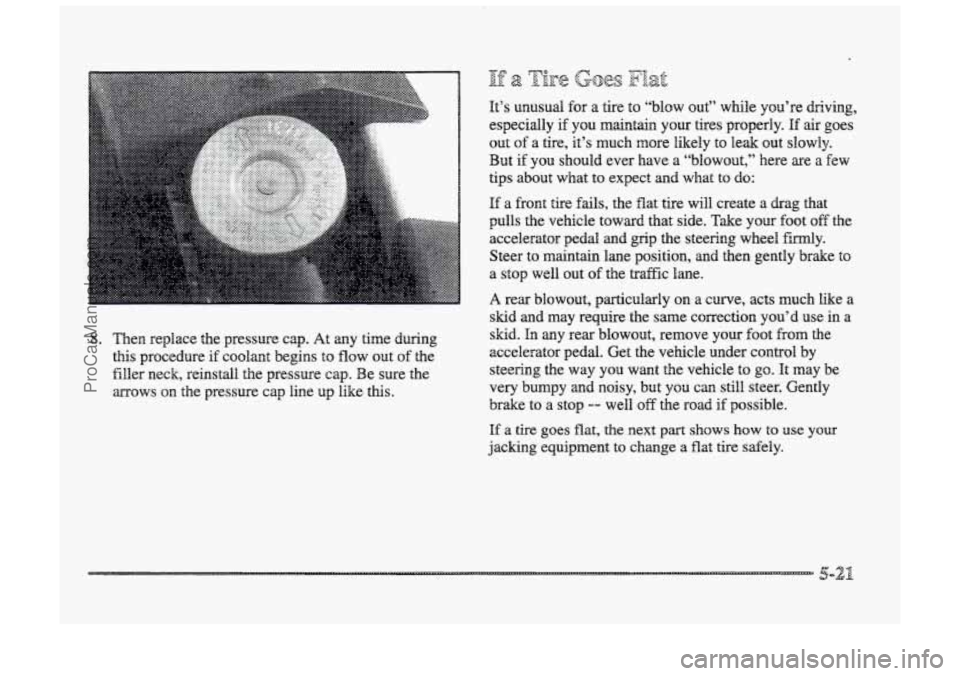
8. Then replace the pressure cap. At any time during
this procedure if
CQQ~EUI~ begins to flow out of the
filler neck, reinstall the pressure cap. Be sure the
mows
on the pressure cap line up like this.
s~. h any kearblowout, remove your foot kom the
accelerator pedal. Get the vehicle under control by
steering the
way you want the vehicle to go. It may be
very bumpy and noisy, but you can still steer. Gently
brake to
a stop -- well off the road if possible.
If a tire goes flat, the next part shows how to use your
jacking equipment to change a flat
tire safely.
ProCarManuals.com
Page 264 of 426
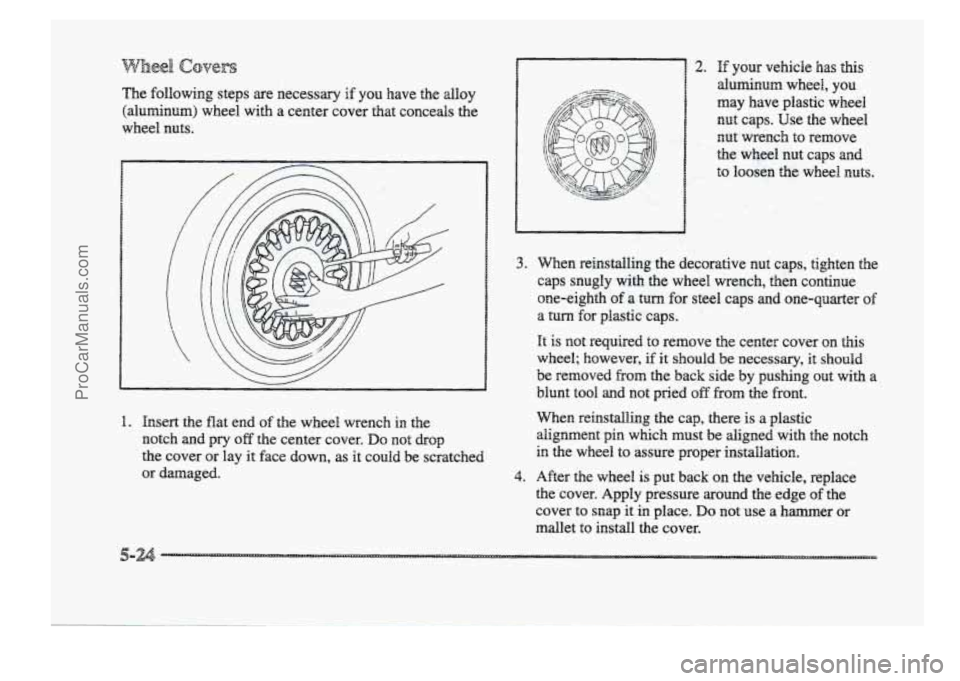
The following steps are necessary if you have the dloy
(alu~num) wheel with a center cover that conceals the
wheel nuts.
1. Insert the flat end of the wheel wrench in the
notch and pry
off the center cover. DQ not drop
the cover QP lay it face down, as it could be scratched
or damaged.
2. If your vehicle has this
aluhum wheel, you
may have plastic wheel
nut caps. Use
the wheel
nut wrench to remove
the wheel nut caps
anad
to loosen the wheel nuts.
3. When reinstalling the decorative nut caps, tighten the
caps snugly with
the wheel wrench, then continue
one-eighth
of a turn for steel caps and one-quarter of
a turn €or plastic caps.
It is not required
to remove the center cover on this
wheel; however, i€ it should be necessary, it should
be removed hm the back side by pushing out with a
blunt tool and not pried off from the front.
When reinstalling the cap, there
is a plastic
alignment pin which must be aligned with the notch
in the wheel to assure proper installation.
4. After the wheel is put back on the vehicle, replace
the cover. Apply pressure around
the edge of the
cover
to snap it in place. Do not use a hammer or
mallet to instdl the cover.
ProCarManuals.com
Page 265 of 426
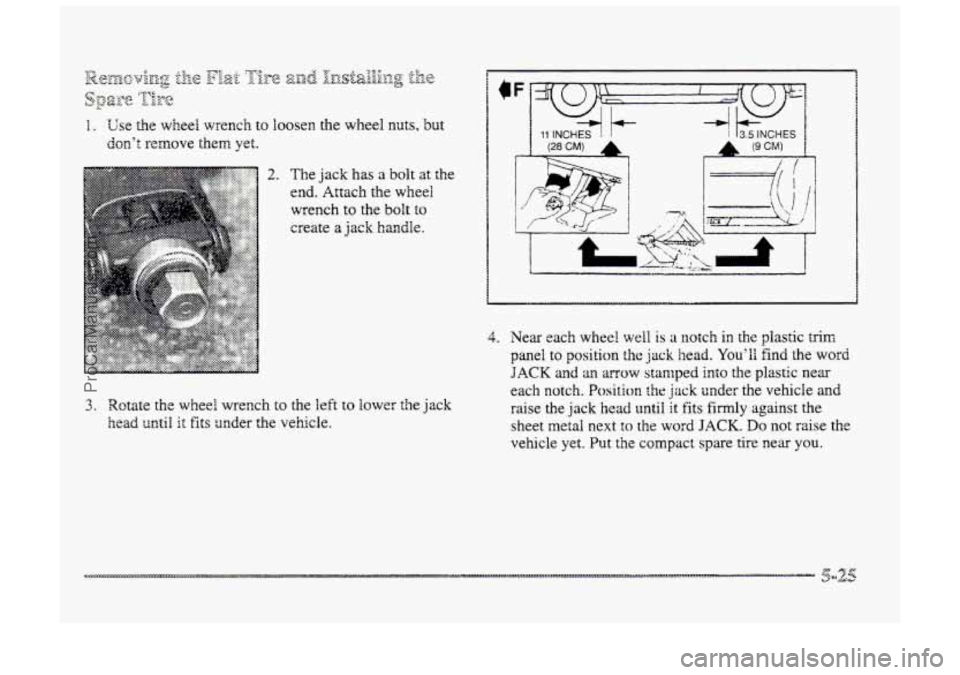
I. Use the wheel wrench to loosen the wheel nuts, but
don’t. remove them yet.
2. The jack has a bolt at the
end.
Attach the wheel
wrench
to the bolt to
create a jack handle.
3. Rotate the wheel wrench to the left to lower the jack
head until it fits under the vehicle.
11 INCHES I
(28 CM)
1
4. Near each wheel well is a KIO~C~ in the plastic trim
panel to position the jack head. You’ll find the word
JACK and an amow stamped into the plastic near
each
notch. Position the jack under the vehicle and
raise the
jack head until it fits firmly against the
sheet metal
next to the word JACK. Do not raise the
vehicle yet. Put
the compact spare tire near you.
ProCarManuals.com
Page 266 of 426
. .. .
Raising your vehicle with the jack improperly
positioned can damage the vehicle and even
make
the vehicle fall. To help avoid personal
injury and vehicle damage, be sure to fit the jack
lift head into the proper lo~ation before raising
the vehicle.
. .. 1.. ... .... -..:::q , . ... , . , ._.. : ,.. .. . ..
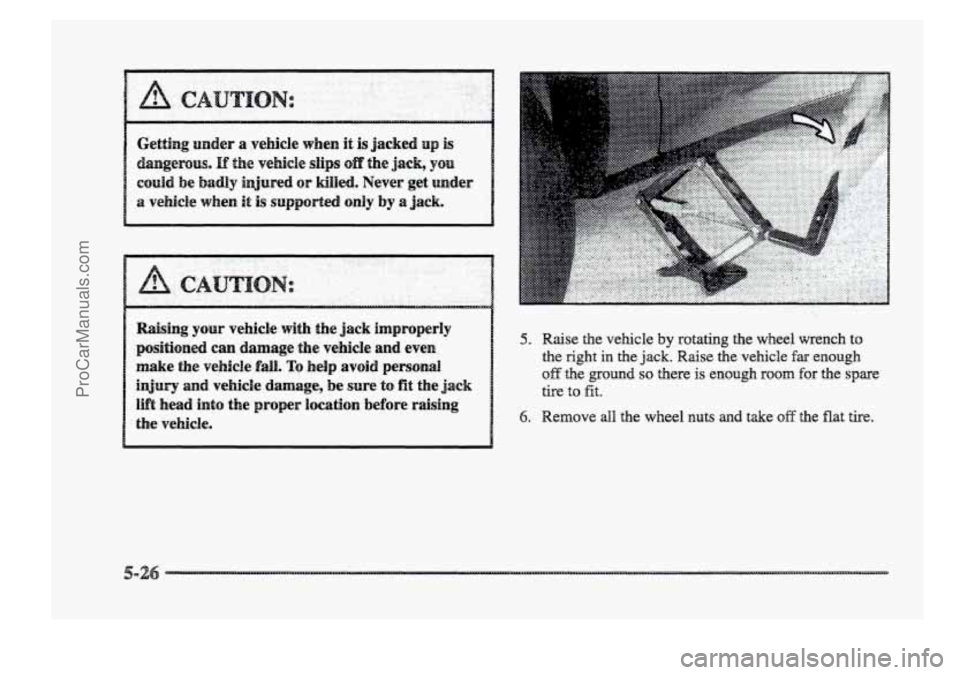
5. Raise the vehicle by rotating the wheel wrench to
the right in the jack. Raise the.vehicle far enough
off the ground so there is enough room for the spare
tire to fit.
6. Remove all she wheel nuts and take off the flat tire.
ProCarManuals.com
Page 267 of 426
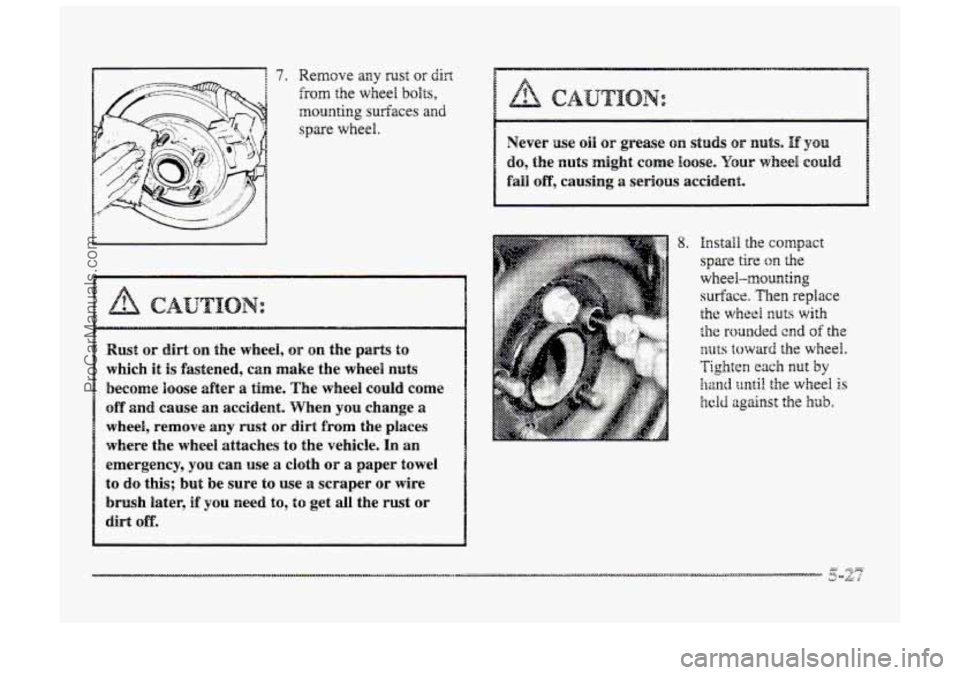
7. Remove my rust or Girt
from the wheel bolts,
aoundng surfaces and
spare wheel.
CAUTION:
Rust or dirt on the wheel, OB" on the parts to
which it is fastened, can make the wheel nuts
become Boose dter a time. The wheel could come
off and cause an accident. When YOU change a
wheel, remove any rust or dirt from the places
where the wheel attaches to the vehicle. In an
emergency, you can use a cloth or a paper dowel
to
do this; but be sure to use a scraper or wire
brush later, if you need to, to get all the rust or
dirt
off.
Never use oil or grease on studs OF nubs. If yon
do, the nuts might come EOQS~. YQUF wheeI could
fajI off, causing a serious accident.
ProCarManuals.com
Page 268 of 426
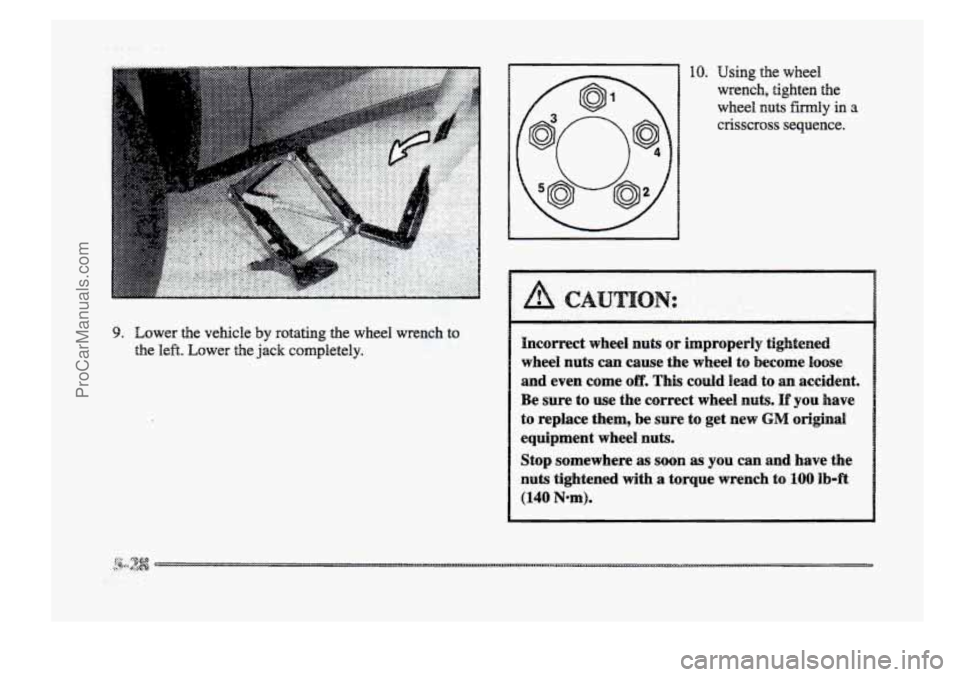
9. Lower the vehicle by rotating the wheel wrench to
the left. Lower the jack completely.
10. Using the wheel
wrench,
tighten the
wheel nuts fdy in a
Incorrect wheel nuts or improperly tightened
wheel nuts
can cause the wheel to become ~cocpse
and even come off. This could lead to an accident.
Be
sure to use the correct wheel nuts. If you have
to replace them, be sure to get new GM original
equipment wheel nuts.
Stop somewhere
as soon as you can and have the
nuts tightened with a torque wrench to PO0 lb-ft
(140 Nem).
ProCarManuals.com
Page 273 of 426
j NOTICE:
Spinning your wheeEs can destroy parts sf your
vehicle as well as the tires. If YOU spin the wheels
&OO fast while shifting your transaxle back and
forth, you can destroy your tramaxle.
~ ~ ~~~~
FOP information about using tire chains on ycur vehicle,
see “Tire
Chains” in the Index.
ProCarManuals.com