ECU BUICK PARK AVENUE 1998 Owners Manual
[x] Cancel search | Manufacturer: BUICK, Model Year: 1998, Model line: PARK AVENUE, Model: BUICK PARK AVENUE 1998Pages: 426, PDF Size: 23.59 MB
Page 26 of 426
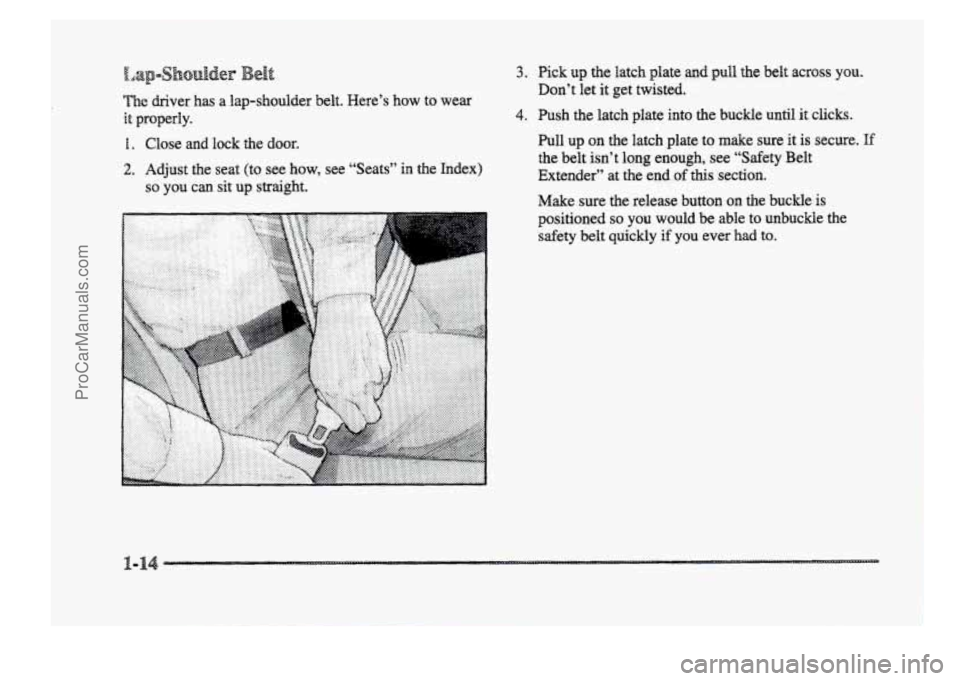
The driver has a lap-shoulder belt. Here’s how to wear
it properly.
1. Close and lock the door.
2. Adjust the seat (to see how, see “Seats” in the Index)
so you can sit up straight.
3. Pick up the Batch plate and pull the belt across you.
Don’t let it get twisted.
4. Push the latch plate into the buckle until it clicks.
Pull up on the latch plate to make sure it is secure.
E
the belt isn’t long enough, see “Safety Belt
Extender” at the end. of
this section.
Make sure the release
button on the buckle is
positioned so you would be able to unbuckle the
‘safety belt quickly i€ you ever had to.
ProCarManuals.com
Page 35 of 426
CAmHoN: (CQdIIUd)
Young children and infants need the protection that
a child restraint system can provide. Always
secure children properly in your vehicle.
To
read how, see the part of this manual called
“Children”
and see the caution labels on the
smvisoss and the right front passenger’s
safety belt.
There is an air bag
readiness light
on the
instrument panel, which
BAG
shows AIR BAG.
The system checks the air bag electrical system for
malfunctions. The light
tells YOU if there is an electrical
problem. See
“Air Bag Readiness Light” in the Index
for more information.
..
... ... .; ........
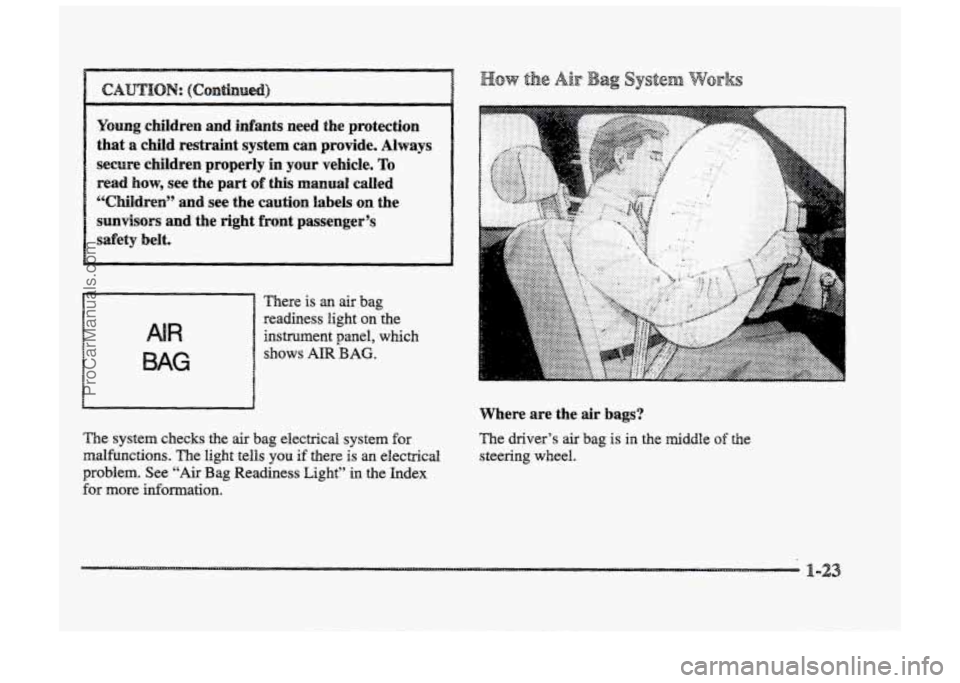
Where are the air bags?
The driver’s air bag is in the middle of the
steering wheel.
ProCarManuals.com
Page 46 of 426
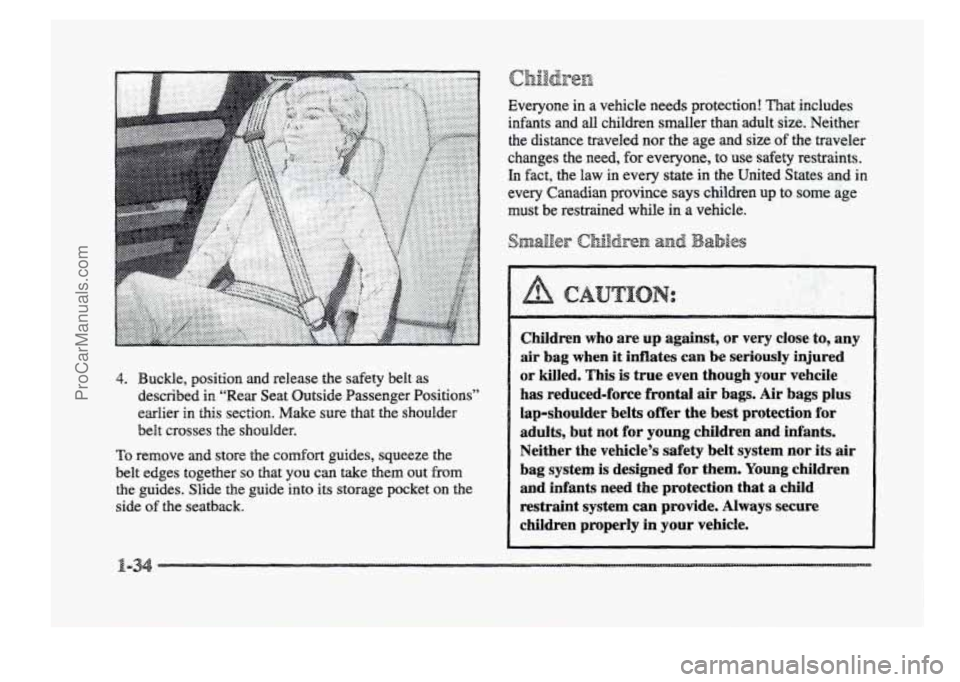
4. Buckle, position and release the safety belt as
described
in “Rear Seat Outside Passenger Positions”
earlier
in this section. Make sure that the shoulder
belt crosses the shoulder.
To remove and store the comfort guides, squeeze the
belt edges together so that you can take them out from
the guides. Slide the guide into its storage pocket on the
side
of the seatback.
Children
Everyone in a vehicle needs protection! That includes
infants and all children smaller
than adult size. Neither
the distance traveled nor the age and size of the traveler
changes the need,
for everyone, to use safety restraints.
In fact, the law in every state in the United States and in
every Canadian province says children up to some age
must be restrained while in
a vehicle.
Children who are up against, or very close to, any
air bag when it Mates can be seriously injured
or Wed.
This is true even though your vehcile
has reduced-force frontal air bags. Air bags plus
lag-shoulder belts offer the best protection for
adults, but not for young children
and infants.
Neither the vehicle’s safety belt system nor its air
bag system is designed for them. Young children
and
infants need the protection that a child
restraint system can
provide. Always secure
children
properly in your vehicle.
ProCarManuals.com
Page 50 of 426
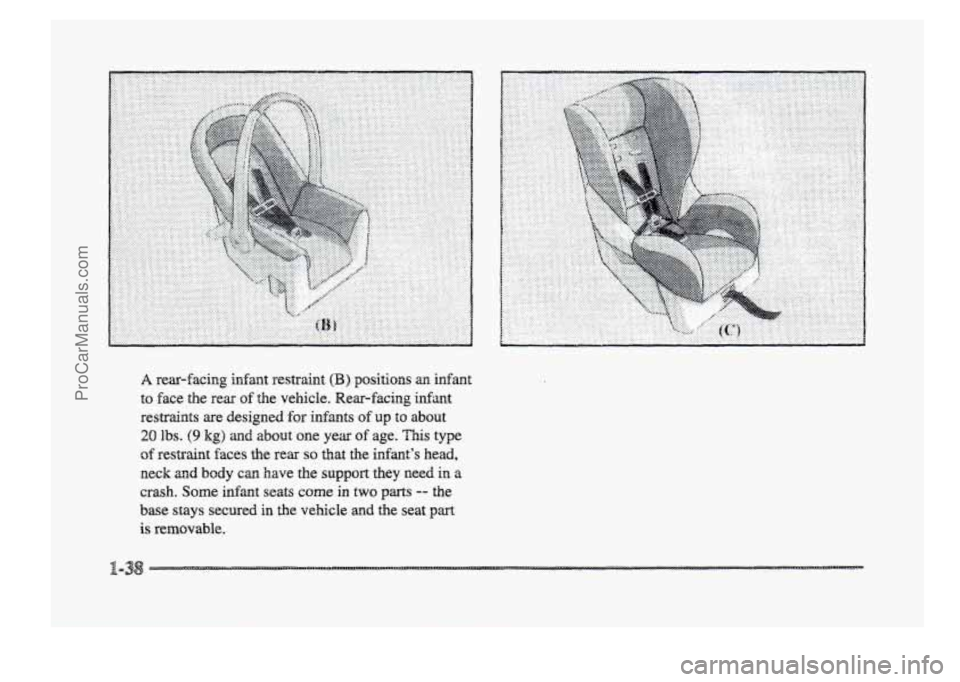
A rear-facing infant restraint (B) positions an infant
to face the rear of the vehicle. Wear-facing infant
restraints are designed
for infants of up to about
20 Ibs. (9 kg) agld about one year of age. "his type
of restraint faces the rear so that the infant's head,
neck
and body can have the support they need in a
crash. Some infant seats come in two parts -- the
base stays secured
in the vehicle and the seat part
is removable.
ProCarManuals.com
Page 53 of 426
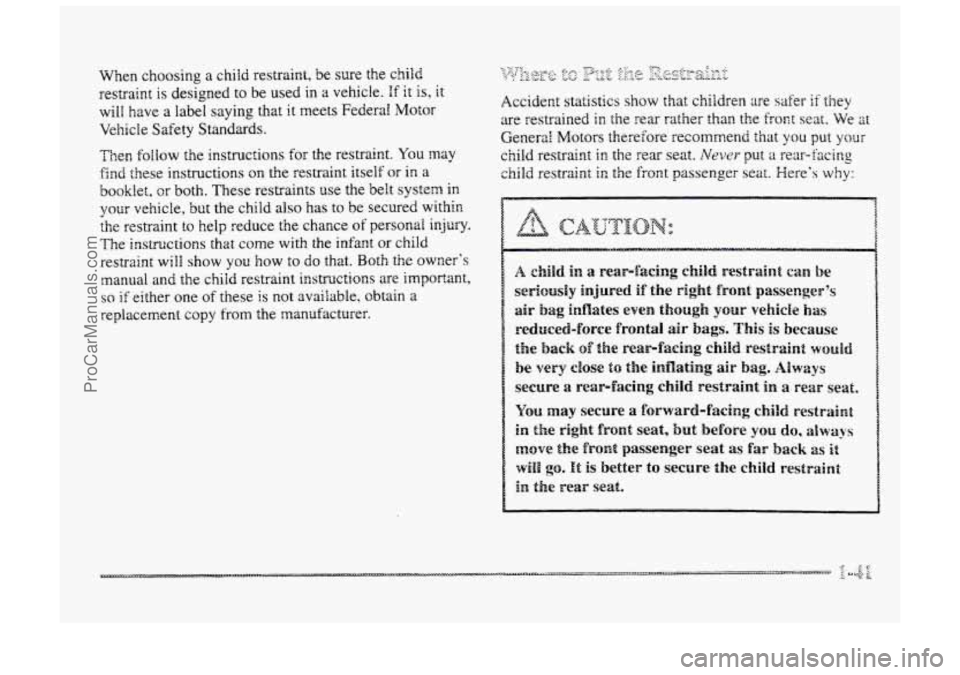
Wnen choosing a child restraint, be sure the child
restraint is designed to be used in
a vehicle. If it is, it
will have
a label saying that it meets Federal Motor
Vehicle Safety
Standards.
Ynen foliow the instructions for the restraint. You may
fixi these instructions on the restraint itself or in a
booklet, or both. These restraints use the belt system in
your vehicle, but the child also has to be secured within
the restraint to help reduce the chance of personal. injury.
The insmctions that come with
the infant or child
restraint will show YOU how to do that. Both the owner's
manual and the chiid restraint instructions are important,
so if either one of these is not available, obtain a
replacement copy from the manufacturer.
ProCarManuals.com
Page 54 of 426
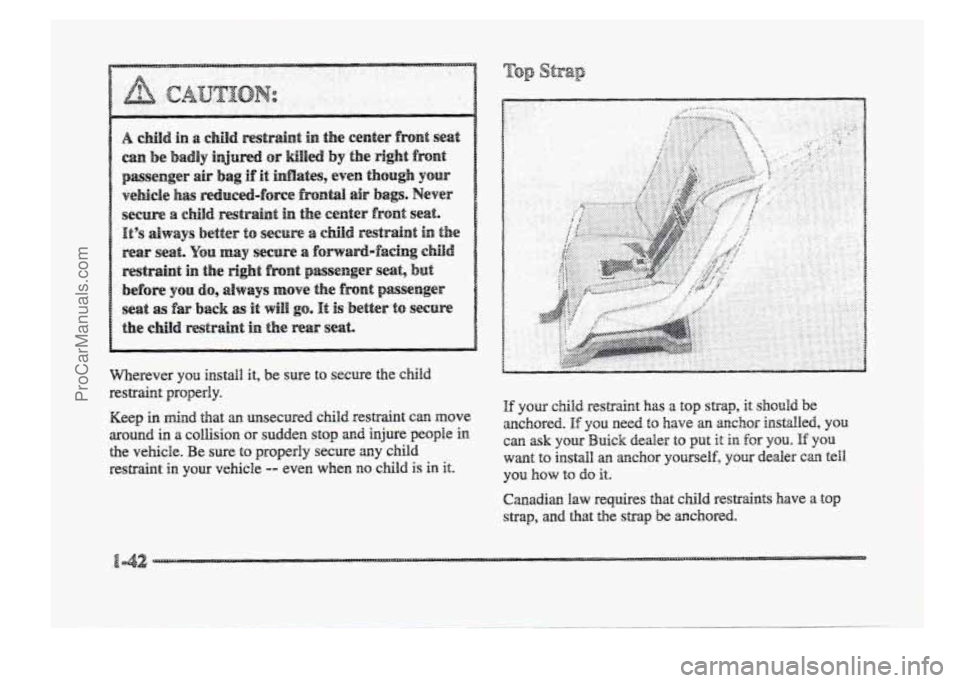
Wherever you install it, be sure to secure the child
restsa..int properly.
Keep in finad that m unsecured child restraint can move
around in a collision or sudden stop and injure people in
the vehicle. Be sure to properly secure my child
restraint in YOU vehicle -- even when no child is in it.
If your child restraint has a top strap, it should be
anchored. If you need to have an anchor installed, you
can ask your Buick dealer to gut it in for YSU. Hf you
want to install m anchor yourself9 your deder can tell
you how to do it.
Canadian law requires that child restraints have a top
strap, and that the strap be anchored.
ProCarManuals.com
Page 56 of 426
C,', , . :..:.>x ......
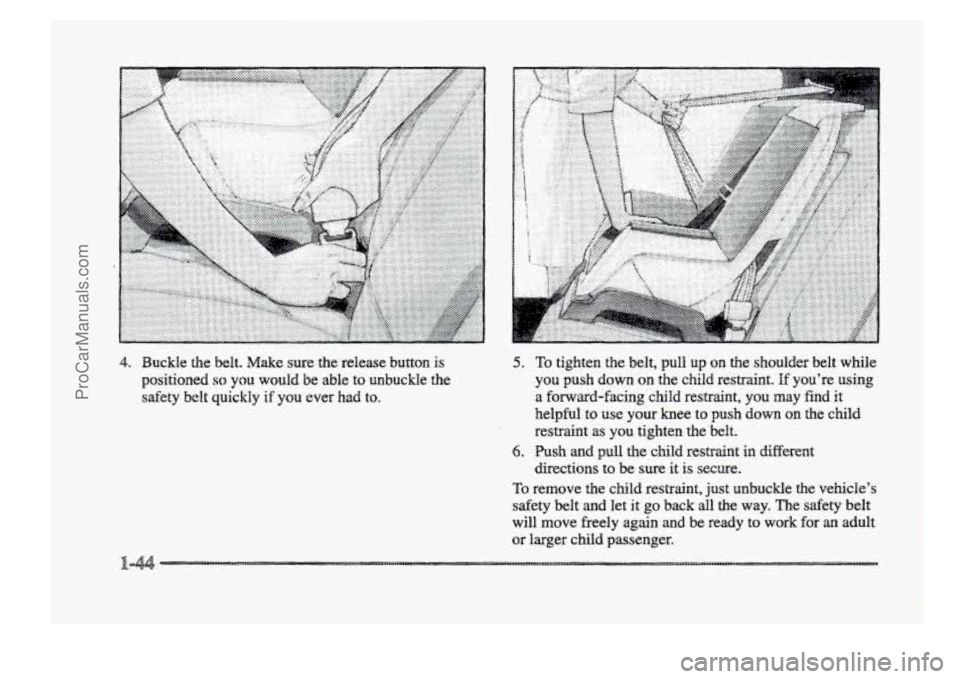
4. Buckle the belt. Make sure the release button is
positioned so you would be able to unbuckle the
safety
belt quickly if' you ever had to.
5.
6.
.......... . . , ., . , . ...........
To tighten the belt, pull up on the shoulder belt while
you push down on the child restraint. If you're using
a forward-facing child restraint, you may find it
helpful to use your knee
to push down on the child
restraint as
you tighten the belt.
Push and gull the child restraint in different
directions
to be sure it is secure.
To remove the child restraint, just unbuckle the vehicle's
safety belt
and let it go back dl the way. The safety belt
will move freely again and be ready to work for
m adult
or larger child passenger.
ProCarManuals.com
Page 57 of 426
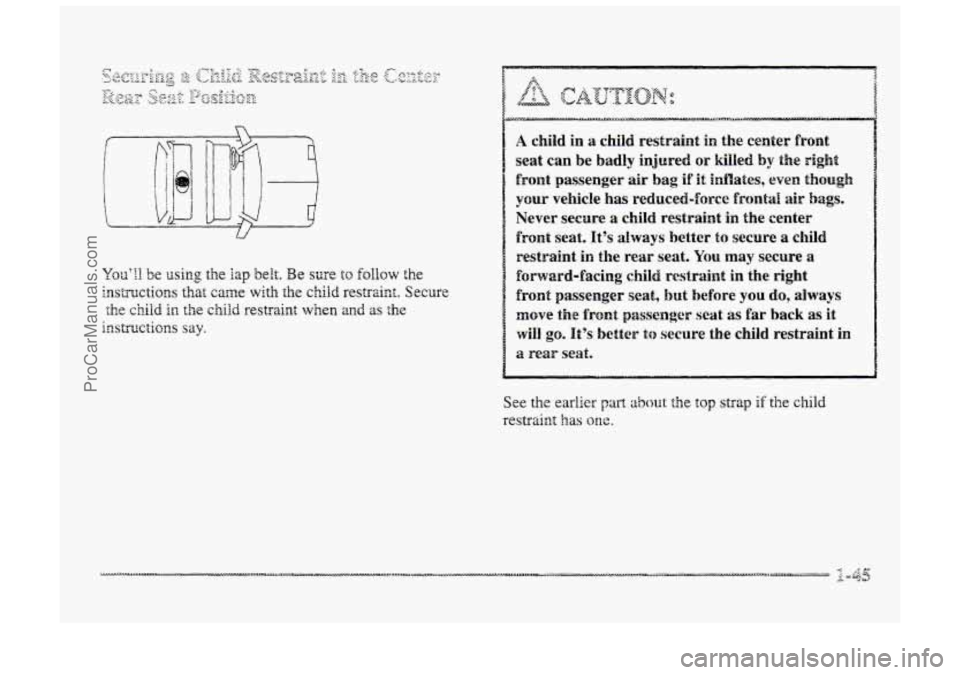
A child in a child. restraint in the center €ront
seat can be
badly injnred ~1 killed by the sight
front passenger air bag if it idates, even though
your vehicle has reduced-force frontal air bags.
Never secure
a child restraiamt in the center
front seat. It’s always better to secure a child
restraint
in the rear seat. You may secure a
forward-facing child restraint in the right
font passenger seat, but before you do, always
PPEQV~ the fr~nt passenger seat as far back as it
will gap. It’s better to secure the child restraint in
8 rear seat.
See the earlier part about the top strap if the child
restraint has one.
ProCarManuals.com
Page 59 of 426
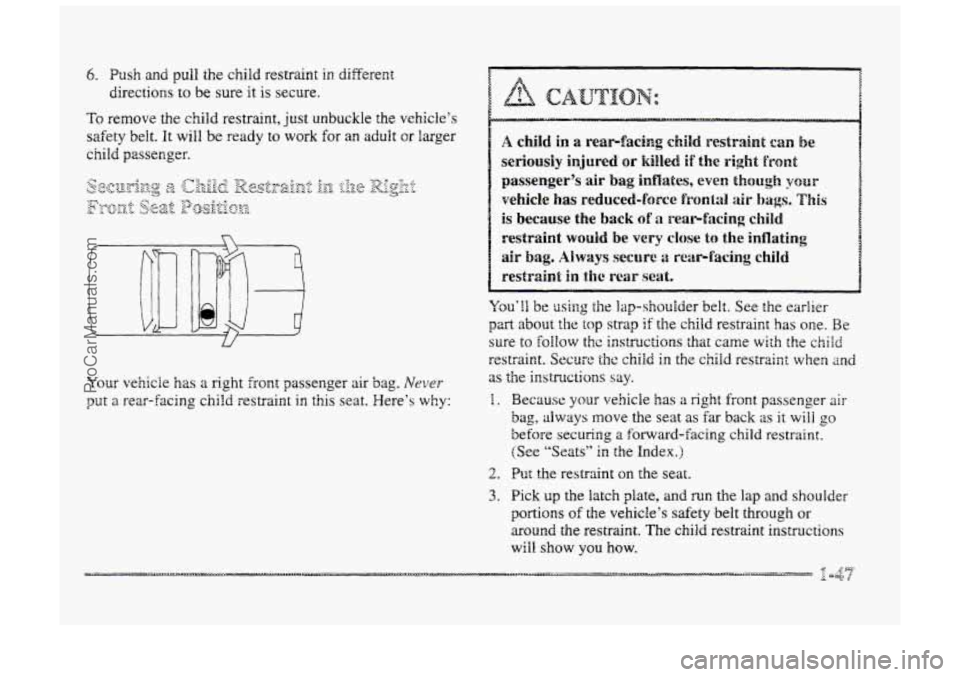
6. Push and pull the child restraint in differezt
directions
to be sure it is secure.
To remove the child restraint, just unbuckle the vehicle’s
sa€ety belt.
It will be ready to work for an adult cr larger
child passenger.
U
YQUT vehicle has a right front passenger air bag. Never
put a rear-facing child restraint in this seat. Here’s why:
You’ll be using the lap-shoulder belt. See the earlier
part aboemt the top strap if the chiid restraint has one. Be
sure to FokBow the instructions that came with the child
restraint. Secure the child in the child restraint when and
as the instructions say.
1. Because your vehicle has a right front passenger air
bag, always move the seat as far back as it wi6i go
before securing a forward-facing child restraint.
(See “Seats” in the Index.)
2. Put the restraint on the seat.
3. Pick up the latch plate, and run the lap and shoulder
portions of the vehicle’s safety belt through or
around the restraint. The child restraint instructions
will show
you how.
- .. L - 7 &fcT
ProCarManuals.com
Page 61 of 426
r
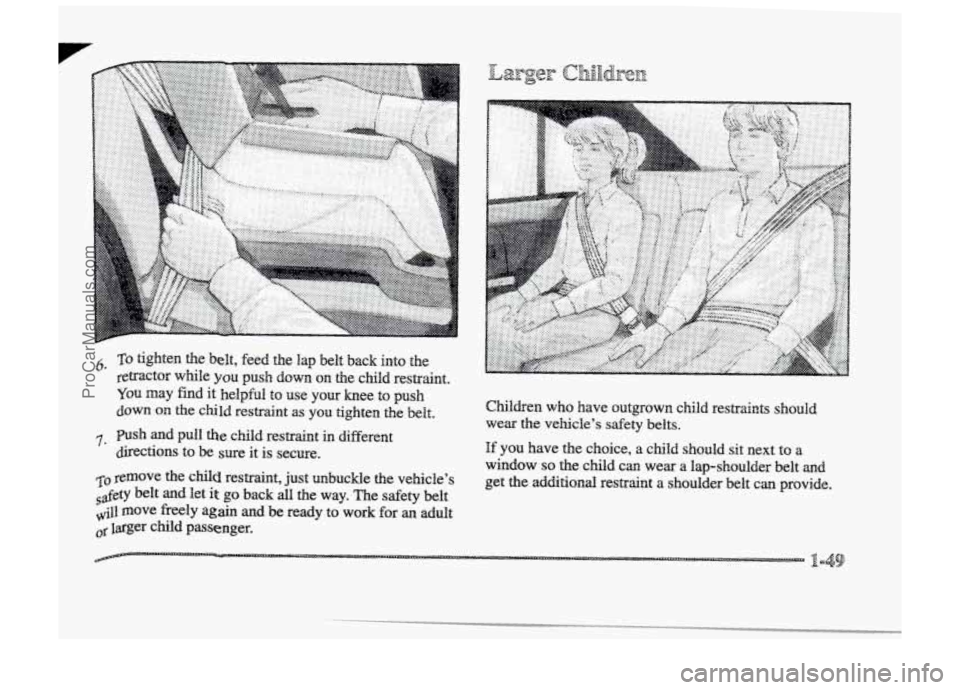
6. TQ tighten the belt, feed the lap belt back into the
retractor while you push
down on the child restraint.
~QU may find it helpful to use pur knee to push
down on the child restraint as you tighten the belt.
If you have the choice, a child should sit next to a
window
so the child can wear a lap-shoulder belt and
get the additional restraint a shoulder belt can provide.
7 Bush and pull the child restraint in different
$0 emove the child restraint, just unbuckle the vehicle’s
directions to be sure it is secure.
belt and let
it go back all the way. The safety belt
Nil1 move freely again and be ready to work for an adult
larger child passenger.
ProCarManuals.com