change wheel BUICK PARK AVENUE 1998 Owners Manual
[x] Cancel search | Manufacturer: BUICK, Model Year: 1998, Model line: PARK AVENUE, Model: BUICK PARK AVENUE 1998Pages: 426, PDF Size: 23.59 MB
Page 100 of 426
The switch for the driver’s window has an express-down
feature. Pull the switch back all the way, release it and
the window will lower automatically.
To stop the
window from lowering, pull the switch again. To
partially open the window, pull the switch back half
way. When the switch is released, the window will stop
moving.
To raise the window, press and hold the
switch
forward.
Press the window lock switch on the driver’s armrest to
disable dl passenger window switches,
or just the rear
passenger switches.
The middle of the switch will light
to indicate thc window lockout is active.
The diver’s window corat.rds will slill be operable. This is
a useful fwture when you have children as passengers.
Press the windcw lock switch a second time to ailow
passengers to use their window controls again. The light
in the center of the switch will go off to indicate that the
feature is disabled.
Vehicles are delivered programed
to Bock out all
passenger windows. If you have the optional DK, you
can choose
to lock out only the rea- windows. See
“Personal Choice Features” or “Driver Information
Center’’ in the Index for programming instructions.
If
you do not have the DIC feature, see your dealer if YOU
choose to have this setting changed to lock out only the
rear windows.
Nearly the entire surface
of the center pad of the
steering wheel is an active horn switch. Press anywhere
on the pad to sound the horn.
ProCarManuals.com
Page 101 of 426
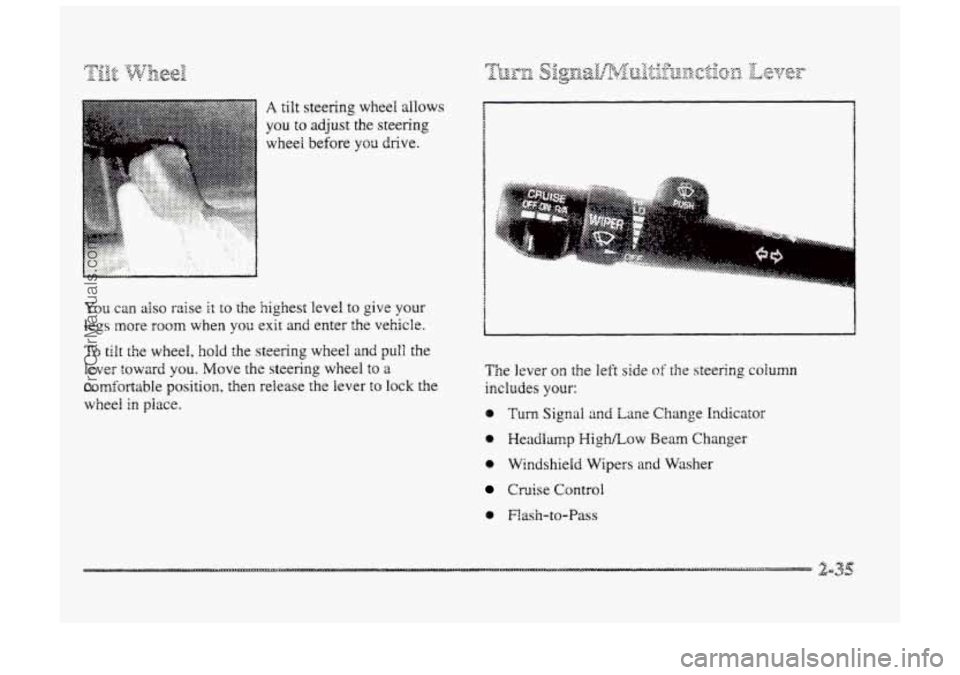
A tilt steering wheel allows
you to adjust the steering
wheel before
you drive.
You can also raise it to the highest level to give your
legs more room when you exit and enter the vehicle.
To tilt the wheel, hold the steering wheel and pull the
lever
toward you. Move the steering wheel to a
comfortable position, then release the Iever to lock the
wheel
in piace.
a
. . . . . . . . . . . . .,.>:<<.:
The lever on the left side of the steering column
includes YOGI-:
e Turn Signal and Lane Change Indicator
Headlamp PIighLow Beam Changer
0 Windshield Wipers and Washer
Cruise Control
Flash-to-Pass
ProCarManuals.com
Page 211 of 426
Remember: Anti-lock doesn’t change the the you need
to get your foot up to the br&e pedal or always decrease
stopping distance. If you get too dose to the vehicle in
front of you, you won’t have time to apply your brakes
If that vehicle suddenly slows or stcps. Always leave
enough
room up ahead tu stop, even though yorr have
anti-lock brakes.
Don’t pump the brakes. Just hold the brake pedal down
5mly and let anti-lock work for you. You may feel a
slight brake pedal gulsation or notice some noise, but
this is normal.
?F? 5-~~l:”~p.Tp LC :~?$<:4:?~$ ,y...,iq:py; (TF &&@$B&) r ,y a% *.-blL& . ,%*i ...,‘. --’3 li Y z .i I A -2.
YQW vehicle may have a traction control system thzat
limits wheel spin. This is especially useful in slippery
road conditions. The system operates only if it senses
that one
or both of the front wheels are spinning or
beginning to lose traction. When this happens, the
system works the front brakes and reduces engine power
to limit wheel spin.
You may feel or hear the system working, but this
is nomal.
__ . ... a
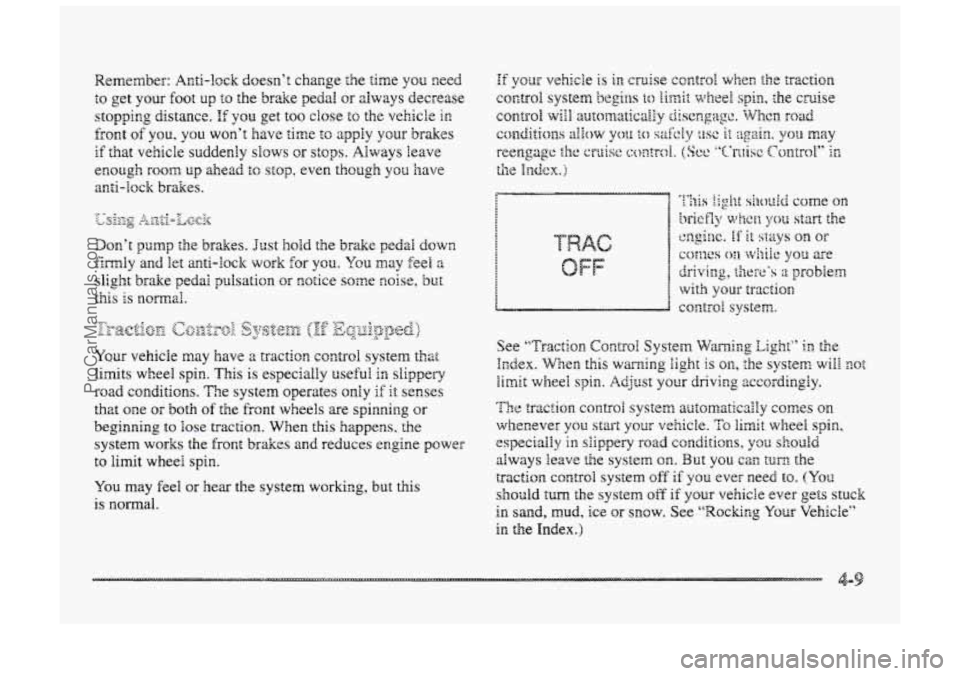
See ‘‘T~-acti~m Contra1 System Warning Eight” ii: the
Irzdex. WEen this warning light is on, the system will mt
limit wheel spin. Adjust your driving zccsrdingly.
The traction COII~FO~ system arr;2smaticaily comes on
whenever you start your vehicle. To limit wheel spin,
especially in siippery road conditio~s, y3u shouEd
always leave the system on. But you can turn- the
traction control system off‘ if you ever need to. (YQQ
should turn the system off if pur vehicBe ever gets stuck
in sand, mud, ice or snow. See “Rockr~g Your Vehicle”
in the Index.)
ProCarManuals.com
Page 213 of 426
It‘s important to take curves at ;r reasonable speed.
A lot of the “driver lost control” accidents mentioned on
the news happen on curves. Here’s why:
Experienced driver or beginner, each of us is subject to
the same laws of physics when driving on curves. The
traction of the tires agzjinst the roaC surface makes it
possible fcr the vehicle to change its path when you turn
the front wheels. If there’s no traction, inertia wiHl keep
the vehicle going in
the same direction. If you‘ve ever
tried
to steer a vehicle on wet ice, YQK‘IB understacd this.
The
trzctionr YOU can get in a curve depends on the
condition of your tires md the road surface, the angle at
which Gie curve
is banked, and your speed. Mile you’re
in ip curve, speed is the one fxtor you can control.
Suppose ycu’re steering through a sharp curve.
Then you suddenly accelerate. Both control
ProCarManuals.com
Page 261 of 426
0:. .. . .
If 8 Goes FE&
It’s unusual for a tire to “blow out” while you’re driving,
especially
if you maintain your tires properly. If air goes
i...
...
out of a &e, it’s much moie likely to leak out slowly.
But if you should ever have a “blowout,” here are
a few
tips about what to expect
and what to do: 1 ‘i
< 1 If a front tire fails, the flat tire will create a drag that
’, !! pulls the vehicle toward that side. Take YOLK foot off the g accelerator pedal and grip the steering wheel firmly.
P Steer to maintain lane position, and then gently brake to
-4 ,i a stop well out of the traffic lane.
.2? .
skid and may require the same correction you’d use in a
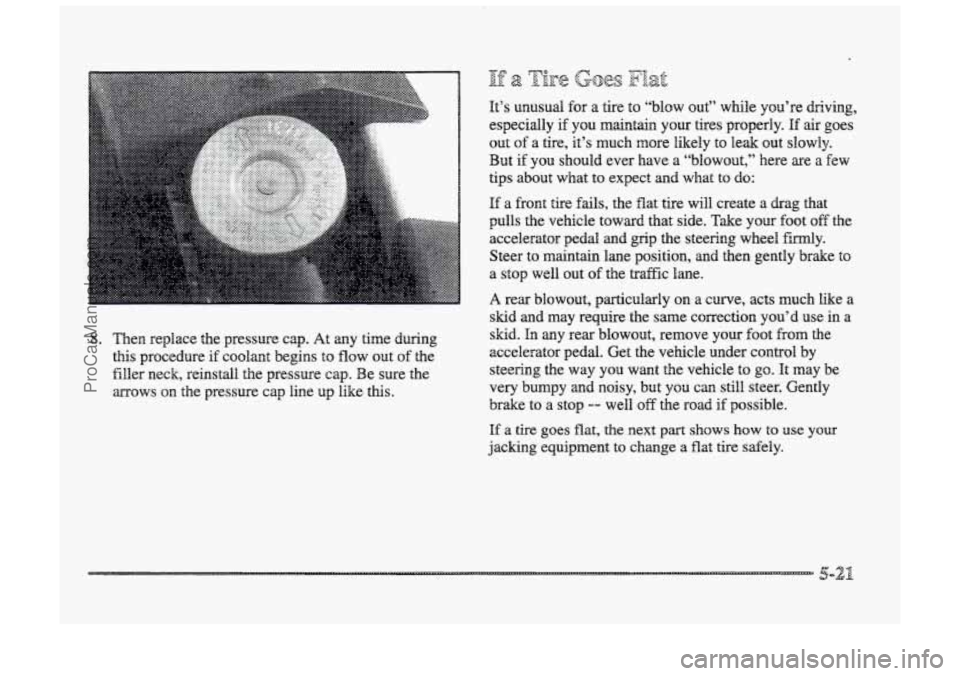
8. Then replace the pressure cap. At any time during
this procedure if
CQQ~EUI~ begins to flow out of the
filler neck, reinstall the pressure cap. Be sure the
mows
on the pressure cap line up like this.
s~. h any kearblowout, remove your foot kom the
accelerator pedal. Get the vehicle under control by
steering the
way you want the vehicle to go. It may be
very bumpy and noisy, but you can still steer. Gently
brake to
a stop -- well off the road if possible.
If a tire goes flat, the next part shows how to use your
jacking equipment to change a flat
tire safely.
ProCarManuals.com
Page 267 of 426
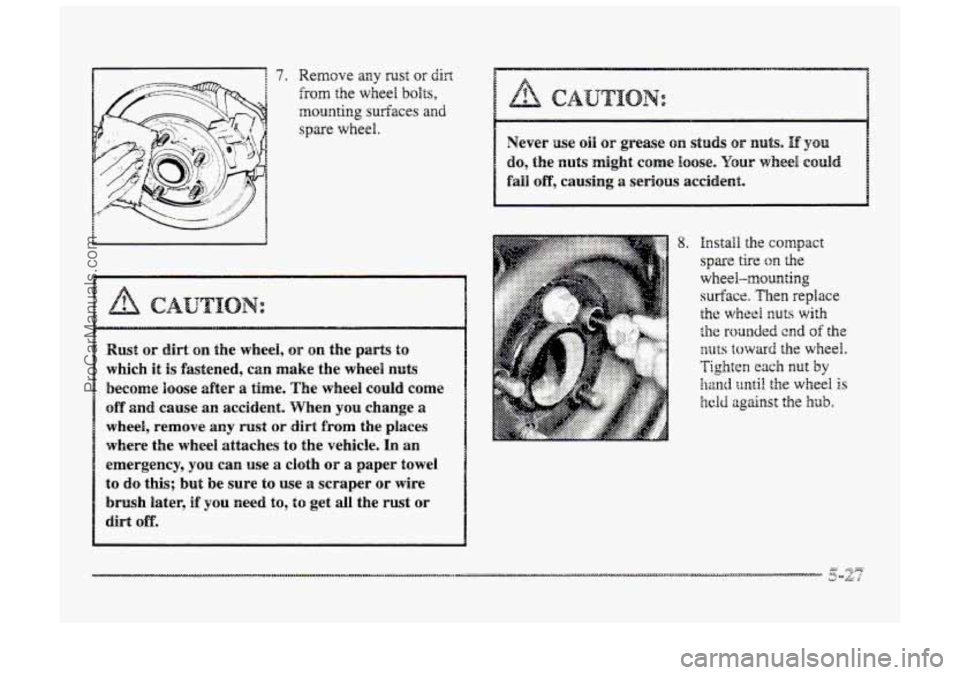
7. Remove my rust or Girt
from the wheel bolts,
aoundng surfaces and
spare wheel.
CAUTION:
Rust or dirt on the wheel, OB" on the parts to
which it is fastened, can make the wheel nuts
become Boose dter a time. The wheel could come
off and cause an accident. When YOU change a
wheel, remove any rust or dirt from the places
where the wheel attaches to the vehicle. In an
emergency, you can use a cloth or a paper dowel
to
do this; but be sure to use a scraper or wire
brush later, if you need to, to get all the rust or
dirt
off.
Never use oil or grease on studs OF nubs. If yon
do, the nuts might come EOQS~. YQUF wheeI could
fajI off, causing a serious accident.
ProCarManuals.com
Page 306 of 426
Some driving conditions or climates may cause a brake
squeal when the brakes are first applied or lightly
applied. This does not mean something is wrong with
your brakes.
Properiy
torqued whee! nuts irre necessary to heIp
prevent
brake pulsation. When tires are rotated, inspect
brake
pacts for wear and evenly torque wheel nuts in the
proper sequence to GM specifications.
Brake linings should always be replaced 2s complete
axle seis.
See "Brake System Inspectioc" in Section 7 of this
nanuai under Part C "Periodic Maintecance
Inspections."
Every time
you apply the brakes, with or wiFhcut the
vehicle moving, your brakes adjust for wear.
Tie braking system a modem vehicle is complex.
Its many parts have to be of top quality and work weII
together if the vehicle is io lxwe reakly good braking.
Your vehicle \vas designed and tested with top-quality
GM brake puts. When you replace parts of your braking
system
-- for example, when your brake kings wear
down and you have to Rave new ones put irn -- be sure
you get new approved GM replacement parts. If YOQ
don't, your brakes may no ionger work properly. For
example,
if someone puts in brake linings that are wrong
for your vehicle, the balance between your front and
rex brzkes can change -- for the worse. The braking
performance
you've come to expect cm change in many
other ways if someone ~dts in the wrong replacement
brake
parts.
Every new Buick has an ACIMCQ ~reedcm~ battery.
You never have to add water to one of these. Wen it's
time for a new battery, we recommend m ACDelco
Freedom battery. Get one
that has the replacement
mrnber shown cn the original battery's label.
ProCarManuals.com
Page 346 of 426
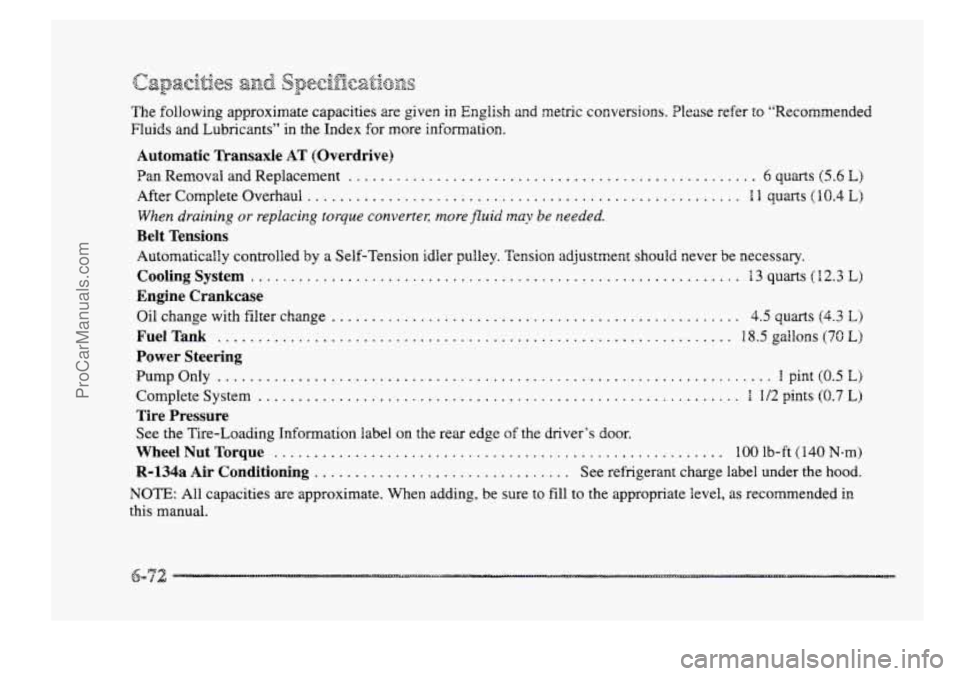
The following approximate capacities are given in English and metric conversions. Please refer to “Recommended
Fluids and Lubricants” in the Index for more information.
Automatic Transaxle AT (Overdrive)
Pan Removal and Replacement ................................................... 6 quarts (5.6 L)
After Complete Overhaul ...................................................... 1 I quarts (10.4 E)
When draining or replacing torque convertep; nzore fluid may be needed.
Belt Tensions
Automatically controlled by a Self-Tension idler pulley. Tension adjustment should never be necessary.
Cooling System ............................................................. 13 quarts (12.3 k)
Engine Crankcase
Oil change with filter change ................................................... 4.5 quarts (4.3 L)
Power Steering
Complete System ............................................................ 1 1/2 pints (0.7 L)
Tire Pressure
See the Tire-Loading Information label on the rear edge of the driver’s door.
WheelNutTorque ........................................................ 1001b-ft(140N-m)
R-134a Air Conditioning ................................ See refrigerant charge label under the hood.
FuelTank ................................................................ 18SgaIlons(70L)
PumpOnly ..................................................................... 1pint(OSE)
NOTE: All capacities are approximate. When adding, be sure to fill to the appropriate level, as recommended in
this manual.
ProCarManuals.com
Page 404 of 426

Brake Adjustment
.................................. 6-32
Fluid
....................................... 6-29
Master Cylinder
.............................. 6-29
Parking
..................................... 2- 27
PedalTravel
................................. 6-32
Replacing System Parts
........................ 6-32
System Warning Light
......................... 2-77
Transaxle Shift Interlock
....................... 2-3 1
Transaxle Shift Interlock Check .................. 7-33
Wear
....................................... 6-31
Trailer
...................................... 4-36
Brakes,
Anti-Lock ............................... 4-7
Brahng ........................................ 4-6
Braking in Emergencies
.......................... 4-10
Break-In,
New Vehicle .......................... 2-20
BTSI ......................................... 2- 31
BTSI Check
................................... 7-33
Bulb Replacement
.............................. 6-33
Canadian Roadside Assistance
.................... 8-5
Capacities and Specifications ...................... 6-72
Carbon Monoxide
............... 2- 15,2-32,4-29.4-35
Cassette Deck Service
........................... 7-3 1
Cassette Tape Player ....................... 3- 10. 3. 14
Care
....................................... 3-35
Errors ................................. 3.12. 3.16
CD Changer. Trunk Mounted
...................... 3-27
Cellular Phone Readiness Package
................. 2-64
Center Passenger Position
........................ 1-27
Central
Door Unlocking System .................... 2-5
Certification Label
.............................. 4-3 1
Chains. Safety ................................. 4-35
Chains. Tire
................................... 6-54
Change Engine Oil Soon ......................... 6-16
Changing a Flat Tire
............................. 5-22
Check Engine Light
............................. 2-79
Check Tire Pressure System
....................... 6-47
Checking Your Restraint Systems
.................. 1-52
Chemical Paint Spotting
.......................... 6-61
Child Restraints
................................ 1-37
Securing
in a Rear Outside Seat Position ........... 1-43
Securing in the Center Rear Seat Position
.......... 1-45
Securing in the Right Front Seat Position
.......... 1-47
TopStrap
................................... 1-42
Where to Put
................................ 1-41
Chrome Wheels. Cleaning
........................ 6-60
Cigarette Lighter
............................... 2-63
Circuit Breakers
and Fuses ....................... 6-65
Cleaner.
Air ................................... 6-17
Cleaning Aluminum or Chrome Wheels
................... 6-60
Exterior LampsLenses
........................ 6-59
Fabric
...................................... 6-56
Glass
....................................... 6-58
Inside of Your Vehicle ......................... 6-55
InstrumentPanel
............................. 6-57
Leather
..................................... 6-57
Outside
of Your Vehicle ........................ 6-59
Speaker Covers
.............................. 6-57
Special Problems
............................. 6-56
Stains
...................................... 6-56
Tires
....................................... 6-60
Vinyl
....................................... 6-57
Wheels
..................................... 6-60
Windshield and Wiper Blades
................... 6-58
ProCarManuals.com
Page 413 of 426
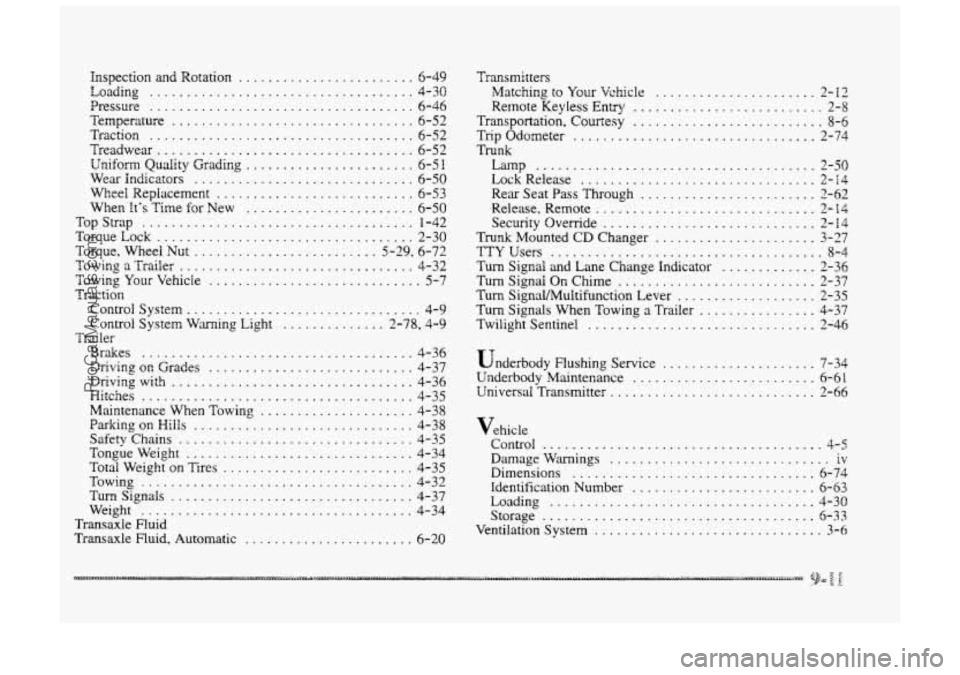
Inspection and Rotation ........................ 6-49
Pressure .................................... 6-46
Temperature
................................. 6-52
Traction
.................................... 6-52
Treadwear
................................... 6-52
Uniform
Qudity Grading ....................... 6-5 I
Wear indicators .............................. 6-50
Wheel Replacement
........................... 6-53
When
It’s Time for New ....................... 6-50
TorqueLock
................................... 2-30
Torque. Wheel Nut ......................... 5.29. 6.72
Towing
a Trailer ................................ 4-32
Towing
Your Vehicle ............................. 5-7
Traction
Loading .................................... 4-30
TQpSiXlp ..................................... 1-42
Control
CORtI’Ol
Trailer
Brakes
Driving
Driving
Hitches System
................................ 4-9
System Warning
Light .............. 2.78. 4.9
..................................... 4-36
onGrades
............................ 4-37
with
................................. 4-36
..................................... 4-35
Maintenance When Towing
..................... 4-38
Parking
on Hiik .............................. 4-38
Safety Chains
................................ 4-35
Tongueweight
............................... 4-34
Total Weight on
Tires .......................... 4-35
Towing
..................................... 4-32
Turnsignals
................................. 4-37
Weight
..................................... 4-34
Transaxle
Fluid
Transaxle Fluid. Automatic ....................... 6-20
Transmitters
Matching
to Your VcEricle ......................
Trunk
Lan~p ...................................... 2-50
LockRelease ................................ 2-24
Rear Seat Pass Through ........................ 2-62
Release. Remote .............................. 2-14
Security Override ............................. 2-14
TrunkMountedCD Changer
...................... 3-27
TTYUsers ..................................... 8-4
Turn Signal and Lane Change Indicator ............. 2-36
Turn Signal On Chime ........................... 2-37
Turn Signalhlultifunction Lever ................... 2-35
Turn Signals When Towing a Trailer ................ 4-37
Twilight Sentinel ............................... 2-46
Underbody Hushing Service
..................... 7-34
Underbody Maintenance ......................... 6-61
Universal Transmitter ............................ 2-66
Vehicle
Control ...................................... 4-5
Damage Warnings .............................. iv
Dimensions ................................. 6-74
Identification Number ......................... 6-63
Loading .................................... 4-30
Storage ..................................... 6-33
Ventilation System ............................... 3-6
ProCarManuals.com