fuel BUICK PARK AVENUE 2003 Owner's Guide
[x] Cancel search | Manufacturer: BUICK, Model Year: 2003, Model line: PARK AVENUE, Model: BUICK PARK AVENUE 2003Pages: 372, PDF Size: 2.8 MB
Page 304 of 372
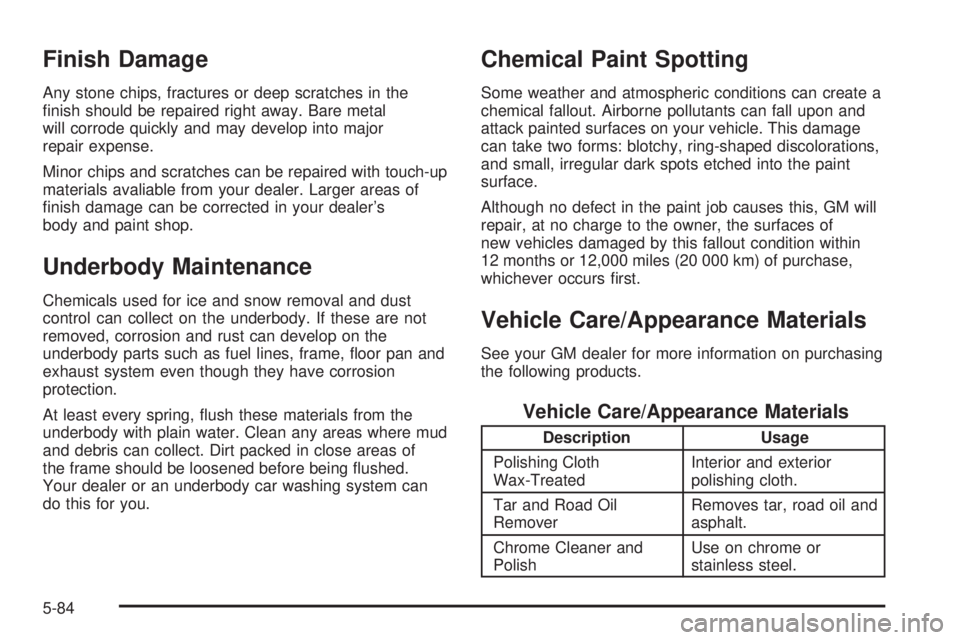
Finish Damage
Any stone chips, fractures or deep scratches in the
®nish should be repaired right away. Bare metal
will corrode quickly and may develop into major
repair expense.
Minor chips and scratches can be repaired with touch-up
materials avaliable from your dealer. Larger areas of
®nish damage can be corrected in your dealer's
body and paint shop.
Underbody Maintenance
Chemicals used for ice and snow removal and dust
control can collect on the underbody. If these are not
removed, corrosion and rust can develop on the
underbody parts such as fuel lines, frame, ¯oor pan and
exhaust system even though they have corrosion
protection.
At least every spring, ¯ush these materials from the
underbody with plain water. Clean any areas where mud
and debris can collect. Dirt packed in close areas of
the frame should be loosened before being ¯ushed.
Your dealer or an underbody car washing system can
do this for you.
Chemical Paint Spotting
Some weather and atmospheric conditions can create a
chemical fallout. Airborne pollutants can fall upon and
attack painted surfaces on your vehicle. This damage
can take two forms: blotchy, ring-shaped discolorations,
and small, irregular dark spots etched into the paint
surface.
Although no defect in the paint job causes this, GM will
repair, at no charge to the owner, the surfaces of
new vehicles damaged by this fallout condition within
12 months or 12,000 miles (20 000 km) of purchase,
whichever occurs ®rst.
Vehicle Care/Appearance Materials
See your GM dealer for more information on purchasing
the following products.
Vehicle Care/Appearance Materials
Description Usage
Polishing Cloth
Wax-TreatedInterior and exterior
polishing cloth.
Tar and Road Oil
RemoverRemoves tar, road oil and
asphalt.
Chrome Cleaner and
PolishUse on chrome or
stainless steel.
5-84
Page 311 of 372
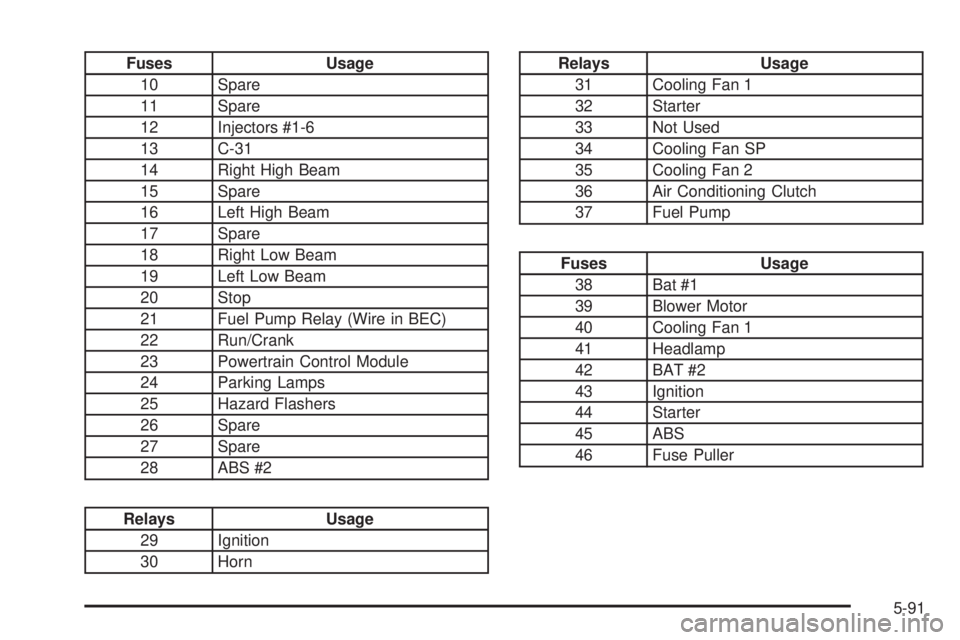
Fuses Usage
10 Spare
11 Spare
12 Injectors #1-6
13 C-31
14 Right High Beam
15 Spare
16 Left High Beam
17 Spare
18 Right Low Beam
19 Left Low Beam
20 Stop
21 Fuel Pump Relay (Wire in BEC)
22 Run/Crank
23 Powertrain Control Module
24 Parking Lamps
25 Hazard Flashers
26 Spare
27 Spare
28 ABS #2
Relays Usage
29 Ignition
30 Horn
Relays Usage
31 Cooling Fan 1
32 Starter
33 Not Used
34 Cooling Fan SP
35 Cooling Fan 2
36 Air Conditioning Clutch
37 Fuel Pump
Fuses Usage
38 Bat #1
39 Blower Motor
40 Cooling Fan 1
41 Headlamp
42 BAT #2
43 Ignition
44 Starter
45 ABS
46 Fuse Puller
5-91
Page 316 of 372
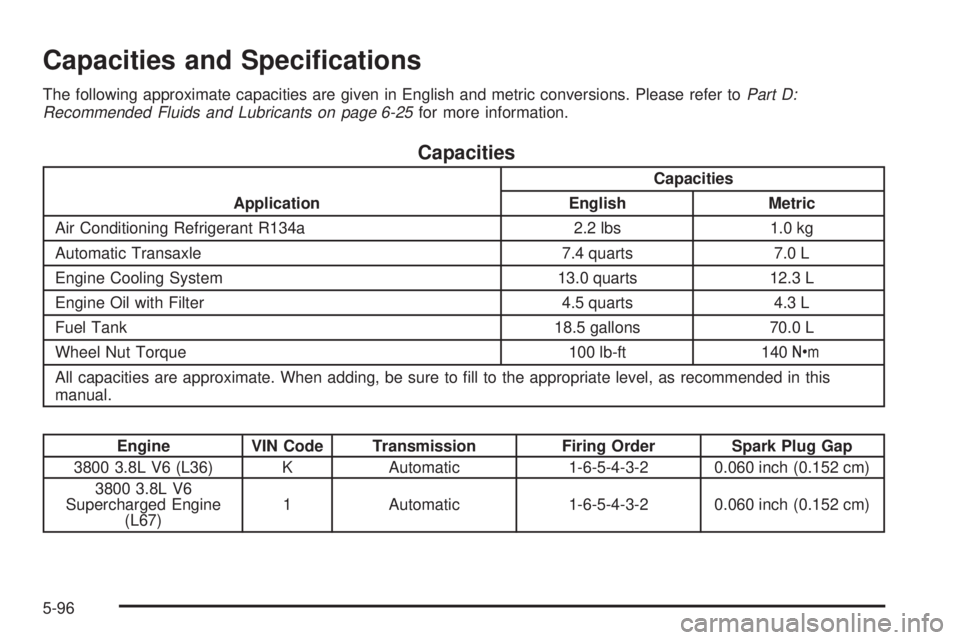
Capacities and Speci®cations
The following approximate capacities are given in English and metric conversions. Please refer toPart D:
Recommended Fluids and Lubricants on page 6-25for more information.
Capacities
ApplicationCapacities
English Metric
Air Conditioning Refrigerant R134a 2.2 lbs 1.0 kg
Automatic Transaxle 7.4 quarts 7.0 L
Engine Cooling System 13.0 quarts 12.3 L
Engine Oil with Filter 4.5 quarts 4.3 L
Fuel Tank 18.5 gallons 70.0 L
Wheel Nut Torque 100 lb-ft 140Y
All capacities are approximate. When adding, be sure to ®ll to the appropriate level, as recommended in this
manual.
Engine VIN Code Transmission Firing Order Spark Plug Gap
3800 3.8L V6 (L36) K Automatic 1-6-5-4-3-2 0.060 inch (0.152 cm)
3800 3.8L V6
Supercharged Engine
(L67)1 Automatic 1-6-5-4-3-2 0.060 inch (0.152 cm)
5-96
Page 317 of 372
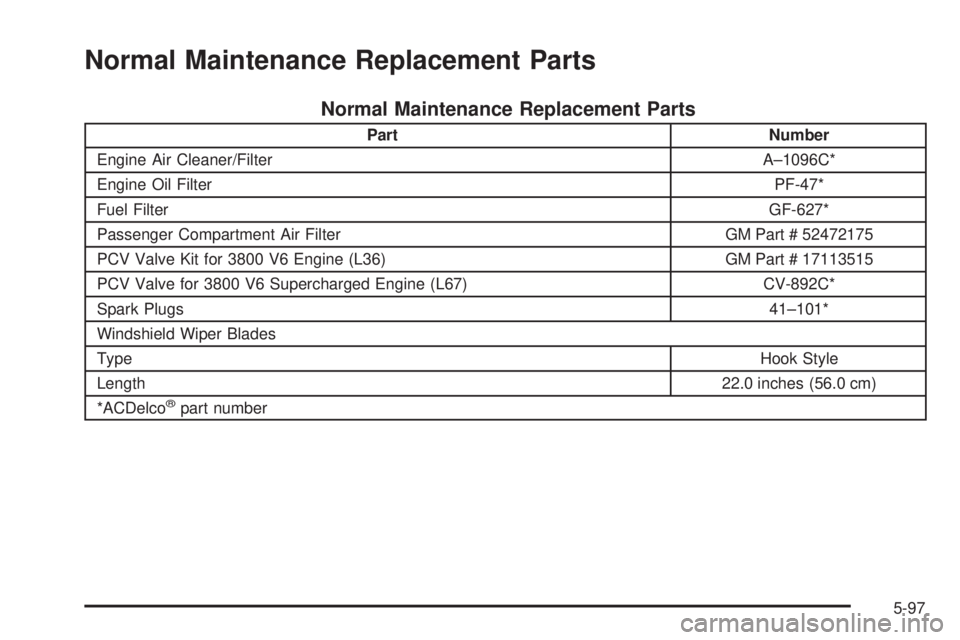
Normal Maintenance Replacement Parts
Normal Maintenance Replacement Parts
Part Number
Engine Air Cleaner/Filter A±1096C*
Engine Oil FilterPF-47*
Fuel FilterGF-627*
Passenger Compartment Air Filter GM Part # 52472175
PCV Valve Kit for 3800 V6 Engine (L36) GM Part # 17113515
PCV Valve for 3800 V6 Supercharged Engine (L67) CV-892C*
Spark Plugs41±101*
Windshield Wiper Blades
TypeHook Style
Length22.0 inches (56.0 cm)
*ACDelco
žpart number
5-97
Page 319 of 372
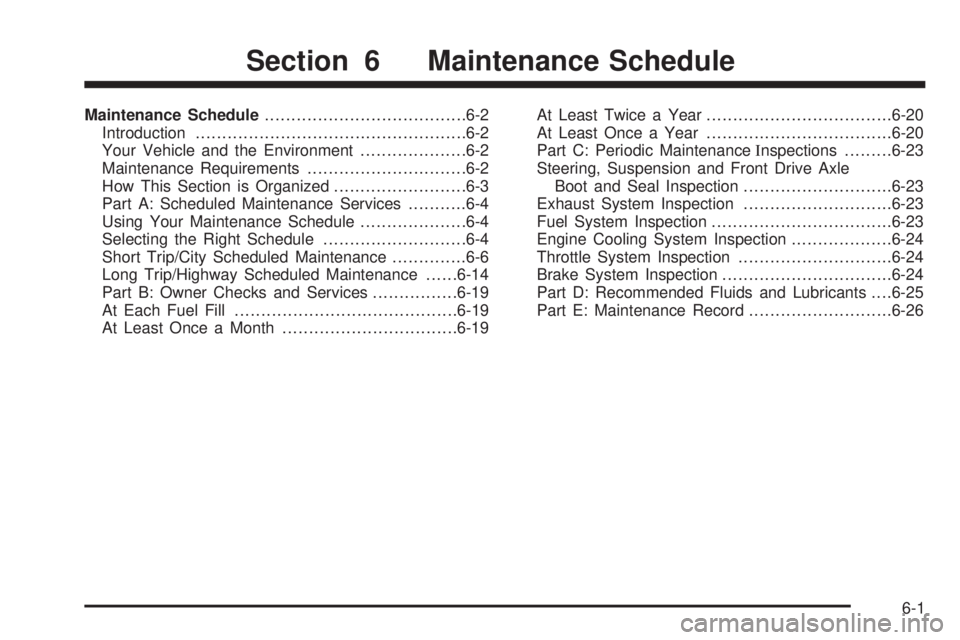
Maintenance Schedule......................................6-2
Introduction...................................................6-2
Your Vehicle and the Environment....................6-2
Maintenance Requirements..............................6-2
How This Section is Organized.........................6-3
Part A: Scheduled Maintenance Services...........6-4
Using Your Maintenance Schedule....................6-4
Selecting the Right Schedule...........................6-4
Short Trip/City Scheduled Maintenance..............6-6
Long Trip/Highway Scheduled Maintenance......6-14
Part B: Owner Checks and Services................6-19
At Each Fuel Fill..........................................6-19
At Least Once a Month.................................6-19At Least Twice a Year...................................6-20
At Least Once a Year...................................6-20
Part C: Periodic MaintenanceInspections.........6-23
Steering, Suspension and Front Drive Axle
Boot and Seal Inspection............................6-23
Exhaust System Inspection............................6-23
Fuel System Inspection..................................6-23
Engine Cooling System Inspection...................6-24
Throttle System Inspection.............................6-24
Brake System Inspection................................6-24
Part D: Recommended Fluids and Lubricants. . . .6-25
Part E: Maintenance Record...........................6-26
Section 6 Maintenance Schedule
6-1
Page 322 of 372
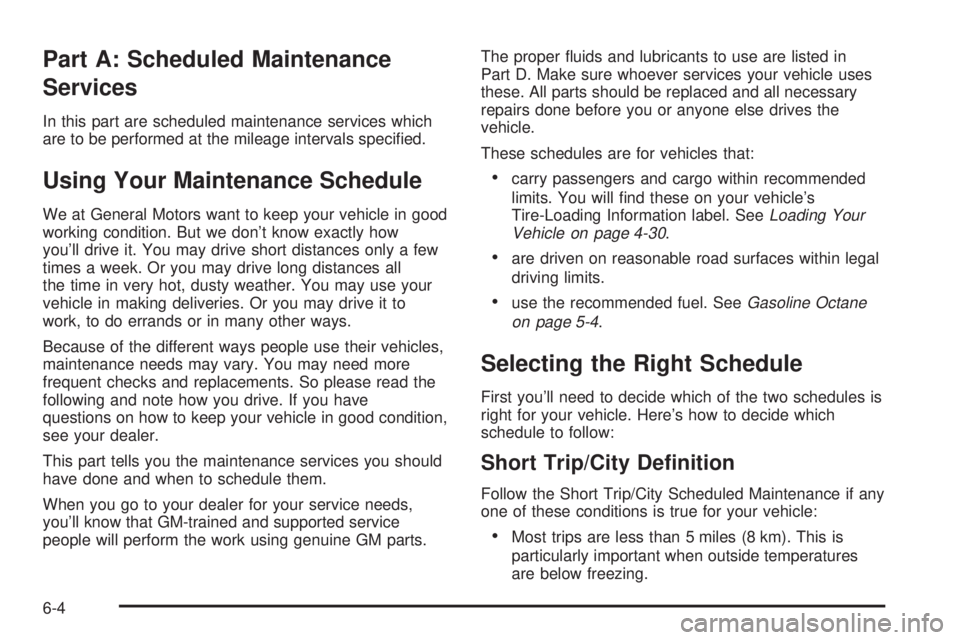
Part A: Scheduled Maintenance
Services
In this part are scheduled maintenance services which
are to be performed at the mileage intervals speci®ed.
Using Your Maintenance Schedule
We at General Motors want to keep your vehicle in good
working condition. But we don't know exactly how
you'll drive it. You may drive short distances only a few
times a week. Or you may drive long distances all
the time in very hot, dusty weather. You may use your
vehicle in making deliveries. Or you may drive it to
work, to do errands or in many other ways.
Because of the different ways people use their vehicles,
maintenance needs may vary. You may need more
frequent checks and replacements. So please read the
following and note how you drive. If you have
questions on how to keep your vehicle in good condition,
see your dealer.
This part tells you the maintenance services you should
have done and when to schedule them.
When you go to your dealer for your service needs,
you'll know that GM-trained and supported service
people will perform the work using genuine GM parts.The proper ¯uids and lubricants to use are listed in
Part D. Make sure whoever services your vehicle uses
these. All parts should be replaced and all necessary
repairs done before you or anyone else drives the
vehicle.
These schedules are for vehicles that:
·carry passengers and cargo within recommended
limits. You will ®nd these on your vehicle's
Tire-Loading Information label. See
Loading Your
Vehicle on page 4-30.
·are driven on reasonable road surfaces within legal
driving limits.
·use the recommended fuel. SeeGasoline Octane
on page 5-4
.
Selecting the Right Schedule
First you'll need to decide which of the two schedules is
right for your vehicle. Here's how to decide which
schedule to follow:
Short Trip/City De®nition
Follow the Short Trip/City Scheduled Maintenance if any
one of these conditions is true for your vehicle:
·Most trips are less than 5 miles (8 km). This is
particularly important when outside temperatures
are below freezing.
6-4
Page 325 of 372
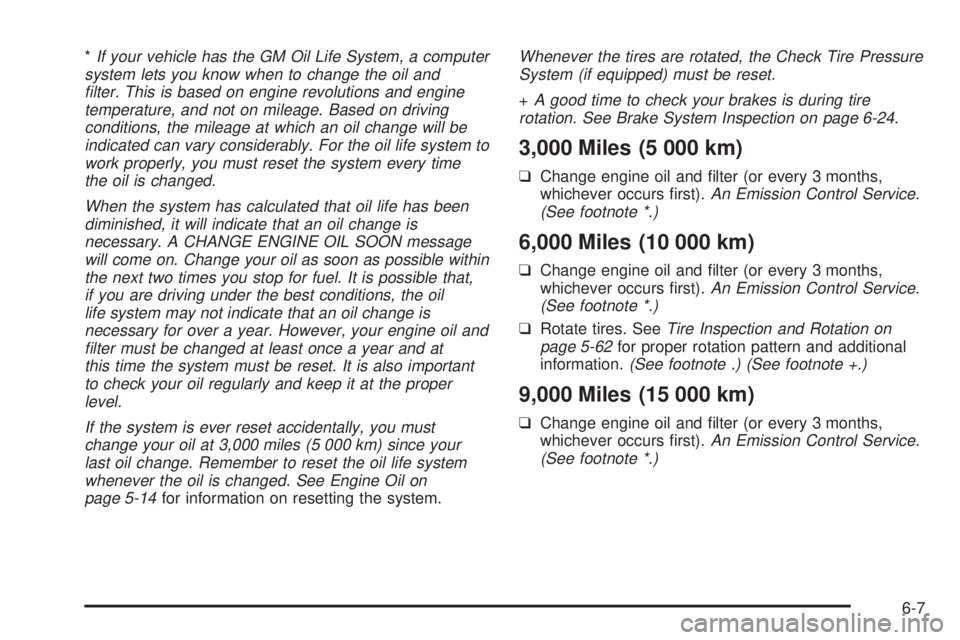
*If your vehicle has the GM Oil Life System, a computer
system lets you know when to change the oil and
®lter. This is based on engine revolutions and engine
temperature, and not on mileage. Based on driving
conditions, the mileage at which an oil change will be
indicated can vary considerably. For the oil life system to
work properly, you must reset the system every time
the oil is changed.
When the system has calculated that oil life has been
diminished, it will indicate that an oil change is
necessary. A CHANGE ENGINE OIL SOON message
will come on. Change your oil as soon as possible within
the next two times you stop for fuel. It is possible that,
if you are driving under the best conditions, the oil
life system may not indicate that an oil change is
necessary for over a year. However, your engine oil and
®lter must be changed at least once a year and at
this time the system must be reset. It is also important
to check your oil regularly and keep it at the proper
level.
If the system is ever reset accidentally, you must
change your oil at 3,000 miles (5 000 km) since your
last oil change. Remember to reset the oil life system
whenever the oil is changed. See Engine Oil on
page 5-14
for information on resetting the system.
Whenever the tires are rotated, the Check Tire Pressure
System (if equipped) must be reset.
+A good time to check your brakes is during tire
rotation. See Brake System Inspection on page 6-24.
3,000 Miles (5 000 km)
qChange engine oil and ®lter (or every 3 months,
whichever occurs ®rst).An Emission Control Service.
(See footnote *.)
6,000 Miles (10 000 km)
qChange engine oil and ®lter (or every 3 months,
whichever occurs ®rst).An Emission Control Service.
(See footnote *.)
qRotate tires. SeeTire Inspection and Rotation on
page 5-62for proper rotation pattern and additional
information.(See footnote .) (See footnote +.)
9,000 Miles (15 000 km)
qChange engine oil and ®lter (or every 3 months,
whichever occurs ®rst).An Emission Control Service.
(See footnote *.)
6-7
Page 332 of 372
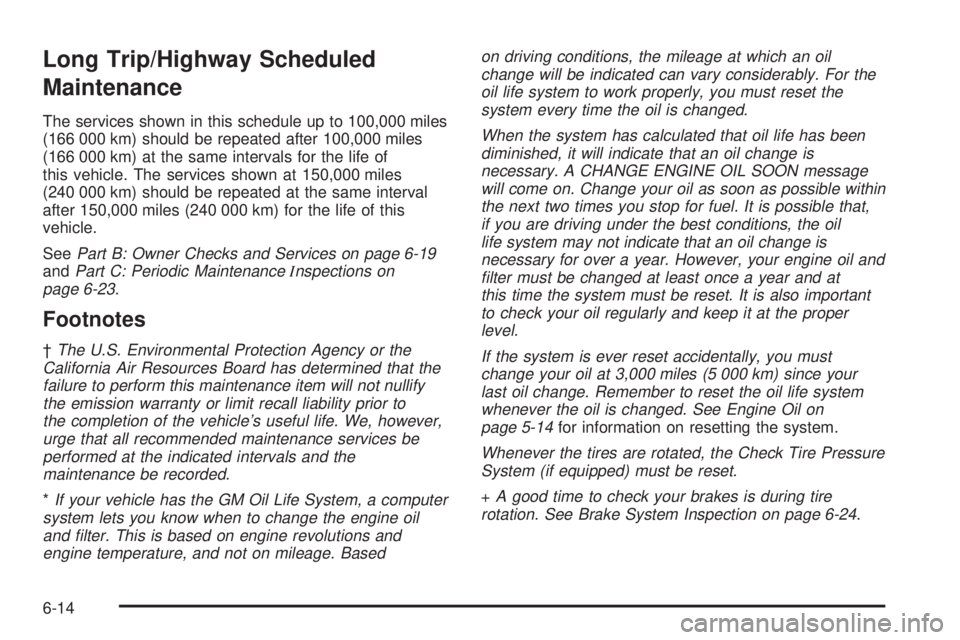
Long Trip/Highway Scheduled
Maintenance
The services shown in this schedule up to 100,000 miles
(166 000 km) should be repeated after 100,000 miles
(166 000 km) at the same intervals for the life of
this vehicle. The services shown at 150,000 miles
(240 000 km) should be repeated at the same interval
after 150,000 miles (240 000 km) for the life of this
vehicle.
See
Part B: Owner Checks and Services on page 6-19andPart C: Periodic MaintenanceInspections on
page 6-23.
Footnotes
²The U.S. Environmental Protection Agency or the
California Air Resources Board has determined that the
failure to perform this maintenance item will not nullify
the emission warranty or limit recall liability prior to
the completion of the vehicle's useful life. We, however,
urge that all recommended maintenance services be
performed at the indicated intervals and the
maintenance be recorded.
*If your vehicle has the GM Oil Life System, a computer
system lets you know when to change the engine oil
and ®lter. This is based on engine revolutions and
engine temperature, and not on mileage. Basedon driving conditions, the mileage at which an oil
change will be indicated can vary considerably. For the
oil life system to work properly, you must reset the
system every time the oil is changed.
When the system has calculated that oil life has been
diminished, it will indicate that an oil change is
necessary. A CHANGE ENGINE OIL SOON message
will come on. Change your oil as soon as possible within
the next two times you stop for fuel. It is possible that,
if you are driving under the best conditions, the oil
life system may not indicate that an oil change is
necessary for over a year. However, your engine oil and
®lter must be changed at least once a year and at
this time the system must be reset. It is also important
to check your oil regularly and keep it at the proper
level.
If the system is ever reset accidentally, you must
change your oil at 3,000 miles (5 000 km) since your
last oil change. Remember to reset the oil life system
whenever the oil is changed. See Engine Oil on
page 5-14
for information on resetting the system.
Whenever the tires are rotated, the Check Tire Pressure
System (if equipped) must be reset.
+A good time to check your brakes is during tire
rotation. See Brake System Inspection on page 6-24.
6-14
Page 337 of 372
Part B: Owner Checks and Services
Listed in this part are owner checks and services
which should be performed at the intervals speci®ed to
help ensure the safety, dependability and emission
control performance of your vehicle.
Be sure any necessary repairs are completed at once.
Whenever any ¯uids or lubricants are added to your
vehicle, make sure they are the proper ones, as shown
in Part D.
At Each Fuel Fill
It is important for you or a service station attendant to
perform these underhood checks at each fuel ®ll.
Engine Oil Level Check
Check the engine oil level and add the proper oil if
necessary. SeeEngine Oil on page 5-14for further
details.
Engine Coolant Level Check
Check the engine coolant level and add DEX-COOLž
coolant mixture if necessary. SeeEngine Coolant
on page 5-24for further details.
Windshield Washer Fluid Level Check
Check the windshield washer ¯uid level in the windshield
washer tank and add the proper ¯uid if necessary.
See
Windshield Washer Fluid on page 5-38for further
details.
At Least Once a Month
Tire In¯ation Check
Visually inspect your tires and make sure tires are
in¯ated to the correct pressures. Don't forget to check
your spare tire. See
Tires on page 5-59for further
details.
Cassette Tape Player Service
Clean cassette tape player. Cleaning should be done
every 50 hours of tape play. SeeAudio System(s)
on page 3-51for further details.
6-19
Page 341 of 372
Part C: Periodic
MaintenanceInspections
Listed in this part are inspections and services which
should be performed at least twice a year (for instance,
each spring and fall).
You should let your dealer's
service department do these jobs. Make sure any
necessary repairs are completed at once.
Proper procedures to perform these services may be
found in a service manual. SeeService Publications
Ordering Information on page 7-9.
Steering, Suspension and Front
Drive Axle Boot and Seal Inspection
Inspect the front and rear suspension and steering
system for damaged, loose or missing parts, signs of
wear or lack of lubrication. Inspect the power steering
lines and hoses for proper hook-up, binding, leaks,
cracks, cha®ng, etc. Clean and then inspect the drive
axle boot seals for damage, tears or leakage. Replace
seals if necessary.
Exhaust System Inspection
Inspect the complete exhaust system. Inspect the body
near the exhaust system. Look for broken, damaged,
missing or out-of-position parts as well as open seams,
holes, loose connections or other conditions which
could cause a heat build-up in the ¯oor pan or could let
exhaust fumes into the vehicle. See
Engine Exhaust
on page 2-31.
Fuel System Inspection
Inspect the complete fuel system for damage or leaks.
6-23