battery BUICK PARK AVENUE 2005 Owner's Guide
[x] Cancel search | Manufacturer: BUICK, Model Year: 2005, Model line: PARK AVENUE, Model: BUICK PARK AVENUE 2005Pages: 388, PDF Size: 2.55 MB
Page 245 of 388
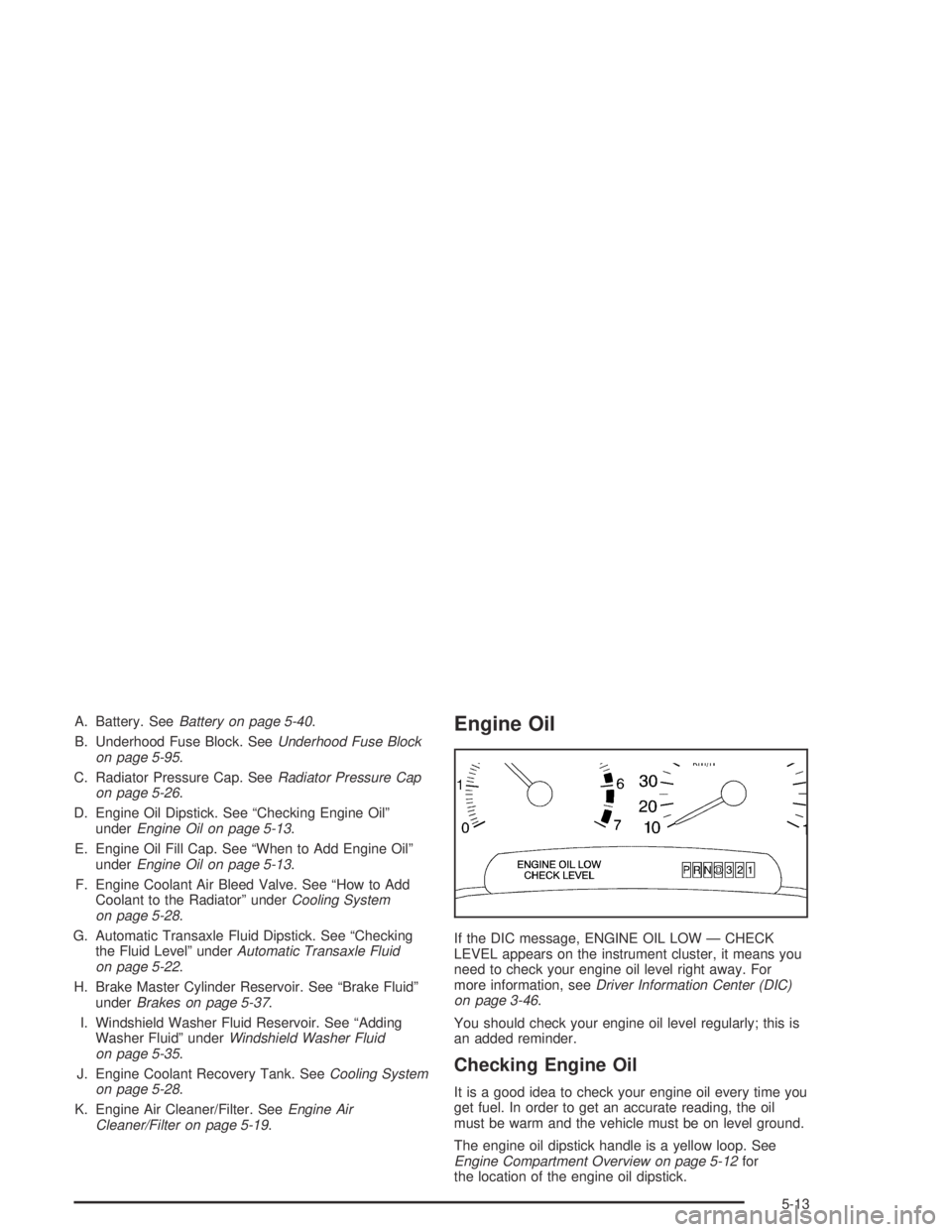
A. Battery. SeeBattery on page 5-40.
B. Underhood Fuse Block. SeeUnderhood Fuse Block
on page 5-95.
C. Radiator Pressure Cap. SeeRadiator Pressure Cap
on page 5-26.
D. Engine Oil Dipstick. See “Checking Engine Oil”
underEngine Oil on page 5-13.
E. Engine Oil Fill Cap. See “When to Add Engine Oil”
underEngine Oil on page 5-13.
F. Engine Coolant Air Bleed Valve. See “How to Add
Coolant to the Radiator” underCooling System
on page 5-28.
G. Automatic Transaxle Fluid Dipstick. See “Checking
the Fluid Level” underAutomatic Transaxle Fluid
on page 5-22.
H. Brake Master Cylinder Reservoir. See “Brake Fluid”
underBrakes on page 5-37.
I. Windshield Washer Fluid Reservoir. See “Adding
Washer Fluid” underWindshield Washer Fluid
on page 5-35.
J. Engine Coolant Recovery Tank. SeeCooling System
on page 5-28.
K. Engine Air Cleaner/Filter. SeeEngine Air
Cleaner/Filter on page 5-19.Engine Oil
If the DIC message, ENGINE OIL LOW — CHECK
LEVEL appears on the instrument cluster, it means you
need to check your engine oil level right away. For
more information, seeDriver Information Center (DIC)
on page 3-46.
You should check your engine oil level regularly; this is
an added reminder.
Checking Engine Oil
It is a good idea to check your engine oil every time you
get fuel. In order to get an accurate reading, the oil
must be warm and the vehicle must be on level ground.
The engine oil dipstick handle is a yellow loop. See
Engine Compartment Overview on page 5-12for
the location of the engine oil dipstick.
5-13
Page 272 of 388
Battery
Your vehicle has a maintenance free battery. When it is
time for a new battery, get one that has the replacement
number shown on the original battery’s label. We
recommend an ACDelco
®replacement battery. See
Engine Compartment Overview on page 5-12for
battery location.
Warning:Battery posts, terminals and related
accessories contain lead and lead compounds,
chemicals known to the State of California to
cause cancer and reproductive harm. Wash hands
after handling.
Vehicle Storage
If you are not going to drive your vehicle for 25 days
or more, remove the black, negative (−) cable from
the battery. This will help keep your battery from
running down.
{CAUTION:
Batteries have acid that can burn you and gas
that can explode. You can be badly hurt if you
are not careful. SeeJump Starting on
page 5-41for tips on working around a battery
without getting hurt.
Contact your dealer to learn how to prepare your
vehicle for longer storage periods.
Also, for your audio system, seeTheft-Deterrent
Feature on page 3-70.
5-40
Page 273 of 388
Jump Starting
If your battery has run down, you may want to use
another vehicle and some jumper cables to start your
vehicle. Be sure to use the following steps to do it safely.
{CAUTION:
Batteries can hurt you. They can be
dangerous because:
They contain acid that can burn you.
They contain gas that can explode
or ignite.
They contain enough electricity to
burn you.
If you do not follow these steps exactly, some
or all of these things can hurt you.Notice:Ignoring these steps could result in costly
damage to your vehicle that would not be covered
by your warranty.
Trying to start your vehicle by pushing or pulling it
will not work, and it could damage your vehicle.
1. Check the other vehicle. It must have a 12-volt
battery with a negative ground system.
Notice:If the other vehicle’s system is not a 12-volt
system with a negative ground, both vehicles can
be damaged. Only use vehicles with 12-volt systems
with negative grounds to jump start your vehicle.
2. Get the vehicles close enough so the jumper cables
can reach, but be sure the vehicles are not touching
each other. If they are, it could cause a ground
connection you do not want. You would not be able
to start your vehicle, and the bad grounding
could damage the electrical systems.
To avoid the possibility of the vehicles rolling, set
the parking brake rmly on both vehicles involved in
the jump start procedure. Put an automatic
transaxle in PARK (P) or a manual transaxle in
NEUTRAL (N) before setting the parking brake.
5-41
Page 274 of 388
Notice:If you leave your radio or other accessories
on during the jump starting procedure, they could
be damaged. The repairs would not be covered
by your warranty. Always turn off your radio and
other accessories when jump starting your vehicle.
3. Turn off the ignition on both vehicles. Unplug
unnecessary accessories plugged into the cigarette
lighter or the accessory power outlet(s). Turn off
the radio and all lamps that are not needed. This will
avoid sparks and help save both batteries. And it
could save the radio!
4. Open the hoods and locate the batteries. Find the
positive (+) and negative (–) terminal locations on
each vehicle. SeeEngine Compartment Overview
on page 5-12for more information on location.
{CAUTION:
An electric fan can start up even when the
engine is not running and can injure you. Keep
hands, clothing and tools away from any
underhood electric fan.
{CAUTION:
Using a match near a battery can cause battery
gas to explode. People have been hurt doing
this, and some have been blinded. Use a
ashlight if you need more light.
Be sure the battery has enough water. You do
not need to add water to the ACDelco
®battery
installed in your new vehicle. But if a battery
has ller caps, be sure the right amount of
uid is there. If it is low, add water to take care
of that rst. If you do not, explosive gas could
be present.
Battery uid contains acid that can burn you.
Do not get it on you. If you accidentally get it
in your eyes or on your skin, ush the place
with water and get medical help immediately.
5-42
Page 275 of 388
{CAUTION:
Fans or other moving engine parts can injure
you badly. Keep your hands away from moving
parts once the engine is running.
5. Check that the jumper cables do not have loose or
missing insulation. If they do, you could get a
shock. The vehicles could be damaged too.
Before you connect the cables, here are some
basic things you should know. Positive (+) will go to
positive (+) or to a remote positive (+) terminal if
the vehicle has one. Negative (−) will go to a heavy,
unpainted metal engine part or to a remote
negative (–) terminal if the vehicle has one.
Do not connect positive (+) to negative (−)oryou
will get a short that would damage the battery
and maybe other parts too. And do not connect the
negative (−) cable to the negative (−) terminal on
the dead battery because this can cause sparks.
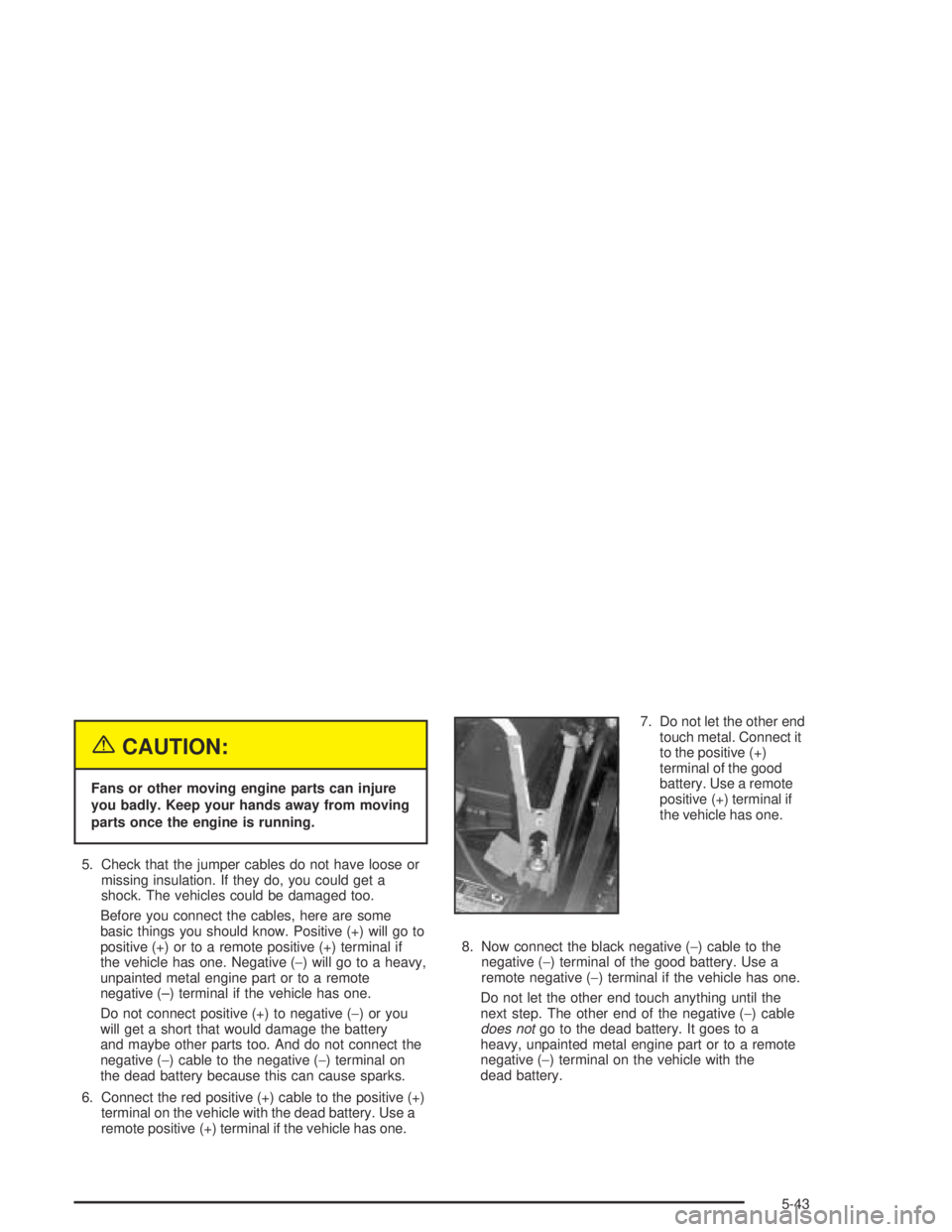
6. Connect the red positive (+) cable to the positive (+)
terminal on the vehicle with the dead battery. Use a
remote positive (+) terminal if the vehicle has one.7. Do not let the other end
touch metal. Connect it
to the positive (+)
terminal of the good
battery. Use a remote
positive (+) terminal if
the vehicle has one.
8. Now connect the black negative (−) cable to the
negative (−) terminal of the good battery. Use a
remote negative (−) terminal if the vehicle has one.
Do not let the other end touch anything until the
next step. The other end of the negative (−) cable
does notgo to the dead battery. It goes to a
heavy, unpainted metal engine part or to a remote
negative (−) terminal on the vehicle with the
dead battery.
5-43
Page 276 of 388
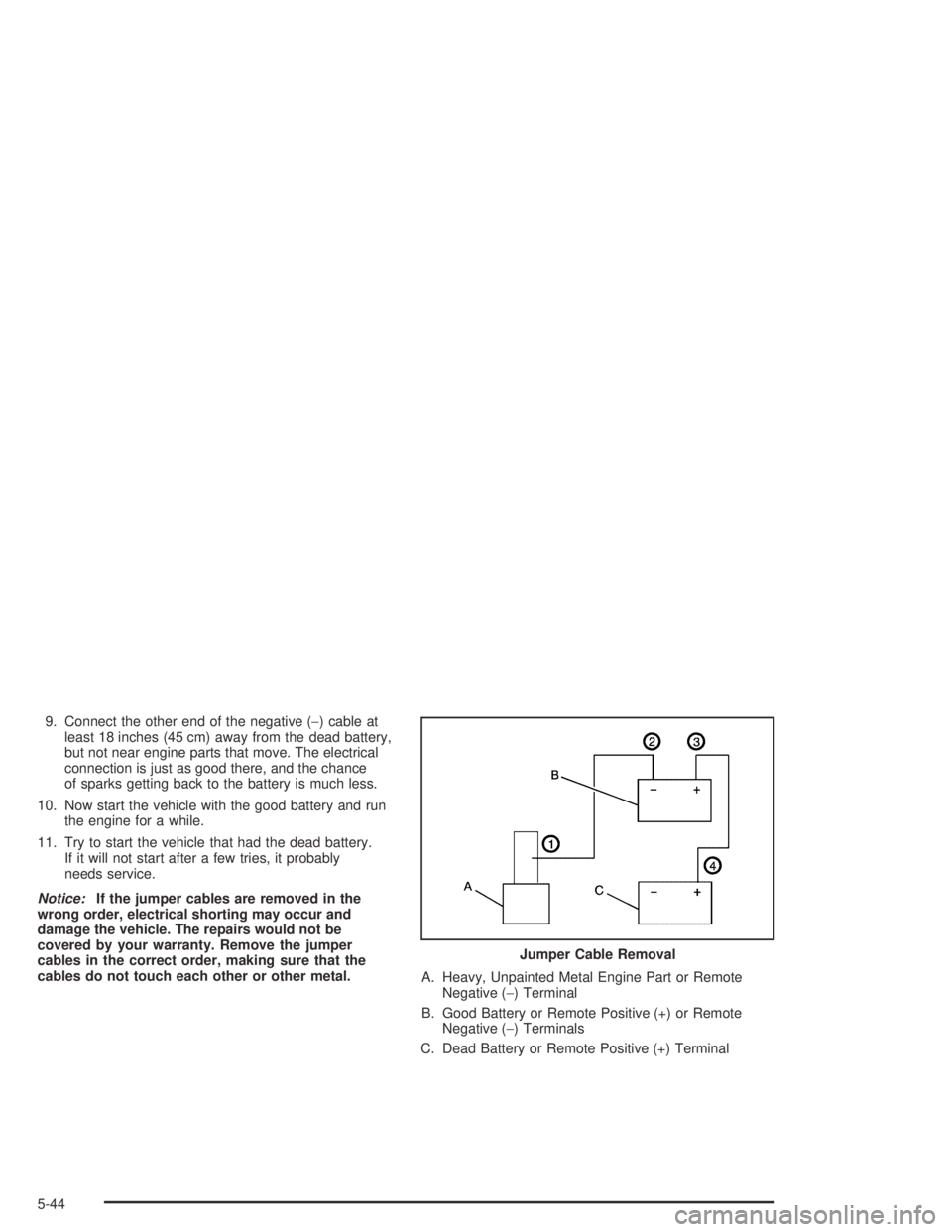
9. Connect the other end of the negative (−) cable at
least 18 inches (45 cm) away from the dead battery,
but not near engine parts that move. The electrical
connection is just as good there, and the chance
of sparks getting back to the battery is much less.
10. Now start the vehicle with the good battery and run
the engine for a while.
11. Try to start the vehicle that had the dead battery.
If it will not start after a few tries, it probably
needs service.
Notice:If the jumper cables are removed in the
wrong order, electrical shorting may occur and
damage the vehicle. The repairs would not be
covered by your warranty. Remove the jumper
cables in the correct order, making sure that the
cables do not touch each other or other metal.
A. Heavy, Unpainted Metal Engine Part or Remote
Negative (−) Terminal
B. Good Battery or Remote Positive (+) or Remote
Negative (−) Terminals
C. Dead Battery or Remote Positive (+) TerminalJumper Cable Removal
5-44
Page 277 of 388
To disconnect the jumper cables from both vehicles, do
the following:
1. Disconnect the black negative (−) cable from the
vehicle that had the dead battery.
2. Disconnect the black negative (−) cable from the
vehicle with the good battery.
3. Disconnect the red positive (+) cable from the
vehicle with the good battery.
4. Disconnect the red positive (+) cable from the
other vehicle.
Headlamp Aiming
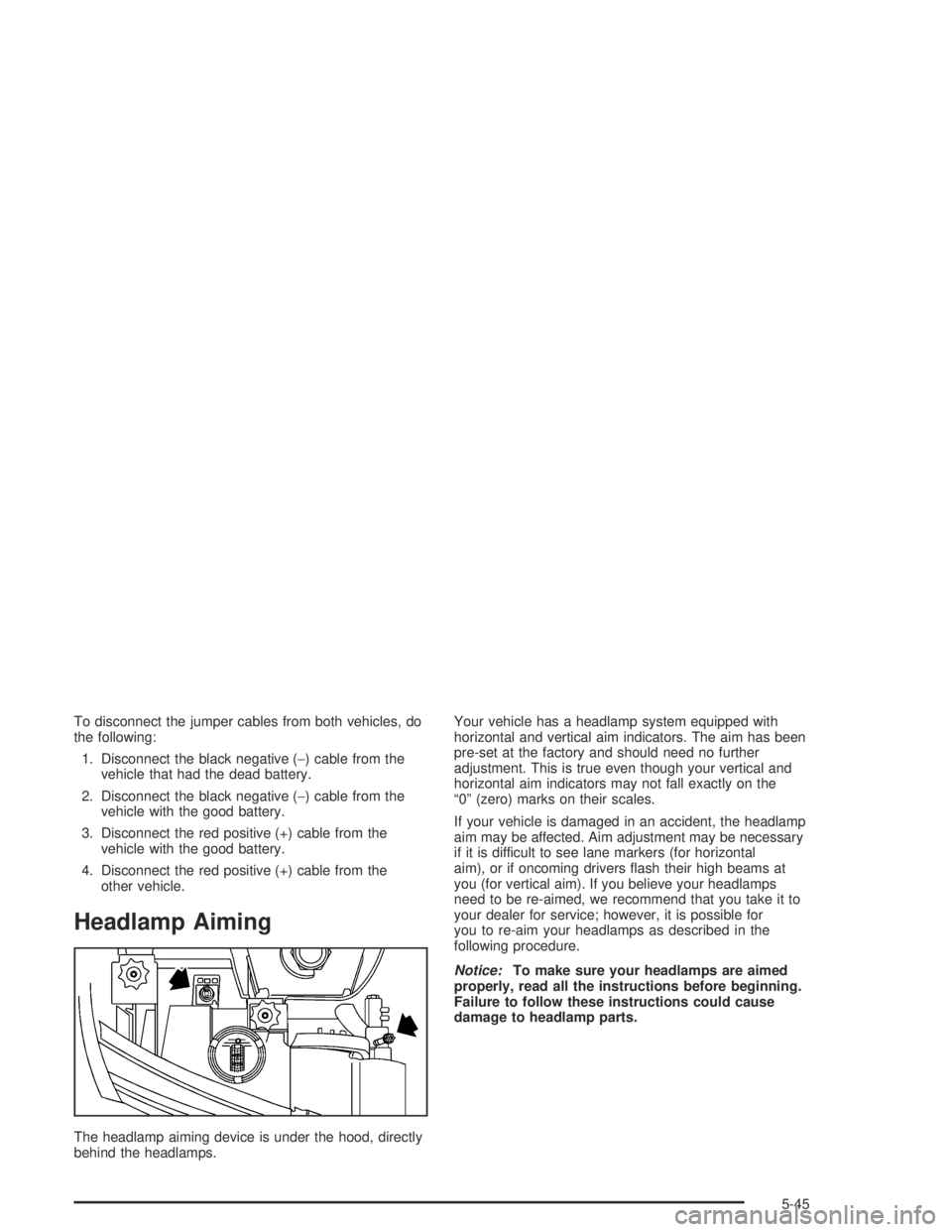
The headlamp aiming device is under the hood, directly
behind the headlamps.Your vehicle has a headlamp system equipped with
horizontal and vertical aim indicators. The aim has been
pre-set at the factory and should need no further
adjustment. This is true even though your vertical and
horizontal aim indicators may not fall exactly on the
“0” (zero) marks on their scales.
If your vehicle is damaged in an accident, the headlamp
aim may be affected. Aim adjustment may be necessary
if it is difficult to see lane markers (for horizontal
aim), or if oncoming drivers ash their high beams at
you (for vertical aim). If you believe your headlamps
need to be re-aimed, we recommend that you take it to
your dealer for service; however, it is possible for
you to re-aim your headlamps as described in the
following procedure.
Notice:To make sure your headlamps are aimed
properly, read all the instructions before beginning.
Failure to follow these instructions could cause
damage to headlamp parts.
5-45
Page 368 of 388
Roadside Assistance Program
Call 1-800-252-1112 for Buick Roadside Assistance.
As the proud owner of a new Buick vehicle, you
are automatically enrolled in the Buick Roadside
Assistance program. This value-added service is
intended to provide you with peace of mind as you drive
in the city or travel the open road. Buick’s Roadside
Assistance toll-free number is staffed by courteous and
capable Roadside Assistance Representatives who
are available 24 hours a day, 365 days a year.
We will provide the following services during the
Bumper-to-Bumper warranty period, at no expense
to you:
Fuel Delivery:Delivery of enough fuel,
$5 maximum, for the customer to get to the nearest
service station.
Lock-out Service (identication required):
Replacement keys or locksmith service will
be covered at no charge if you are unable to gain
entry into your vehicle. Delivery of the replacement
key will be covered within 10 miles.
Emergency Tow:Tow to the nearest dealership for
warranty service or in the event of a
vehicle-disabling accident. Assistance when the
vehicle is mired in sand, mud, or snow.
Flat Tire Change:Installation of a spare tire will be
covered at no charge. The customer is responsible
for the repair or replacement of the tire if not
covered by a warrantable failure.
Jump Start:No-start occurrences which require a
battery jump start will be covered at no charge.
Dealer Locator Service
In many instances, mechanical failures are covered
under Buick’s Bumper-to-Bumper warranty. However,
when other services are utilized, our Roadside
Assistance Representatives will explain any payment
obligations you might incur.
For prompt and efficient assistance when calling,
please provide the following to the Roadside
Assistance Representative:
Your name, home address, and home
telephone number.
Telephone number of your location.
Location of the vehicle.
Model, year, color, and license plate number.
Mileage, Vehicle Identication Number, and delivery
date of the vehicle.
Description of the problem.
7-6
Page 376 of 388
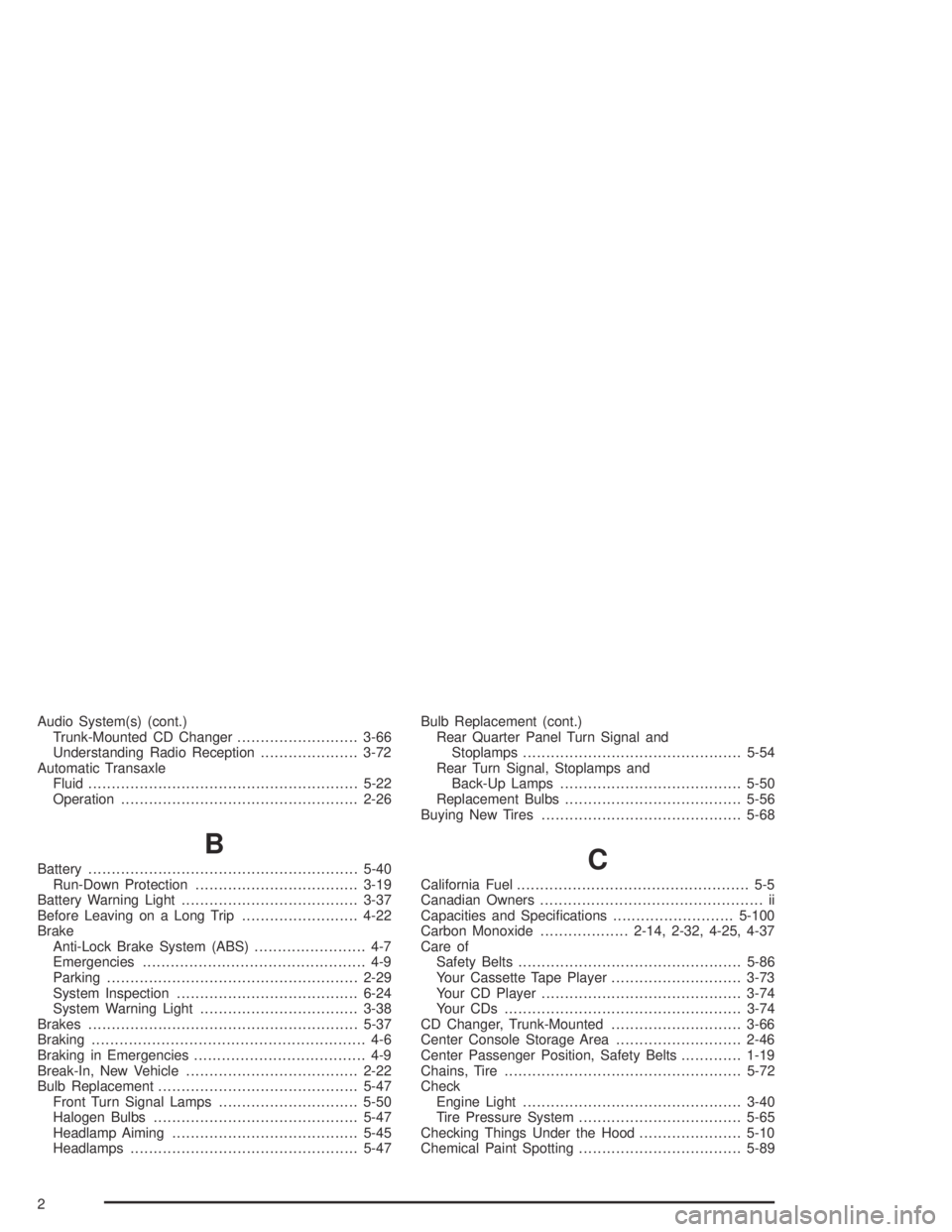
Audio System(s) (cont.)
Trunk-Mounted CD Changer..........................3-66
Understanding Radio Reception.....................3-72
Automatic Transaxle
Fluid..........................................................5-22
Operation...................................................2-26
B
Battery..........................................................5-40
Run-Down Protection...................................3-19
Battery Warning Light......................................3-37
Before Leaving on a Long Trip.........................4-22
Brake
Anti-Lock Brake System (ABS)........................ 4-7
Emergencies................................................ 4-9
Parking......................................................2-29
System Inspection.......................................6-24
System Warning Light..................................3-38
Brakes..........................................................5-37
Braking........................................................... 4-6
Braking in Emergencies..................................... 4-9
Break-In, New Vehicle.....................................2-22
Bulb Replacement...........................................5-47
Front Turn Signal Lamps..............................5-50
Halogen Bulbs............................................5-47
Headlamp Aiming........................................5-45
Headlamps.................................................5-47Bulb Replacement (cont.)
Rear Quarter Panel Turn Signal and
Stoplamps...............................................5-54
Rear Turn Signal, Stoplamps and
Back-Up Lamps.......................................5-50
Replacement Bulbs......................................5-56
Buying New Tires...........................................5-68C
California Fuel.................................................. 5-5
Canadian Owners................................................ ii
Capacities and Specications..........................5-100
Carbon Monoxide...................2-14, 2-32, 4-25, 4-37
Care of
Safety Belts................................................5-86
Your Cassette Tape Player............................3-73
Your CD Player...........................................3-74
Your CDs ...................................................3-74
CD Changer, Trunk-Mounted............................3-66
Center Console Storage Area...........................2-46
Center Passenger Position, Safety Belts.............1-19
Chains, Tire...................................................5-72
Check
Engine Light...............................................3-40
Tire Pressure System...................................5-65
Checking Things Under the Hood......................5-10
Chemical Paint Spotting...................................5-89
2
Page 379 of 388
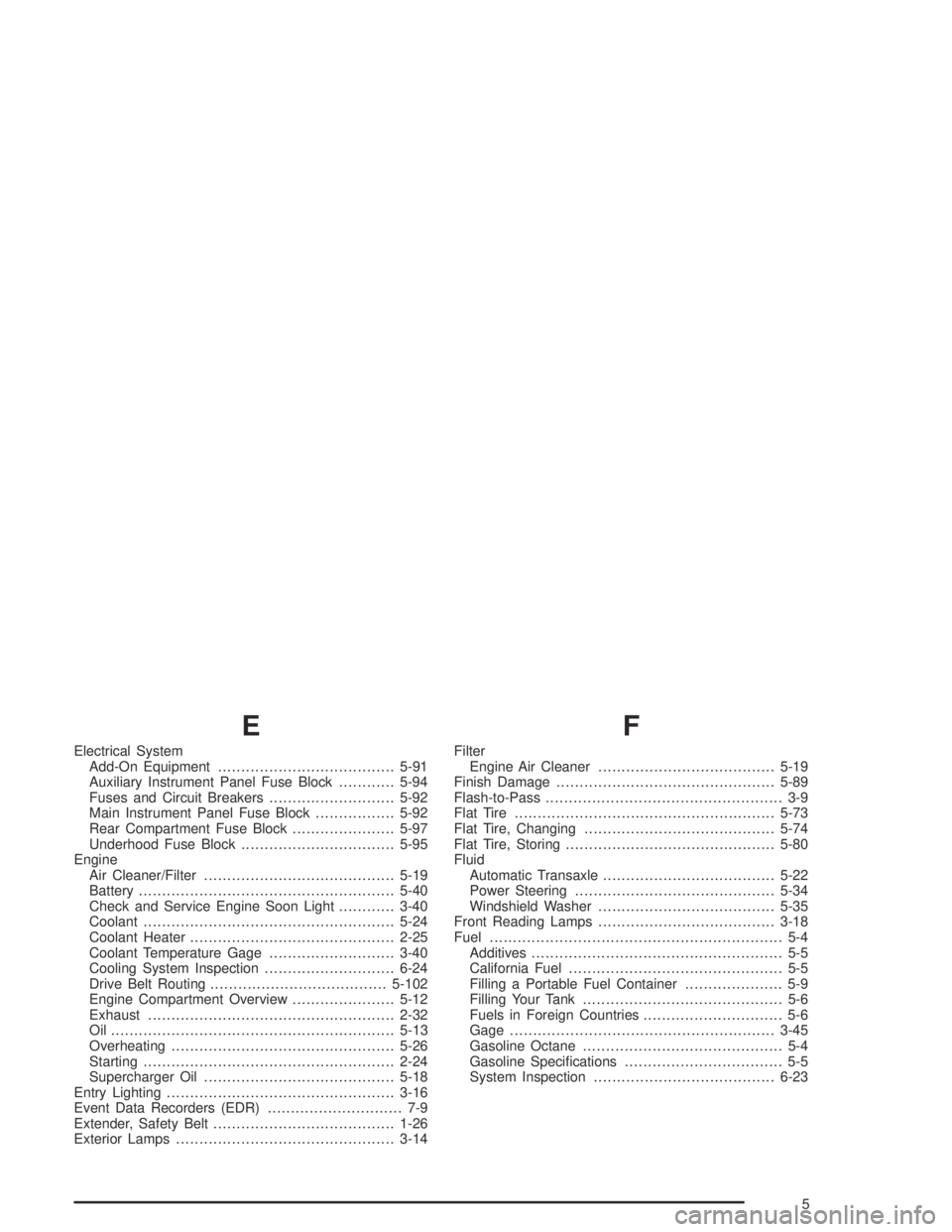
E
Electrical System
Add-On Equipment......................................5-91
Auxiliary Instrument Panel Fuse Block............5-94
Fuses and Circuit Breakers...........................5-92
Main Instrument Panel Fuse Block.................5-92
Rear Compartment Fuse Block......................5-97
Underhood Fuse Block.................................5-95
Engine
Air Cleaner/Filter.........................................5-19
Battery.......................................................5-40
Check and Service Engine Soon Light............3-40
Coolant......................................................5-24
Coolant Heater............................................2-25
Coolant Temperature Gage...........................3-40
Cooling System Inspection............................6-24
Drive Belt Routing......................................5-102
Engine Compartment Overview......................5-12
Exhaust.....................................................2-32
Oil .............................................................5-13
Overheating................................................5-26
Starting......................................................2-24
Supercharger Oil.........................................5-18
Entry Lighting.................................................3-16
Event Data Recorders (EDR)............................. 7-9
Extender, Safety Belt.......................................1-26
Exterior Lamps...............................................3-14
F
Filter
Engine Air Cleaner......................................5-19
Finish Damage...............................................5-89
Flash-to-Pass................................................... 3-9
Flat Tire........................................................5-73
Flat Tire, Changing.........................................5-74
Flat Tire, Storing.............................................5-80
Fluid
Automatic Transaxle.....................................5-22
Power Steering...........................................5-34
Windshield Washer......................................5-35
Front Reading Lamps......................................3-18
Fuel............................................................... 5-4
Additives...................................................... 5-5
California Fuel.............................................. 5-5
Filling a Portable Fuel Container..................... 5-9
Filling Your Tank........................................... 5-6
Fuels in Foreign Countries.............................. 5-6
Gage.........................................................3-45
Gasoline Octane........................................... 5-4
Gasoline Specications.................................. 5-5
System Inspection.......................................6-23
5