lock BUICK PARK AVENUE 2005 Manual PDF
[x] Cancel search | Manufacturer: BUICK, Model Year: 2005, Model line: PARK AVENUE, Model: BUICK PARK AVENUE 2005Pages: 388, PDF Size: 2.55 MB
Page 245 of 388
A. Battery. SeeBattery on page 5-40.
B. Underhood Fuse Block. SeeUnderhood Fuse Block
on page 5-95.
C. Radiator Pressure Cap. SeeRadiator Pressure Cap
on page 5-26.
D. Engine Oil Dipstick. See “Checking Engine Oil”
underEngine Oil on page 5-13.
E. Engine Oil Fill Cap. See “When to Add Engine Oil”
underEngine Oil on page 5-13.
F. Engine Coolant Air Bleed Valve. See “How to Add
Coolant to the Radiator” underCooling System
on page 5-28.
G. Automatic Transaxle Fluid Dipstick. See “Checking
the Fluid Level” underAutomatic Transaxle Fluid
on page 5-22.
H. Brake Master Cylinder Reservoir. See “Brake Fluid”
underBrakes on page 5-37.
I. Windshield Washer Fluid Reservoir. See “Adding
Washer Fluid” underWindshield Washer Fluid
on page 5-35.
J. Engine Coolant Recovery Tank. SeeCooling System
on page 5-28.
K. Engine Air Cleaner/Filter. SeeEngine Air
Cleaner/Filter on page 5-19.Engine Oil
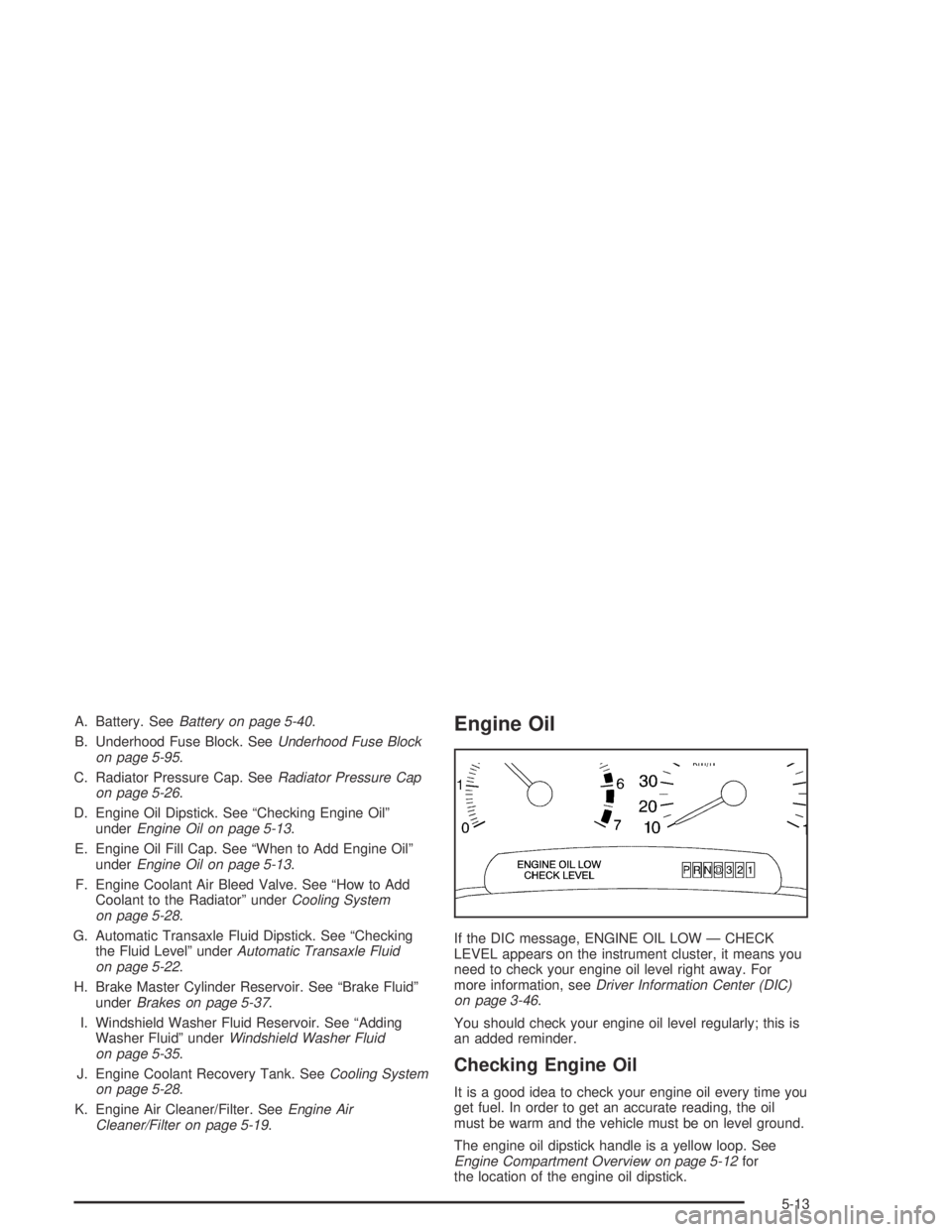
If the DIC message, ENGINE OIL LOW — CHECK
LEVEL appears on the instrument cluster, it means you
need to check your engine oil level right away. For
more information, seeDriver Information Center (DIC)
on page 3-46.
You should check your engine oil level regularly; this is
an added reminder.
Checking Engine Oil
It is a good idea to check your engine oil every time you
get fuel. In order to get an accurate reading, the oil
must be warm and the vehicle must be on level ground.
The engine oil dipstick handle is a yellow loop. See
Engine Compartment Overview on page 5-12for
the location of the engine oil dipstick.
5-13
Page 255 of 388
Checking the Fluid Level
Prepare your vehicle as follows:
Park your vehicle on a level place. Keep the
engine running.
With the parking brake applied, place the shift lever
in PARK (P).
With your foot on the brake pedal, move the shift
lever through each gear range, pausing for about
three seconds in each range. Then, position the shift
lever in PARK (P).
Let the engine run at idle for three to ve minutes.
Then, without shutting off the engine, follow these steps:
The transaxle uid dipstick
top is a round, red loop
and is located next to the
brake master cylinder
reservoir behind the engine
block. SeeEngine
Compartment Overview on
page 5-12for more
information on location.
1. Pull out the dipstick and wipe it with a clean rag or
paper towel.2. Push it back in all the way, wait three seconds and
then pull it back out again.
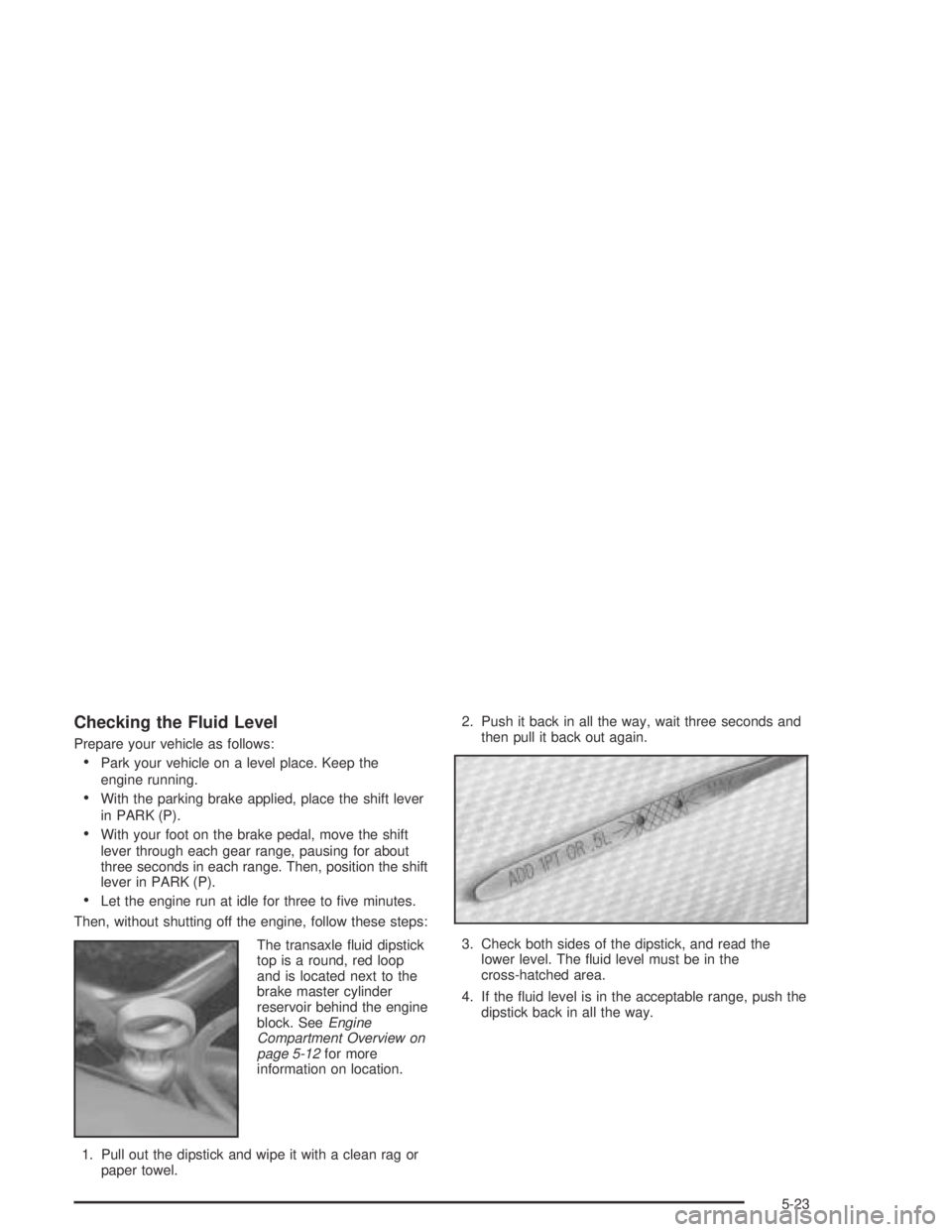
3. Check both sides of the dipstick, and read the
lower level. The uid level must be in the
cross-hatched area.
4. If the uid level is in the acceptable range, push the
dipstick back in all the way.
5-23
Page 263 of 388
If the overheat warning continues, there is one more
thing you can try. You can add the proper coolant
mixture directly to the radiator, but be sure the cooling
system is cool before you do it.
{CAUTION:
Steam and scalding liquids from a hot cooling
system can blow out and burn you badly. They
are under pressure, and if you turn the radiator
pressure cap — even a little — they can come
out at high speed. Never turn the cap when the
cooling system, including the radiator pressure
cap, is hot. Wait for the cooling system and
radiator pressure cap to cool if you ever have
to turn the pressure cap.
How to Add Coolant to the Radiator
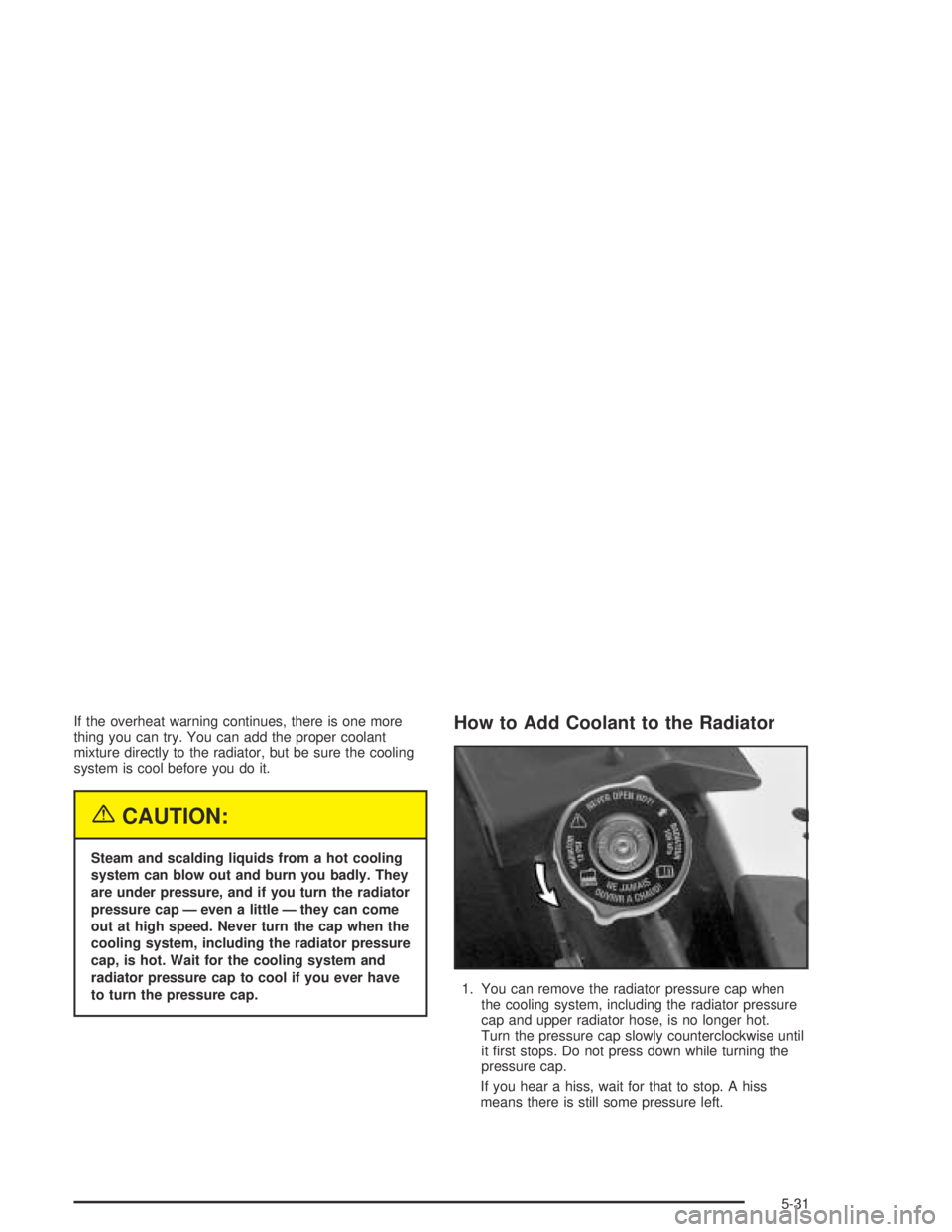
1. You can remove the radiator pressure cap when
the cooling system, including the radiator pressure
cap and upper radiator hose, is no longer hot.
Turn the pressure cap slowly counterclockwise until
it rst stops. Do not press down while turning the
pressure cap.
If you hear a hiss, wait for that to stop. A hiss
means there is still some pressure left.
5-31
Page 264 of 388
2. Then keep turning the pressure cap, but now push
down as you turn it. Remove the pressure cap.
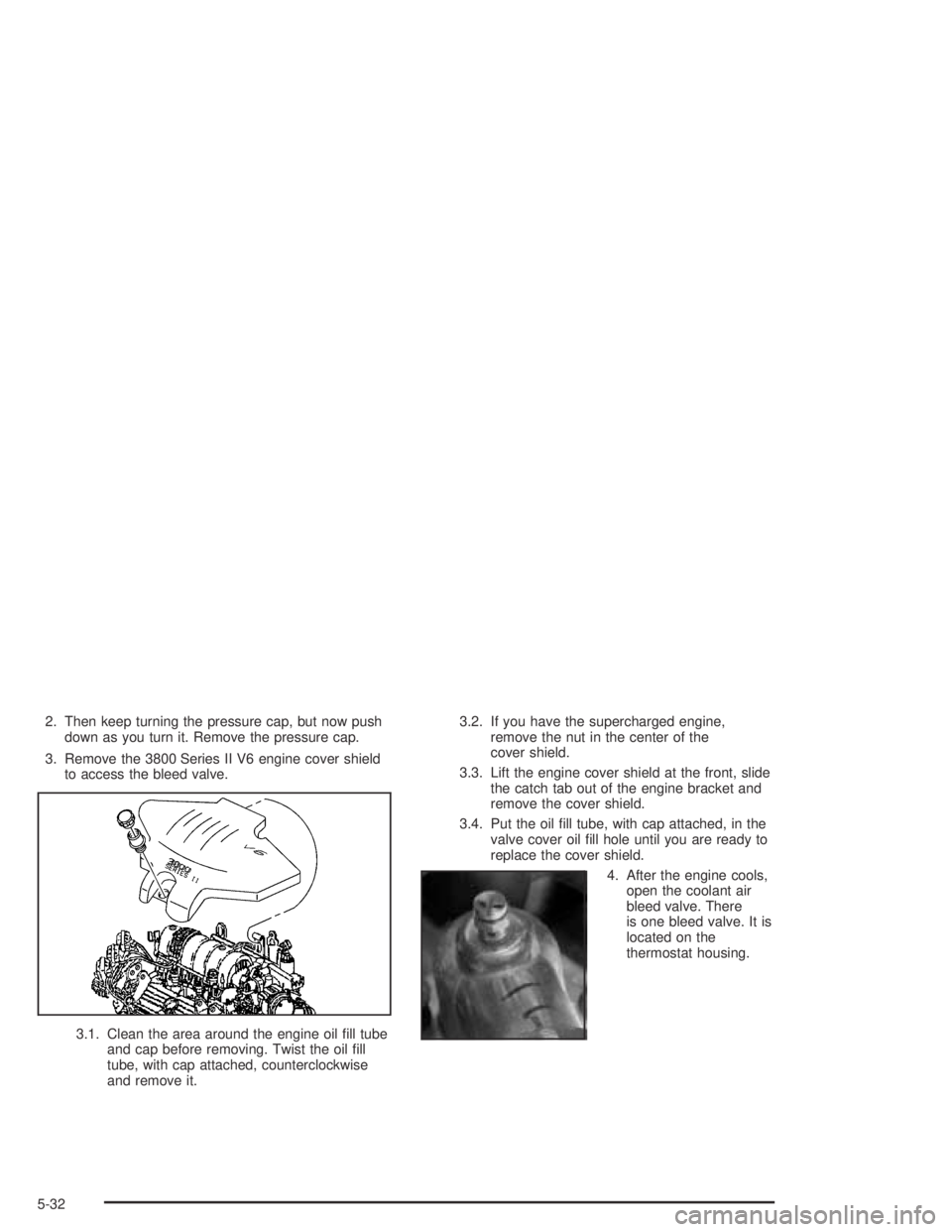
3. Remove the 3800 Series II V6 engine cover shield
to access the bleed valve.
3.1. Clean the area around the engine oil ll tube
and cap before removing. Twist the oil ll
tube, with cap attached, counterclockwise
and remove it.3.2. If you have the supercharged engine,
remove the nut in the center of the
cover shield.
3.3. Lift the engine cover shield at the front, slide
the catch tab out of the engine bracket and
remove the cover shield.
3.4. Put the oil ll tube, with cap attached, in the
valve cover oil ll hole until you are ready to
replace the cover shield.
4. After the engine cools,
open the coolant air
bleed valve. There
is one bleed valve. It is
located on the
thermostat housing.
5-32
Page 265 of 388
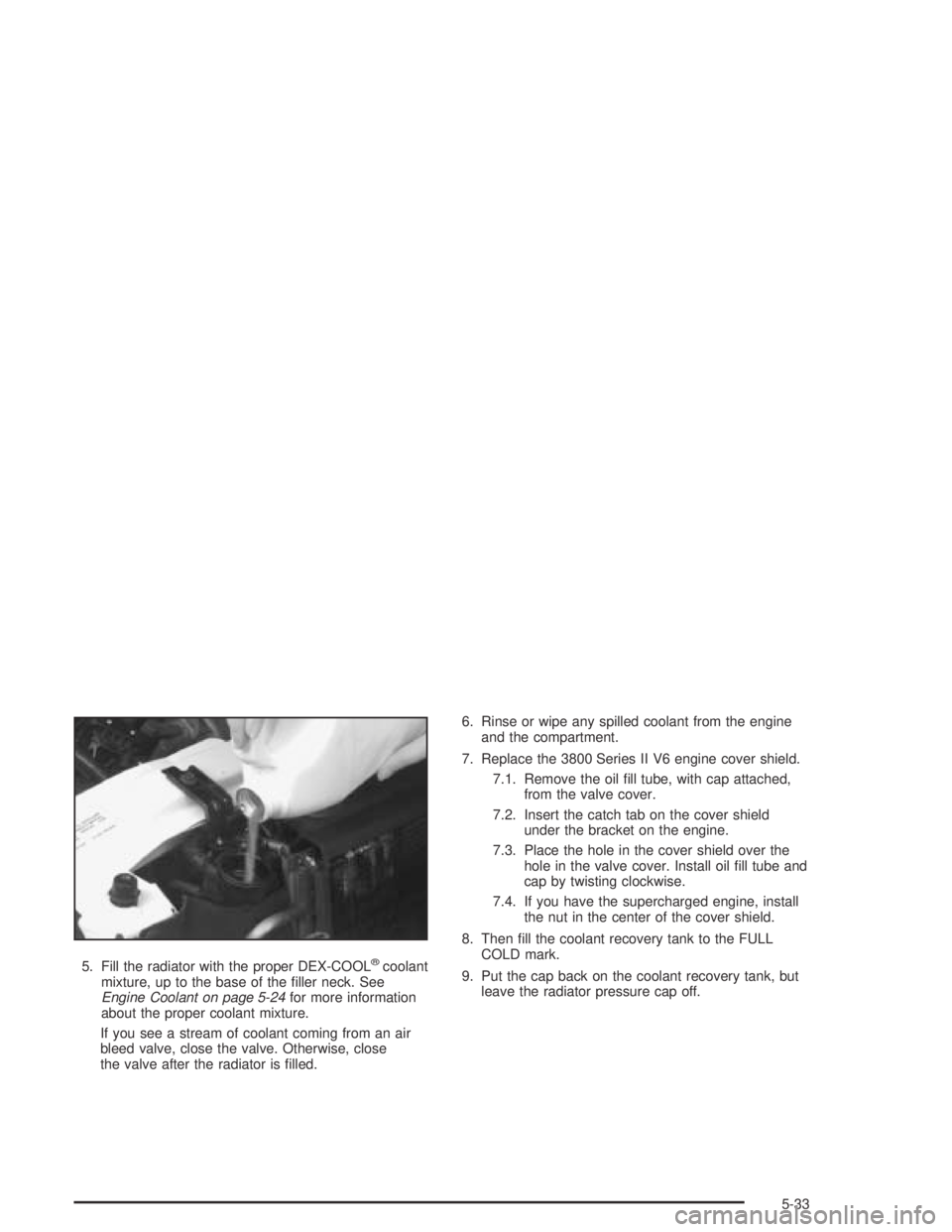
5. Fill the radiator with the proper DEX-COOL®coolant
mixture, up to the base of the ller neck. See
Engine Coolant on page 5-24for more information
about the proper coolant mixture.
If you see a stream of coolant coming from an air
bleed valve, close the valve. Otherwise, close
the valve after the radiator is lled.6. Rinse or wipe any spilled coolant from the engine
and the compartment.
7. Replace the 3800 Series II V6 engine cover shield.
7.1. Remove the oil ll tube, with cap attached,
from the valve cover.
7.2. Insert the catch tab on the cover shield
under the bracket on the engine.
7.3. Place the hole in the cover shield over the
hole in the valve cover. Install oil ll tube and
cap by twisting clockwise.
7.4. If you have the supercharged engine, install
the nut in the center of the cover shield.
8. Then ll the coolant recovery tank to the FULL
COLD mark.
9. Put the cap back on the coolant recovery tank, but
leave the radiator pressure cap off.
5-33
Page 280 of 388
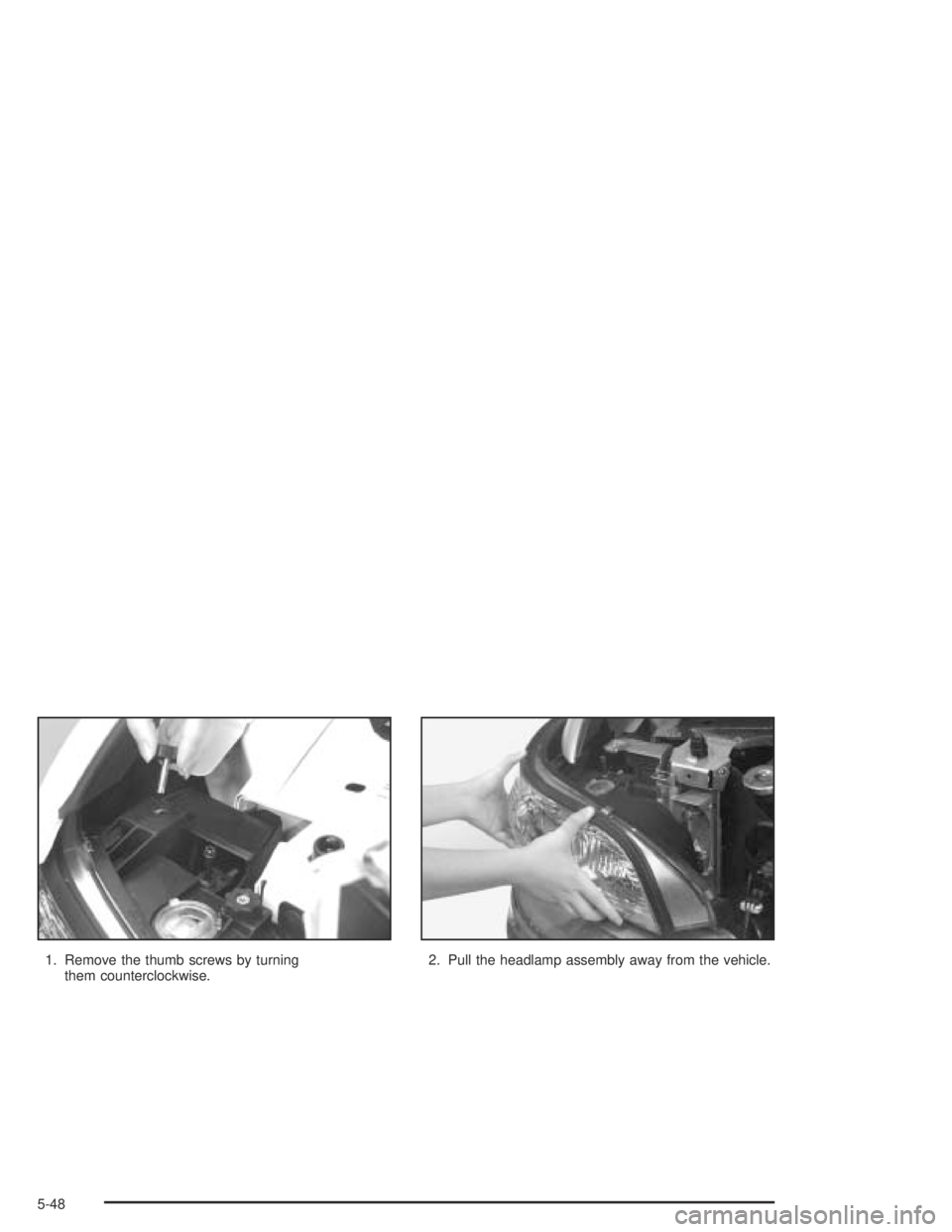
1. Remove the thumb screws by turning
them counterclockwise.2. Pull the headlamp assembly away from the vehicle.
5-48
Page 281 of 388
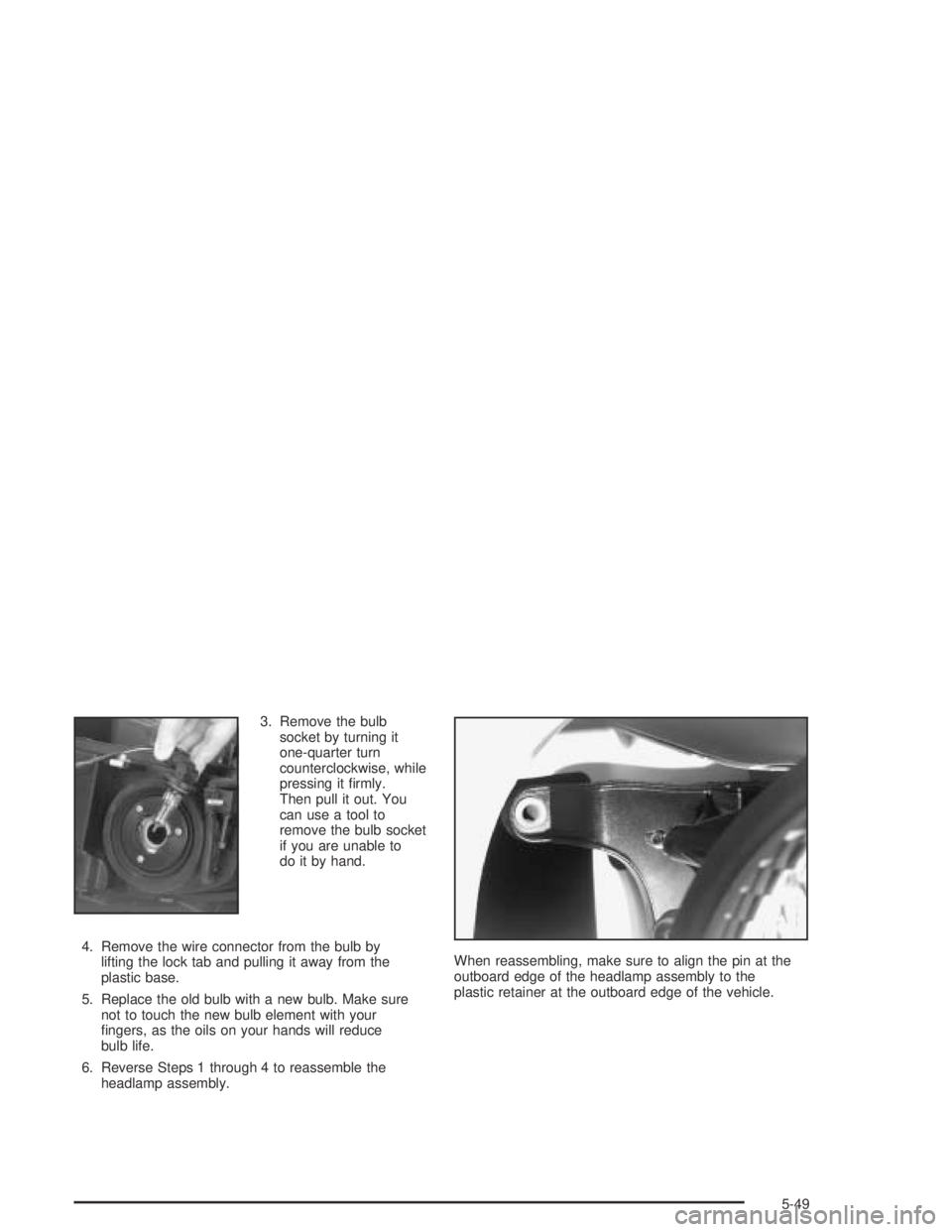
3. Remove the bulb
socket by turning it
one-quarter turn
counterclockwise, while
pressing it rmly.
Then pull it out. You
can use a tool to
remove the bulb socket
if you are unable to
do it by hand.
4. Remove the wire connector from the bulb by
lifting the lock tab and pulling it away from the
plastic base.
5. Replace the old bulb with a new bulb. Make sure
not to touch the new bulb element with your
ngers, as the oils on your hands will reduce
bulb life.
6. Reverse Steps 1 through 4 to reassemble the
headlamp assembly.When reassembling, make sure to align the pin at the
outboard edge of the headlamp assembly to the
plastic retainer at the outboard edge of the vehicle.
5-49
Page 282 of 388
Front Turn Signal Lamps
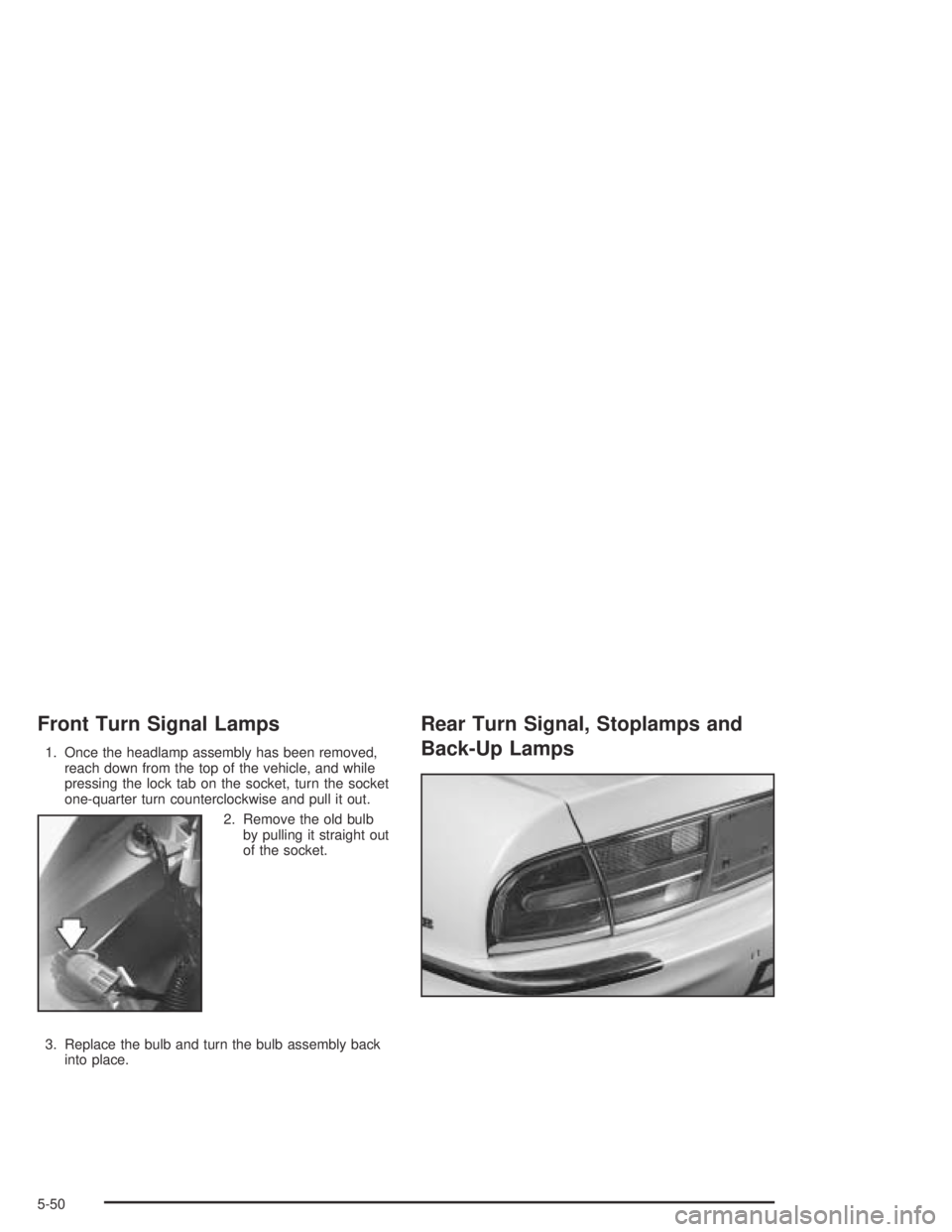
1. Once the headlamp assembly has been removed,
reach down from the top of the vehicle, and while
pressing the lock tab on the socket, turn the socket
one-quarter turn counterclockwise and pull it out.
2. Remove the old bulb
by pulling it straight out
of the socket.
3. Replace the bulb and turn the bulb assembly back
into place.
Rear Turn Signal, Stoplamps and
Back-Up Lamps
5-50
Page 285 of 388
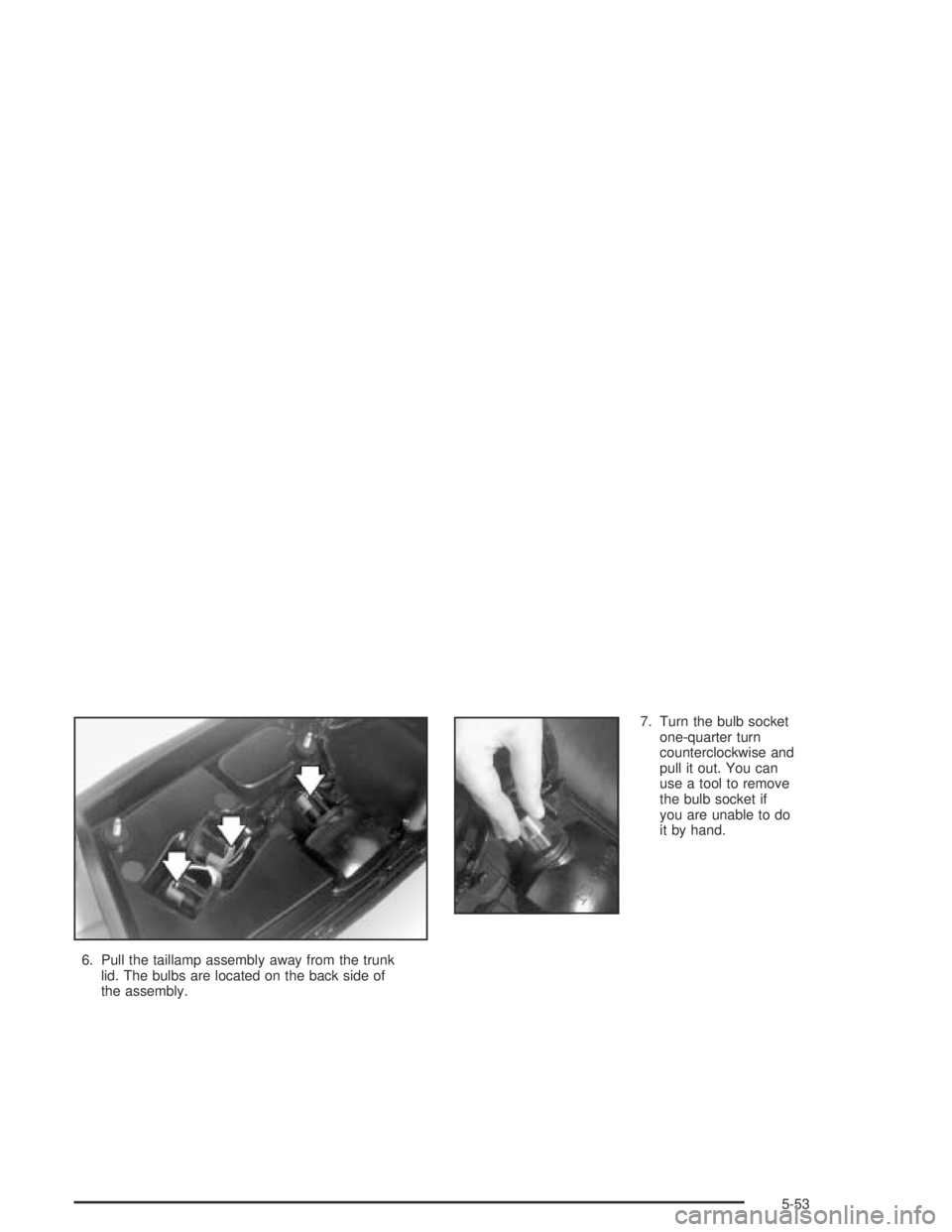
6. Pull the taillamp assembly away from the trunk
lid. The bulbs are located on the back side of
the assembly.7. Turn the bulb socket
one-quarter turn
counterclockwise and
pull it out. You can
use a tool to remove
the bulb socket if
you are unable to do
it by hand.
5-53
Page 286 of 388
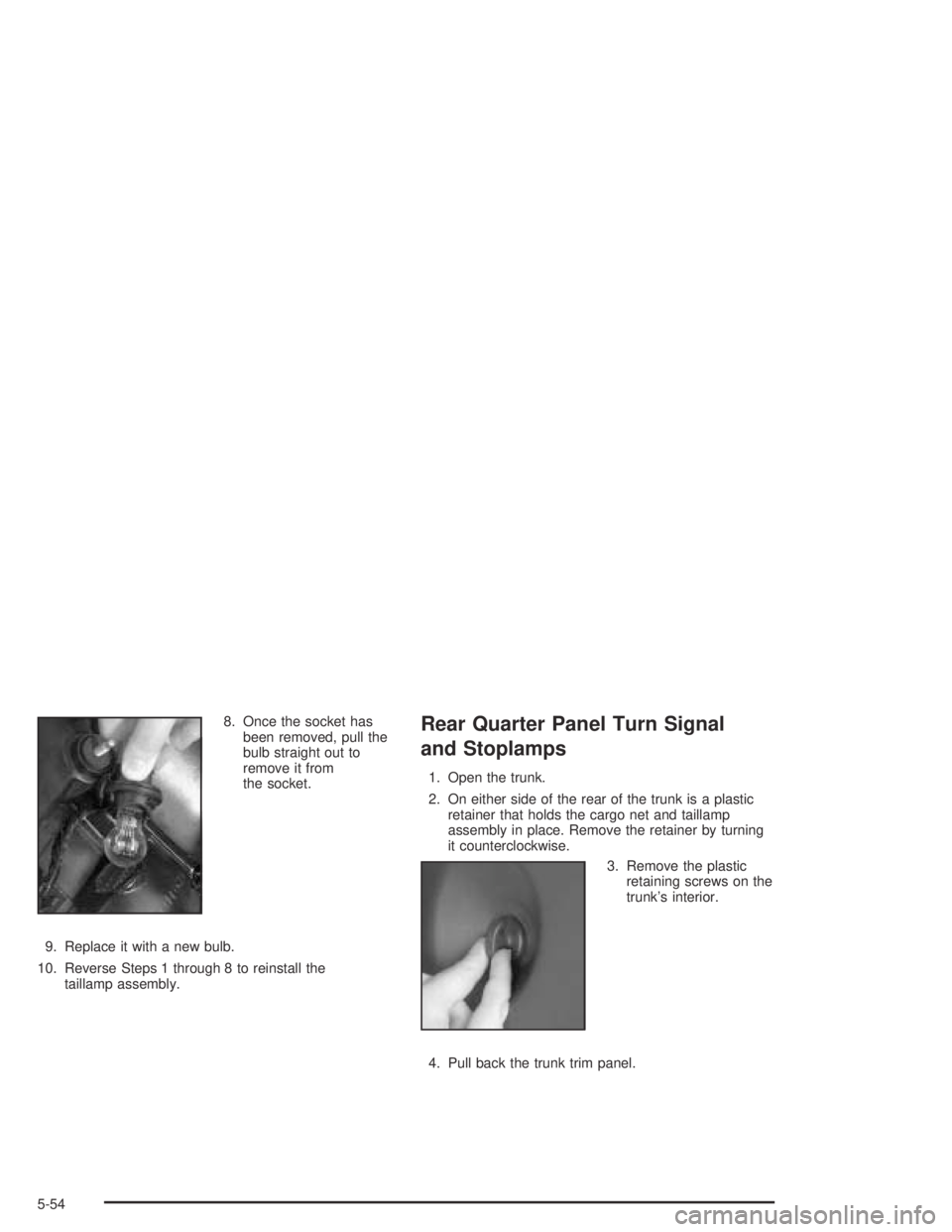
8. Once the socket has
been removed, pull the
bulb straight out to
remove it from
the socket.
9. Replace it with a new bulb.
10. Reverse Steps 1 through 8 to reinstall the
taillamp assembly.Rear Quarter Panel Turn Signal
and Stoplamps
1. Open the trunk.
2. On either side of the rear of the trunk is a plastic
retainer that holds the cargo net and taillamp
assembly in place. Remove the retainer by turning
it counterclockwise.
3. Remove the plastic
retaining screws on the
trunk’s interior.
4. Pull back the trunk trim panel.
5-54