seats BUICK RAINIER 2004 User Guide
[x] Cancel search | Manufacturer: BUICK, Model Year: 2004, Model line: RAINIER, Model: BUICK RAINIER 2004Pages: 452, PDF Size: 4.51 MB
Page 32 of 452
Child Restraints
Older Children
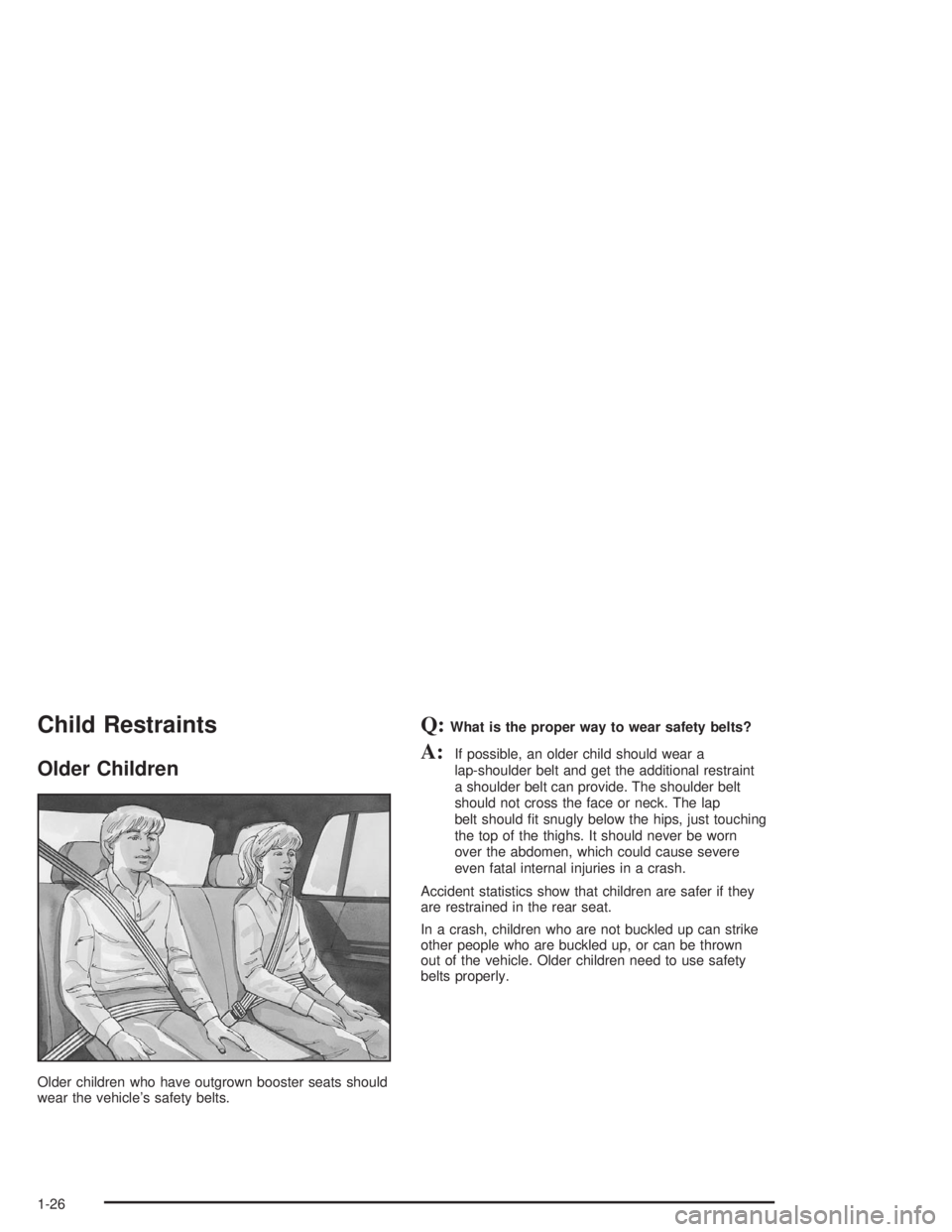
Older children who have outgrown booster seats should
wear the vehicle’s safety belts.
Q:What is the proper way to wear safety belts?
A:If possible, an older child should wear a
lap-shoulder belt and get the additional restraint
a shoulder belt can provide. The shoulder belt
should not cross the face or neck. The lap
belt should t snugly below the hips, just touching
the top of the thighs. It should never be worn
over the abdomen, which could cause severe
even fatal internal injuries in a crash.
Accident statistics show that children are safer if they
are restrained in the rear seat.
In a crash, children who are not buckled up can strike
other people who are buckled up, or can be thrown
out of the vehicle. Older children need to use safety
belts properly.
1-26
Page 39 of 452
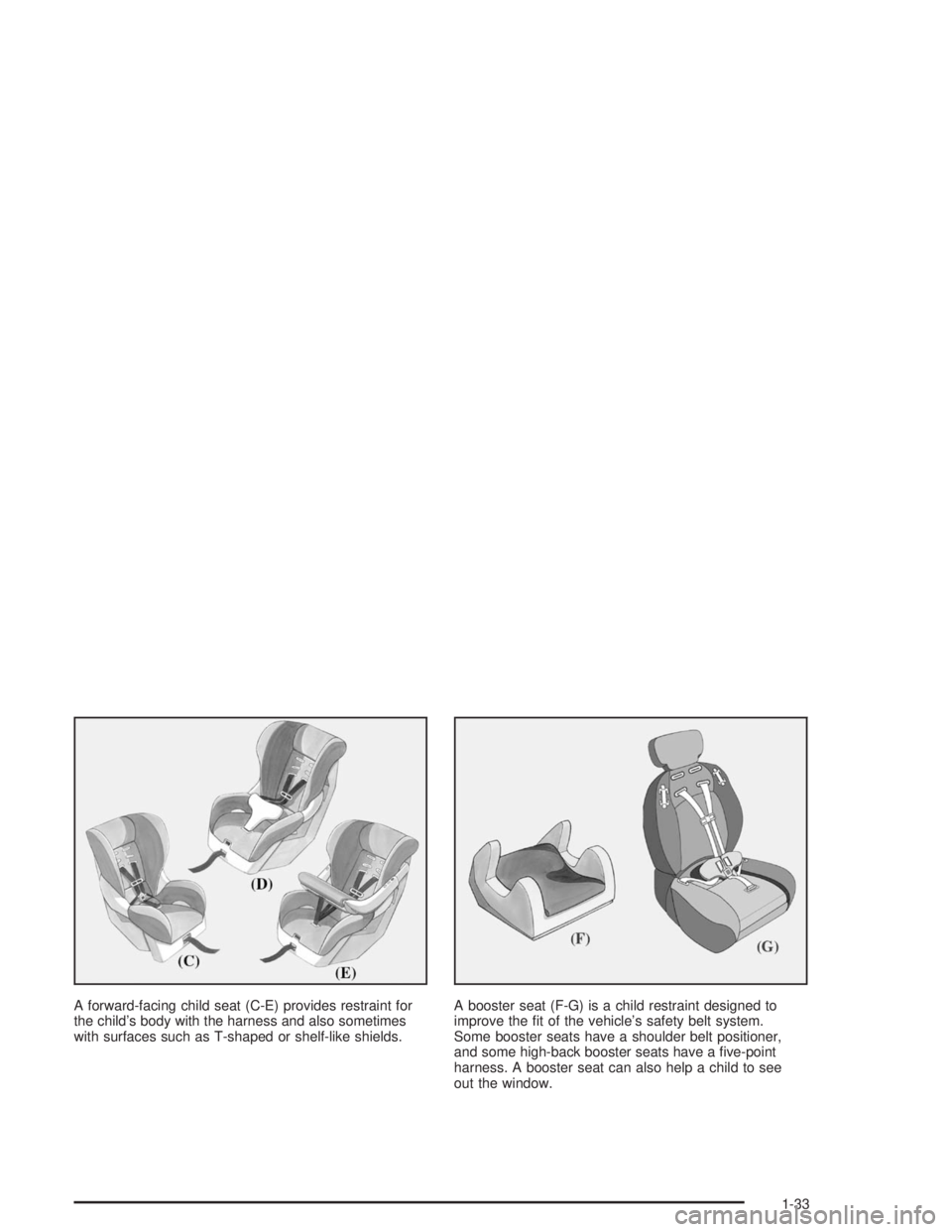
A forward-facing child seat (C-E) provides restraint for
the child’s body with the harness and also sometimes
with surfaces such as T-shaped or shelf-like shields.A booster seat (F-G) is a child restraint designed to
improve the t of the vehicle’s safety belt system.
Some booster seats have a shoulder belt positioner,
and some high-back booster seats have a ve-point
harness. A booster seat can also help a child to see
out the window.
1-33
Page 49 of 452
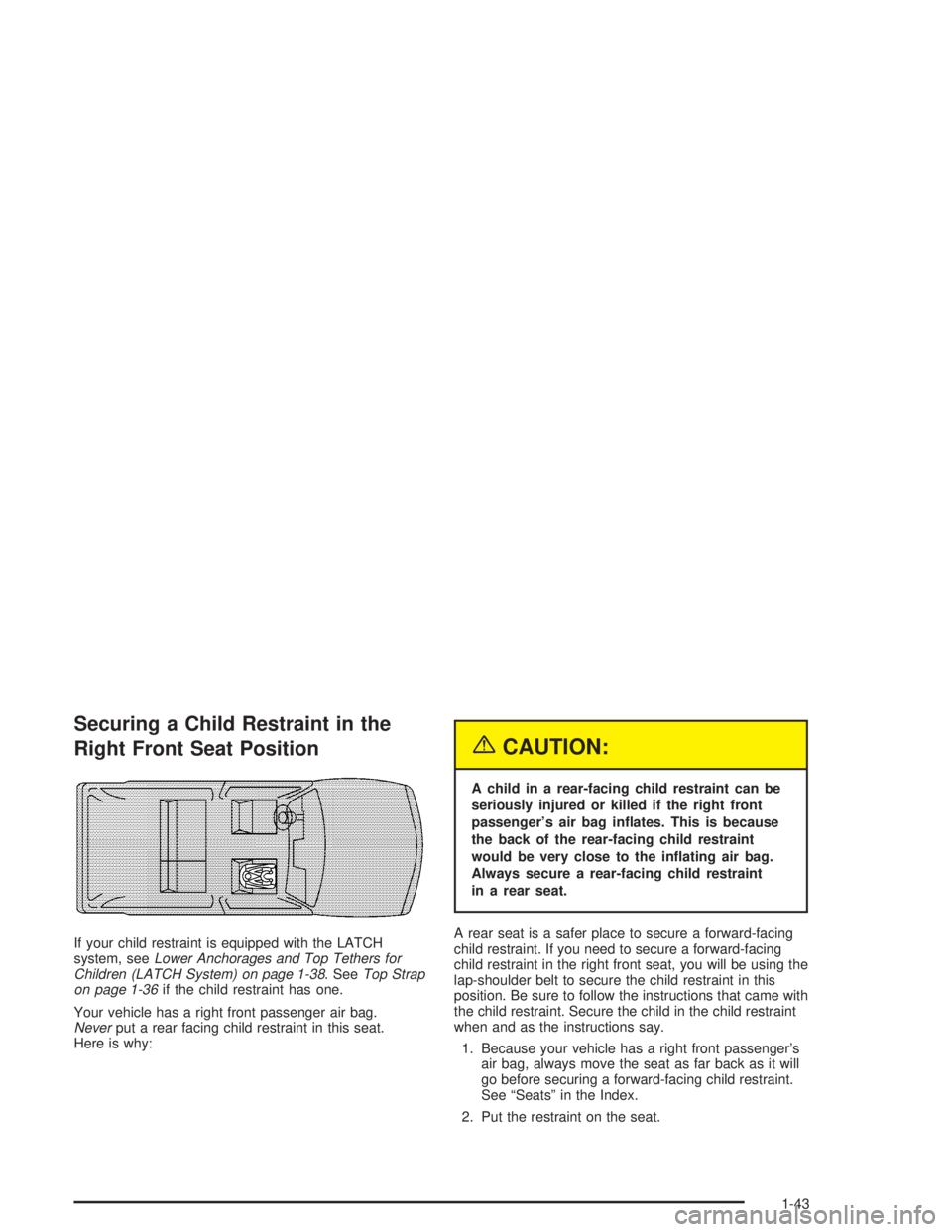
Securing a Child Restraint in the
Right Front Seat Position
If your child restraint is equipped with the LATCH
system, seeLower Anchorages and Top Tethers for
Children (LATCH System) on page 1-38. SeeTop Strap
on page 1-36if the child restraint has one.
Your vehicle has a right front passenger air bag.
Neverput a rear facing child restraint in this seat.
Here is why:
{CAUTION:
A child in a rear-facing child restraint can be
seriously injured or killed if the right front
passenger’s air bag inates. This is because
the back of the rear-facing child restraint
would be very close to the inating air bag.
Always secure a rear-facing child restraint
in a rear seat.
A rear seat is a safer place to secure a forward-facing
child restraint. If you need to secure a forward-facing
child restraint in the right front seat, you will be using the
lap-shoulder belt to secure the child restraint in this
position. Be sure to follow the instructions that came with
the child restraint. Secure the child in the child restraint
when and as the instructions say.
1. Because your vehicle has a right front passenger’s
air bag, always move the seat as far back as it will
go before securing a forward-facing child restraint.
See “Seats” in the Index.
2. Put the restraint on the seat.
1-43
Page 133 of 452
Operation Tips
Keep the hood and front air inlets free of ice, snow,
or any other obstruction (such as leaves). The
heater and defroster will work far better, reducing
the chance of fogging the inside of your windows.
When you enter a vehicle in cold weather, turn the
fan knob all the way to the right for a few moments
before driving. This helps clear the intake ducts
of snow and moisture, and reduces the chance of
fogging the inside of your window.
Keep the air path under the front seats clear of
objects. This helps air to circulate throughout
your vehicle.
Adding outside equipment to the front of your
vehicle, such as hood-air deectors, may affect the
performance of the heating and air conditioning
system. Check with your dealer before adding
equipment to the outside of your vehicle.
Rear Climate Control System
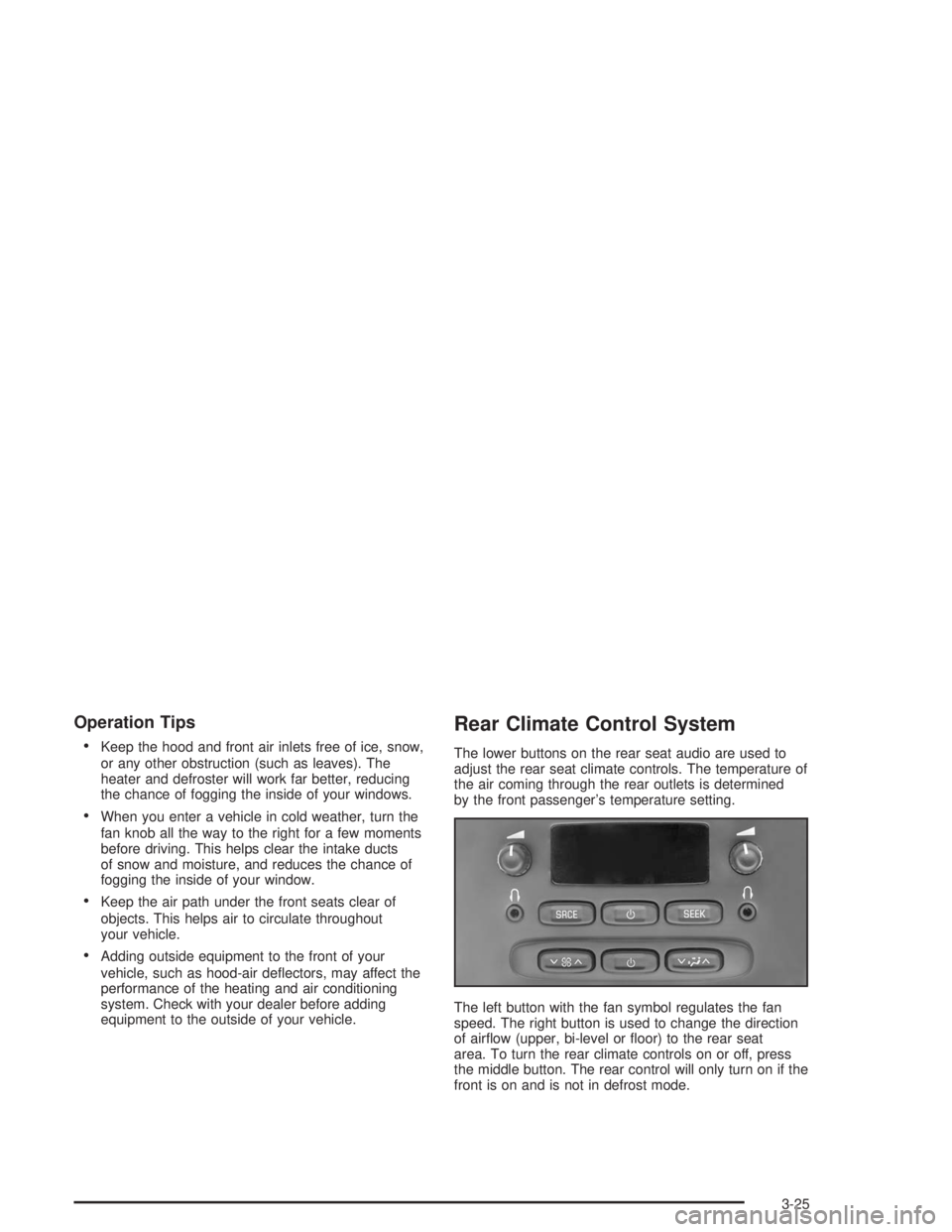
The lower buttons on the rear seat audio are used to
adjust the rear seat climate controls. The temperature of
the air coming through the rear outlets is determined
by the front passenger’s temperature setting.
The left button with the fan symbol regulates the fan
speed. The right button is used to change the direction
of airow (upper, bi-level or oor) to the rear seat
area. To turn the rear climate controls on or off, press
the middle button. The rear control will only turn on if the
front is on and is not in defrost mode.
3-25
Page 275 of 452
{CAUTION:
Do not load your vehicle any heavier than the
GVWR, or either the maximum front or rear
GAWR. If you do, parts on your vehicle can
break, and it can change the way your vehicle
handles. These could cause you to lose
control and crash. Also, overloading can
shorten the life of your vehicle.
Using heavier suspension components to get added
durability might not change your vehicle’s weight ratings.
Ask your dealer to help you load your vehicle the
right way.
Notice:Overloading your vehicle may cause
damage. Repairs would not be covered by your
warranty. Do not overload your vehicle.
If you put things inside your vehicle-like suitcases, tools,
packages, or anything else-they will go as fast as the
vehicle goes. If you have to stop or turn quickly, or
if there’s a crash, they’ll keep going.
{CAUTION:
Things you put inside your vehicle can strike
and injure people in a sudden stop or turn,
or in a crash.
Put things in the cargo area of your
vehicle. Try to spread the weight evenly.
Never stack heavier things, like suitcases,
inside the vehicle so that some of them
are above the tops of the seats.
Do not leave an unsecured child restraint
in your vehicle.
When you carry something inside the
vehicle, secure it whenever you can.
Do not leave a seat folded down unless
you need to.
There’s also important loading information for off-road
driving in this manual.
4-51
Page 352 of 452
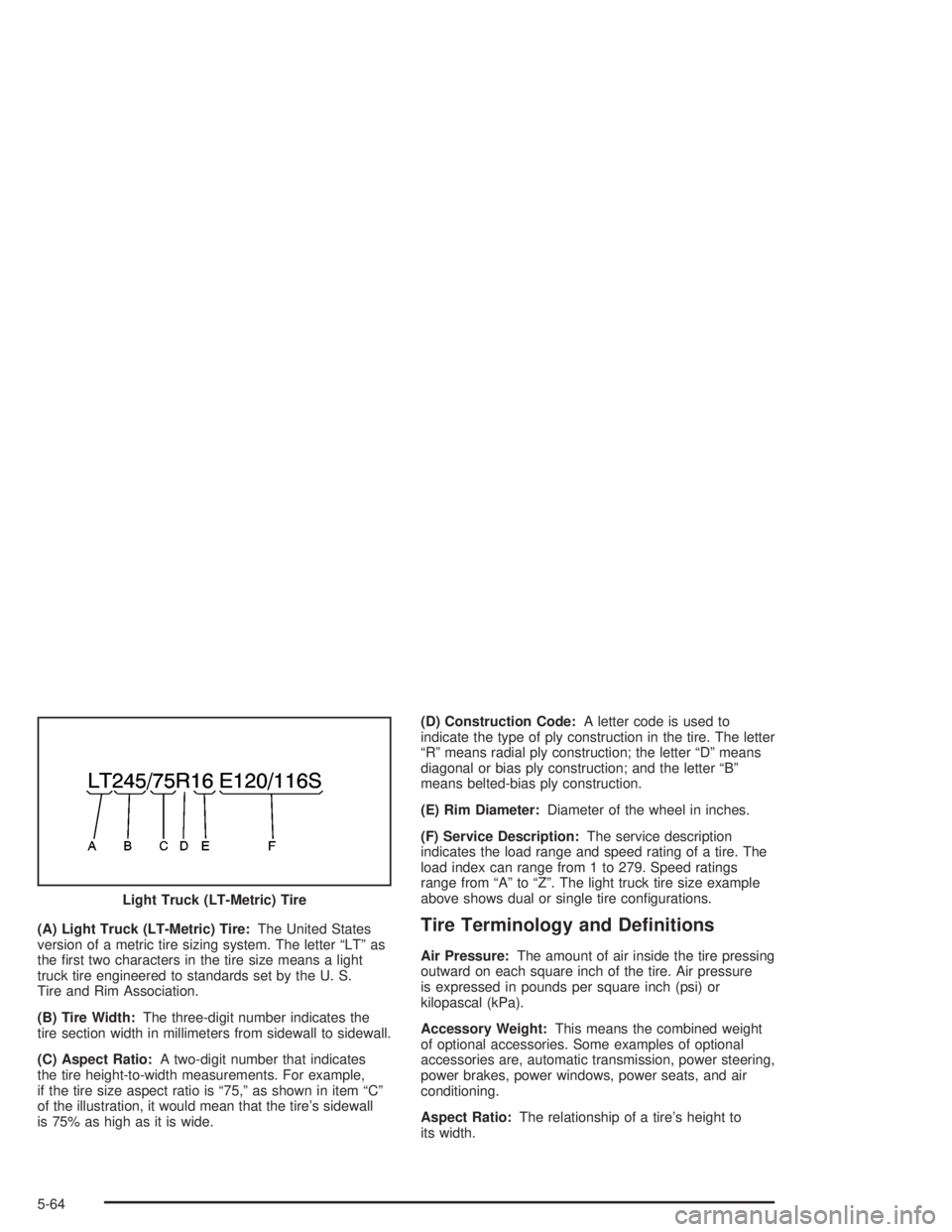
(A) Light Truck (LT-Metric) Tire:The United States
version of a metric tire sizing system. The letter “LT” as
the rst two characters in the tire size means a light
truck tire engineered to standards set by the U. S.
Tire and Rim Association.
(B) Tire Width:The three-digit number indicates the
tire section width in millimeters from sidewall to sidewall.
(C) Aspect Ratio:A two-digit number that indicates
the tire height-to-width measurements. For example,
if the tire size aspect ratio is “75,” as shown in item “C”
of the illustration, it would mean that the tire’s sidewall
is 75% as high as it is wide.(D) Construction Code:A letter code is used to
indicate the type of ply construction in the tire. The letter
“R” means radial ply construction; the letter “D” means
diagonal or bias ply construction; and the letter “B”
means belted-bias ply construction.
(E) Rim Diameter:Diameter of the wheel in inches.
(F) Service Description:The service description
indicates the load range and speed rating of a tire. The
load index can range from 1 to 279. Speed ratings
range from “A” to “Z”. The light truck tire size example
above shows dual or single tire congurations.Tire Terminology and Denitions
Air Pressure:The amount of air inside the tire pressing
outward on each square inch of the tire. Air pressure
is expressed in pounds per square inch (psi) or
kilopascal (kPa).
Accessory Weight:This means the combined weight
of optional accessories. Some examples of optional
accessories are, automatic transmission, power steering,
power brakes, power windows, power seats, and air
conditioning.
Aspect Ratio:The relationship of a tire’s height to
its width. Light Truck (LT-Metric) Tire
5-64
Page 399 of 452
Fuses Usage
01 Right Door Control Module
02 Left Door Control Module
03 Endgate Module 2
04 Truck Body Controller 3
05 Rear Fog Lamps
06 Blank
07 Truck Body Controller 2
08 Power Seats
09 Rear Wiper
10 Driver Door Module
11 Amplier
12 Passenger Door Module
13 Rear Climate Controls
14 Left Rear Parking Lamps
15 Blank
16Vehicle Center High-Mounted
Stop LampFuses Usage
17 Right Rear Parking Lamps
18 Locks
19Liftgate Module/Driver Seat
Module
20 Sunroof
21 Lock
23 Blank
24 Unlock
25 Blank
26 Blank
27 OH Battery/OnStar
®System
29 Rainsense™ Wipers
30 Parking Lamps
31 Truck Body Controller Accessory
32 Truck Body Controller 5
33 Front Wipers
34 Vehicle Stop
5-111
Page 415 of 452
Usage Fluid/Lubricant
Front and
Rear AxleSAE 75W-90 Synthetic Axle
Lubricant (GM Part No. U.S.
12378261, in Canada 10953455)
meeting GM Specication 9986115.
Transfer CaseAUTO-TRAK II Fluid (GM Part No.
U.S. 12378508, in Canada
10953626).
Hood Latch
Assembly,
Secondary
Latch, Pivots,
Spring Anchor
and
Release PawlLubriplate Lubricant Aerosol
(GM Part No. U.S. 12346293,
in Canada 992723) or lubricant
meeting requirements of NLGI #2,
Category LB or GC-LB.
Hood and
Door Hinges,
Body Door
Hinge Pins,
Liftgate Hinge
and Linkage,
Folding Seats
and Fuel
Door HingeMulti-Purpose Lubricant, Superlube
(GM Part No. U.S. 12346241,
in Canada 10953474).Usage Fluid/Lubricant
Outer Tailgate
Handle
Pivot Points
and HingesMulti-Purpose Lubricant, Superlube
(GM Part No. U.S. 12346241,
in Canada 10953474).
Weatherstrip
ConditioningDielectric Silicone Grease
(GM Part No. U.S. 12345579,
in Canada 992887).
Weatherstrip
SqueaksSynthetic Grease with Teon,
Superlube (GM Part No.
U.S.12371287, in Canada
10953437).
6-13
Page 442 of 452
H
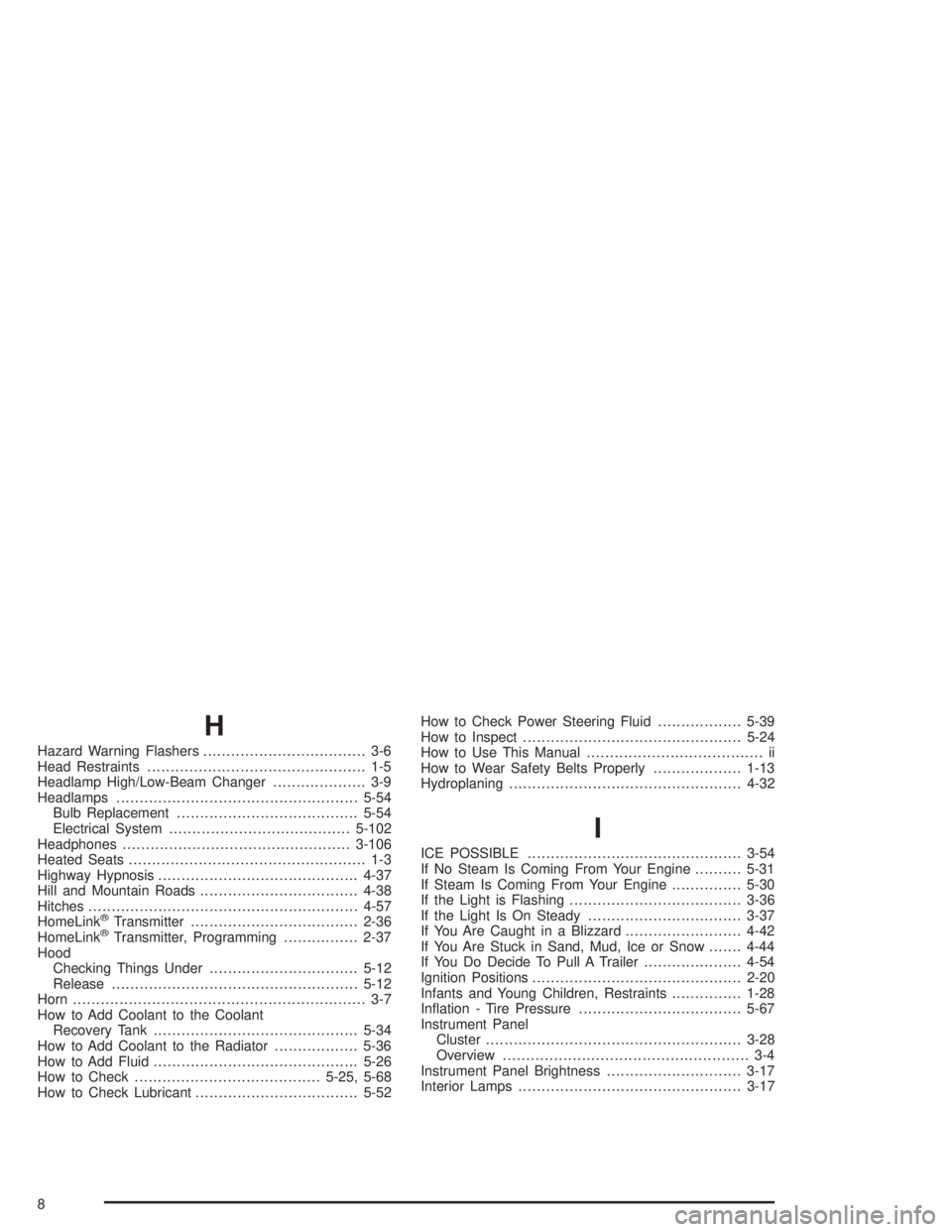
Hazard Warning Flashers................................... 3-6
Head Restraints............................................... 1-5
Headlamp High/Low-Beam Changer.................... 3-9
Headlamps....................................................5-54
Bulb Replacement.......................................5-54
Electrical System.......................................5-102
Headphones.................................................3-106
Heated Seats................................................... 1-3
Highway Hypnosis...........................................4-37
Hill and Mountain Roads..................................4-38
Hitches..........................................................4-57
HomeLink
®Transmitter....................................2-36
HomeLink®Transmitter, Programming................2-37
Hood
Checking Things Under................................5-12
Release.....................................................5-12
Horn............................................................... 3-7
How to Add Coolant to the Coolant
Recovery Tank............................................5-34
How to Add Coolant to the Radiator..................5-36
How to Add Fluid............................................5-26
How to Check........................................5-25, 5-68
How to Check Lubricant...................................5-52How to Check Power Steering Fluid..................5-39
How to Inspect...............................................5-24
How to Use This Manual...................................... ii
How to Wear Safety Belts Properly...................1-13
Hydroplaning..................................................4-32
I
ICE POSSIBLE..............................................3-54
If No Steam Is Coming From Your Engine..........5-31
If Steam Is Coming From Your Engine...............5-30
If the Light is Flashing.....................................3-36
If the Light Is On Steady.................................3-37
If You Are Caught in a Blizzard.........................4-42
If You Are Stuck in Sand, Mud, Ice or Snow.......4-44
If You Do Decide To Pull A Trailer.....................4-54
Ignition Positions.............................................2-20
Infants and Young Children, Restraints...............1-28
Ination - Tire Pressure...................................5-67
Instrument Panel
Cluster.......................................................3-28
Overview..................................................... 3-4
Instrument Panel Brightness.............................3-17
Interior Lamps................................................3-17
8
Page 448 of 452
S
Safety Belt
Reminder Light............................................3-30
Safety Belts
Care of......................................................5-96
Driver Position............................................1-13
How to Wear Safety Belts Properly................1-13
Questions and Answers About Safety Belts.....1-12
Rear Safety Belt Comfort Guides
for Children and Small Adults.....................1-23
Rear Seat Passengers.................................1-20
Right Front Passenger Position......................1-20
Safety Belt Extender....................................1-25
Safety Belt Use During Pregnancy.................1-19
Safety Belts Are for Everyone......................... 1-7
Safety Chains.................................................4-58
Safety Warnings and Symbols.............................. iii
Scanning the Terrain.......................................4-19
Scheduled Maintenance..................................... 6-4
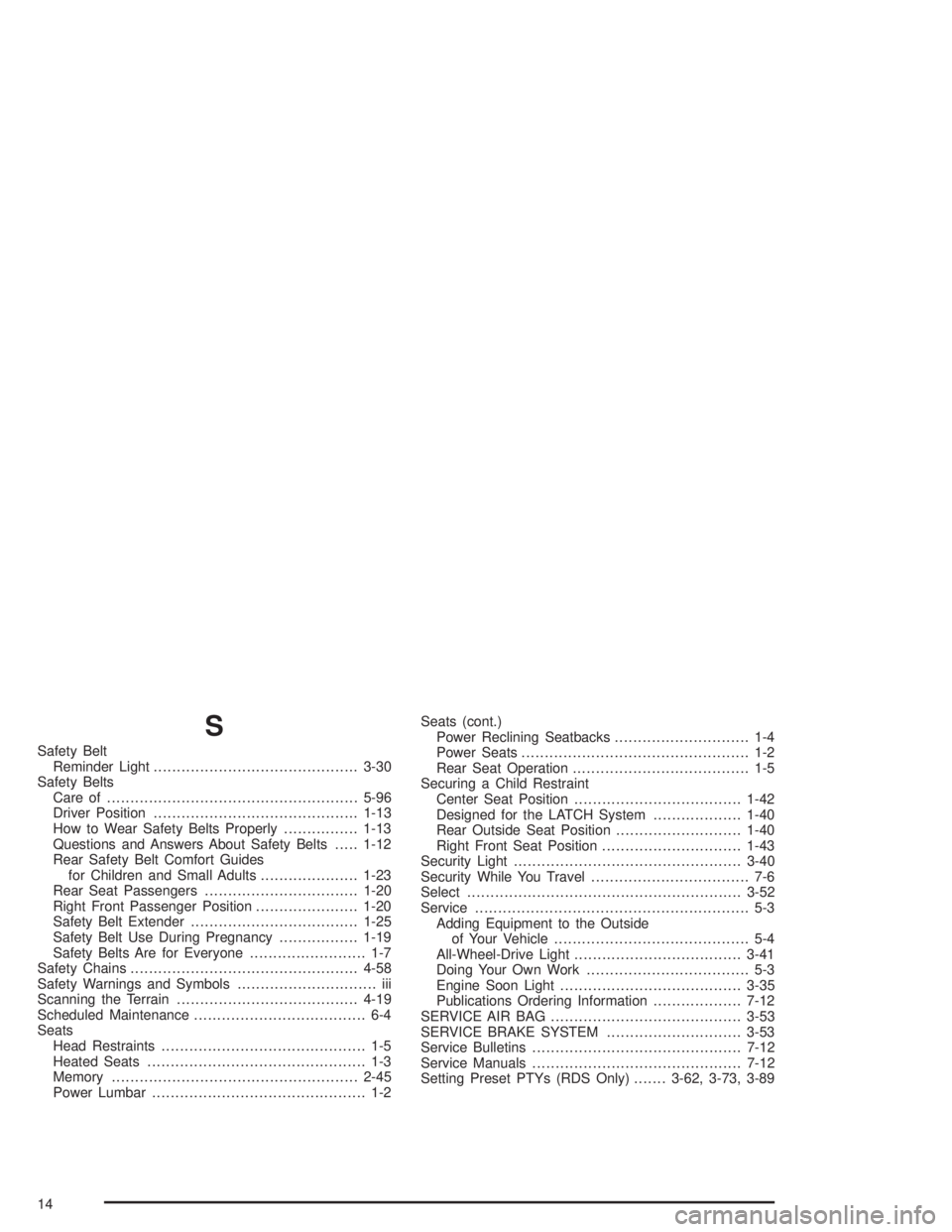
Seats
Head Restraints............................................ 1-5
Heated Seats............................................... 1-3
Memory.....................................................2-45
Power Lumbar.............................................. 1-2Seats (cont.)
Power Reclining Seatbacks............................. 1-4
Power Seats................................................. 1-2
Rear Seat Operation...................................... 1-5
Securing a Child Restraint
Center Seat Position....................................1-42
Designed for the LATCH System...................1-40
Rear Outside Seat Position...........................1-40
Right Front Seat Position..............................1-43
Security Light.................................................3-40
Security While You Travel.................................. 7-6
Select...........................................................3-52
Service........................................................... 5-3
Adding Equipment to the Outside
of Your Vehicle.......................................... 5-4
All-Wheel-Drive Light....................................3-41
Doing Your Own Work................................... 5-3
Engine Soon Light.......................................3-35
Publications Ordering Information...................7-12
SERVICE AIR BAG.........................................3-53
SERVICE BRAKE SYSTEM.............................3-53
Service Bulletins.............................................7-12
Service Manuals.............................................7-12
Setting Preset PTYs (RDS Only).......3-62, 3-73, 3-89
14