brakes BUICK RAINIER 2004 Owner's Guide
[x] Cancel search | Manufacturer: BUICK, Model Year: 2004, Model line: RAINIER, Model: BUICK RAINIER 2004Pages: 452, PDF Size: 4.51 MB
Page 283 of 452
Driving with a Trailer
{CAUTION:
If you have a rear-most window open and you
pull a trailer with your vehicle, carbon
monoxide (CO) could come into your vehicle.
You can not see or smell CO. It can cause
unconsciousness or death. SeeEngine
Exhaust on page 2-29. To maximize your safety
when towing a trailer:
Have your exhaust system inspected for
leaks, and make necessary repairs before
starting on your trip.
Keep the rear-most windows closed.
If exhaust does come into your vehicle
through a window in the rear or another
opening, drive with your front, main
heating or cooling system on and with
the fan on any speed. This will bring
fresh, outside air into your vehicle.
CAUTION: (Continued)
CAUTION: (Continued)
Do not use the climate control setting for
maximum air because it only recirculates
the air inside your vehicle. SeeDual
Automatic Climate Control System on
page 3-20.
Towing a trailer requires a certain amount of experience.
Before setting out for the open road, you’ll want to get
to know your rig. Acquaint yourself with the feel of
handling and braking with the added weight of the trailer.
And always keep in mind that the vehicle you are
driving is now a good deal longer and not nearly as
responsive as your vehicle is by itself.
Before you start, check all trailer hitch parts and
attachments, safety chains, electrical connection, lamps,
tires and mirror adjustment. If the trailer has electric
brakes, start your vehicle and trailer moving and then
apply the trailer brake controller by hand to be sure
the brakes are working. This lets you check your
electrical connection at the same time.
During your trip, check occasionally to be sure that the
load is secure, and that the lamps and any trailer
brakes are still working.
4-59
Page 285 of 452
Driving On Grades
Reduce speed and shift to a lower gearbeforeyou
start down a long or steep downgrade. If you don’t shift
down, you might have to use your brakes so much
that they would get hot and no longer work well.
You can tow in DRIVE (D). You may want to shift the
transmission to THIRD (3) or a lower gear, under heavy
loads or hilly conditions.
When towing at high altitude on steep uphill grades,
consider the following: Engine coolant will boil at a lower
temperature than at normal altitudes. If you turn your
engine off immediately after towing at high altitude
on steep uphill grades, your vehicle may show signs
similar to engine overheating. To avoid this, let the
engine run while parked (preferably on level ground)
with the automatic transmission in PARK (P) for a
few minutes before turning the engine off. If you do
get the overheat warning, seeEngine Overheating
on page 5-29.
Parking on Hills
{CAUTION:
You really should not park your vehicle, with
a trailer attached, on a hill. If something goes
wrong, your rig could start to move. People
can be injured, and both your vehicle and the
trailer can be damaged.
But if you ever have to park your rig on a hill, here’s
how to do it:
1. Apply your regular brakes, but don’t shift into
PARK (P) yet. When parking uphill, turn your wheels
away from the curb. When parking downhill, turn
your wheels into the curb.
2. Have someone place chocks under the trailer
wheels.
3. When the wheel chocks are in place, release the
regular brakes until the chocks absorb the load.
4. Reapply the regular brakes. Then apply your
parking brake, and then shift into PARK (P).
5. Release the regular brakes.
4-61
Page 286 of 452
When You Are Ready to Leave After
Parking on a Hill
1. Apply your regular brakes and hold the pedal
down while you:
start your engine,
shift into a gear, and
release the parking brake.
2. Let up on the brake pedal.
3. Drive slowly until the trailer is clear of the chocks.
4. Stop and have someone pick up and store the
chocks.
Maintenance When Trailer Towing
Your vehicle will need service more often when you’re
pulling a trailer. See the Maintenance Schedule for more
on this. Things that are especially important in trailer
operation are automatic transmission uid (don’t overll),
engine oil, axle lubricant, belt(s), cooling system and
brake system. Each of these is covered in this manual,
and the Index will help you nd them quickly. If you’re
trailering, it’s a good idea to review these sections before
you start your trip.
Check periodically to see that all hitch nuts and bolts
are tight.
4-62
Page 287 of 452
Trailer Wiring Harness
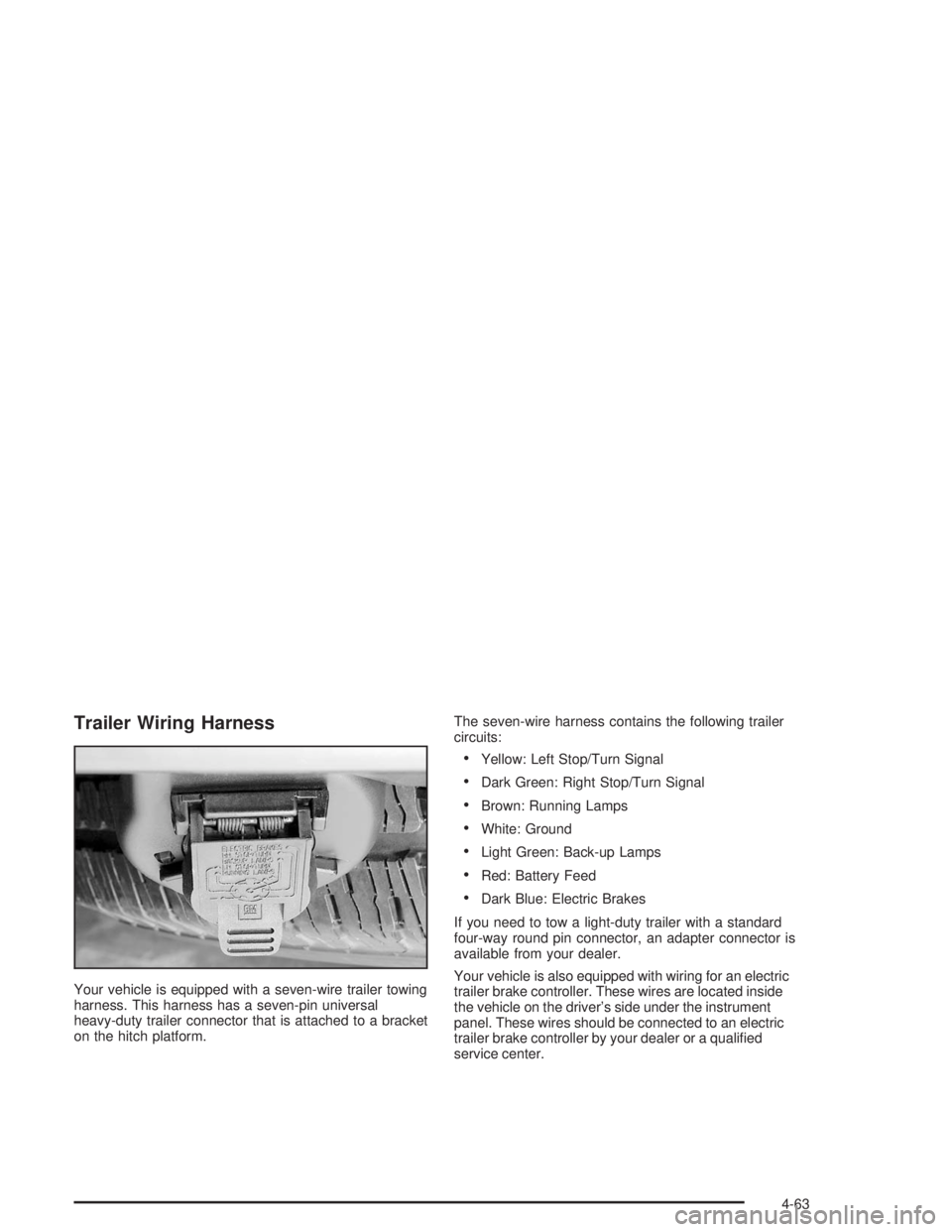
Your vehicle is equipped with a seven-wire trailer towing
harness. This harness has a seven-pin universal
heavy-duty trailer connector that is attached to a bracket
on the hitch platform.The seven-wire harness contains the following trailer
circuits:
Yellow: Left Stop/Turn Signal
Dark Green: Right Stop/Turn Signal
Brown: Running Lamps
White: Ground
Light Green: Back-up Lamps
Red: Battery Feed
Dark Blue: Electric Brakes
If you need to tow a light-duty trailer with a standard
four-way round pin connector, an adapter connector is
available from your dealer.
Your vehicle is also equipped with wiring for an electric
trailer brake controller. These wires are located inside
the vehicle on the driver’s side under the instrument
panel. These wires should be connected to an electric
trailer brake controller by your dealer or a qualied
service center.
4-63
Page 289 of 452
Service............................................................5-3
Doing Your Own Service Work.........................5-3
Adding Equipment to the Outside
of Your Vehicle...........................................5-4
Fuel................................................................5-4
Gasoline Octane............................................5-5
Gasoline Specications....................................5-5
California Fuel...............................................5-6
Additives.......................................................5-6
Fuels in Foreign Countries...............................5-7
Filling Your Tank............................................5-8
Filling a Portable Fuel Container.....................5-11
Checking Things Under the Hood....................5-12
Hood Release..............................................5-12
Engine Compartment Overview.......................5-14
Engine Oil...................................................5-18
Engine Air Cleaner/Filter................................5-23
Automatic Transmission Fluid.........................5-24
Engine Coolant.............................................5-27
Radiator Pressure Cap..................................5-29
Engine Overheating.......................................5-29
Cooling System............................................5-32
Engine Fan Noise.........................................5-38
Power Steering Fluid.....................................5-39
Windshield Washer Fluid................................5-40Brakes........................................................5-41
Battery........................................................5-44
Jump Starting...............................................5-45
All-Wheel Drive..............................................5-51
Rear Axle.......................................................5-51
Front Axle......................................................5-53
Bulb Replacement..........................................5-54
Headlamps..................................................5-54
Taillamps and Turn Signal Lamps...................5-54
Replacement Bulbs.......................................5-55
Windshield Wiper Blade Replacement..............5-56
Tires..............................................................5-59
Ination - Tire Pressure.................................5-67
Tire Inspection and Rotation...........................5-68
When It Is Time for New Tires.......................5-70
Buying New Tires.........................................5-71
Uniform Tire Quality Grading..........................5-72
Wheel Alignment and Tire Balance..................5-73
Wheel Replacement......................................5-74
Tire Chains..................................................5-75
Accessory Inator.........................................5-76
If a Tire Goes Flat........................................5-78
Changing a Flat Tire.....................................5-79
Spare Tire...................................................5-92
Section 5 Service and Appearance Care
5-1
Page 303 of 452
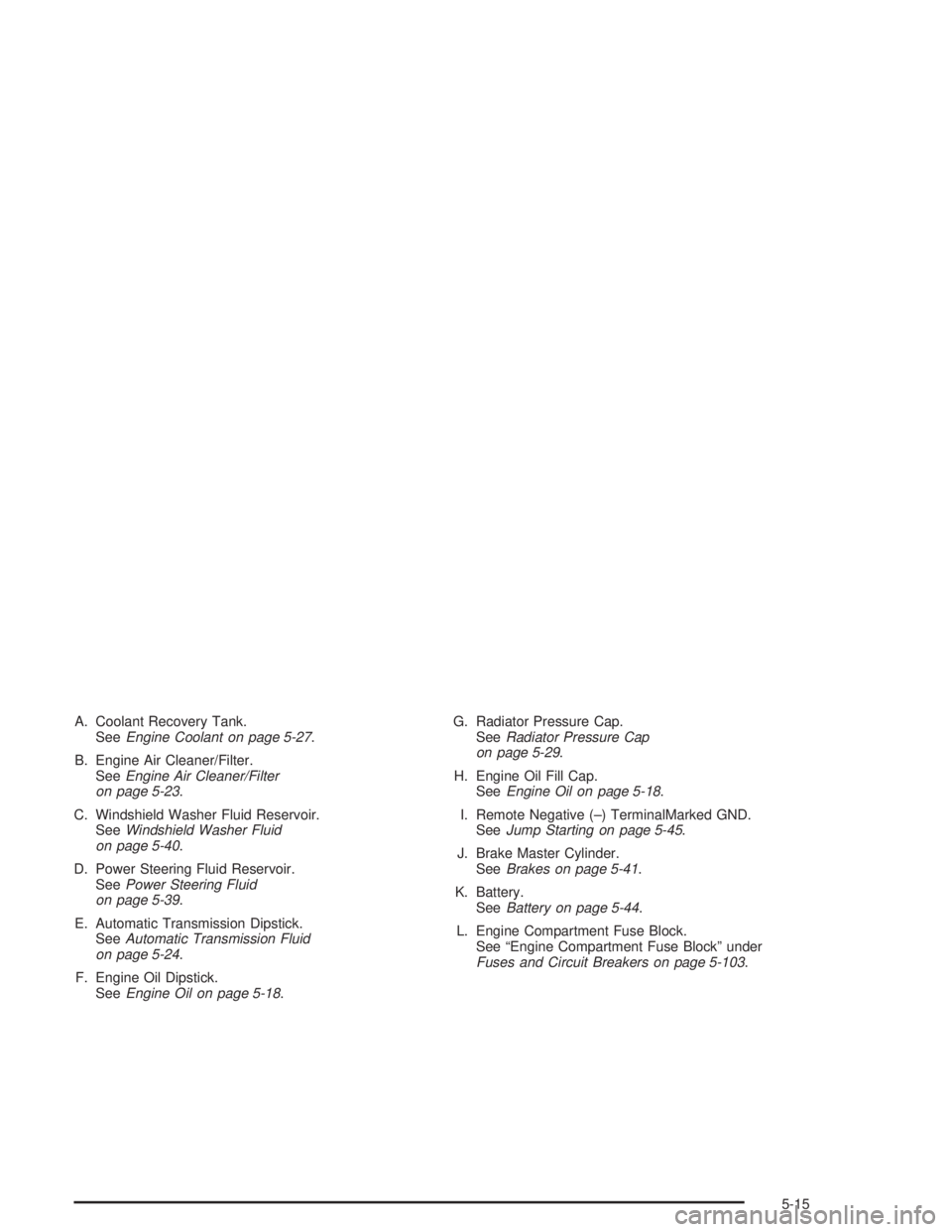
A. Coolant Recovery Tank.
SeeEngine Coolant on page 5-27.
B. Engine Air Cleaner/Filter.
SeeEngine Air Cleaner/Filter
on page 5-23.
C. Windshield Washer Fluid Reservoir.
SeeWindshield Washer Fluid
on page 5-40.
D. Power Steering Fluid Reservoir.
SeePower Steering Fluid
on page 5-39.
E. Automatic Transmission Dipstick.
SeeAutomatic Transmission Fluid
on page 5-24.
F. Engine Oil Dipstick.
SeeEngine Oil on page 5-18.G. Radiator Pressure Cap.
SeeRadiator Pressure Cap
on page 5-29.
H. Engine Oil Fill Cap.
SeeEngine Oil on page 5-18.
I. Remote Negative (–) TerminalMarked GND.
SeeJump Starting on page 5-45.
J. Brake Master Cylinder.
SeeBrakes on page 5-41.
K. Battery.
SeeBattery on page 5-44.
L. Engine Compartment Fuse Block.
See “Engine Compartment Fuse Block” under
Fuses and Circuit Breakers on page 5-103.
5-15
Page 305 of 452
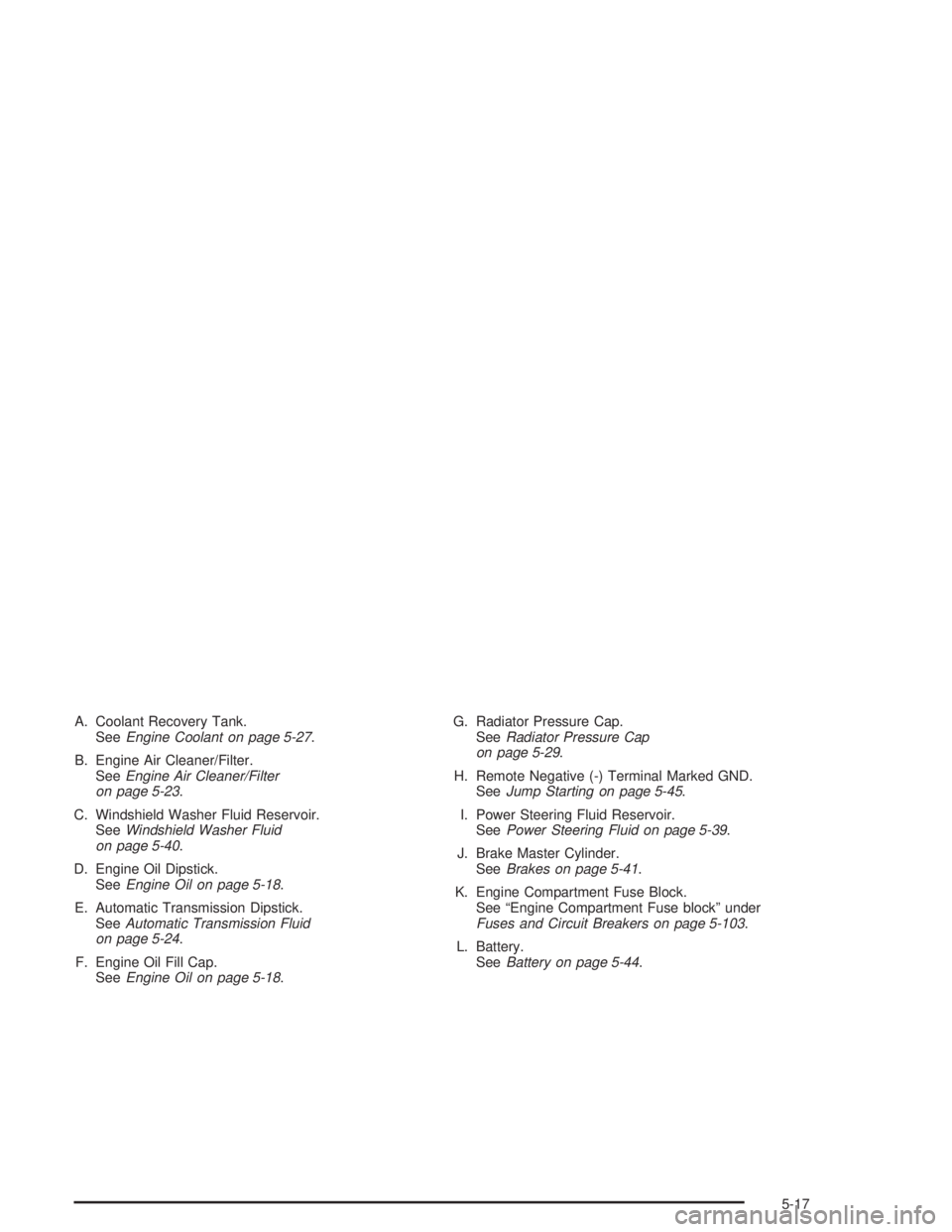
A. Coolant Recovery Tank.
SeeEngine Coolant on page 5-27.
B. Engine Air Cleaner/Filter.
SeeEngine Air Cleaner/Filter
on page 5-23.
C. Windshield Washer Fluid Reservoir.
SeeWindshield Washer Fluid
on page 5-40.
D. Engine Oil Dipstick.
SeeEngine Oil on page 5-18.
E. Automatic Transmission Dipstick.
SeeAutomatic Transmission Fluid
on page 5-24.
F. Engine Oil Fill Cap.
SeeEngine Oil on page 5-18.G. Radiator Pressure Cap.
SeeRadiator Pressure Cap
on page 5-29.
H. Remote Negative (-) Terminal Marked GND.
SeeJump Starting on page 5-45.
I. Power Steering Fluid Reservoir.
SeePower Steering Fluid on page 5-39.
J. Brake Master Cylinder.
SeeBrakes on page 5-41.
K. Engine Compartment Fuse Block.
See “Engine Compartment Fuse block” under
Fuses and Circuit Breakers on page 5-103.
L. Battery.
SeeBattery on page 5-44.
5-17
Page 329 of 452
Brakes
Brake Fluid
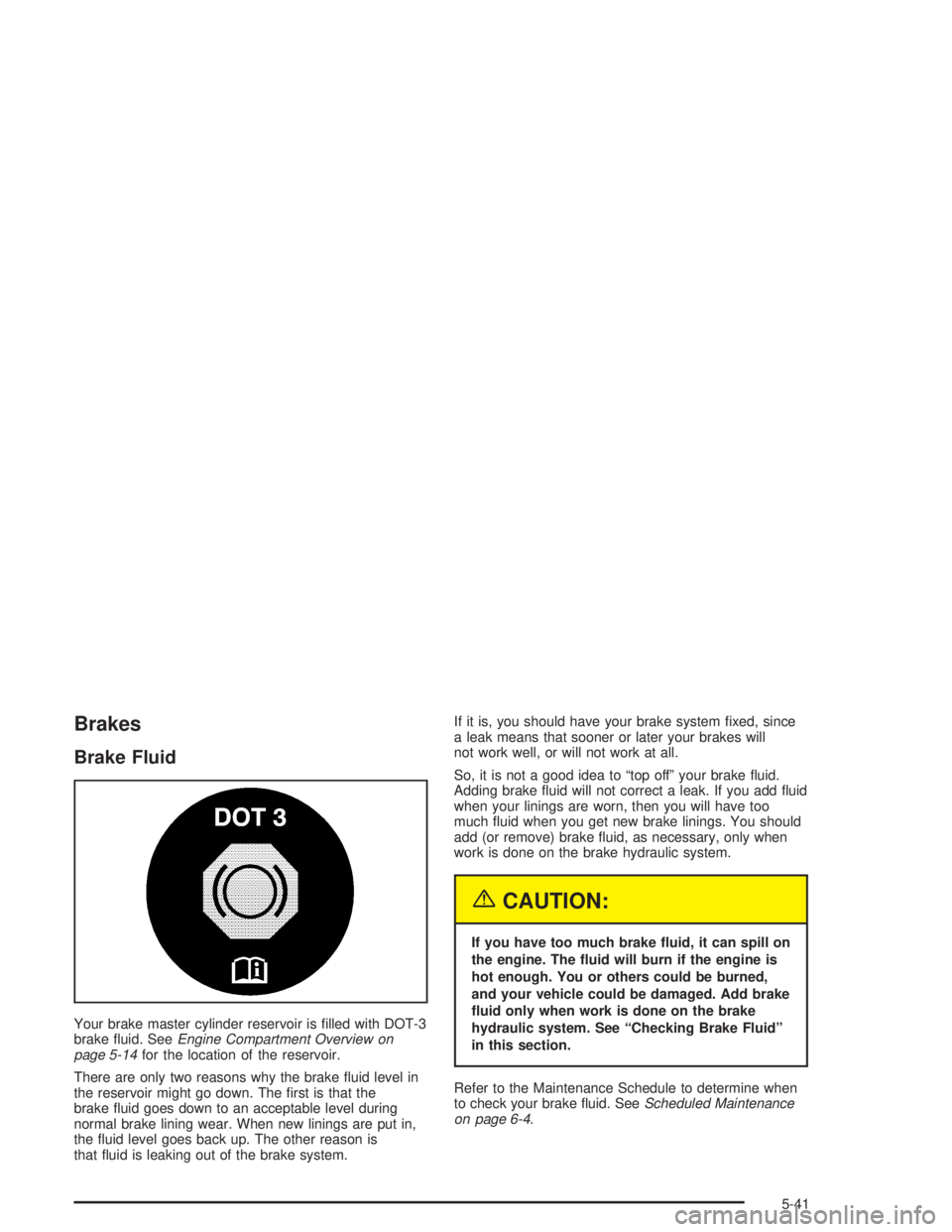
Your brake master cylinder reservoir is lled with DOT-3
brake uid. SeeEngine Compartment Overview on
page 5-14for the location of the reservoir.
There are only two reasons why the brake uid level in
the reservoir might go down. The rst is that the
brake uid goes down to an acceptable level during
normal brake lining wear. When new linings are put in,
the uid level goes back up. The other reason is
that uid is leaking out of the brake system.If it is, you should have your brake system xed, since
a leak means that sooner or later your brakes will
not work well, or will not work at all.
So, it is not a good idea to “top off” your brake uid.
Adding brake uid will not correct a leak. If you add uid
when your linings are worn, then you will have too
much uid when you get new brake linings. You should
add (or remove) brake uid, as necessary, only when
work is done on the brake hydraulic system.
{CAUTION:
If you have too much brake uid, it can spill on
the engine. The uid will burn if the engine is
hot enough. You or others could be burned,
and your vehicle could be damaged. Add brake
uid only when work is done on the brake
hydraulic system. See “Checking Brake Fluid”
in this section.
Refer to the Maintenance Schedule to determine when
to check your brake uid. SeeScheduled Maintenance
on page 6-4.
5-41
Page 330 of 452
Checking Brake Fluid
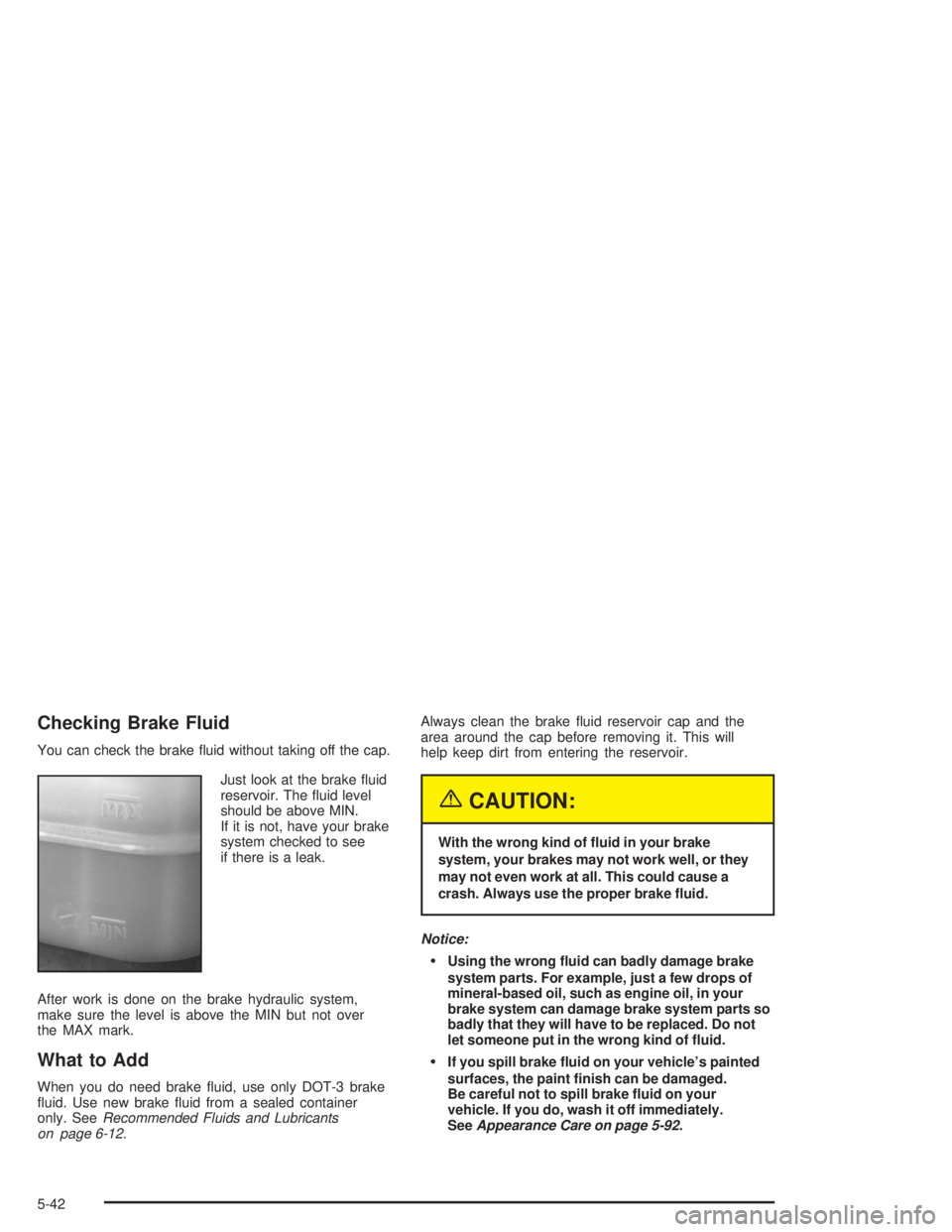
You can check the brake uid without taking off the cap.
Just look at the brake uid
reservoir. The uid level
should be above MIN.
If it is not, have your brake
system checked to see
if there is a leak.
After work is done on the brake hydraulic system,
make sure the level is above the MIN but not over
the MAX mark.
What to Add
When you do need brake uid, use only DOT-3 brake
uid. Use new brake uid from a sealed container
only. SeeRecommended Fluids and Lubricants
on page 6-12.Always clean the brake uid reservoir cap and the
area around the cap before removing it. This will
help keep dirt from entering the reservoir.
{CAUTION:
With the wrong kind of uid in your brake
system, your brakes may not work well, or they
may not even work at all. This could cause a
crash. Always use the proper brake uid.
Notice:
Using the wrong uid can badly damage brake
system parts. For example, just a few drops of
mineral-based oil, such as engine oil, in your
brake system can damage brake system parts so
badly that they will have to be replaced. Do not
let someone put in the wrong kind of uid.
If you spill brake uid on your vehicle’s painted
surfaces, the paint nish can be damaged.
Be careful not to spill brake uid on your
vehicle. If you do, wash it off immediately.
SeeAppearance Care on page 5-92.
5-42
Page 331 of 452
Brake Wear
Your vehicle has four-wheel disc brakes.
Disc brake pads have built-in wear indicators that make
a high-pitched warning sound when the brake pads
are worn and new pads are needed. The sound
may come and go or be heard all the time your vehicle
is moving (except when you are pushing on the
brake pedal rmly).
{CAUTION:
The brake wear warning sound means that
soon your brakes will not work well. That
could lead to an accident. When you hear the
brake wear warning sound, have your vehicle
serviced.Notice:Continuing to drive with worn-out brake
pads could result in costly brake repair.
Some driving conditions or climates may cause a brake
squeal when the brakes are rst applied or lightly
applied. This does not mean something is wrong with
your brakes.
Properly torqued wheel nuts are necessary to help
prevent brake pulsation. When tires are rotated, inspect
brake pads for wear and evenly tighten wheel nuts in
the proper sequence to GM torque specications.
Brake linings should always be replaced as complete
axle sets.Brake Pedal Travel
See your dealer if the brake pedal does not return to
normal height, or if there is a rapid increase in
pedal travel. This could be a sign of brake trouble.
Brake Adjustment
Every time you make a brake stop, your disc brakes
adjust for wear.
5-43