change wheel BUICK RAINIER 2005 User Guide
[x] Cancel search | Manufacturer: BUICK, Model Year: 2005, Model line: RAINIER, Model: BUICK RAINIER 2005Pages: 452, PDF Size: 2.6 MB
Page 264 of 452
Approaching a Hill
When you approach a hill, you need to decide if it is one
of those hills that is just too steep to climb, descend or
cross. Steepness can be hard to judge. On a very small
hill, for example, there may be a smooth, constant incline
with only a small change in elevation where you can
easily see all the way to the top. On a large hill, the incline
may get steeper as you near the top, but you may not see
this because the crest of the hill is hidden by bushes,
grass or shrubs.
Here are some other things to consider as you approach
a hill.
Is there a constant incline, or does the hill get
sharply steeper in places?
Is there good traction on the hillside, or will the
surface cause tire slipping?
Is there a straight path up or down the hill so you
will not have to make turning maneuvers?
Are there obstructions on the hill that can block your
path, such as boulders, trees, logs, or ruts?
What is beyond the hill? Is there a cliff, an
embankment, a drop-off, a fence? Get out and
walk the hill if you do not know. It is the smart way
to nd out.
Is the hill simply too rough? Steep hills often have
ruts, gullies, troughs and exposed rocks because
they are more susceptible to the effects of erosion.
Driving Uphill
Once you decide you can safely drive up the hill, you
need to take some special steps.
Use a low gear and get a rm grip on the steering
wheel.
Get a smooth start up the hill and try to maintain
your speed. Do not use more power than you
need, because you do not want your wheels to start
spinning or sliding.
Try to drive straight up the hill if at all possible. If
the path twists and turns, you might want to nd
another route.
{CAUTION:
Turning or driving across steep hills can be
dangerous. You could lose traction, slide
sideways, and possibly roll over. You could be
seriously injured or killed. When driving up
hills, always try to go straight up.
4-20
Page 270 of 452
Driving in Mud, Sand, Snow or Ice
When you drive in mud, snow or sand, your wheels will
not get good traction. You cannot accelerate as quickly,
turning is more difficult, and you will need longer braking
distances.
It is best to use a low gear when you are in mud — the
deeper the mud, the lower the gear. In really deep mud,
the idea is to keep your vehicle moving so you do not
get stuck.
When you drive on sand, you will sense a change in
wheel traction. But it will depend upon how loosely
packed the sand is. On loosely packed sand, such as on
beaches or sand dunes, your tires will tend to sink into
the sand. This has an effect on steering, accelerating and
braking. Drive at a reduced speed and avoid sharp turns
or abrupt maneuvers.
Hard packed snow and ice offer the worst tire traction.
On these surfaces, it is very easy to lose control.
On wet ice, for example, the traction is so poor that you
will have difficulty accelerating. And, if you do get
moving, poor steering and difficult braking can cause
you to slide out of control.{CAUTION:
Driving on frozen lakes, ponds or rivers can be
dangerous. Underwater springs, currents
under the ice, or sudden thaws can weaken the
ice. Your vehicle could fall through the ice and
you and your passengers could drown. Drive
your vehicle on safe surfaces only.
Driving in Water
Heavy rain can mean ash ooding, and ood waters
demand extreme caution.
Find out how deep the water is before you drive through
it. If it is deep enough to cover your wheel hubs,
axles or exhaust pipe, do not try it — you probably will
not get through. Also, water that deep can damage
your axle and other vehicle parts.
4-26
Page 287 of 452
Rocking Your Vehicle to Get It Out
First, turn your steering wheel left and right. That
will clear the area around your front wheels. Then shift
back and forth between REVERSE (R) and a forward
gear, spinning the wheels as little as possible. Release
the accelerator pedal while you shift, and press
lightly on the accelerator pedal when the transmission is
in gear. By slowly spinning your wheels in the forward
and reverse directions, you will cause a rocking
motion that may free your vehicle. If that does not get
you out after a few tries, you may need to be towed out.
If you do need to be towed out, seeTowing Your
Vehicle on page 4-50.
Loading Your Vehicle
It is very important to know how much weight your
vehicle can carry. This weight is called the vehicle
capacity weight and includes the weight of all occupants,
cargo and all nonfactory-installed options. Two labels
on your vehicle show how much weight it was designed
to carry, the Tire and Loading Information label and
the Certication/Tire label.
{CAUTION:
Do not load your vehicle any heavier than the
Gross Vehicle Weight Rating (GVWR), or either
the maximum front or rear Gross Axle Weight
Rating (GAWR). If you do, parts on your
vehicle can break, and it can change the way
your vehicle handles. These could cause you
to lose control and crash. Also, overloading
can shorten the life of your vehicle.
4-43
Page 292 of 452
Using heavier suspension components to get added
durability might not change your vehicle’s weight ratings.
Ask your dealer to help you load your vehicle the
right way.
Notice:Overloading your vehicle may cause
damage. Repairs would not be covered by your
warranty. Do not overload your vehicle.
If you put things inside your vehicle-like suitcases, tools,
packages, or anything else-they will go as fast as the
vehicle goes. If you have to stop or turn quickly, or
if there’s a crash, they’ll keep going.
{CAUTION:
Things you put inside your vehicle can strike
and injure people in a sudden stop or turn, or
in a crash.
Put things in the cargo area of your
vehicle. Try to spread the weight evenly.
Never stack heavier things, like suitcases,
inside the vehicle so that some of them
are above the tops of the seats.
CAUTION: (Continued)
CAUTION: (Continued)
Do not leave an unsecured child restraint
in your vehicle.
When you carry something inside the
vehicle, secure it whenever you can.
Do not leave a seat folded down unless
you need to.
There’s also important loading information for off-road
driving in this manual. See “Loading Your Vehicle
for Off-Road Driving” underOperating Your
All-Wheel-Drive Vehicle Off Paved Roads on page 4-15.
Electronically Controlled Air
Suspension System
Your vehicle may be equipped with an electronically
controlled air suspension system that automatically
keeps your vehicle level as you load and unload. The
system includes a compressor, two height sensors
and two air springs supporting the rear axle.
The system also has an internal clock to prevent
overheating. If the system overheats, all leveling function
stops until the system cools down. During this time, the
indicator light on the air inator system will be ashing.
4-48
Page 365 of 452
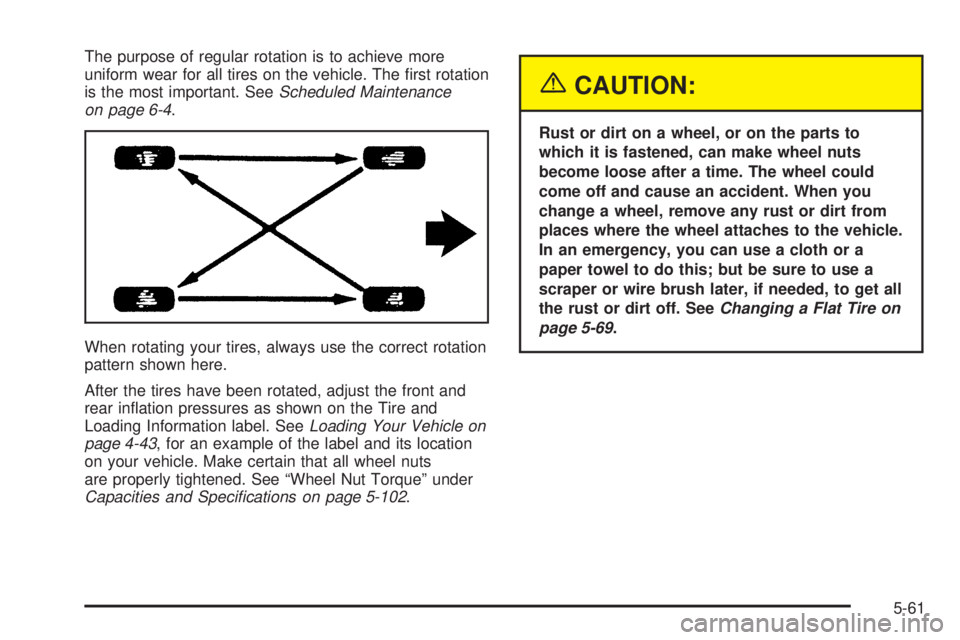
The purpose of regular rotation is to achieve more
uniform wear for all tires on the vehicle. The rst rotation
is the most important. SeeScheduled Maintenance
on page 6-4.
When rotating your tires, always use the correct rotation
pattern shown here.
After the tires have been rotated, adjust the front and
rear ination pressures as shown on the Tire and
Loading Information label. SeeLoading Your Vehicle on
page 4-43, for an example of the label and its location
on your vehicle. Make certain that all wheel nuts
are properly tightened. See “Wheel Nut Torque” under
Capacities and Specications on page 5-102.
{CAUTION:
Rust or dirt on a wheel, or on the parts to
which it is fastened, can make wheel nuts
become loose after a time. The wheel could
come off and cause an accident. When you
change a wheel, remove any rust or dirt from
places where the wheel attaches to the vehicle.
In an emergency, you can use a cloth or a
paper towel to do this; but be sure to use a
scraper or wire brush later, if needed, to get all
the rust or dirt off. SeeChanging a Flat Tire on
page 5-69.
5-61
Page 373 of 452
{CAUTION:
Lifting a vehicle and getting under it to do
maintenance or repairs is dangerous without
the appropriate safety equipment and training.
The jack provided with your vehicle is
designed only for changing a at tire. If it is
used for anything else, you or others could be
badly injured or killed if the vehicle slips off
the jack. Use the jack provided with your
vehicle only for changing a at tire.
If a tire goes at, the next part shows how to use your
jacking equipment to change a at tire safely.
Changing a Flat Tire
If a tire goes at, avoid further tire and wheel damage
by driving slowly to a level place. Turn on your
hazard warning ashers.
{CAUTION:
Changing a tire can be dangerous. The vehicle
can slip off the jack and roll over or fall on you
or other people. You and they could be badly
injured or even killed. Find a level place to
change your tire. To help prevent the vehicle
from moving:
1. Set the parking brake rmly.
2. Put the shift lever in PARK (P).
3. Turn off the engine and do not restart
while the vehicle is raised.
4. Do not allow passengers to remain in the
vehicle.
To be even more certain the vehicle will not
move, you should put blocks at the front and
rear of the tire farthest away from the one
being changed. That would be the tire, on the
other side, at the opposite end of the vehicle.
5-69
Page 374 of 452
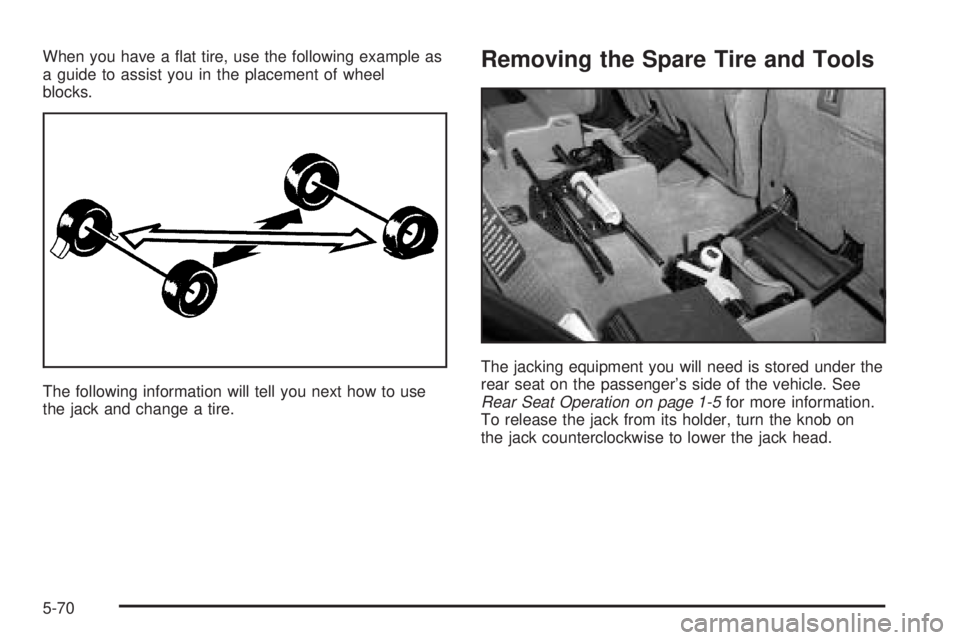
When you have a at tire, use the following example as
a guide to assist you in the placement of wheel
blocks.
The following information will tell you next how to use
the jack and change a tire.Removing the Spare Tire and Tools
The jacking equipment you will need is stored under the
rear seat on the passenger’s side of the vehicle. See
Rear Seat Operation on page 1-5for more information.
To release the jack from its holder, turn the knob on
the jack counterclockwise to lower the jack head.
5-70
Page 378 of 452
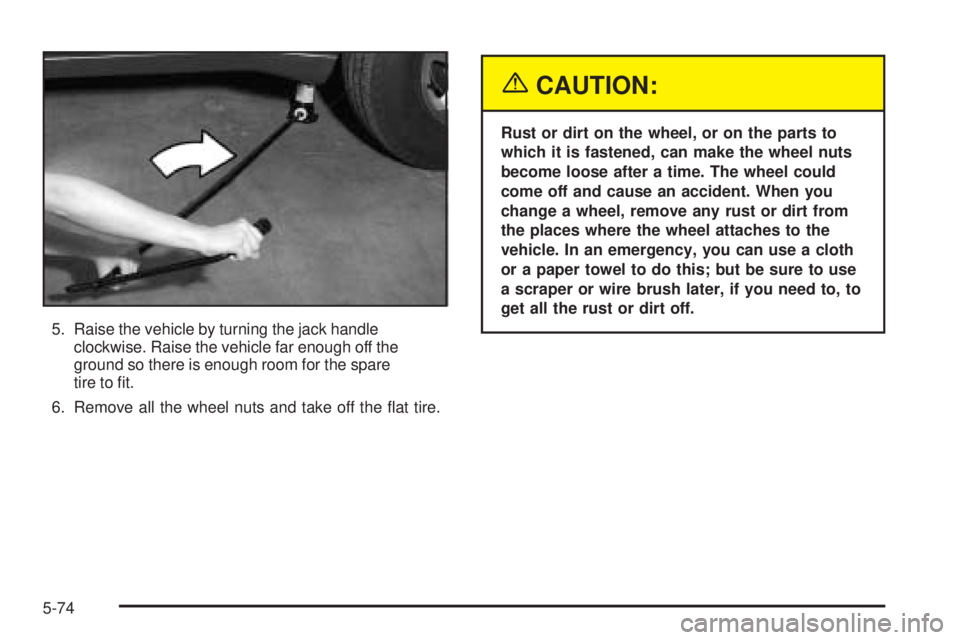
5. Raise the vehicle by turning the jack handle
clockwise. Raise the vehicle far enough off the
ground so there is enough room for the spare
tire to t.
6. Remove all the wheel nuts and take off the at tire.
{CAUTION:
Rust or dirt on the wheel, or on the parts to
which it is fastened, can make the wheel nuts
become loose after a time. The wheel could
come off and cause an accident. When you
change a wheel, remove any rust or dirt from
the places where the wheel attaches to the
vehicle. In an emergency, you can use a cloth
or a paper towel to do this; but be sure to use
a scraper or wire brush later, if you need to, to
get all the rust or dirt off.
5-74
Page 445 of 452
Instrument Panel
Brightness..................................................3-16
Cluster.......................................................3-26
Overview..................................................... 3-4
J
Jump Starting.................................................5-41
K
Keyless Entry System....................................... 2-4
Keys............................................................... 2-3
L
Labelling, Tire Sidewall....................................5-54
Lamps
Battery Run-Down Protection.........................3-18
Dome........................................................3-16
Dome Lamp Override...................................3-17
Fog ...........................................................3-16
Reading.....................................................3-17LATCH System
Child Restraints...........................................1-38
Securing a Child Restraint Designed for the
LATCH System........................................1-40
Liftgate/Liftglass..............................................2-13
Liftglass/Liftgate..............................................2-13
Light
Airbag Readiness........................................3-29
Anti-Lock Brake System Warning...................3-34
Brake System Warning.................................3-32
Change Engine Oil......................................3-39
Charging System.........................................3-31
Check Gages Warning.................................3-41
Check Gas Cap..........................................3-42
Cruise Control.............................................3-40
Gate Ajar...................................................3-41
Highbeam On.............................................3-40
Low Fuel Warning.......................................3-42
Malfunction Indicator....................................3-35
Passenger Airbag Status Indicator..................3-30
Reduced Engine Power................................3-40
Safety Belt Reminder...................................3-28
Security.....................................................3-39
Service All-Wheel-Drive................................3-41
Lighting
Entry.........................................................3-17
Exit...........................................................3-17
7
Page 447 of 452
O
Odometer......................................................3-27
Odometer, Trip...............................................3-27
Off-Road Recovery..........................................4-12
Oil
Change Engine Oil Light...............................3-39
Engine.......................................................5-16
Pressure Gage............................................3-38
Older Children, Restraints................................1-26
Online Owner Center........................................ 7-3
OnStar
®System.............................................2-40
Operating Your All-Wheel-Drive Vehicle Off
Paved Roads..............................................4-15
Other Warning Devices...................................... 3-6
Outlet Adjustment............................................3-24
Outside
Convex Mirror.............................................2-40
Curb View Assist Mirror................................2-39
Heated Mirrors............................................2-40
Power Mirror...............................................2-39
Overhead Console..........................................2-46
Owner Checks and Services.............................. 6-9
Owners, Canadian............................................... ii
P
Park (P)
Shifting Into................................................2-26
Shifting Out of............................................2-27
Parking
Brake........................................................2-25
Over Things That Burn.................................2-28
Passenger Airbag Status Indicator.....................3-30
Passenger Sensing System..............................1-55
Passing.........................................................4-12
Passlock
®......................................................2-18
Personalization, Climate Controls......................3-25
Power
Accessory Outlets........................................3-18
Door Locks.................................................. 2-8
Electrical System.........................................5-92
Lumbar Controls........................................... 1-2
Reclining Seatbacks...................................... 1-4
Reduced Engine Light..................................3-40
Retained Accessory (RAP)............................2-19
Seat............................................................ 1-2
Steering Fluid.............................................5-35
Windows....................................................2-15
Pretensioners, Safety Belt................................1-25
Programmable Automatic Door Locks.................. 2-9
Programming the HomeLink
®Transmitter...........2-43
9