steering wheel BUICK RANDEZVOUS 2003 Owner's Guide
[x] Cancel search | Manufacturer: BUICK, Model Year: 2003, Model line: RANDEZVOUS, Model: BUICK RANDEZVOUS 2003Pages: 432, PDF Size: 2.75 MB
Page 273 of 432

If you have traction control, keep the system on. It will
improve your ability to accelerate when driving on a
slippery road. But you can turn the traction system off if
your vehicle ever gets stuck in sand, mud, ice or
snow. SeeIf You Are Stuck: In Sand, Mud, Ice or Snow
on page 4-30. Even though your vehicle has a traction
system, you’ll want to slow down and adjust your driving
to the road conditions. SeeTraction Control System
(TCS) on page 4-10.
If you don’t have a traction system, accelerate gently.
Try not to break the gentle traction. If you accelerate too
fast, the drive wheels will spin and polish the surface
under the tires even more.
Unless you have the anti-lock braking system, you’ll
want to brake very gently, too. (If you do have anti-lock,
seeBraking on page 4-7. This system improves your
vehicle’s stability when you make a hard stop on a
slippery road.) Whether you have the anti-lock braking
system or not, you’ll want to begin stopping sooner than
you would on dry pavement. Without anti-lock brakes,
if you feel your vehicle begin to slide, let up on the
brakes a little. Push the brake pedal down steadily to
get the most traction you can.Remember, unless you have anti-lock, if you brake so
hard that your wheels stop rolling, you’ll just slide. Brake
so your wheels always keep rolling and you can still
steer.
Whatever your braking system, allow greater
following distance on any slippery road.
Watch for slippery spots. The road might bene
until you hit a spot that’s covered with ice. On
an otherwise clear road, ice patches may appear in
shaded areas where the sun can’t reach: around
clumps of trees, behind buildings or under bridges.
Sometimes the surface of a curve or an overpass
may remain icy when the surrounding roads
are clear. If you see a patch of ice ahead of you,
brake before you are on it. Try not to brake
while you’re actually on the ice, and avoid sudden
steering maneuvers.
4-27
2003 - Rendezvous OM
Page 276 of 432

If You Are Stuck: In Sand, Mud, Ice
or Snow
In order to free your vehicle when it is stuck, you will
need to spin the wheels, but you don’t want to spin your
wheels too fast. The method known as“rocking”can
help you get out when you’re stuck, but you must
use caution.
{CAUTION:
If you let your tires spin at high speed, they
can explode, and you or others could be
injured. And, the transaxle or other parts of the
vehicle can overheat. That could cause an
engine compartmentfire or other damage.
When you’re stuck, spin the wheels as little as
possible. Don’t spin the wheels above 35 mph
(55 km/h) as shown on the speedometer.
Notice:Spinning your wheels can destroy parts of
your vehicle as well as the tires. If you spin the
wheels too fast while shifting your transaxle back
and forth, you can destroy your transaxle. See
“Rocking Your Vehicle To Get It Out.”For information about using tire chains on your vehicle,
seeTire Chains on page 5-56.
Rocking Your Vehicle To Get It Out
First, turn your steering wheel left and right. That will
clear the area around your front wheels. If your vehicle
has traction control, you should turn your traction
control system off. SeeTraction Control System (TCS)
on page 4-10. Then shift back and forth between
REVERSE (R) and a forward gear, spinning the wheels
as little as possible. Release the accelerator pedal
while you shift, and press lightly on the accelerator pedal
when the transaxle is in gear. By slowly spinning your
wheels in the forward and reverse directions, you
will cause a rocking motion that may free your vehicle. If
that doesn’t get you out after a few tries, you may
need to be towed out. If you do need to be towed out,
see“Towing Your Vehicle”following.
4-30
2003 - Rendezvous OM
Page 278 of 432

Dolly Towing
If you have a two-wheel-drive vehicle, it can be towed
with two of its wheels on the ground. To dolly tow
your vehicle, do the following:
1. Put the front wheels on a dolly.
2. Put the vehicle in PARK (P).
3. Set the parking brake and then remove the key.
4. Clamp the steering wheel in a straight-ahead
position with a clamping device designed for towing.
5. Release the parking brake.
If you have an all-wheel-drive vehicle, it cannot be
towed with any of its wheels on the ground. It can be
towed with car carrier equipment.
Notice:Towing an all-wheel-drive vehicle with all
four wheels on the ground, or even with only two of
its wheels on the ground, will damage drivetrain
components. Don’t tow an all-wheel-drive vehicle if
any of its wheels will be on the ground.
Loading Your Vehicle
The Certication/Tire Label is found on the rear edge of
the driver’s door.
The label shows the size of your original tires and the
ination pressures needed to obtain the gross weight
capacity of your vehicle. This is called the Gross Vehicle
Weight Rating (GVWR). The GVWR includes the
weight of the vehicle, all occupants, fuel and cargo.
The Certication/Tire Label also tells you the maximum
weights for the front and rear axles, called the Gross
Axle Weight Rating (GAWR). Tond out the actual loads
on your front and rear axles, you need to go to a
4-32
2003 - Rendezvous OM
Page 285 of 432

Passing
You’ll need more passing distance up ahead when
you’re towing a trailer. And, because you’re a good deal
longer, you’ll need to go much farther beyond the
passed vehicle before you can return to your lane.
Backing Up
Hold the bottom of the steering wheel with one hand.
Then, to move the trailer to the left, just move that hand
to the left. To move the trailer to the right, move your
hand to the right. Always back up slowly and, if possible,
have someone guide you.
Making Turns
Notice:Making very sharp turns while trailering
could cause the trailer to come in contact with the
vehicle. Your vehicle could be damaged. Avoid
making very sharp turns while trailering.
When you’re turning with a trailer, make wider turns
than normal. Do this so your trailer won’t strike
soft shoulders, curbs, road signs, trees or other objects.
Avoid jerky or sudden maneuvers. Signal well in
advance.
Turn Signals When Towing a Trailer
When you tow a trailer, your vehicle has to have extra
wiring.
The arrows on your instrument panel willash whenever
you signal a turn or lane change. Properly hooked up,
the trailer lamps will alsoash, telling other drivers
you’re about to turn, change lanes or stop.
When towing a trailer, the arrows on your instrument
panel willash for turns even if the bulbs on the trailer
are burned out. Thus, you may think drivers behind
you are seeing your signal when they are not. It’s
important to check occasionally to be sure the trailer
bulbs are still working.
4-39
2003 - Rendezvous OM
Page 289 of 432

Service............................................................5-3
Doing Your Own Service Work.........................5-3
Adding Equipment to the Outside of
Your Vehicle..............................................5-4
Fuel................................................................5-4
Gasoline Octane............................................5-4
Gasoline Specifications....................................5-5
California Fuel...............................................5-5
Additives.......................................................5-6
Fuels in Foreign Countries...............................5-6
Filling Your Tank............................................5-6
Filling a Portable Fuel Container.......................5-8
Checking Things Under
the Hood......................................................5-9
Hood Release................................................5-9
Engine Compartment Overview.......................5-10
Engine Oil...................................................5-11
Engine Air Cleaner/Filter................................5-15
Automatic Transaxle Fluid..............................5-17
Engine Coolant.............................................5-19
Radiator Pressure Cap..................................5-21
Engine Overheating.......................................5-22
Cooling System............................................5-24
Power Steering Fluid.....................................5-31Windshield Washer Fluid................................5-32
Brakes........................................................5-33
Battery........................................................5-36
Jump Starting...............................................5-36
All-Wheel Drive..............................................5-41
Bulb Replacement..........................................5-42
Halogen Bulbs..............................................5-43
Headlamps..................................................5-43
Front Turn Signal, Sidemarker and
Parking Lamps..........................................5-44
Taillamps, Turn Signal, and Stoplamps............5-45
Taillamps and Back-Up Lamps.......................5-45
Replacement Bulbs.......................................5-46
Windshield Wiper Blade Replacement..............5-47
Tires..............................................................5-48
Inflation -- Tire Pressure................................5-49
Check Tire Pressure System..........................5-49
Tire Inspection and Rotation...........................5-51
When It Is Time for New Tires
.......................5-52
Buying New Tires
.........................................5-53
Uniform Tire Quality Grading
..........................5-54
Wheel Alignment and Tire Balance
..................5-55
Wheel Replacement
......................................5-55
Section 5Service and Appearance Care
5-1
2003 - Rendezvous OM
Page 346 of 432

If the accessory inflator system does not turn on or the
light does not come on, the fuse may be blown or
installed incorrectly. SeeFuses and Circuit Breakers on
page 5-86or see your dealer for service.
Your accessory inflator will automatically shut off after
about 10 minutes. The light in the switch will blink. After
about one minute you can use the system again. Press
the inflator switch and the indicator light will come on.
Notice:Don’t run your accessory inflator for longer
than 30 minutes at one time. If you do, you may
damage the system.
After running the accessory inflator for 30 minutes, wait
at least 10 minutes before restarting the accessory
inflator.
To turn off the inflator, do the following:
1. Press the switch and detach the hose,first from the
inflated object, then from the outlet.
2. Put the protective cap back on.
3. Place the inflator kit tools in the pouch, and store in
the glove box.
To put the cover back on, line up the tabs at the back of
the cover and put it in place. Push down the tab to
secure the cover.If a Tire Goes Flat
It’s unusual for a tire to“blowout”while you’re driving,
especially if you maintain your tires properly. If air goes
out of a tire, it’s much more likely to leak out slowly.
But if you should ever have a“blowout”, here are a few
tips about what to expect and what to do:
If a front tire fails, theflat tire will create a drag that
pulls the vehicle toward that side. Take your foot off the
accelerator pedal and grip the steering wheelfirmly.
Steer to maintain lane position, and then gently brake to
a stop well out of the traffic lane.
A rear blowout, particularly on a curve, acts much like a
skid and may require the same correction you’d use
in a skid. In any rear blowout, remove your foot from the
accelerator pedal. Get the vehicle under control by
steering the way you want the vehicle to go. It may be
very bumpy and noisy, but you can still steer. Gently
brake to a stop—well off the road if possible.
If a tire goesflat, the next part shows how to use your
jacking equipment to change aflat tire safely.
5-58
2003 - Rendezvous OM
Page 375 of 432
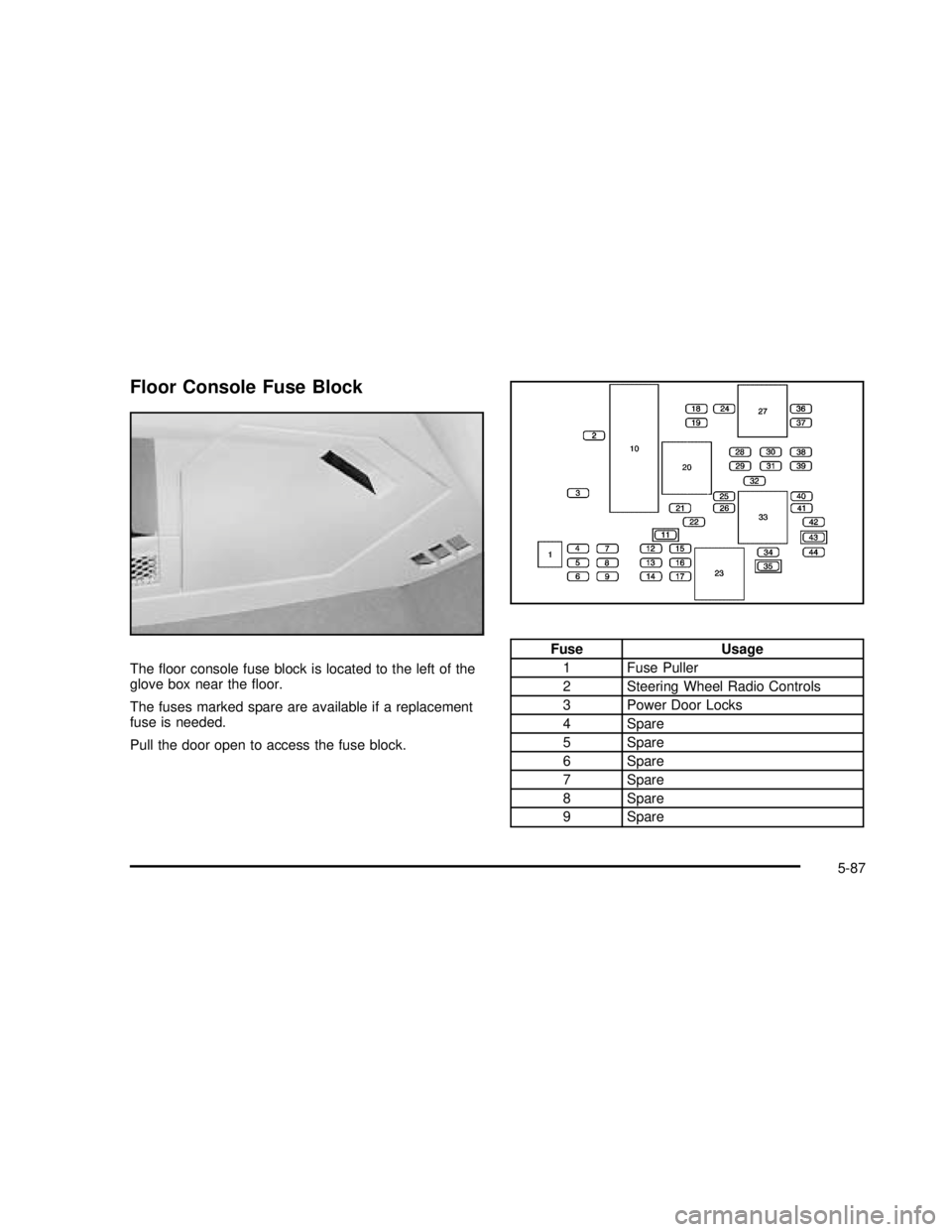
Floor Console Fuse Block
Thefloor console fuse block is located to the left of the
glove box near thefloor.
The fuses marked spare are available if a replacement
fuse is needed.
Pull the door open to access the fuse block.
Fuse Usage
1 Fuse Puller
2 Steering Wheel Radio Controls
3 Power Door Locks
4 Spare
5 Spare
6 Spare
7 Spare
8 Spare
9 Spare
5-87
2003 - Rendezvous OM
Page 383 of 432

Maintenance Schedule......................................6-2
Introduction...................................................6-2
Your Vehicle and the Environment....................6-2
Maintenance Requirements..............................6-2
How This Section is Organized.........................6-3
Part A: Scheduled Maintenance Services...........6-4
Using Your Maintenance Schedule....................6-4
Scheduled Maintenance...................................6-5
Part B: Owner Checks and Services.................6-9
At Each Fuel Fill............................................6-9
At Least Once a Month...................................6-9
At Least Twice a Year....................................6-9At Least Once a Year...................................6-10
Part C: Periodic Maintenance Inspections.........6-13
Steering, Suspension and Front Drive Axle
Boot and Seal Inspection............................6-13
Exhaust System Inspection............................6-13
Fuel System Inspection..................................6-13
Engine Cooling System Inspection...................6-13
Throttle System Inspection.............................6-14
All-Wheel Drive Inspection..............................6-14
Brake System Inspection................................6-14
Part D: Recommended Fluids and Lubricants......6-15
Part E: Maintenance Record...........................6-16
Section 6 Maintenance Schedule
6-1
2003 - Rendezvous OM
Page 411 of 432

A
About Driving Your Vehicle.....................................ii
Accessory Inflator...........................................5-57
Accessory Power Outlets.................................3-23
Adding Washer Fluid.......................................5-32
Additional Program Information........................... 7-8
Additives, Fuel................................................. 5-6
Add-On Electrical Equipment............................5-85
Adjusting the Captain’s Chairs
(Second Row).............................................1-12
Adjusting the Speakers....................3-67, 3-74, 3-84
Air Bag
Readiness Light..........................................3-37
Air Bag Systems.............................................1-67
How Does an Air Bag Restrain?....................1-73
Servicing Your Air Bag-Equipped Vehicle.........1-76
What Makes an Air Bag Inflate?....................1-73
What Will You See After an Air Bag Inflates?......1-74
When Should an Air Bag Inflate?...................1-72
Where Are the Air Bags?..............................1-70
Air Cleaner/Filter, Engine.................................5-15
All Overseas Locations...................................... 7-4
All-Wheel Drive......................................5-41, 5-77
All-Wheel Drive Disable Warning Message..........3-49
All-Wheel-Drive (AWD) System.........................4-11
Aluminum or Chrome-Plated Wheels..................5-82
AM .............................................................3-108
Antenna, Integrated Windshield.......................3-110Antenna, XM™ Satellite Radio Antenna System . . . 3-110
Anti-lock Brake System (ABS)............................ 4-8
Anti-Lock Brake, System Warning Light..............3-39
Appearance Care............................................5-77
Care of Safety Belts....................................5-80
Chemical Paint Spotting...............................5-83
Cleaning the Inside of Your Vehicle................5-78
Cleaning the Outside of Your Vehicle..............5-80
Finish Damage............................................5-83
GM Vehicle Care/Appearance Materials..........5-83
Sheet Metal Damage...................................5-82
Underbody Maintenance...............................5-83
Weatherstrips..............................................5-80
Arming with the Power Lock Switch...................2-15
Arming with the Remote Keyless Entry
Transmitter
.................................................2-16
Ashtrays
........................................................3-24
Audio Speakers
..............................................3-95
Audio System(s)
.............................................3-64
Audio Steering Wheel Controls
....................3-107
Care of Your Cassette Tape Player
...............3-108
Care of Your CD and DVD Player
................3-109
Care of Your CDs and DVDs
.......................3-109
Integrated Windshield Antenna
.....................3-110
Radio with Cassette and CD
.........................3-71
Radio with CD
............................................3-65
Radio with Six-Disc CD
................................3-82
Rear Seat Audio (RSA)
...............................3-105
1
2003 - Rendezvous OM
Page 418 of 432

Inspection
Brake System
.............................................6-14
Engine Cooling System
................................6-13
Exhaust System
..........................................6-13
Fuel System
...............................................6-13
Part C - Periodic Maintenance
.......................6-13
Steering, Suspension and Front Drive Axle
Boot and Seal
.........................................6-13
Throttle System
...........................................6-14
All-Wheel Drive
...........................................6-14
Instrument Panel
Cluster
.......................................................3-34
Overview
..................................................... 3-4
Switchbank
.................................................3-18
Instrument Panel Brightness
.............................3-14
Integrated Windshield Antenna
........................3-110
Interior Lamps
................................................3-14
Interior Lamps Control
.....................................3-14
Interior Lighting Delay
......................................3-58
Interior Lighting On
.........................................3-59
Interior Plastic Components
..............................5-80
J
Jump Starting
.................................................5-36
K
Key Lock Cylinders Service..............................6-10
Keyless Entry System....................................... 2-5
Keys............................................................... 2-3
L
Lamps
Exterior......................................................3-12
Interior.......................................................3-14
Lamps on Reminder........................................3-13
Lap-Shoulder Belt...........................1-24, 1-35, 1-38
LATCH System
Child Restraints...........................................1-59
Securing a Child Restraint Designed for the
LATCH System........................................1-61
Leather.........................................................5-79
Leaving Your Vehicle.......................................2-11
Leaving Your Vehicle With the Engine Running......2-27
Liftgate..........................................................2-11
Liftgate Release..............................................2-12
Light
Air Bag Readiness.......................................3-37
Anti-Lock Brake System Warning...................3-39
Brake System Warning.................................3-38
Cruise Control.............................................3-43
8
2003 - Rendezvous OM