power steering BUICK RANDEZVOUS 2003 Owner's Manual
[x] Cancel search | Manufacturer: BUICK, Model Year: 2003, Model line: RANDEZVOUS, Model: BUICK RANDEZVOUS 2003Pages: 432, PDF Size: 2.75 MB
Page 103 of 432

Ignition Positions
With the key in the ignition, you can turn the key to four
different positions.
A (OFF):This is the only position in which you can
remove the key. This position locks the steering wheel,
ignition and transaxle.Notice:If your key seems stuck in OFF and you
can’t turn it, be sure you are using the correct key;
if so, is it all the way in? If it is, then turn the
steering wheel left and right while you turn the key
hard. Turn the key only with your hand. Using a
tool to force it could break the key or the ignition
switch. If none of these works, then your vehicle
needs service.
B (ACCESSORY):This position allows you to use
things like the radio and the windshield wipers while the
engine is off. This position will allow you to turn off
the engine, but still turn the steering wheel. Use
ACCESSORY if you must have your vehicle in motion
while the engine is off, for example, if your vehicle
is being pushed or towed.
C (ON):This is the position that the switch returns to
after you start your engine and release the key.
The switch stays in ON when the engine is running. But
even when the engine is not running, you can use
ON to operate your electrical power accessories, and to
display some instrument panel warning lights.
D (START):This position starts the engine. When the
engine starts, release the key. The ignition switch
will return to ON for normal driving.
If the engine is not running, ACCESSORY and ON are
positions that allow you to operate your electrical
accessories, such as the radio.
2-19
2003 - Rendezvous OM
Page 141 of 432

The main components of the instrument panel are the
following:
A. Exterior/Interior Lamps Control
B. Turn Signal/Multifunction Lever
C. Hazard Warning Flasher Switch
D. Instrument Panel Cluster
E. Shift Lever
F. Instrument Panel Outlets
G. Audio System
H. Audio Steering Wheel Controls
I. Head-Up Display Switch and Driver Information
Center (DIC) Controls
J. Hood Release
K. Ignition Switch
L. Climate Controls
M. Instrument Panel Switchbank
N. Front Armrest Storage
O. Ashtray/Cigarette Lighter/Accessory Power
Outlet/Cell Phone Storage/Purse Storage/Cupholders
P. Floor Console Fuse Block
Q. Glove BoxHazard Warning Flashers
Your hazard warning flashers let you warn others. They
also let police know you have a problem. Your front
and rear turn signal lamps will flash on and off.
3-5
2003 - Rendezvous OM
Page 256 of 432

If you don’t have anti-lock, use a“squeeze”braking
technique. This will give you maximum braking while
maintaining steering control. You can do this by pushing
on the brake pedal with steadily increasing pressure.
In an emergency, you will probably want to squeeze the
brakes hard without locking the wheels. If you hear or
feel the wheels sliding, ease off the brake pedal.
This will help you retain steering control. If youdohave
anti-lock, it’s different. See“Anti-Lock Brakes.”
In many emergencies, steering can help you more than
even the very best braking.
Traction Control System (TCS)
Your vehicle may have a traction control system that
limits wheel spin. This is especially useful in slippery
road conditions. The system operates only if it senses
that one or both of the front wheels are spinning or
beginning to lose traction. When this happens,
the system works the front brakes and reduces engine
power to limit wheel spin.
The TRACTION ACTIVE message will come on when
the traction control system is limiting wheel spin.
SeeTraction Active Message on page 3-45. You may
feel or hear the system working, but this is normal.
If your vehicle is in cruise control when the traction
control system begins to limit wheel spin, the cruise
control will automatically disengage. When roadconditions allow you to safely use it again, you may
reengage the cruise control. See“Cruise Control”under
Turn Signal/Multifunction Lever on page 3-7.
If this message comes on and stays on or comes on
while you are driving, there’s a problem with your
traction control system.
SeeService Traction System Warning Message on
page 3-44. When this warning message is on, the TRAC
OFF light will come on to remind you that the system
will not limit wheel spin. Adjust your driving accordingly.
The traction control system automatically comes on
whenever you start your vehicle. To limit wheel
spin, especially in slippery road conditions, you should
always leave the system on. But you can turn the
traction control system off if you ever need to. You
should turn the system off if your vehicle ever gets stuckUnited States
Canada
4-10
2003 - Rendezvous OM
Page 257 of 432

in sand, mud or snow and rocking the vehicle is
required. SeeIf You Are Stuck: In Sand, Mud, Ice or
Snow on page 4-30.
To turn the system off,
press the TRAC OFF
button located on
the instrument panel
switchbank.
If the system is limiting wheel spin when you press the
button, the message will go off, but the system will not
turn off until there is no longer a current need to limit
wheel spin. The TRAC OFF light will come on to remind
you the system is off. You can turn the system back on at
any time by pressing the button again. The traction
control system warning message should go off.All-Wheel Drive (AWD) System
If your vehicle has all-wheel drive (AWD), the AWD
system operates automatically without any action
required by the driver. If the front drive wheels begin to
slip, the rear wheels will automatically begin to drive
the vehicle as required. There may be a slight
engagement noise during hard use but this is normal.
During heavy AWD applications, the engine torque may
be reduced to protect AWD system components. If
the vehicle is exposed to extended heavy AWD usage,
the AWD system will shut itself off to protect the
system from overheating. When the system cools down,
the AWD system will activate itself again automatically;
this cool-down can take up to 20 minutes depending
on outside temperature and vehicle use. SeeAll-Wheel
Drive Disable Warning Message on page 3-49.
Steering
Power Steering
If you lose power steering assist because the engine
stops or the system is not functioning, you can steer but
it will take much more effort.
4-11
2003 - Rendezvous OM
Page 289 of 432

Service............................................................5-3
Doing Your Own Service Work.........................5-3
Adding Equipment to the Outside of
Your Vehicle..............................................5-4
Fuel................................................................5-4
Gasoline Octane............................................5-4
Gasoline Specifications....................................5-5
California Fuel...............................................5-5
Additives.......................................................5-6
Fuels in Foreign Countries...............................5-6
Filling Your Tank............................................5-6
Filling a Portable Fuel Container.......................5-8
Checking Things Under
the Hood......................................................5-9
Hood Release................................................5-9
Engine Compartment Overview.......................5-10
Engine Oil...................................................5-11
Engine Air Cleaner/Filter................................5-15
Automatic Transaxle Fluid..............................5-17
Engine Coolant.............................................5-19
Radiator Pressure Cap..................................5-21
Engine Overheating.......................................5-22
Cooling System............................................5-24
Power Steering Fluid.....................................5-31Windshield Washer Fluid................................5-32
Brakes........................................................5-33
Battery........................................................5-36
Jump Starting...............................................5-36
All-Wheel Drive..............................................5-41
Bulb Replacement..........................................5-42
Halogen Bulbs..............................................5-43
Headlamps..................................................5-43
Front Turn Signal, Sidemarker and
Parking Lamps..........................................5-44
Taillamps, Turn Signal, and Stoplamps............5-45
Taillamps and Back-Up Lamps.......................5-45
Replacement Bulbs.......................................5-46
Windshield Wiper Blade Replacement..............5-47
Tires..............................................................5-48
Inflation -- Tire Pressure................................5-49
Check Tire Pressure System..........................5-49
Tire Inspection and Rotation...........................5-51
When It Is Time for New Tires
.......................5-52
Buying New Tires
.........................................5-53
Uniform Tire Quality Grading
..........................5-54
Wheel Alignment and Tire Balance
..................5-55
Wheel Replacement
......................................5-55
Section 5Service and Appearance Care
5-1
2003 - Rendezvous OM
Page 298 of 432

Engine Compartment Overview
When you lift the hood, you’ll see these items:
A. Underhood Fuse Block
B. Remote Positive (+) TerminalC. Power Steering Fluid Reservoir
D. Automatic Transaxle Fluid Dipstick
5-10
2003 - Rendezvous OM
Page 319 of 432

9. Thenfill the coolant recovery tank to the FULL
COLD mark.
10. Put the cap back on the coolant recovery tank.
Power Steering Fluid
The power steeringfluid reservoir is located to the right
of the windshield washerfluid reservoir, at the back
of the engine compartment.
When to Check Power Steering Fluid
It is not necessary to regularly check power steeringfluid
unless you suspect there is a leak in the system or
you hear an unusual noise. Afluid loss in this system
could indicate a problem. Have the system inspected
and repaired. SeeEngine Compartment Overview
on page 5-10for reservoir location.
5-31
2003 - Rendezvous OM
Page 320 of 432

How to Check Power Steering Fluid
Turn the key off, let the engine compartment cool down,
wipe the cap and the top of the reservoir clean, then
unscrew the cap and wipe the dipstick with a clean rag.
Replace the cap and completely tighten it. Then
remove the cap again and look at thefluid level on the
dipstick.
When the engine compartment is hot, the level should
be at the H (hot) mark. When it’s cold, the level
should be at the C (cold) mark. If thefluid is at the ADD
mark, you should addfluid.
What to Use
To determine what kind offluid to use, seePart D:
Recommended Fluids and Lubricants on page 6-15.
Always use the properfluid. Failure to use the proper
fluid can cause leaks and damage hoses and seals.
Windshield Washer Fluid
What to Use
When you need windshield washerfluid, be sure to read
the manufacturer’s instructions before use. If you will
be operating your vehicle in an area where the
temperature may fall below freezing, use afluid that has
sufficient protection against freezing. SeeEngine
Compartment Overview on page 5-10for reservoir
location.
Adding Washer Fluid
Open the cap with the
washer symbol on it. Add
washerfluid until the
tank is full.
Notice:
•When using concentrated washerfluid,
follow the manufacturer’s instructions for
adding water.
•Don’t mix water with ready-to-use washerfluid.
Water can cause the solution to freeze and
damage your washerfluid tank and other parts
of the washer system. Also, water doesn’t
clean as well as washerfluid.
•Fill your washerfluid tank only three-quarters
full when it’s very cold. This allows for
expansion if freezing occurs, which could
damage the tank if it is completely full.
5-32
2003 - Rendezvous OM
Page 375 of 432
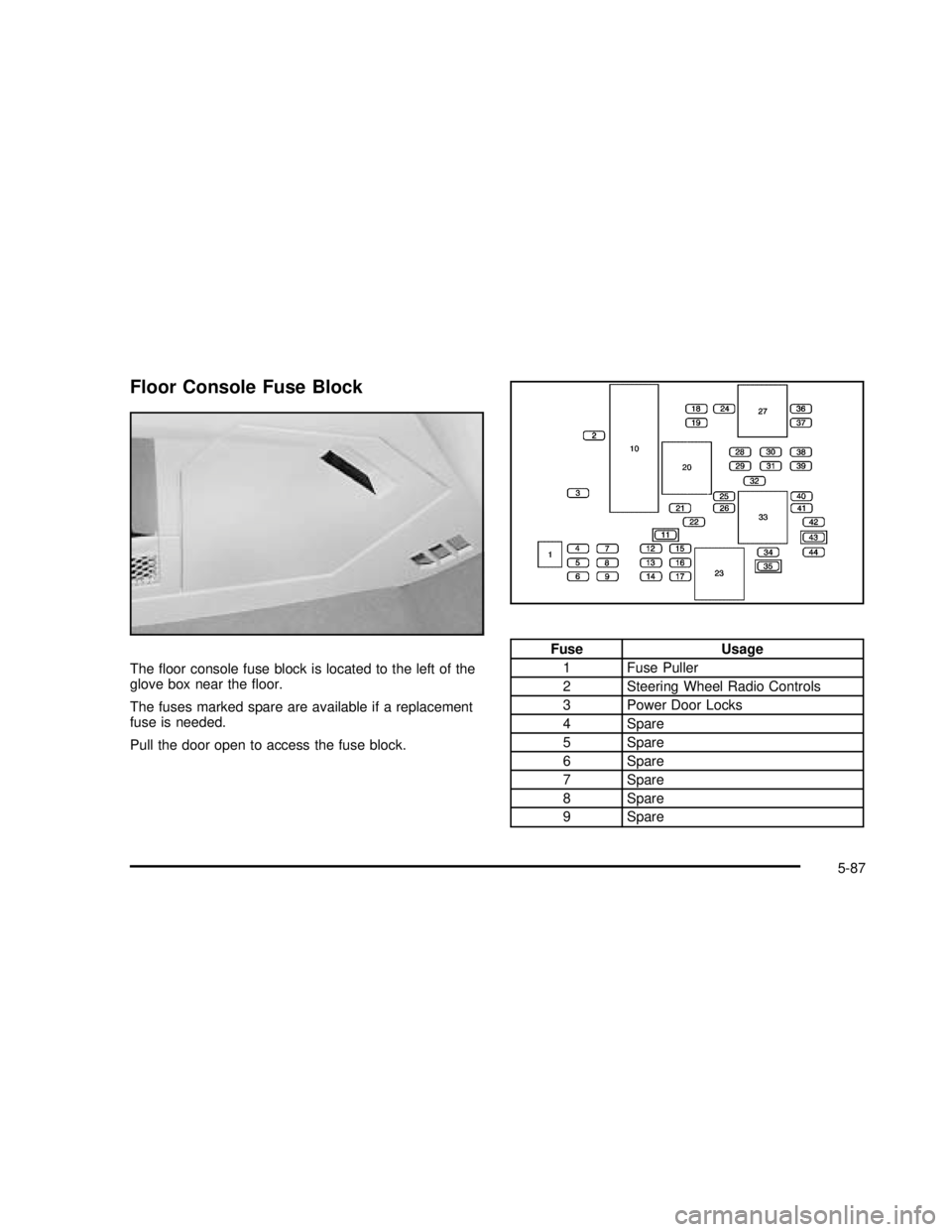
Floor Console Fuse Block
Thefloor console fuse block is located to the left of the
glove box near thefloor.
The fuses marked spare are available if a replacement
fuse is needed.
Pull the door open to access the fuse block.
Fuse Usage
1 Fuse Puller
2 Steering Wheel Radio Controls
3 Power Door Locks
4 Spare
5 Spare
6 Spare
7 Spare
8 Spare
9 Spare
5-87
2003 - Rendezvous OM
Page 395 of 432

Part C: Periodic Maintenance
Inspections
Listed in this part are inspections and services which
should be performed at least twice a year (for instance,
each spring and fall).You should let your dealer’s
service department or other qualified service center do
these jobs. Make sure any necessary repairs are
completed at once.
Proper procedures to perform these services may be
found in a service manual. SeeService Publications
Ordering Information on page 7-9.
Steering, Suspension and Front
Drive Axle Boot and Seal Inspection
Inspect the front and rear suspension and steering
system for damaged, loose or missing parts, signs of
wear or lack of lubrication. Inspect the power steering
lines and hoses for proper hook-up, binding, leaks,
cracks, chang, etc. Clean and then inspect the drive
axle boot seals for damage, tears or leakage. Replace
seals if necessary.
Exhaust System Inspection
Inspect the complete exhaust system. Inspect the body
near the exhaust system. Look for broken, damaged,
missing or out-of-position parts as well as open seams,
holes, loose connections or other conditions which
could cause a heat build-up in theoor pan or could let
exhaust fumes into the vehicle. SeeEngine Exhaust
on page 2-29.
Fuel System Inspection
Inspect the complete fuel system for damage or leaks.
Engine Cooling System Inspection
Inspect the hoses and have them replaced if they
are cracked, swollen or deteriorated. Inspect all pipes,
ttings and clamps; replace as needed. Clean the
outside of the radiator and air conditioning condenser.
To help ensure proper operation, a pressure test of
the cooling system and pressure cap is recommended
at least once a year.
6-13
2003 - Rendezvous OM