lock BUICK RANDEZVOUS 2006 Owner's Manual
[x] Cancel search | Manufacturer: BUICK, Model Year: 2006, Model line: RANDEZVOUS, Model: BUICK RANDEZVOUS 2006Pages: 478, PDF Size: 2.97 MB
Page 339 of 478
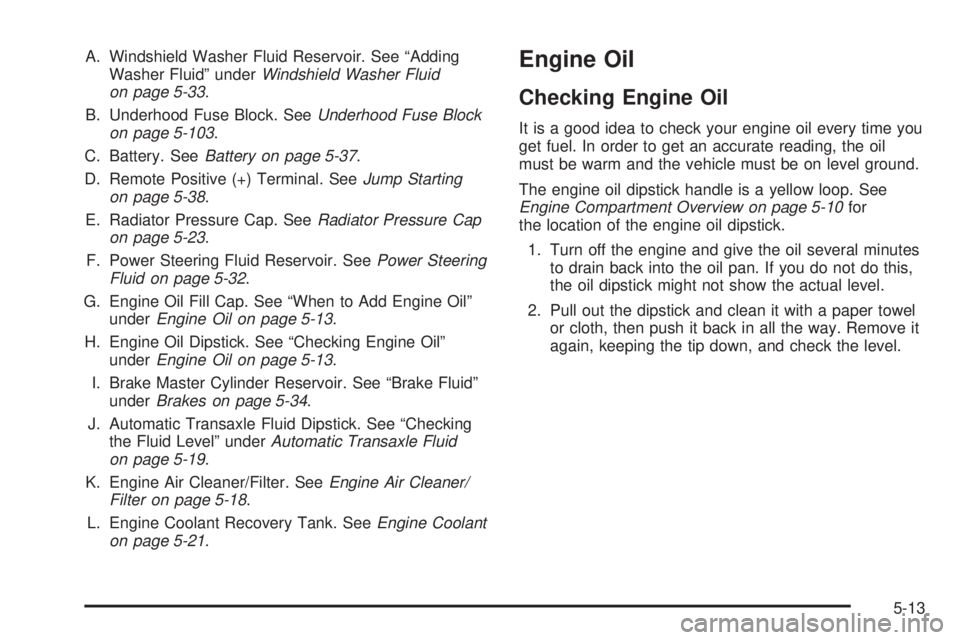
A. Windshield Washer Fluid Reservoir. See “Adding
Washer Fluid” underWindshield Washer Fluid
on page 5-33.
B. Underhood Fuse Block. SeeUnderhood Fuse Block
on page 5-103.
C. Battery. SeeBattery on page 5-37.
D. Remote Positive (+) Terminal. SeeJump Starting
on page 5-38.
E. Radiator Pressure Cap. SeeRadiator Pressure Cap
on page 5-23.
F. Power Steering Fluid Reservoir. SeePower Steering
Fluid on page 5-32.
G. Engine Oil Fill Cap. See “When to Add Engine Oil”
underEngine Oil on page 5-13.
H. Engine Oil Dipstick. See “Checking Engine Oil”
underEngine Oil on page 5-13.
I. Brake Master Cylinder Reservoir. See “Brake Fluid”
underBrakes on page 5-34.
J. Automatic Transaxle Fluid Dipstick. See “Checking
the Fluid Level” underAutomatic Transaxle Fluid
on page 5-19.
K. Engine Air Cleaner/Filter. SeeEngine Air Cleaner/
Filter on page 5-18.
L. Engine Coolant Recovery Tank. SeeEngine Coolant
on page 5-21.Engine Oil
Checking Engine Oil
It is a good idea to check your engine oil every time you
get fuel. In order to get an accurate reading, the oil
must be warm and the vehicle must be on level ground.
The engine oil dipstick handle is a yellow loop. See
Engine Compartment Overview on page 5-10for
the location of the engine oil dipstick.
1. Turn off the engine and give the oil several minutes
to drain back into the oil pan. If you do not do this,
the oil dipstick might not show the actual level.
2. Pull out the dipstick and clean it with a paper towel
or cloth, then push it back in all the way. Remove it
again, keeping the tip down, and check the level.
5-13
Page 355 of 478
If the overheat warning continues, there is one more
thing you can try. You can add the proper coolant
mixture directly to the radiator, but be sure the cooling
system is cool before you do it.
{CAUTION:
Steam and scalding liquids from a hot cooling
system can blow out and burn you badly. They
are under pressure, and if you turn the radiator
pressure cap — even a little — they can come
out at high speed. Never turn the cap when the
cooling system, including the radiator pressure
cap, is hot. Wait for the cooling system and
radiator pressure cap to cool if you ever have
to turn the pressure cap.
How to Add Coolant to the Radiator
Notice:Your engine has a specic radiator
ll procedure. Failure to follow this procedure could
cause your engine to overheat and be severely
damaged.
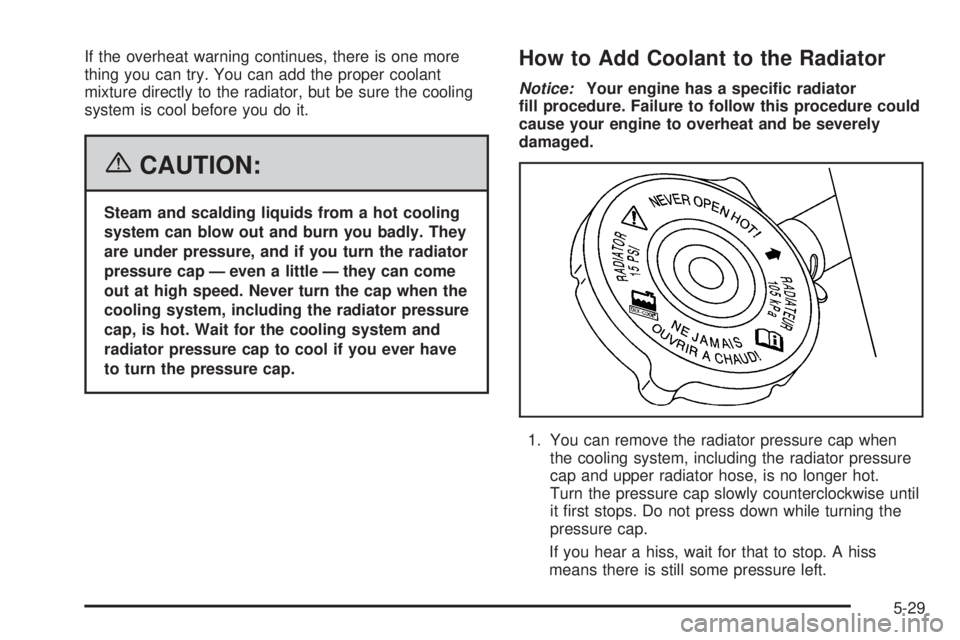
1. You can remove the radiator pressure cap when
the cooling system, including the radiator pressure
cap and upper radiator hose, is no longer hot.
Turn the pressure cap slowly counterclockwise until
it rst stops. Do not press down while turning the
pressure cap.
If you hear a hiss, wait for that to stop. A hiss
means there is still some pressure left.
5-29
Page 365 of 478

4. Open the hood on the other vehicle and locate the
positive (+) and negative (−) terminal locations on
that vehicle.
You will not need to access your battery for jump
starting. Your vehicle has a remote positive (+) jump
starting terminal for that purpose. The terminal is
located under a tethered cap at the front of the
underhood fuse block. SeeEngine Compartment
Overview on page 5-10for more information
on location.
If your vehicle has the
3.5L V6 engine, squeeze
the tabs and swing the cap
out of the way to access
the remote positive (+)
terminal.If your vehicle has the
3.6L V6 engine, pull up
on the cap to access
the remote positive (+)
terminal.
You should always use the remote positive (+)
terminal instead of the positive (+) terminal on
the battery.
{CAUTION:
An electric fan can start up even when the
engine is not running and can injure you.
Keep hands, clothing and tools away from
any underhood electric fan. 3.5L V6 Engine
3.6L V6 Engine
5-39
Page 371 of 478

Headlamps, Front Turn Signal,
Sidemarker, and Parking Lamps
1. Open the hood. SeeHood Release on page 5-9for
more information.
2. Push in on the
headlamp panel and
lift up the headlamp
retaining clip partway,
but do not remove.
3. Remove the wing stud on the upper, outboard side
of the lamp assembly.4. Unsnap the headlamp assembly by pulling it
forward, away from the vehicle.
5. Disconnect the electrical connector by pulling
back on the locking tab, located on the electrical
connector, to separate the two connectors.
6. Turn the bulb socket
one-quarter of a turn
clockwise.
7. Pull the bulb assembly out from the lamp housing.
5-45
Page 372 of 478

8. Unhook the electrical connector by lifting up the
gray tabs and separate the connector from the
bulb base.9. Install the appropriate new bulb into the electrical
connector. Push the bulb rmly enough so that the
gray tabs hook over the tab on the bulb.
10. Put the bulb assembly back into the lamp housing
and turn the bulb socket one-quarter of a turn
counterclockwise.
11. Align the retaining clips on the back of the headlamp
with the rectangular holes in the mounting panel.
12. Push rmly on both ends of the headlamp to snap it
into position.
13. Push the retaining clip down to its original position.
14. Reinstall the wing stud.
5-46
Page 373 of 478

Taillamps, Turn Signal, and
Stoplamps
1. Open the liftgate. SeeLiftgate on page 2-11for
more information.
2. Remove the two screws
on the inboard taillamp
panel.
3. Pull the lamp directly rearward from the vehicle.4. Turn the bulb socket one-quarter of a turn
counterclockwise.
5. Pull the bulb assembly out from the lamp housing.
6. Unhook the electrical connector by lifting up the tabs
and separate the connector from the bulb base.
7. Install the new bulb into the electrical connector.
Push the bulb rmly enough so that the tabs hook
over the tab on the bulb.
8. Reverse the steps to reinstall.
9. Reinstall the lamp to its pocket by lining up the
mounting pin and pushing forward to set the
position.
10. Reinstall the screws removed in Step 2.
11. Close the liftgate.
5-47
Page 374 of 478

Taillamps and Back-Up Lamps
This procedure is for the liftgate-mounted taillamps
and back-up lamps. To replace one of these bulbs,
do the following:
1. Open the liftgate. SeeLiftgate on page 2-11for
more information.
2. Remove the panel inside the liftgate by lifting the
tabs and pulling the panel off.
3. Remove the seven
wing nuts and the
four outboard nuts
(two at each end).
4. Gently lower the liftgate.
5. Pull the lamp assembly directly rearward from
the vehicle.A. Outboard Taillamp
B. Center Taillamp
C. Inboard Back-Up Lamp
6. Turn the bulb socket counterclockwise one-quarter
of a turn.
7. Pull the bulb assembly out from the lamp housing.
8. Pull the bulb out of the base.
9. Install the new bulb into the electrical connector.
Push the bulb rmly enough so that the tabs hook
over the tab on the bulb.
10. Put the bulb assembly back into the lamp housing
and turn the bulb socket clockwise one-quarter
of a turn.
5-48
Page 385 of 478
Check Tire Pressure System
Your vehicle may have a check tire pressure system
that can alert you to a large change in the pressure of
one tire. The system won’t alert you before you drive
that a tire is low or at. You must begin driving before
the system will work properly.
The LOW TIRE PRESSURE HOLD SET TO RESET
message will appear on the Driver Information Center
(DIC) and the LOW TIRE PRESSURE message
will come on the message center if pressure difference,
or low pressure, is detected in one tire. In the following
conditions, the LOW TIRE PRESSURE message
may not come on even if the tire pressure is low, or it
may come on when the tire pressure is actually normal:
More than one tire is low
Only one tire is replaced with a new tire during service
The vehicle is moving faster than 70 mph (113 km/h)
The system is not yet calibrated
The tire treadwear is uneven
The compact spare tire is installed
Tire chains are being used
The vehicle is being driven on a rough or frozen roadIf the anti-lock brake system warning light comes on,
the check tire pressure system may not be working
properly. See your dealer for service. Also, see
Anti-Lock Brake System Warning Light on page 3-45.
The check tire pressure system detects differences in
tire rotation speeds that are caused by changes in tire
pressure. The system can alert you about a low tire – but
it does not replace normal tire maintenance. SeeTires
on page 5-51.
When the LOW TIRE PRESSURE HOLD SET TO
RESET message appears on the Driver Information
Center and the LOW TIRE PRESSURE message comes
on the message center, you should stop as soon as
you can and check all your tires for damage. If a tire is
at, seeIf a Tire Goes Flat on page 5-69. Also check
the tire pressure in all four tires as soon as you can.
SeeInation - Tire Pressure on page 5-57.
Any time you adjust a tire’s pressure or have one or
more tires repaired or replaced, you’ll need to reset, or
calibrate, the check tire pressure system. You’ll also need
to reset the system whenever you rotate the tires, buy
new tires and install or remove the compact spare.
Do not reset the check tire pressure system without
rst correcting the cause of the problem and checking
and adjusting the pressure in all four tires. If you
reset the system when the tire pressures are incorrect,
the check tire pressure system will not work properly
and may not alert you when a tire is low or high.
5-59
Page 390 of 478
Different Size Tires and Wheels
If you add wheels or tires that are a different size than
your original equipment wheels and tires, this may
affect the way your vehicle performs, including its
braking, ride and handling characteristics, stability and
resistance to rollover. Additionally, if your vehicle
has electronic systems such as, antilock brakes; traction
control; and electronic stability control, the performance
of these systems can be affected.
{CAUTION:
If you add different sized wheels, your
vehicle may not provide an acceptable level
of performance and safety if tires not
recommended for those wheels are selected.
You may increase the chance that you will
crash and suffer serious injury. Only use
GM specic wheel and tire systems developed
for your vehicle, and have them properly
installed by a GM certied technician.
SeeBuying New Tires on page 5-62andAccessories
and Modications on page 5-3for additional information.
Uniform Tire Quality Grading
Quality grades can be found where applicable on the
tire sidewall between tread shoulder and maximum
section width. For example:
Treadwear 200 Traction AA Temperature A
The following information relates to the system
developed by the United States National Highway
Traffic Safety Administration, which grades tires by
treadwear, traction and temperature performance.
(This applies only to vehicles sold in the United States.)
The grades are molded on the sidewalls of most
passenger car tires. The Uniform Tire Quality Grading
system does not apply to deep tread, winter-type
snow tires, space-saver or temporary use spare tires,
tires with nominal rim diameters of 10 to 12 inches
(25 to 30 cm), or to some limited-production tires.
While the tires available on General Motors passenger
cars and light trucks may vary with respect to these
grades, they must also conform to federal safety
requirements and additional General Motors Tire
Performance Criteria (TPC) standards.
5-64
Page 396 of 478

Changing a Flat Tire
If a tire goes at, avoid further tire and wheel damage
by driving slowly to a level place. Turn on your vehicle’s
hazard warning ashers. SeeHazard Warning Flashers
on page 3-6for more information.
{CAUTION:
Changing a tire can be dangerous. The vehicle
can slip off the jack and roll over or fall on you
or other people. You and they could be badly
injured or even killed. Find a level place to
change your tire. To help prevent the vehicle
from moving:
1. Set the parking brake rmly.
2. Put the shift lever in PARK (P).
CAUTION: (Continued)
CAUTION: (Continued)
3. Turn off the engine and do not restart
while the vehicle is raised.
4. Do not allow passengers to remain in
the vehicle.
To be even more certain the vehicle will not
move, you should put blocks at the front
and rear of the tire farthest away from the
one being changed. That would be the tire,
on the other side, at the opposite end of the
vehicle.
5-70