lane assist BUICK RANDEZVOUS 2006 Owner's Manual
[x] Cancel search | Manufacturer: BUICK, Model Year: 2006, Model line: RANDEZVOUS, Model: BUICK RANDEZVOUS 2006Pages: 478, PDF Size: 2.97 MB
Page 126 of 478
Outside Convex Mirror
{CAUTION:
A convex mirror can make things (like other
vehicles) look farther away than they really are.
If you cut too sharply into the right lane, you
could hit a vehicle on your right. Check your
inside mirror or glance over your shoulder
before changing lanes.
The passenger’s side mirror is convex. A convex mirror’s
surface is curved so more can be seen from the driver’s
seat. It also makes things appear farther away than they
really are.
Outside Heated Mirrors
If the vehicle has this feature, the outside rearview
mirrors are heated when the rear window defogger is
turned on. See “Rear Window Defogger” underClimate
Control System on page 3-28,Dual Climate Control
System on page 3-30,orDual Automatic Climate Control
System on page 3-33.
OnStar®System
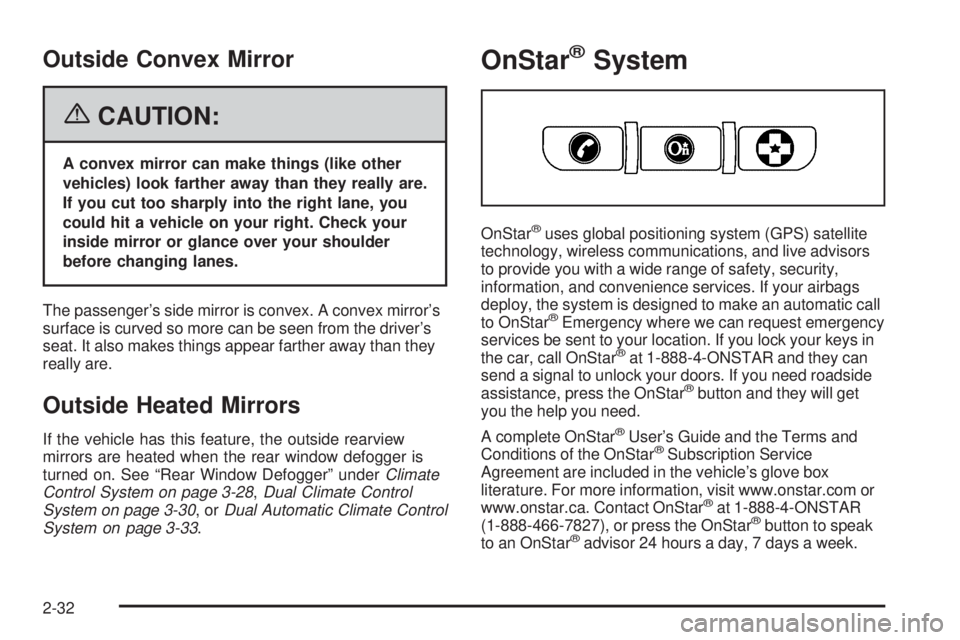
OnStar®uses global positioning system (GPS) satellite
technology, wireless communications, and live advisors
to provide you with a wide range of safety, security,
information, and convenience services. If your airbags
deploy, the system is designed to make an automatic call
to OnStar
®Emergency where we can request emergency
services be sent to your location. If you lock your keys in
the car, call OnStar
®at 1-888-4-ONSTAR and they can
send a signal to unlock your doors. If you need roadside
assistance, press the OnStar
®button and they will get
you the help you need.
A complete OnStar
®User’s Guide and the Terms and
Conditions of the OnStar®Subscription Service
Agreement are included in the vehicle’s glove box
literature. For more information, visit www.onstar.com or
www.onstar.ca. Contact OnStar
®at 1-888-4-ONSTAR
(1-888-466-7827), or press the OnStar®button to speak
to an OnStar®advisor 24 hours a day, 7 days a week.
2-32
Page 143 of 478
Instrument Panel Overview...............................3-4
Hazard Warning Flashers................................3-6
Other Warning Devices...................................3-6
Horn.............................................................3-6
Tilt Wheel.....................................................3-6
Turn Signal/Multifunction Lever.........................3-7
Turn and Lane-Change Signals........................3-7
Headlamp High/Low-Beam Changer..................3-8
Flash-to-Pass.................................................3-8
Windshield Wipers..........................................3-9
Windshield Washer.........................................3-9
Rear Window Wiper/Washer...........................3-10
Cruise Control..............................................3-10
Exterior Lamps.............................................3-14
Daytime Running Lamps (DRL).......................3-14
Automatic Headlamp System..........................3-15
Fog Lamps..................................................3-15
Interior Lamps..............................................3-16
Instrument Panel Brightness...........................3-16
Interior Lamps Control...................................3-16
Headlamp Exit Delay.....................................3-17
Entry Lighting...............................................3-17
Delayed Lighting...........................................3-18
Exit Lighting.................................................3-18
Perimeter Lighting.........................................3-19
Front Reading Lamps....................................3-19
Rear Reading Lamps....................................3-19Cargo Lamp.................................................3-19
Battery Run-Down Protection..........................3-20
Instrument Panel Switchbank..........................3-20
Head-Up Display (HUD).................................3-21
Ultrasonic Rear Parking Assist (URPA)............3-24
Accessory Power Outlet(s).............................3-26
Ashtray(s) and Cigarette Lighter......................3-27
Climate Controls............................................3-28
Climate Control System.................................3-28
Dual Climate Control System..........................3-30
Dual Automatic Climate Control System...........3-33
Outlet Adjustment.........................................3-36
Warning Lights, Gages, and Indicators............3-37
Instrument Panel Cluster................................3-38
Speedometer and Odometer...........................3-39
Trip Odometer..............................................3-39
Tachometer.................................................3-40
Safety Belt Reminder Light.............................3-40
Airbag Readiness Light..................................3-41
Passenger Airbag Status Indicator...................3-42
Brake System Warning Light..........................3-44
Anti-Lock Brake System Warning Light.............3-45
Traction Control System (TCS) Warning Light......3-45
Engine Coolant Temperature Gage..................3-46
Malfunction Indicator Lamp.............................3-46
Fuel Gage...................................................3-50
Section 3 Instrument Panel
3-1
Page 303 of 478

{CAUTION:
If you do not shift down, your brakes could get
so hot that they would not work well. You
would then have poor braking or even none
going down a hill. You could crash. Shift down
to let your engine assist your brakes on a
steep downhill slope.
{CAUTION:
Coasting downhill in NEUTRAL (N) or with the
ignition off is dangerous. Your brakes will have
to do all the work of slowing down. They could
get so hot that they would not work well. You
would then have poor braking or even none
going down a hill. You could crash. Always
have your engine running and your vehicle in
gear when you go downhill.
Know how to go down hills. The most important
thing to know is this: let your engine do some of
the slowing down. Shift to a lower gear when you go
down a steep or long hill.
Know how to go uphill. You may want to shift down
to a lower gear. The lower gears help cool your
engine and transaxle, and you can climb the
hill better.
Stay in your own lane when driving on two-lane
roads in hills or mountains. Do not swing wide
or cut across the center of the road. Drive at speeds
that let you stay in your own lane.
As you go over the top of a hill, be alert. There
could be something in your lane, like a stalled car
or an accident.
You may see highway signs on mountains that
warn of special problems. Examples are long
grades, passing or no-passing zones, a falling rocks
area, or winding roads. Be alert to these and take
appropriate action.
4-25
Page 457 of 478

Additional Program Information
Courtesy Transportation is available during the
Bumper-to-Bumper warranty coverage period, but
it is not part of the New Vehicle Limited Warranty.
A separate booklet entitledWarranty and Owner
Assistance Informationfurnished with each new vehicle
provides detailed warranty coverage information.
Courtesy Transportation is available only at participating
dealers and all program options, such as shuttle
service, may not be available at every dealer. Please
contact your dealer for specic information about
availability. All Courtesy Transportation arrangements
will be administered by appropriate dealer personnel.
Canadian Vehicles:For warranty repairs during
the Complete Vehicle Coverage period of the General
Motors of Canada New Vehicle Limited Warranty,
alternative transportation may be available under the
Courtesy Transportation Program. Please consult
your dealer for details.
General Motors reserves the right to unilaterally modify,
change or discontinue Courtesy Transportation at
any time and to resolve all questions of claim eligibility
pursuant to the terms and conditions described
herein at its sole discretion.
Vehicle Data Collection and Event
Data Recorders
Your vehicle, like other modern motor vehicles, has a
number of sophisticated computer systems that monitor
and control several aspects of the vehicle’s performance.
Your vehicle uses on-board vehicle computers to monitor
emission control components to optimize fuel economy,
to monitor conditions for airbag deployment and, if so
equipped, to provide anti-lock braking and to help the
driver control the vehicle in difficult driving situations.
Some information may be stored during regular
operations to facilitate repair of detected malfunctions;
other information is stored only in a crash event by
computer systems, such as those commonly called
event data recorders (EDR).
In a crash event, computer systems, such as the Airbag
Sensing and Diagnostic Module (SDM) in your vehicle
may record information about the condition of the vehicle
and how it was operated, such as data related to engine
speed, brake application, throttle position, vehicle speed,
safety belt usage, airbag readiness, airbag performance,
and the severity of a collision. This information has been
used to improve vehicle crash performance and may be
used to improve crash performance of future vehicles
and driving safety. Unlike the data recorders on many
airplanes, these on-board systems do not record sounds,
such as conversation of vehicle occupants.
7-9
Page 477 of 478

Theft-Deterrent Systems...................................2-15
Content Theft-Deterrent................................2-15
PASS-Key
®III .............................................2-17
PASS-Key®III Operation..............................2-18
Tilt Wheel........................................................ 3-6
Tires.............................................................5-51
Aluminum or Chrome-Plated Wheels,
Cleaning.................................................5-96
Buying New Tires........................................5-62
Chains.......................................................5-67
Changing a Flat Tire....................................5-70
Check Tire Pressure System.........................5-59
Cleaning....................................................5-96
Compact Spare Tire.....................................5-90
Different Size..............................................5-64
If a Tire Goes Flat.......................................5-69
Ination -- Tire Pressure...............................5-57
Inator, Accessory.......................................5-68
Inspection and Rotation................................5-60
Installing the Spare Tire................................5-77
Removing the Flat Tire.................................5-77
Removing the Spare Tire and Tools...............5-71
Secondary Latch System..............................5-81
Storing a Flat or Spare Tire and Tools............5-84
Tire Sidewall Labeling..................................5-52
Tire Terminology and Denitions....................5-55
Uniform Tire Quality Grading.........................5-64
Wheel Alignment and Tire Balance.................5-66Tires (cont.)
Wheel Replacement.....................................5-66
When It Is Time for New Tires......................5-62
Towing
Recreational Vehicle.....................................4-36
Towing a Trailer..........................................4-38
Your Vehicle...............................................4-36
Traction
Active Message...........................................3-52
Control System (TCS)..................................4-10
Control System Warning Light.......................3-45
Service Traction System Warning Message.....3-51
Transaxle
Fluid, Automatic...........................................5-19
Transaxle Operation, Automatic.........................2-23
Trip Odometer................................................3-39
Turn and Lane-Change Signals.......................... 3-7
Turn Signal/Multifunction Lever........................... 3-7
U
Ultrasonic Rear Parking Assist (URPA)...............3-24
Understanding Radio Reception.......................3-133
Uniform Tire Quality Grading............................5-64
Universal Home Remote System.......................2-34
Operation...................................................2-35
13