fuel cap BUICK RANDEZVOUS 2007 User Guide
[x] Cancel search | Manufacturer: BUICK, Model Year: 2007, Model line: RANDEZVOUS, Model: BUICK RANDEZVOUS 2007Pages: 528, PDF Size: 2.99 MB
Page 360 of 528

{CAUTION:
If you spill fuel and then something
ignites it, you could be badly burned. Fuel
can spray out on you if you open the fuel
cap too quickly. This spray can happen if
your tank is nearly full, and is more likely
in hot weather. Open the fuel cap slowly
and wait for any hiss noise to stop. Then
unscrew the cap all the way.
Be careful not to spill fuel. Do not top off or overll
the tank and wait a few seconds after you have
nished pumping before removing the nozzle.
Clean fuel from painted surfaces as soon as
possible. SeeWashing Your Vehicle on page 455.
When replacing the fuel cap, turn it clockwise until it
clicks. Make sure the cap is fully installed. The
diagnostic system can determine if the fuel cap has
been left off or improperly installed. This would
allow fuel to evaporate into the atmosphere.
SeeMalfunction Indicator Lamp on page 222.Your vehicle may also have a light that will come
on in the message center to let you know your
gas cap is open. SeeCheck Gas Cap Message
on page 231for more information.
{CAUTION:
If a re starts while you are refueling, do
not remove the nozzle. Shut off the ow
of fuel by shutting off the pump or by
notifying the station attendant. Leave
the area immediately.
Notice:If you need a new fuel cap, be sure to
get the right type. Your dealer can get one
for you. If you get the wrong type, it may not
t properly. This may cause your malfunction
indicator lamp to light and may damage
your fuel tank and emissions system. See
Malfunction Indicator Lamp on page 222.
360
Page 365 of 528
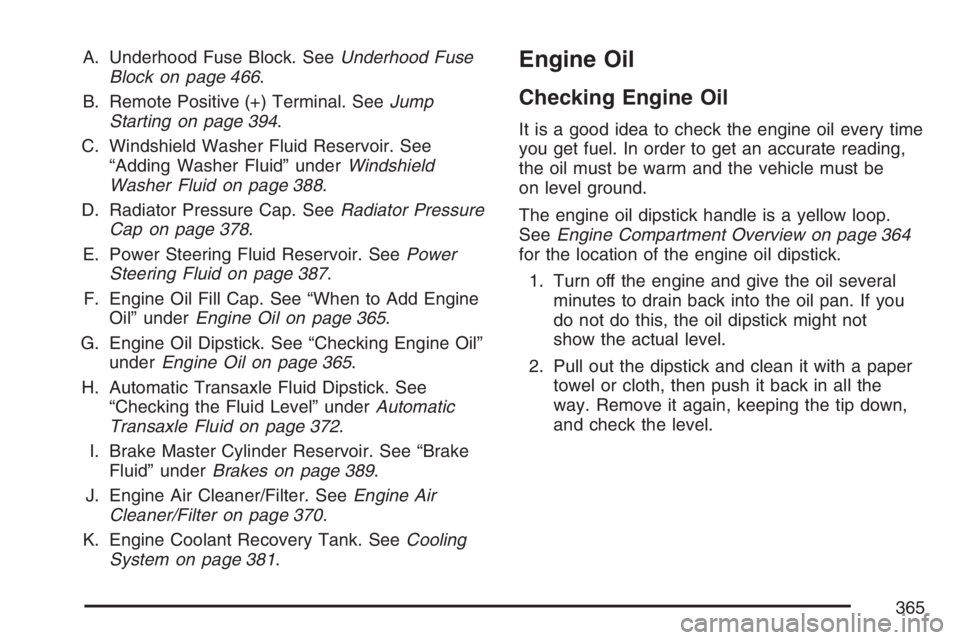
A. Underhood Fuse Block. SeeUnderhood Fuse
Block on page 466.
B. Remote Positive (+) Terminal. SeeJump
Starting on page 394.
C. Windshield Washer Fluid Reservoir. See
“Adding Washer Fluid” underWindshield
Washer Fluid on page 388.
D. Radiator Pressure Cap. SeeRadiator Pressure
Cap on page 378.
E. Power Steering Fluid Reservoir. SeePower
Steering Fluid on page 387.
F. Engine Oil Fill Cap. See “When to Add Engine
Oil” underEngine Oil on page 365.
G. Engine Oil Dipstick. See “Checking Engine Oil”
underEngine Oil on page 365.
H. Automatic Transaxle Fluid Dipstick. See
“Checking the Fluid Level” underAutomatic
Transaxle Fluid on page 372.
I. Brake Master Cylinder Reservoir. See “Brake
Fluid” underBrakes on page 389.
J. Engine Air Cleaner/Filter. SeeEngine Air
Cleaner/Filter on page 370.
K. Engine Coolant Recovery Tank. SeeCooling
System on page 381.Engine Oil
Checking Engine Oil
It is a good idea to check the engine oil every time
you get fuel. In order to get an accurate reading,
the oil must be warm and the vehicle must be
on level ground.
The engine oil dipstick handle is a yellow loop.
SeeEngine Compartment Overview on page 364
for the location of the engine oil dipstick.
1. Turn off the engine and give the oil several
minutes to drain back into the oil pan. If you
do not do this, the oil dipstick might not
show the actual level.
2. Pull out the dipstick and clean it with a paper
towel or cloth, then push it back in all the
way. Remove it again, keeping the tip down,
and check the level.
365
Page 411 of 528
Cold Tire Pressure:The amount of air pressure
in a tire, measured in pounds per square inch (psi)
or kilopascals (kPa) before a tire has built up heat
from driving. SeeInation - Tire Pressure on
page 413.
Curb Weight:This means the weight of a motor
vehicle with standard and optional equipment
including the maximum capacity of fuel, oil, and
coolant, but without passengers and cargo.
DOT Markings:A code molded into the sidewall
of a tire signifying that the tire is in compliance with
the U.S. Department of Transportation (DOT)
motor vehicle safety standards. The DOT code
includes the Tire Identication Number (TIN), an
alphanumeric designator which can also identify the
tire manufacturer, production plant, brand, and date
of production.
GVWR:Gross Vehicle Weight Rating. See
Loading Your Vehicle on page 332.
GAWR FRT:Gross Axle Weight Rating for the
front axle. SeeLoading Your Vehicle on page 332.
GAWR RR:Gross Axle Weight Rating for the
rear axle. SeeLoading Your Vehicle on page 332.Intended Outboard Sidewall:The side of an
asymmetrical tire, that must always face outward
when mounted on a vehicle.
Kilopascal (kPa):The metric unit for air pressure.
Light Truck (LT-Metric) Tire:A tire used on light
duty trucks and some multipurpose passenger
vehicles.
Load Index:An assigned number ranging from
1 to 279 that corresponds to the load carrying
capacity of a tire.
Maximum Ination Pressure:The maximum air
pressure to which a cold tire may be inated.
The maximum air pressure is molded onto
the sidewall.
Maximum Load Rating:The load rating for a tire
at the maximum permissible ination pressure
for that tire.
Maximum Loaded Vehicle Weight:The sum of
curb weight, accessory weight, vehicle capacity
weight, and production options weight.
Normal Occupant Weight:The number of
occupants a vehicle is designed to seat multiplied
by 150 lbs (68 kg). SeeLoading Your Vehicle
on page 332.
411
Page 413 of 528
Vehicle Maximum Load on the Tire:Load on an
individual tire due to curb weight, accessory weight,
occupant weight, and cargo weight.
Vehicle Placard:A label permanently attached to
a vehicle showing the vehicle’s capacity weight and
the original equipment tire size and recommended
ination pressure. See “Tire and Loading
Information Label” underLoading Your Vehicle on
page 332.
Ination - Tire Pressure
Tires need the correct amount of air pressure to
operate effectively.
Notice:Do not let anyone tell you that
under-ination or over-ination is all right.
It is not. If your tires do not have enough air
(under-ination), you can get the following:
Too much exing
Too much heat
Tire overloading
Premature or irregular wear
Poor handling
Reduced fuel economyIf your tires have too much air (over-ination),
you can get the following:
Unusual wear
Poor handling
Rough ride
Needless damage from road hazards
A Tire and Loading Information label is attached to
the vehicle’s center pillar (B-pillar). This label shows
your vehicle’s original equipment tires and the
correct ination pressures for your tires when they
are cold. The recommended cold tire ination
pressure, shown on the label, is the minimum
amount of air pressure needed to support your
vehicle’s maximum load carrying capacity.
For additional information regarding how much
weight your vehicle can carry, and an example of
the Tire and Loading Information label, seeLoading
Your Vehicle on page 332. How you load your
vehicle affects vehicle handling and ride comfort.
Never load your vehicle with more weight than it
was designed to carry.
413
Page 469 of 528

Capacities and Specications
The following approximate capacities are given in English and metric conversions. SeeRecommended
Fluids and Lubricants on page 485for more information.
ApplicationCapacities
English Metric
Air Conditioning Refrigerant R134aFor the air conditioning system refrigerant charge
amount, see the refrigerant caution label located
under the hood. See your dealer for more
information.
Automatic Transaxle (Pan Removal and Replacement) 7.4 qt 7.0 L
Cooling System 11.3 qt 10.7 L
Engine Oil with Filter 4.0 qt 3.8 L
Fuel Capacity 18.0 gal 68.1 L
Wheel Nut Torque 100 ft lb
140Y
Engine Specications
Engine VIN Code Transaxle Spark Plug Gap
3.5L V6 L Automatic 0.060 inches (1.52 mm)
469
Page 514 of 528

Ashtray(s).................................................... 200
Audio System(s).......................................... 250
Audio Steering Wheel Controls................. 296
Care of Your CD and DVD Player............ 298
Care of Your CDs and DVDs................... 298
Fixed Mast Antenna................................. 299
Navigation/Radio System, see
Navigation Manual................................ 277
Radio with CD......................................... 252
Radio with Six-Disc CD............................ 262
Rear Seat Audio (RSA)............................ 293
Setting the Time...................................... 252
Theft-Deterrent Feature............................ 296
Understanding Radio Reception............... 297
XM™ Satellite Radio Antenna System...... 299
Automatic Headlamp System....................... 187
Automatic Transaxle
Fluid........................................................ 372
Operation................................................. 132
B
Battery........................................................ 393
Run-Down Protection............................... 192
Before Leaving on a Long Trip.................... 323
Bench Seat, Split.......................................... 15Brake
Anti-Lock Brake System (ABS)................. 307
Emergencies............................................ 309
Low Fluid Warning Message.................... 232
Parking.................................................... 135
System Warning Light.............................. 219
Brakes........................................................ 389
Braking....................................................... 306
Braking in Emergencies............................... 309
Break-In, New Vehicle................................. 127
Bulb Replacement....................................... 399
Halogen Bulbs......................................... 399
Headlamps, Front Turn Signal,
Sidemarker, and Parking Lamps........... 399
Replacement Bulbs.................................. 404
Taillamps and Back-Up Lamps................. 402
Taillamps, Turn Signal, and Stoplamps..... 401
Buying New Tires........................................ 418
C
Calibration................................................... 238
California Fuel............................................. 357
California Proposition 65 Warning................ 355
Canadian Owners........................................... 3
Capacities and Specications...................... 469
Captain Chairs, Rear..................................... 21
514
Page 518 of 528

F
Filter
Engine Air Cleaner................................... 370
Finish Damage............................................ 459
Fixed Mast Antenna.................................... 299
Flashers, Hazard Warning........................... 176
Flash-to-Pass.............................................. 179
Flat Tire...................................................... 427
Flat Tire, Changing...................................... 428
Flat Tire, Storing......................................... 444
Fluid
Automatic Transaxle................................. 372
Power Steering........................................ 387
Windshield Washer.................................. 388
Fog Lamps.................................................. 187
Front Armrest Storage Area......................... 160
Front Console Storage Area........................ 160
Front Reading Lamps.................................. 191
Fuel............................................................ 356
Additives.................................................. 357
California Fuel.......................................... 357
Filling a Portable Fuel Container.............. 361
Filling Your Tank...................................... 359
Fuels in Foreign Countries....................... 358Fuel (cont.)
Gage....................................................... 225
Gasoline Octane...................................... 356
Gasoline Specications............................ 356
Low Warning Message............................. 232
Fuses
Floor Console Fuse Block........................ 463
Fuses and Circuit Breakers...................... 463
Underhood Fuse Block............................. 466
Windshield Wiper..................................... 462
G
Gage
Engine Coolant Temperature.................... 221
Fuel......................................................... 225
Speedometer........................................... 213
Tachometer.............................................. 214
Garage Door Opener..........................147, 148
Gas, Check Cap Message........................... 231
Gasoline
Octane..................................................... 356
Specications........................................... 356
Glove Box................................................... 158
GM Mobility Reimbursement Program.......... 497
518
Page 521 of 528

M
Maintenance Schedule
Additional Required Services.................... 478
At Each Fuel Fill...................................... 481
At Least Once a Month............................ 481
At Least Once a Year.............................. 482
Introduction.............................................. 472
Maintenance Footnotes............................ 479
Maintenance Record................................ 488
Maintenance Requirements...................... 472
Normal Maintenance
Replacement Parts............................... 486
Owner Checks and Services.................... 480
Recommended Fluids and Lubricants....... 485
Scheduled Maintenance........................... 475
Using....................................................... 473
Your Vehicle and the Environment............ 473
Malfunction Indicator Light........................... 222
Manual Lumbar Controls............................... 10
Manual Seats.................................................. 9
Memory Seat and Mirrors.............................. 11
Message
Center..................................................... 225
Change Engine Oil................................... 230
Charging System Indicator....................... 228
Check Gas Cap....................................... 231Message (cont.)
Door Ajar Warning................................... 230
Engine Coolant Temperature Warning....... 227
Highbeam Out Warning............................ 235
Low Brake Fluid Warning......................... 232
Low Fuel Warning.................................... 232
Low Oil Pressure..................................... 229
Low Washer Fluid Warning...................... 231
Park Lamp Warning................................. 234
PASS-Key
®III Security............................. 231
Program Mode......................................... 233
Rear Hatch Ajar Warning......................... 230
Reduced Engine Power............................ 228
Remote Keyless Entry Transmitter Battery
Low Warning........................................ 234
Service Traction System Warning............. 226
Service Vehicle Soon............................... 233
Traction Active......................................... 227
Mirrors
Manual Rearview Mirror........................... 142
Outside Convex Mirror............................. 143
Outside Curb View Assist Mirror............... 143
Outside Heated Mirrors............................ 143
Outside Power Mirror............................... 142
MyGMLink.com............................................ 495
521