instrument panel BUICK RANDEZVOUS 2007 User Guide
[x] Cancel search | Manufacturer: BUICK, Model Year: 2007, Model line: RANDEZVOUS, Model: BUICK RANDEZVOUS 2007Pages: 528, PDF Size: 2.99 MB
Page 118 of 528

Lockout Protection
The lockout protection feature may prevent you
from locking your key in your vehicle. Pressing the
power door lock switch will lock all doors, then
unlock the driver’s door, if the key is in the ignition
when a door is opened.
If you leave the key in your vehicle but not in the
ignition or if you use the manual door lock,
you could still lock the key in the vehicle. Always
remember to take the key with you.
Liftgate
{CAUTION:
It can be dangerous to drive with the
liftgate open because carbon monoxide
(CO) gas can come into your vehicle. You
cannot see or smell CO. It can cause
unconsciousness and even death. If you
must drive with the liftgate open or if
electrical wiring or other cable
connections must pass through the seal
between the body and the liftgate:
Make sure all other windows are shut.
Turn the fan on your heating or
cooling system to its highest speed
and select the control setting that will
force outside air into your vehicle. See
Climate Control System on page 200.
If you have air outlets on or under the
instrument panel, open them all the
way. SeeEngine Exhaust on page 140.
118
Page 122 of 528

Sun Visors
To block out glare you can swing down the visors.
You can also remove them from the center
mount and swing them to the side. There may be
an extension on the inboard side of the sun
visors. Pull the extension out to block out glare.
Visor Vanity Mirror
Pull down the sun visor. Flip up the cover to
expose the vanity mirror.
Lighted Visor Vanity Mirrors
If your vehicle has this feature, pull down the sun
visor. Flip up the cover to expose the vanity
mirror. The lamps will come on when you open
the cover.
Theft-Deterrent Systems
Vehicle theft is big business, especially in some
cities. Although your vehicle has a number of
theft-deterrent features, we know that nothing we
put on it can make it impossible to steal.
Content Theft-Deterrent
Your vehicle may have a theft-deterrent alarm
system.
A security light, located
on top of the instrument
panel will ash slowly
to let you know that the
system has been
armed.
While armed, the doors will not unlock with the
power door lock switch.
Once armed, the alarm will go off if someone tries
to enter the vehicle without using the optional
remote keyless entry transmitter or the key, or tries
to turn the ignition on without using the correct
key. The horn will sound and the headlamps and
parking lamps will ash any time the alarm
sounds.
122
Page 123 of 528

When the content theft-deterrent system is armed,
the liftgate may be opened by pressing the
REAR button on the remote keyless entry
transmitter. The alarm will go into standby mode.
Once the liftgate is closed, the alarm will be
armed. See “Liftgate Release” underLiftgate on
page 118for more information on how to open the
liftgate.
Arming with the Power Lock Switch
The content theft-deterrent alarm system will arm
when you use either power door lock switch to
lock the doors while any door or the liftgate is open
and the key is removed from the ignition. The
security light, located on top of the instrument
panel, will start ashing when the system is armed.
Within ve seconds, after the security light
begins to ash, any door can be manually
unlocked and opened, without sounding the alarm.
A door unlocked manually will remain unlocked
until locked again.
Arming with the Remote Keyless
Entry Transmitter
Your alarm system will arm when you press LOCK
once on your remote keyless entry transmitter
to lock the doors. The alarm system light will come
on for 30 seconds and then start ashing to let
you know the system is armed.
Within the 30 second delay after the security light
comes on, and an additional ve seconds after
the light begins to ash, any door can be manually
unlocked and opened, without sounding the
alarm.
If LOCK is pressed on your remote keyless entry
transmitter twice within ve seconds, any door
can be manually unlocked and opened within ve
seconds after the security light begins to ash,
without sounding the alarm. A door unlocked
manually will remain unlocked until locked again.
Disarming with Your Key
Your alarm system will disarm when you use your
key to unlock the driver’s door. The security
light will stop ashing to let you know the system
is no longer armed.
123
Page 124 of 528

Disarming with the Remote Keyless
Entry Transmitter
Your alarm system will disarm when you press
UNLOCK on your remote keyless entry transmitter
to unlock the doors. The security light, on top of
the instrument panel, will stop ashing to let
you know the system is no longer armed.
PASS-Key®III
Your PASS-Key®III system operates on a radio
frequency subject to Federal Communications
Commission (FCC) Rules and with Industry
Canada.
This device complies with Part 15 of the FCC
Rules. Operation is subject to the following
two conditions:
1. This device may not cause harmful
interference.
2. This device must accept any interference
received, including interference that may
cause undesired operation.This device complies with RSS-210 of Industry
Canada. Operation is subject to the following
two conditions:
1. This device may not cause interference.
2. This device must accept any interference
received, including interference that may
cause undesired operation of the device.
Changes or modications to this system by other
than an authorized service facility could void
authorization to use this equipment.
PASS-Key®III uses a radio frequency transponder
in the key that matches a decoder in your
vehicle.
124
Page 128 of 528

Ignition Positions
With the key in the ignition, you can turn it to four
different positions.
A (OFF):This is the only position in which you
can remove the key. This position locks the ignition
and transaxle.
Notice:Using a tool to force the key from the
ignition switch could cause damage or break
the key. Use the correct key and turn the key
only with your hand. Make sure the key is all the
way in. If none of this works, then your vehicle
needs service.B (ACCESSORY):This position allows you to use
things like the radio and the windshield wipers
while the engine is off. This position will also allow
you to turn off the engine. Use ACCESSORY if
you must have your vehicle in motion while
the engine is off, for example, if your vehicle is
being pushed or towed.
C (ON):This is the position that the switch
returns to after you start your engine and release
the key. The switch stays in ON when the
engine is running. But even when the engine is
not running, you can use ON to operate your
electrical power accessories, and to display some
instrument panel warning lights.
The battery could be drained if you leave the key
in the ACCESSORY or On position with the
engine off. You may not be able to start your
vehicle if the battery is allowed to drain for
an extended period of time.
D (START):This position starts the engine. When
the engine starts, release the key. The ignition
switch will return to ON for normal driving.
128
Page 135 of 528

Notice:Driving in SECOND (2) for more than
25 miles (40 km) or at speeds over 55 mph
(90 km/h) may damage the transaxle. Also,
shifting into SECOND (2) at speeds above
65 mph (105 km/h) can cause damage. Drive in
THIRD (3) or DRIVE (D) instead of SECOND (2).
Notice:If your vehicle seems to start up
rather slowly, or if it seems not to shift gears
as you go faster, something may be wrong with
a transaxle system sensor. If you drive very
far that way, your vehicle can be damaged.
So, if this happens, have your vehicle serviced
right away. Until then, you can use SECOND (2)
when you are driving less than 35 mph
(55 km/h) and THIRD (3) for higher speeds.
FIRST (1):This position reduces vehicle speed
more than SECOND (2) without using your brakes.
You can use it on very steep hills, or in deep
snow or mud. If the shift lever is put in FIRST (1),
the transaxle will not shift into rst gear until
the vehicle is going slowly enough.
Notice:Spinning the tires or holding the
vehicle in one place on a hill using only the
accelerator pedal may damage the transaxle. If
you are stuck, do not spin the tires. When
stopping on a hill, use the brakes, or parking
brake to hold the vehicle in place.Parking Brake
The parking brake is
located under the
instrument panel on the
driver’s side of the
vehicle.
To set the parking brake, hold the regular brake
pedal down with your right foot and push down on
the parking brake pedal with your left foot.
If the ignition is on, the brake system warning light
will come on. SeeBrake System Warning Light
on page 219.
135
Page 171 of 528

Instrument Panel Overview........................ 174
Hazard Warning Flashers.......................... 176
Other Warning Devices............................. 176
Horn.......................................................... 176
Tilt Wheel.................................................. 177
Turn Signal/Multifunction Lever.................. 177
Turn and Lane-Change Signals................. 178
Headlamp High/Low-Beam Changer.......... 179
Flash-to-Pass............................................ 179
Windshield Wipers..................................... 179
Windshield Washer.................................... 180
Rear Window Wiper/Washer...................... 180
Cruise Control........................................... 181
Exterior Lamps.......................................... 185
Daytime Running Lamps (DRL)................. 186
Automatic Headlamp System..................... 187
Fog Lamps................................................ 187
Interior Lamps........................................... 188
Instrument Panel Brightness...................... 188
Interior Lamps Control............................... 188
Headlamp Exit Delay................................. 189
Entry Lighting............................................ 189
Delayed Lighting........................................ 190
Exit Lighting.............................................. 190
Perimeter Lighting..................................... 191Front Reading Lamps................................ 191
Rear Reading Lamps................................ 191
Cargo Lamp.............................................. 192
Battery Run-Down Protection..................... 192
Instrument Panel Switchbank..................... 192
Head-Up Display (HUD)............................ 193
Ultrasonic Rear Parking Assist (URPA)...... 196
Accessory Power Outlet(s)........................ 199
Ashtray(s) and Cigarette Lighter................ 200
Climate Controls......................................... 200
Climate Control System............................. 200
Dual Climate Control System..................... 203
Dual Automatic Climate Control System.... 206
Outlet Adjustment...................................... 210
Warning Lights, Gages, and Indicators..... 211
Instrument Panel Cluster........................... 212
Speedometer and Odometer...................... 213
Trip Odometer........................................... 213
Tachometer............................................... 214
Safety Belt Reminder Light........................ 215
Airbag Readiness Light............................. 215
Passenger Airbag Status Indicator............. 217
Brake System Warning Light..................... 219
Anti-Lock Brake System Warning Light...... 220
Section 3 Instrument Panel
171
Page 172 of 528

Traction Control System (TCS) Warning
Light...................................................... 220
Engine Coolant Temperature Gage............ 221
Malfunction Indicator Lamp........................ 222
Fuel Gage................................................. 225
Message Center.......................................... 225
Passenger Seatbelt Reminder Message..... 226
Service Traction System Warning
Message................................................ 226
Traction Active Message........................... 227
Engine Coolant Temperature Warning
Message................................................ 227
Charging System Indicator Message.......... 228
Reduced Engine Power Message.............. 228
Low Oil Pressure Message........................ 229
Change Engine Oil Message..................... 230
Door Ajar Warning Message...................... 230
Rear Hatch Ajar Warning Message............ 230
Check Gas Cap Message......................... 231
PASS-Key
®III Security Message............... 231
Low Washer Fluid Warning Message......... 231
Low Fuel Warning Message...................... 232
Low Brake Fluid Warning Message........... 232
Service Vehicle Soon Message................. 233Program Mode Message........................... 233
Remote Keyless Entry Transmitter Battery
Low Warning Message........................... 234
Parking Lamp Warning Message............... 234
Highbeam Out Warning Message.............. 235
Driver Information Center (DIC).................. 235
DIC Controls and Displays........................ 236
DIC Compass............................................ 238
DIC Vehicle Personalization....................... 240
Audio System(s)......................................... 250
Setting the Time........................................ 252
Radio with CD........................................... 252
Radio with Six-Disc CD............................. 262
XM Radio Messages................................. 276
Navigation/Radio System........................... 277
Rear Seat Entertainment System............... 277
Rear Seat Audio (RSA)............................. 293
Theft-Deterrent Feature............................. 296
Audio Steering Wheel Controls.................. 296
Radio Reception........................................ 297
Care of Your CDs and DVDs.................... 298
Care of the CD and DVD Player............... 298
Fixed Mast Antenna.................................. 299
XM™ Satellite Radio Antenna System....... 299
Section 3 Instrument Panel
172
Page 174 of 528
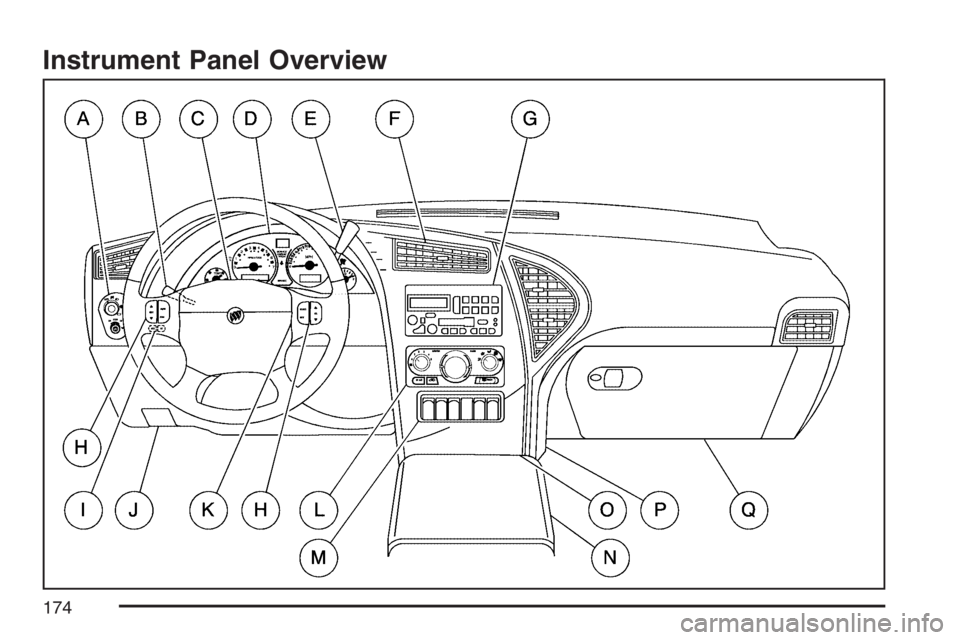
Instrument Panel Overview
174
Page 175 of 528

The main components of the instrument panel are the following:
A. Exterior/Interior Lamps Control. SeeExterior
Lamps on page 185andInterior Lamps
on page 188.
B. Turn Signal/Multifunction Lever. SeeTurn
Signal/Multifunction Lever on page 177.
C. Hazard Warning Flasher Button. SeeHazard
Warning Flashers on page 176.
D. Instrument Panel Cluster. SeeInstrument
Panel Cluster on page 212.
E. Shift Lever. SeeAutomatic Transaxle Operation
on page 132.
F. Instrument Panel Outlets. SeeOutlet
Adjustment on page 210.
G. Audio System. SeeAudio System(s) on
page 250.
H. Audio Steering Wheel Controls. SeeAudio
Steering Wheel Controls on page 296.
I. Head-Up Display Switch and Driver Information
Center (DIC) Controls (If Equipped). See
Head-Up Display (HUD) on page 193andDIC
Controls and Displays on page 236.J. Hood Release. SeeHood Release on
page 363.
K. Ignition Switch. SeeIgnition Positions on
page 128.
L. Climate Controls. SeeClimate Control System
on page 200,Dual Climate Control System
on page 203orDual Automatic Climate Control
System on page 206.
M. Instrument Panel Switchbank. SeeInstrument
Panel Switchbank on page 192.
N. Front Armrest Storage. SeeFront Armrest
Storage Area on page 160.
O. Ashtray/Cigarette Lighter/Accessory Power
Outlet/Cell Phone Storage/Cupholders.
SeeAshtray(s) and Cigarette Lighter on
page 200,Accessory Power Outlet(s) on
page 199,Cell Phone Storage Area on
page 159,Floor Console Storage Area on
page 160andCupholder(s) on page 158.
P. Floor Console Fuse Block. SeeFloor Console
Fuse Block on page 463.
Q. Glove Box. SeeGlove Box on page 158.
175