check engine BUICK REGAL 1993 User Guide
[x] Cancel search | Manufacturer: BUICK, Model Year: 1993, Model line: REGAL, Model: BUICK REGAL 1993Pages: 308, PDF Size: 16.35 MB
Page 176 of 308
Following Distance
Stay at least twice as far behind the vehicle ahead as you
would when driving your vehicle without a trailer. This
can help you avoid situations that require heavy braking
and sudden turns.
Passing
You’ll need more passing distance up ahead when
you’re towing a trailer. And, because you’re a good deal
longer,
you’ll need to go much farther beyond the
passed vehicle before
you can return to your lane.
Backing Up
Hold the bottom of the steering wheel with one hand.
Then, to move the trailer to the left, just move that hand
to the left. To move the trailer to the right, move your
hand to the right. Always back up slowly and, if
possible, have someone guide you.
Making Turns
When you’re turning with a trailer, make wider turns
than normal.
Do this so your trailer won’t strike soft
shoulders, curbs, road signs, trees, or other objects.
Avoid jerky or sudden maneuvers. Signal well in
advance.
firn Signals When Towing a Trailer
When you tow a trailer, your vehicle has to have a
different turn signal flasher and extra wiring. The green
arrows on your instrument panel will flash whenever
you signal a turn or lane change. Properly hooked up,
the trailer lights will also flash, telling other drivers
you’re about to turn, change lanes or stop.
When towing a trailer, the green arrows
on your
instrument panel will flash for turns even if the bulbs on
the trailer are burned out.
Thus, you may think drivers
behind you are seeing your signal when they are not.
It’s
important to check occasionally to be sure the trailer
bulbs are still working.
Driving On Grades
Reduce speed and shift to a lower gear before you start
down a long or steep downgrade. If
you don’t shift
down, you might have to use your brakes
so much that
they would get hot and no longer work well.
On a long uphill grade, shift down and reduce your
speed to around
45 mph (70 km/h) to reduce the
possibility of engine and transaxle overheating.
If you are towing a trailer that weighs more than
1,000
pounds ( 450 kg), and you have an automatic transaxle
with Overdrive, you may prefer to drive in
“D” instead
of Overdrive
(or, as you need to, a lower gear).
174
ProCarManuals.com
Page 177 of 308
Parking on Hills
You really should not park your vehicle, with a trailer
attached, on a hill. If something goes wrong, your rig
could start to move. People can be injured, and both
your vehicle and the trailer can be damaged.
But if
you ever have to park your rig on a hill, here’s
how to do it:
1.
2.
3.
4.
5.
Apply your regular brakes, but don’t shift into “P’
(Park) yet.
Have someone place chocks under the trailer wheels.
When the wheel chocks are in place, release the
regular brakes until the chocks absorb the load.
Reapply the regular brakes. Then apply your parking
brake, and then shift to “P” (Park).
Release the regular brakes.
When You Are Ready to Leave After
Parking on
a Hill
1. Apply your regular brakes and hold the pedal down
while you:
Start your engine;
Shift into a gear; and
0 Release the parking brake.
2. Let up on the brake pedal.
3. Drive slowly until the trailer is clear of the chocks.
4. Stop and have someone pick up and store the chocks.
Maintenance When Trailer Towing
Your vehicle will need service more often when you’re
pulling a trailer. See the Maintenance Schedule for more
on this. Things that are especially important in trailer
operation are automatic transaxle fluid (don’t overfill),
engine oil, belt, cooling system, and brake adjustment.
Each
of these is covered in this manual, and the Index
will help you find them quickly. If you’re trailering, it’s
a good idea to review these sections before
you start
your trip.
Check periodically to see that all hitch nuts and bolts are
tight.
175
ProCarManuals.com
Page 184 of 308
1
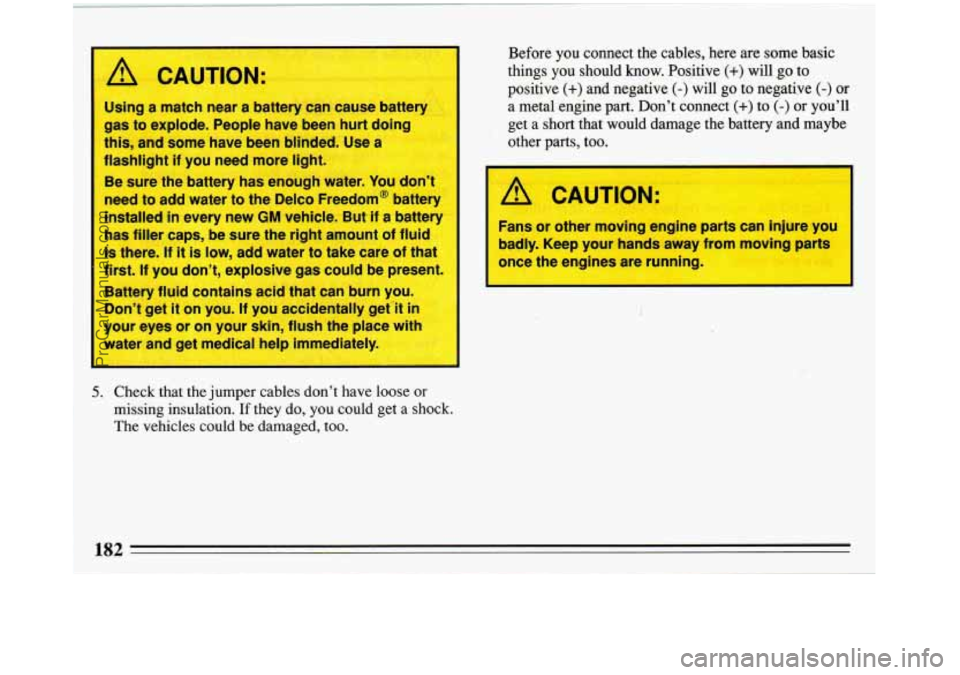
I A CAUTION:
Using a match near a battery can cause battery
this, and some have been blinded. Use a
I gas to explode. People have been hurt doing
I
I flashlight if you need more light.
Be sure the battery has enough water. You don‘-
need to add water
to the Delco Freedom@ battery
installed
in every new GM vehicle. But if a battery
has filler caps, be sure the right amount of fluid
is there. If it is low, add water to take care of that
First. If you don’t, explosive gas could be present.
Battery fluid contains acid that can burn you.
Don’t get
it on you. If you accidentally get-it in
your eyes or on your skin, flush the place with
water and get medical help immediately.
1 I
5. Check that the jumper cables don’t have loose or
missing insulation. If they do, you could get a shock.
The vehicles could
be damaged, too.
I
Before you connect the cables, here are some basic
things
you should know. Positive (+) will go to
positive
(+) and negative (-) will go to negative (-) or
a metal engine
part. Don’t connect (+) to (-) or you’ll
get a short that would damage the battery and maybe
other
parts, too.
I A CAUTION:
Fans or other moving engine parts can injure you
badly. Keep your hands away from moving parts
I once the engines are running.
l 182
ProCarManuals.com
Page 196 of 308
tder the hood can =&drt up even
is not running and can injure
--, clothing and tools away frnm
I nlcwtric fan-
~ ~~~~ ---
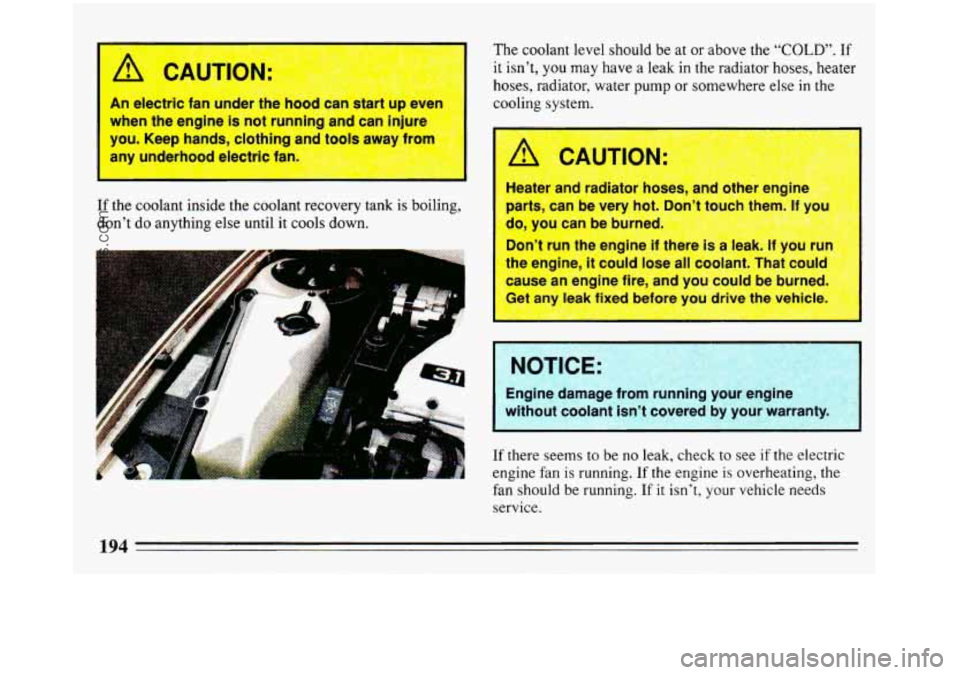
If the coolant inside the coolant recovery tank is boiling,
don’t do anything else until it
cools down. The
coolant level should be at or above the
“COLD”. If
it isn’t, you may have a leak in the radiator hoses, heater
hoses, radiator, water pump or somewhere else
in the
cooling system.
9
Heater and radiator hoses, and other englne
parts, can be very hot.
do, you can be burned.
Don’t run the engine
if there is a leak. If you r,,,
the engine, it could lose all coolant. That could
cause an engine fire, and you could be burned
my leak fixed before you drive +he vehicl,.
I U
If there seems to be no leak, check to see if the electric
engine fan
is running. If the engine is overheating, the
fan should be running.
If it isn’t, your vehicle needs
service.
194
ProCarManuals.com
Page 218 of 308
gasolines with these blending materials, such as MTBE
and ethanol. By doing
so, you can help clean the air,
especially
in those parts of the country that have high
carbon monoxide levels.
In addition, some gasoline suppliers are now producing
reformulated gasolines. These gasolines are specially
designed to reduce vehicle emissions. General Motors
recommends that
you use reformulated gasoline. By
doing
so, you can help clean the air, especially in those
parts of the country that have high ozone levels.
You should ask your service station operators
if their
gasolines contain detergents and oxygenates, and
if they
have been reformulated
to reduce vehicle emissions.
Fuels in Foreign Countries
If you plan on driving in another country outside the
U.S. or Canada, unleaded fuel may be hard to find. Do
not use leaded gasoline. If you use even one tankful,
your emission controls won’t work well or at all. With
continuous
use, spark plugs can get fouled, the exhaust
system can corrode, and your engine oil can deteriorate
quickly. Your vehicle’s oxygen sensor will be damaged.
All of that means costly repairs that wouldn’t be covered
by your warranty.
To check on fuel availability, ask an auto club, or
contact a major oil company that does business in the
country where you’ll be driving.
You can also write us at the following address for
advice. Just tell us where you’re going and give your
Vehicle Identification Number (VIN).
General Motors of Canada Ltd.
International Export Sales
P.O. Box 828
Oshawa, Ontario L1H 7N1, Canada
216
ProCarManuals.com
Page 222 of 308
Before closing the hood, be sure all the filler caps are on
properly.
Then just pull the hood down and close it firmly.
Engine Oil
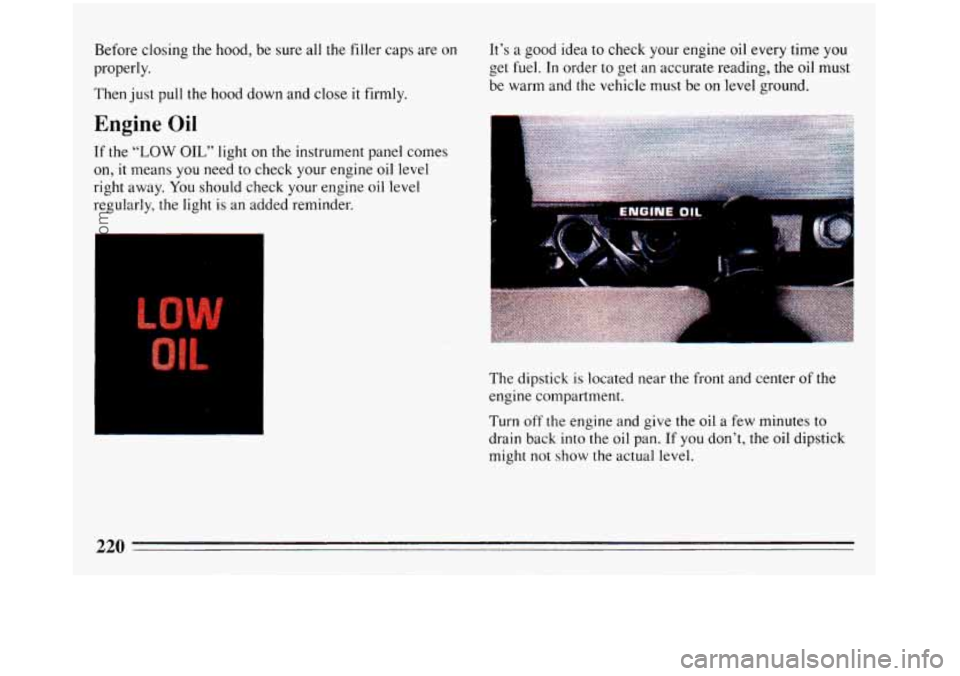
If the “LOW OIL” light on the instrument panel comes
on, it means you need to check your engine oil level
right away.
You should check your engine oil level
regularly, the light
is an added reminder. It’s
a good idea to check your engine oil every time you
get fuel.
In order to get an accurate reading, the oil must
be warm and the vehicle must be
on level ground.
The dipstick is located near the front and center
of the
engine compartment.
Turn
off the engine and give the oil a few minutes to
drain back into the oil pan. If you don’t, the oil dipstick
might not show the actual level.
ProCarManuals.com
Page 223 of 308
L
A
A
A
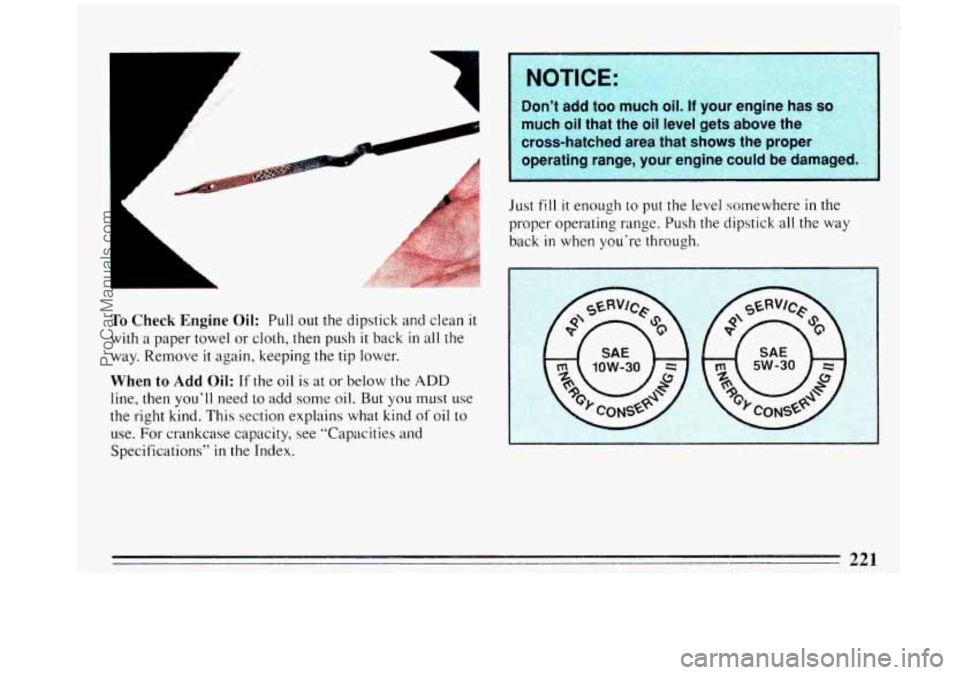
Don’t add too much oil. If your engine has so
much oil that the oil level gets above the
cross-hatched area that shows the proper
r operating range, your engine could be damaged. I il
r
Just fill it enough to put the level somewhere in the
proper operating range. Push the dipstick all
the way
back
in when you’re through. L
L
To Check Engine Oil: Pull out the dipstick and clean it
with a paper towel or cloth, then push it back in all the
way. Remove
it again, keeping the tip lower.
When to Add Oil: If the oil is at or below the ADD
line, then you’ll need to add some oil. But you must use
the right kind. This section explains what kind of
oil to
use. For crankcase capacity, see “Capacities and
Specifications”
in the Index.
I
I
22 1.
ProCarManuals.com
Page 228 of 308
Automatic Transaxle Fluid
When to Check and Change:
A good time to check your automatic transaxle fluid
level is when
the engine oil is changed. Refer to the
Maintenance Schedule to determine when to change
your fluid. See “Scheduled Maintenance Services” in
the Index.
How to Check:
Because this operation can be a little difficult, you may
choose to have this done at a Buick dealership Service
Department.
If you do it yourself, be sure to follow all the
instructions here, or you could get a false reading on the
dipstick.
NOTICE:
Too much or too little fluid can damage your
transaxle.
Too much can mean that some of the
fluid could come out and fall
on hot engine parts,
starting a fire. Be sure to get an accurate reading
if you check your transaxle fluid.
Wait at least 30 minutes before checking the transaxle
fluid level if you have been driving:
When outside temperatures are above 90°F (32 ” C).
At high speed for quite a while.
0 In heavy traffic -- especially in hot weather.
0 While pulling a trailer.
To get the right reading, the fluid should be at normal
operating temperature, which is
180 F to 200 F (82 C
Get the vehicle warmed up by driving about 15 miles
(24 km) when outside temperatures are above
50°F
(10°C). If it’s colder than 50°F (lO°C), you may have
to drive longer.
To check the fluid level:
Park your vehicle on a level place.
0 Place the shift lever in “F’ (Park) with the parking
0 With your foot on the brake pedal, move the shift
to
93
O C).
brake applied.
lever through each gear range, pausing for about
three seconds
in each range. Then, position the shift
lever
in “P” (Park).
0 Let the engine run at idle for three to five minutes.
226
ProCarManuals.com
Page 229 of 308
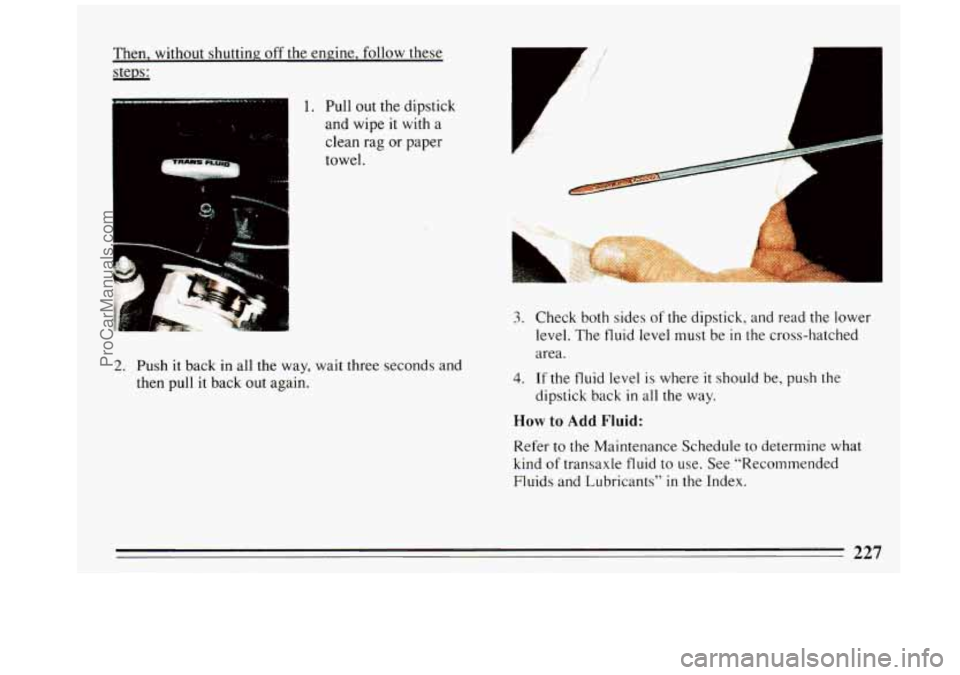
Then, without shutting off the engine, follow these
steps:
1. Pull out the dipstick
and wipe it with
a
clean rag or paper
towel.
‘i
2. Push it back in all the way, wait three seconds and
then pull it back out again.
A
3. Check both sides of the dipstick, and read the lower
level. The fluid level must be
in the cross-hatched
area.
4. If the fluid level is where it should be, push the
dipstick back
in all the way.
How to Add Fluid:
Refer to the Maintenance Schedule to determine what
kind
of transaxle fluid to use. See “Recommended
Fluids and Lubricants’’
in the Index.
ProCarManuals.com
Page 230 of 308
If the fluid level is low, add only enough of the proper
fluid to bring the level into the cross-hatched area on the
dipstick. It doesn’t take much fluid, generally less than a
pint. Don’t overfill. We recommend you use only fluid
labeled DEXRONB-IIE, because fluids with that label
are made especially for your automatic transaxle.
Damage caused by fluid other than DEXRONB-IIE is
not covered by your new vehicle warranty.
After adding fluid, recheck the fluid level as
described under “How
to Check.”
When the correct fluid level is obtained, push the
dipstick back in all the way.
Engine Coolant
The following explains your cooling system and how to
add coolant when
it is low. If you have a problem with
engine overheat.ing or if you need to add coolant to your
radiator, see “Engine Overheating”
in the Index.
The proper coolant for your Buick will:
0 Give freezing protection down to -34OF (-37OC) .
0 Give boiling protection up to 262 OF (128 “C) .
Protect against rust and corrosion.
0 Help keep the proper engine temperature.
0 Let the warning lights work as they should.
What to Use:
Use a mixture of one-half clean water (preferably
distilled) and one-half antifreeze that meets
“GM
Specification 1825-M,” which won’t damage aluminum
parts. You can also use a recycled coolant conforming to
GM Specification 1825-M with a complete coolant flush
and refill. Use GM Engine Coolant Supplement (sealer)
with any complete coolant change. If you use these, you
don’t need to add anything else.
can be aangerous. Plain water, or some other
liquid like alcohol, can boil before the proper
coolant mix will. Your vehicle’s coolant warning
system is set for the proper coolant mix. With
plain water or the wrong mix, your engine could
get too hot but you wouldn’t get the overhe-”
warning. Your engine could catch fire and
yuu or
others could be burned. Use a 50/50 mix of clean
water and a proper antifreeze.
G:~Z.+T~:, p:.t+d+s
228
ProCarManuals.com