check engine BUICK REGAL 1993 Owner's Manual
[x] Cancel search | Manufacturer: BUICK, Model Year: 1993, Model line: REGAL, Model: BUICK REGAL 1993Pages: 308, PDF Size: 16.35 MB
Page 231 of 308
NOTICE:
If you use an improper coolant mix, your engine
could overheat and be badly damaged. The
repair cost wouldn’t be covered by
your
warranty. Too much water in the mix can freeze
and crack the enqine, radiator, heater
core and
other parts.
I
Adding Coolant
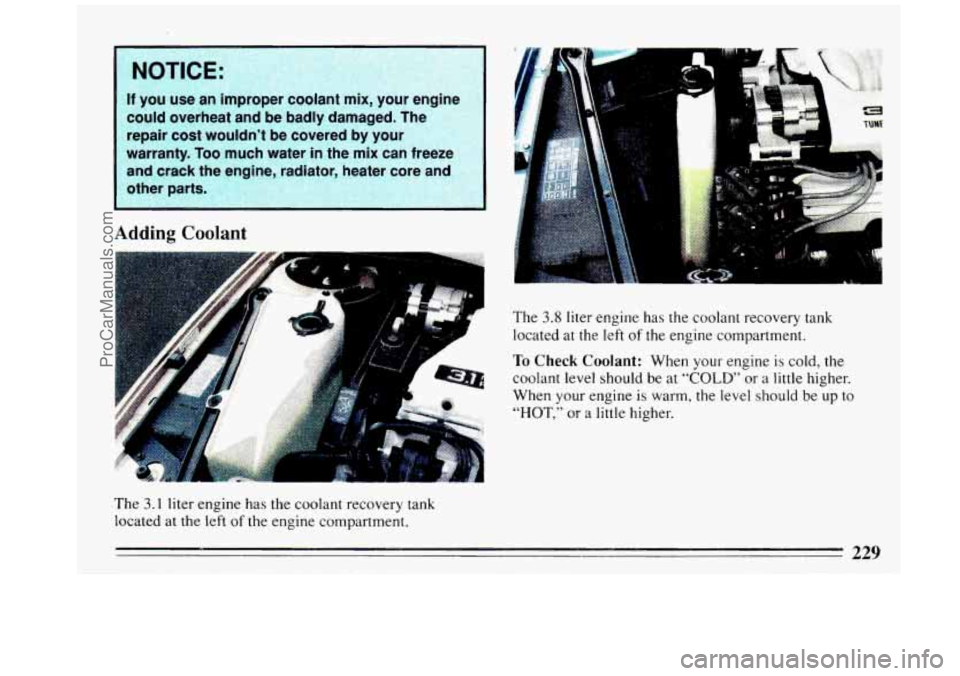
The 3.1 liter engine has the coolant recovery tank
located at the
left of the engine Compartment.
__./”
t
The 3.8 liter engine has the coolant recovery tank
located at the left of
the engine compartment.
To Check Coolant: When your engine is cold, the
coolant
level should be at “COLD” or a little higher.
When your engine is warm, the level should
be up to
“HOT,” or a little higher.
229
ProCarManuals.com
Page 233 of 308
Radiator Pressure Cap rower Steerlng Fluid
1; NOTICE: 1
.:: Your radiator cap is a 15 psi (1 05 kPa)
:: pressure-type cap and must be tightly installed
,*to prevent coolant loss and possible engine
q:. damage from overheating. Be sure the arrows on
,. the cap line up with the overflow tube on the
8: radiator filfer neck.
When you replace your radiator pressure cap, an AC@
cap is recommended.
Thermostat
Engine coolant temperature is controlled by a thermostat
in the engine coolant system. The thermostat stops the
flow of coolant through the radiator until the coolant
reaches a preset temperature.
When you replace your thermostat, an
AC@ thermostat
is recommended.
L
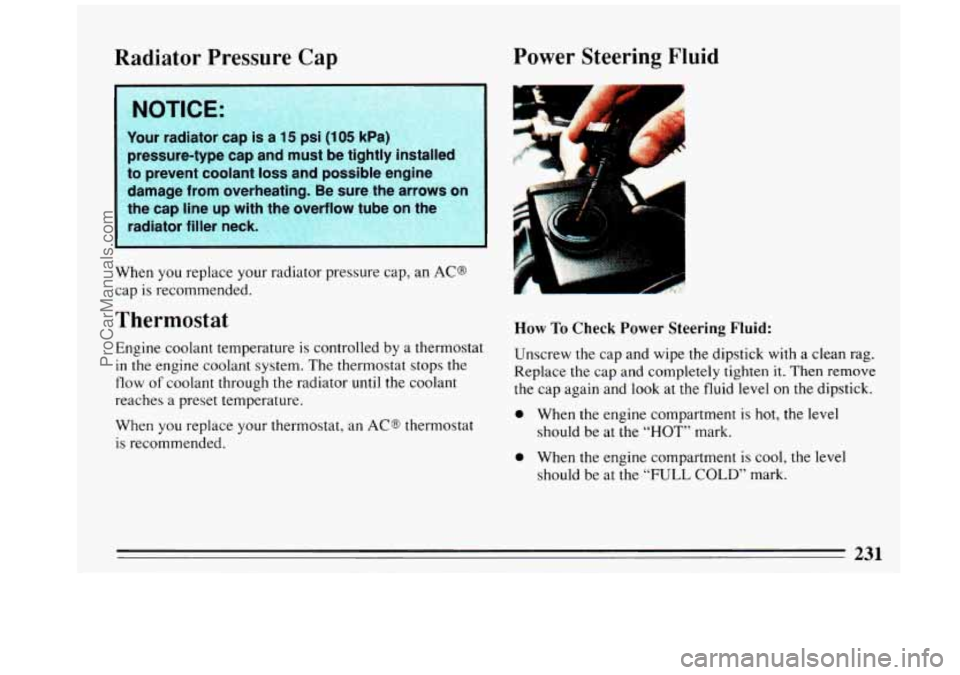
How To Check Power Steering Fluid:
Unscrew the cap and wipe the dipstick with a clean rag.
Replace the cap and completely tighten
it. Then remove
the cap again and look at the fluid level on the dipstick.
0 When the engine compartment is hot, the level
should be at the
“HOT” mark.
0 When the engine compartment is cool, the level
should be at the
“FULL COLD” mark.
231
ProCarManuals.com
Page 258 of 308
Vehicle Identification Number (VIN) Service Parts Identification Label
I SAMPLE4UXPM072675
ENGINE A3 t ASSEMBLY I
CODE MODEL YEAR PLANT
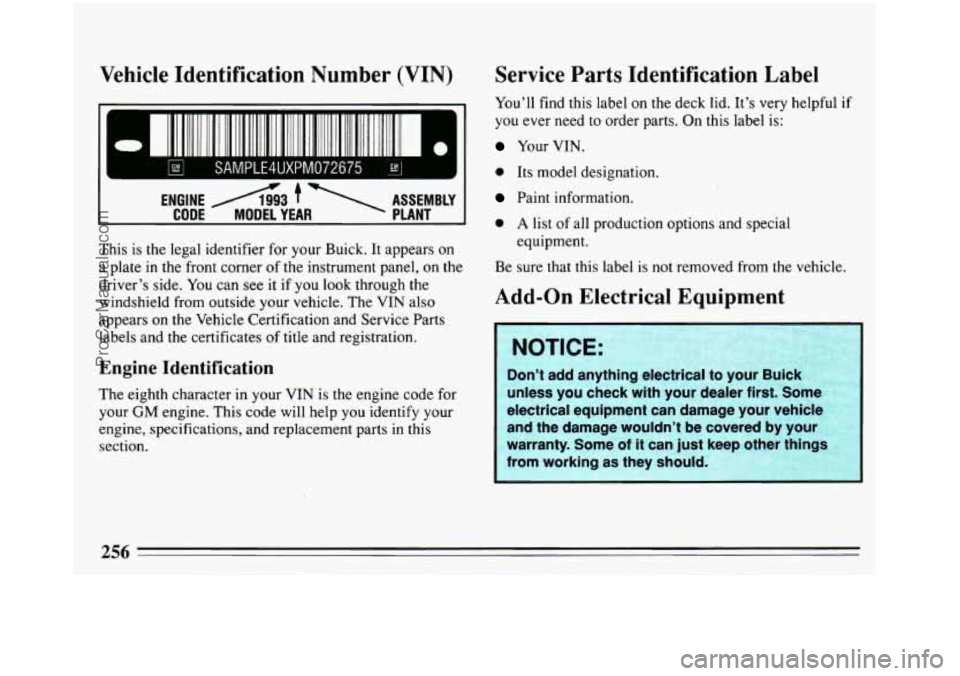
This is the legal identifier for your Buick. It appears on
a plate in the front comer
of the instrument panel, on the
driver’s side.
You can see it if you look through the
windshield from outside your vehicle. The VIN also
appears on the Vehicle Certification and Service Parts
labels and the certificates of title and registration.
Engine Identification
The eighth character in your VIN is the engine code for
your
GM engine. This code will help you identify your
engine, specifications, and replacement parts in this
section. You’ll
find this label on the deck lid. It’s very helpful
if
you ever need to order parts. On this label is:
Your VIN.
0 Its model designation.
Paint information.
0 A list of all production options and special
Be sure that this label is not removed from the vehicle.
equipment.
Add-on Electrical Equipment
I NOTICE:
Don’t add anything electrical
to your Buick
unless you check with your dealer first. Some
electrical equipment can damage your vehicle
and the damage wouldn’t be covered by your
warranty. Some of it can just keep other things
from working
as they should.
1
256
ProCarManuals.com
Page 268 of 308
IMPORTANT:
KEEP ENGINE OIL
AT THE PROPER
LEVEL AND CHANGE AI
RECOMMENDED
’/an
Have you purchased the GM Protection Plan? The
Plan supplements your new vehicle warranties. See
your Buick dealer for details.
Introduction
A Word About Maintenance
We at General Motors want to help you keep your
vehicle in good working condition. But we don’t know
exactly how
you’ll drive it. You may drive very short
distances only
a few times a week. Or you may drive
long distances all the time in very
hot, dusty weather.
You may use your vehicle in making deliveries. Or you
may drive it to work, to
do errands or in many other
ways.
Because of all
the different ways people use their GM
vehicles, maintenance needs vary. You may even need
more frequent checks and replacements
than you will
find in the schedules in this part.
So please read this part
and note how
you drive. If you have any questions on
how
to keep your vehicle in good condition, see your
Buick dealer, the place many GM owners choose to
have their maintenance work done. Your dealer can be
relied upon to use proper parts and practices.
266
-
ProCarManuals.com
Page 276 of 308
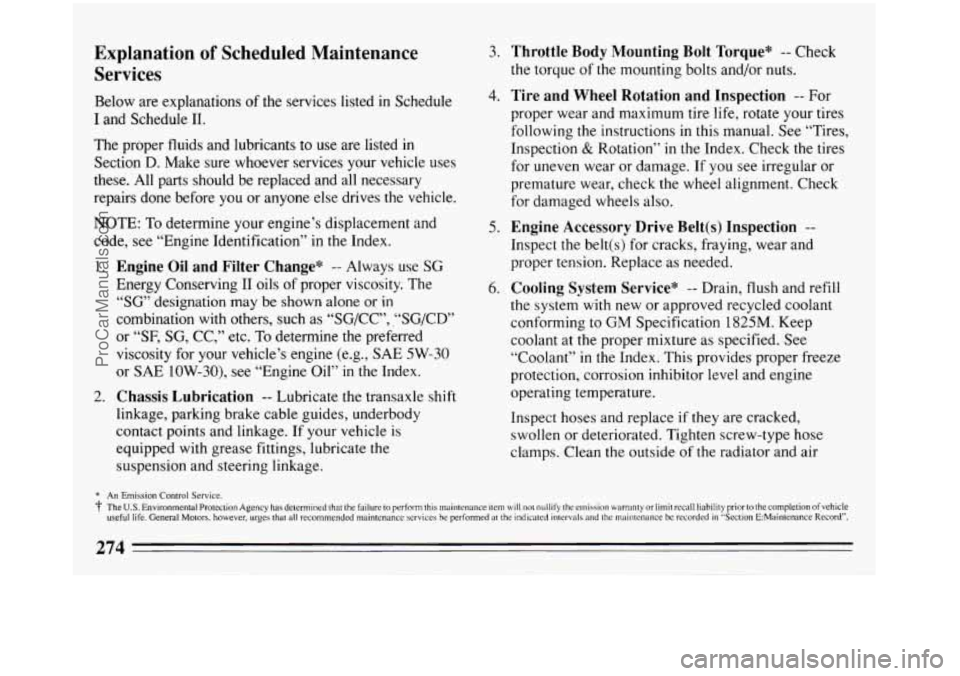
Explanation of Scheduled Maintenance
Services
Below are explanations of the services listed in Schedule
I and Schedule 11.
The proper fluids and lubricants to use are listed in
Section D. Make sure whoever services your vehicle uses
these. All parts should be replaced and all necessary
repairs done before
you or anyone else drives the vehicle.
NOTE: To determine your engine’s displacement and
code, see “Engine Identification” in the Index.
1. Engine Oil and Filter Change* -- Always use SG
Energy Conserving I1 oils of proper viscosity. The
“SG” designation may be shown alone or in
combination with others, such as “SG/CC”, ,“SG/CD”
or
“SF, SG, CC,” etc. To determine the preferred
viscosity for your vehicle’s engine (e.g., SAE 5W-30
or SAE 10W-30), see “Engine Oil”
in the Index.
2. Chassis Lubrication -- Lubricate the transaxle shift
linkage, parking brake cable guides, underbody
contact points and linkage. If your vehicle is
equipped with grease fittings, lubricate
the
suspension and steering linkage. 3.
Throttle Body Mounting
Bolt Torque* -- Check
the torque
of the mounting bolts and/or nuts.
4. Tire and Wheel Rotation and Inspection -- For
proper wear and maximum tire life, rotate your tires
following the instructions
in this manual. See “Tires,
Inspection
& Rotation” in the Index. Check the tires
for uneven wear or damage. If you see irregular or
premature wear, check the wheel alignment. Check
for damaged wheels also.
5. Engine Accessory Drive Belt(s) Inspection --
Inspect the belt(s) for cracks, fraying, wear and
proper tension. Replace as needed.
6. Cooling System Service* -- Drain, flush and refill
the system
with new or approved recycled coolant
conforming to GM Specification 1825M. Keep
coolant at the proper mixture as specified. See
“Coolant”
in the Index. This provides proper freeze
protection, corrosion inhibitor level and engine
operating temperature.
Inspect hoses and replace
if they are cracked,
swollen or deteriorated. Tighten screw-type hose
clamps. Clean the outside
of the radiator and air
* An Emission Control Service.
The
U.S. Environmental Protection Agency has determined that the failure to perform this maintenance item will not nullify the emission warranty or limit recall liability prior tothe completion of vehicle useful life. General Motors, however, urges that all recommended maintenance \
services he performed at the indicatcd intervals and the maintenance be recorded in ”Section E:Maintenance Record”.
274
ProCarManuals.com
Page 278 of 308
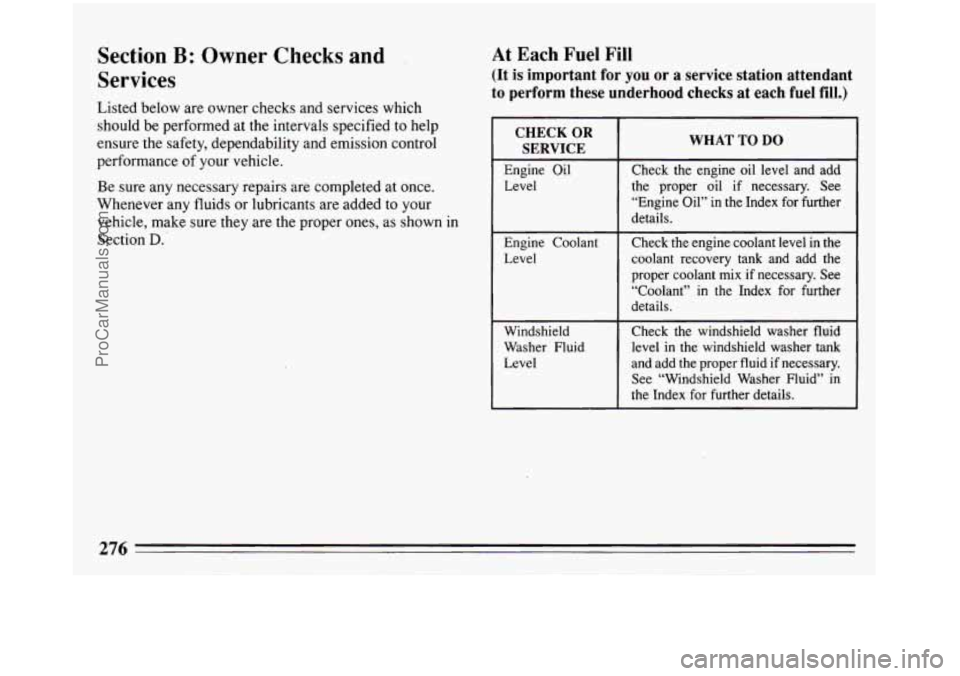
Section B: Owner Checks and
Services
Listed below are owner checks and services which
should be performed
at the intervals specified to help
ensure the safety, dependability and emission control
performance of your vehicle.
Be sure any necessary repairs are completed at once.
Whenever
any fluids or lubricants are added to your
vehicle, make sure they are the proper ones, as shown in
Section
D..
At Each Fuel Fill
(It is important for you or a service station attendant
to perform these underhood checks at each fuel
fill.)
WHAT TO DO
Engine Oil
the proper oil if necessary. See
Level Check the
engine oil level and add
“Engine
Oil” in the Index for further
details.
Engine Coolant coolant recovery tank and add the
Level Check the
engine coolant level in the
“Coolant”
in the Index for further
proper
coolant mix if necessary. See
details.
Windshield
level in the windshield washer tank
Washer Fluid Check
the windshield washer fluid
and add the proper fluid if necessary.
Level
See “Windshield Washer Fluid”
in
the Index for further details.
276
-
ProCarManuals.com
Page 279 of 308
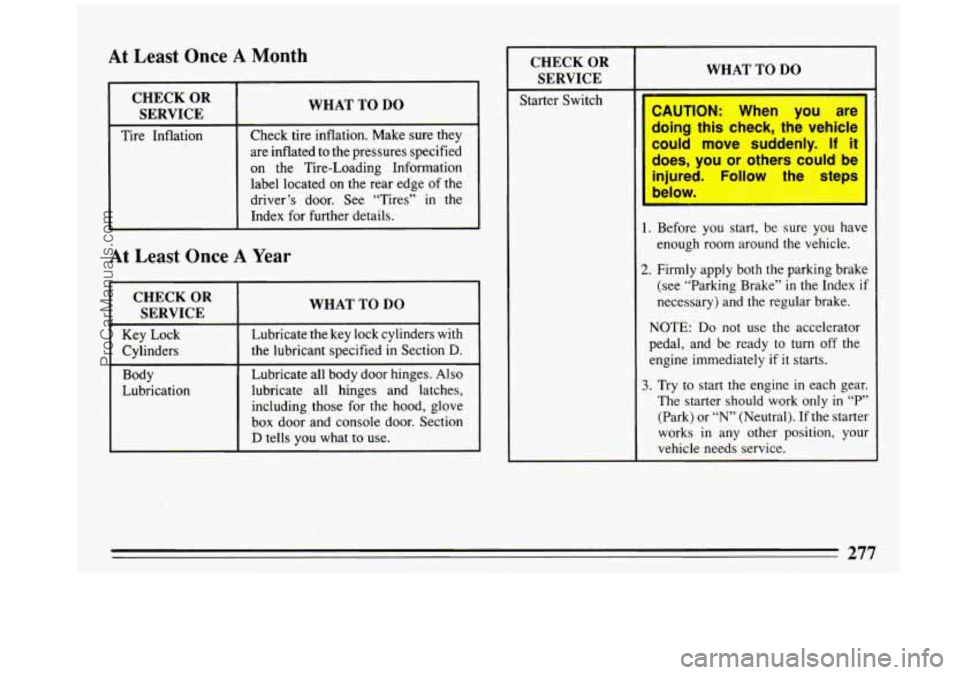
At Least Once A Month
CHECK OR
SERVICE
Tire Inflation
WHAT TO DO
Check tire inflation. Make sure they
are inflated
to the pressures specified
on the Tire-Loading Information
label located on the rear edge of
the
driver’s door. See “Tires” in the
Index for further details.
c!%&lkY 1 --“-+
Starter Switch
At Least Once A Year
I CHECKOR
SERVICE
I WHAT TO DO
Key Lock
the lubricant specified in Section
D. Cylinders Lubricate the
key lock cylinders with
Body
Lubrication Lubricate all
body door hinges.
Also
lubricate all hinges and latches,
including those for the hood, glove
box door and console door. Section
D tells you what to use.
1. Before you start, be sure you have
enough room around the vehicle.
2. Firmly apply both the parking brake
(see “Parking Brake”
in the Index if
necessary) and the regular brake.
NOTE:
Do not use the accelerator
pedal, and
be ready to turn off the
engine immediately if
it starts.
3. Try to start the engine in each gear.
The starter should work only in “P”
(Park) or
“N” (Neutral). If the starter
works
in any other position, your
vehicle needs service.
277
ProCarManuals.com
Page 280 of 308
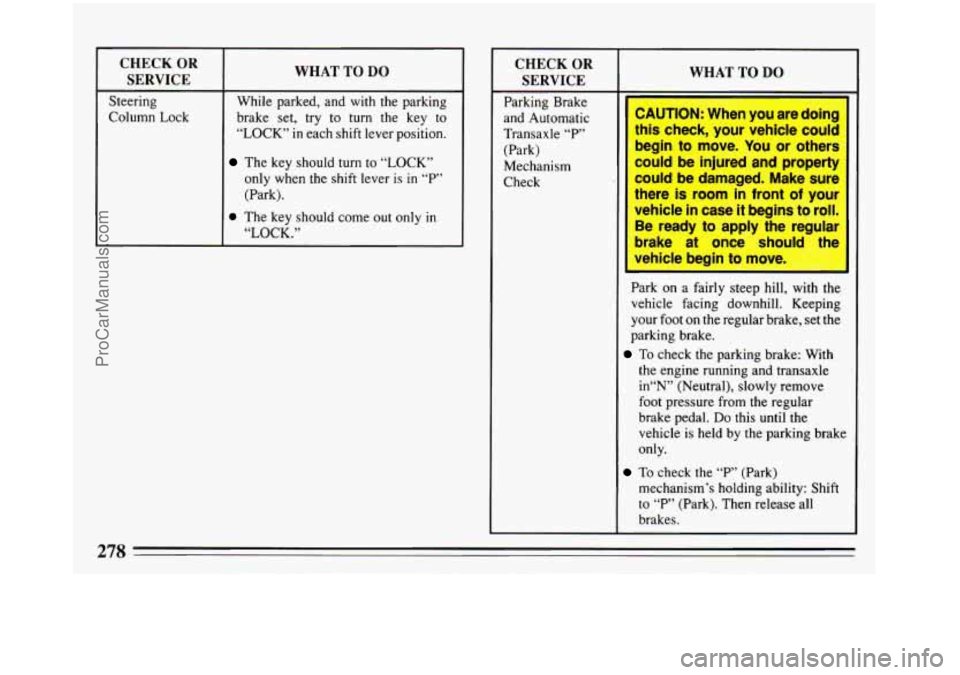
CHECK OR
Steering
Column Lock
WHAT TO DO
While parked, and with the parking
brake set, try to
turn the key to
“LOCK”
in each shift lever position.
The key should turn to “LOCK”
only when the shift lever is in “P’
(Park).
“LOCK.”
0 The key should come out only in
-t
CHECK OR
SERVICE
Parking Brake
and Automatic
Transaxle
“P’
(Park)
Mechanism
Check
WHAT TO DO
.r
CAUTION: When you are doing
s check, your vehicle could
begin to move. You or others
-Ad be injured and property
Jld be damaged. Make sure
rllzre
is room in front of your
U4icle
in case it begins to roll.
__ ready to apply the rnnular
brake at once shoul the
vehicle begin
to mc 5.
Park on a fairly steep hill, with the
vehicle facing downhill. Keeping
your foot on the regular brake, set
the
parking brake.
To check the parking brake: With
the engine running and transaxle
in“N” (Neutral), slowly remove
foot pressure from
the regular
brake pedal.
Do this until the
vehicle is held by the parking brake
only.
To check the “P,’ (Park)
mechanism’s holding ability: Shift
to
“P” (Park). Then release all
brakes.
278
ProCarManuals.com
Page 281 of 308
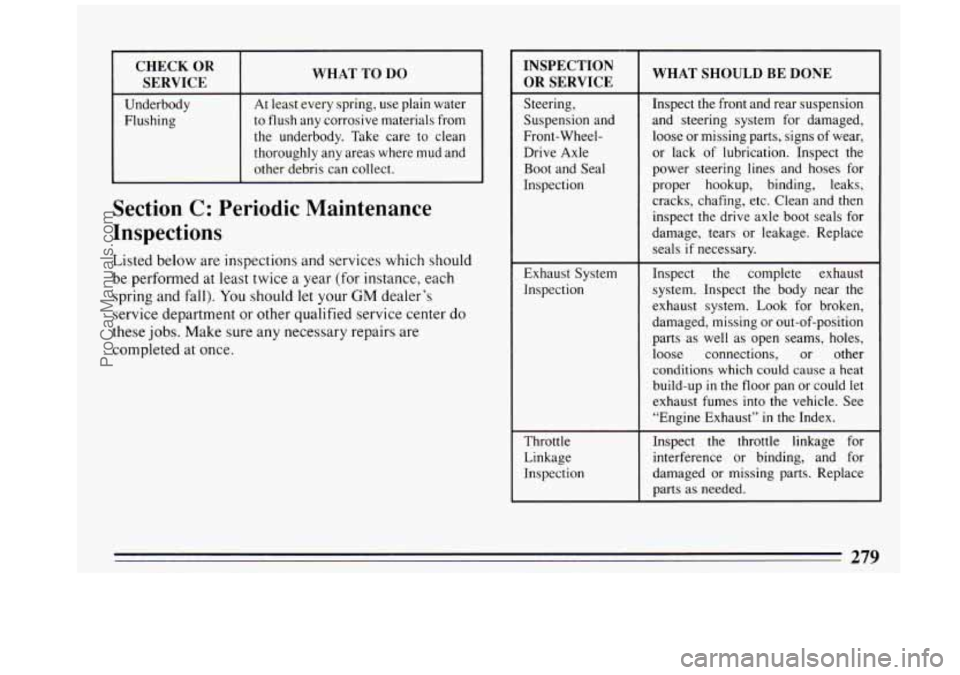
CHECK OR
I SERVICE WHAT TO DO
Underbody
Flushing At
least every spring, use plain water
to flush any corrosive materials from
the underbody. Take care to clean
thoroughly any areas where mud and
other debris can collect.
Section C: Periodic Maintenance
Inspections
Listed below are inspections and services which s ,hou !Id
be performed at least twice a year (for instance, each
spring and fall).
You should let your GM dealer’s
service department or other qualified service center do
these jobs. Make sure any necessary repairs are
completed at once.
INSPECTION
OR SERVICE
Steering,
Suspension and
Front-Wheel- Drive Axle
Boot and Seal
Inspection
Exhaust System
Inspection
Throttle Linkage
Inspection
WHAT SHOULD BE DONE
Inspect the front and rear suspension
and steering system for damaged, loose or missing parts, signs of wear,
or lack of lubrication. Inspect
the
power steering lines and hoses for
proper hookup, binding, leaks,
cracks, chafing, etc. Clean and then
inspect the drive axle boot seals for
damage, tears or leakage. Replace
seals
if necessary.
Inspect the complete exhaust
system. Inspect the body near
the
exhaust system. Look for broken,
damaged, missing or out-of-position
parts as well as open seams, holes,
loose connections, or other conditions which could cause
a heat
build-up
in the floor pan or could let
exhaust fumes into the vehicle. See
“Engine Exhaust”
in the Index.
Inspect the throttle linkage for
interference or binding, and for
damaged or missing parts. Replace
parts
as needed.
279
ProCarManuals.com
Page 282 of 308
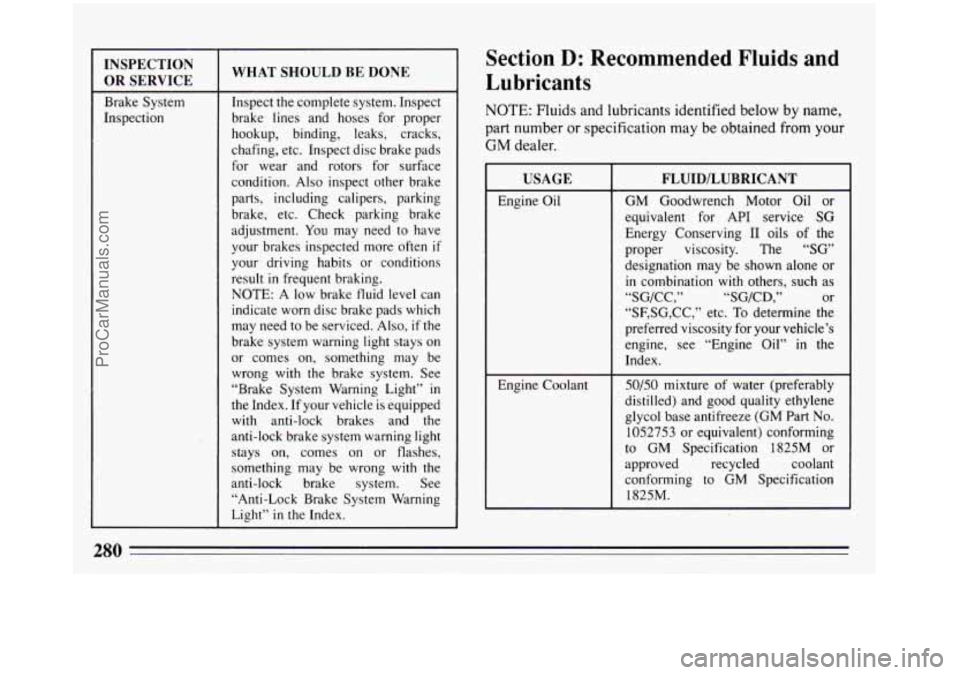
INSPECTION
OR SERVICE
Brake System
Inspection
WHAT SHOULD BE DONE
Inspect the complete system. Inspect
brake lines and hoses for proper
hookup, binding, leaks, cracks,
chafing, etc. Inspect disc brake pads
for wear and rotors for surface
condition. Also inspect other brake
parts, including calipers, parking
brake, etc. Check parking brake
adjustment. You may need to have
your brakes inspected more often
if
your driving habits or conditions
result
in frequent braking.
NOTE:
A low brake fluid level can
indicate worn disc brake pads which
may need to be serviced. Also, if the
brake system warning light stays on
or comes on, something may be
wrong with the brake system. See
“Brake System Warning Light”
in
the Index. If your vehicle is equipped
with anti-lock brakes and the
anti-lock brake system warning light
stays on, comes on or flashes,
something may be wrong with the
anti-lock brake system. See
“Anti-Lock Brake System Warning
Light”
in the Index.
Section D: Recommended Fluids and
Lubricants
NOTE: Fluids and lubricants identified below by name,
part number or specification may be obtained from your
GM dealer.
USAGE
Engine Oil
Engine Coolant
FLUID/LUBRICANT
GM Goodwrench Motor Oil or
equivalent for API service SG
Energy Conserving I1 oils of the
proper viscosity. The “SG”
designation may be shown alone or
in combination with others, such as
“SG/CC,” “SG/CD,”
or
“SF,SG,CC,” etc. To determine the
preferred viscosity for your vehicle’s
engine, see “Engine Oil” in the
Index.
50/50 mixture of water (preferably
distilled) and good quality ethylene
glycol base antifreeze (GM Part
No.
1052753 or equivalent) conforming
to
GM Specification 1825111 or
approved recycled coolant
conforming to
GM Specification
1825M.
ProCarManuals.com