turn signal BUICK REGAL 1993 User Guide
[x] Cancel search | Manufacturer: BUICK, Model Year: 1993, Model line: REGAL, Model: BUICK REGAL 1993Pages: 308, PDF Size: 16.35 MB
Page 154 of 308
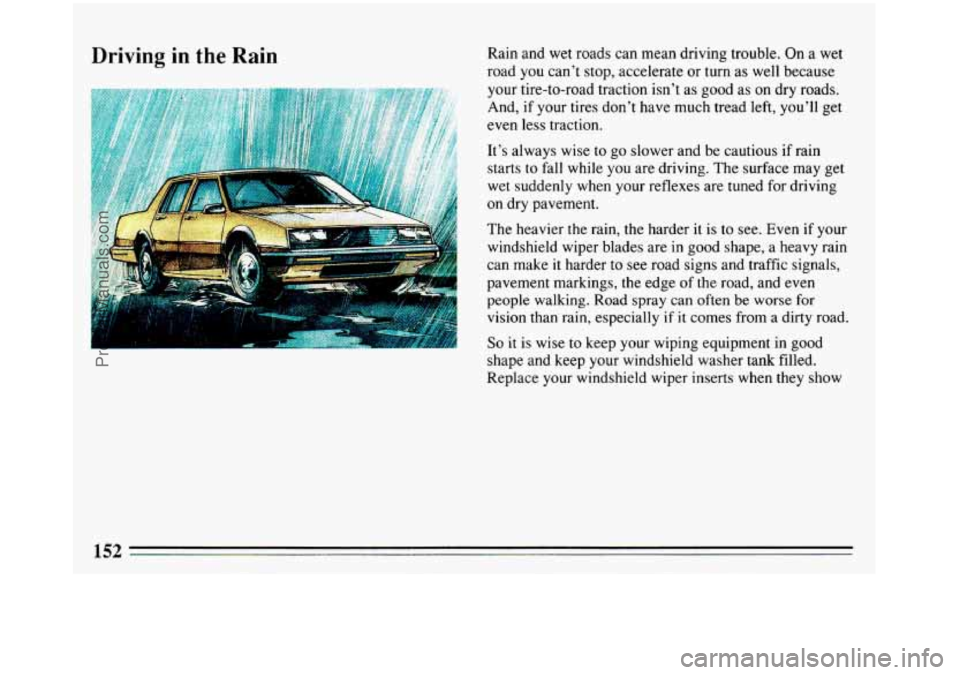
Driving in the Rain Rain and wet roads can mean driving trouble. On a wet
road
you can’t stop, .accelerate or turn as well because
your tire-to-road traction isn’t as good as on dry roads.
And, if your tires don’t have much tread left, you’ll get
even less traction.
It’s always wise to go slower and be cautious if rain
starts
to fall while you are driving. The surface may get
wet suddenly when your reflexes are tuned for driving
on dry pavement.
The heavier the rain, the harder it is to see. Even if your
windshield wiper blades are in good shape, a heavy rain
can make
it harder to see road signs and traffic signals,
pavement markings, the edge of the road, and even
people walking. Road spray
can often be worse for
vision than rain, especially if it comes from a dirty road.
So it is wise to keep your wiping equipment in good
shape and keep your windshield washer tank filled.
Replace your windshield wiper inserts when
they show
1 L3
ProCarManuals.com
Page 158 of 308
your horn at intervals or when you hear approaching
traffic.
Pass other vehicles in fog only if you can see far enough
ahead to pass safely. Even then, be prepared to delay
your pass
if you suspect the fog is worse up ahead. If
other vehicles try
to pass you, make it easy for them.
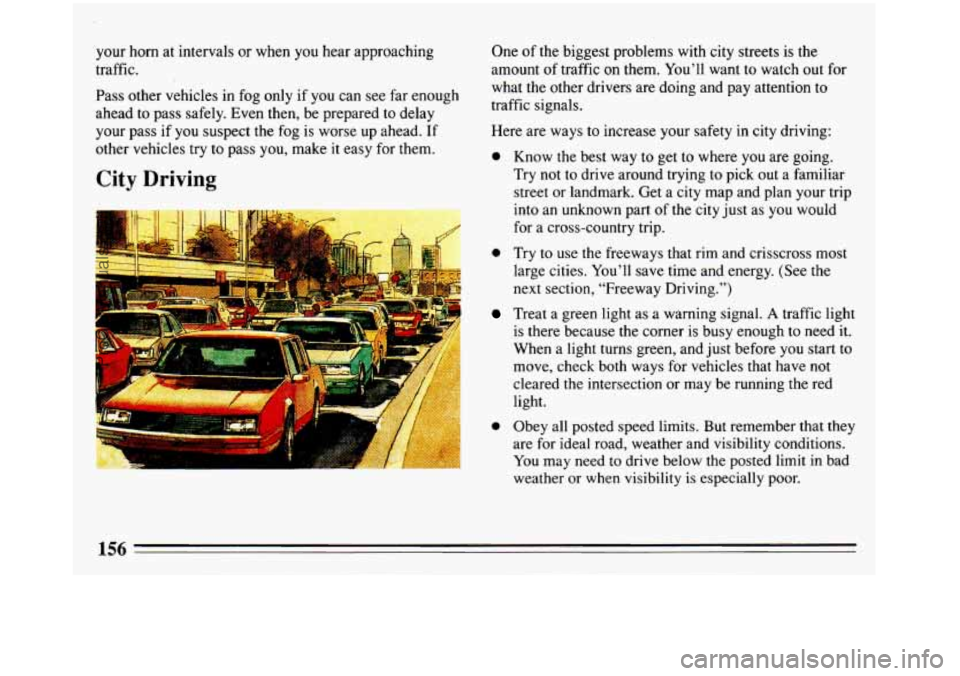
City Driving
One of the biggest problems with city streets is the
amount of traffic on them. You’ll want to watch out for
what the other drivers are doing and pay attention to
traffic signals.
Here are ways to increase your safety in city driving:
0 Know the best way to get to where you are going.
Try not to drive around trying to pick out a familiar
street or landmark. Get a city map and plan your trip
into an unknown part
of the city just as you would
for a cross-country trip.
large cities. You’ll save time and energy. (See the
next section, “Freeway Driving.”)
i 0 Try to use the freeways that rim and crisscross most
I Treat a green light as a warning signal. A traffic light
is there because the corner is busy enough
to need it.
When a light turns green, and
just before you start to
move, check both ways for vehicles that have not
cleared the intersection or may be running the red
light.
0 Obey all posted speed limits. But remember that they
are for ideal road, weather and visibility conditions.
You may need to drive below the posted limit in bad
weather or when visibility is especially poor.
156
ProCarManuals.com
Page 159 of 308
Pull to the right (with care) and stop clear or
intersections when you see or hear emergency
vehicles.
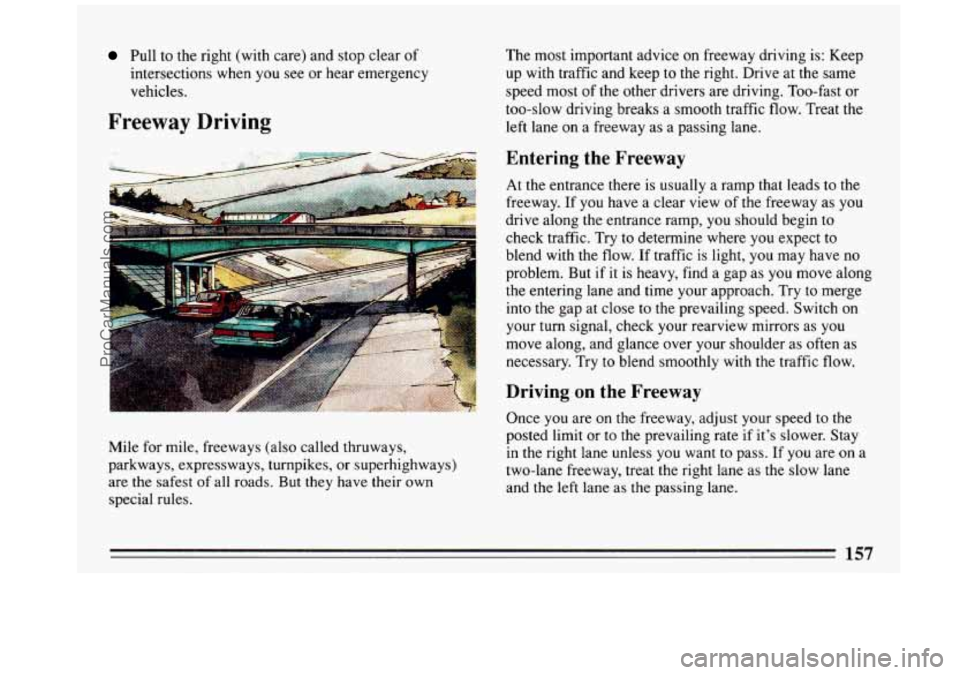
Freeway Driving
Mile for mile, freeways (also called thruways,
parkways, expressways, turnpikes, or superhighways)
are the safest of all roads. But they have their own
special rules. The
most important advice on freeway driving is: Keep
up with traffic and keep to the right. Drive at the same
speed most of the other drivers are driving. Too-fast or
too-slow driving breaks a smooth traffic flow. Treat the
left lane on a freeway as a passing lane.
Entering the Freeway
At the entrance there is usually a ramp that leads to the
freeway.
If you have a clear view of the freeway as you
drive along the entrance ramp, you should begin to
check traffic. Try to determine where you expect to
blend with the flow. If traffic is light, you may have no
problem. But if it is heavy, find a gap as
you move along
the entering lane and time your approach. Try to merge
into the gap at close to the prevailing speed. Switch on
your turn signal, check your rearview mirrors as you
move along, and glance over your shoulder as often as
necessary. Try to blend smoothly with the traffic flow.
Driving on the Freeway
Once you are on the freeway, adjust your speed to the
posted limit or to the prevailing rate if it's slower. Stay
in the right lane
unless you want to pass. If you are on a
two-lane freeway, treat the right lane as the slow lane
and the left lane as the passing lane.
157
ProCarManuals.com
Page 160 of 308
If you are on a three-lane freeway, treat the right lane as
the slower-speed through lane, the middle lane
as the
higher-speed through lane, and the left lane as the
passing lane.
Before changing lanes, check your rearview mirrors.
Then use your turn signal.
Just before you leave the lane, glance quickly over your
shoulder
to make sure there isn’t another vehicle in your
“blind” spot.
If you are moving from an outside to a center lane on a
freeway having more than two lanes, make sure another
vehicle isn’t about to move into the same spot. Look at
the vehicles two lanes over and watch for telltale signs:
turn signals flashing, an increase in speed, or moving
toward the edge
of the lane. Be prepared to delay your
move.
Once
you are moving on the freeway, make certain you
allow a reasonable following distance. Expect
to move
slightly slower at night.
Leaving the Freeway
When you want to leave the freeway, move to the proper
lane well in advance. Dashing across lanes at the last
minute is dangerous.
If you miss your exit do not, under any
circumstances, stop and back up. Drive
on to the
next exit.
At each exit point is a deceleration lane. Ideally it
should be long enough for
you to enter it at freeway
speed (after signaling, of course) and then do your
braking before moving onto the exit ramp.
Unfortunately, not all deceleration lanes are long enough
-- some are too short for all the braking. Decide when to
start braking. If you must brake
on the through lane, and
if there is traffic close behind you, you can allow
a little
extra time and flash your brake lights (in addition to
your turn signal) as extra warning that you are about to
slow down and exit.
The
exit ramp can be curved, sometimes quite sharply.
The exit speed is usually posted. Reduce your speed
according to your speedometer, not to your sense
of
motion. After driving for any distance at higher speeds,
you may tend to think you are going slower than you
actually are. For example,
40 mph (65 km/h) might
seem like
only 20 mph (30 km/h). Obviously, this could
lead
to serious trouble on a ramp designed for 20 mph
(30 km/h)!
158
-
ProCarManuals.com
Page 162 of 308
On two-lane highways or undivided multilane highways
that do not have controlled access, you’ll want to watch
for some situations not usually found on freeways.
Examples are: stop signs and signals, shopping centers
with direct access to the highway, no passing zones and
school zones, vehicles turning left and right
off the road,
pedestrians, cyclists, parked vehicles, and even animals.
Highway Hypnosis
Is there actually such a condition as “highway
hypnosis”? Or is it just plain falling asleep at the wheel?
Call it highway hypnosis, lack
of awareness, or
whatever.
There is something about an easy stretch
of road with
the same scenery, along with the hum of
the tires on the
road, the drone of the engine, and the rush
of the wind
against the vehicle that can make
you sleepy. Don’t let it
happen to
you! If it does, your vehicle can leave the
road in less than a second, and you could crash and be
inj ured.
What can you
do about highway hypnosis? First, be
aware that it can happen. Then
here are some tips:
0
0
0
0
Make sure your vehicle is well ventilated, with a
comfortably cool interior.
Keep your eyes moving. Scan the road ahead and to
the sides. Check your rearview mirrors frequently
and your instruments from time
to time. This can
help you avoid a fixed stare.
Wear good sunglasses in bright light. Glare can
cause drowsiness. But don’t wear sunglasses at
night. They will drastically reduce your overall
vision at
the very time you need all the seeing power
you have.
If you get sleepy, pull off the road into a rest, service,
or parking area and take a nap, get some exercise, or
both. For safety, treat drowsiness on
the highway as
an emergency.
As in any driving situation, keep pace with traffic and
allow adequate following distances.
ProCarManuals.com
Page 176 of 308
Following Distance
Stay at least twice as far behind the vehicle ahead as you
would when driving your vehicle without a trailer. This
can help you avoid situations that require heavy braking
and sudden turns.
Passing
You’ll need more passing distance up ahead when
you’re towing a trailer. And, because you’re a good deal
longer,
you’ll need to go much farther beyond the
passed vehicle before
you can return to your lane.
Backing Up
Hold the bottom of the steering wheel with one hand.
Then, to move the trailer to the left, just move that hand
to the left. To move the trailer to the right, move your
hand to the right. Always back up slowly and, if
possible, have someone guide you.
Making Turns
When you’re turning with a trailer, make wider turns
than normal.
Do this so your trailer won’t strike soft
shoulders, curbs, road signs, trees, or other objects.
Avoid jerky or sudden maneuvers. Signal well in
advance.
firn Signals When Towing a Trailer
When you tow a trailer, your vehicle has to have a
different turn signal flasher and extra wiring. The green
arrows on your instrument panel will flash whenever
you signal a turn or lane change. Properly hooked up,
the trailer lights will also flash, telling other drivers
you’re about to turn, change lanes or stop.
When towing a trailer, the green arrows
on your
instrument panel will flash for turns even if the bulbs on
the trailer are burned out.
Thus, you may think drivers
behind you are seeing your signal when they are not.
It’s
important to check occasionally to be sure the trailer
bulbs are still working.
Driving On Grades
Reduce speed and shift to a lower gear before you start
down a long or steep downgrade. If
you don’t shift
down, you might have to use your brakes
so much that
they would get hot and no longer work well.
On a long uphill grade, shift down and reduce your
speed to around
45 mph (70 km/h) to reduce the
possibility of engine and transaxle overheating.
If you are towing a trailer that weighs more than
1,000
pounds ( 450 kg), and you have an automatic transaxle
with Overdrive, you may prefer to drive in
“D” instead
of Overdrive
(or, as you need to, a lower gear).
174
ProCarManuals.com
Page 180 of 308
k
Hazard Warning Flashers
3
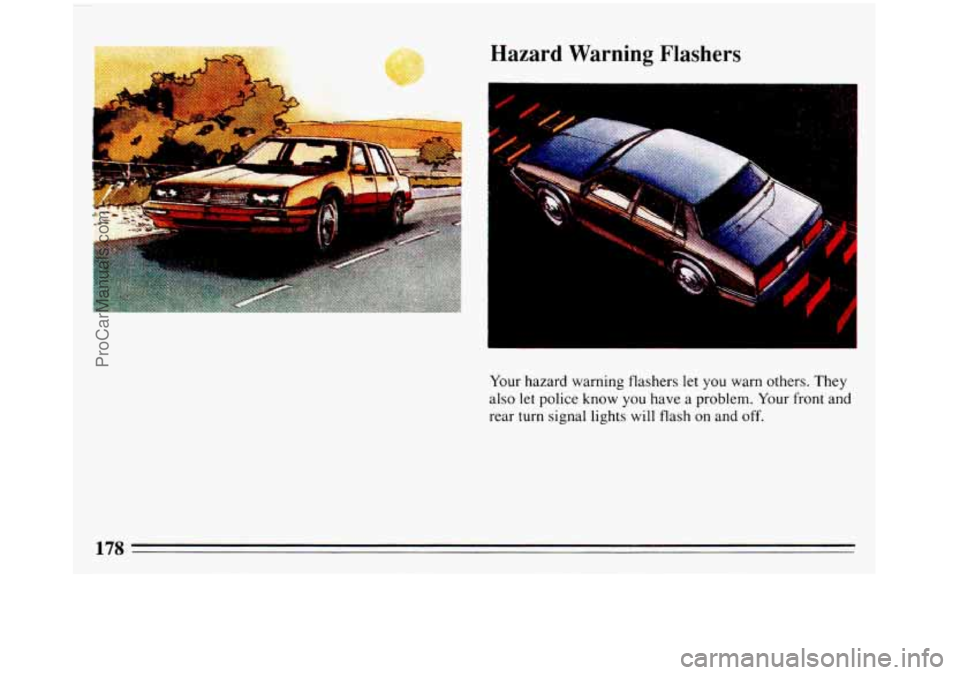
Your hazard warning flashers let you warn others. They
also let police know
you have a problem. Your front and
rear turn signal lights will flash
on and off.
ProCarManuals.com
Page 181 of 308
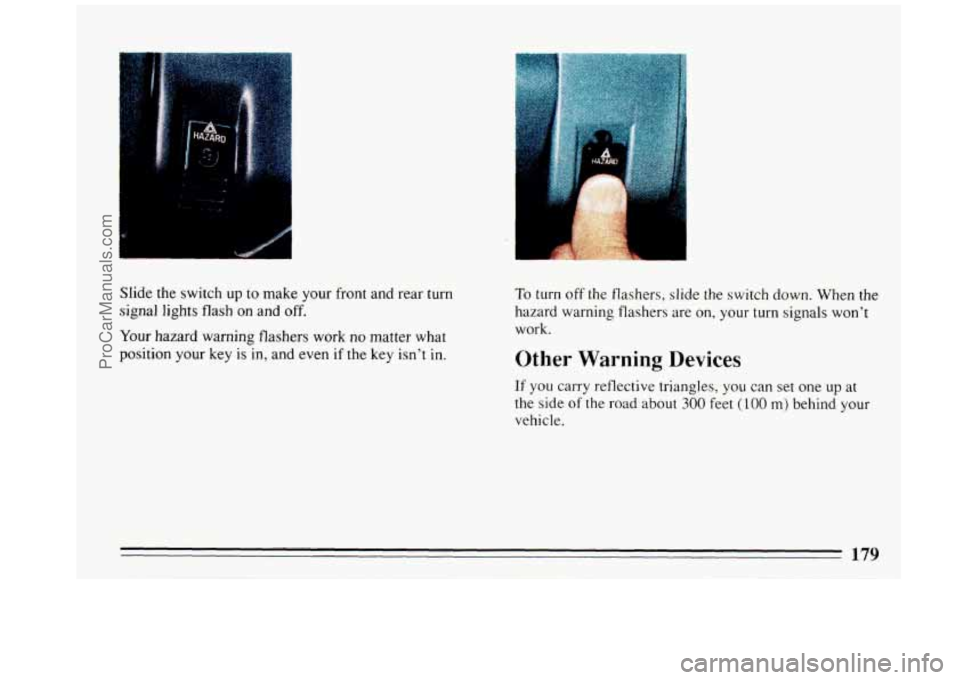
Slide the switch up to make your front and rear turn
signal lights flash
on and off.
Your hazard warning flashers work no matter what
position your key is in, and even
if the key isn’t in.
1
To turn off the flashers, slide the switch down. When the
hazard warning flashers are on, your turn signals won’t
work.
Other Warning Devices
If you carry reflective triangles, you can set one up at
the side
of the road about 300 feet (100 m) behind your
vehicle.
179
ProCarManuals.com
Page 259 of 308
Fuses and Circuit Breakers
The wiring circuits in your car are protected from short
circuits by a combination
of fuses, circuit breakers, and
fusible themdi links in the wiring itself.
This greatly
reduces the chance
of fires caused by electrical problems.
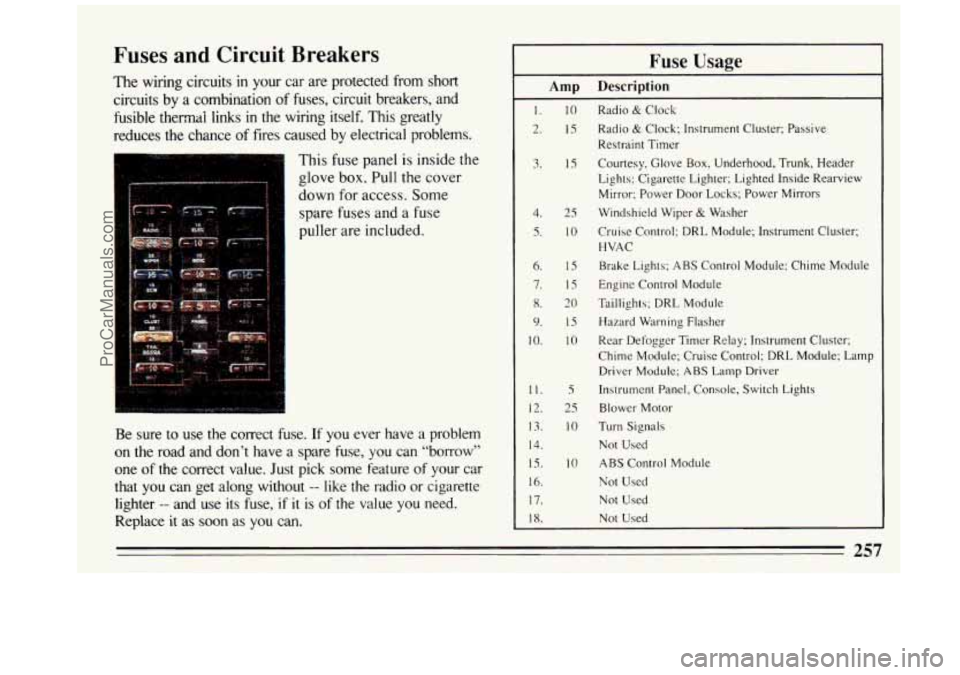
This fuse panel is inside the
glove box. Pull the cover
down for access. Some
spare fuses and
a fuse
puller are included.
Be sure
to use the correct fuse. If you ever have a problem
on the road and don’t have
a spare fuse, you can “borrow”
one of the correct value. Just pick some feature of your car
that you can get along without
-- like the radio or cigarette
lighter
-- and use its fuse, if it is of the value you need.
Replace
it as soon as you can.
Fuse Usage
Amp Description
1.
2.
3.
10
15
15
4.
5.
6.
7.
8.
9.
10.
11.
12.
13.
14.
1s.
16.
17.
18.
25
10
1s
15
20
15
10
5
25
10
10
Radio & Clock
Radio
& Clock; Instrument Cluster; Passive
Restraint Timer
Courtesy, Glove Box, Underhood, Trunk, Header
Lights; Cigarette Lighter; Lighted Inside Rearview Mirror; Power Door Locks; Power Mirrors
Windshield Wiper
& Washer
Cruise Control: DRL Module; Instrument Cluster;
HVAC
Brake Lights;
ABS Control Module; Chime Module
Engine Control Module
Taillights; DRL Module
Hazard Warning Flasher
Rear Defogger Timer Relay: Instrument Cluster;
Chime Module; Cruise Control; DRL Module; Lamp
Driver
Module; ABS Lamp Driver
Instrument Panel. Console, Switch Lights
Blower Motor
Turn Signals
Not Used ABS Control Module
Not Used Not Used
Not Used
257
ProCarManuals.com
Page 300 of 308
Heater. Engine Block .......................... 70. 224
“Highway Hypnosis”
............................. 160
Hill and Mountain Roads
.......................... 16 1
Hills. Parking on ................................ 163
Hitches. Trailer
.................................. 172
Holding a Baby
in .Your Car ......................... 4 1
Hood. Opening the ............................... 21 8
Horn
........................................... 80
Hot Coolant Warning Gage
........................ 103
Hot Engine. Safety Warnings About
................. 193
Hydroplaning
................................... 153
High
Speed. Shifting When Your Engine is Running at
... 72
Ice. Driving on
................................. 167
Identification Label. Service Parts
................... 256
Identification Number. Vehicle ..................... 256
Idling Your Engine
................................ 78
If You’re Stuck: In Sand. Mud. Ice
or Snow ........... 21 1
Ignition Key Positions ............................. 66
Indicator. Turn Signal ............................. 81
Indicators. Disc Brake Wear
....................... 142
Indicators. Warning Lights and Gages
................ 100
Infant Restraint
................................... 42
Inflation. Tire
................................... 241
Inside Mirror
.................................... 94
Inspection. Tire
................................. 242
Instrument Panel
................................. 99
Interior Cleaning ................................ 248
Introduction. How to Use this Manual
................. 10
..................................... J ack. Tire 202
Jacking Up the Car
............................... 202
“Jump” Starting
................................. 180
Keys
.......................................... 58
Keyless Entry System. Remote
...................... 62
Kilometer Indicator
............................... 99
Label. Service Parts Identification
.................. 256
Lane Change Indicator
............................. 81
LapBelt
........................................ 35
Lap-Shoulder Belt Usage by Children
................. 54
Latches. Front Seatback
............................ 18
Leathercleaning
................................ 250
Leaving Your Vehicle .............................. 77
Light. Safety Belt
................................. 25
Light. Turn Sigllal Indicator
......................... 81
Lighter. Cigarette
................................. 97
Lights Light Bulbs. Replaceable
.......................... 262
Daytime Running
.............................. 92
Fog
......................................... 92
Gages and Warning Indicators
................... 100
“On” Warning ................................ 100
Operation .................................... 91
Reading
...................................... 93
Traffic
...................................... 133
Loading
Your Vehicle ............................ 238
298
ProCarManuals.com