turn signal BUICK REGAL 1993 Owners Manual
[x] Cancel search | Manufacturer: BUICK, Model Year: 1993, Model line: REGAL, Model: BUICK REGAL 1993Pages: 308, PDF Size: 16.35 MB
Page 14 of 308
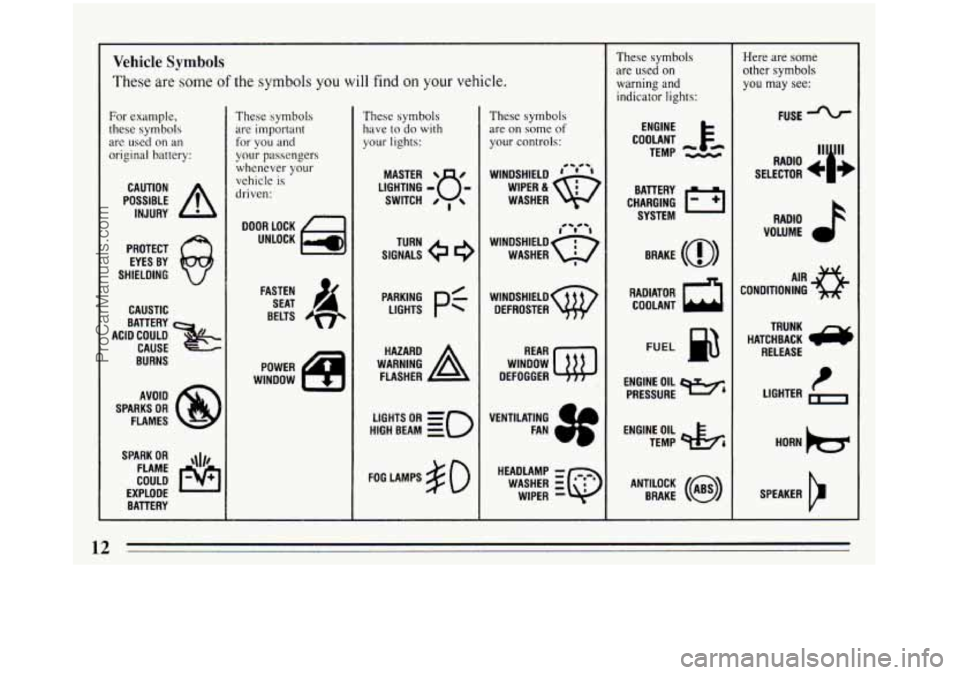
Vehicle Symbols
These are some of the symbols you will find on your vehicle.
For example,
these symbols
are used on an
original battery:
POSSIBLE A
CAUTION
INJURY
PROTECT EYES BY
SHIELDING
CAUSTIC
BURNS AVOID
SPARKS
OR
FLAMES
SPARK
OR ,\I/,
COULD FLAME
EXPLODE BATTERY
These symbols
are important
for you and
your passengers
whenever your
vehicle
is
driven:
DOOR LOCK
UNLOCK
e
e
BELTS 4
POWER
WINDOW
These symbols
have
to do with
your lights:
SIGNALS e @
TURN
HIGH BEAM
OR = =o
FOG LAMPS $0
These symbols
are on some
of
your controls:
WINDSHIELD ' ' ' 0- 0-
WASHER
WINDSHIELD WASHER
WINDOW
DEFOGGER
VENTILATING FAN
HEADLAMP
-
WIPER
WASHER
Q
These symbols
are
used on
warning and
indicator lights:
COOLANT F-
TEMP --
ENGINE
CHARGING
I-1
BATTERY SYSTEM
BRAKE
(0)
RADIATOR 0
COOLANT
FUEL
ENGINE OIL w,
PRESSURE
TEMP
OIL &b
ANTILOCK (a)
BRAKE
Here are some
other symbols
you may see:
FUSE
RADIO
VOLUME
CONDITIONING
AIR 43
HATCHBACK TRUNK
RELEASE
t LIGHTER
HORN
SPEAKER
12
ProCarManuals.com
Page 59 of 308
'art 2 Features And Controls
Here you can learn about the many standard and optional features on your Buick. and information on .. starting. shifting ..
and braking . Also explained are the instrument panel and
properly
.. and what to do if you have a problem .
Part 2 includes: the warning
systems that tell you
if every
Thing is working
Keys ........................................................................\
....
DoorLocks ....................................................................... \
NewVehicleBreak-In ..............................................................
StartingtheEngine .................................................................
ShiftingtheTransaxle ..............................................................
Windows ........................................................................\
.
TiltSteeringWheel ................................................................
Multi-FunctionLever ...............................................................
TurnandI, aneChangeSignals ...................................................
Headlight High-Low Beam Changer ..............................................
WindshieldWiper/Washer ......................................................
Cruisecontrol ................................................................
Mirrors ........................................................................\
..
Instrumentpanel ...................................................................
Speedometer and Odometer .....................................................
Warning Lights, Gages and Indicators .............................................
58
59
65
67
71
79
80
81
81
83
84
86
94
99
99
100
ProCarManuals.com
Page 83 of 308
To tilt the wheel, hold the steering wheel and pull the
lever. Move the steering wheel to a comfortable level,
then release the lever to lock the wheel in place.
The Turn Signal/Headlight Beam
Lever
TE
If
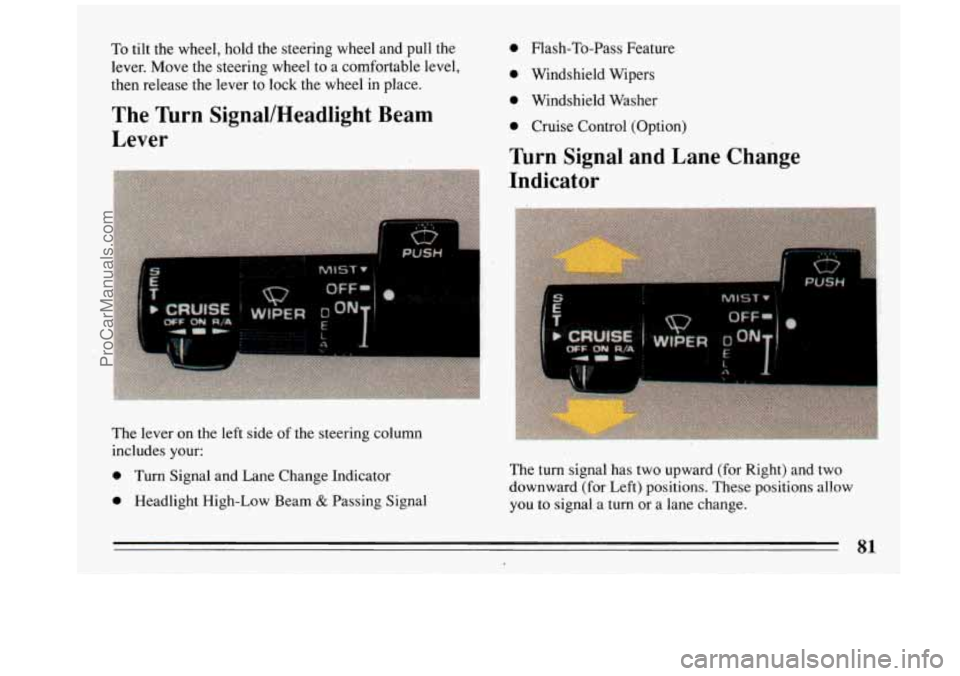
The lever on the left side of the steering column
includes your:
0 Turn Signal and Lane Change Indicator
0 Headlight High-Low Beam & Passing Signal
0
0
0
0
Flash-To-Pass Feature
Windshield Wipers
Windshield Washer
Cruise Control (Option)
Turn Signal and Lane Change
Indicator
The turn signal has two upward (for Right) and two
downward (for Left) positions. These positions allow
you to signal a turn or a lane change.
81
ProCarManuals.com
Page 84 of 308
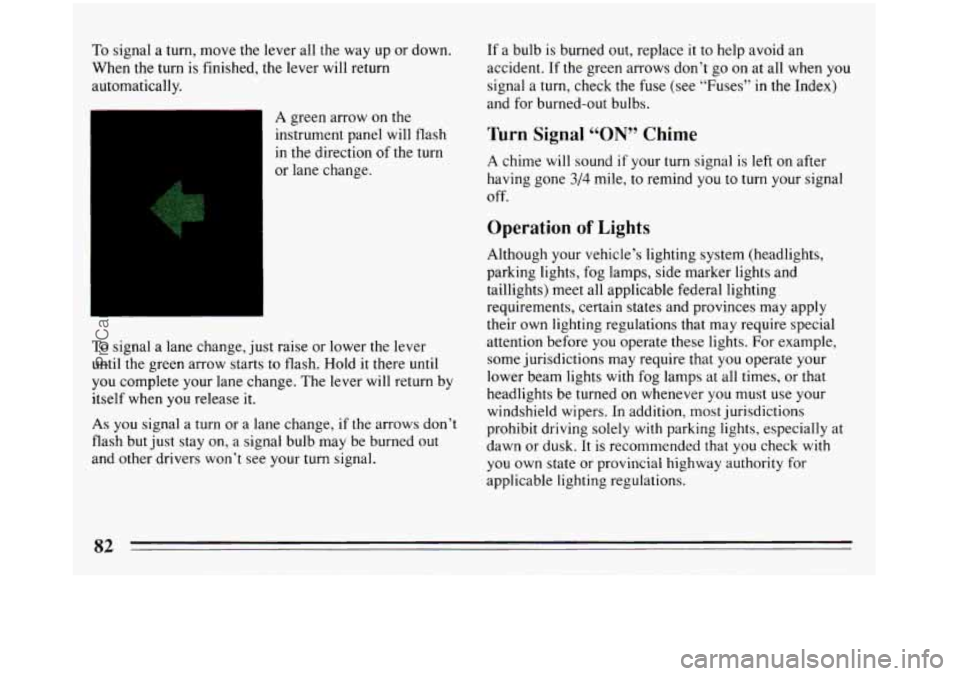
To signal a turn, move the lever all the way up or down.
When the turn
is finished, the lever will return
automatically.
A green arrow on the
instrument panel will flash in the direction of the turn
or lane change.
To signal a lane change, just raise or lower the lever
until the green arrow starts to flash. Hold it there
until
you complete your lane change. The lever will return by
itself when
you release it.
As you signal a turn or a lane change, if the arrows don’t
flash but just stay
on, a signal bulb may be burned out
and other drivers won’t see your
turn signal. If
a bulb
is burned out, replace it to help avoid an
accident. If the green arrows don’t
go on at all when you
signal a turn, check the fuse (see “Fuses” in the Index)
and for burned-out bulbs.
Turn Signal “ON” Chime
A chime will sound if your turn signal is left on after
having gone
3/4 mile, to remind you to turn your signal
off.
Operation of Lights
Although your vehicle’s lighting system (headlights,
parking lights, fog lamps, side marker lights and
taillights) meet
all applicable federal lighting
requirements, certain states and provinces may apply
their own lighting regulations that may require special
attention before you operate these lights. For example,
some jurisdictions may require that you operate your
lower beam lights with fog lamps at all times, or that
headlights be turned on whenever you must use your
windshield wipers. In addition,
most jurisdictions
prohibit driving solely with parking lights, especially at
dawn or dusk. It is recommended that you check with
you own state or provincial highway authority for
applicable lighting regulations.
82
-
ProCarManuals.com
Page 85 of 308
Headlight High-Low Beam
rc
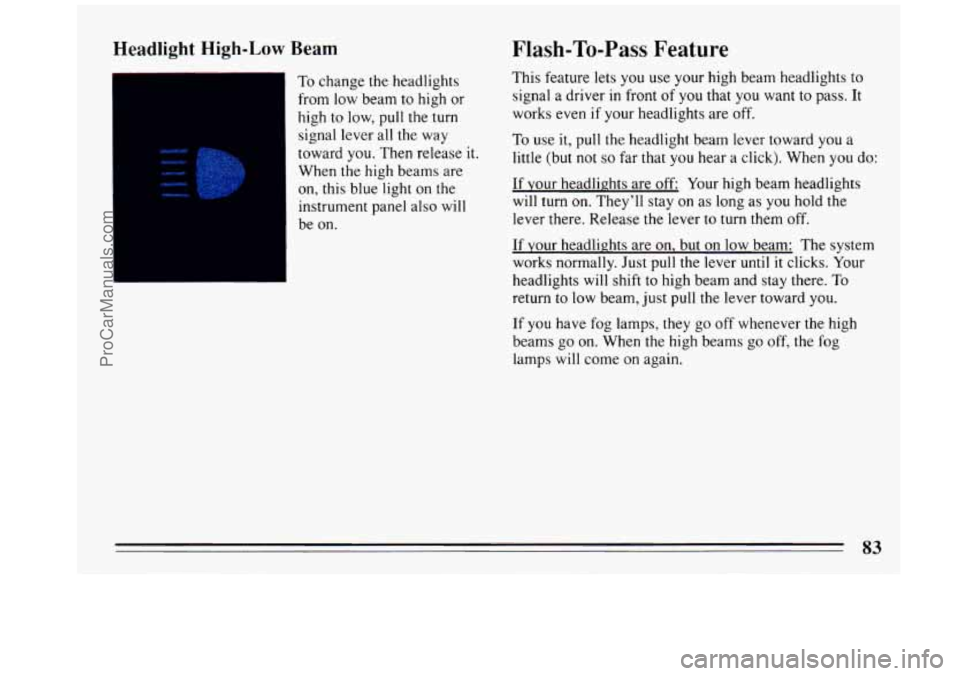
To change the headlights
from low beam to high or
high to low, pull the turn
signal lever all the way
toward you. Then release
it.
When the high beams are
on, this blue light on the
instrument panel also will
be on.
Flash-To-Pass Feature
This feature lets you use your high beam headlights to
signal a driver
in front of you that you want to pass. It
works even if your headlights are off.
To use it, pull the headlight beam lever toward you a
little (but
not so far that you hear a click). When you do:
If your headlights are off Your high beam headlights
will
turn on. They’ll stay on as long as you hold the
lever there. Release the lever
t.o turn them off.
If your headliphts are on, but on low beam: The system
works normally. Just pull the lever until
it clicks. Your
headlights will shift to high beam and stay there.
To
return to low beam, just pull the lever toward you.
If
you have fog lamps, they go off whenever the high
beams go on. When the high beams
go off, the fog
lamps will come
on again.
83
ProCarManuals.com
Page 102 of 308
the numbers, probably someone has tried to turn it back.
The numbers may not be true.
You may wonder what happens if a car has to have a
new odometer installed. If possible, the new one has to
be set to the same reading the old one had. If it can’t be,
then it’s set at zero, but
a label on the driver’s door must
show the old reading and when the new one was
installed.
Trip Odometer
TRIP
SET 90
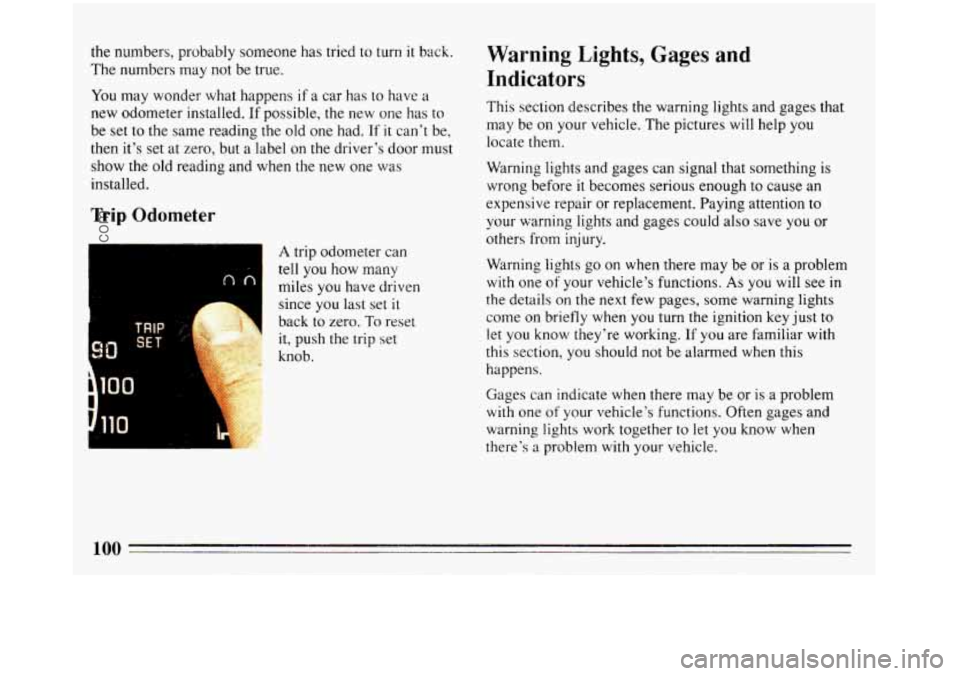
A trip odometer can
tell
you how many
miles you have driven
since you last set
it
back to zero. To reset
it, push the trip set
knob.
Warning Lights, Gages and
Indicators
This section describes the warning lights and gages that
may be on your vehicle. The pictures will help you
locate them.
Wdrning lights and gages can signal that something
is
wrong before it becomes serious enough to cause an
expensive re,pair or replacement. Paying attention to
your warning lights and gages could also save you or
others from injury.
Warning lights go on when there may be or
is a problem
with one of your vehicle’s functions. As you will see in
the details on the next few pages, some warning lights
come on briefly when you turn
the ignition key just to
let you know they’re working.
If you are familiar with
this section, you should not be alarmed when this
happens.
Gages
can indicate when there may be or is a problem
with one of your vehicle’s functions. Often gages and
warning lights work together
to let you know when
there’s a problem with your vehicle.
100
ProCarManuals.com
Page 126 of 308
Care of Your Compact Discs
Handle discs carefully. Store them in their original cases
or other protective cases and away from direct sunlight
and dust. If the surface of a disc is soiled, dampen a
clean, soft cloth in a mild, neutral detergent solution and
clean it, wiping from the center to the edge.
Be sure never to touch the signal surface when handling
discs. Pick up discs by grasping the outer edges or the
edge
of the hole and the outer edge.
Fixed Mast Antenna
The fixed mast antenna can withstand most car washes
without being damaged. If the mast should ever become
slightly bent, you can straighten it
out by hand. If the
mast is badly bent, as it might be by vandals,
you should
replace it.
Power Antenna Mast Care
Your power antenna will look its best and work well if
it’s cleaned from time to time.
To Clean the Antenna Mast:
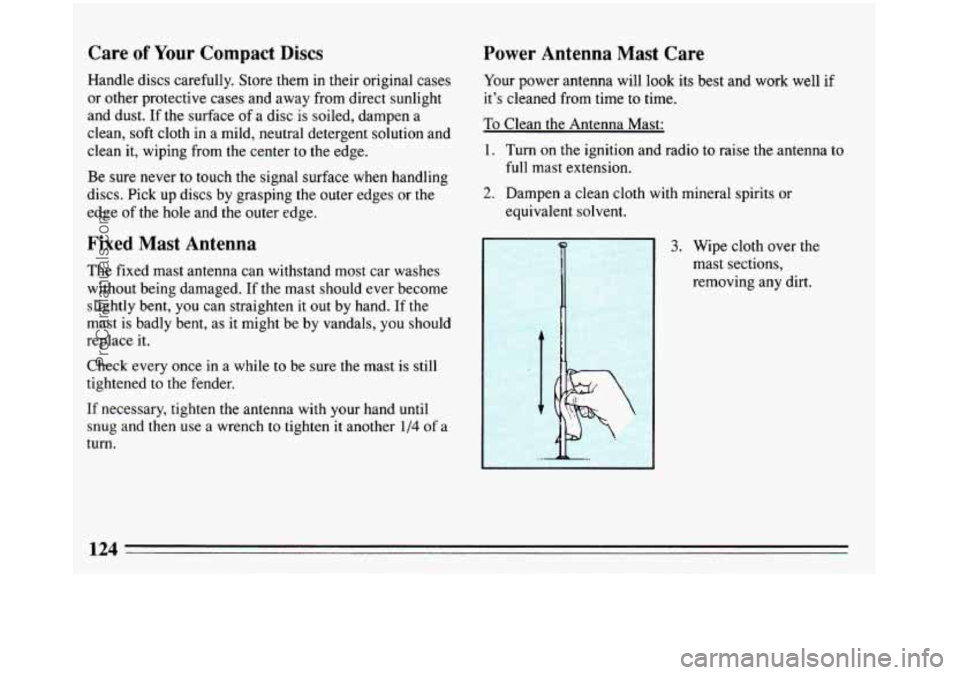
1. Turn on the ignition and radio to raise the antenna to
full mast extension.
2. Dampen a clean cloth with mineral spirits or
equivalent solvent.
3. Wipe cloth over the
mast sections,
removing any dirt.
Check every once in a while
to be sure the mast is still
tightened to the fender,
If necessary, tighten the antenna with your hand until
snug and then use a wrench to tighten it another
1/4 of a
turn.
124
ProCarManuals.com
Page 136 of 308
time. A green arrow means you may drive in that lane.
Look for the signs posted to warn drivers what hours
and days these systems are in
effect.
Pavement Markings
NO
PASSING
ZONE
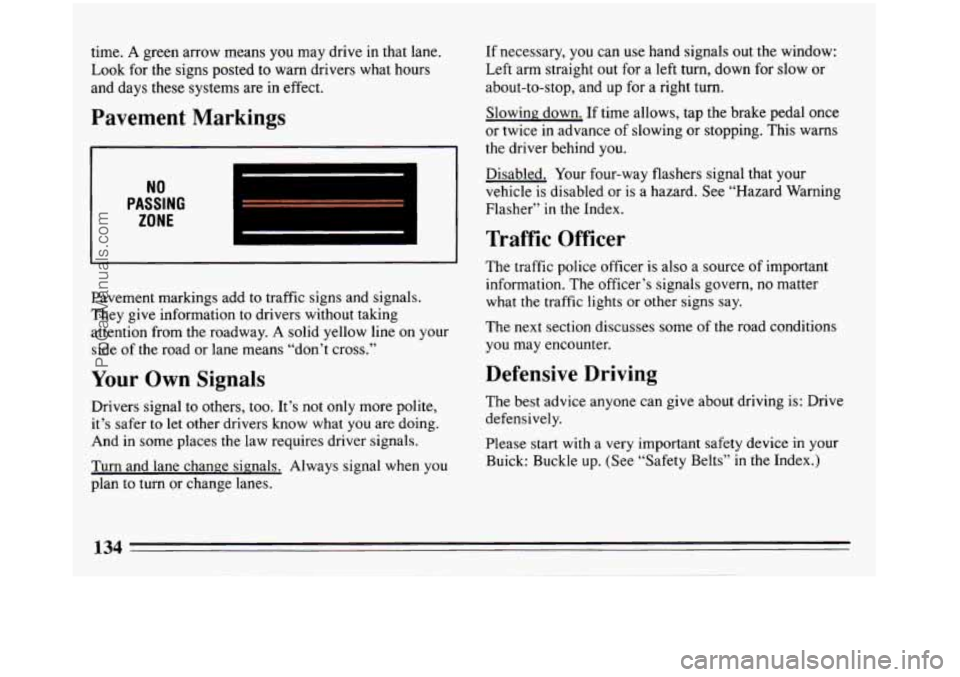
Pavement markings add to traffic signs and signals.
They give information to drivers without taking
attention from the roadway.
A solid yellow line on your
side of the road or lane means “don’t cross.”
Your Own Signals
Drivers signal to others, too. It’s not only more polite,
it’s safer
to let other drivers know what you are doing.
And in some places the law requires driver signals.
Turn and lane change signals. Always signal when
you
plan to turn or change lanes. If
necessary,
you can use hand signals out the window:
Left arm straight out for a left turn, down for slow or
about-to-stop, and up for
a right turn.
Slowing down. If time allows, tap the brake pedal once
or twice in advance of slowing or stopping. This warns
the driver behind you.
Disabled. Your four-way flashers signal that your
vehicle is disabled or
is a hazard. See “Hazard Warning
Flasher”
in the Index.
Traffic Officer
The traffic police officer is also a source of important
information. The officer’s signals govern,
no matter
what
the traffic lights or other signs say.
The next section discusses some of the road conditions
you may encounter.
Defensive Driving
The best advice anyone can give about driving is: Drive
defensively.
Please start with a very important safety device in your
Buick: Buckle up. (See “Safety Belts” in
the Index.)
134
-
ProCarManuals.com
Page 150 of 308
0
0
0
0
0
you need only slow down and drop back again and
wait
for another opportunity.
If other cars are lined up to pass a slow vehicle, wait
your turn. But take care that someone isn’t trying to
pass you as you pull out to pass the slow vehicle.
Remember to glance over your shoulder and check
the blind spot.
Check your mirrors, glance over your shoulder, and
start your left lane change signal before moving out
of the right lane to pass. When you are far enough
ahead of the passed vehicle to see its front
in your
inside mirror, activate your right lane change signal
and move back into the right lane. (Remember that
your right outside
mirror is convex. The vehicle you
just passed may seem to be farther away from
you
than it really is.)
Try not to pass more than one vehicle at a time
on
two-lane roads. Reconsider before passing the next
vehicle.
Don’t overtake a slowly moving vehicle too rapidly.
Even though
the brake lights are not flashing, it may
be slowing down or starting to turn.
If you’re being passed, make it easy for the
following driver to get ahead of you. Perhaps
you
can ease a little to the right.
Loss of Control
Let’s review what driving experts say about what
happens when the three control systems (brakes, steering
and acceleration) don’t have enough friction where the
tires meet the road to do what the driver has asked.
In any emergency, don’t give up. Keep trying
to steer
and constantly seek an escape route or area of less
danger.
Skidding
In a skid, a driver can lose control of the vehicle.
Defensive drivers avoid most skids by taking reasonable
care suited to existing conditions, and by not
“overdriving” those conditions. But skids are always
possible.
The three types
of skids correspond to your Buick’s
three control system.s. In
the braking skid your wheels
aren’t rolling. In the steering or cornering skid,
too
much speed or steeri.ng in a curve causes tires to slip and
lose cornering force.
And in the acceleration skid too
much throttle causes the driving wheels to spin.
A cornering skid and an acceleration skid are best
handied by easing your foot off the accelerator pedal.
If your vehicle starts
to slide (as when you turn a corner
on a wet, snow- or ice-covered road), ease your
foot off
148
ProCarManuals.com
Page 153 of 308
High Beams
If the vehicle approaching you has its high beams on,
signal by flicking yours
to high and then back to low
beam. This is the usual signal to lower the headlight
beams. If the other driver still doesn’t lower the beams,
resist the temptation to put your high beams on. This
only makes two half-blinded drivers.
On a freeway, use your high beams only in remote areas
where you won’t impair approaching drivers. In some
places, like cities, using high beams is illegal.
When
you follow another vehicle on a freeway or
highway, use low beams. True, most vehicles now have
day-night mirrors that enable the driver
to reduce glare.
But outside mirrors are not
of this type and high beams
from behind can bother the driver ahead.
A Few More Night Driving Suggestions
Keep your windshield and all the glass on your vehicle
clean
-- inside and out. Glare at night is made much
worse by dirt on the glass. Even the inside of the glass
can build up a film caused by dust. Tobacco smoke also
makes inside glass surfaces very filmy and can be
a
vision hazard if it’s left there.
Dirty glass makes lights dazzle and flash more than
clean glass would, making the pupils of your eyes
contract repeatedly.
You might even want to keep a cloth
and some glass cleaner in your vehicle if you need
to
clean your glass frequently.
Remember that your headlights light up far less of a
roadway when you are in a turn or curve.
Keep your eyes moving; that way, it’s easier to pick out
dimly lighted objects.
Just as your headlights should be checked regularly for
proper aim,
so should your eyes be examined regularly.
Some drivers suffer from night blindness
-- the inability
to see in dim light
-- and aren’t even aware of it.
151
ProCarManuals.com