brakes BUICK REGAL 1993 Owner's Manual
[x] Cancel search | Manufacturer: BUICK, Model Year: 1993, Model line: REGAL, Model: BUICK REGAL 1993Pages: 308, PDF Size: 16.35 MB
Page 177 of 308
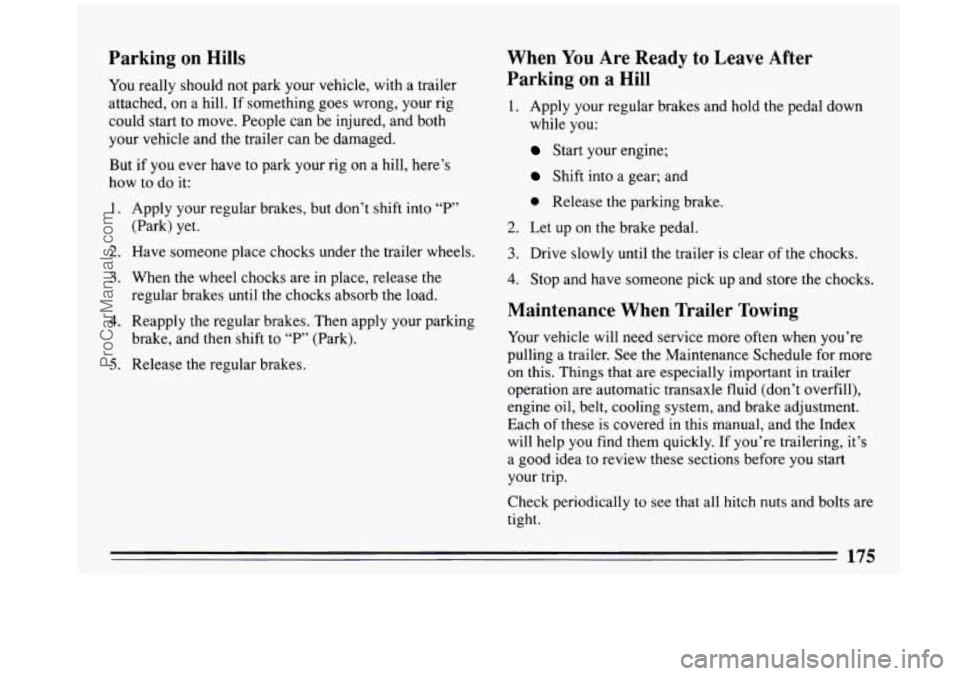
Parking on Hills
You really should not park your vehicle, with a trailer
attached, on a hill. If something goes wrong, your rig
could start to move. People can be injured, and both
your vehicle and the trailer can be damaged.
But if
you ever have to park your rig on a hill, here’s
how to do it:
1.
2.
3.
4.
5.
Apply your regular brakes, but don’t shift into “P’
(Park) yet.
Have someone place chocks under the trailer wheels.
When the wheel chocks are in place, release the
regular brakes until the chocks absorb the load.
Reapply the regular brakes. Then apply your parking
brake, and then shift to “P” (Park).
Release the regular brakes.
When You Are Ready to Leave After
Parking on
a Hill
1. Apply your regular brakes and hold the pedal down
while you:
Start your engine;
Shift into a gear; and
0 Release the parking brake.
2. Let up on the brake pedal.
3. Drive slowly until the trailer is clear of the chocks.
4. Stop and have someone pick up and store the chocks.
Maintenance When Trailer Towing
Your vehicle will need service more often when you’re
pulling a trailer. See the Maintenance Schedule for more
on this. Things that are especially important in trailer
operation are automatic transaxle fluid (don’t overfill),
engine oil, belt, cooling system, and brake adjustment.
Each
of these is covered in this manual, and the Index
will help you find them quickly. If you’re trailering, it’s
a good idea to review these sections before
you start
your trip.
Check periodically to see that all hitch nuts and bolts are
tight.
175
ProCarManuals.com
Page 215 of 308
Part 6 Service And Appearance Care
vehicle, and a section devoted to its appearance care.
Part
6 includes:
ServiceTips
...................................................................... 214
Fuel ........................................................................\
.....
HoodRelease ..................................................................... 218
EngineOil ....................................................................... \
AirCleane r.. ..................................................................... 225
Automatic Transaxle Fluid ...........................................................
Enginecoolant .................................................................... 228
Power Steering Fluid .......................... % ....................................
Windshield Washer Fluid ............................................................ 232
Brakes ........................................................................\
...
Battery ........................................................................\
.. 235
BulbReplacement ................................................................. 236
LoadingYourVehicle ...............................................................
Tires ........................................................................\
....
Appearancecare ..................................................................
Vehicle Identification Number (VIN) ..................................................
FusesandCircuitBreakers ........................................................... 257
Capacities and Specifications ......................................................... 263
ProCarManuals.com
Page 235 of 308
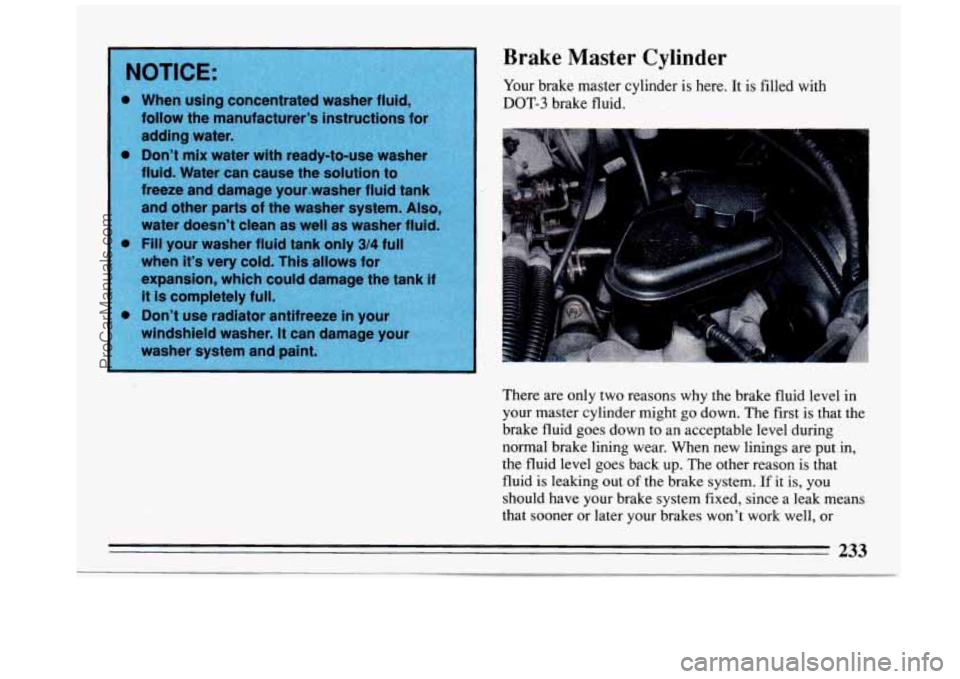
Brake Master Cylinder
Your brake master cylinder is here. It is filled with
DOT-3 brake fluid.
There are only two reasons why the brake fluid level in
your master cylinder might @down. The first
is that the
brake fluid goes down to an acceptable level during
normal brake lining wear. When new linings are put in,
the fluid level goes back
up. The other reason is that
fluid is leaking
out of the brake system. If it is, you
should have your brake system fixed, since a leak means
that sooner or later your brakes won't work well, or
233
ProCarManuals.com
Page 236 of 308
won’t work at all. So, it isn’t a good idea to “top off’
your brake fluid. Adding brake fluid won’t correct a
leak.
If you add fluid when your linings are worn, then
you’ll have too much fluid when you get new brake
linings. You should add (or remove) brake fluid,
as
necessary, only when work is done on the brake
hydraulic system.
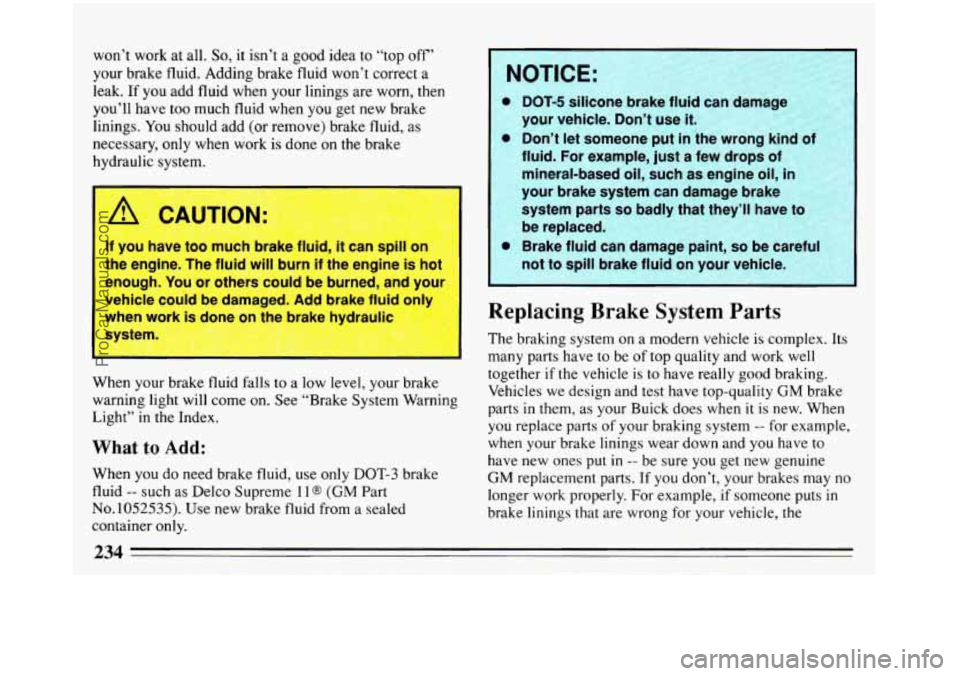
a LAUTION:
1
If you have too much brake flui,, I. ;an sblll orl
the engine. The fluid will burn if the engine is hot
enough. You or others could be burned, and your
vehicle could be damaged. Add brake fluid only
when work is done on the brake hydraulic
-stem.
When your brake fluid falls to a low level, your brake
warning light will come on. See “Brake System Warning
Light” in the Index.
What to Add:
When you do need brake fluid, use only DOT-3 brake
fluid
-- such as Delco Supreme 11 @ (GM Part
N0.1052535). Use new brake fluid from a sealed
container only.
0
0
DOT-5 silicone brake fluid can damage
your vehicle. Don’t use it.
Don’t let someone put
in the wrong kind of
fluid. For example, just a few drops of
mineral-based oil, such as engine oil,
in
your brake system can damage brake
system parts
so badly that they’ll have to
be replaced.
Brake fluid can damage paint,
so be careful
not to spill brake fluid on your vehicle.
Replacing Brake System Parts
The braking system on a modern vehicle is complex. Its
many parts have to be
of top quality and work well
together if the vehicle is to have really good braking.
Vehicles we design and test have top-quality GM brake
parts in them, as your Buick does when
it is new. When
you replace parts of your braking system
-- for example,
when your brake linings wear down and
you have to
have new ones put in
-- be sure you get new genuine
GM replacement parts. If
you don’t, your brakes may no
longer work properly. For example, if someone puts
in
brake linings that are wrong for your vehicle, the
234
ProCarManuals.com
Page 237 of 308
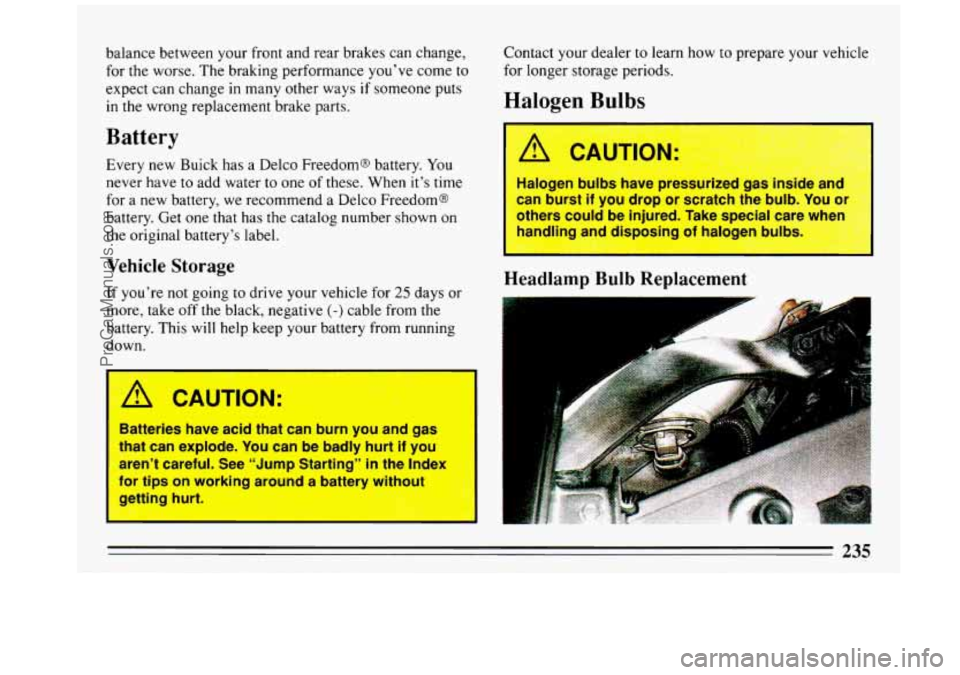
balance between your front and rear brakes can change,
for the worse. The braking performance you've come to
expect can change in many other ways
if someone puts
in the wrong replacement brake parts.
Battery
Every new Bukk has a Delco Freedoma battery. You
never have to add water to one of these. When it's time
for a new battery, we recommend a Delco Freedom@
battery. Get one that has the catalog number shown on
the original battery's label.
Vehicle Storage
If you're not going to drive your vehicle for 25 days or
more, take off the black, negative
(-) cable from the
battery. This
will help keep your battery from running
down.
;;? j .-:q -' : i-.; . 6'
Batteries have acid thia'f can &urn you'and gas p. -'
that can explode. You can be badly hurt if you <;*.
aren't careful. See "Jump Starting'' in the Index"
for tips on working around a battery without
Xing hurt.
Contact your dealer to learn how to prepare your vehicle
for longer storage periods.
Halogen Bulbs
A CAUTI IN
Halogen bull have pressurized gas inside and
in burst if you drop or scratch the bulb. You or
orhers could be injured. Take special car vhen
handling
an< "isDoPg of halc-?n hnnlbs
Headlamp Bulb Replacement
d
- 235
ProCarManuals.com
Page 260 of 308
5
15
10
60
50
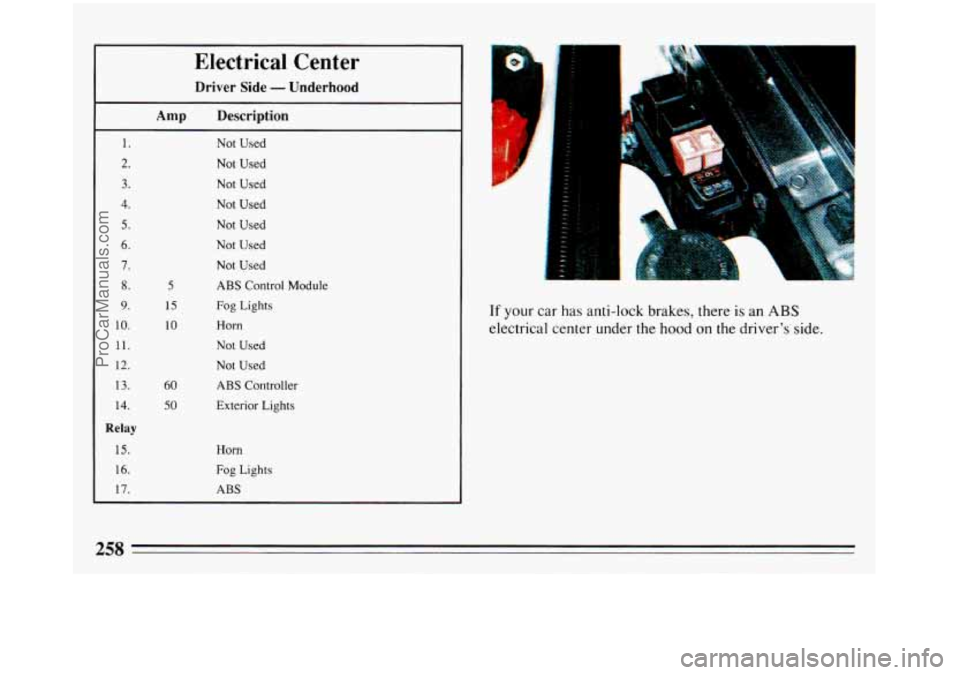
Electrical Center
Driver Side - Underhood
Amp Description
1. Not Used
2. Not Used
, 3. Not Used
4. Not Used
5. Not Used
6. Not Used
7. Not Used
8. ABS Control Module
9. Fog Lights
10. Horn
11. Not Used
12. Not Used
13. ABS Controller
14. Exterior Lights
Relay
15.
16.
17.
Horn
Fog Lights
ABS
a
If your car has anti-lock brakes, there is an ABS
electrical center under the hood on the driver's side.
258
ProCarManuals.com
Page 280 of 308
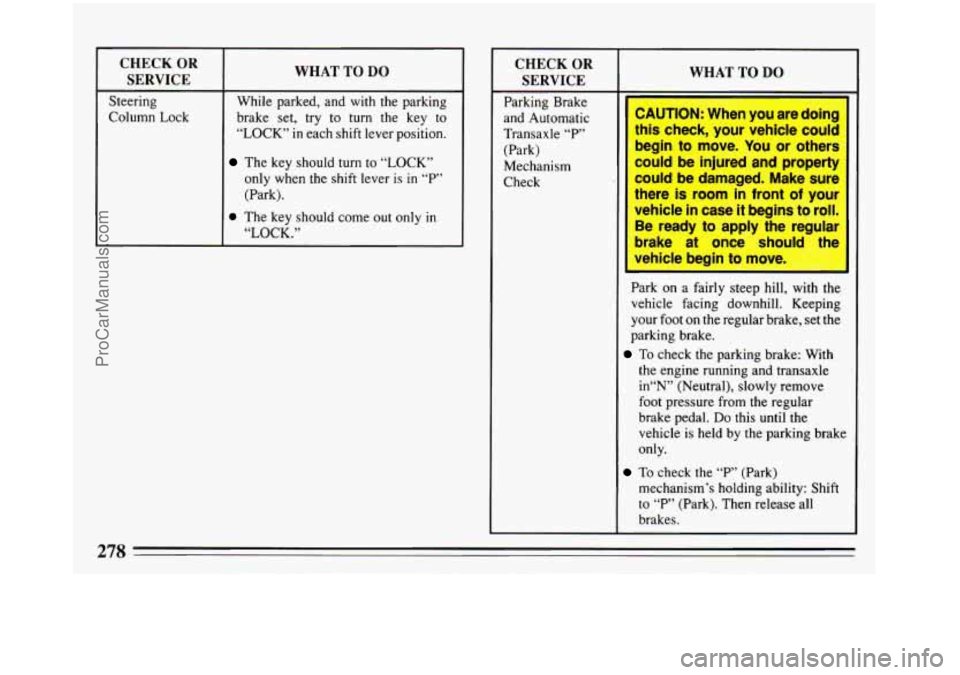
CHECK OR
Steering
Column Lock
WHAT TO DO
While parked, and with the parking
brake set, try to
turn the key to
“LOCK”
in each shift lever position.
The key should turn to “LOCK”
only when the shift lever is in “P’
(Park).
“LOCK.”
0 The key should come out only in
-t
CHECK OR
SERVICE
Parking Brake
and Automatic
Transaxle
“P’
(Park)
Mechanism
Check
WHAT TO DO
.r
CAUTION: When you are doing
s check, your vehicle could
begin to move. You or others
-Ad be injured and property
Jld be damaged. Make sure
rllzre
is room in front of your
U4icle
in case it begins to roll.
__ ready to apply the rnnular
brake at once shoul the
vehicle begin
to mc 5.
Park on a fairly steep hill, with the
vehicle facing downhill. Keeping
your foot on the regular brake, set
the
parking brake.
To check the parking brake: With
the engine running and transaxle
in“N” (Neutral), slowly remove
foot pressure from
the regular
brake pedal.
Do this until the
vehicle is held by the parking brake
only.
To check the “P,’ (Park)
mechanism’s holding ability: Shift
to
“P” (Park). Then release all
brakes.
278
ProCarManuals.com
Page 282 of 308
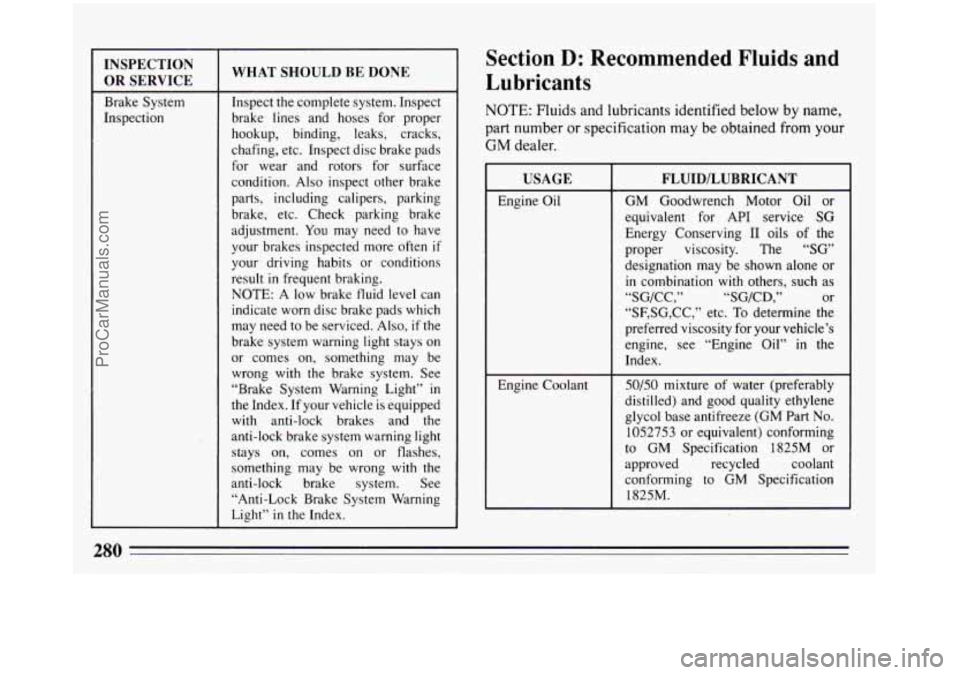
INSPECTION
OR SERVICE
Brake System
Inspection
WHAT SHOULD BE DONE
Inspect the complete system. Inspect
brake lines and hoses for proper
hookup, binding, leaks, cracks,
chafing, etc. Inspect disc brake pads
for wear and rotors for surface
condition. Also inspect other brake
parts, including calipers, parking
brake, etc. Check parking brake
adjustment. You may need to have
your brakes inspected more often
if
your driving habits or conditions
result
in frequent braking.
NOTE:
A low brake fluid level can
indicate worn disc brake pads which
may need to be serviced. Also, if the
brake system warning light stays on
or comes on, something may be
wrong with the brake system. See
“Brake System Warning Light”
in
the Index. If your vehicle is equipped
with anti-lock brakes and the
anti-lock brake system warning light
stays on, comes on or flashes,
something may be wrong with the
anti-lock brake system. See
“Anti-Lock Brake System Warning
Light”
in the Index.
Section D: Recommended Fluids and
Lubricants
NOTE: Fluids and lubricants identified below by name,
part number or specification may be obtained from your
GM dealer.
USAGE
Engine Oil
Engine Coolant
FLUID/LUBRICANT
GM Goodwrench Motor Oil or
equivalent for API service SG
Energy Conserving I1 oils of the
proper viscosity. The “SG”
designation may be shown alone or
in combination with others, such as
“SG/CC,” “SG/CD,”
or
“SF,SG,CC,” etc. To determine the
preferred viscosity for your vehicle’s
engine, see “Engine Oil” in the
Index.
50/50 mixture of water (preferably
distilled) and good quality ethylene
glycol base antifreeze (GM Part
No.
1052753 or equivalent) conforming
to
GM Specification 1825111 or
approved recycled coolant
conforming to
GM Specification
1825M.
ProCarManuals.com
Page 302 of 308
Power Antenna Cleaning
............................. 124
DoorLocks
................................... 61
Mirrors
...................................... 94
Seat Controls
.................................. 15
Steering
..................................... 144
Steering Fluid
................................ 231
Windows
..................................... 79
Pregnancy. Use of Safety Belts During
................ 33
Pressure. Tire ................................... 241
Problems on the Road
............................ 177
Proper Safety Belt Usage. for Adults
.................. 26
Publications Order Form
.......................... 291
Publications. Service
............................. 288
Push-Starting Your Car
........................... 180
R (Reverse) Gear Position ......................... 71
Racing. Shifting When Your Engine is
................ 79
Radiator Pressure Cap ............................ 231
Radio. Two-way. Adding
a ........................ 1 14
Radio Systems
.................................. 1 13
Rain. Driving
in ................................. 152
Reaction Time
in Braking ......................... 139
Reading Lights
................................... 93
Rear Seat Console and Pass-Through
................. 98
Rear Window Defogger
........................... 113
Reclining Front Seatbacks
.......................... 16
Recommended Fluids and Lubricants
................ 280
Radiator Overheating ............................. 192 Recovery.
Off-Road
.............................. 146
Recreational Vehicle. Towing
a ..................... 170
Remote Keyless Entry System
....................... 62
Remote Trunk Release
............................. 61
Replaceable Light Bulbs .......................... 262
Replacing Brake System Parts
...................... 234
Replacing Safety Belts ............................. 56
Replacing Wheels ............................... 246
Reporting Safety Defects
.......................... 287
Restarting Your
Car When It’s Moving ................ 79
Restraint. Child
.................................. 42
Restraint Systems. Checking Your
.................... 55
Restraints. Head .................................. 17
Reverse Gear Position
.............................. 71
“Riding” the Brakes
.............................. 139
Roads. Hill and Mountain
.......................... 161
Rotation. Tire
................................... 242
Run (Ignition Key Position) ......................... 67
Running Lights. Daytime
........................... 92
Replacing
Tires
................................. 244
Roadsigns
..................................... 128
Rocking Your Vehicle
............................ 170
Running Your Engine While You’re Parked
............ 77
Safety Belt Care
................................ 251
Safety Belt Extender
.............................. 55
Safety Belt Reminder Light ......................... 25
Safety Belt Replacement ............................ 56
Safety Belt Usage by Adults
........................ 26
300
ProCarManuals.com
Page 304 of 308
Subscribing to Buick Service Publications ............ 288
Sunroof
......................................... 80
Symbols on Road Signs
........................... 132
Symbols on Your Car
.............................. 12
Table
of Contents ................................. 9
Tachometer ..................................... 108
Taillight Bulb Replacement
........................ 236
Tamper-Resistance
of Odometer ..................... 99
TapePlayerCare ................................ 123
Temperature. Engine Coolant Warning Light
.......... 103
Theft
........................................... 64
Thermostat
..................................... 23 1
Third Gear. When to Use ........................... 72
Tilt Steering Wheel
............................... 82
Time. Setting the
............................ 116. 120
TireBalance .................................... 245
Tire Chains
..................................... 247
Tire. Flat
....................................... 201
Tire Inflation ................................... 241
Tire Inspection and Rotation
....................... 242
Tire Quality Grading
............................. 244
Tires
.......................................... 240
Tires. When to Replace
........................... 244
Tires. White Sidewall. Cleaning
.................... 253
Torn Safety Belts
................................. 56 Torque Lock
(Automatic Transaxle)
................. 165
Towing Hook-Ups
............................... 187
Towing a Trailer
................................. 170
Towing Your Car
................................ 185
Trademarks. GM ................................ 214
Traffic Lights
................................... 133
Traffic Officer
.................................. 134
Trailer Brakes
................................... 173
Trailer Towing
.................................. 170
Transaxle. Automatic .............................. 71
Transaxle Fluid
.................................. 226
Trip Odometer
.................................. 100
Trunk Release. Remote
............................ 61
Turn Signal and Headlight Beam Lever ................ 81
Turn Signal and Lane Change Indicator
............... 81
Turn Signal Reminder
............................. 82
Twisted Safety Belts
............................... 33
Two Children Wearing the Same Safety Belt
............ 54
Underbody Cleaning
............................ 253
Uniform Tire Quality Grading ...................... 244
Unleaded Gasoline
............................... 215
Uphill Parking .................................. 164
Upholstery Care ................................. 250
Used Oil Disposal
............................... 224
Used Replacement Wheels
......................... 247
302
ProCarManuals.com