brakes BUICK REGAL 1993 User Guide
[x] Cancel search | Manufacturer: BUICK, Model Year: 1993, Model line: REGAL, Model: BUICK REGAL 1993Pages: 308, PDF Size: 16.35 MB
Page 146 of 308
That could be off the road, into the very thing you were
trying to avoid,
or into traffic.
If you don’t have anti-lock, use
a “squeeze” braking
technique. This will give
you maximum braking while
maintaining steering control. You do this by pushing on
the brake pedal with steadily increasing pressure.
In an emergency
you will probably want to “squeeze”
the brakes hard without locking the wheels. If you hear
or feel the wheels sliding, ease off the brake pedal. This
will help you retain steering control.
(If
you & have anti-lock, it’s different: see Index under
“Anti-lock Brake System.”) In
many emergencies,
steering can help
you more than even the very best
braking.
Steering
Power Steering
If you lose power steering assist because the engine
stops or the system fails to function, you can steer but
it
will take much more effort.
Steering Tips
Driving on Curves
It’s important to take curves at a r8 easonable speed.
A lot of the “driver lost control” accidents mentioned on
the news happen
on curves. Here’s why:
Experienced driver or beginner, each of us is subject to
the same laws of physics when driving on curves. The
traction of the tires against the road surface makes it
possible for the vehicle to change its path when
you turn
the front wheels. If there’s
no traction, inertia will keep
the vehicle going in the same direction. If you’ve ever
tried to steer a vehicle on wet ice,
you’ll understand this.
The traction you can get in a curve depends on the
condition of your tires and the road surface, the angle at
which the curve is banked, and your speed. While
you’re in a curve, speed
is the one factor you can
control.
Suppose you’re steering through
a sharp curve. Then
you suddenly apply the brakes. Both control systems --
steering and braking -- have to do their work where the
tires meet the road. Unless you have four-wheel
anti-lock brakes, adding the hard braking can demand
too much
of those places. You can lose control.
The same thing can happen if you’re steering through a
sharp curve and you suddenly accelerate.
Those two control systems
-- steering and acceleration --
can overwhelm those places where the tires meet the
road and make you lose control.
144
ProCarManuals.com
Page 147 of 308
What should you do if this ever happens? Let up on the
brake or accelerator pedal, steer the vehicle the way you
want it to
go, and slow down.
Speed limit signs near curves warn that
you should
adjust your speed. Of course, the posted speeds are
based on good weather and road conditions. Under less
favorable conditions you’ll want to
go slower.
If you need to reduce your speed as
you approach a
curve, do it before
you enter the curve, while your front
wheels are straight ahead.
Try to adjust your speed
so you can “drive” through the
curve. Maintain a reasonable, steady speed. Wait to
accelerate until you are out
of the curve, and then
accelerate gently
into the straightaway.
When you drive into a curve at night, it’s harder to see
the road ahead of you because it bends away from the
straight beams
of your lights. This is one good reason to
drive slower.
Steering in Emergencies
There are times when steering can be more effective
than braking. For example,
you come over a hill and
find a truck stopped in your lane, or a car suddenly pulls
out from nowhere, or a child darts out from between
parked cars and stops right in front
of you. You can
avoid these problems by braking
-- if you can stop in
time. But sometimes
you can’t; there isn’t room. That’s
the time for evasive action
-- steering around the
problem.
Your Buick can perform very well in emergencies like
these. First apply your brakes
-- but, unless you have
anti-lock, not enough to lock your wheels. It is better to
remove as much speed
as you can from a possible
collision. Then steer around the problem, to the left or
right depending on the space available.
An emergency like this requires close attention and a
quick decision. If you are holding the steering wheel at
the recommended
9 and 3 o’clock positions, you can
turn it a
full 180 degrees very quickly without removing
either hand.
Rut you have to act fast, steer quickly, and
just as quickly straighten
the wheel once you have
avoided the object. You must then be prepared
to steer
back to your original lane and then brake to a controlled
stop.
Depending on your speed, this can be rather violent for
an unprepared driver. This
is one of the reasons driving
1 AC
ProCarManuals.com
Page 150 of 308
0
0
0
0
0
you need only slow down and drop back again and
wait
for another opportunity.
If other cars are lined up to pass a slow vehicle, wait
your turn. But take care that someone isn’t trying to
pass you as you pull out to pass the slow vehicle.
Remember to glance over your shoulder and check
the blind spot.
Check your mirrors, glance over your shoulder, and
start your left lane change signal before moving out
of the right lane to pass. When you are far enough
ahead of the passed vehicle to see its front
in your
inside mirror, activate your right lane change signal
and move back into the right lane. (Remember that
your right outside
mirror is convex. The vehicle you
just passed may seem to be farther away from
you
than it really is.)
Try not to pass more than one vehicle at a time
on
two-lane roads. Reconsider before passing the next
vehicle.
Don’t overtake a slowly moving vehicle too rapidly.
Even though
the brake lights are not flashing, it may
be slowing down or starting to turn.
If you’re being passed, make it easy for the
following driver to get ahead of you. Perhaps
you
can ease a little to the right.
Loss of Control
Let’s review what driving experts say about what
happens when the three control systems (brakes, steering
and acceleration) don’t have enough friction where the
tires meet the road to do what the driver has asked.
In any emergency, don’t give up. Keep trying
to steer
and constantly seek an escape route or area of less
danger.
Skidding
In a skid, a driver can lose control of the vehicle.
Defensive drivers avoid most skids by taking reasonable
care suited to existing conditions, and by not
“overdriving” those conditions. But skids are always
possible.
The three types
of skids correspond to your Buick’s
three control system.s. In
the braking skid your wheels
aren’t rolling. In the steering or cornering skid,
too
much speed or steeri.ng in a curve causes tires to slip and
lose cornering force.
And in the acceleration skid too
much throttle causes the driving wheels to spin.
A cornering skid and an acceleration skid are best
handied by easing your foot off the accelerator pedal.
If your vehicle starts
to slide (as when you turn a corner
on a wet, snow- or ice-covered road), ease your
foot off
148
ProCarManuals.com
Page 151 of 308
the accelerator pedal as soon as you feel the vehicle start
to slide. Quickly steer the way you want the vehicle to
go. If you start steering quickly enough, your vehicle
will straighten
out. As it does, straighten the front
wheels.
Of course, traction is reduced when water, snow, ice,
gravel, or other material is on the road. For safety, you’ll
want to slow down and adjust your driving to these
conditions.
It is important to slow down on slippery
surfaces because stopping distance will be longer and
vehicle control more limited.
While driving on a surface with reduced traction, try
your best to avoid sudden steering, acceleration, or
braking (including engine braking
by shifting to a lower
gear). Any sudden changes could cause the tires to slide.
You may not realize the surface is slippery until your
vehicle is skidding. Learn to recognize warning clues
--
such as enough water, ice or packed snow on the road to
make a “mirrored surface” -- and slow down when you
have any doubt.
If you have the anti-lock braking system, remember: It
helps avoid only the braking skid. If you do not have
anti-lock, then in a braking skid (where the wheels are
no longer rolling), release enough pressure on the brakes
to get the wheels rolling again. This restores steering
control. Push the brake pedal down steadily when you have
to stop suddenly.
As long as the wheels are rolling,
you will have steering control. Steer the way you want
to go.
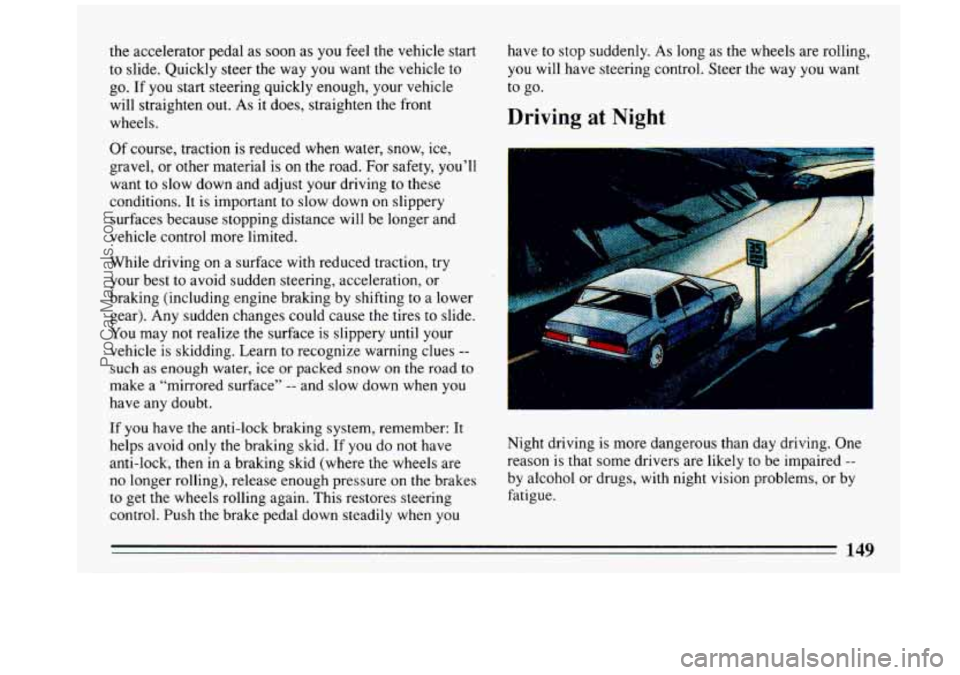
Driving at Night
Night driving is more dangerous than day driving. One
reason is that some drivers are likely
to be impaired --
by alcohol or drugs, with night vision problems, or by
fatigue.
149
ProCarManuals.com
Page 155 of 308
signs of streaking or missing areas on the windshield, or
when strips
of rubber start to separate from the inserts.
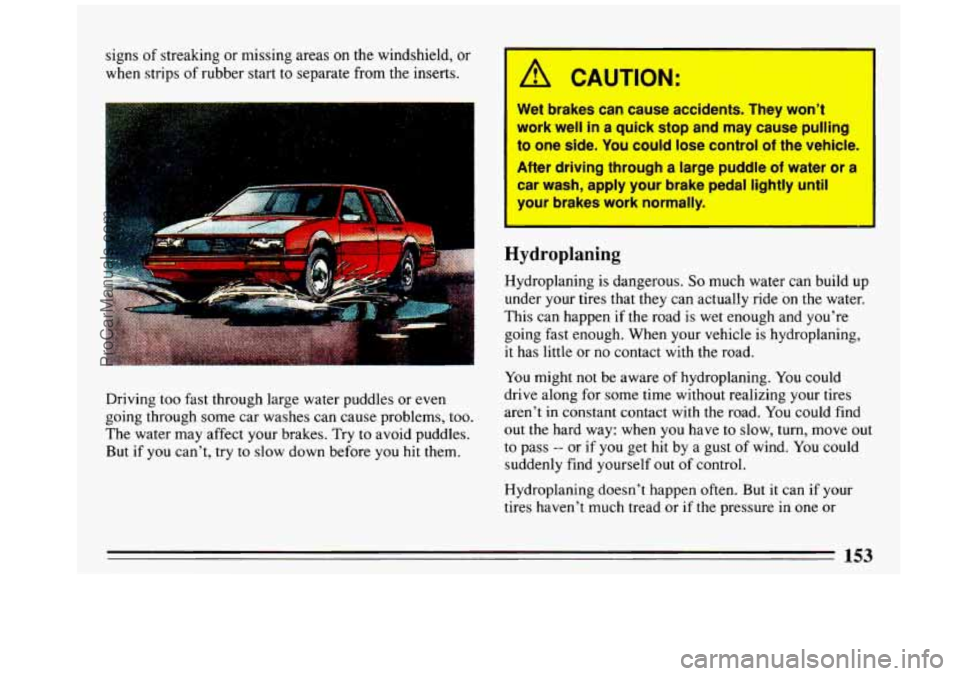
Driving too fast through large water puddles or even
going through some car washes can cause problems,
too.
The water may affect your brakes. Try to avoid puddles.
But if
you can’t, try to slow down before you hit them.
A CAUTION:
Wet brakes can cause accidents. They won’t
work well in a quick stop and may cause pulling
to one side. You could lose control
of the vehicle.
After driving through a large puddle
of water or a
car wash, apply your brake pedal lightly until
your brakes work normally.
Hydroplaning
Hydroplaning is dangerous. So much water can build up
under your tires that they can actually ride on the water.
This can happen if the road
is wet enough and you’re
going fast enough. When your vehicle is hydroplaning,
it has little or no contact with the road.
You might not be aware of hydroplaning. You could
drive along for some time without realizing your tires
aren’t in constant contact with the road. You could find
out the hard way: when you have to slow, turn, move out
to pass -- or if you get hit by a gust of wind. You could
suddenly find yourself out
of control.
Hydroplaning doesn’t happen often. But it can if your
tires haven’t much tread or if the pressure in one or
153
~.-lll
ProCarManuals.com
Page 164 of 308
IL
CAUTION
If you don’t shift down, Jour brakes ,auld get so
hot that they wouldn’t work well. You would then I
have poor braking or even none going down a
hill. You could crash. Shift down to let your
engirp
assist your brakes on a steep downhill
I A
CAUTION
Coasting downhill in “N” (Neutral) or with the
ignition
off is dangerous. Your brakes will have
to do
all the work of slowing down. They could I
get so hot that they wouldn’t work well.
could crash. Always have your engine runn
g
and your vel - le i gear en ya-- go downhill.
I
Know how to go uphill. You may want to shift down
. to a lower gear. The lower gears help cool your
engine and transaxle, and
you can climb the hill
better.
I
0 Stay in your own lane when driving on two-lane
roads in hills or mountains. Don’t swing wide or cut
across the center
of the road. Drive at speeds that let
you stay in your own lane. That way, you won’t be
surprised by a vehicle coming toward
you in the
same lane.
It takes longer to pass another vehicle when you’re
going uphill.
You’ll want to leave extra room to pass.
If a vehicle is passing you and doesn’t have enough
room, slow down to make it easier for the other
vehicle
to get by.
0 As you go over the top of a hill, be alert. There could
be something in your lane, like
a stalled car or an
accident.
0 You may see highway signs on mountains that warn
of special problems. Examples are long grades,
passing or no-passing zones, a falling rocks area, or
winding roads. Be alert
to these and take appropriate
action.
0 Winter driving can present special problems. See
“Winter Driving’’ in the Index.
162
ProCarManuals.com
Page 169 of 308
Driving on Snow or Ice
Most of the time, those places where your tires meet the
road probably have good traction.
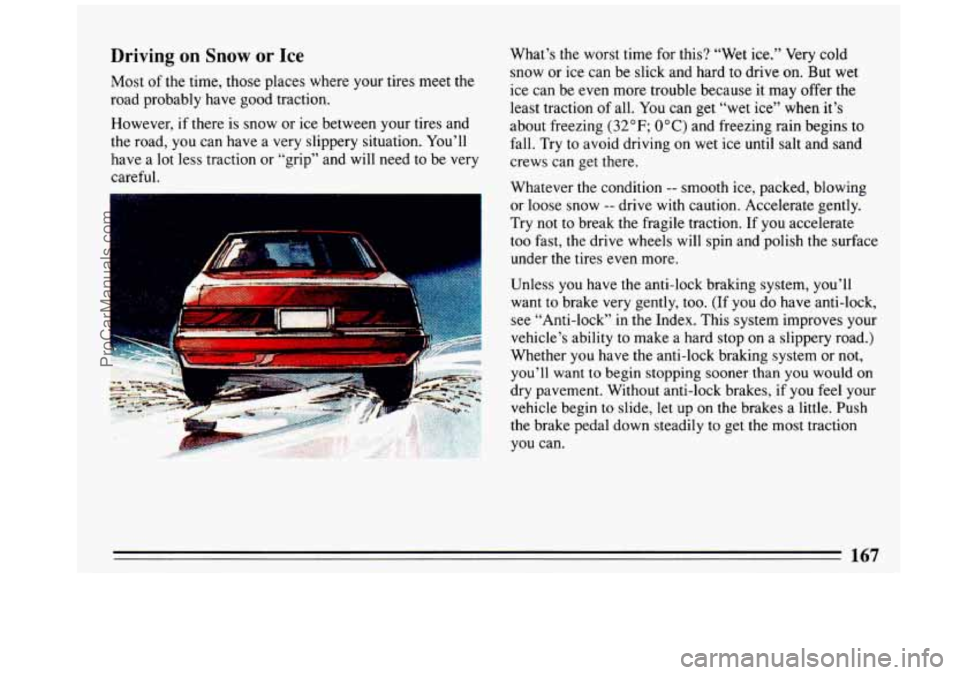
However,
if there is snow or ice between your tires and
the road, you can have
a very slippery situation. You’ll
have a lot less traction or “grip” and will need to be very
careful.
-.*
9
What’s the worst time for this? “Wet ice.” Very cold
snow or ice can be slick and hard to drive on. But wet
ice can be even more trouble because it may offer the
least traction of all. You can get “wet ice” when it’s
about freezing
(32 OF; 0 O C) and freezing rain begins to
fall. Try to avoid driving on wet
ice until salt and sand
crews can get there.
Whatever the condition
-- smooth ice, packed, blowing
or loose snow
-- drive with caution. Accelerate gently.
Try
not to break the fragile traction. If you accelerate
too fast, the drive wheels will spin and polish the surface
under the tires even more.
Unless you have the anti-lock braking system, you’ll
want to brake very gently,
too. (If you do have anti-lock,
see “Anti-lock” in the Index. This system improves your
vehicle’s ability to make a hard stop on a slippery road.)
Whether you have the anti-lock braking system or not,
you’ll want to begin stopping sooner than you would on
dry pavement. Without anti-lock brakes, if you feel your
vehicle begin to slide, let up
on the brakes a little. Push
the brake pedal down steadily to get the most traction
you can.
167
ProCarManuals.com
Page 172 of 308
Then, shut the engine off and close the window almost
all the way to preserve the heat. Start the engine again
and repeat this only when you
feel really uncomfortable
from the cold. But do it as little
as possible. Preserve the
fuel as long as you can.
To help keep warm, you can get
out
of the vehicle and do some fairly vigorous exercises
every half hour
or so until help comes.
If You’re Stuck in Deep Snow
This manual explains how to get the vehicle out of deep
snow without damaging it. See “Rocking Your Vehicle”
in the Index.
Towing a Trailer
(n CAUTION:
If you don’t use the correct equipment and drive
properly, you can
lose control when you pull a
trailer. For example,
if the trailer is too heavy, the
brakes may not work well
-- or even at all. You
and your passengers could be seriously injured.
Pull a trailer only if you have followed all the
steps
in this section.
I NOTICE:
Pulling a trailer improperly can damage your
vehicle and result
in costly repairs not covered
by your warranty.
To pull a trailer correctly, follov
the advice in this section. ‘I
Your vehicle can tow a trailer. To identify what the
vehicle trailering capacity is for your vehicle, you
should read the information in “Weight
of the Trailer”
that appears later in this section. But trailering is
different than just driving your vehicle by itself.
Trailering means changes in handling, durability, and
fuel economy. Successful, safe trailering takes correct
equipment, and it has
to be used properly.
That’s the reason for this section. In
it are many
time-tested, important trailering tips and safety rules.
Many
of these are important for your safety and that of
your passengers.
So please read this section carefully
before
you pull a trailer.
Load-pulling components such as the engine, transaxle,
wheel assemblies, and tires are forced to work harder
against the drag of the added weight. The engine is
required to operate at relatively higher speeds and under
greater loads, generating extra heat. What’s more, the
170
- -
ProCarManuals.com
Page 175 of 308
Safety Chains
You should always attach chains between your vehicle
and your trailer. Cross the safety chains under the
tongue of the trailer
so that the tongue will not drop to
the road if it becomes separated from the hitch.
Instructions about safety chains may be provided by the
hitch manufacturer or by the trailer manufacturer.
Follow the manufacturer’s recommendation for
attaching safety chains. Always leave just enough slack
so you can turn with your rig. And, never allow safety
chains to drag on the ground.
Trailer Brakes
If your trailer weighs more than 1,000 pounds (450 kg)
loaded, then it needs
its own brakes -- and they must be
adequate. Be sure
to read and follow the instructions for
the trailer brakes
so you’ll be able to install, adjust and
maintain them properly. If your vehicle has anti-lock
brakes, do not try
to tap into your vehicle’s brake
system. If you do, both brake systems won’t work well,
or at all. Even if your vehicle doesn’t have anti-lock
brakes, don’t tap into your vehicle’s brake system if
the
trailer’s brake system will use more than 0.02 cubic inch
(0.3 cc) of fluid from your vehicle’s master cylinder. If it
does, both braking systems won’t work well.
You could
even
lose your brakes.
Will the trailer brake parts take 3,000 psi (20 650
kPa) of pressure? If not, the trailer brake system
must not be used with your vehicle.
If everything checks out this far, then make the brake
fluid tap at the upper rear master cylinder port. But
don’t
use copper tubing for this. If you do, it will
bend and finally break
off. Use steel brake tubing.
Driving with a Trailer
Towing a trailer requires a certain amount of experience.
Before setting out for
the open road, you’ll want to get
to know your rig. Acquaint yourself with the feel of
handling and braking with the added weight of the
trailer. And always keep
in mind that the vehicle you are
driving is
now a good deal longer and not nearly so
responsive as your vehicle is by itself.
Before you start, check the trailer hitch and platform,
safety chains, electrical connector, lights, tires and
mirror adjustment. If the trailer has electric brakes, start
your vehicle and trailer moving and then apply the
trailer brake controller by hand to be sure
the brakes are
working. This lets you check your electrical connection
at the same time.
During your trip, check occasionally
to be sure that the
load is secure, and that the lights and any trailer brakes
are still working.
172
ProCarManuals.com
Page 176 of 308
Following Distance
Stay at least twice as far behind the vehicle ahead as you
would when driving your vehicle without a trailer. This
can help you avoid situations that require heavy braking
and sudden turns.
Passing
You’ll need more passing distance up ahead when
you’re towing a trailer. And, because you’re a good deal
longer,
you’ll need to go much farther beyond the
passed vehicle before
you can return to your lane.
Backing Up
Hold the bottom of the steering wheel with one hand.
Then, to move the trailer to the left, just move that hand
to the left. To move the trailer to the right, move your
hand to the right. Always back up slowly and, if
possible, have someone guide you.
Making Turns
When you’re turning with a trailer, make wider turns
than normal.
Do this so your trailer won’t strike soft
shoulders, curbs, road signs, trees, or other objects.
Avoid jerky or sudden maneuvers. Signal well in
advance.
firn Signals When Towing a Trailer
When you tow a trailer, your vehicle has to have a
different turn signal flasher and extra wiring. The green
arrows on your instrument panel will flash whenever
you signal a turn or lane change. Properly hooked up,
the trailer lights will also flash, telling other drivers
you’re about to turn, change lanes or stop.
When towing a trailer, the green arrows
on your
instrument panel will flash for turns even if the bulbs on
the trailer are burned out.
Thus, you may think drivers
behind you are seeing your signal when they are not.
It’s
important to check occasionally to be sure the trailer
bulbs are still working.
Driving On Grades
Reduce speed and shift to a lower gear before you start
down a long or steep downgrade. If
you don’t shift
down, you might have to use your brakes
so much that
they would get hot and no longer work well.
On a long uphill grade, shift down and reduce your
speed to around
45 mph (70 km/h) to reduce the
possibility of engine and transaxle overheating.
If you are towing a trailer that weighs more than
1,000
pounds ( 450 kg), and you have an automatic transaxle
with Overdrive, you may prefer to drive in
“D” instead
of Overdrive
(or, as you need to, a lower gear).
174
ProCarManuals.com