fuel BUICK REGAL 1993 Owner's Manual
[x] Cancel search | Manufacturer: BUICK, Model Year: 1993, Model line: REGAL, Model: BUICK REGAL 1993Pages: 308, PDF Size: 16.35 MB
Page 241 of 308
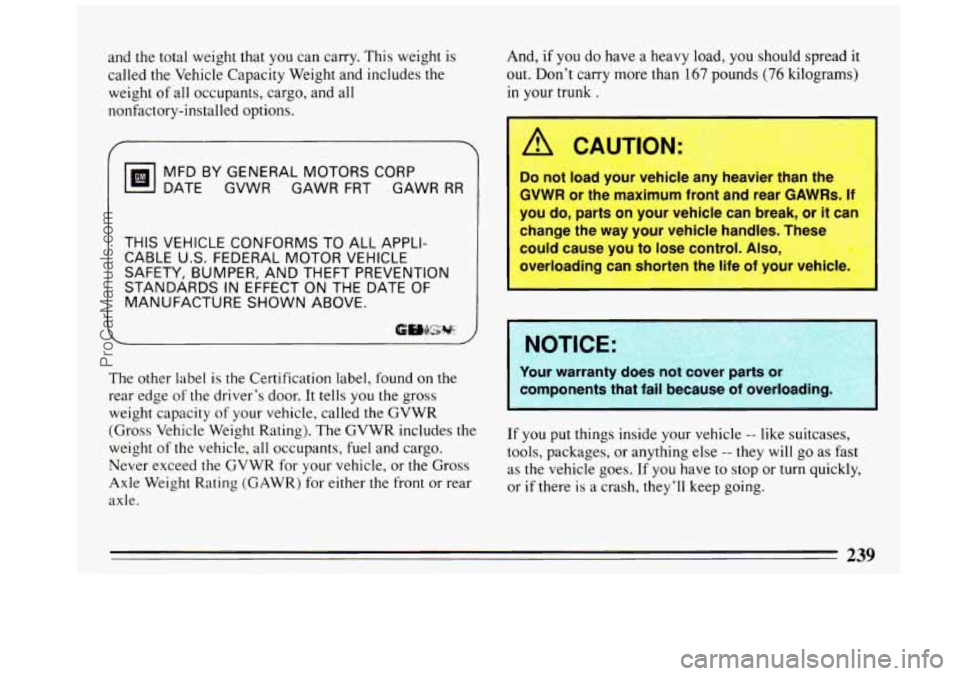
and the total weight that you can carry. This weight is
called the Vehicle Capacity Weight and includes the
weight
of all occupants, cargo, and all
nonfactory-installed options.
/
MFD BY GENERAL MOTORS CORP
DATE GVWR GAWR FRT GAWR
RR
THIS VEHICLE CONFORMS TO ALL APPLI-
CABLE
U.S. FEDERAL MOTOR VEHICLE
SAFETY, BUMPER, AND THEFT PREVENTION
STANDARDS
IN EFFECT ON THE DATE OF
MANUFACTURE SHOWN ABOVE.
And, if you do have a heavy load, you should spread it
out. Don’t carry more than
167 pounds (76 kilograms)
in your trunk .
The other label is the Certification label, found on the
rear edge
of the driver’s door. It tells you the gross
weight capacity of your vehicle, called the
GVWR
(Gross Vehicle Weight Rating). The GVWR includes the
weight
of the vehicle, all occupants, fuel and cargo.
Never exceed the GVWR for your vehicle, or the Gross
Axle Weight Rating (GAWR) for either the front or rear
axle.
A CAUTION:
Do not load your vehicle any heavier than the
GVWR or the maximum front and rear GAWRs.
If
you do, parts on your vehicle can break, or it me-
change the way your vehicle handles. These
could cause you to lose control. Also,
--yloadPq can short- th- life
of yonfr ~e~;~’~
Your warranty
does not cover parts or
components that fail because of overloading.
If you put things inside your vehicle -- like suitcases,
tools, packages, or anything
else -- they will go as fast
as the vehicle goes. If
you have to stop or turn quickly,
or
if there is a crash, they’ll keep going.
1
239
ProCarManuals.com
Page 255 of 308
White Sidewall Tires
Your Buick dealer has a GM White Sidewall Tire
Cleaner. You can use a stiff brush with it.
Weatherstrips
These are places where glass or metal meets rubber.
Silicone grease there will make them last longer, seal
better, and not stick or squeak. Apply silicone grease
with a clean cloth at least every six months.
Sheet Metal Damage
If your vehicle is damaged and requires sheet metal
repair or replacement, make sure the body repair shop
applies anti-corrosion material to the parts repaired or
replaced to restore corrosion protection.
Foreign Material
Calcium chloride and other salts, ice melting agents,
road oil and tar, tree sap, bird droppings, chemicals from
industrial chimneys, and other foreign matter can
damage your vehicle’s finish
if they remain on painted
surfaces. Use cleaners that are marked safe for painted
surfaces for these stains.
Finish Damage
Any stone chips, fractures or deep scratches in the finish
should be repaired right away. Bare metal will corrode
quickly and may develop into a major repair expense.
Minor chips and scratches can be repaired with touch-up
materials available from your dealer or other service
outlets. Larger areas
of finish damage can be corrected
in your dealer’s body and paint shop.
Underbody Maintenance
Chemicals used for ice and snow removal and dust
control can collect on
the underbody. If these are not
removed, accelerated corrosion (rust) can occur
on the
underbody parts such as fuel lines, frame, floor pan, and
exhaust system even though they have corrosion
protection.
At least every spring,
flush these materials from the
underbody with plain water. Clean any areas where mud
and other debris can collect. Dirt packed in closed areas
of the frame should be loosened before being flushed.
Your dealer or an underbody vehicle washing system
can do
this for you,
253
ProCarManuals.com
Page 261 of 308
10
10
15
10
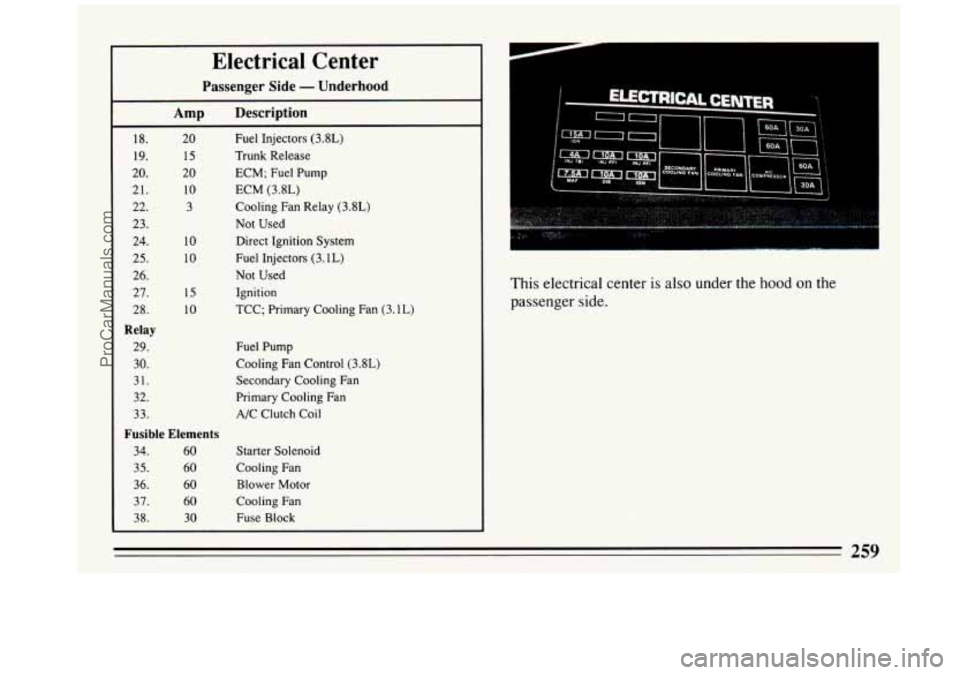
Electrical Center
Passenger Side - Underhood
Amp Description
18. 20 Fuel Injectors (3.8L)
19.
15 Trunk Release
20. 20 ECM; Fuel Pump
21. 10 ECM (3.8L)
22. 3
Cooling Fan Relay (3.8L)
23. Not Used
24. Direct Ignition System
25. Fuel Injectors (3.1 L)
26. Not Used
27. Ignition
28. TCC; Primary Cooling Fan (3.1 L)
Relay
29.
30.
31.
32.
33.
Fusible Elements
34. 60 Starter Solenoid
35. 60 Cooling Fan
37. 60 Cooling Fan
36. 60 Blower Motor
38. 30 Fuse Block Fuel Pump
Cooling Fan Control
(3.8L)
Secondary Cooling Fan
Primary Cooling Fan
A/C Clutch Coil
This electrical center is also under the hood on the
passenger side.
259
ProCarManuals.com
Page 265 of 308
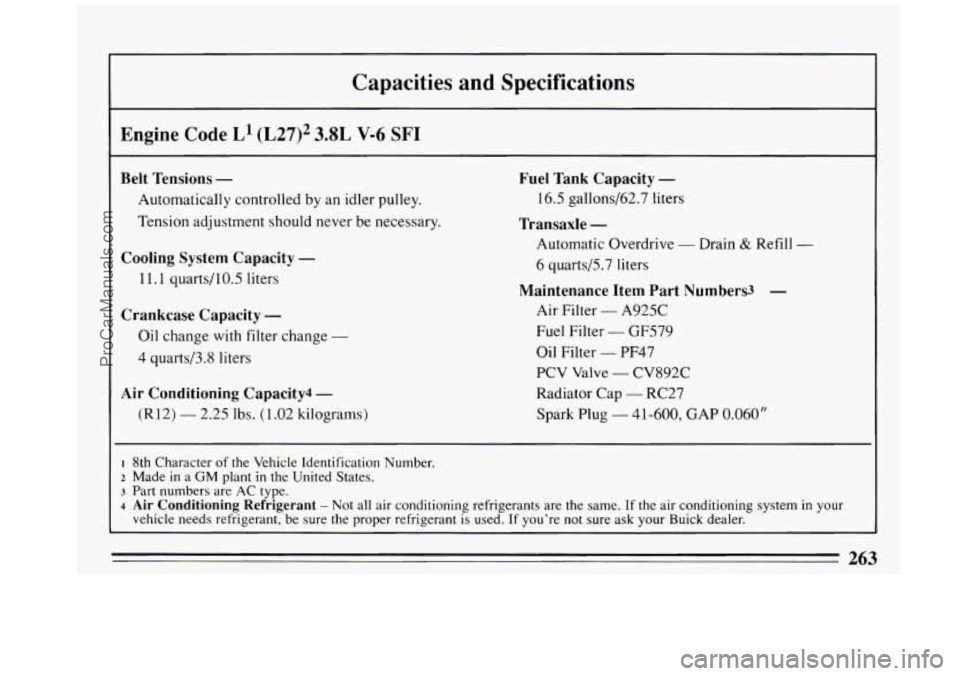
Capacities and Specifications
Engine Code L1 (L27)2 3.8L V-6 SF1
Belt Tensions - Fuel Tank Capacity -
Automatically controlled by an idler pulley.
16.5 gallons/62.7 liters
Tension adjustment should never be necessary.
Transaxle -
Automatic Overdrive - Drain & Refill -
6 quarts/5.7 liters
Maintenance Item Part Numbers3 -
Air Filter - A925C
Fuel Filter
- GF579
Oil Filter
- PF47
PCV Valve
- CV892C
Radiator Cap
- RC27
Spark Plug
- 41-600, GAP 0.060”
Cooling System Capacity -
11.1 quarts/l0.5 liters
Crankcase Capacity -
Oil change with filter change -
4 quarts/3.8 liters
Air Conditioning Capacity4 -
(R12) - 2.25 lbs. (1.02 kilograms)
-
4 Air Conditioning Refrigerant - Not all air conditioning refrigerants are the same. If the air conditioning system in your
vehicle needs refrigerant, be sure the proper refrigerant
is used. If you’re not sure ask your Buick dealer.
~ ~~
I 8th Character of the Vehicle Identification Number.
2 Made in a GM plant in the United States.
3 Part numbers are AC tvDe.
263
ProCarManuals.com
Page 266 of 308
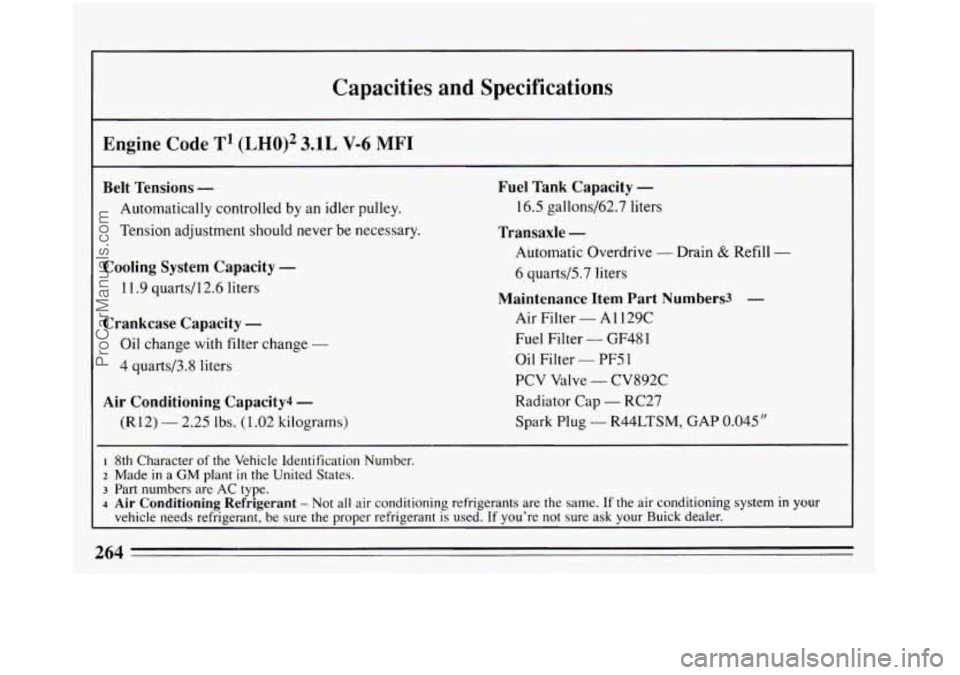
Capacities and Specifications
Engine Code T1 (LH0)2 3.1L V-6 MFI
Belt Tensions -
Automatically controlled by an idler pulley.
Tension adjustment should never be necessary.
Cooling System Capacity -
11.9 quarts/l2.6 liters
Crankcase Capacity -
Oil change with filter change -
4 quarts/3.8 liters
Air Conditioning Capacity4 -
(R12) - 2.25 Ibs. (1.02 kilograms)
Fuel Tank Capacity -
16.5 gallons/62.7 liters
1 ransaxle -
Automatic Overdrive - Drain & Refil 1-
6 quartd5.7 liters
Maintenance Item Part Numbers3 -
Air Filter - A1 129C
Fuel Filter
- GF48 1
Oil Filter - PF5 1
PCV Valve - CV892C
Radiator Cap
- RC27
Spark Plug
- R44LTSM, GAP 0.045”
~~ ~
1 8th Character of the Vehicle Identification Number.
z Made in a GM plant in the United States.
3 Part numbers are AC type.
4 Air Conditioning Refrigerant - Not all air conditioning refrigerants are the same. If the air conditioning system in your
vehicle needs refrig
nt, be sure the proper refrigerant is used. If you’re not sure ask your Buick dealer.
264
ProCarManuals.com
Page 267 of 308
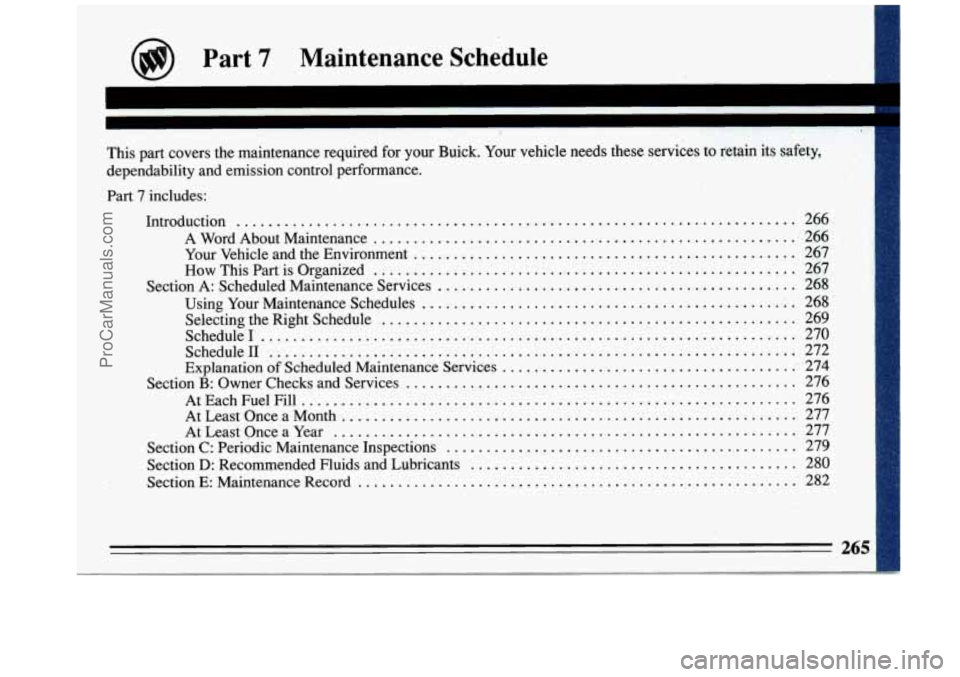
@ Part 7 . Maintenance Schedule
I
This part covers the maintenance required for your Buick . Your vehicle needs these services to retain its safety.
dependability and emission control performance
.
Part 7 includes:
Introduction
......................................................................
A Word About Maintenance .....................................................
Your Vehicle and the Environment ................................................
How This Part is Organized .....................................................
Section A: Scheduled Maintenance Services .............................................
Using Your Maintenance Schedules ...............................................
Selecting the Right Schedule ....................................................
Schedule1 ...................................................................
Schedule11 ..................................................................
Explanation of Scheduled Maintenance Services .....................................
Section B: Owner Checks and Services .................................................
AtEachFuelFill ...............................................................
AtLeastOnceaMonth .........................................................
AtLeastOnceaYear ..........................................................
Section C: Periodic Maintenance Inspections ............................................
Section D: Recommended Fluids and Lubricants .........................................
Section E: Maintenance Record .......................................................
266
266
267
267
268
268
269 270
272
274
276
276
277 277
279
280
282
265
ProCarManuals.com
Page 269 of 308
Your Vehicle and the Environment
Proper vehicle maintenance not only helps to keep your
vehicle in good working condition, but also helps the
environment. All recommended maintenance procedures
are important. Improper vehicle maintenance or the
removal of important components can significantly
affect the quality of the air we breathe. Improper fluid
levels or even the wrong tire inflation can increase the
level of emissions from your vehicle. To help protect
our environment, and to help keep your vehicle in
good
condition, please maintain your vehicle properly.
How This Part is Organized
The remainder of this part is divided into five sections:
“Section
A: Scheduled Maintenance Services” shows
what to have done and how often. Some of these
services can be complex,
so unless you are technically
qualified and have the necessary equipment, you should
let your dealer’s service department or another qualified
service center do these jobs.
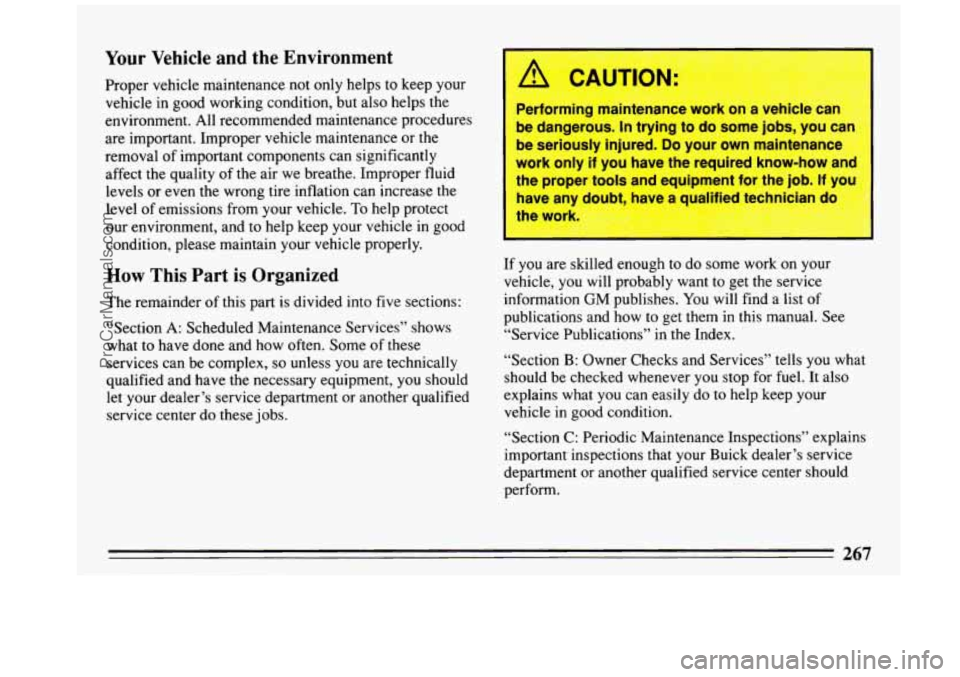
e dangerous. In trying to do some jobs, you ca
le seriously injured.
Do your own maintenanc
work only if you have the required know-how and
:he proper tools and equipment for the job.
If you
have any lubt, have a qualified technic’
1 do
the work.
If you are skilled enough to do some work on your
vehicle, you will probably want to get the service
information GM publishes. You
will find a list of
publications and how to get them
in this manual. See
“Service Publications”
in the Index.
“Section B: Owner Checks and Services” tells you what
should be checked whenever you stop for fuel. It also
explains what you can easily do to help keep your
vehicle in good condition.
“Section
C: Periodic Maintenance Inspections” explains
important inspections that your Buick dealer’s service
department or another qualified service center should
perform.
267
ProCarManuals.com
Page 270 of 308
“Section D: Recommended Fluids and Lubricants” lists
some products GM recommends to help keep your
vehicle properly maintained. These products, or their
equivalents, should be used whether you do the work
yourself or have it done.
“Section
E: Maintenance Record” provides a place for
you to record the maintenance performed
on your
vehicle. Whenever
any maintenance is performed, be
sure to write it down in this section. This will help you
determine when your next maintenance should be done.
In addition, it is a good idea to keep your maintenance
receipts. They may be needed
to qualify your vehicle for
warranty repairs.
Section A: Scheduled Maintenance
Services
Using Your Maintenance Schedules
This section tells you the maintenance services you
should have done and when
you should schedule them.
Your Buick dealer
knows your vehicle best and wants
you to be happy with it.
If you go to your dealer for your
service needs, you’ll know that GM-trained and
supported service people will perform the work using
genuine GM parts.
These schedules are for vehicles that:
0
0
0
carry passengers and cargo within recommended
limits.
You will find these limits on your vehicle’s
Tire-Loading Information label. See “Loading Your
Vehicle” in the Index.
are driven
on reasonable road surfaces within legal
driving limits.
use
the recommended unleaded fuel. See “Fuel” in
the Index.
ProCarManuals.com
Page 277 of 308
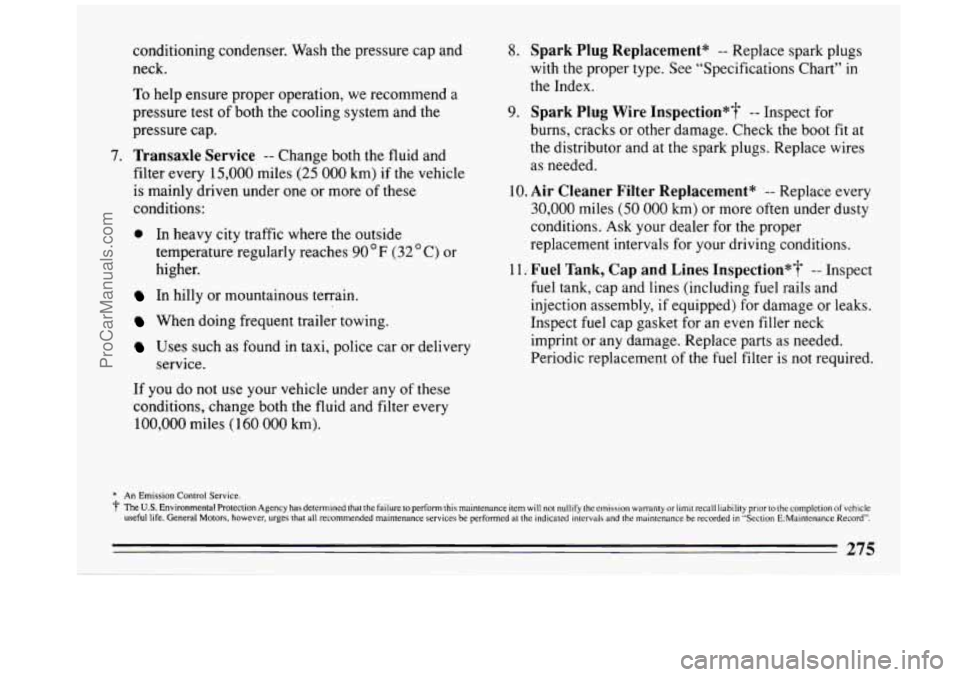
conditioning condenser. Wash the pressure cap and
neck.
To help ensure proper operation, we recommend a
pressure test of both the cooling system and the
pressure cap.
7. Transaxle Service -- Change both the fluid and
filter every
15,000 miles (25 000 km) if the vehicle
is mainly driven under one or more of these
conditions:
0 In heavy city traffic where the outside
temperature regularly reaches
90 F (32 C) or
higher.
In hilly or mountainous terrain.
When doing frequent trailer towing.
Uses such as found in taxi, police car or delivery
If you do not use your vehicle under any of these
conditions, change both the fluid and filter every
100,000 miles ( 160 000 km).
service.
8. Spark Plug Replacement* -- Replace
spark plugs
with the proper type. See “Specifications Chart” in
the Index.
9. Spark Plug Wire Inspection”? -- Inspect for
burns, cracks or other damage. Check the boot fit at
the distributor and at the spark plugs. Replace wires
as needed.
10.
Air Cleaner Filter Replacement* -- Replace every
30,000 miles (50 000 km) or more often under dusty
conditions. Ask your dealer for the proper
replacement intervals for your driving conditions.
11
.. Fuel Tank, Cap and Lines Inspection”? -- Inspect
fuel tank, cap and lines (including fuel rails and
injection assembly, if equipped) for damage or leaks.
Inspect fuel cap gasket for an even filler neck
imprint or any damage. Replace parts as needed.
Periodic replacement of the fuel filter is not required.
275
ProCarManuals.com
Page 278 of 308
Section B: Owner Checks and
Services
Listed below are owner checks and services which
should be performed
at the intervals specified to help
ensure the safety, dependability and emission control
performance of your vehicle.
Be sure any necessary repairs are completed at once.
Whenever
any fluids or lubricants are added to your
vehicle, make sure they are the proper ones, as shown in
Section
D..
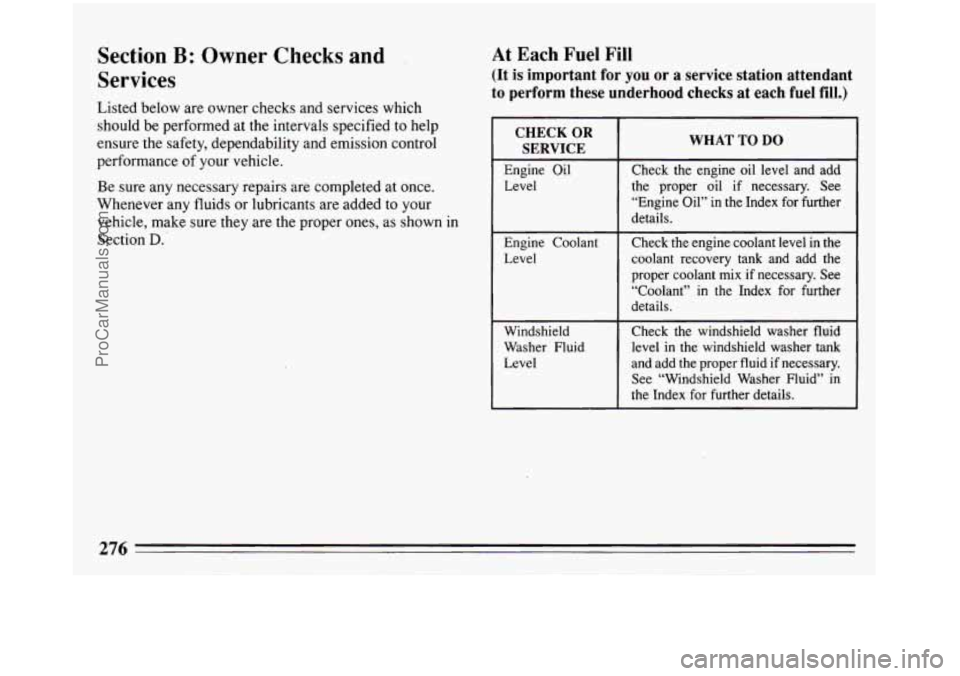
At Each Fuel Fill
(It is important for you or a service station attendant
to perform these underhood checks at each fuel
fill.)
WHAT TO DO
Engine Oil
the proper oil if necessary. See
Level Check the
engine oil level and add
“Engine
Oil” in the Index for further
details.
Engine Coolant coolant recovery tank and add the
Level Check the
engine coolant level in the
“Coolant”
in the Index for further
proper
coolant mix if necessary. See
details.
Windshield
level in the windshield washer tank
Washer Fluid Check
the windshield washer fluid
and add the proper fluid if necessary.
Level
See “Windshield Washer Fluid”
in
the Index for further details.
276
-
ProCarManuals.com