oil BUICK REGAL 1993 Owner's Manual
[x] Cancel search | Manufacturer: BUICK, Model Year: 1993, Model line: REGAL, Model: BUICK REGAL 1993Pages: 308, PDF Size: 16.35 MB
Page 230 of 308
If the fluid level is low, add only enough of the proper
fluid to bring the level into the cross-hatched area on the
dipstick. It doesn’t take much fluid, generally less than a
pint. Don’t overfill. We recommend you use only fluid
labeled DEXRONB-IIE, because fluids with that label
are made especially for your automatic transaxle.
Damage caused by fluid other than DEXRONB-IIE is
not covered by your new vehicle warranty.
After adding fluid, recheck the fluid level as
described under “How
to Check.”
When the correct fluid level is obtained, push the
dipstick back in all the way.
Engine Coolant
The following explains your cooling system and how to
add coolant when
it is low. If you have a problem with
engine overheat.ing or if you need to add coolant to your
radiator, see “Engine Overheating”
in the Index.
The proper coolant for your Buick will:
0 Give freezing protection down to -34OF (-37OC) .
0 Give boiling protection up to 262 OF (128 “C) .
Protect against rust and corrosion.
0 Help keep the proper engine temperature.
0 Let the warning lights work as they should.
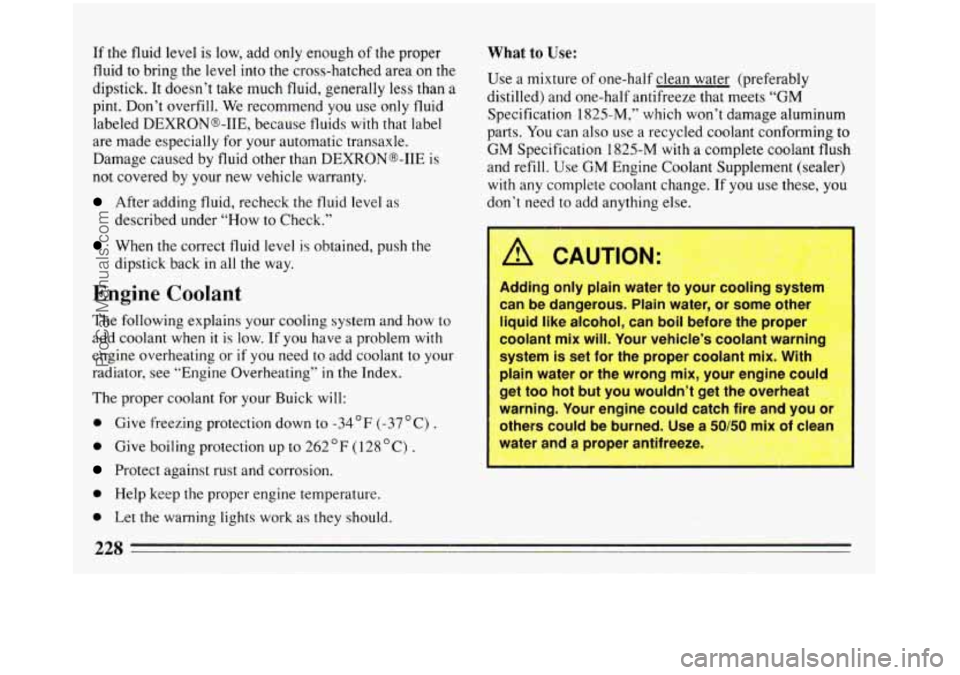
What to Use:
Use a mixture of one-half clean water (preferably
distilled) and one-half antifreeze that meets
“GM
Specification 1825-M,” which won’t damage aluminum
parts. You can also use a recycled coolant conforming to
GM Specification 1825-M with a complete coolant flush
and refill. Use GM Engine Coolant Supplement (sealer)
with any complete coolant change. If you use these, you
don’t need to add anything else.
can be aangerous. Plain water, or some other
liquid like alcohol, can boil before the proper
coolant mix will. Your vehicle’s coolant warning
system is set for the proper coolant mix. With
plain water or the wrong mix, your engine could
get too hot but you wouldn’t get the overhe-”
warning. Your engine could catch fire and
yuu or
others could be burned. Use a 50/50 mix of clean
water and a proper antifreeze.
G:~Z.+T~:, p:.t+d+s
228
ProCarManuals.com
Page 236 of 308
won’t work at all. So, it isn’t a good idea to “top off’
your brake fluid. Adding brake fluid won’t correct a
leak.
If you add fluid when your linings are worn, then
you’ll have too much fluid when you get new brake
linings. You should add (or remove) brake fluid,
as
necessary, only when work is done on the brake
hydraulic system.
a LAUTION:
1
If you have too much brake flui,, I. ;an sblll orl
the engine. The fluid will burn if the engine is hot
enough. You or others could be burned, and your
vehicle could be damaged. Add brake fluid only
when work is done on the brake hydraulic
-stem.
When your brake fluid falls to a low level, your brake
warning light will come on. See “Brake System Warning
Light” in the Index.
What to Add:
When you do need brake fluid, use only DOT-3 brake
fluid
-- such as Delco Supreme 11 @ (GM Part
N0.1052535). Use new brake fluid from a sealed
container only.
0
0
DOT-5 silicone brake fluid can damage
your vehicle. Don’t use it.
Don’t let someone put
in the wrong kind of
fluid. For example, just a few drops of
mineral-based oil, such as engine oil,
in
your brake system can damage brake
system parts
so badly that they’ll have to
be replaced.
Brake fluid can damage paint,
so be careful
not to spill brake fluid on your vehicle.
Replacing Brake System Parts
The braking system on a modern vehicle is complex. Its
many parts have to be
of top quality and work well
together if the vehicle is to have really good braking.
Vehicles we design and test have top-quality GM brake
parts in them, as your Buick does when
it is new. When
you replace parts of your braking system
-- for example,
when your brake linings wear down and
you have to
have new ones put in
-- be sure you get new genuine
GM replacement parts. If
you don’t, your brakes may no
longer work properly. For example, if someone puts
in
brake linings that are wrong for your vehicle, the
234
ProCarManuals.com
Page 251 of 308
0 Use solvent-type cleaners In a well-ventilated area
only. If you use them, don’t saturate the stained area.
If a ring forms after spot cleaning, clean the entire
area immediately or it will set.
Using Foam-Type Cleaner on Fabric
0
0
0
0
0
0
0
0
0
0
Vacuum and brush the area to remove any loose dirt.
Always clean a
whole trim panel or section. Mask
surrounding trim along stitch or welt lines.
Mix Multi-Purpose Powdered Cleaner following the
directions
on the container label.
Use suds only and apply with a clean sponge.
Don’t saturate the material.
Don’t rub
it roughly.
As soon
as you’ve cleaned the section, use a sponge
to remove
the suds.
Rinse the section with a clean, wet sponge.
Wipe off what’s left with a slightly damp paper towel
or cloth.
Then dry it immediately with an air hose, a hair
dryer
or a heat lamp.
I NOTICE:
I
Be careful with a hair dryer or heat lamp. You
could scorch the fabric.
I
Wipe with a clean cloth.
Using Solvent-Type Cleaner on
Fabric
First, see if you have to use solvent-type cleaner at all.
Some spots and stains will clean off better with just
water and mild soap.
If you need to use it, then:
0 Gently scrape excess soil from the trim material with
a clean, dull knife or scraper. Use very little cleaner,
light pressure and clean cloths (preferably
cheesecloth). Cleaning should start at the outside
of
the stain, “feathering” toward the center. Keep
changing
to a clean section of the cloth.
the area with an air hose, hair dryer, or heat lamp to
help prevent a cleaning ring. (See the previous
NOTICE.)
0 When you clean a stain from fabric, immediately dry
249
ProCarManuals.com
Page 252 of 308
Special Cleaning Problems
Greasy or Oily Stains: Like grease, oil, butter,
margarine, shoe polish, coffee with cream, chewing
gum, cosmetic creams, vegetable oils, wax crayon, tar
and asphalt.
Carefully scrape off excess stain.
Then follow the solvent-type instructions above.
Shoe polish, wax crayon, tar and asphalt will stain if
left on a vehicle seat fabric. They should be removed
as soon as possible. Be careful, because the cleaner
will dissolve them and may cause them to bleed.
Non-Greasy Stains: Like catsup, coffee (black), egg,
fruit, fruit juice, milk, soft drinks, wine, vomit, urine and
blood.
0
0
0
Carefully scrape off excess stain, then sponge the
soiled area with cool water.
If a stain remains, follow the foam-type instructions
above.
If an odor lingers after cleaning vomit or urine, treat
the area with a waterbaking soda solution:
1
teaspoon (5 ml) of baking soda to 1 cup (250 ml) of
lukewarm water.
Finally, if needed, clean lightly with solvent-type
Combination Stains: Like candy, ice cream,
mayonnaise, chili sauce and unknown st.ains.
0 Carefully scrape off excess stain, then clean with
cleaner.
cool water and allow
to dry.
If a stain remains, clean it with solvent-type cleaner.
Cleaning Vinyl or Leather
Just use warm water and a clean cloth.
0 Rub with a clean, damp cloth to remove dirt. You
may have to do it more than once.
0 Things like tar, asphalt and shoe polish will stain if
you don’t get them
off quickly. Use a clean cloth and
solvent-type vinylbeather cleaner.
Cleaning the Top of the Instrument
Panel
Use only mild soap and water to clean the top surfaces
of the instrument panel. Sprays containing silicones or
waxes may cause annoying reflections in the windshield
and even make
it difficult to see through the windshield
under certain conditions.
250
ProCarManuals.com
Page 255 of 308
White Sidewall Tires
Your Buick dealer has a GM White Sidewall Tire
Cleaner. You can use a stiff brush with it.
Weatherstrips
These are places where glass or metal meets rubber.
Silicone grease there will make them last longer, seal
better, and not stick or squeak. Apply silicone grease
with a clean cloth at least every six months.
Sheet Metal Damage
If your vehicle is damaged and requires sheet metal
repair or replacement, make sure the body repair shop
applies anti-corrosion material to the parts repaired or
replaced to restore corrosion protection.
Foreign Material
Calcium chloride and other salts, ice melting agents,
road oil and tar, tree sap, bird droppings, chemicals from
industrial chimneys, and other foreign matter can
damage your vehicle’s finish
if they remain on painted
surfaces. Use cleaners that are marked safe for painted
surfaces for these stains.
Finish Damage
Any stone chips, fractures or deep scratches in the finish
should be repaired right away. Bare metal will corrode
quickly and may develop into a major repair expense.
Minor chips and scratches can be repaired with touch-up
materials available from your dealer or other service
outlets. Larger areas
of finish damage can be corrected
in your dealer’s body and paint shop.
Underbody Maintenance
Chemicals used for ice and snow removal and dust
control can collect on
the underbody. If these are not
removed, accelerated corrosion (rust) can occur
on the
underbody parts such as fuel lines, frame, floor pan, and
exhaust system even though they have corrosion
protection.
At least every spring,
flush these materials from the
underbody with plain water. Clean any areas where mud
and other debris can collect. Dirt packed in closed areas
of the frame should be loosened before being flushed.
Your dealer or an underbody vehicle washing system
can do
this for you,
253
ProCarManuals.com
Page 261 of 308
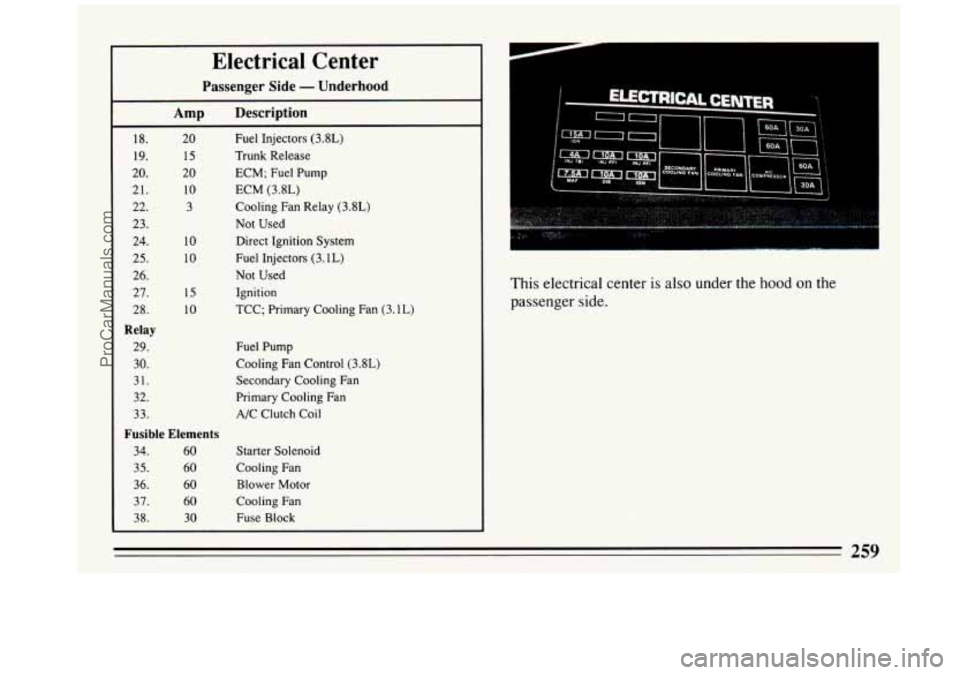
10
10
15
10
Electrical Center
Passenger Side - Underhood
Amp Description
18. 20 Fuel Injectors (3.8L)
19.
15 Trunk Release
20. 20 ECM; Fuel Pump
21. 10 ECM (3.8L)
22. 3
Cooling Fan Relay (3.8L)
23. Not Used
24. Direct Ignition System
25. Fuel Injectors (3.1 L)
26. Not Used
27. Ignition
28. TCC; Primary Cooling Fan (3.1 L)
Relay
29.
30.
31.
32.
33.
Fusible Elements
34. 60 Starter Solenoid
35. 60 Cooling Fan
37. 60 Cooling Fan
36. 60 Blower Motor
38. 30 Fuse Block Fuel Pump
Cooling Fan Control
(3.8L)
Secondary Cooling Fan
Primary Cooling Fan
A/C Clutch Coil
This electrical center is also under the hood on the
passenger side.
259
ProCarManuals.com
Page 265 of 308
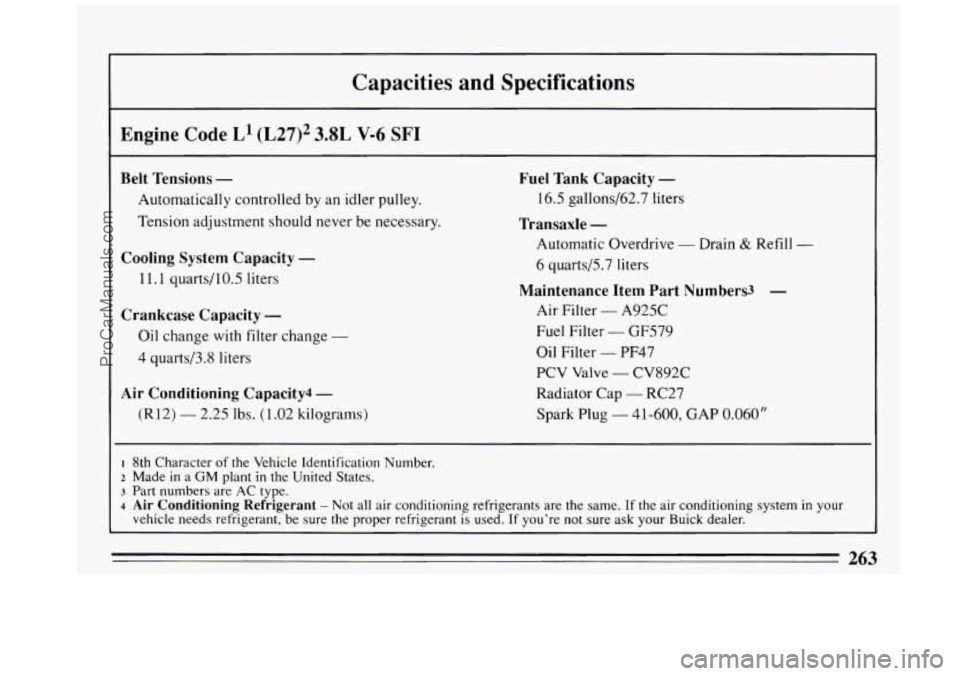
Capacities and Specifications
Engine Code L1 (L27)2 3.8L V-6 SF1
Belt Tensions - Fuel Tank Capacity -
Automatically controlled by an idler pulley.
16.5 gallons/62.7 liters
Tension adjustment should never be necessary.
Transaxle -
Automatic Overdrive - Drain & Refill -
6 quarts/5.7 liters
Maintenance Item Part Numbers3 -
Air Filter - A925C
Fuel Filter
- GF579
Oil Filter
- PF47
PCV Valve
- CV892C
Radiator Cap
- RC27
Spark Plug
- 41-600, GAP 0.060”
Cooling System Capacity -
11.1 quarts/l0.5 liters
Crankcase Capacity -
Oil change with filter change -
4 quarts/3.8 liters
Air Conditioning Capacity4 -
(R12) - 2.25 lbs. (1.02 kilograms)
-
4 Air Conditioning Refrigerant - Not all air conditioning refrigerants are the same. If the air conditioning system in your
vehicle needs refrigerant, be sure the proper refrigerant
is used. If you’re not sure ask your Buick dealer.
~ ~~
I 8th Character of the Vehicle Identification Number.
2 Made in a GM plant in the United States.
3 Part numbers are AC tvDe.
263
ProCarManuals.com
Page 266 of 308
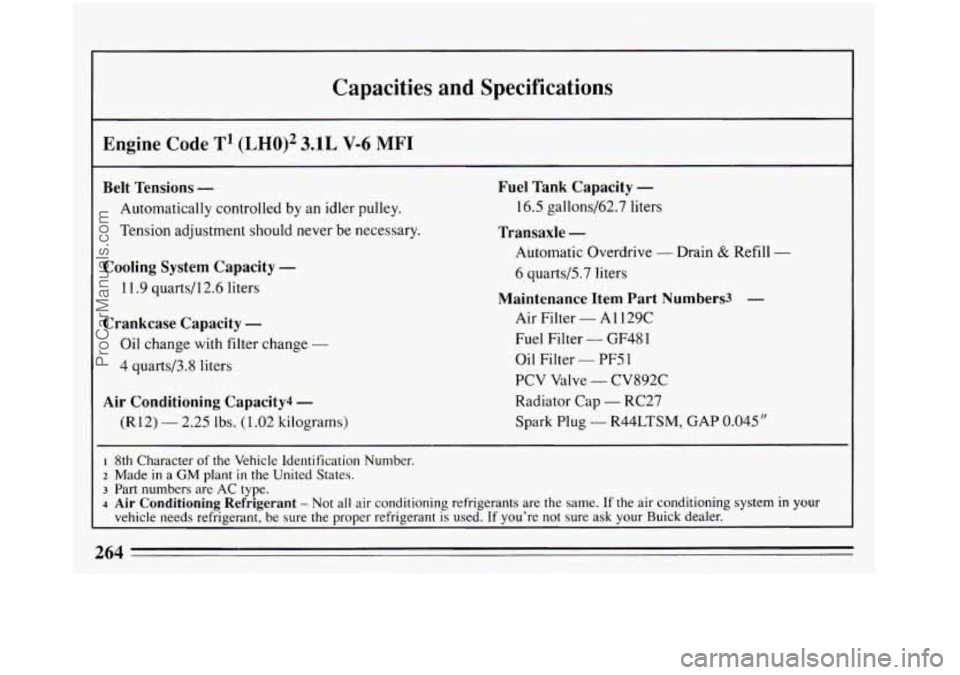
Capacities and Specifications
Engine Code T1 (LH0)2 3.1L V-6 MFI
Belt Tensions -
Automatically controlled by an idler pulley.
Tension adjustment should never be necessary.
Cooling System Capacity -
11.9 quarts/l2.6 liters
Crankcase Capacity -
Oil change with filter change -
4 quarts/3.8 liters
Air Conditioning Capacity4 -
(R12) - 2.25 Ibs. (1.02 kilograms)
Fuel Tank Capacity -
16.5 gallons/62.7 liters
1 ransaxle -
Automatic Overdrive - Drain & Refil 1-
6 quartd5.7 liters
Maintenance Item Part Numbers3 -
Air Filter - A1 129C
Fuel Filter
- GF48 1
Oil Filter - PF5 1
PCV Valve - CV892C
Radiator Cap
- RC27
Spark Plug
- R44LTSM, GAP 0.045”
~~ ~
1 8th Character of the Vehicle Identification Number.
z Made in a GM plant in the United States.
3 Part numbers are AC type.
4 Air Conditioning Refrigerant - Not all air conditioning refrigerants are the same. If the air conditioning system in your
vehicle needs refrig
nt, be sure the proper refrigerant is used. If you’re not sure ask your Buick dealer.
264
ProCarManuals.com
Page 268 of 308
IMPORTANT:
KEEP ENGINE OIL
AT THE PROPER
LEVEL AND CHANGE AI
RECOMMENDED
’/an
Have you purchased the GM Protection Plan? The
Plan supplements your new vehicle warranties. See
your Buick dealer for details.
Introduction
A Word About Maintenance
We at General Motors want to help you keep your
vehicle in good working condition. But we don’t know
exactly how
you’ll drive it. You may drive very short
distances only
a few times a week. Or you may drive
long distances all the time in very
hot, dusty weather.
You may use your vehicle in making deliveries. Or you
may drive it to work, to
do errands or in many other
ways.
Because of all
the different ways people use their GM
vehicles, maintenance needs vary. You may even need
more frequent checks and replacements
than you will
find in the schedules in this part.
So please read this part
and note how
you drive. If you have any questions on
how
to keep your vehicle in good condition, see your
Buick dealer, the place many GM owners choose to
have their maintenance work done. Your dealer can be
relied upon to use proper parts and practices.
266
-
ProCarManuals.com
Page 272 of 308
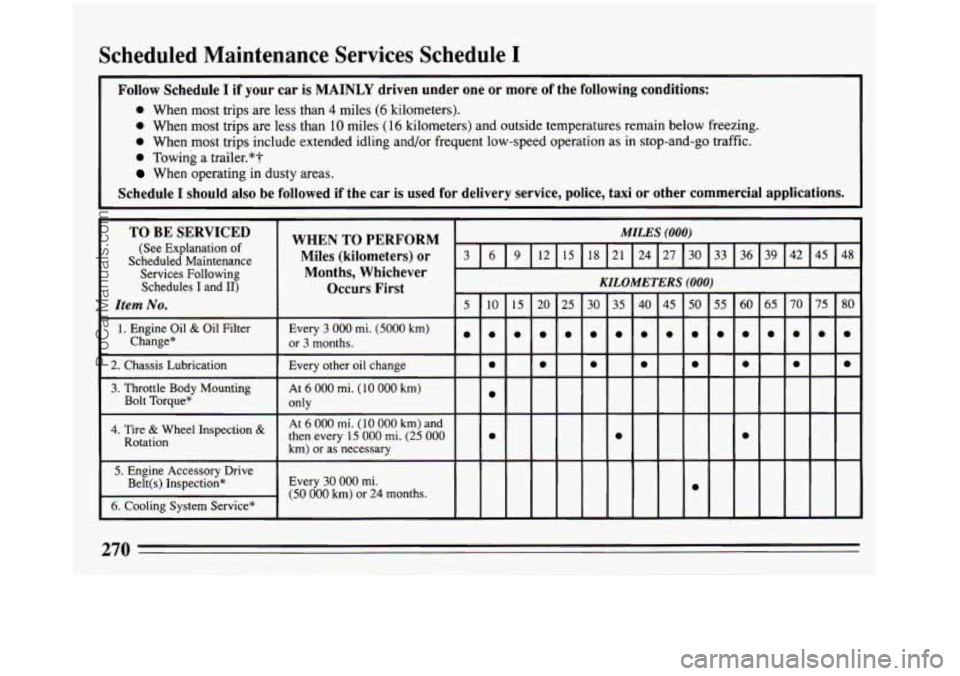
Scheduled Maintenance Services Schedule I
Follow Schedule I if your car is MAINLY driven under one or more of the following conditions: I
0 When most trips are less than 4 miles (6 kilometers).
0 When most trips are less than 10 miles (16 kilometers) and outside temperatures remain below freezing.
0 When most trips include extended idling and/or frequent low-speed operation as in stop-and-go traffic.
0 Towing a trailer.*?
When operating in dusty areas.
Schedule I should also be followed if the car is used for delivery service, police, taxi or other commercial applications.
TO BE SERVICED
(See Explanation of
Scheduled Maintenance
Services Following Schedules
I and 11)
Item No.
1. Engine Oil & Oil Filter
Change*
2. Chassis Lubrication
3. Throttle Body Mounting Bolt Torque*
4. Tire & Wheel Inspection &
Rotation
5. Engine Accessory Drive
' Belt(s) Inspection*
6. Cooling System Service*
65 70 75 80
0.00
0 0
270
ProCarManuals.com