tires BUICK REGAL 1993 Owner's Manual
[x] Cancel search | Manufacturer: BUICK, Model Year: 1993, Model line: REGAL, Model: BUICK REGAL 1993Pages: 308, PDF Size: 16.35 MB
Page 240 of 308
I
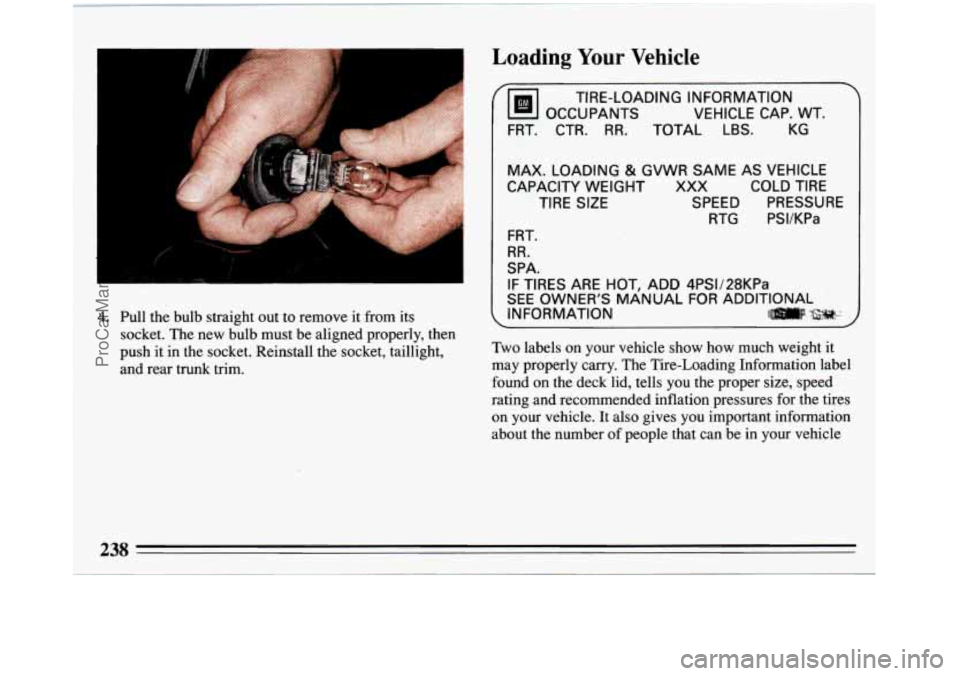
4. Pull the bulb straight out to remove it from its
socket. The new bulb must be aligned properly, then
push it in the socket. Reinstall the socket, taillight,
and rear trunk trim.
Loading Your Vehicle
OCCUPANTS VEHICLE CAP. WT.
TIRE-LOADING
INFORMATION
FRT. CTR.
RR. TOTAL LBS. KG
MAX. LOADING
& GVWR SAME AS VEHICLE
CAPACITY WEIGHT XXX COLD TIRE
TIRE SIZE SPEED PRESSURE RTG PSVKPa
FRT.
RR.
SPA. IF TIRES ARE HOT, ADD 4PSV28KPa
SEE OWNER'S MANUAL FOR ADDITIONAL
INFORMATION
ll]m' .$$;i#..:.
Two labels on your vehicle show how much weight it
may properly carry. The Tire-Loading Information label
found on the deck lid, tells you the proper size, speed
rating and recommended inflation pressures
for the tires
on your vehicle. It also gives you important information
about the number of people that can be in your vehicle
ProCarManuals.com
Page 242 of 308
I A CAUTION:
l Tires
We don’t make tires. Your new vehicle comes with high
quality tires made by a leading tire manufacturer. These
tires are warranted by the tire manufacturers and their
warranties are delivered with every
new Buick. If your
spare tire is
a different brand than your road tires, you
will have a tire warranty folder from each of these
manufacturers.
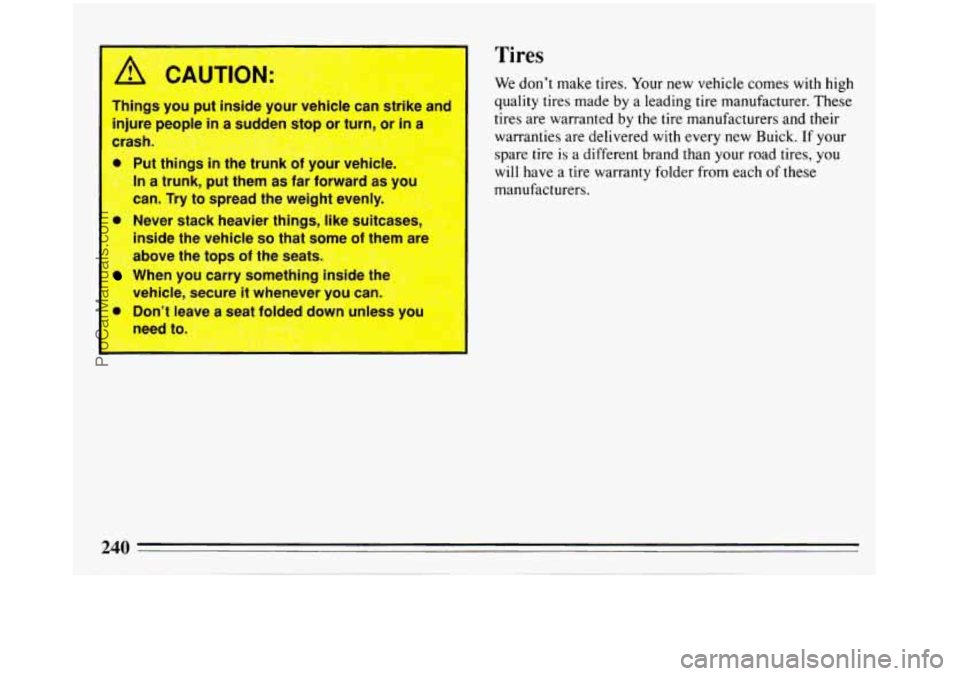
above the tops of the seats
vehicle, secure
it whenever you can.
When you carry something inside 1
240
ProCarManuals.com
Page 243 of 308
A CAUTION:
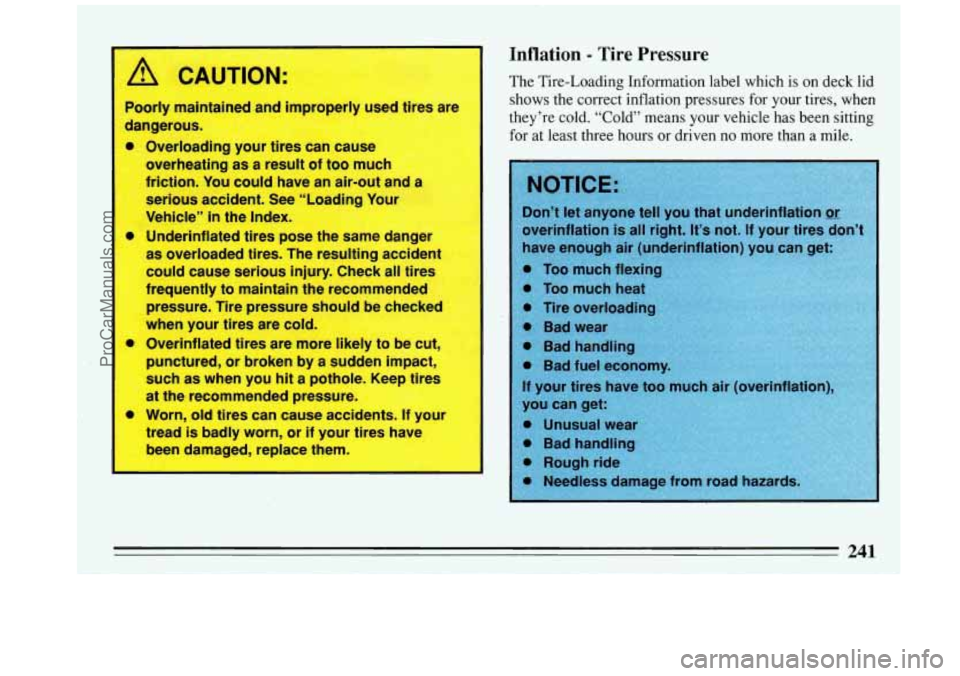
Poorly maintained and improperly used tires are
dangerous.
0
Overloading your tires can cause
overheating as a result
of too much
friction. You could have an air-out and a
serious accident. See “Loading Your
Vehicle”
in the Index.
Underinflated tires pose the same danger
as overloaded tires. The resulting accident
could cause serious injury. Check all tires
frequently to maintain the recommended
pressure. Tire pressure should be checked
when your tires are cold.
Overinflated tires are more likely to be cut,
punctured, or broken by
a sudden impact,
such as when you
hit a pothole. Keep tires
at the recommended pressure.
Worn, old tires can cause accidents.
If your
tread
is badly worn, or if your tires have
been damaged, replace them.
Inflation - Tire Pressure
The Tire-Loading Information label which is on deck lid
shows the correct inflation pressures for your tires, when
they’re cold. “Cold” means your vehicle has been sitting
for at least three hours or driven
no more than a mile.
241
ProCarManuals.com
Page 244 of 308
When to Check: Check your tires once a month or
more.
Don’t forget your compact spare tire. It should be at
60
psi (420 kPa).
How to Check: Use a good quality pocket-type gage to
check tire pressure. Simply looking at the tires will not
tell
you the pressure, especially if you have radial tires --
which may look properly inflated even if they’re
underinflated.
If your tires have valve caps, be sure to put them back
on.
They help prevent leaks by keeping out dirt and
moisture.
Tire Inspection and Rotation
To make your tires last longer, have them inspected and
rotated at the mileages recommended
in the
Maintenance Schedule. See “Scheduled Maintenance
Services”
in the Index.
I
I‘
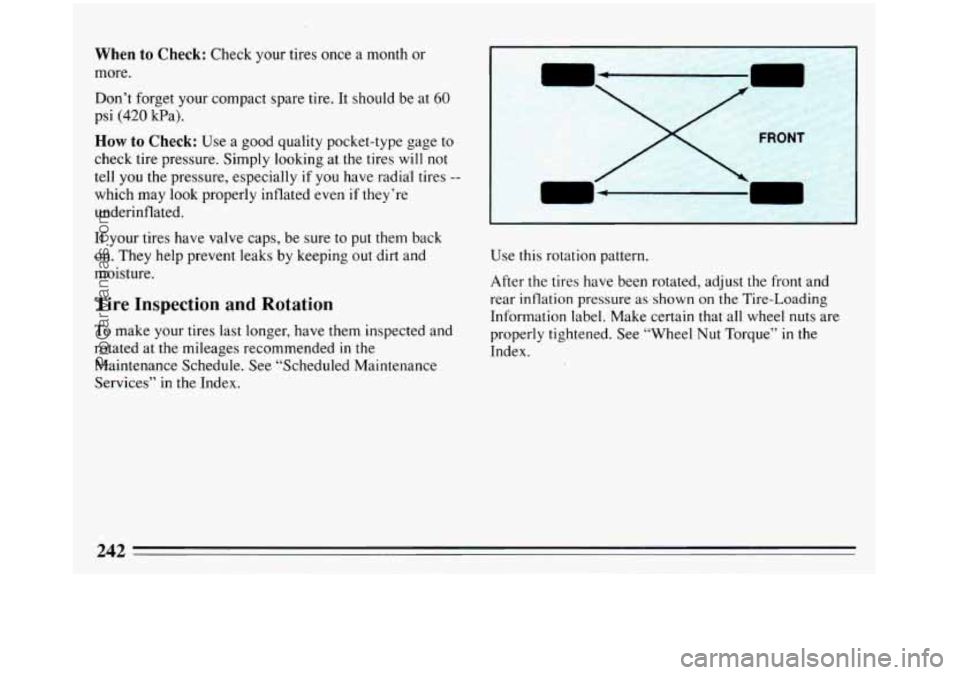
Use this rotation pattern.
After the tires have been rotated, adjust the front and
rear inflation pressure
as shown on the Tire-Loading
Information label. Make certain that all wheel nuts are
properly tightened. See “Wheel Nut Torque”
in the
Index.
242
ProCarManuals.com
Page 245 of 308
A CAW’ON
Rust or dirt on a wheel, or on the parts to which
it is fastened, can make wheel nuts become
loose after a time. The wheel could come off
a-”
cause an accident. When you change a wheel,
remove any rust or dirt from places where the
wheel attaches to the vehicle.
In an emergency,
you can use a cloth
or a paper towel to do this;
but be sure to use a scraper or wire brush later, if
you need to, to get all the rust or dirt off. (See
“nhanging a Flat
in the Index.)
I
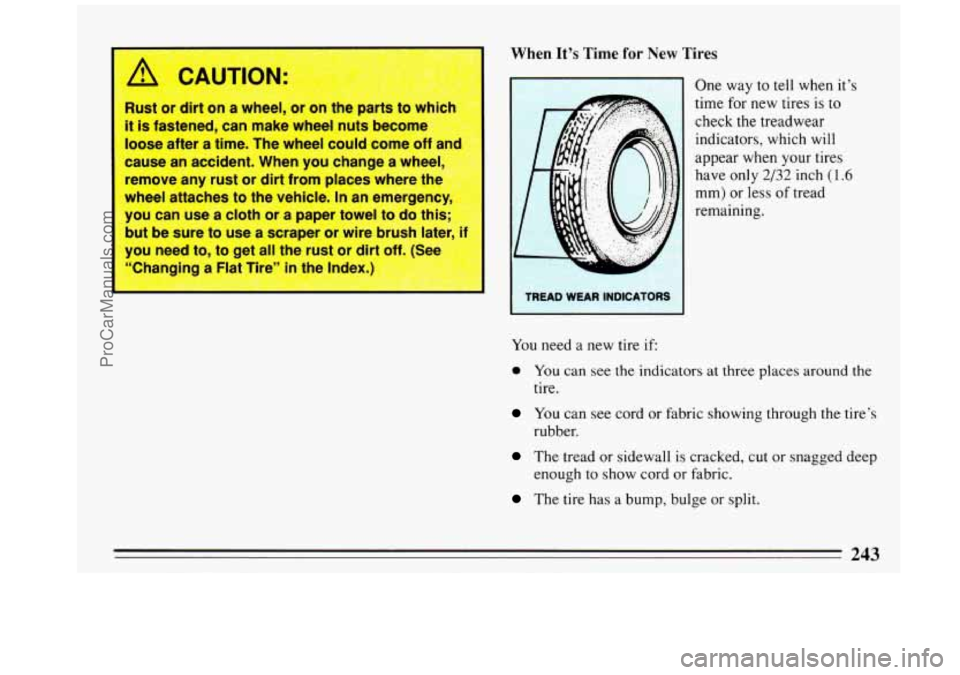
When It’s Time for New Tires
b One wav to tell when it’s r’
time for new tires is to
check
the treadwear
indicators, which will
appear when your tires
have only
2/32 inch (1.6
mm) or less of tread
remaining.
I TREAD WEAR INDICATORS I
You need a new tire if
0 You can see the indicators at three places around the
tire.
You can see cord or fabric showing through the tire‘s
rubber.
The tread or sidewall is cracked, cut or snagged deep
enough to show cord or fabric.
The tire has a bump, bulge or split.
243
ProCarManuals.com
Page 246 of 308
0 The tire has a puncture, cut, or other damage that
can’t be repaired well because
of the size or location
of the damage.
Buying New Tires
To find out what kind and size of tires you need, look at
the Tire-Loading Information label.
The tires installed on your vehicle when it was new had
a Tire Performance Criteria Specification (TPC Spec)
number on each tire’s sidewall. When you get new tires,
get ones with that same TPC Spec number. That way,
your vehicle will continue to have tires that are designed
to give proper endurance, handling, speed rating,
traction, ride and other things during normal service on
your vehicle.
If your tires have an all-season tread
design, the TPC number
will be followed by a “MS”
(for mud and snow).
If you ever replace your tires with those not having a
TPC Spec number, make sure they are
the same size,
load range, speed rating and construction type (bias,
bias-belted or radial) as your original tires.
A CA
I Mixing ur
ITION:
coui4 au 1 you IO lose c
while driving. If you m~x tires of different sizes or
types (radial and bias-belted tires), the vehicle
may not handle properly, and you could have a
;k :.
crash. Be sure to use the .LLL same .n size and type ;:L*:..% , T.,-?<’
though. It was developed for limited use on YOUI‘..~
vehicle.
I
Uniform Tire Quality Grading
The following information relates to the system
developed by the United States National Highway
Traffic Safety Administration which grades tires by
treadwear, traction and temperature performance. (This
applies only to vehicles sold in the United States.)
Treadwear
The treadwear grade is a comparative rating based on
the wear rate of the tire when tested under controlled
conditions on a specified government test course. For
example, a tire graded
150 would wear one and a half (1
244
ProCarManuals.com
Page 247 of 308
1/2) times as well on the government course as a tire
graded
100. The relative performance of tires depends
upon the actual conditions of their use, however, and
may depart significantly from the norm due to variations
in driving habits, service practices and differences
in
road characteristics and climate.
Traction - A, B, C
The traction grades, from highest to lowest are: A, B,
and C. They represent the tire’s ability to stop on wet
pavement as measured under controlled conditions on
specified government test surfaces of asphalt and
concrete.
A tire marked C may have poor traction
performance.
Warning: The traction grade assigned to this tire
is based
on braking (straight-ahead) traction tests and does not
include cornering (turning) traction.
Temperature - A, B, C
The temperature grades are A (the highest), B, and C,
representing the tire’s resistance to the generation of
heat and its ability to dissipate heat when tested under
controlled conditions on a specified indoor laboratory
test wheel. Sustained high temperature can cause the
material
of the tire to degenerate and reduce tire life, and
excessive temperature can lead to sudden tire failure. The
grade
C corresponds to a level of performance
which all passenger car tires must meet under the
Federal Motor Vehicle Safety Standard
No. 109. Grades
B and A represent higher levels of performance on the
laboratory test wheel than the minimum required by law.
Warning: The temperature grade for this tire
is
established for a tire that is properly inflated and not
overloaded. Excessive speed, underinflation, or
excessive loading, either separately or
in combination,
can cause heat buildup and possible tire failure.
These grades are molded
on the sidewalls of passenger
car tires.
While the tires available
as standard or optional
equipment
on General Motors vehicles may vary with
respect to these grades, all such tires meet General
Motors performance standards and have been approved
for use on General Motors vehicles. All passenger type
(P Metric) tires must conform to Federal safety
requirements
in addition to these grades.
Wheel Alignment and Tire Balance
The wheels on your vehicle were aligned and balanced
carefully at the factory to give
you the longest tire life
and best overall performance.
245
ProCarManuals.com
Page 248 of 308
In most cases, you will not need to have your wheels
aligned again. However, if
you notice unusual tire wear
or your vehicle pulling one way or the other, the
alignment may need to be reset.
If you notice your
vehicle vibrating when driving on a smooth road, your
wheels may need to be rebalanced.
Wheel Replacement
Replace any wheel that is bent, cracked or badly rusted.
If wheel nuts keep coming loose, the wheel, wheel bolts,
and wheel nuts should be replaced. If the wheel leaks air
out, replace it (except some aluminum wheels, which
can sometimes be repaired). See your Buick dealer if
any
of these conditions exist.
Your dealer will know the kind of wheel you need.
Each new wheel should have the same load carrying
capacity, diameter, width, offset, and be mounted the
same way as the one it replaces.
If you need to replace any of your wheels, wheel bolts,
or wheel nuts, replace them only with new
GM original
equipment parts. This way, you will be sure to have the
right wheel, wheel bolts, and wheel nuts for your Buick
model.
A CAUTION:
Using the wrong replacement wheels, wheel
bolts, or wheel nuts on your vehicle can be
dangerous.
It could affect the braking and
handling of your vehicle, make your tires lose air
and make you lose control. You could have a
collision in which you or others could be injured.
Always use the correct wheel, wheel bolts, and
wheel nuts for replacement.
I I
1:-
ProCarManuals.com
Page 249 of 308
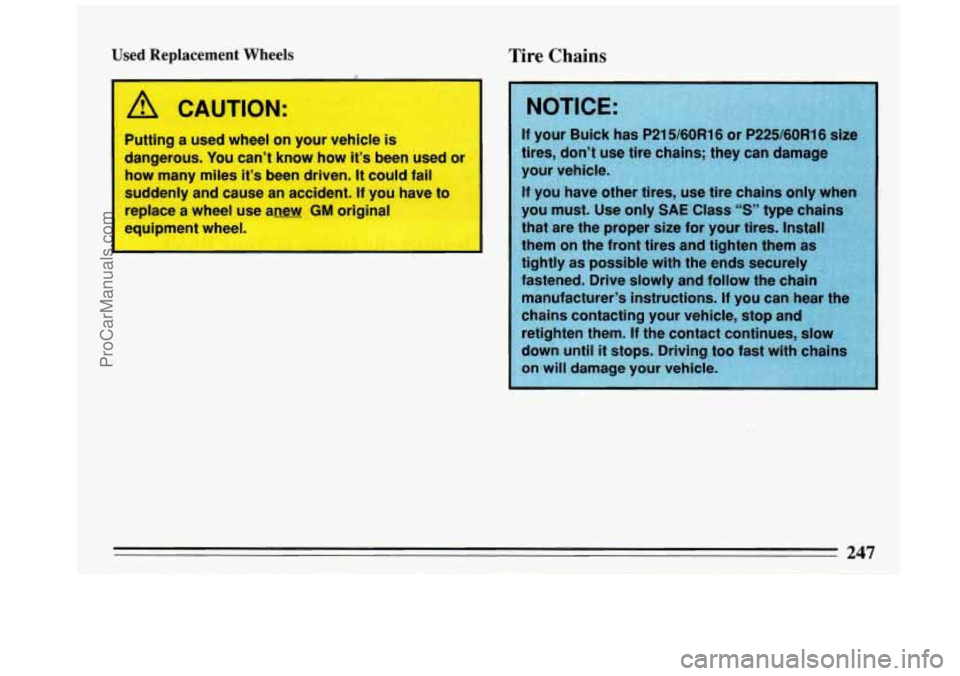
Used Replacement Wheels
A CAUTION:
Putting a used wheel on your vehicle is
dangerous. You can’t know how it’s been used or
how many miles it’s been driven.
It could fail
suddenly
and cause an accident. If you have to
equipment wheel.
~ replace a wheel use anew GM original
I
Tire Chains
If your Buick has P215160RI 6
tires, don’t us
your vehicle.
If you have other tires, use tire chains only when
you must. Use only
SAE Class “S” type chains
that are the proper size for your tires. Install
them on the front tires and tighten them as
tightly as possible with the ends securely
fastened. Drive slowly and follow the chain
manufacturer’s instructions.
If you can hear the
chains contacting your vehicle, stop and
retighten them.
If the contact continues, slow
down until it stops. Driving too fast with chains
on
will damage your vehicle.
ProCarManuals.com
Page 255 of 308
White Sidewall Tires
Your Buick dealer has a GM White Sidewall Tire
Cleaner. You can use a stiff brush with it.
Weatherstrips
These are places where glass or metal meets rubber.
Silicone grease there will make them last longer, seal
better, and not stick or squeak. Apply silicone grease
with a clean cloth at least every six months.
Sheet Metal Damage
If your vehicle is damaged and requires sheet metal
repair or replacement, make sure the body repair shop
applies anti-corrosion material to the parts repaired or
replaced to restore corrosion protection.
Foreign Material
Calcium chloride and other salts, ice melting agents,
road oil and tar, tree sap, bird droppings, chemicals from
industrial chimneys, and other foreign matter can
damage your vehicle’s finish
if they remain on painted
surfaces. Use cleaners that are marked safe for painted
surfaces for these stains.
Finish Damage
Any stone chips, fractures or deep scratches in the finish
should be repaired right away. Bare metal will corrode
quickly and may develop into a major repair expense.
Minor chips and scratches can be repaired with touch-up
materials available from your dealer or other service
outlets. Larger areas
of finish damage can be corrected
in your dealer’s body and paint shop.
Underbody Maintenance
Chemicals used for ice and snow removal and dust
control can collect on
the underbody. If these are not
removed, accelerated corrosion (rust) can occur
on the
underbody parts such as fuel lines, frame, floor pan, and
exhaust system even though they have corrosion
protection.
At least every spring,
flush these materials from the
underbody with plain water. Clean any areas where mud
and other debris can collect. Dirt packed in closed areas
of the frame should be loosened before being flushed.
Your dealer or an underbody vehicle washing system
can do
this for you,
253
ProCarManuals.com