lock BUICK REGAL 1993 Workshop Manual
[x] Cancel search | Manufacturer: BUICK, Model Year: 1993, Model line: REGAL, Model: BUICK REGAL 1993Pages: 308, PDF Size: 16.35 MB
Page 219 of 308
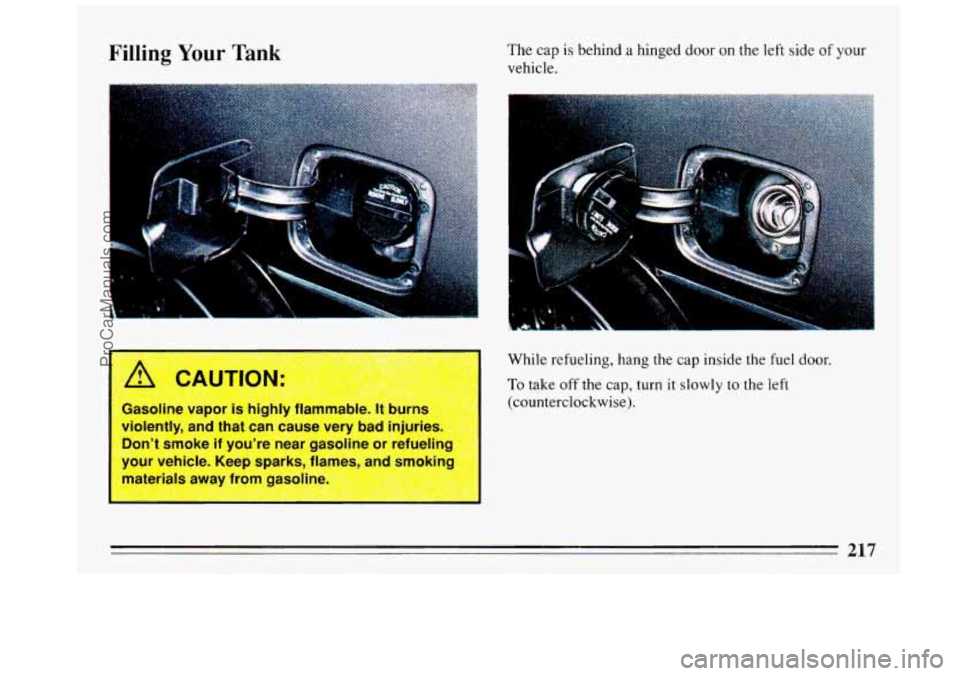
Filling Your Tank The cap is behind a hinged door on the left side of your
vehicle.
11ne vapor IS nlghly Tlarnrnao
violently, and that can cause very Dad injuries.
Don’t smoke if you’re near gasoline or refuelin
your vehicle. Keep sparks, flames, (rr4erials away
+rqm ga-line. ~~2;: LMk
While refueling, hang the cap inside the fuel door.
To take off the cap, turn it slowly to the kft
(counterclockwise).
217
ProCarManuals.com
Page 226 of 308
When to Change Engine Oil: See if any one of these
is true for you:
Most trips are less than 4 miles (6 km).
9 It’s below freezing outside and most trips are less
9 The engi.ne is at low speed most of the time (as in
door-to-door delivery, or in stop-and-go traffic).
You tow a trailer often. .-
9 Most trips are through dusty places.
If
any one of thes,e is true for your vehicle, then you
need to change your oil and filter every
3,000 miles (5
000 km) or 3 months -- whichever comes first.
If none of them is true, change the oil every 7,500 miles
(12
500 km) or 12 months -- whichever comes first.
Change the filter at the first
oil change and at every
other
oil change after that.
Engine Block Heater: An engine block heater can be a
big help if you have to park outside in very cold
than
10 miles (16 km).
weather,
-20 F (-29 C)
or colder. If your vehicle has
this option, see ”Engine
Block Heater” in the Index.
What to Do with Used Oil:
Used engine oil contains things that ha\, zaused
skin cancer in laboratory animals. Don’t let use6 oil stay on your skin for very long. Clean your
skin and nails with soap and water, or a good
hand cleaner. Wash
or properly throw away
4othing or rags containing used engine oil
Used oil can be a real threat to the environment. If you
change your own oil, be sure
to drain all free-flowing oil
from the filter before disposal. Don’t ever dispose of oil
by pouring
it on the ground, into sewers, or into streams
or bodies of water. Instead, recycle
it by taking it to a
place that collects used oil.
If you have a problem
224
ProCarManuals.com
Page 238 of 308
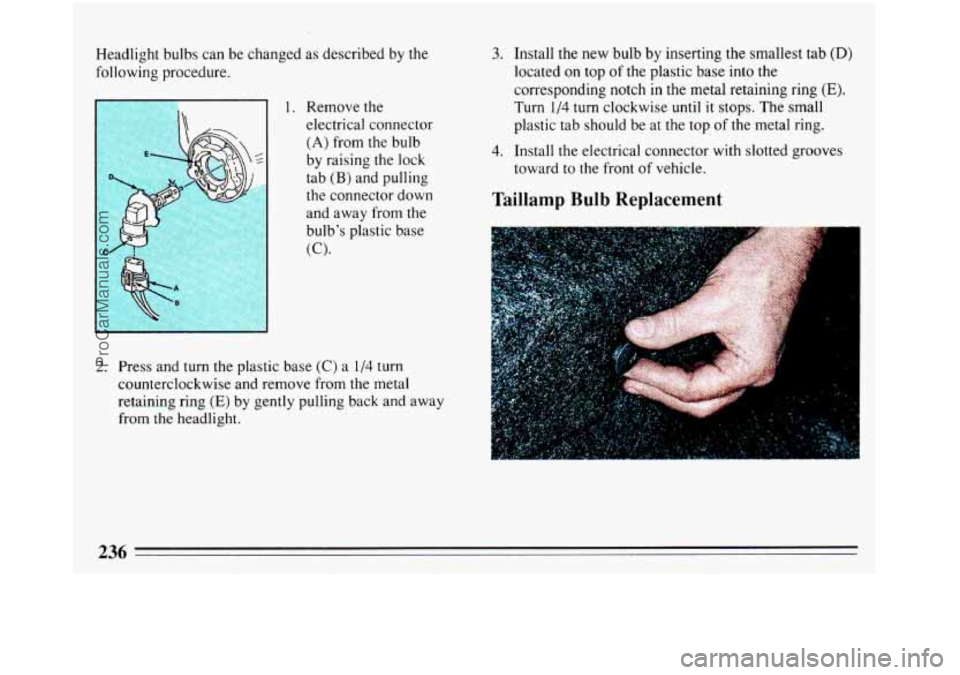
Headlight bulbs can be changed as described by the
following procedure.
1. Remove the
electrical connector
(A) from the bulb
by raising the lock tab
(B) and pulling
the connector down
and away from the
bulb’s plastic base
(C).
2. Press and turn the plastic base (C) a 1/4 turn
counterclockwise and remove from the metal
retaining ring
(E) by gently pulling back and away
from
the headlight.
3. Install the new bulb by inserting the smallest tab (D)
located on top of the plastic base into the
corresponding
notch in the metal retaining ring (E).
Turn 1/4 turn clockwise until it stops. The small
plastic tab should be at the top
of the metal ring.
4. Install the electrical connector with slotted grooves
toward
to the front of vehicle.
Taillamp Bulb Replacement
ProCarManuals.com
Page 259 of 308
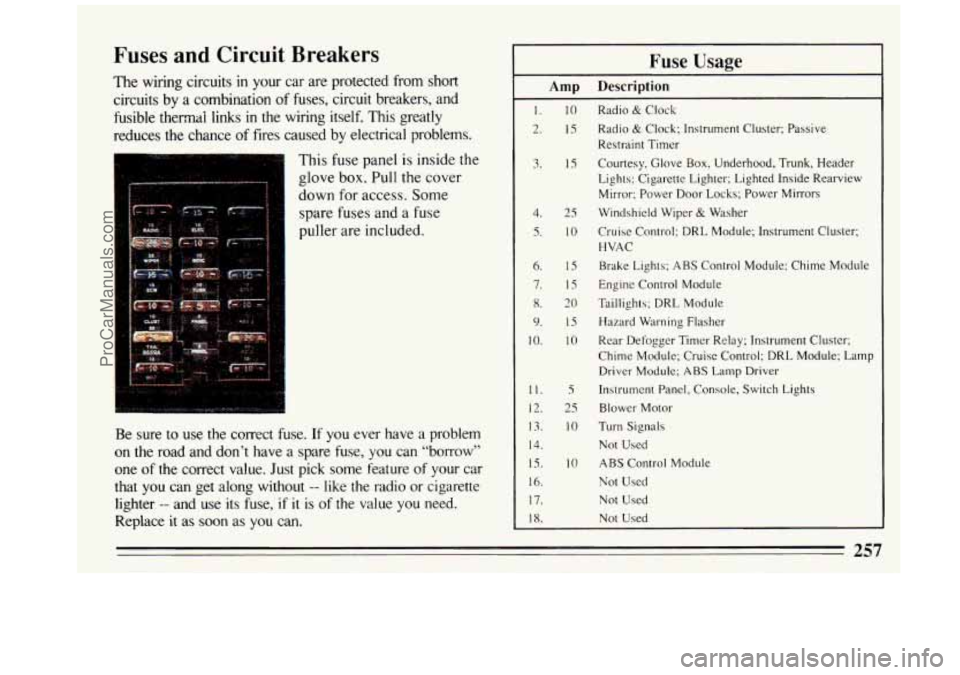
Fuses and Circuit Breakers
The wiring circuits in your car are protected from short
circuits by a combination
of fuses, circuit breakers, and
fusible themdi links in the wiring itself.
This greatly
reduces the chance
of fires caused by electrical problems.
This fuse panel is inside the
glove box. Pull the cover
down for access. Some
spare fuses and
a fuse
puller are included.
Be sure
to use the correct fuse. If you ever have a problem
on the road and don’t have
a spare fuse, you can “borrow”
one of the correct value. Just pick some feature of your car
that you can get along without
-- like the radio or cigarette
lighter
-- and use its fuse, if it is of the value you need.
Replace
it as soon as you can.
Fuse Usage
Amp Description
1.
2.
3.
10
15
15
4.
5.
6.
7.
8.
9.
10.
11.
12.
13.
14.
1s.
16.
17.
18.
25
10
1s
15
20
15
10
5
25
10
10
Radio & Clock
Radio
& Clock; Instrument Cluster; Passive
Restraint Timer
Courtesy, Glove Box, Underhood, Trunk, Header
Lights; Cigarette Lighter; Lighted Inside Rearview Mirror; Power Door Locks; Power Mirrors
Windshield Wiper
& Washer
Cruise Control: DRL Module; Instrument Cluster;
HVAC
Brake Lights;
ABS Control Module; Chime Module
Engine Control Module
Taillights; DRL Module
Hazard Warning Flasher
Rear Defogger Timer Relay: Instrument Cluster;
Chime Module; Cruise Control; DRL Module; Lamp
Driver
Module; ABS Lamp Driver
Instrument Panel. Console, Switch Lights
Blower Motor
Turn Signals
Not Used ABS Control Module
Not Used Not Used
Not Used
257
ProCarManuals.com
Page 260 of 308
5
15
10
60
50
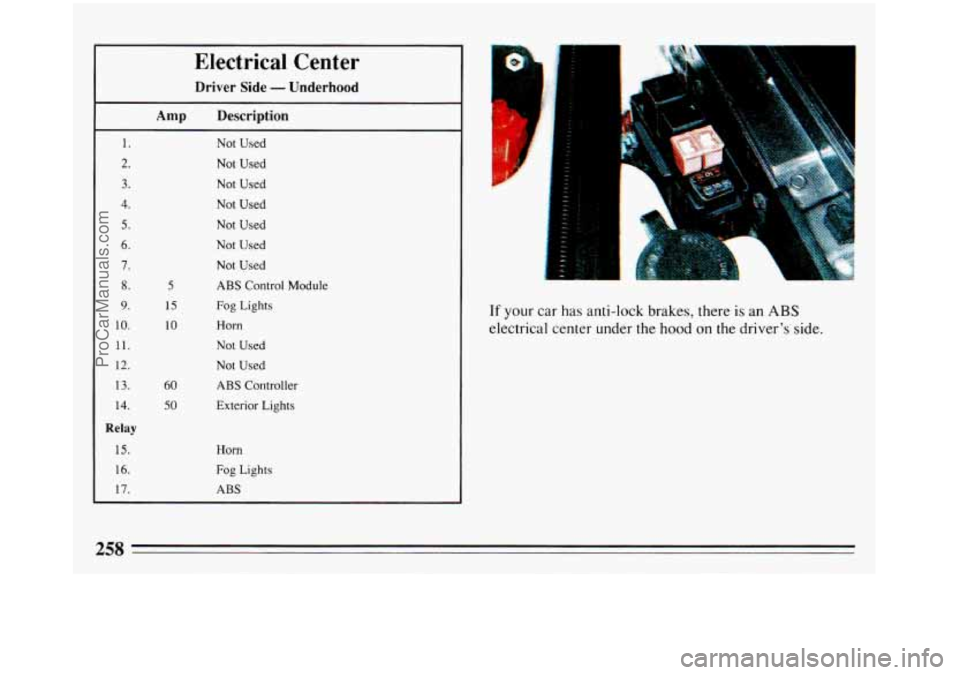
Electrical Center
Driver Side - Underhood
Amp Description
1. Not Used
2. Not Used
, 3. Not Used
4. Not Used
5. Not Used
6. Not Used
7. Not Used
8. ABS Control Module
9. Fog Lights
10. Horn
11. Not Used
12. Not Used
13. ABS Controller
14. Exterior Lights
Relay
15.
16.
17.
Horn
Fog Lights
ABS
a
If your car has anti-lock brakes, there is an ABS
electrical center under the hood on the driver's side.
258
ProCarManuals.com
Page 261 of 308
10
10
15
10
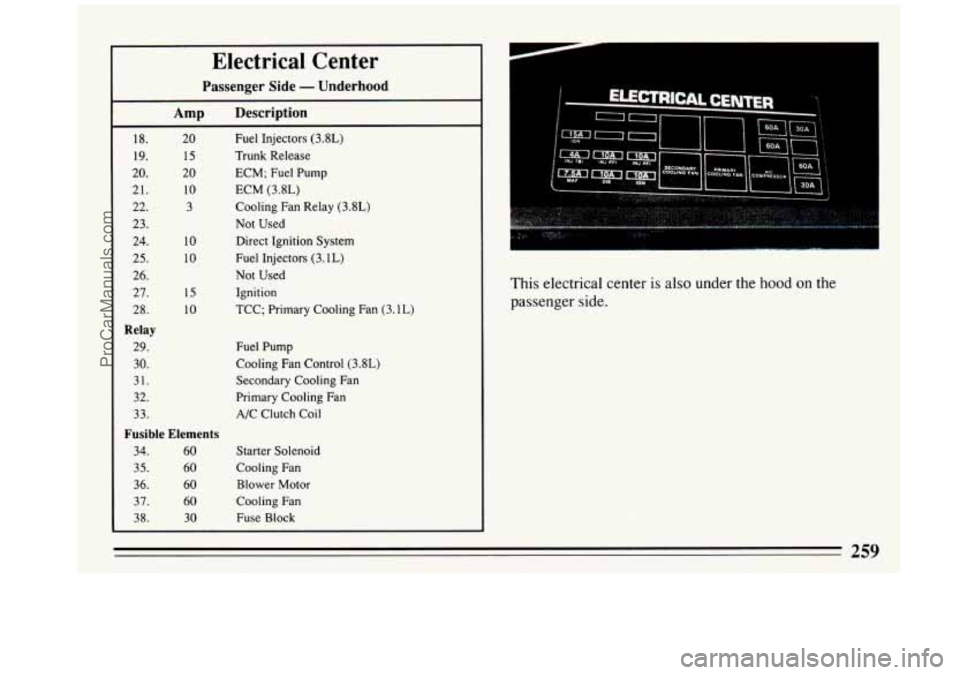
Electrical Center
Passenger Side - Underhood
Amp Description
18. 20 Fuel Injectors (3.8L)
19.
15 Trunk Release
20. 20 ECM; Fuel Pump
21. 10 ECM (3.8L)
22. 3
Cooling Fan Relay (3.8L)
23. Not Used
24. Direct Ignition System
25. Fuel Injectors (3.1 L)
26. Not Used
27. Ignition
28. TCC; Primary Cooling Fan (3.1 L)
Relay
29.
30.
31.
32.
33.
Fusible Elements
34. 60 Starter Solenoid
35. 60 Cooling Fan
37. 60 Cooling Fan
36. 60 Blower Motor
38. 30 Fuse Block Fuel Pump
Cooling Fan Control
(3.8L)
Secondary Cooling Fan
Primary Cooling Fan
A/C Clutch Coil
This electrical center is also under the hood on the
passenger side.
259
ProCarManuals.com
Page 279 of 308
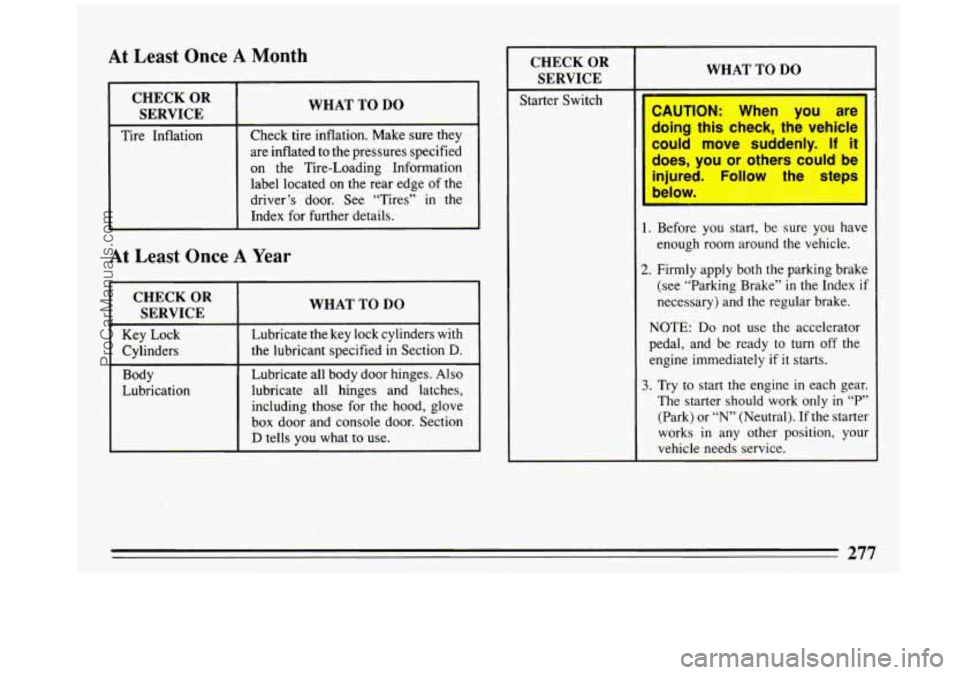
At Least Once A Month
CHECK OR
SERVICE
Tire Inflation
WHAT TO DO
Check tire inflation. Make sure they
are inflated
to the pressures specified
on the Tire-Loading Information
label located on the rear edge of
the
driver’s door. See “Tires” in the
Index for further details.
c!%&lkY 1 --“-+
Starter Switch
At Least Once A Year
I CHECKOR
SERVICE
I WHAT TO DO
Key Lock
the lubricant specified in Section
D. Cylinders Lubricate the
key lock cylinders with
Body
Lubrication Lubricate all
body door hinges.
Also
lubricate all hinges and latches,
including those for the hood, glove
box door and console door. Section
D tells you what to use.
1. Before you start, be sure you have
enough room around the vehicle.
2. Firmly apply both the parking brake
(see “Parking Brake”
in the Index if
necessary) and the regular brake.
NOTE:
Do not use the accelerator
pedal, and
be ready to turn off the
engine immediately if
it starts.
3. Try to start the engine in each gear.
The starter should work only in “P”
(Park) or
“N” (Neutral). If the starter
works
in any other position, your
vehicle needs service.
277
ProCarManuals.com
Page 280 of 308
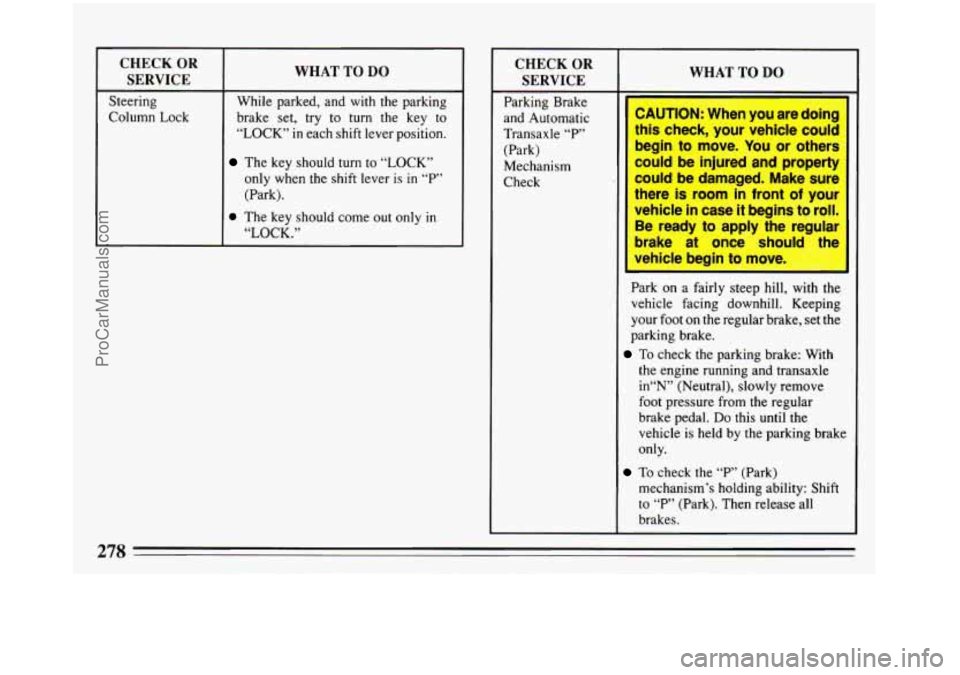
CHECK OR
Steering
Column Lock
WHAT TO DO
While parked, and with the parking
brake set, try to
turn the key to
“LOCK”
in each shift lever position.
The key should turn to “LOCK”
only when the shift lever is in “P’
(Park).
“LOCK.”
0 The key should come out only in
-t
CHECK OR
SERVICE
Parking Brake
and Automatic
Transaxle
“P’
(Park)
Mechanism
Check
WHAT TO DO
.r
CAUTION: When you are doing
s check, your vehicle could
begin to move. You or others
-Ad be injured and property
Jld be damaged. Make sure
rllzre
is room in front of your
U4icle
in case it begins to roll.
__ ready to apply the rnnular
brake at once shoul the
vehicle begin
to mc 5.
Park on a fairly steep hill, with the
vehicle facing downhill. Keeping
your foot on the regular brake, set
the
parking brake.
To check the parking brake: With
the engine running and transaxle
in“N” (Neutral), slowly remove
foot pressure from
the regular
brake pedal.
Do this until the
vehicle is held by the parking brake
only.
To check the “P,’ (Park)
mechanism’s holding ability: Shift
to
“P” (Park). Then release all
brakes.
278
ProCarManuals.com
Page 282 of 308
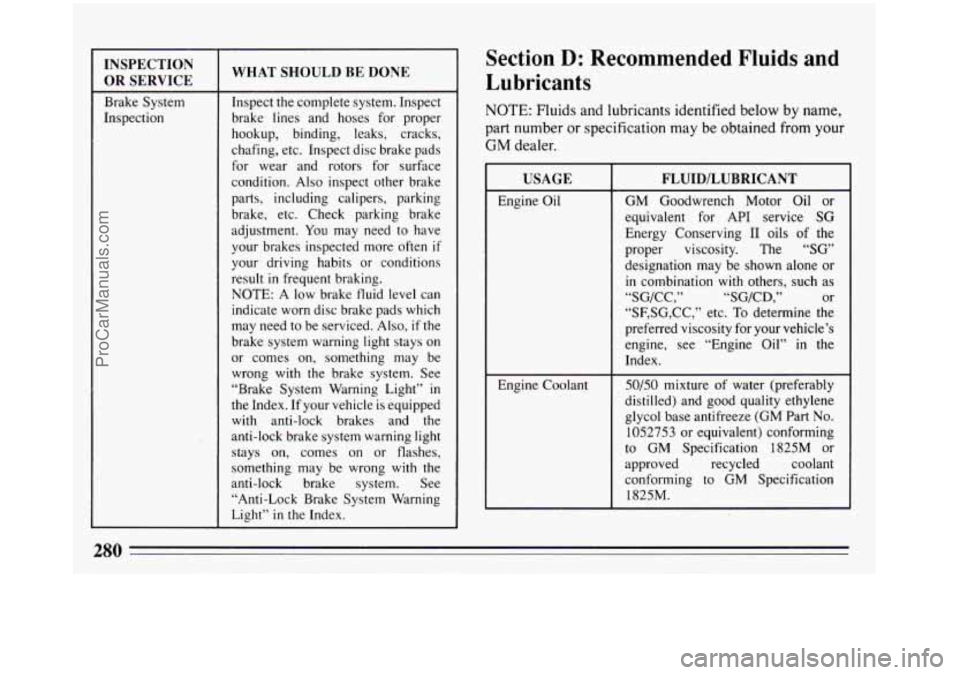
INSPECTION
OR SERVICE
Brake System
Inspection
WHAT SHOULD BE DONE
Inspect the complete system. Inspect
brake lines and hoses for proper
hookup, binding, leaks, cracks,
chafing, etc. Inspect disc brake pads
for wear and rotors for surface
condition. Also inspect other brake
parts, including calipers, parking
brake, etc. Check parking brake
adjustment. You may need to have
your brakes inspected more often
if
your driving habits or conditions
result
in frequent braking.
NOTE:
A low brake fluid level can
indicate worn disc brake pads which
may need to be serviced. Also, if the
brake system warning light stays on
or comes on, something may be
wrong with the brake system. See
“Brake System Warning Light”
in
the Index. If your vehicle is equipped
with anti-lock brakes and the
anti-lock brake system warning light
stays on, comes on or flashes,
something may be wrong with the
anti-lock brake system. See
“Anti-Lock Brake System Warning
Light”
in the Index.
Section D: Recommended Fluids and
Lubricants
NOTE: Fluids and lubricants identified below by name,
part number or specification may be obtained from your
GM dealer.
USAGE
Engine Oil
Engine Coolant
FLUID/LUBRICANT
GM Goodwrench Motor Oil or
equivalent for API service SG
Energy Conserving I1 oils of the
proper viscosity. The “SG”
designation may be shown alone or
in combination with others, such as
“SG/CC,” “SG/CD,”
or
“SF,SG,CC,” etc. To determine the
preferred viscosity for your vehicle’s
engine, see “Engine Oil” in the
Index.
50/50 mixture of water (preferably
distilled) and good quality ethylene
glycol base antifreeze (GM Part
No.
1052753 or equivalent) conforming
to
GM Specification 1825111 or
approved recycled coolant
conforming to
GM Specification
1825M.
ProCarManuals.com
Page 283 of 308
~~ - -
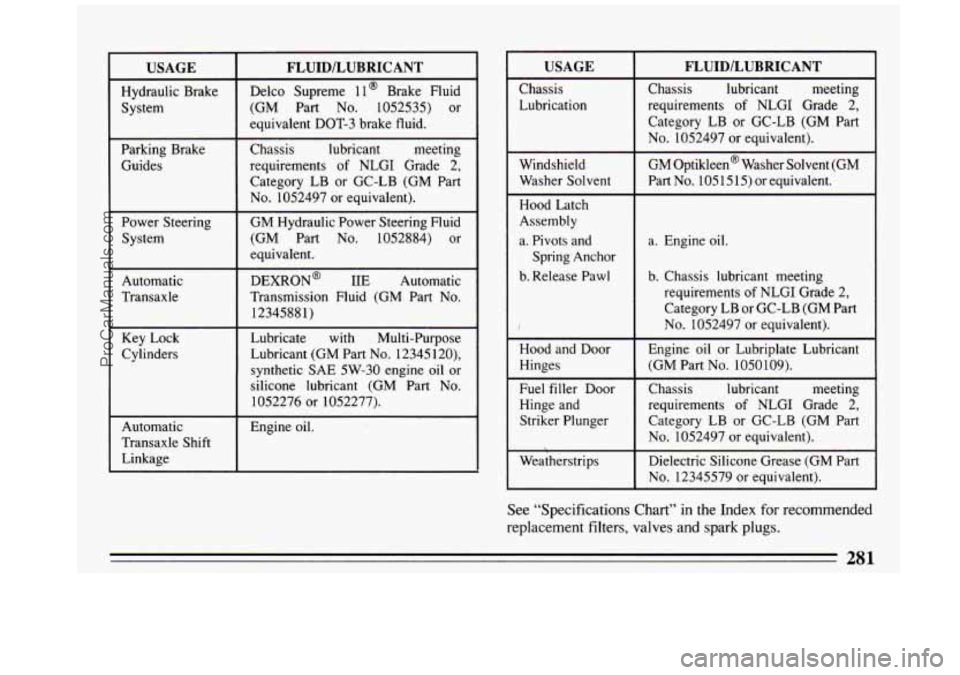
USAGE
FLUID/LUBRICANT
Hydraulic
Brake
(GM Part No. 1052535) or
System Delco Supreme 1 l@ Brake Fluid
equivalent DOT-3 brake fluid.
Parking Brake
Category LB or GC-LB (GM Part
requirements
of NLGI Grade
2,
Guides Chassis lubricant meeting
No.
1052497
or equivalent).
Power Steering
Transmission Fluid (GM Part No.
Transaxle DEXRON@
IIE Automatic
Automatic (GM Part
No. 1052884) or
System GM
Hydraulic Power Steering Fluid
equivalent.
1234588 1)
Key Lock Lubricate with Multi-Purpose
Cylinders Lubricant (GM
Part No. 12345120),
synthetic SAE 5W-30 engine
oil or
silicone lubricant (GM Part No.
1052276 or 1052277).
Automatic
Transaxle Shift Engine oil.
Linkage
USAGE
Chassis
Lubrication
Windshield
Washer Solvent
Hood Latch
Assembly
a. Pivots and
b. Release Pawl
Spring
Anchor
i
Hood and Door
Hinges
Fuel
filler Door
Hinge and
Striker Plunger
Weatherstrips
FLUIDlLUBRICANT
Chassis lubricant meeting
requirements
of NLGI Grade 2,
Category LB or GC-LB (GM Part
No. 1052497 or equivalent).
GM Optikleen@ Washer Solvent (GM
Part No.
105 15 15) or equivalent.
a. Engine oil.
b. Chassis lubricant meeting
requirements
of NLGI Grade 2,
Category LB or GC-LB (GM Part
No. 1052497 or equivalent).
Engine
oil or Lubriplate Lubricant
(GM Part No. 1050109).
Chassis lubricant meeting
requirements
of NLGI Grade 2,
Category LB
or GC-LB (GM Part
No. 1052497 or equivalent).
Dielectric Silicone Grease (GM Part
No. 12345579 or equivalent).
See “Specifications Chart” in the Index for recommended
replacement filters, valves and spark plugs.
301
ProCarManuals.com