change time BUICK REGAL 1993 Owners Manual
[x] Cancel search | Manufacturer: BUICK, Model Year: 1993, Model line: REGAL, Model: BUICK REGAL 1993Pages: 308, PDF Size: 16.35 MB
Page 4 of 308
GENERAL MOTORS, GM and the GM Emblem,
BUICK, and the BUICK Emblem are registered
trademarks of General Motors Corporation.
This manual includes the latest information at
the time it
was printed. We reserve the right to make changes in the
product after that time without further notice.
For vehicles
first sold in Canada, substitute the name “General Motors
of Canada Limited” for Buick Motor Division whenever it
appears in this manual.
VOLUNTARY TECHNICIAN WE SUPPORT
CLRIIFICATION THROUGH
Naraonal InsImle for AUTOMOTIVE SERVICE EXCELLENCE
We support voluntary
technician certification.
For Canadian Owners Who Prefer a
French Language Manual:
Aux prooriktaires canadiens: Vous pouvez vous procurer
un exemplaire de ce guide en franc;ais chez votre
Please keep this manual in your Buick,
SO it will be there if concessionaire ou 5 DGN Marketing Services Ltd., 1500
YOU ever need it when you’re on the road. If YOU Sell the Bonhill Rd., Mississauga, Ontario L5T 1~7.
vehicle, please leave this manual in it so the new owner can
use
it.
2
ProCarManuals.com
Page 65 of 308
Operation
The driver’s door will unlock automatically when
UNLOCK is pressed. If UNLOCK, is pressed twice
quickly,
all doors will unlock. The interior lights will
also come on for approximately
40 seconds and go off
when the ignition is turned on.
All doors will lock when
DOOR is pressed.
The trunk
will unlock when the opened trunk symbol is
pressed, but only
when the transaxle is in PARK.
Matching Transmitter(s) To Your Vehicle
Each key chain transmitter is coded to prevent another
transmitter from unlocking your vehicle. If a transmitter
is
lost or stolen, a replacement can be purchased through
your dealer. Remember to bring the remaining
transmitter with you when
you go to your dealer. When
the dealer matches
the replacement transmitter to your
vehicle, the remaining transmitter must also be matched.
Once the
new transmitter is coded, the lost transmitter
will
not unlock your vehicle.
You can match a transmitter to as many different
vehicles as you own, provided they are equipped with
exactly the same model system
. (General Motors offers
several different models
of these systems on their vehicles.) Each vehicle can
have only two transmitters
matched to
it.
See your dealer to match transmitters to another vehicle.
Battery Replacement
Under normal use, the batteries in your key chain
transmitter should last about two years.
You can tell the batteries are weak if the transmitter
won’t work at the normal range
in any location. If you
have to get close to your vehicle before the transmitter
works, it’s probably time to change the batteries.
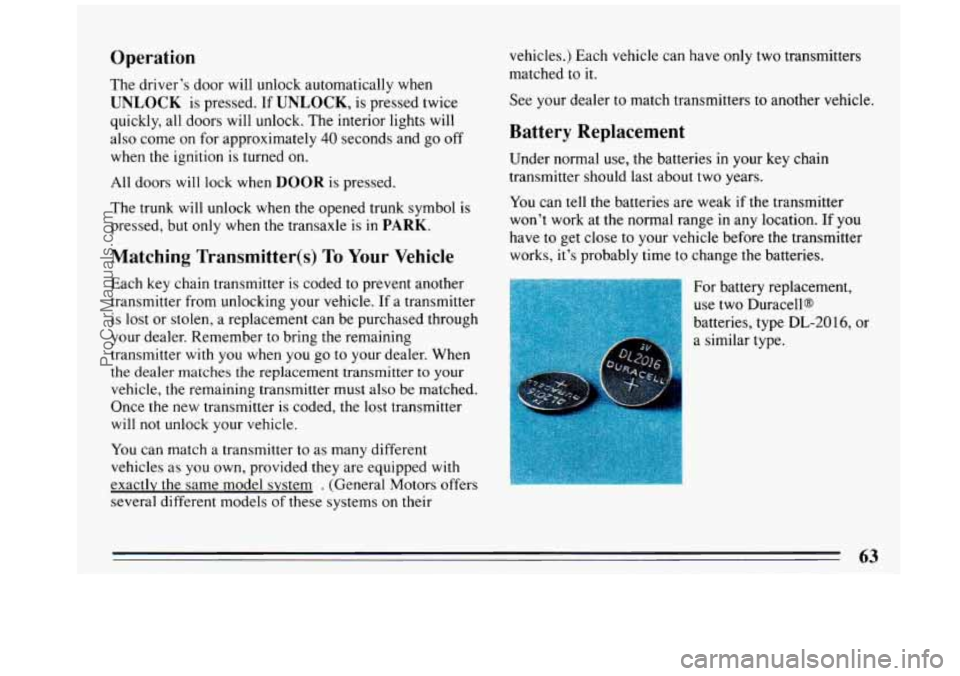
For battery replacement,
use two DuracellB
batteries, type
DL-2016, or
a similar type.
63
ProCarManuals.com
Page 70 of 308
To start your 3.1 Liter (Code T) engine:
1. Don’t push
the accelerator pedal before starting your
engine. In some other vehicles you might need to do
this, but because of your vehicle’s computer systems,
you don’t.
starts, let
go of the key. The idle speed will go down
as your engine gets warm.
2. Turn your ignition key to “Start.” When the engine
omng your Key In “Start” for longer tna
seconds at a time will cause your battery to
t
drained much sooner. And the excessive hear
3. If your engine won’t start (or starts but then stops), it
could be flooded with too much gasoline. Try
pushing your accelerator pedal all the
way to the
floor and holding it there
as you hold the key in
“Start” for about three seconds. If the vehicle starts
briefly but then stops again, do
the same thing, but
this time keep the pedal down for five
or six seconds.
This clears the extra gasoline from the engine.
[ electronics in your vehicle. If you add electrical
parts or accessories, you could change the way
the fuel injection system operates. Before adding
electrical equipment, check with your dealer.
1-
you don’t, your engine might not perforn
properly.
If you ever have to have your vehicle towed, see
the part
of this Manual that tells how to do it
without damaging your vehicle. See “Towing
Your Vehicle” in the Index.
4
-$,.-q*+&< ..,-. >%--:* ..“I)“:.. , .--..:<::.,: m.v;,,, ,‘‘Tmy, ““,u, .; ::x,.* ..,, L, W“ . , ~’‘&&‘, ’~=:.*>:** . .. l\l_ $p;Y-.T@ b
68
ProCarManuals.com
Page 71 of 308
To start your 3.8 Liter (Code L) engine:
1. Don’t push the accelerator pedal before starting your
engine. In some other vehicles you might need
to do
this, but because of your vehicle’s computer systems,
you don’t.
2. Turn your ignition key to “Start.” When the engine
starts,
let go of the key, The idle speed will go down
as your engine gets warm.
3. If it doesn’t start right away, hold your key in “Start”
for about three seconds at
a time until your engine
starts. Wait about
15 seconds between each try to
help avoid draining your battery.
Holding your key in “Start” for longer than 15
seconds at a time will cause your battery to be
drained much sooner.
And the excessive heat
can damage your starter motor.
4. If your engine still won’t start (or starts but then
stops), it could be flooded with too much gasoline.
Try pushing your accelerator pedal all the way to the
floor and holding
it there as you hold the key in
“Start” for about three seconds.
If the vehicle starts
briefly but then stops again,
do the same thing, but
this time keep the pedal down for five or six seconds.
This clears the extra gasoline from the engine. After
waiting about
15 seconds, repeat the normal starting
procedure.
electronics in your vehicle. If you add electric
parts or accessories, you could change
the way
the fuel injection system operates. Before adding
electrical equipment, check with your dealer
‘I.
you don’t, your engine might not perform
properly.
If you ever
h h hicle towea,
the part
of this Manual that tells how to do it
without damaging your vehicle. See “To
Your Vehicle” in the Index, :, ’ .
69
ProCarManuals.com
Page 84 of 308
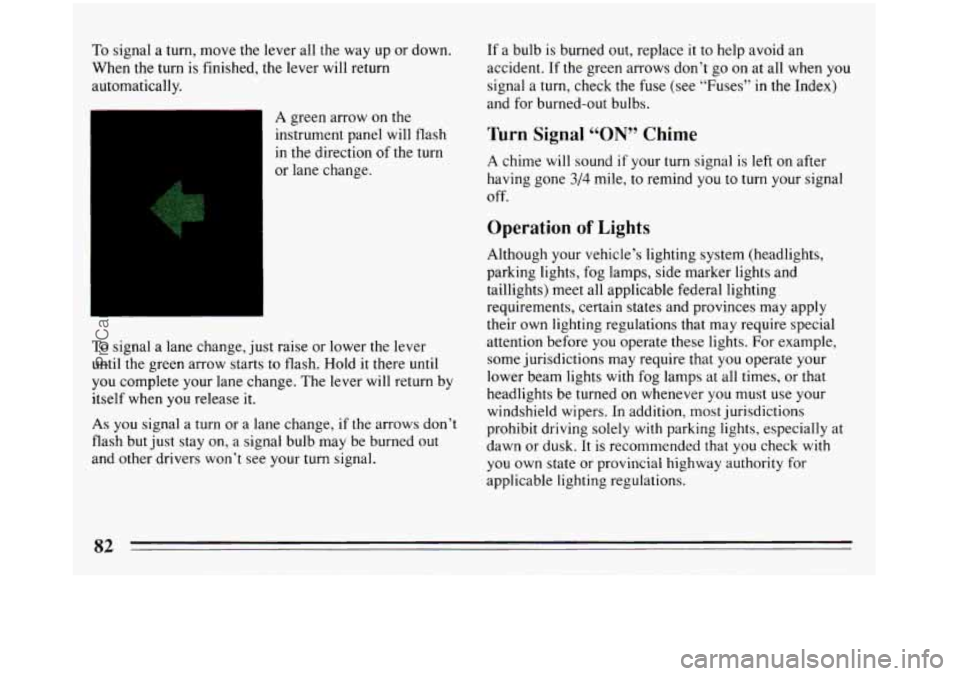
To signal a turn, move the lever all the way up or down.
When the turn
is finished, the lever will return
automatically.
A green arrow on the
instrument panel will flash in the direction of the turn
or lane change.
To signal a lane change, just raise or lower the lever
until the green arrow starts to flash. Hold it there
until
you complete your lane change. The lever will return by
itself when
you release it.
As you signal a turn or a lane change, if the arrows don’t
flash but just stay
on, a signal bulb may be burned out
and other drivers won’t see your
turn signal. If
a bulb
is burned out, replace it to help avoid an
accident. If the green arrows don’t
go on at all when you
signal a turn, check the fuse (see “Fuses” in the Index)
and for burned-out bulbs.
Turn Signal “ON” Chime
A chime will sound if your turn signal is left on after
having gone
3/4 mile, to remind you to turn your signal
off.
Operation of Lights
Although your vehicle’s lighting system (headlights,
parking lights, fog lamps, side marker lights and
taillights) meet
all applicable federal lighting
requirements, certain states and provinces may apply
their own lighting regulations that may require special
attention before you operate these lights. For example,
some jurisdictions may require that you operate your
lower beam lights with fog lamps at all times, or that
headlights be turned on whenever you must use your
windshield wipers. In addition,
most jurisdictions
prohibit driving solely with parking lights, especially at
dawn or dusk. It is recommended that you check with
you own state or provincial highway authority for
applicable lighting regulations.
82
-
ProCarManuals.com
Page 94 of 308
Headlight “On” Warning
If the light switch is left on you’ll hear a warning tone
when you turn the ignition
off and open the driver’s
door.
Fog Eights (GS Only Option)
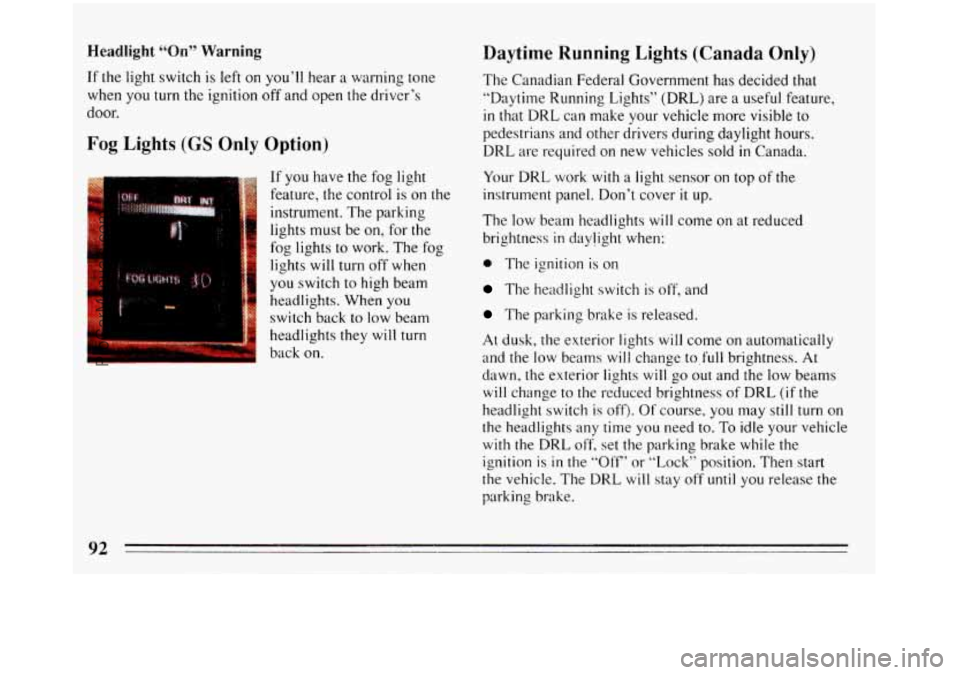
If you have the fog light
feature, the control is on the
instrument. The parking
lights must be on, for the
fog lights to work. The fog
lights will turn off
when
you switch to high beam
headlights. When you
switch back to
low beam
headlights they
will turn
back on.
Daytime Running Lights (Canada Only)
The Canadian Federal Government has decided that
“Daytime Running Lights”
(DRL) are a useful feature,
in that DRL can make your vehicle more visible to
pedestrians and other drivers during daylight hours.
DRL are required on new vehicles sold
in Canada.
Your DRL work
with a light sensor on top of the
instrument panel. Don’t cover
it up.
The low beam headlights will come on at reduced
brightness
in daylight when:
0 The ignition is on
The headlight switch is off, and
The parking brake is released.
At dusk, the exterior lights will come on automatically
and the low beams will change to.full brightness.
At
dawn, the exterior lights will go out and the low beams
will change to the reduced brightness of DRL (if the
headlight switch
is off>. Of course, you may still turn on
the headlights any time you need to. To idle your vehicle
with the DRL off. set the parking brake while the
ignition
is in the “Off“ or “l,ock” position. Then start
the vehicle. The DRL
will stay off until you release the
parking brake.
92
ProCarManuals.com
Page 136 of 308
time. A green arrow means you may drive in that lane.
Look for the signs posted to warn drivers what hours
and days these systems are in
effect.
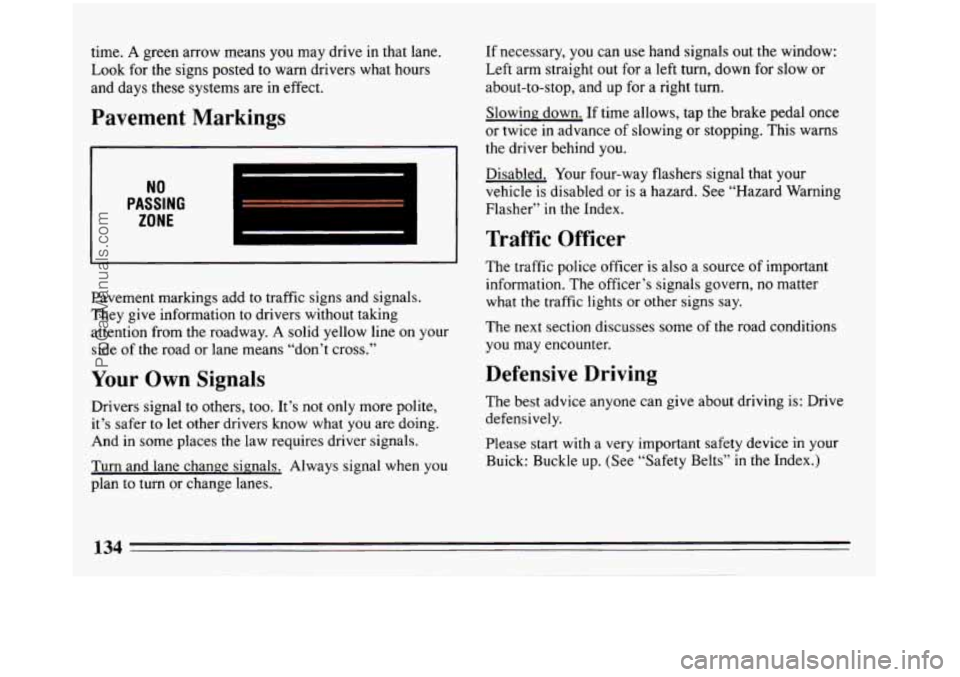
Pavement Markings
NO
PASSING
ZONE
Pavement markings add to traffic signs and signals.
They give information to drivers without taking
attention from the roadway.
A solid yellow line on your
side of the road or lane means “don’t cross.”
Your Own Signals
Drivers signal to others, too. It’s not only more polite,
it’s safer
to let other drivers know what you are doing.
And in some places the law requires driver signals.
Turn and lane change signals. Always signal when
you
plan to turn or change lanes. If
necessary,
you can use hand signals out the window:
Left arm straight out for a left turn, down for slow or
about-to-stop, and up for
a right turn.
Slowing down. If time allows, tap the brake pedal once
or twice in advance of slowing or stopping. This warns
the driver behind you.
Disabled. Your four-way flashers signal that your
vehicle is disabled or
is a hazard. See “Hazard Warning
Flasher”
in the Index.
Traffic Officer
The traffic police officer is also a source of important
information. The officer’s signals govern,
no matter
what
the traffic lights or other signs say.
The next section discusses some of the road conditions
you may encounter.
Defensive Driving
The best advice anyone can give about driving is: Drive
defensively.
Please start with a very important safety device in your
Buick: Buckle up. (See “Safety Belts” in
the Index.)
134
-
ProCarManuals.com
Page 144 of 308
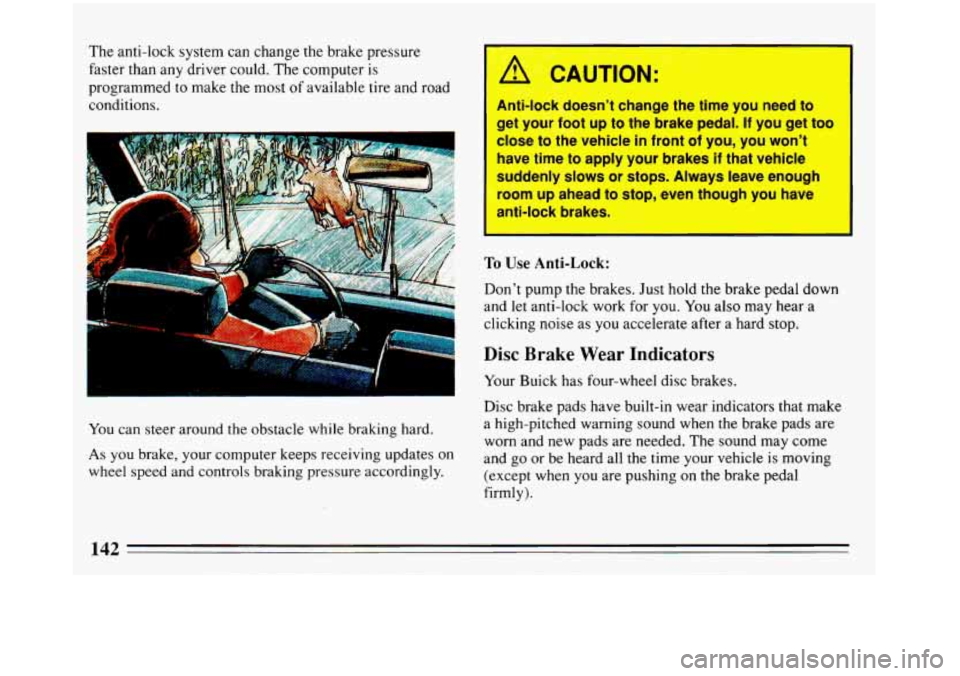
The anti-lock system can change the brake pressure
faster than any driver could. The computer is
programmed to make the most
of available tire and road
conditions.
... ..
You can steer around the obstacle while braking hard.
As you brake, your computer keeps receiving updates on
wheel speed and controls braking pressure accordingly.
/A CAUTION:
Anti-lock doesn't change the time you need to
get your foot
up to the brake pedal. If you get too
close to the vehicle in front of you, you won't
have time to apply your
brakes if that vehicle
cvddenly
slows or stops. Always leave enough
luom up ahead to stop, even though you have
anti-lock brakes.
To Use Anti-Lock:
Don't pump the brakes. Just hold the brake pedal down
and
let anti-lock work for you. You also may hear a
clicking noise as
you accelerate after a hard stop.
Disc Brake Wear Indicators
Your Buick has four-wheel disc brakes.
Disc brake pads have built-in wear indicators that make
a high-pitched warning sound when
the brake pads are
worn and new pads are needed.
The sound may come
and
go or be heard all the time your vehicle is moving
(except when you are pushing on the brake pedal
firmly).
142
--
ProCarManuals.com
Page 150 of 308
0
0
0
0
0
you need only slow down and drop back again and
wait
for another opportunity.
If other cars are lined up to pass a slow vehicle, wait
your turn. But take care that someone isn’t trying to
pass you as you pull out to pass the slow vehicle.
Remember to glance over your shoulder and check
the blind spot.
Check your mirrors, glance over your shoulder, and
start your left lane change signal before moving out
of the right lane to pass. When you are far enough
ahead of the passed vehicle to see its front
in your
inside mirror, activate your right lane change signal
and move back into the right lane. (Remember that
your right outside
mirror is convex. The vehicle you
just passed may seem to be farther away from
you
than it really is.)
Try not to pass more than one vehicle at a time
on
two-lane roads. Reconsider before passing the next
vehicle.
Don’t overtake a slowly moving vehicle too rapidly.
Even though
the brake lights are not flashing, it may
be slowing down or starting to turn.
If you’re being passed, make it easy for the
following driver to get ahead of you. Perhaps
you
can ease a little to the right.
Loss of Control
Let’s review what driving experts say about what
happens when the three control systems (brakes, steering
and acceleration) don’t have enough friction where the
tires meet the road to do what the driver has asked.
In any emergency, don’t give up. Keep trying
to steer
and constantly seek an escape route or area of less
danger.
Skidding
In a skid, a driver can lose control of the vehicle.
Defensive drivers avoid most skids by taking reasonable
care suited to existing conditions, and by not
“overdriving” those conditions. But skids are always
possible.
The three types
of skids correspond to your Buick’s
three control system.s. In
the braking skid your wheels
aren’t rolling. In the steering or cornering skid,
too
much speed or steeri.ng in a curve causes tires to slip and
lose cornering force.
And in the acceleration skid too
much throttle causes the driving wheels to spin.
A cornering skid and an acceleration skid are best
handied by easing your foot off the accelerator pedal.
If your vehicle starts
to slide (as when you turn a corner
on a wet, snow- or ice-covered road), ease your
foot off
148
ProCarManuals.com
Page 161 of 308
Driving a Long Distance
Although most long trips today are made on freeways,
there are still many made on regular highways.
Long-distance driving on freeways and regular
highways is the same in some ways. The trip has to be
planned and the vehicle prepared,
you drive at
higher-than-city speeds, and there are longer turns
behind the wheel. You’ll enjoy your trip more if you and
your vehicle are in good shape. Here are some tips for a
successful long trip.
Before Leaving on a Long Trip
0
0
0
0
0
0
Make sure you’re ready. Try to be well rested. If you
must start when you’re not fresh -- such as after a day’s
work
-- don’t plan to make too many miles that first part
of the journey. Wear comfortable clothing and shoes you
can easily drive
in.
Is your vehicle ready for a long trip? If you keep it
serviced and maintained, it’s ready to go.
If it needs
service, have it done before starting out. Of course,
you’ll find experienced and able service experts in
Buick dealerships all across North America. They’ll be
ready and willing to help
if you need it.
Here are some things you can check before a trip:
0
Windshield Washer Fluid: Is the reservoir full? Are
all windows clean inside and outside?
Wiper Blades: Are they in good shape?
Fuel, Eng;ine Oil, Other Fluids: Have you checked
all levels?
Lights: Are they all working? Are the lenses clean?
- Tires: They are vitally important to a safe,
trouble-free trip.
Is the tread good enough for
long-distance driving? Are the tires all inflated to the
recommended pressure?
Weather Forecasts: What’s the weather outlook
along your route? Should you delay your trip a short
time to avoid a major storm system?
Maps:
Do you have up-to-date maps?
On the Road
Unless you are the only driver, it is good to share the
driving task with others. Limit turns behind
the wheel to
about
100 miles (160 km) or two hours at a sitting.
Then, either change drivers or stop for some refreshment
like coffee, tea or soft drinks and some limbering up.
But do stop and move around. Eat lightly along the way.
Heavier meals tend
to make some people sleepy.
159
ProCarManuals.com