brake light BUICK REGAL 1994 User Guide
[x] Cancel search | Manufacturer: BUICK, Model Year: 1994, Model line: REGAL, Model: BUICK REGAL 1994Pages: 308, PDF Size: 15.78 MB
Page 169 of 308
monoxide (CO) from your exhaust can get into your
vehicle (see “Carbon Monoxide”
in the Index). Dirt
and water can,
too.
The bumpers on your vehicle are not intended for
hitches. Do not attach rental hitches or other
bumper-type hitches to them. Use only a
frame-mounted hitch that does not attach to the
bumper.
Safety Chains
You should always attach chains between your vehicle
and your trailer. Cross the safety chains under the
tongue of the trailer
so that the tongue will not drop to
the road
if it becomes separated from the hitch.
Instructions about safety chains may be provided by the
hitch manufacturer or by the trailer manufacturer.
Follow the manufacturer’s recommendation for
attaching safety chains. Always leave just enough slack
so you can turn with your rig. And, never allow safety
chains to drag
on the ground.
Trailer Brakes
If your trailer weighs more than 1,000 pounds (450 kg)
loaded, then
it needs its own brakes -- and they must be
adequate. Be sure to read and follow the instructions for
the trailer brakes
so you’ll be able to install, adjust and maintain
them properly. Because you have anti-lock
brakes, do not try to tap into your vehicle’s brake
system. If you do, both brake systems won’t work well,
or at all.
Driving with a Trailer
Towing a trailer requires a certain amount of experience.
Before setting out for the open road, you’ll want to get
to know your rig. Acquaint yourself with the feel of
handling and braking with the added weight
of the
trailer. And always keep
in mind that the vehicle you are
driving
is now a good deal longer and not nearly so
responsive as your vehicle is by itself.
Before you start, check the trailer hitch and platform,
,
safety chains, electrical connector, lights, tires and
mirror adjustment. If
the trailer has electric brakes, start
your vehicle and trailer moving and then apply the
trailer brake controller by hand to be sure the brakes are
working. This lets you check your electrical connection
at the same time.
During your trip, check occasionally to be sure that the
load is secure, and that the lights and any trailer brakes
are still working.
167
ProCarManuals.com
Page 170 of 308
Following Distance
Stay at least twice as far behind the vehicle ahead as you
would when driving your vehicle without a trailer. This
can help you avoid situations that require heavy braking
and sudden turns.
Passing
You’ll need more passing distance up ahead when
you’re towing a trailer. And, because you’re a good deal
longer, you’ll need
to go much farther beyond the
passed vehicle before
you can return to your lane.
Backing Up
Hold the bottom of the steering wheel with one hand.
Then,
to move the trailer to the left, just move that hand
to the left.
To move the trailer to the right, move your
hand
to the right. Always back up slowly and, if
possible, have someone guide you.
Making Turns
When you’re turning with a trailer, make wider turns
than normal.
Do this so your trailer won’t strike soft
shoulders, curbs, road signs, trees, or other objects.
Avoid jerky or sudden maneuvers. Signal well
in
advance.
Turn Signals When Towing a Trailer
When you tow a trailer, your vehicle has to have a
different turn signal flasher and extra wiring. The green
arrows
on your instrument panel will flash whenever
you signal a turn or lane change. Properly hooked up,
the trailer lights will also flash, telling other drivers
you’re about to turn, change lanes or stop.
When towing a trailer,
the green arrows on your
instrument panel will flash for turns even
if the bulbs on
the trailer are burned out. Thus, you may think drivers
behind you are seeing your signal when they are
not. It’s
important to check occasionally to be sure the trailer
bulbs are still working.
Driving On Grades
Reduce speed and shift to a lower gear before you start
down a long or steep downgrade. If you don’t shift
down,
you might have to use your brakes so much that
they would get hot and no longer work
well.
On a long uphill grade, shift down and reduce your
speed to around
45 mph (70 km/h) to reduce the
possibility
of engine and transaxle overheating.
If you are towing a trailer that weighs more than
1,000
pounds (450 kg), you may prefer to drive in “D” instead
of Overdrive (or, as you need to, a lower gear).
168
ProCarManuals.com
Page 176 of 308
I NOTICE:
Ignoring these steps could result in costly
damage
to your vehicle that wouldn’t be covered
by your warranty. Trying to start your Buick by
pushing or pulling it won’t work, and it could
damage your vehicle.
To Jump Start Your Buick:
1. Check the other vehicle. It must have a 12-volt
battery
with a negative ground system.
NOTICE:
If the other system isn’t a 12-volt system with a
negative ground, both vehicles can be damaged.
2. Get the vehicles close enough so the jumper cables
can reach, but be sure the vehicles aren’t touching
each other.
If they are, it could cause a ground
connection you don’t want.
You wouldn’t be able to
start your Buick, and the bad grounding could
damage the electrical systems. You
could be injured
if the vehicles roll. Set the
parking brake firmly on each vehicle. Put an
automatic transaxle
in “P” (Park) or a manual
transaxle
in “N” (Neutral).
3. Turn off the ignition on both vehicles. Turn off all
lights that aren’t needed, and radios. This will avoid
sparks and help save both batteries. And
it could
save your radio!
1 NOTICE:
If you leave your radio on, it could be badly
damaged. The repairs wouldn’t be covered by
your warranty.
ProCarManuals.com
Page 230 of 308
Brakes
Brake Master Cylinder
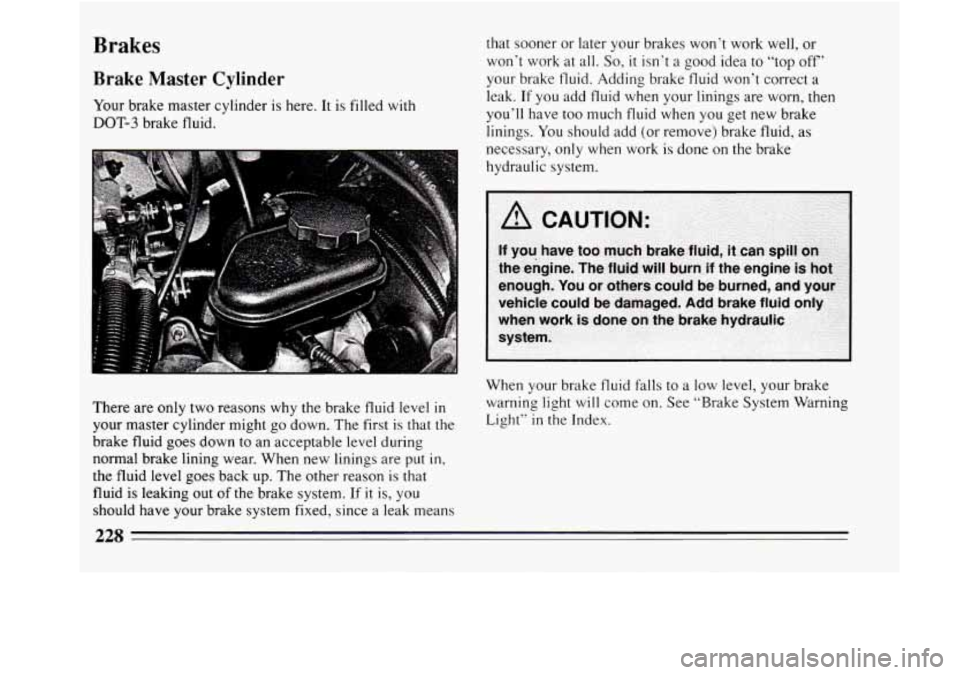
Your brake master cylinder is here. It is filled with
DOT-3 brake fluid. that
sooner or later your brakes won’t work well, or
won’t work at all.
So, it isn’t a good idea to “top off’
your brake fluid. Adding brake fluid won’t correct a
leak. If you add fluid when your linings are worn, then
you’ll have too much fluid when you get new brake
linings. You should add (or remove) brake fluid, as
necessary, only when work is done on the brake
hydraulic system.
When your brake fluid falls to a low level, your brake
There are only two reasons why
the brake fluid level in warning light will come on. See “Brake System Warning
your master cylinder might
go down. The first is that the Light” in the Index.
brake fluid goes down to an acceptable level during
normal brake lining wear. When new linings are
put in,
the fluid level goes back up. The other reason is that
fluid is leaking out
of the brake system. If it is, you
should have your brake system fixed, since a leak means
228
ProCarManuals.com
Page 232 of 308
Some driving conditions or climates may cause a brake
squeal when the brakes are first applied or
lightly
applied. This does not mean something is wrong with
your brakes.
Brake linings should always be replaced as complete
axle sets.
Brake Pedal Travel
See your dealer if the brake pedal does not return to
normal height, or if there is a rapid increase in pedal
travel. This could
be a sign of brake trouble.
Brake Adjustment
Every time you make a moderate brake stop, your disc
brakes adjust for wear. If you rarely make a moderate .or
heavier siop, then your brakes might not adjust
correctly. If you drive
in that way, then -- very carefully
-- make a few moderate brake stops about every 1000
miles (1600 km), so your brakes will adjust properly.
Keplacing Brake System Parts
The braking system on a modern vehicle is complex. Its
many parts have to be
of top quality and work well
together
if the vehicle is to have really good braking. Vehicles we
design and test have top-quality
GM brake
parts
in them, as your Buick does when it is new. When
you replace parts of your braking system
-- for example,
when your brake linings wear down and you have
to
have new ones put in -- be sure you get new genuine
GM replacement parts. If you don’t, your brakes may no
longer work properly. For example,
if someone puts in
brake linings that are wrong for your vehicle, the
balance between your front and rear brakes can change,
for the worse. The braking performance you’ve come
to
expect can change in many other ways if someone puts
in the wrong replacement brake parts.
Battery
Every new Buick has a Delco Freedom@ battery. You
never have to add water to one of these. When it’s time
for a new battery, we recommend a Delco Freedom@
battery. Get one that has the catalog number shown on
the original battery’s label.
Vehicle Storage
If you’re not going to drive your vehicle for 25 days or
more, take off the black, negative
(-) cable from the
battery. This
will help keep your battery from running
down.
230
ProCarManuals.com
Page 244 of 308
Wheel Replacement
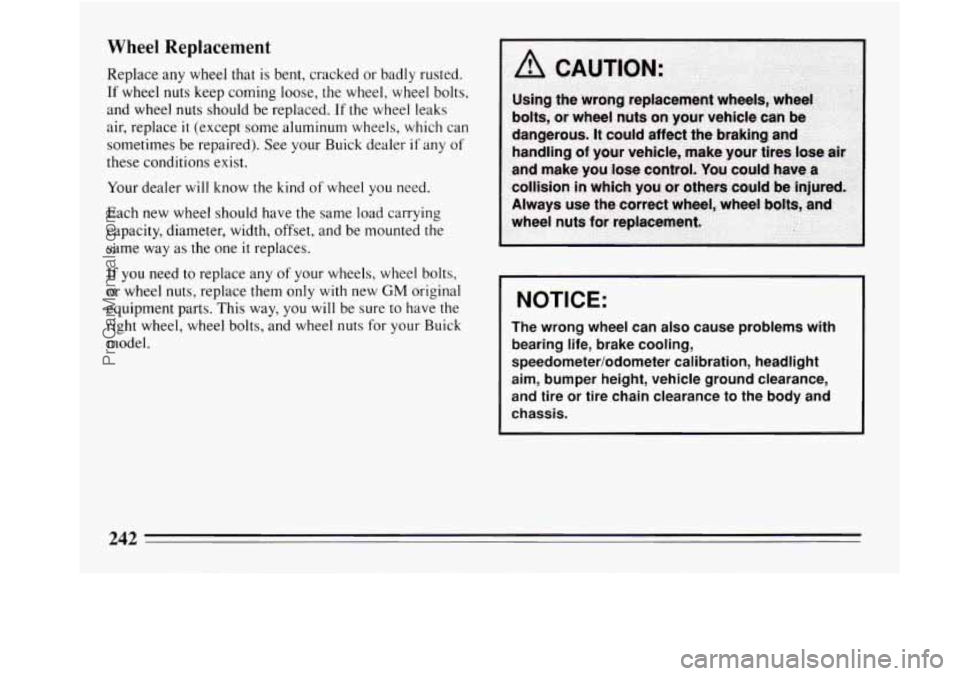
Replace any wheel that is bent, cracked or badly rusted.
If wheel nuts keep coming loose, the wheel, wheel bolts,
and wheel nuts should be replaced. If the wheel leaks
air, replace
it (except some aluminum wheels, which can
sometimes be repaired). See your Buick dealer
if any of
these conditions exist.
Your dealer will know the kind of wheel you need.
Each new wheel should have the same load carrying
capacity, diameter, width, offset, and be mounted the
same way as the one it replaces.
If you need to replace any of your wheels, wheel bolts,
or wheel nuts, replace them only with new
GM original
equipment parts. This way, you will be sure
to have the
right wheel, wheel bolts, and wheel nuts for your Buick
model. NOTICE:
The wrong wheel can also cause problems with
bearing life, brake cooling,
speedometer/odometer calibration, headlight
aim, bumper height, vehicle ground clearance,
and tire or tire chain clearance to the body and
chassis.
242
ProCarManuals.com
Page 257 of 308
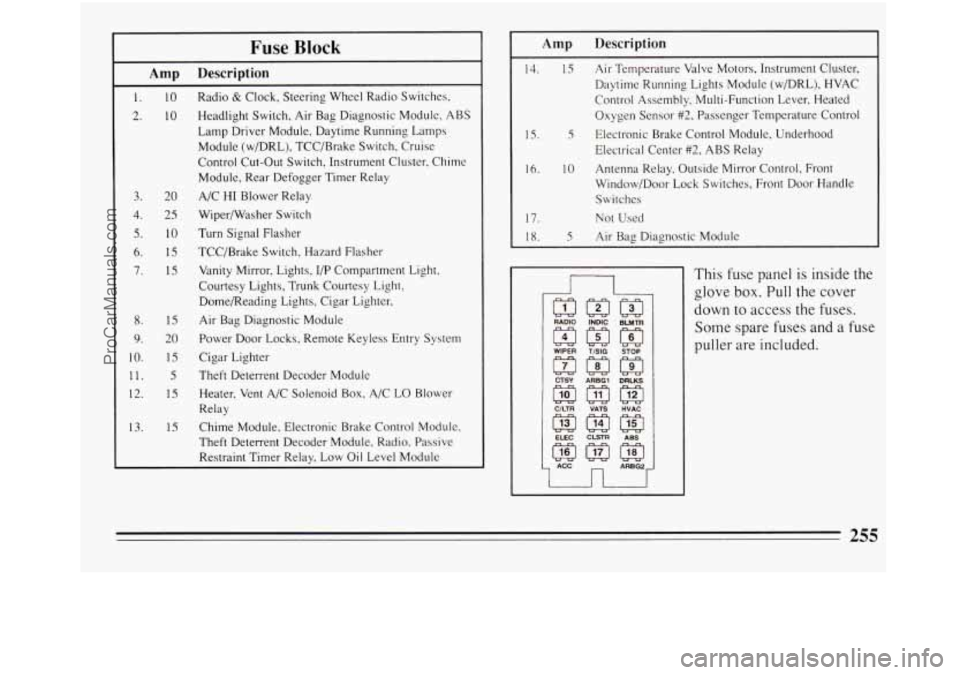
Fuse Block
Amp Description
1.
2.
10
10
3. 20
4.
2s
5. IO
6. 15
7. 15
8. 1s
9. 20
10.
1s
11. 5
12. 1s
13. 15 Radio
& Clock, Steering
Wheel Radio Switches.
Headlight Switch, Air Bag Diagnostic Module, ABS
Lamp Driver Module, Daytime Running Lamps
Module (w/DRL), TCC/Brake Switch, Cruise
Control Cut-Out Switch, Instrument Cluster, Chime
Module, Rear Defogger Timer Relay
A/C HI Blower Relay
Wipermasher Switch
Turn Signal Flasher
TCC/Brake Switch, Hazard Flasher
Vanity Mirror, Lights, I/P Compartment Light,
Courtesy Lights, Trunk Courtesy Light,
Dome/Reading Lights, Cigar Lighter.
Air Bag Diagnostic Module
Power Door Locks, Remote Keyless Entry System
Cigar Lighter
Theft Deterrent Decoder Module
Heater, Vent A/C Solenoid Box, A/C LO Blower
Relay
Chime Module, Electronic Brake Control Module.
Theft Deterrent Decoder Module, Radio, Passive
Restraint Timer Relay, Low Oil Level Module
1s.
Amp Description
14. 15 Air Temperature Valve Motors, Instrument Cluster,
Daytime Running Lights Module (w/DRL), HVAC
Control Assembly, Multi-Function Lever, Heated
Oxygen Sensor
#2, Passenger Temperature Control
Electrical Center
#2, ABS Relay
16. 10 Antenna Relay, Outside Mirror Control, Front
Window/Door Lock Switches, Front Door Handle
Switches
17.
Not Used
18. 5 Air Bag Diagnostic Module
5 Electronic Brake Control Module, Underhood
n
CTSY ARBGl DRLKS
@m@
ClLTR VATS HVAC
This fuse panel is inside the
glove
box. Pull the cover
down to access the
fuses.
Some spare fuses and a fuse
puller are included.
255
ProCarManuals.com
Page 260 of 308
10
25
1s
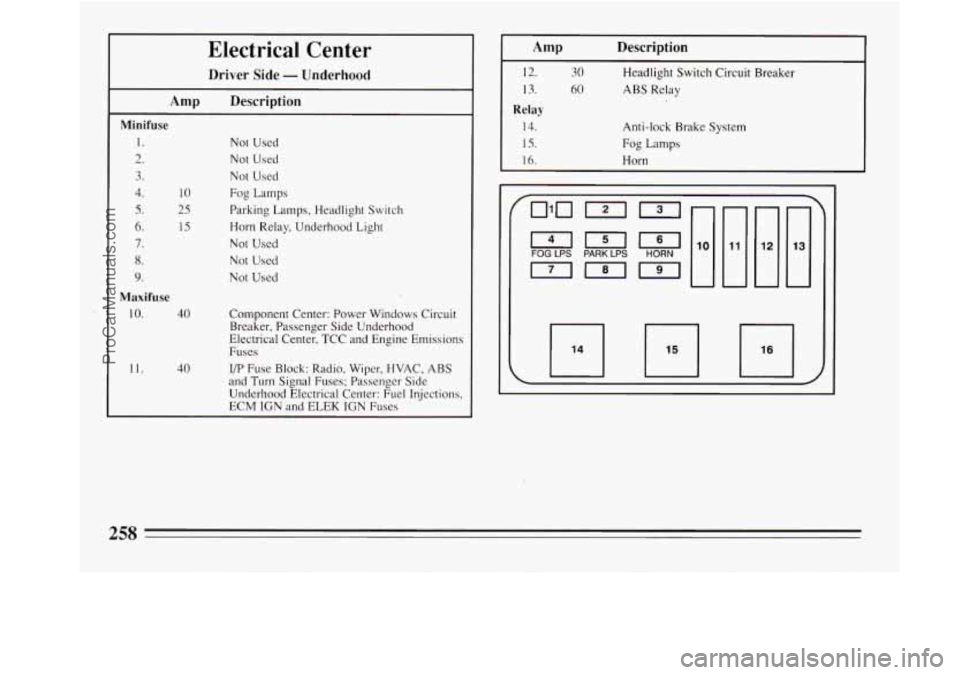
Electrical Center
Driver Side - Underhood
Amp Description
Minifuse
1. Not Used
2. Not Used
3. Not Used
4. Fog Lamps
5. Parking Lamps, Headlight Switch
6. Horn Relay, Underhood Light
7. Not Used
8. Not Used
9. Not Used
Maxifuse
10. 40
11 40
Component Center: Power Windows Circuit
Breaker, Passenger Side Underhood
Electrical Center, TCC and Engine Emissions
Fuses
I/P Fuse Block: Radio, Wiper, HVAC, ABS
and Turn Signal Fuses; Passenger Side
Underhood Electrical Center:
Fuel Injections,
ECM IGN and
ELEK IGN Fuses
Amp Description
12. 30 Headlight Switch Circuit Breaker
13. 60 ABS Relay
Relay
14. Anti-lock Brake System
1s. Fog Lamps
16. Horn
258
ProCarManuals.com
Page 280 of 308
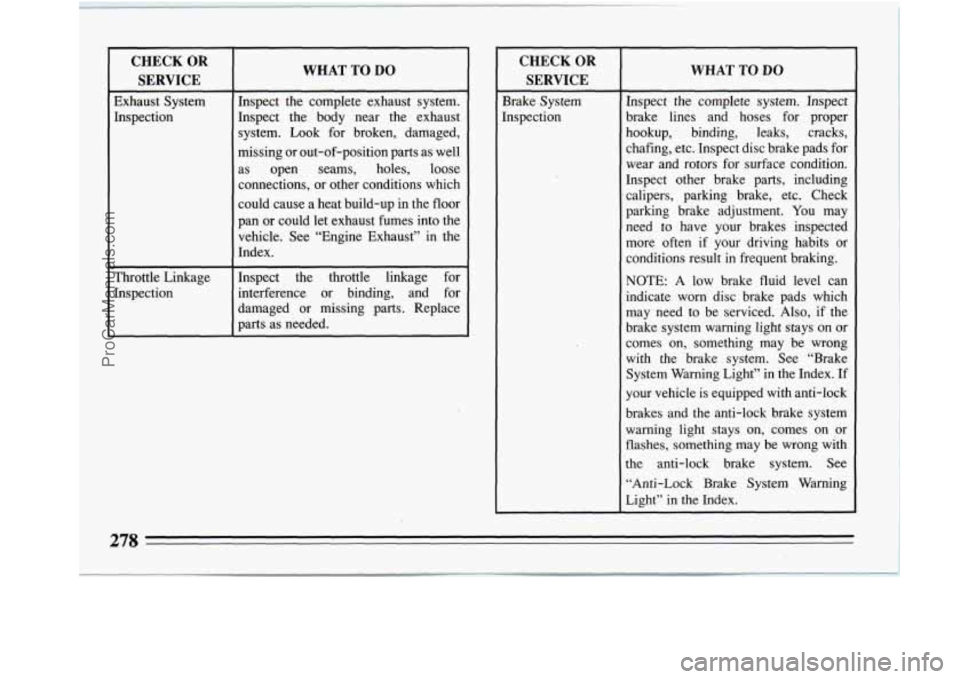
CHECK OR
SERVICE
Exhaust System
Inspection
Throttle Linkage
Inspection
WHAT TO DO
Inspect the complete exhaust system.
Inspect the body near the exhaust
system. Look for broken, damaged,
missing or out-of-position parts as well
as open seams, holes, loose connections, or other conditions which
could cause a heat build-up in the floor
pan or could let exhaust fumes into the
vehicle. See “Engine Exhaust” in the
Index.
Inspect the throttle linkage for
interference or binding, and
for
damaged or missing parts. Replace
parts as needed.
CHECK OR
SERVICE
Brake System
Inspection
WHAT TO DO
Inspect the complete system. Inspect
brake lines and hoses for proper
hookup, binding, leaks, cracks,
chafing, etc. Inspect disc brake pads for
wear and rotors for surface condition.
Inspect other brake parts, including
calipers, parking brake, etc. Check
parking brake adjustment. You may
need to have your brakes inspected
more often if your driving habits or
conditions result in frequent braking.
NOTE: A low brake fluid level can
indicate worn disc brake pads which
may need to be serviced. Also, if the
brake system warning light stays on or
comes on, something may be wrong
with the brake system. See “Brake
System Warning Light” in the Index.
If
your vehicle is equipped with anti-lock
brakes and the anti-lock brake system
warning light stays on, comes on or
flashes, something may be wrong with
the anti-lock brake system. See
“Anti-Lock Brake System Warning
Light” in the Index.
ProCarManuals.com
Page 295 of 308
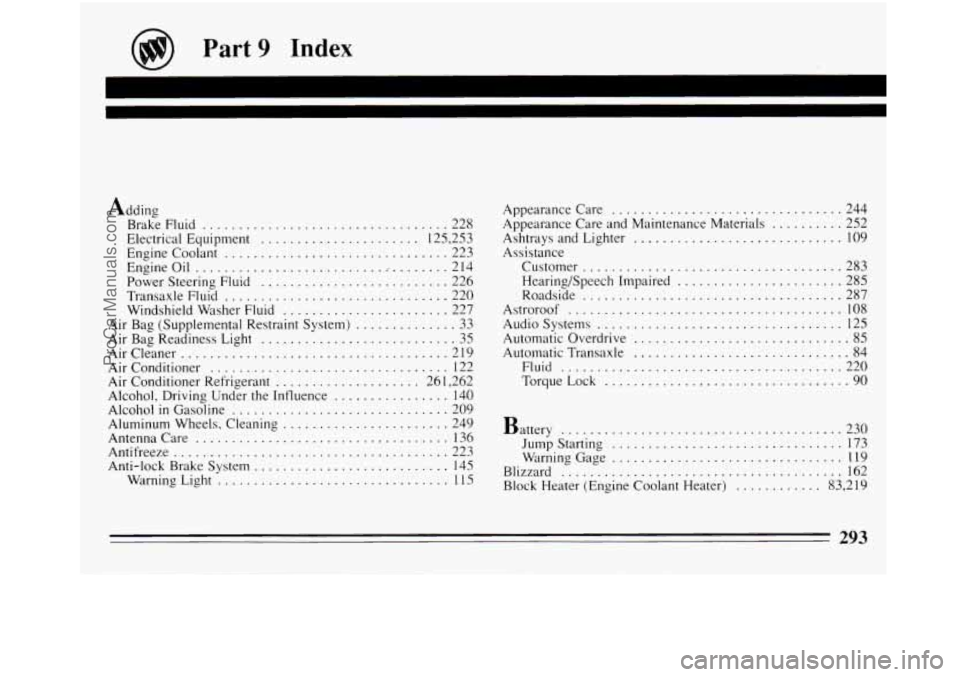
Part 9 Index
Adding Brake Fluid
.................................. 228
Electrical Equipment
...................... 125. 253
Engine Coolant
............................... 223
Engine Oil
.................................... 2 14
Power Steering Fluid
.......................... 226
Transaxle Fluid
............................... 220
Windshield Washer Fluid
....................... 227
Air Bag (Supplemental Restraint System)
.............. 33
Air Bag Readiness Light
........................... 35
Aircleaner
..................................... 219
Air Conditioner
................................. 122
Air Conditioner Refrigerant .................... 26 1. 262
Alcohol. Driving Under the Influence
................ 140
Alcohol
in Gasoline .............................. 209
Aluminum Wheels. Cleaning
....................... 249
Antenna Care
................................... 136
Antifreeze
...................................... 223
Anti-lock Brake System
........................... 145
Warning Light
................................ 115
Appearance Care ................................ 244
Ashtrays and Lighter
............................. 109
Assistance Customer
.................................... 283
Hearing/Speech Impaired
....................... 285
Roadside
.................................... 287
Astroroof
...................................... 108
Audio Systems
.................................. 125
Automatic Overdrive
.............................. 85
Automatic Transaxle .............................. 84
Fluid ....................................... 220
TorqueLock .................................. 90
Appearance
Care and Maintenance Materials
.......... 252
Battery
....................................... 230
Jump Starting
................................ 173
WarningGage
................................ 119
Blizzard
....................................... 162
Block Heater (Engine Coolant Heater)
............ 83. 219
293
ProCarManuals.com