brake light BUICK REGAL 1994 Owners Manual
[x] Cancel search | Manufacturer: BUICK, Model Year: 1994, Model line: REGAL, Model: BUICK REGAL 1994Pages: 308, PDF Size: 15.78 MB
Page 14 of 308
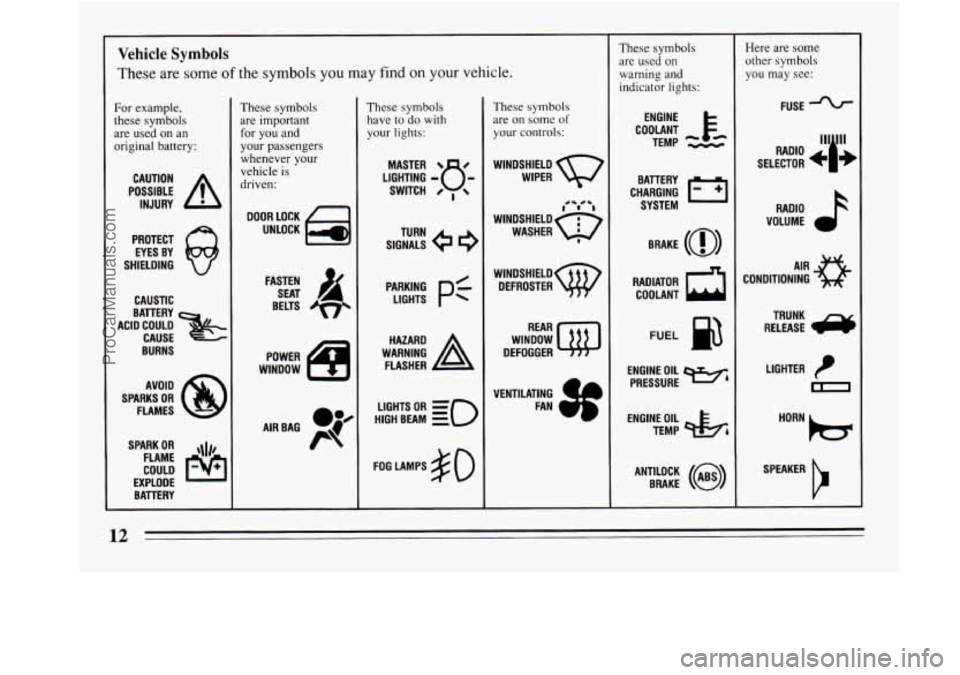
Vehicle Symbols
These are some of the symbols you may find on your vehicle.
For example,
these symbols
are used on an
original battery:
POSSIBLE A
CAUTION
INJURY
PROTECT EYES BY
SHIELDING
CAUSTIC
BURNS AVOID
SPARKS
OR
FLAMES
SPARK OR
,\I/,
FLAME
COULD
EXPLODE
BATTERY
These symbols
are important
for you and
your passengers
whenever your
vehicle is
driven:
DOOR LOCK
UNLOCK
FASTEN SEAT
4
BELTS
POWER
WINDOW
These symbols have
to do with
your lights:
SIGNALS e
TURN
WARNING
A
HAZARD
FLASHER
These symbols are on some
of
your controls:
WINDSHIELD WIPER Q7
WINDOW
DEFOGGER
VENTILATING FAN
HIGH BEAM
=
FOG LAMPS # 0
These symbols
are used
on
warning and
indicator lights:
CHARGING I-1
BATTERY
SYSTEM
RADIATOR COOLANT
FUEL
ENGINE OIL
PRESSURE
Wb
TEMP OIL &
ANTILOCK (a)
BRAKE
Here are some
other symbols
you may see:
FUSE
RADIO
>
VOLUME
CONDITIONING
AIR a
LIGHTER
m
SPEAKER
b
12
ProCarManuals.com
Page 89 of 308
Parking Brake
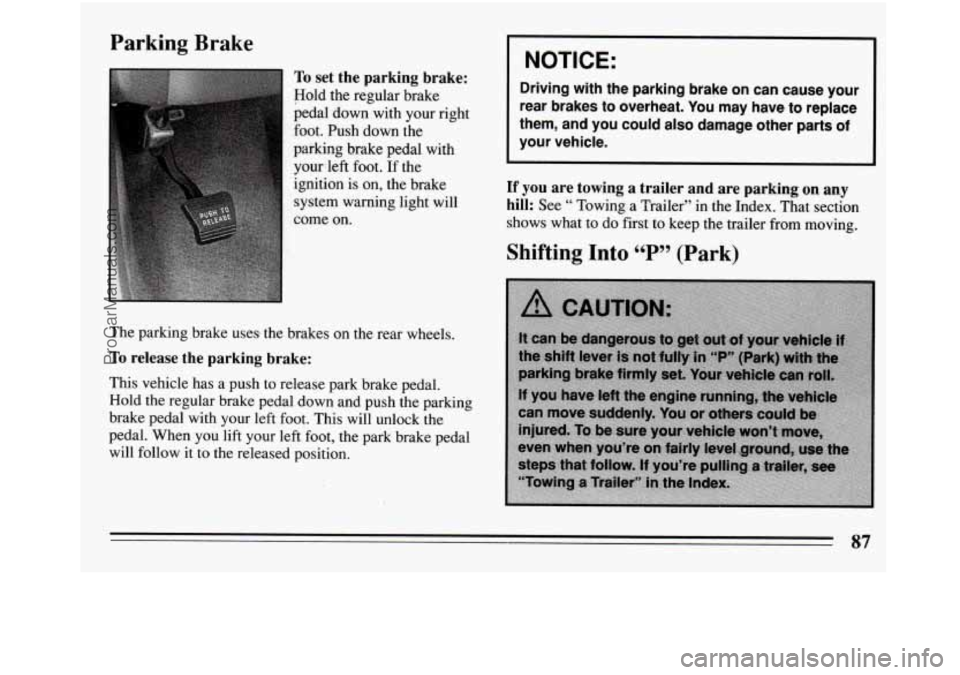
To set the parking brake:
Hold the regular brake
pedal
down with your right
foot. Push down
the
paiking brake pedal with yourleft foot.
If the
ignition is on, the brake
system warning light will
come on.
The parking brake uses the brakes on the rear wheels.
To release the parking brake:
This vehicle has a push to release park brake pedal.
Hold
the regular brake pedal down and push the parking
brake pedal with your left foot. This will unlock the
pedal. When you lift your left foot, the park brake pedal
will follow it to the released position.
I NOTICE: 1
Driving with the parking brake on can cause your
rear brakes to overheat. You may have to replace
them, and you could also damage other parts of
your vehicle.
If you are towing a trailer and are parking on any
hill:
See “ Towing a Trailer” in the Index. That section
shows what to do first to keep the trailer from moving.
87
ProCarManuals.com
Page 102 of 308
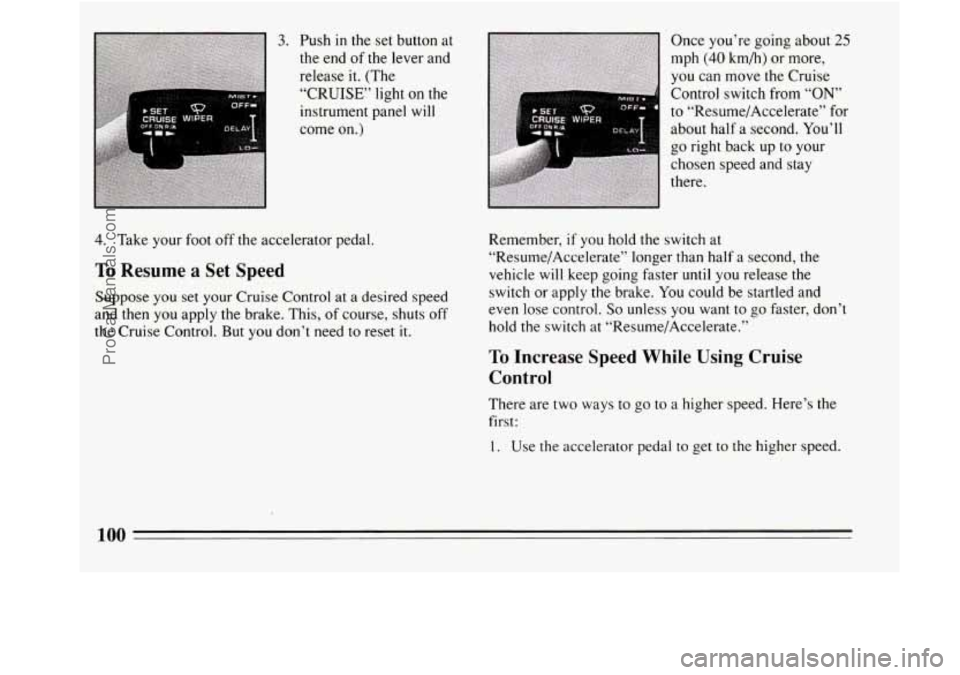
3. Push in the set button at
the end of the lever and
release it. (The
“CRUISE” light
on the
instrument panel will
come
on.)
4. Take your foot off the accelerator pedal.
To Resume a Set Speed
Suppose you set your Cruise Control at a desired speed
and then
you apply the brake. This, of course, shuts off
the Cruise Control. But
you don’t need to reset it. Once
you’re
going about 25
mph (40 km/h) or more,
you can move the Cruise
Control switch from
“ON’
to “Resume/Accelerate” for
about half a second. You’ll
go right back up to your
chosen speed and stay
there.
Remember,
if you hold the switch at
“Resume/Accelerate” longer than half a second, the
vehicle
will keep going faster until you release the
switch or apply the brake.
You could be startled and
even lose control.
So unless you want to go faster, don’t
hold
the switch at “Resume/Accelerate.”
To Increase Speed While Using Cruise
Control
There are two ways to go to a higher speed. Here’s the
first:
1. Use the accelerator pedal to get to the higher speed.
100
ProCarManuals.com
Page 104 of 308
Passing Another Vehicle While Using
Cruise Control
Use the accelerator pedal to increase your speed. When
you take your foot off the pedal, your vehicle
will slow
down
to the Cruise Control speed you set earlier.
Using Cruise Control on Hills
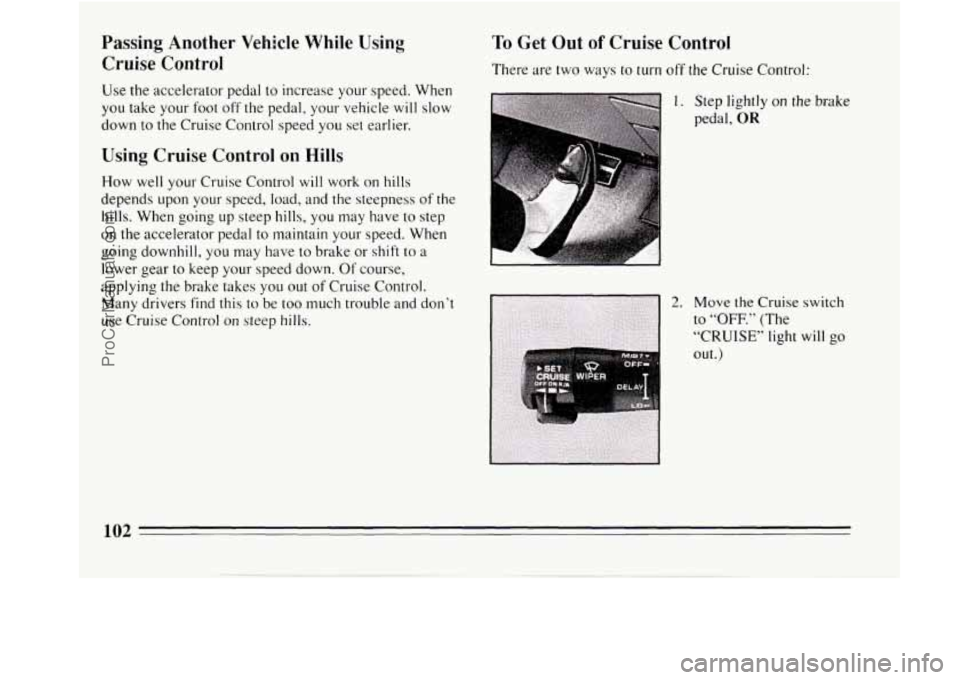
To Get Out of Cruise Control
There are two ways to turn off the Cruise Control:
1. Step lightly on the brake
pedal,
OR
102 -
ProCarManuals.com
Page 106 of 308
Your DRL work with a light sensor on top of the
instrument panel. Don’t cover it up.
The low beam headlights will come on at reduced
brightness in daylight
when:
0 The ignition is on,
0 The headlight switch is off, and
0 The parking brake is released.
At dusk, the exterior lights will come on automatically
and the low beams will change
to full brightness. At
dawn, the exterior lights will
go out and the low beams
will change to
the reduced brightness of DRL (if the
headlight switch is off).
Of course, you may still turp on the headlights any time
you need to.
To idle your vehicle with
the DRL off, set the parking
brake while the ignition
is in the “Off” or “Lock”
position. Then start the vehicle. The DRL will stay off
until
you release the parking brake.
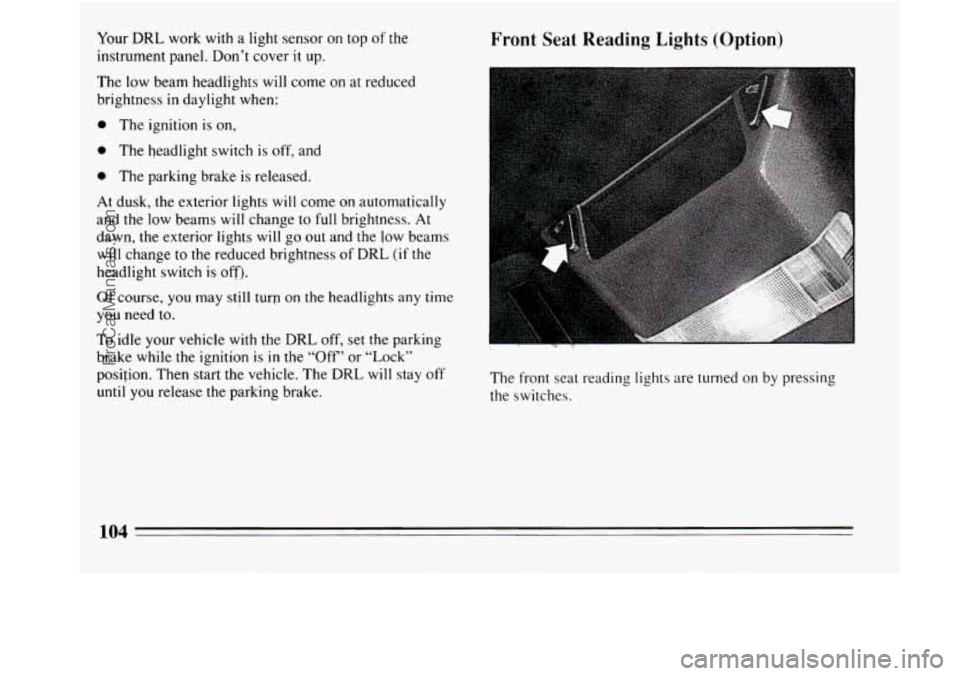
Front Seat Reading Lights (Option)
The front seat reading lights are turned on by pressing
the switches.
104
ProCarManuals.com
Page 116 of 308
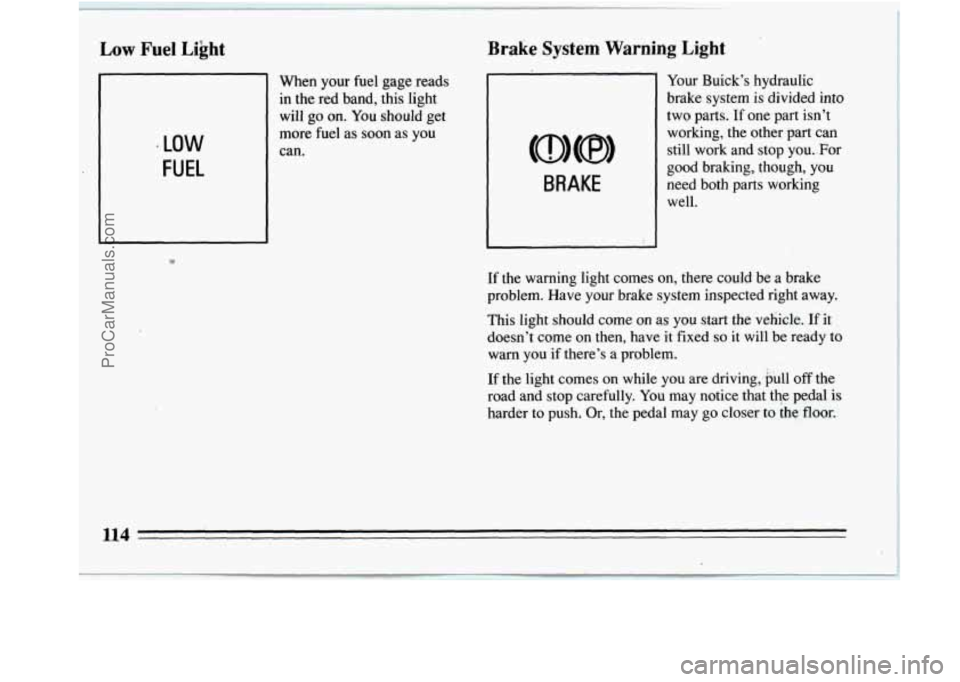
* LOW
FUEL
L
When your fuel gage reads in the red band, this light will
go on. You should get
more fuel
as soon as you
can.
Brake System Warning Light
BRAKE
Your Buick’s hydraulic
brake system is divided into
two parts. If one part isn’t
working, the other
part can
still work and stop you..For
good braking, though, you
need both parts working
well.
If the warning light comes on, there could be
a brake
problem. Have your brake system inspected right away.
This light should come on as you start the vehicle.
If it
doesn’t come on then, have it fixed
so it will be ready to
warn you if there’s a problem.
If the light comes
on while you are driving, pull off the
road and stop carefully. You may notice that the pedal is
harder to push. Or, the pedal may
go closer to the floor.
114
ProCarManuals.com
Page 117 of 308
It may take longer to stop. If the light is still on, or if the
anti-lock brake system warning light is flashing, have
the vehicle towed for service. (See “Anti-Lock Brake
System Warning Light” and “Towing Your Car” in the
Index.)
The brake system warning light will also come on when
you
set your parking brake, and it will stay on if your
parking brake doesn’t release
fully. If it stays on after
your parking brake is
fully released, it means you have a
brake problem.
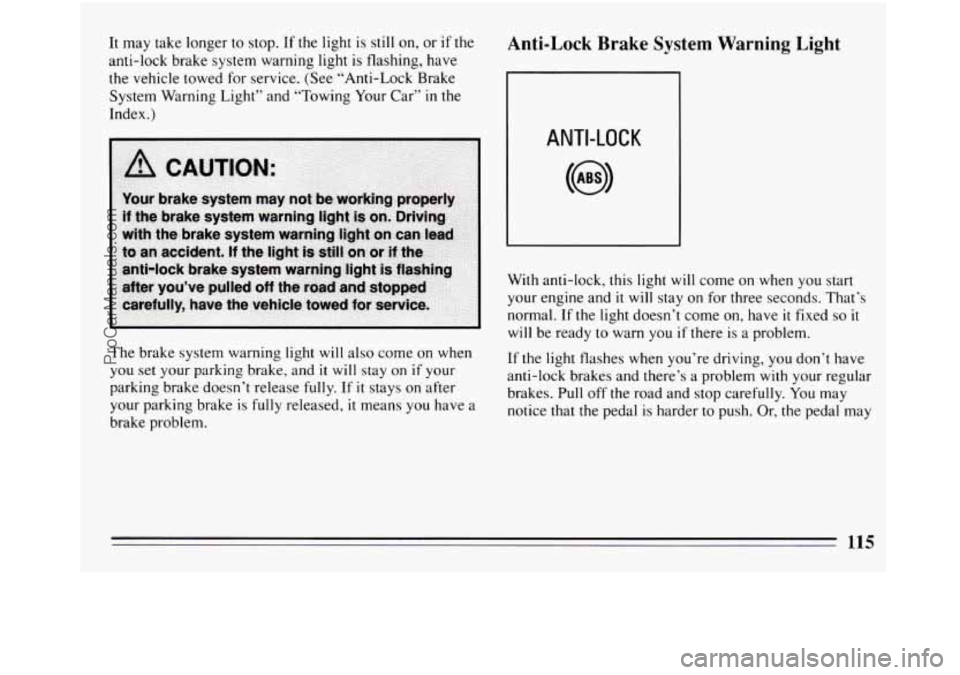
Anti-Lock Brake System Warning Light
ANTI-LOCK
With anti-lock, this light will come on when you start
your engine and
it will stay on for three seconds. That’s
normal. If the light doesn’t come on, have
it fixed so it
will be ready to warn you if there is a problem.
If the light flashes when you’re driving, you don’t have
anti-lock brakes and there’s a problem with your regular
brakes. Pull
off the road and stop carefully. You may
notice that the pedal is harder to push. Or, the pedal may
115
ProCarManuals.com
Page 118 of 308
go closer to the floor. It may take longer to stop. Have
the vehicle towed for service. (See “Towing Your Car”
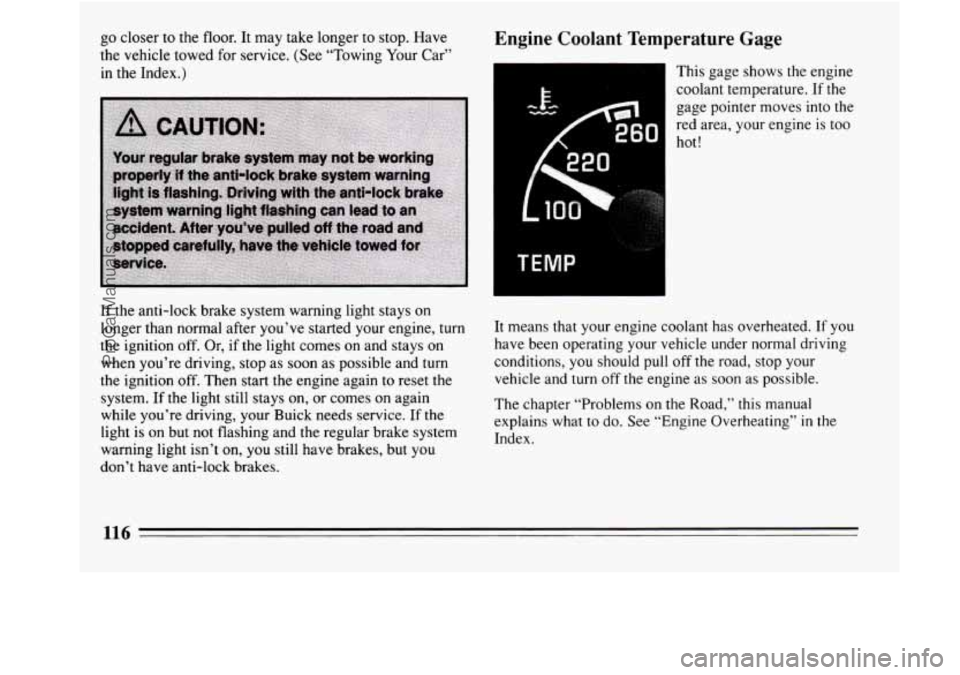
in the Index.) Engine Coolant Temperature Gage
This gage shows the engine
coolant temperature. If the
gage pointer moves into the
red area, your engine
is too
hot!
If the anti-lock brake system warning light stays on
longer than normal after you’ve started your engine, turn
the ignition off. Or,
if the light comes on and stays on
when you’re driving, stop as soon as possible and turn
the ignition off. Then start the engine again to reset the
system. If the light still stays on, or comes on again
while you’re driving, your Buick needs service. If the
light is on but not flashing and the regular brake system
warning light isn’t on,
you still have brakes, but you
don’t have anti-lock brakes. It means
that your engine coolant has overheated. If you
have been operating your vehicle under normal driving
conditions,
you should pull off the road, stop your
vehicle and turn off the engine as soon as possible.
The chapter “Problems on the Road,” this manual
explains what to do. See “Engine Overheating”
in the
Index.
116
ProCarManuals.com
Page 147 of 308
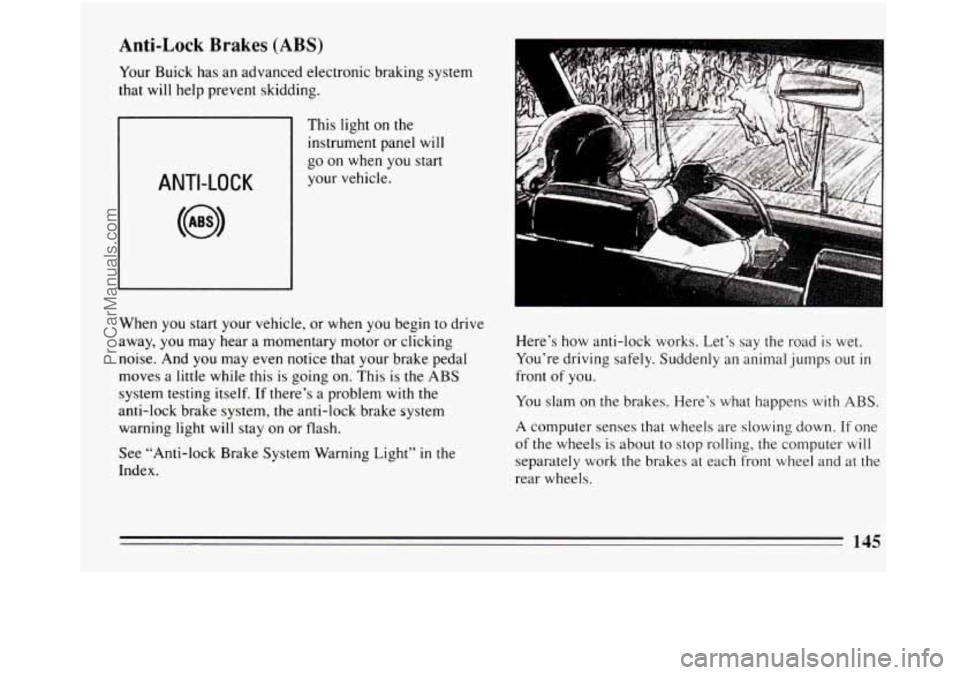
Anti-Lock Brakes (ABS)
Your Buick has an advanced electronic braking system
that will help prevent skidding.
ANTI-LOCK
This light on the
instrument panel will
go on when you start
your vehicle.
When you start your vehicle, or when you begin to drive
away, you may hear a momentary motor or clicking
noise. And
you may even notice that your brake pedal
moves a little while this is going on. This is the
ABS
system testing itself. If there’s a problem with the
anti-lock brake system, the anti-lock brake system
warning light
will stay on or flash.
See “Anti-lock Brake System Warning Light”
in the
Index. Here’s how
anti-lock works. Let’s say the road is wet.
You’re driving safely. Suddenly an animal jumps out
in
front of you.
You slam on the brakes. Here’s what happens
with ABS.
A computer senses that wheels are slowing down. If one
of the wheels
is about to stop rolling, the computer will
separately work the brakes at each front wheel and at the
rear wheels.
145
ProCarManuals.com
Page 152 of 308
Do not get too close to the vehicle you want to pass
while you’re awaiting an opportunity. For one thing,
following too closely reduces your area of vision,
especially if you’re following a larger vehicle. Also,
you won’t have adequate space if the vehicle ahead
suddenly slows or stops. Keep back a reasonable
distance.
0 When it looks like a chance to pass is coming up,
start
to accelerate but stay in the right lane and don’t
get too close. Time.your move
so you will be
increasing speed as the time comes to move into the
other lane. If the way is clear
to pass, you will have a
“running start” that more than makes up for
the
distance you would lose by dropping back. And if
something happens to cause
you to cancel your pass,
you need only slow down and drop back again and
wait for another opportunity.
0 If other cars are lined up to pass a slow vehicle, wait
your turn. But take care that someone isn’t trying to
pass you as
you pull out to pass the slow vehicle.
Remember to glance over your shoulder and check
the blind spot.
Check your mirrors, glance over your shoulder, and
start your left lane change signal before moving out
of the right lane to pass. When you are far enough
ahead of the passed vehicle to see its front in you:
inside mirror, activate your right lane change signal
and move back into the right lane. (Remember that
your right outside mirror is convex. The vehicle you
just passed may seem to be farther away from
you
than it really is.)
Try not to pass more than one vehicle at a time on
two-lane roads. Reconsider before passing the next
vehicle.
0 Don’t overtake a slowly moving vehicle too rapidly.
Even though the brake lights are not flashing,
it may
be slowing down or starting to turn.
If you’re being passed, make it easy for the
following driver to get ahead of you. Perhaps you
can ease a little
to the right.
ProCarManuals.com