instrument panel BUICK REGAL 1994 User Guide
[x] Cancel search | Manufacturer: BUICK, Model Year: 1994, Model line: REGAL, Model: BUICK REGAL 1994Pages: 308, PDF Size: 15.78 MB
Page 113 of 308
Luggage Carrier (Option)
If you have the optional luggage carrier, you can load
things on the deck lid of your vehicle. The luggage
carrier has slats attached to the deck lid, a rear rail, and
tiedowns.
NOTICE:
Loading cargo that weighs more than 50 Ibs
(23 kg) on the luggage carrier may damage your
vehicle. When you carry large things, never let
them hang over the rear or the sides of your
vehicle. Load your cargo
so that it rests on the
slats and does not scratch
or damage the
vehicle. Put the cargo against the rear rail and
fasten
it securely to the luggage carrier.
Don’t exceed the maximum vehicle capacity when
loading your Buick. For more information on vehicle
capacity and loading, see “Loading Your Vehicle”
in the
Index.
To prevent damage or loss of cargo as you’re driving,
check
now and then to make sure the luggage carrier
and cargo are still securely fastened.
The Instrument Panel: Your
Information System
I
Your instrument panel is designed to let you know at a
glance how your car is running. You’ll know how fast
you’re going, how much fuel you’re using, and many
other things
you’ll need to now to drive safely and
economically.
Speedometer and Odometer
Your speedometer lets you see your speed in both miles
per hour (mph) and kilometers per hour (km/h). Your
odometer shows how far
your vehicle has been driven,
in either miles (used in the U.S.) or kilometers (used in
Canada).
111
ProCarManuals.com
Page 119 of 308
LOW Coolant Warning Light Engine Oil Pressure Gage
LOW
COOLANT
If this light comes on, your
system
is low on coolant
and the engine may
overheat.
See “Engine Coolant”
in the Index and have your
vehicle serviced as soon as you can.
1
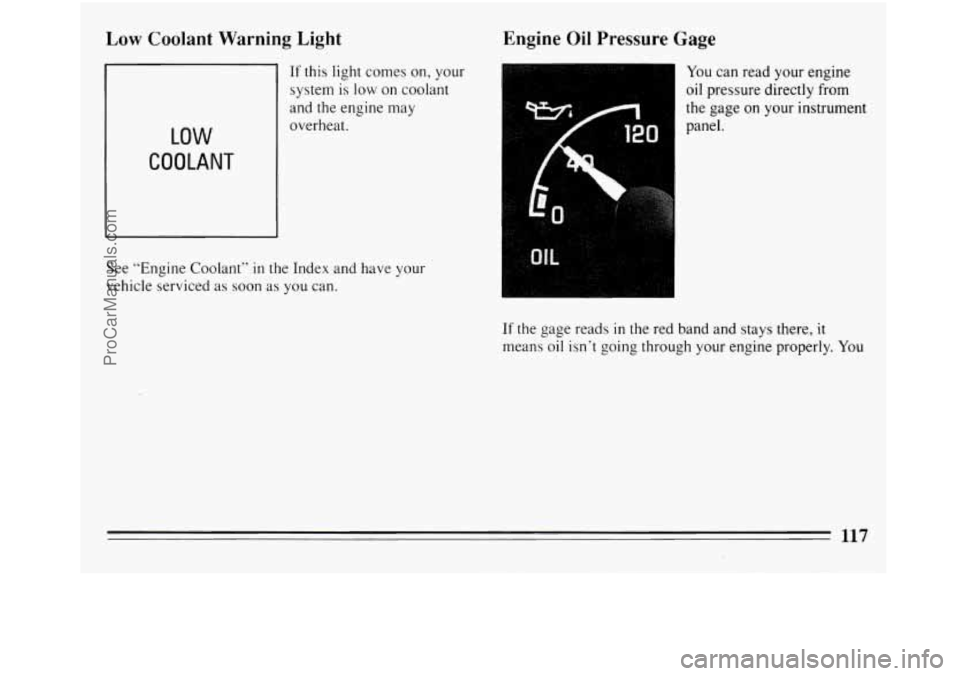
You can read your engine
oil pressure directly from
the gage
on your instrument
panel.
If the gage reads in the red band and stays there, it
means oil isn’t going through your engine properly.
You
117
ProCarManuals.com
Page 125 of 308
Temperature Control conditioner’s compressor will have to do, which should
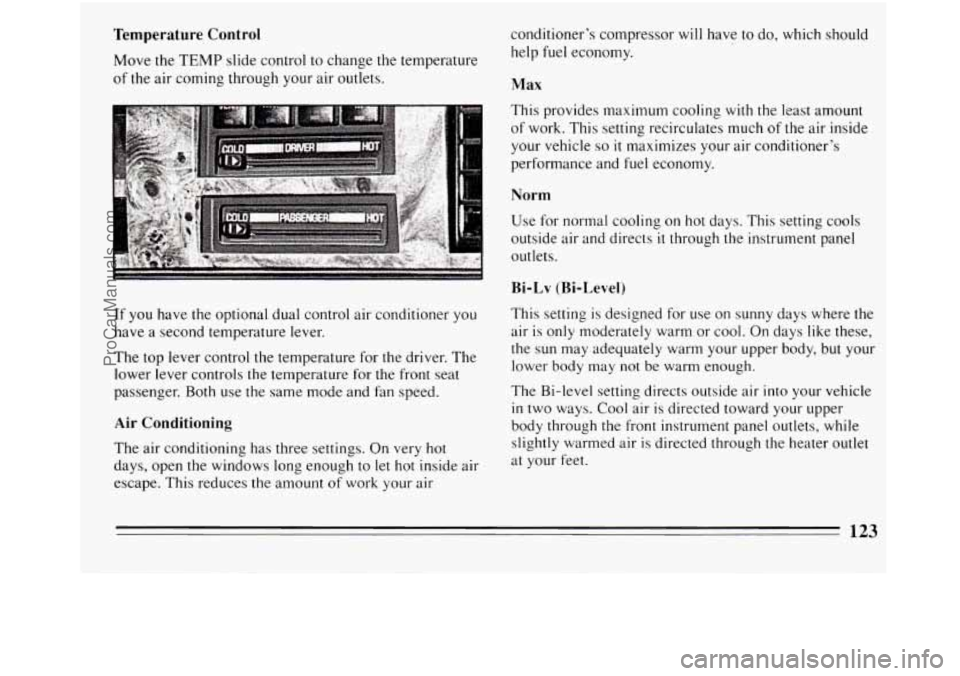
Move the TEMP slide control to change the temperature
of the air coming through your air outlets. Max
help fuel economy.
If you have the optional dual control air conditioner you
have a second temperature lever.
The top lever control the temperature for the driver. The
lower lever controls the temperature for the front seat
passenger. Both use the same mode and fan speed.
Air Conditioning
The air conditioning has three settings. On very hot
days, open
the windows long enough to let hot inside air
escape. This reduces the amount of work your
air
This provides maximum cooling with the least amount
of work. This setting recirculates much of the air inside
your vehicle
so it maximizes your air conditioner’s
performance and fuel economy.
Norm
Use for normal cooling on hot days. This setting cools
outside air and directs
it through the instrument panel
outlets.
Bi-Lv (Bi-Level)
This setting is designed for use on sunny days where the
air is only moderately warm or cool.
On days like these,
the sun may adequately warm your upper body, but your
lower body may not be warm enough.
The Bi-level setting directs outside air into your vehicle
in two ways. Cool air is directed toward your upper
body through the front instrument panel outlets, while
slightly warmed air is directed through the heater outlet
at your feet.
123
ProCarManuals.com
Page 126 of 308
The air conditioner compressor operates in all Air
Conditioning positions, and the Defrost position when
the outside temperature is above
40°F (4.5"C).
Ventilation
For mild outside temperatures, when little heating or
cooling is needed, press the
VENT button. Air will flow
through the instrument panel outlets. Use the air outlets
to turn on, adjust and turn off the air flow. Adjust the
TEMP lever to control the temperature.
Heating
When outside temperatures are cold, press the button
marked HTR and slide the
TEMP lever toward HOT to
send heated air through the floor outlets.
Defog
When your windshield is foggy, press the DEFOG
button to direct most of the air flow toward the
windshield. When it's
50°F (IOOC) or warmer, the
system will provide cooled air.
Defrost
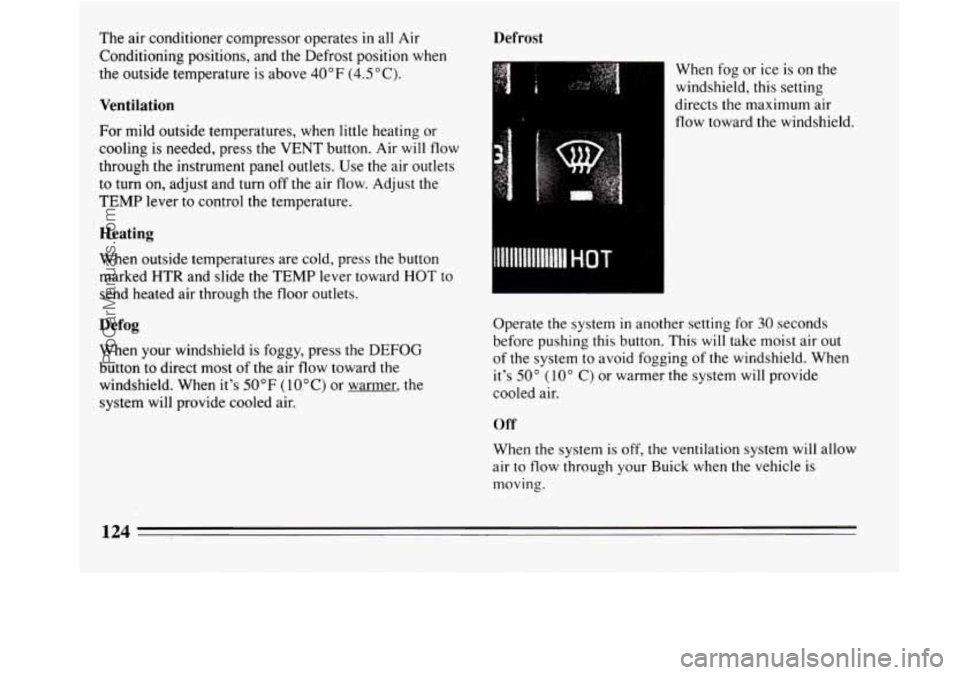
. When fog or ice is on the
windshield, this setting
directs the maximum air
flow toward the windshield.
Operate the system
in another setting for 30 seconds
before pushing this button. This
will take moist air out
of the system to avoid fogging
of the windshield. When
it's 50" (10" C) or warmer the system will provide
cooled air.
Off
When the system is off, the ventilation system will allow
air to flow through your Buick when the vehicle is
moving.
124
ProCarManuals.com
Page 147 of 308
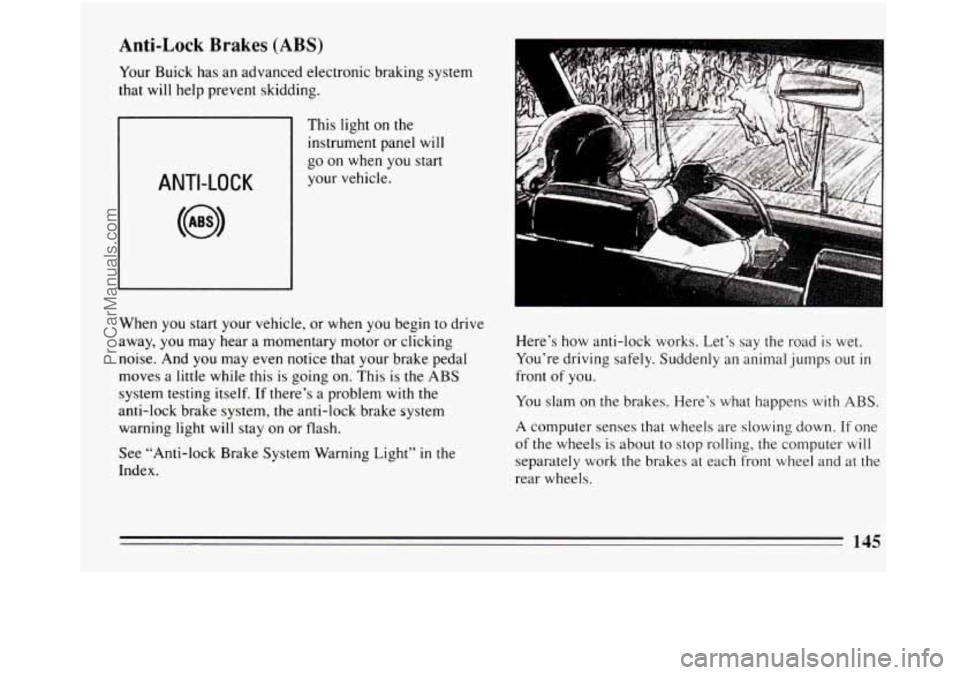
Anti-Lock Brakes (ABS)
Your Buick has an advanced electronic braking system
that will help prevent skidding.
ANTI-LOCK
This light on the
instrument panel will
go on when you start
your vehicle.
When you start your vehicle, or when you begin to drive
away, you may hear a momentary motor or clicking
noise. And
you may even notice that your brake pedal
moves a little while this is going on. This is the
ABS
system testing itself. If there’s a problem with the
anti-lock brake system, the anti-lock brake system
warning light
will stay on or flash.
See “Anti-lock Brake System Warning Light”
in the
Index. Here’s how
anti-lock works. Let’s say the road is wet.
You’re driving safely. Suddenly an animal jumps out
in
front of you.
You slam on the brakes. Here’s what happens
with ABS.
A computer senses that wheels are slowing down. If one
of the wheels
is about to stop rolling, the computer will
separately work the brakes at each front wheel and at the
rear wheels.
145
ProCarManuals.com
Page 170 of 308
Following Distance
Stay at least twice as far behind the vehicle ahead as you
would when driving your vehicle without a trailer. This
can help you avoid situations that require heavy braking
and sudden turns.
Passing
You’ll need more passing distance up ahead when
you’re towing a trailer. And, because you’re a good deal
longer, you’ll need
to go much farther beyond the
passed vehicle before
you can return to your lane.
Backing Up
Hold the bottom of the steering wheel with one hand.
Then,
to move the trailer to the left, just move that hand
to the left.
To move the trailer to the right, move your
hand
to the right. Always back up slowly and, if
possible, have someone guide you.
Making Turns
When you’re turning with a trailer, make wider turns
than normal.
Do this so your trailer won’t strike soft
shoulders, curbs, road signs, trees, or other objects.
Avoid jerky or sudden maneuvers. Signal well
in
advance.
Turn Signals When Towing a Trailer
When you tow a trailer, your vehicle has to have a
different turn signal flasher and extra wiring. The green
arrows
on your instrument panel will flash whenever
you signal a turn or lane change. Properly hooked up,
the trailer lights will also flash, telling other drivers
you’re about to turn, change lanes or stop.
When towing a trailer,
the green arrows on your
instrument panel will flash for turns even
if the bulbs on
the trailer are burned out. Thus, you may think drivers
behind you are seeing your signal when they are
not. It’s
important to check occasionally to be sure the trailer
bulbs are still working.
Driving On Grades
Reduce speed and shift to a lower gear before you start
down a long or steep downgrade. If you don’t shift
down,
you might have to use your brakes so much that
they would get hot and no longer work
well.
On a long uphill grade, shift down and reduce your
speed to around
45 mph (70 km/h) to reduce the
possibility
of engine and transaxle overheating.
If you are towing a trailer that weighs more than
1,000
pounds (450 kg), you may prefer to drive in “D” instead
of Overdrive (or, as you need to, a lower gear).
168
ProCarManuals.com
Page 189 of 308
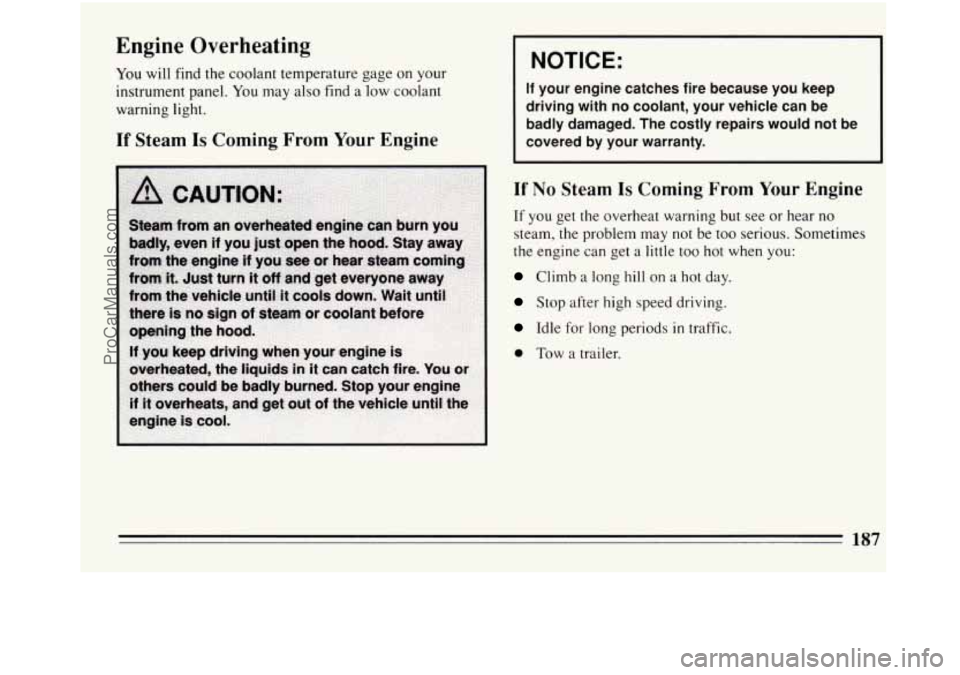
Engine Overheating
You will find the coolant temperature gage on your
instrument panel.
You may also find a low coolant
warning light.
If Steam Is Coming From Your Engine
I NOTICE:
If your engine catches fire because you keep
driving with no coolant, your vehicle can be
badly damaged. The costly repairs would not be
covered by your warranty.
If No Steam Is Coming From Your Engine
If you get the overheat warning but see or hear no
steam, the problem may not be too serious. Sometimes
the engine can get a little too hot when you:
Climb a long hill on a hot day.
Stop after high speed driving.
Idle for long periods in traffic.
0 Tow a trailer.
187
ProCarManuals.com
Page 216 of 308
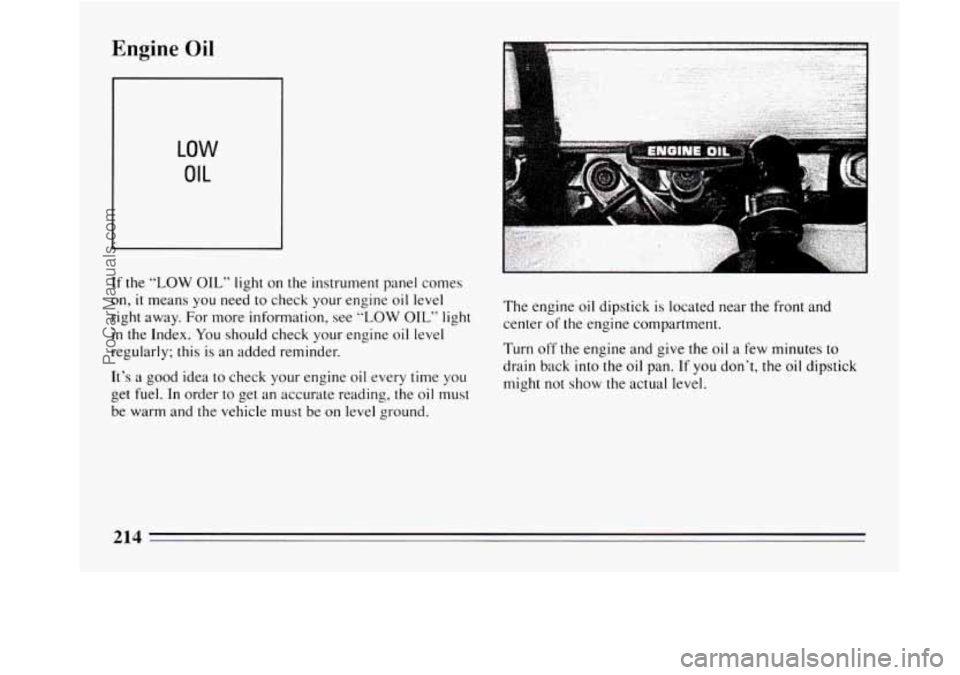
Engine Oil
LOW
OIL
If the “LOW OIL” light on the instrument panel comes
on,
it means you need to check your engine oil level
right away. For more information, see
“LOW OIL” light
in the Index. You should check your engine oil level
regularly; this
is an added reminder.
It’s a good idea
to check your engine oil every time you
get fuel. In order to get an accurate reading, the oil must
be warm and the vehicle
must be on level ground. The
engine oil dipstick is located near the front and
center of the engine compartment.
Turn off the engine and give the oil
a few minutes to
drain back into the oil pan. If you don’t, the oil dipstick
might not show the actual level.
214
ProCarManuals.com
Page 249 of 308
Cleaning Leather
Use a soft cloth with lukewarm water and a mild soap or
saddle soap.
0 For stubborn stains, use a mild solution of 10%
isopropyl alcohol (rubbing alcohol) and 90% water.
0 Never use oils, varnishes, solvent-based or abrasive
cleaners, furniture polish or shoe polish on leather.
Soiled leather should be cleaned immediately. If dirt
is allowed to work into finish, it can harm the
leather.
Cleaning the Top of the Instrument Panel
Use only mild soap and water to clean the top surfaces
of the instrument panel. Sprays containing silicones or
waxes may cause annoying reflections
in the windshield
and even make
it difficult to see through the windshield
under certain conditions.
Care of Safety Belts
Keep belts clean and dry.
I not be able to provide adequate protection. Clean
Glass
Glass should be cleaned often. GM Glass Cleaner (GM
Part No. 1050427) or a liquid household glass cleaner
will remove normal tobacco smoke and dust films.
Don’t use abrasive cleaners on glass, because they may
cause scratches. Avoid placing decals on the inside rear
window, since they may have to be scraped off later.
If
abrasive cleaners are used on the inside of the rear
window, an electric defogger element may be damaged.
Any temporary license should not be attached across the
defogger grid.
247
ProCarManuals.com
Page 255 of 308
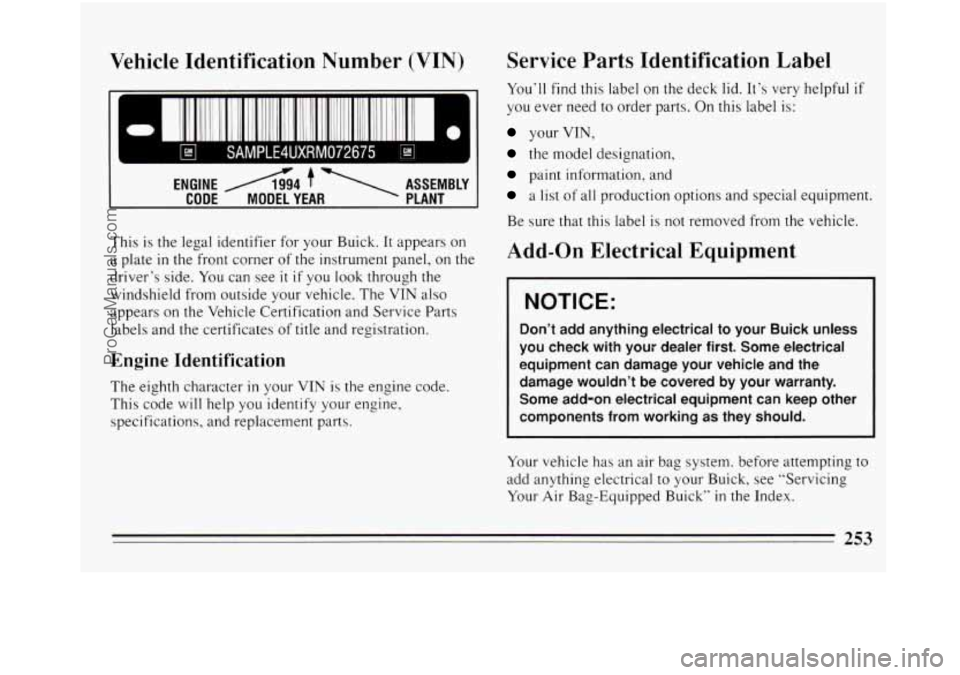
Vehicle Identification Number (VIN)
Ip1“l SAMPLE4UXRM072675
ENGINE 44 f ASSEMBLY
CODE MODEL YEAR PLANT
This is the legal identifier for your Buick. It appears on
a plate
in the front corner of the instrument panel, on the
driver’s side.
You can see it if you look through the
windshield from outside your vehicle. The VIN also
appears on the Vehicle Certification and Service Parts
labels and the certificates of
title and registration.
Engine Identification
The eighth character in your VIN is the engine code.
This code will help
you identify your engine,
specifications, and replacement parts.
Service Parts Identification Label
You’ll find this label on the deck lid. It’s very helpful if
you ever need to order parts. On this label is:
your VIN,
the model designation,
paint information, and
a list of all production options and special equipment.
Be sure that this label is not removed from the vehicle.
Add-on Electrical Equipment
NOTICE:
Don’t add anything electrical to your Buick unless
you check with your dealer first. Some electrical equipment can damage your vehicle and the
damage wouldn’t be covered by your warranty.
Some add-on electrical equipment can keep other
components from working as they should.
Your vehicle has an air bag system. before attempting to
add anything electrical to your Buick, see “Servicing
Your Air Bag-Equipped Buick”
in the Index.
253
ProCarManuals.com