tires BUICK REGAL 1994 Owner's Manual
[x] Cancel search | Manufacturer: BUICK, Model Year: 1994, Model line: REGAL, Model: BUICK REGAL 1994Pages: 308, PDF Size: 15.78 MB
Page 240 of 308
Tire Inspection and Rotation
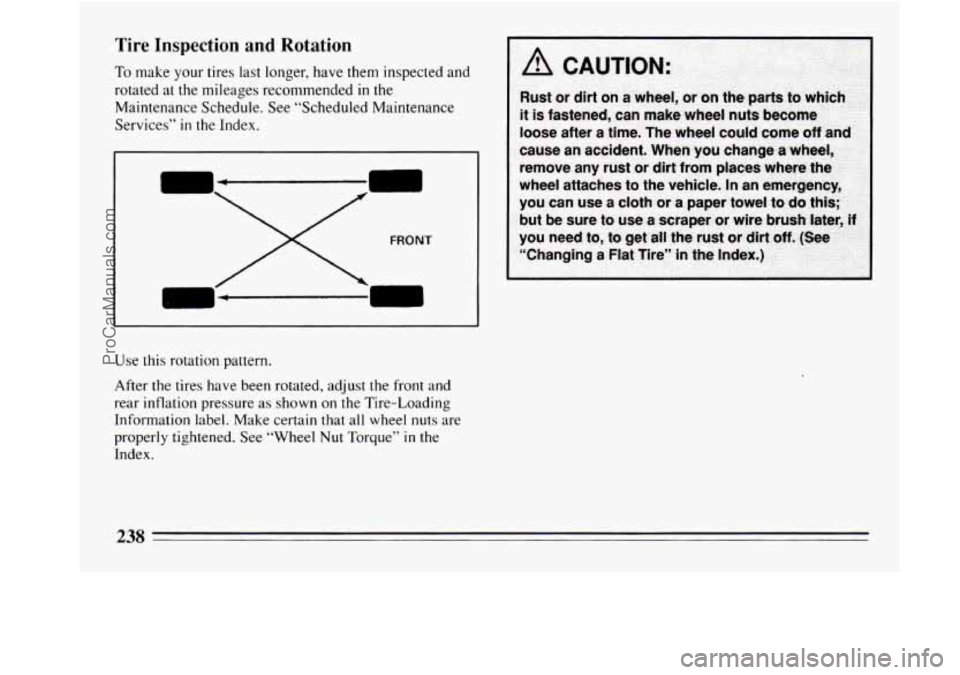
To make your tires last longer, have them inspected and
rotated at the mileages recommended
in the
Maintenance Schedule. See “Scheduled Maintenance
Services”
in the Index.
FRONT
Use this rotation pattern.
After the tires have been rotated, adjust the front and
rear inflation pressure as shown
on the Tire-Loading
Information label. Make certain that all wheel nuts are
properly tightened. See “Wheel Nut Torque”
in the
Index.
238
ProCarManuals.com
Page 241 of 308
When It’s Time for New Tires
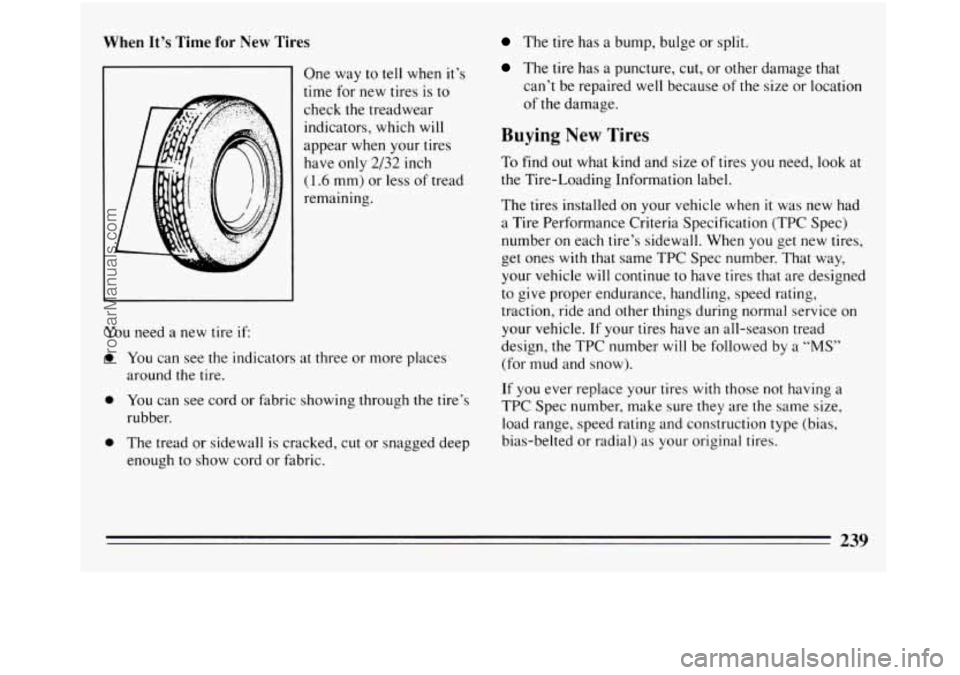
One way to tell when it’s
time for new tires
is to
check the treadwear
indicators, which will
appear when your tires
have
only 2/32 inch
(1.6 mm) or less of tread
remaining.
You need a new tire
if
0 You can see the indicators at three or more places
around the tire.
0 You can see cord or fabric showing through the tire’s
rubber.
0 The tread or sidewall is cracked, cut or snagged deep
enough to show cord or fabric.
The tire has a bump, bulge or split.
The tire has a puncture, cut, or other damage that
can’t be repaired well because of the size or location
of the damage.
Buying New Tires
To find out what kind and size of tires you need, look at
the Tire-Loading Information label.
The tires installed on your vehicle
when it was new had
a Tire Performance Criteria Specification (TPC Spec)
number on each tire’s sidewall. When you get new tires,
get ones
with that same TPC Spec number. That way,
your vehicle
will continue to have tires that are designed
to give proper endurance, handling, speed rating,
traction, ride and other things during normal service on
your vehicle. If your tires have an all-season tread
design, the TPC number will be followed by a
“MS”
(for mud and snow).
If you ever replace your tires with those not having a
TPC Spec number, make sure they are the same size,
load range, speed rating and construction type (bias,
bias-belted or radial) as your original tires.
239
ProCarManuals.com
Page 242 of 308
Uniform Tire Quality Grading
The following infortnation relates to the system
developed by the United States National Highway
Traffic Safety Administration which grades tires by
tfeadwear, traction and temperature performance. (This
applies only to vehicles sold in the United States.)
Treadwear
The treadwear grade is a comparative rating based on
the wear rate
of the tire when tested under controlled
conditiolis on a specified government test course. For
example, a tire graded
150 would wear one and a half
(1 1/2) times as well on the government course as a tire
graded
100. The relative performance of tires depends
upon the actual conditions
of their use, however, and
may depart significantly
from the norm due to variations
in driving habits, service practices and differences in
road characteristics and climate.
Traction - A, B, C
The traction grades, ffom highest to lowest are: A, B,
and C. They represent the tire's ability to stop on .wet
pavement as measured under controlled conditions on
specified government test surfaces of asphalt and
concrete.
A tire marked C may have poor traction
performance.
Warning: The traction grade assigned to this tire .is based
on braking (straight-ahead) traction tests and does not
include cornering (turning) traction.
240
ProCarManuals.com
Page 243 of 308
Temperature - A, B, C
The temperature grades are A (the highest), B, and C,
representing the tire’s resistance to the generation of
heat and its ability
to dissipate heat when tested under
controlled conditions on a specified indoor laboratory
test wheel. Sustained high temperature can cause the
material of the tire
to degenerate and reduce tire life, and
excessive temperature can lead to sudden tire failure.
The grade
C corresponds to a level of performance
which all passenger car tires must meet under the
Federal Motor Vehicle Safety Standard
No. 109. Grades
B and A represent higher levels of performance on the
laboratory test
wheel than the minimum required by law.
Warning: The temperature grade for this tire is
established for a tire that is properly inflated and not
overloaded. Excessive speed, underinflation, or
excessive loading, either separately or
in combination,
can cause heat buildup and possible tire failure.
These grades are molded on
the sidewalls of passenger
car tires. While the tires
available as standard or optional
equipment
on General Motors vehicles may vary with
respect to these grades, all such tires meet General
Motors performance standards and have been approved
for use on General Motors vehicles. All passenger type
(P Metric) tires must conform to Federal safety
requirements
in addition to these grades.
Wheel Alignment and Tire Balance
The wheels on your vehicle were aligned and balanced
carefully at the factory to give you the longest tire life
and best overall performance.
In most cases, you will not need to have your wheels
aligned again. However,
if you notice unusual tire wear
or your vehicle pulling one way or the other, the
alignment may need to be reset. If you notice your
vehicle vibrating when driving on a smooth road, your
wheels may need to be rebalanced.
241
ProCarManuals.com
Page 245 of 308
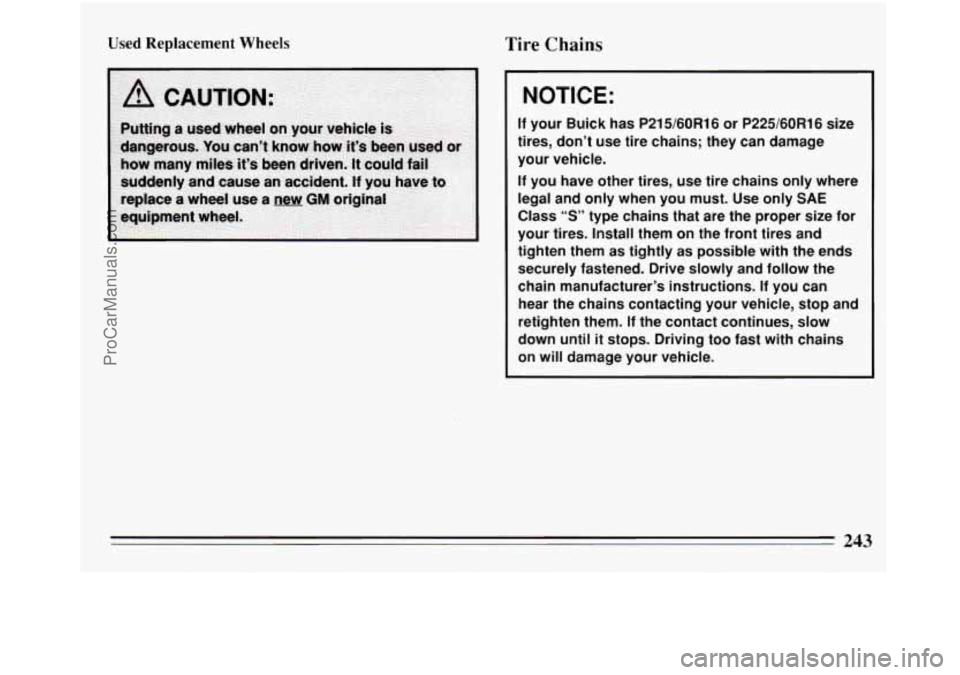
Used Replacement Wheels Tire Chains
NOTICE:
If your Buick has P215/60R16 or P225/60R16 size
tires, don’t use tire chains; they can damage
your vehicle.
If you have other tires, use tire chains only where
legal and only when you must.
Use only SAE
Class “S” type chains that are the proper size for
your tires. Install them on the front tires and
tighten them as tightly as possible with the ends
securely fastened. Drive slowly and follow the
chain manufacturer’s instructions.
If you can
hear the chains contacting your vehicle, stop and
retighten them. If the contact continues, slow
down until
it stops. Driving too fast with chains
on will damage your vehicle.
243
ProCarManuals.com
Page 251 of 308
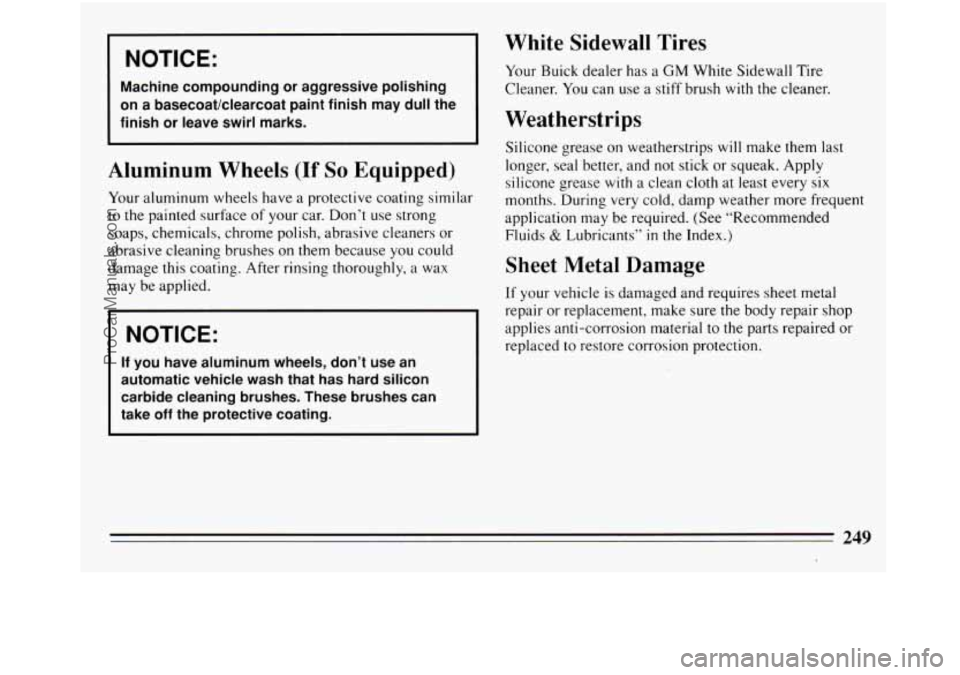
I NOTICE:
Machine compounding or aggressive polishing
on a basecoat/clearcoat paint finish may dull the
finish or leave swirl marks.
Aluminum Wheels (If So Equipped)
Your aluminum wheels have a protective coating similar
to
the painted surface of your car. Don’t use strong
soaps, chemicals, chrome polish, abrasive cleaners or
abrasive cleaning brushes
on them because you could
damage this coating. After rinsing thoroughly, a wax
may be applied.
If you have aluminum wheels, don’t use an
automatic vehicle wash that has hard silicon
carbide cleaning brushes. These brushes can
take off the protective coating.
White Sidewall Tires
Your Buick dealer has a GM White Sidewall Tire
Cleaner. You can use a stiff brush
with the cleaner.
Weatherstrips
Silicone grease on weatherstrips will make them last
longer, seal better, and not stick or squeak. Apply
silicone grease with a clean cloth at least every six
months. During very cold, damp weather more frequent
application may be required. (See “Recommended
Fluids
& Lubricants” in the Index.)
Sheet Metal Damage
If your vehicle is damaged and requires sheet metal
repair or replacement, make sure the body repair shop
applies anti-corrosion material to the parts repaired or
replaced to restore corrosion protection.
249
ProCarManuals.com
Page 274 of 308

Explanation of Scheduled Maintenance
Services
Below are explanations of the services listed in Schedule
I and Schedule 11.
The proper fluids and lubricants to use are listed
in
Section D. Make sure whoever services your vehicle uses
these. All
parts should be replaced and all necessary
repairs done before you or anyone else drives the vehicle.
NOTE: To determine your engine’s displacement and
code, see “Engine Identification”
in the Index.
1.
Engine Oil and Filter Change* -- Always use SH or
SG Energy Conserving I1 oils of proper viscosity. The
“SH” or “SG” designation may be shown alone or in
combination with others, such as “SH/CD,” “SH, SG,
CD,” “SG/CD” etc.
To determine the preferred
viscosity for your vehicle’s engine (e.g., SAE 5W-30-
or SAE 10W-30), see “Engine Oil” in the Index.
2. Chassis Lubrication -- Lubricate the transaxle shift
linkage, parking brake cable guides, underbody
contact points and linkage. If your vehicle is
equipped with grease fittings, lubricate the
suspension and steering linkage. 3.
4.
5.
Tire
and Wheel Rotation and Inspection -- For
proper wear and maximum tire life, rotate your tires
following the instructions
in this manual. See “Tires,
Inspection
& Rotation” in the Index. Check the tires
for uneven wear or damage. If you see irregular or
premature wear, check the wheel alignment. Check
for damaged wheels also.
Engine Accessory Drive Belt(s) Inspection -- Inspect
the belt(s) for cracks, fraying, wear and proper tension.
Replace as needed. (Belts can have small cracks
in
individual ribs without affecting performance).
Cooling System Service* -- Drain, flush and refill
the system
with new or approved recycled coolant
conforming to GM Specification
1825M. Keep
coolant at the proper mixture as specified. See
“Coolant”
in the Index. This provides proper freeze
protection, corrosion inhibitor level and engine
operating temperature.
Inspect hoses and replace if they are cracked, swollen
or deteriorated. Tighten screw-type hose clamps.
Clean the outside of the radiator and air conditioning
condenser. Wash the pressure cap and neck.
272
ProCarManuals.com
Page 277 of 308
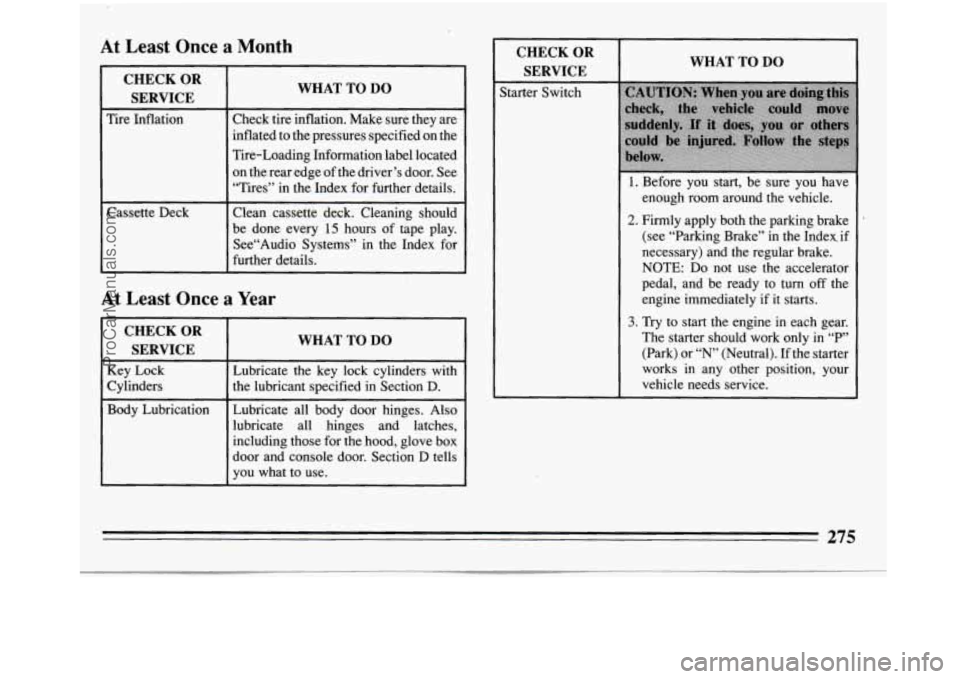
At Least Once a Month
CHECK OR
SERVICE
Tire Inflation
Cassette Deck
WHAT TO DO
Check tire inflation. Make sure they are
inflated to the pressures specified on the
Tire-Loading Information label located
on the rear edge of the driver’s door. See
“Tires” in the Index for further details.
Clean cassette deck. Cleaning should
be done every
15 hours of tape play.
See“Audio Systems” in the Index for
further details.
At Least Once a Year
CHECK OR
SERVICE
Key Lock
Cylinders
Body Lubrication
WHAT TO DO
Lubricate the key lock cylinders with
the lubricant specified in Section D.
Lubricate all body door hinges. Also
lubricate all hinges and latches,
including those for the hood, glove box
door and console door. Section
D tells
you what to use.
WHAT TO DO
1. Before you start, be sure you have
enough room around the vehicle.
2. Firmly apply both the parking brake
(see “Parking Brake” in the Index. if
necessary) and the regular brake.
NOTE: Do not use the accelerator
pedal, and be ready to turn
off the
engine immediately if
it starts.
3. Try to start the engine in each gear.
The starter should work only in
“P”
(Park) or “N’ (Neutral). If the starter
works in any other position, your
vehicle needs service.
275
ProCarManuals.com
Page 296 of 308
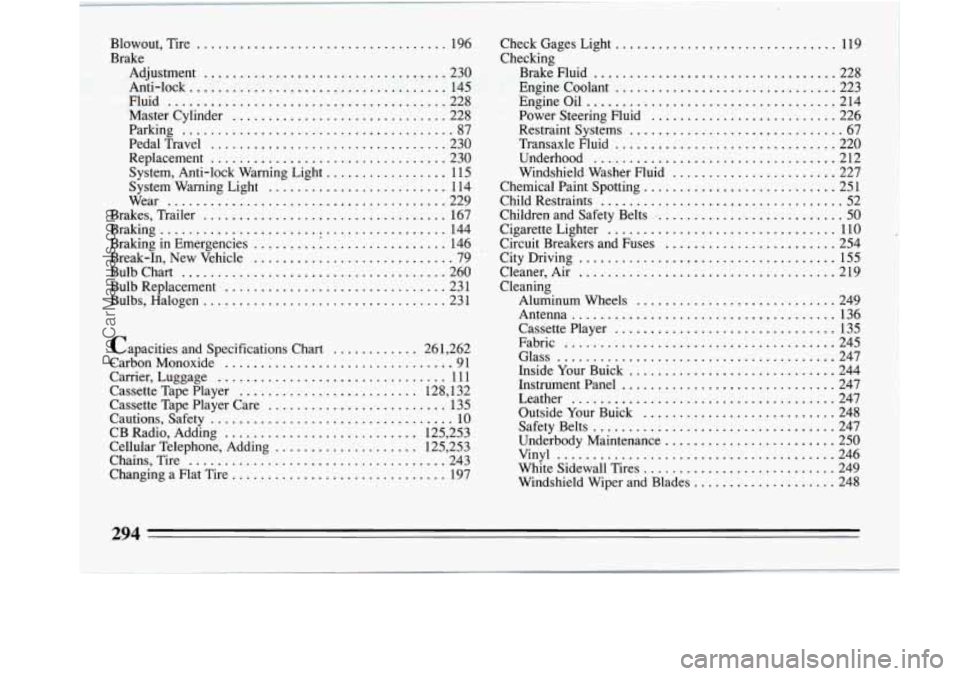
'Blowout. Tire ................................... 196
Adjustment
.................................. 230
Anti-lock
.................................... 145
Fluid
................................. ; ..... 228
Master Cylinder
.............................. 228
Parking
...................................... 87
Replacement
................................. 230
System. Anti-lock Warning Light
................. 115
System Warning Light
......................... 114
Wear
....................................... 229
Brakes. Trailer
.................................. 167
Braking
........................................ 144
Braking in Emergencies
......... : ................. 146
Break-In. New Vehicle
............................ 79
BulbChart
..................................... 2 60
Bulb Replacement ............................... 23 1
Bulbs. Halogen
.................................. 231
Brake
PedalTravel
................................. 230
Capacities and Specifications Chart
............. 261. 262
CarbonMonoxide
...... : ......................... 91
Carrier. Luggage
................................ 11 1
Cassette Tape Player ......................... 128, 132
Cassette Tape Player Care
......................... 135
Cautions, Safety
.................................. 10
CB Radio, Adding ........................... 125, 253
Changing a Flat Tire
.............................. 197
Cellular Telephone, Adding
.................... 125,
253
Chains, Tire
.................................... 243 Check Gages Light
............................... 119
Engine Coolant
................................ 223
Power Steering Fluid
.......................... 226
Restraint Systems
............................... 67
Transaxle Fluid
............................... 220
Underhood
.................................. 212
Windshield Washer Fluid
....................... 227
Chemical Paint Spotting
........................... 251
Child Restraints
.................................. 52
Children and Safety Belts
........................... 50
Cigarette Lighter ................................ 110
Circuit Breakers and Fuses
........................ 254
CityDriving
.................................... 155
Cleaner. Air
.................................... 219
Cleaning Aluminum Wheels
............................ 249
Antenna
..................................... 136
Cassette Player
............................... 135
Fabric
...................................... 245
Glass
....................................... 247
Inside Your Buick
............................. 244
Instrument Panel
.............................. 247
Leather
..................................... 247
Outside Your Buick
........................... 248
Safety Belts
.................................. 247
Underbody Maintenance
........................ 250
Vinyl
....................................... 246
White Sidewall Tires
........................... 249
Windshield Wiper and Blades
.................... 248
Checking
BrakeFluid
.................................. 228
Engine Oil
.................................... 214
294
ProCarManuals.com
Page 300 of 308
NightDriving ................................... 152
Number. Vehicle Identification (VIN)
................ 253
Octane Requirements
........................... 209
Odometer
...................................... 1 11
Oil. Engine ..................................... 214
Off-Road Recovery
.............................. 149
Change
..................................... 218
Quality
..................................... 2 16
Warning Light
................................ 117
Overheated Engine
............................... 187
Overdrive. Automatic
............................. 85
Paint Spotting
.................................. 251
Park Position
.................................... 84
Parking Park. Shifting Into
................................ 87
Over Things That Burn
.......................... 90
With the Engine Running ........................ 91
Passing
........................................ 14 9
PASS-Key Security System ......................... 78
Polishing and Waxing
............................ 248
Antenna
..................................... 136
DoorLocks
................................... 73
Mirrors
..................................... 106
Seats
........................................ 15
Brake ........................................ 87
With a Trailer
................................ 169
Power Steering
..................................... 146
Steering Fluid
................................ 226
Windows
..................................... 92
Pregnancy. Safety Belts Use ........................ 38
Problems on the Road ............................ 171
Publications. Service
............................. 288
Radiator Overheating
............................ 187
Radiator Pressure Cap
............................ 225
Radio
......................................... 125
Reading Lights
.................................. 104
Rear Window Defogger
................... ! ....... 125
Reclining Seatbacks
............................... 16
Remote Keyless Entry System ....................... 74
Remote Trunk Release
............................. 73
Replacing Brake System Parts
............................ 230
Lights Bulbs
........................ 1 ........ 231
Safety Belts
................................... 68
Tires
....................................... 239
Wheels
..................................... 242
Reporting Safety Defects
.......................... 285
Restraint System. Supplemental (Air Bag)
............. 33
Restraint Systems
................................. 19
Restraints. Child
.................................. 52
Restraints. Head
.................................. 17
Reverse Gear Position
............................. 84
Roadside Assistance
.............................. 287
Rocking Your Vehicle
............................ 206
Rotation. Tire
................................... 238
Running Your Engine While Parked
.................. 91
298
ProCarManuals.com