gas type BUICK REGAL 1994 Owners Manual
[x] Cancel search | Manufacturer: BUICK, Model Year: 1994, Model line: REGAL, Model: BUICK REGAL 1994Pages: 308, PDF Size: 15.78 MB
Page 38 of 308
When is an air bag expected to inflate?
The air bag is designed to inflate in moderate to severe
frontal or near-frontal crashes. The air bag will only
inflate if the velocity of the impact is above the designed
threshold level. When impacting straight into a wall that
does not move or deform,
the threshold level for most
GM vehicles is between 9 and 15 mph (14 and 23
km/h). However, this velocity threshold depends on the
vehicle design and may be several miles-per-hour faster
or slower. In addition, this threshold velocity will be
considerably higher if the vehicle strikes an object such
as a parked car which will move and deform on impact.
The air bag is also not designed
to inflate in rollovers,
side impacts, or rear impacts where the inflation would
provide
no occupant protection benefit.
In any particular crash, the determination of whether
the
air bag should have inflated cannot be based solely on
the level of damage on the vehicle(s). Inflation is
determined by the angle
of the impact and the vehicle’s
deceleration, of which vehicle damage is only one
indication. Repair cost is
not a good indicator of
whether an air bag should have deployed.
What makes an air bag inflate?
In a frontal impact of sufficient severity, the air bag
sensing system detects that
the vehicle is suddenly
stopping as a result of a crash. The sensing system
triggers a chemical reaction of the sodium azide sealed
in the inflator. The reaction produces nitrogen gas,
which inflates the cloth bag. The inflator, cloth bag, and
related hardware are all part of the air bag inflator
module packed inside the steering wheel.
How does an air bag restrain?
In moderate to severe frontal or near-frontal collisions,
even belted occupants can contact the steering wheel.
The air bag supplements the protection provided by
safety belts. Air bags distribute the force of the impact
more evenly over the occupant’s upper body, stopping
the occupant more gradually. But air bags would not
provide protection
in many types of collisions, including
rollovers and rear and side impacts, primarily because
an occupant’s motion is not toward the air bag. Air bags
should never be regarded as anything more than a
supplement to safety belt protection in moderate to
severe frontal and near-frontal collisions.
36
ProCarManuals.com
Page 214 of 308
Checking Things Under the Hood
Be careful not to spill gasoline. Clean gasoline from
painted surfaces as soon as possible. See “Cleaning the
Outside
of Your Buick” in the Index.
When you put.the cap back on, turn it to the right until
you hear
a clicking noise.
NOTICE:
If you need a new cap, be sure to get the right
type. Your dealer can get one for you.
If you get
the wrong type, it may not fit or have proper
venting, and your
fuel tank and emissions
system might be damaged.
Hood Release
1
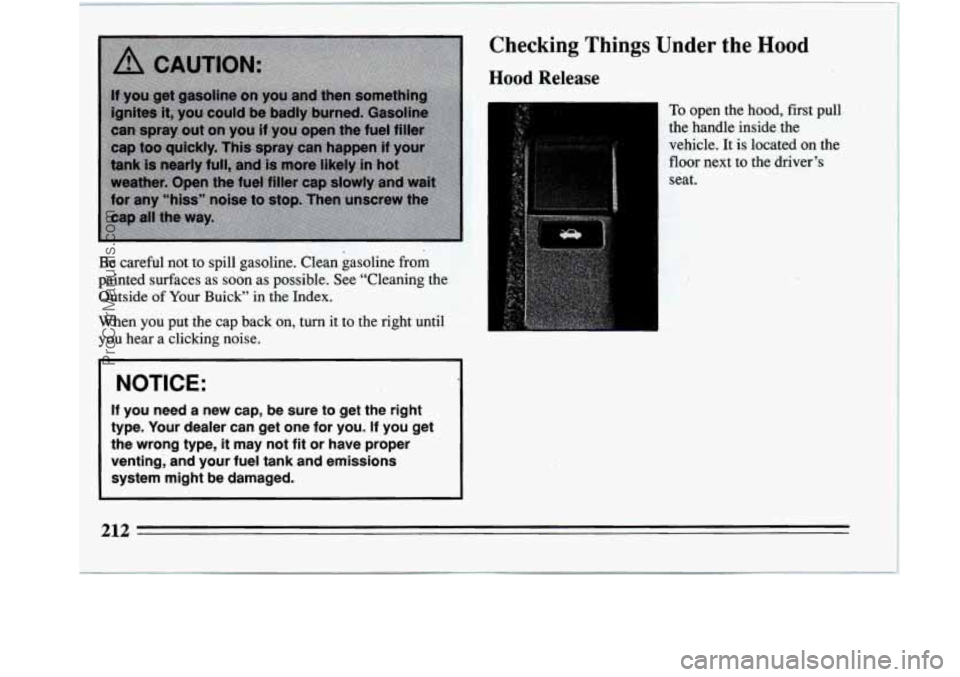
To open the hood, first pull
the handle inside the
vehicle. It is located on the
floor next to the driver’s
seat.
212
ProCarManuals.com
Page 246 of 308
Appearance Care
Remember, cleaning products can be hazardous. Some
are toxic. Others can burst into flame
if you strike a
match or get them on a hot part of the vehicle. Some are
dangerous if you breathe their fumes in a closed space.
When you use anything from a container to clean your
Buick, be sure to follow the manufacturer’s warnings
and instructions. And always open your doors
or
windows when you’re cleaning the inside.
Never use these to clean your vehicle:
0
0
0
0
0
0
0
0
a
Gasoline Benzene
Naphtha Carbon Tetrachloride
Acetone
Paint Thinner
Turpentine
Lacquer Thinner
Nail Polish Remover
They can all be hazardous
-- some more than others --
and they can all damage your vehicle, too.
NOTICE:
Don’t use any of these unless this manual says
you can. In many uses, these
will damage your
vehicle:
Alcohol
0 Laundry Soap
Bleach
Reducing Agents
Cleaning the Inside of Your Buick
Use a vacuum cleaner often to get rid of dust and loose
dirt. Wipe vinyl or leather with a clean, damp cloth.
Your Buick dealer has two
GM cleaners, a solvent-type
spot lifter and a foam-type powdered cleaner. They will
clean normal spots and stains very well.
Do not use
them on
vinyl or leather.
Here are some cleaning tips:
0 Always read the instructions on the cleaner label.
0 Clean up stains as soon as you can -- before they set.
0 Use a clean cloth or sponge, and change to a clean
area often.
A soft brush may be used if stains are
stubborn.
244
ProCarManuals.com
Page 275 of 308
To help ensure proper operation, we recommend a
pressure test of both the cooling system and the
pressure cap.
6. Transaxle Service -- Change both the fluid and filter
every
15,000 miles (25 000 km) if the vehicle is
mainly driven under one or more
of these conditions:
In heavy city traffic where the outside
temperature regularly reaches
90 F (32 C) or
higher.
In hilly or mountainous terrain.
When doing frequent trailer towing.
Uses such as found in taxi, police car or delivery
service.
If you do not use your vehicle under any of these
conditions, change both the fluid and filter every
100,000 miles (1 60 000 km).
7.
8.
9.
Spark Plug Replacement* -- Replace spark plugs
with the proper type. See “Specifications Chart” in
the Index.
Spark Plug Wire Inspection*? -- Inspect for burns,
cracks
or other damage. Check the boot fit at the
distributor and at the spark plugs. Replace wires as
needed.
Air Cleaner Filter Replacement* -- Replace every
30,000 miles (50 000 km) or more often under dusty
conditions. Ask your dealer for the proper
replacement intervals for your driving conditions.
10. Fuel Tank, Cap and Lines Inspection*? -- Inspect
fuel tank, cap and lines (including fuel rails and
injection assembly,
if equipped) for damage or leaks.
Inspect fuel cap gasket for an even filler neck
imprint or any damage. Replace parts as needed.
Periodic replacement of the fuel filter is not required.
* An Emission Control Service.
The
U.S. Environmental Protection Agency or the California Air Resources Board has determined that the failure to perform this maintenance item will not nullify the
emission warranty or limit recall liability prior to the completion of vehicle useful life. General Motors, however, urges that all recommended maintenance services be
performed at the indicated intervals and the maintenance be recorded in “Section E:Maintenance Record”. s
ProCarManuals.com