no start BUICK REGAL 1995 User Guide
[x] Cancel search | Manufacturer: BUICK, Model Year: 1995, Model line: REGAL, Model: BUICK REGAL 1995Pages: 340, PDF Size: 17.16 MB
Page 76 of 340
Driving Through Deep Standing
Water
NOTICE:
If you drive too quickly through deep puddles or
standing water, water can come in through your
engine’s
air intake and badly damage your
engine. Never drive through water that
is slightly
lower than the underbody
of your vehicle. If you
can’t avoid deep puddles or standing water, drive
through them very slowly.
Engine Coolant Heater (Option)
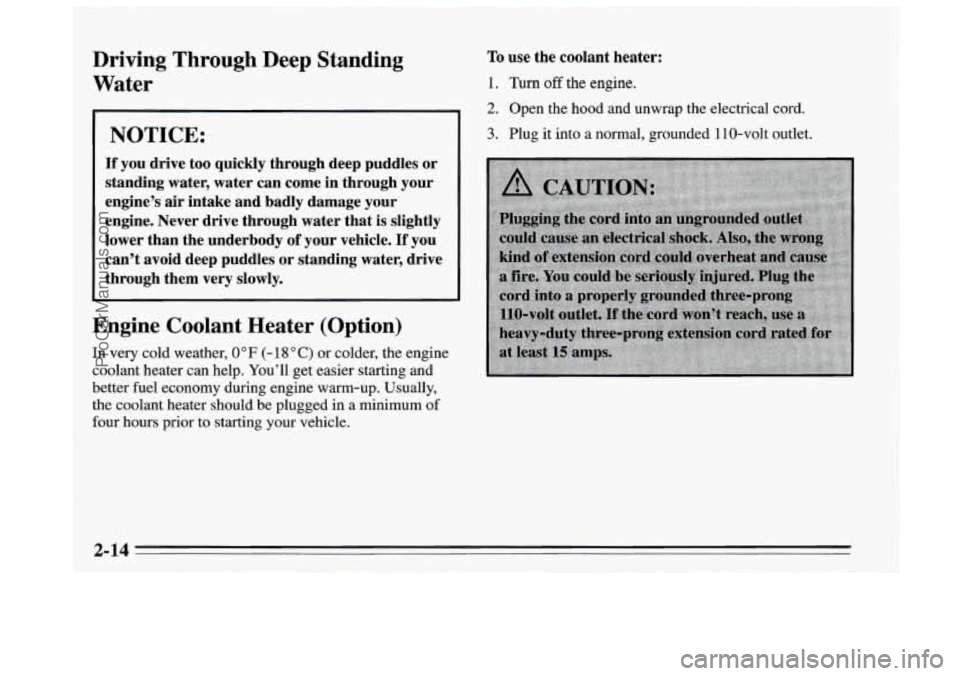
To use the coolant heater:
I. Turn off the engine.
2. Open the hood and unwrap the electrical cord.
3. Plug it into a normal, grounded 110-volt outlet.
In very cold weather,
0°F (- 18 O C) or colder, the engine
coolant heater can help. You’ll get easier starting and
better fuel economy during engine warm-up. Usually,
the coolant heater should be plugged in a minimum
of
four hours prior to starting your vehicle.
2-14
ProCarManuals.com
Page 77 of 340
NOTICE:
After you’ve used the coolant heater, be sure to
store the cord as it was before to keep it away
from moving engine parts. If you don’t, it could
be damaged.
How long should you keep the coolant heater plugged
in? The answer depends on the weather, the kind of oil
you have, and some other things. Instead of trying to list
everything here, we ask that you contact your Buick
dealer in the area where you’ll be parking your vehicle.
The dealer can give you the best advice for that
particular area.
Automatic Transaxle
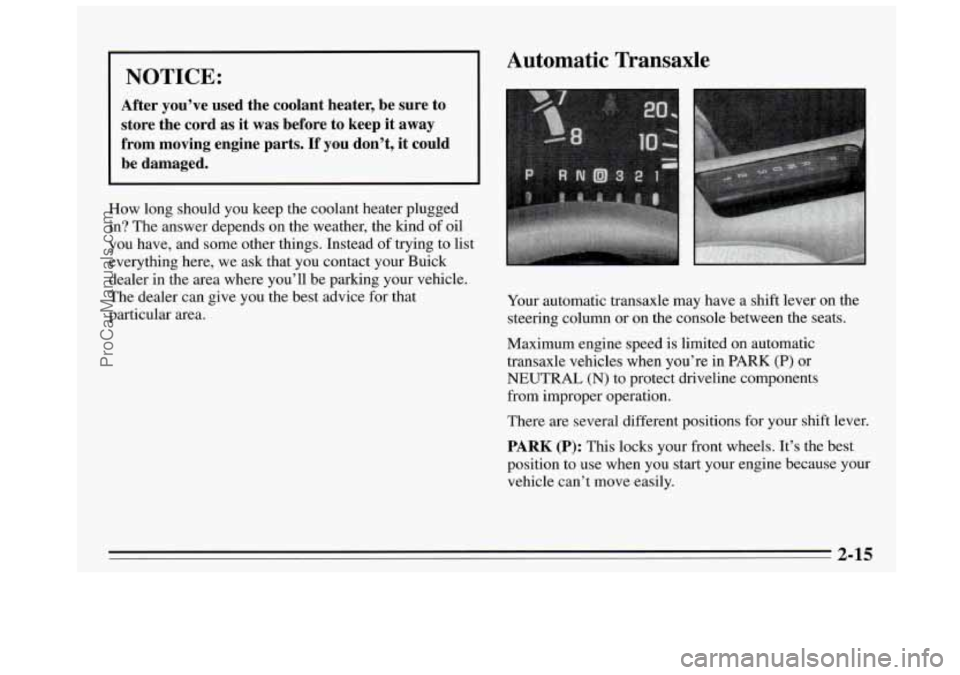
Your automatic transaxle may have a shift lever on the
steering column or on the console between the seats.
Maximum engine speed is limited on automatic
transaxle vehicles when you’re in
PARK (P) or
NEUTRAL (N) to protect driveline components
from improper operation.
There are several different positions for your shift lever.
PARK (P): This locks your front wheels. It’s the best
position to use when you start your engine because your vehicle can’t move easily.
2-15
ProCarManuals.com
Page 78 of 340
Make sure the shift lever is fully into PARK (P) range
before starting the engine. Your Buick has a
brake-transaxle shift interlock. You must fully apply
your regular brakes before you can shift from
PARK (P)
when the ignition is in RUN. If you cannot shift out of
PARK
(P), ease pressure on the shift lever by pushing
it all the way into PARK (P) while keeping the brake
pedal pushed down. Release the shift lever button
if
you have a console shift. Then move the shift lever out
of PARK (P), being sure to press the shift lever button
if you have a console shift. See “Shifting Out of
PARK (P)” in the Index.
REVERSE (R): Use this gear to back up.
NOTICE:
Shifting to REVERSE (R) while ybm vehicle is
moving forward could damage your transaxle.
Shift to REVERSE
(R) only after your vehicle
is stopped.
To rock your vehicle back and forth to get out of snow,
ice
or sand without damaging your transaxle, see
“Stuck: In Sand, Mud, Ice or Snow” in the Index.
NEUTRAL (N): In this position, your engine doesn’t
connect with the wheels.
To restart when you’re already
moving, use NEUTRAL (N)
only. Also, use
NEUTRAL (N) when your vehicle is being towed.
ProCarManuals.com
Page 79 of 340

I NOTICE:
Damage to your transaxle caused by shifting out of
PARK (P) or NEUTRAL (N) with the engine
racing isn’t covered by your warranty.
DRIVE (D): This position is for normal driving. It is the
Overdrive position.
If you need more power for passing,
and you’re:
- Going less than 35 mph (56 km/h), push your
accelerator pedal about halfway
down.
- Going about 35 mph (56 km/h) or more, push the
accelerator pedal all
the way down.
You’ll shifi down to the next gear and have more power.
NOTICE:
If your vehicle seems to start up rather slowly, or
if it seems not to shift gears as you go faster,
something may be wrong with
a transaxle system
sensor.
If you drive very far that way, your vehicle
can be damaged.
So, if this happens, have your
vehicle serviced right away. Until then, you can
use
SECOND (2) when you are driving less than
35 mph (56 km/h) and DRIVE (D) for higher speeds.
THIRD (3): THIRD (3) is like DRIVE (D), but you
never go into Overdrive.
Here are some times you might choose
THIRD (3)
instead of DRIVE (D):
- When driving on hilly, winding roads.
- When towing a trailer, so there is less shifting
- When going down a steep hill.
between gears.
2-17
ProCarManuals.com
Page 84 of 340
Shifting Out of PARK (P)
Your Buick has a brake-transaxle shift interlock. You
must fully apply your regular brakes before you can
shift from PARK
(P) when the ignition is in RUN. See
“Automatic Transaxle” in the Index.
If you cannot shift out of PARK (P), ease pressure on
the shift lever by pushing
it all the way into PARK (P)
while keeping the brake pedal pushed down. Release the
shift lever button
if you have a console shift. Then move
the shift lever
out of PARK (P), being sure to press the
shift lever button
if you have a console shift.
If
you ever hold the brake pedal down but still can’t
shift out
of PARK (P), try this:
I. Turn the key to OFF.
2. Apply and hold the brake until the end of step 4.
3. Shift to NEUTRAL (N).
4. Start the vehicle and shift to the drive gear you want.
5. Have the vehicle fixed as soon as you can.
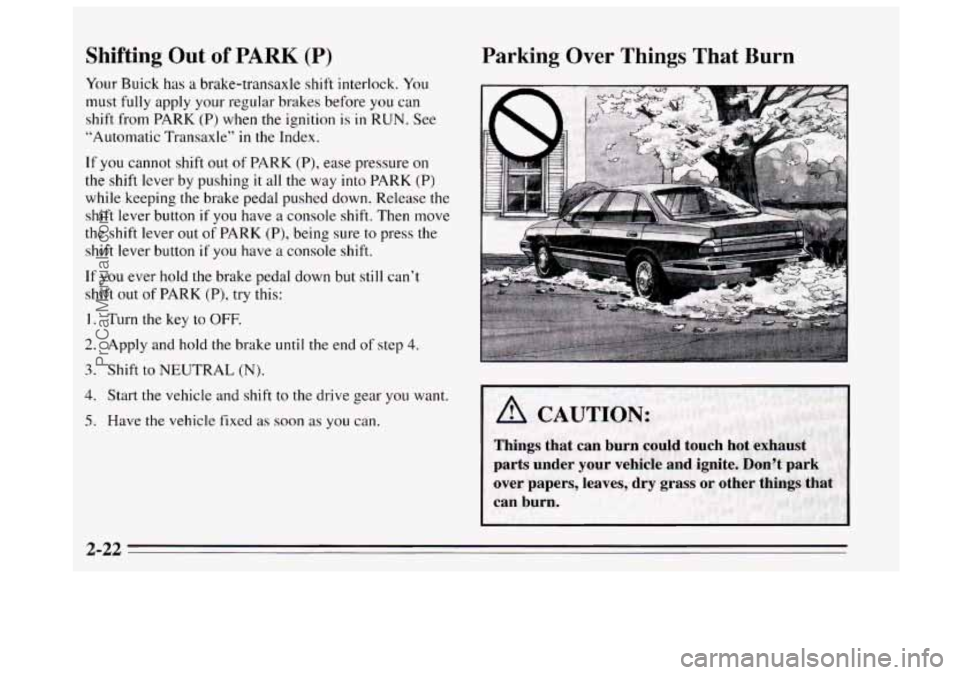
Parking Over Things That Burn
2-22
ProCarManuals.com
Page 88 of 340
Turn Signal and Lane Change Indicator
The turn signal has two upward (for right) and two
downward (for left) positions. These positions allow you
to signal a turn or a lane change.
To signal
a turn, move the lever all the way up or down.
When
the turn is finished, the lever will return
automatically.
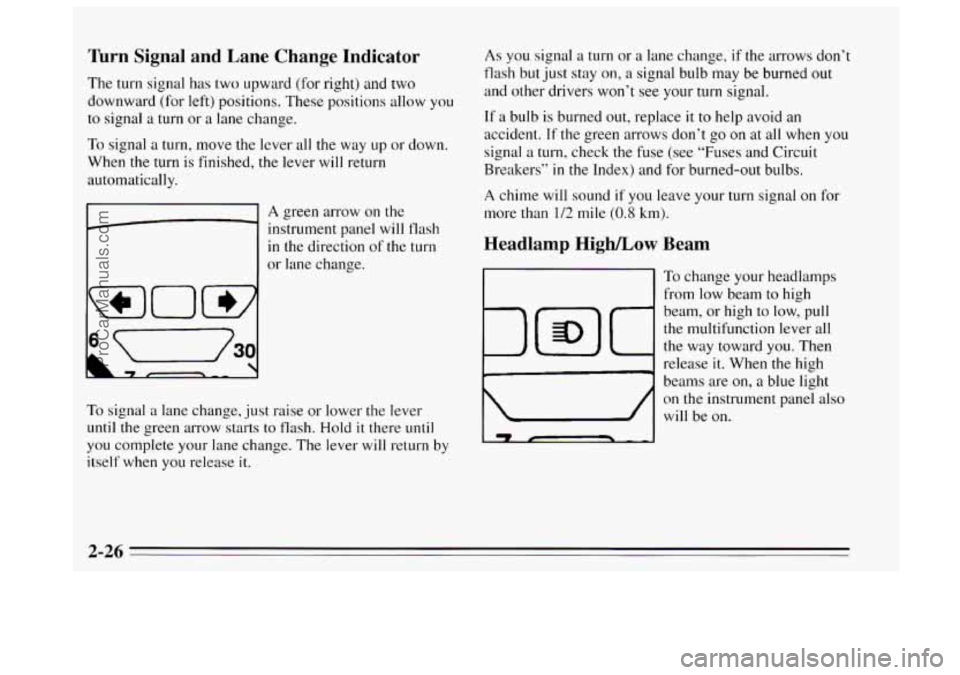
A green arrow on the
instrument panel will flash
in the direction of the turn
or lane change.
To signal a lane change, just raise or lower the lever
until the green arrow starts to flash. Hold it there until
you complete your lane change. The lever will return by
itself when you release it.
As you signal a turn or a lane change, if the arrows don’t
flash but just stay on, a signal bulb may be burned out
and other drivers won’t see
your turn signal.
If a bulb is burned out, replace
it to help avoid an
accident. If the green arrows don’t go on at all
when you
signal a turn, check the fuse (see
“Fuses and Circuit
Breakers”
in the Index) and for burned-out bulbs.
A chime will sound if you leave your turn signal on for
more than 1/2 mile
(0.8 km).
Headlamp High/Low Beam
bmd
To change your headlamps
from low beam to high
beam, or high to low, pull
the multifunction lever all
the way toward you. Then
release
it. When the high
beams are on,
a blue light
on the instrument panel
also
will be on.
2-26
ProCarManuals.com
Page 94 of 340

Instrument Panel Lamps
You can brighten or dim the instrument panel lamps by
moving the PANEL
LAMPS dial. If you turn the dial
past
HI, your courtesy or interior lamps will conle on.
Daytime Running Lamps (Canada Only)
Daytime Running Lamps (DRL) can make it easier for
others to see the front of your vehicle during the day.
DRL can be helpful in many different driving
conditions, but they can be especially helpful
in the
short periods after dawn and before sunset.
A light sensor on top of the instrument panel makes the
DRL work,
so be sure it isn’t covered,
The
DRL system will make your low-beam headlamps
come on at a reduced brightness when: When the DRL
are
on, only your low-bearn headlamps
will be on. The taillamps, sidemarker and other lamps
won‘t be
on. Your instrument panel won’t be lit up either.
When it’s dark enough outside, your low-beam
headlamps will change to
full brightness. The other lamps
that come
on with your headlamps will also come on.
When it’s bright enough outside, the regular lamps
will
go off, and your low-beam headlamps change to the
reduced brightness of DRL.
To idle your vehicle with the DRL off, set the parking brake
while the ignition is
in OFF or LOCK. Then start your vehicle.
The
DIU will stay off until you release the parking brake.
As with any vehicle, you should turn on the regular
headlamp system any time you need it.
0 The ignition is on,
0 The headlamp switch is off, and
0 The parking brake is released.
2-32
ProCarManuals.com
Page 95 of 340
Interior Lamps
When any door is opened, several lamps come on. These
lamps
are courtesy lamps. They make it easy for you to enter
and leave your
vehcle. You can also turn these lamps on by
moving the PANEL LAMPS dial all the way up past
HI.
Some of the lamps have switches so you can turn them
on, even when the doors are closed. These lamps are
reading lamps.
To avoid draining your battery, be sure to
turn
off all reading lamps when leaving your vehicle.
Illuminated Entry
Battery Saver
Your vehicle has a feature to help prevent you from draining
the battery, in case you accidentally leave the courtesy lamps
on. If you leave the PANEL LAMPS dial turned all the
way up past
HI, or if you leave a door open, the lamps will
automatically
turn off after 10 minutes if the ignition is off.
This feature will not turn off the reading lamps, only the
lamps controlled by
the PANEL LAMPS dial. Be sure to
turn off any reading lamps using the switch before you
leave the vehicle. Your
courtesy lamps will come on and stay on for
a set
time whenever you:
Pull a front door handle.
0 Press UNLOCK on the Remote Lock Control
(if equipped).
0 Press DOOR on the Remote Lock Control
(if equipped).
If you open
a door, the lamps will stay on while it’s open
and then turn off automatically about 18 seconds after
you close it. If you don’t open a door,
the lamps will
turn off after about 18 seconds, unless you pressed
UNLOCK
on the Remote Lock Control. If you pressed
UNLOCK and don’t open
a door, the lamps will turn off
after about 55 seconds.
Illuminated entry includes a feature called theater
dimming. With theater dimming,
the lamps don’t just
turn off at the end of the delay time. Instead, they slowly
dim during the delay time
until they go out. The delay
time
is cancelled if you turn the ignition key to RUN or
START,
so the lamps will go out right away.
When the ignition is on, Illuminated Entry is inactive,
which means the courtesy lamps won’t come on.
ProCarManuals.com
Page 99 of 340
Convenience Net (Option)
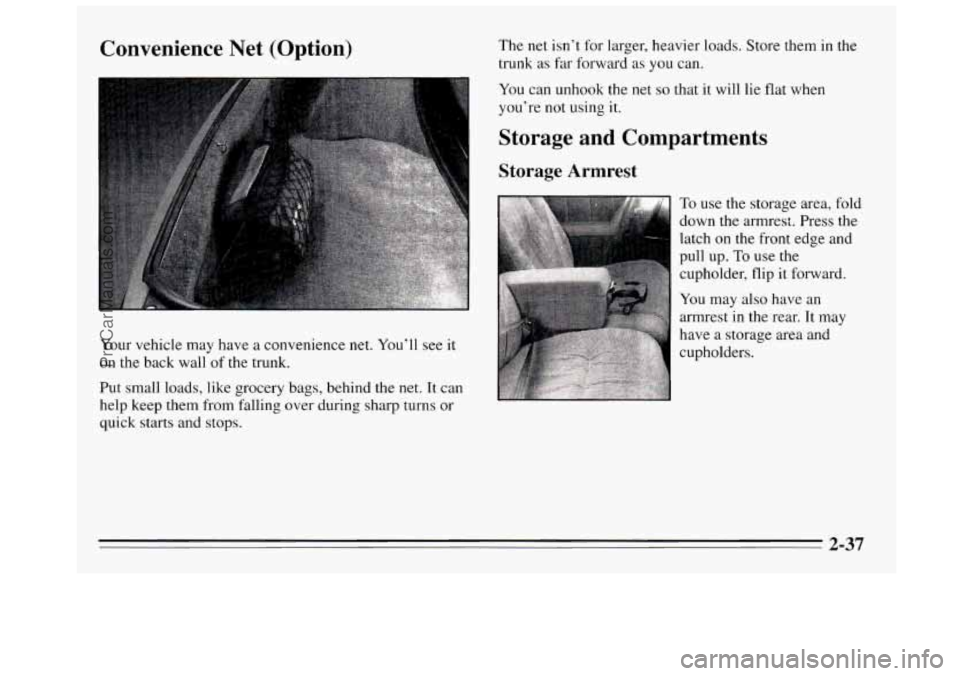
Your vehicle may have a convenience net. You’ll see it
on the back wall of the trunk.
Put small loads, like grocery bags, behind the net. It can
help keep them from falling over during sharp turns or
quick starts and
stops.
The net isn’t for larger, heavier loads. Store them in the
trunk as far forward as you can.
You can unhook the net so that it will lie flat when
you’re not using it.
Storage and Compartments
Storage Armrest
To use the storage area, fold
down the armrest. Press the
latch on the front edge and
pull
up. To use the
cupholder, flip it forward.
You may also have an
armrest in the rear. It may
have a storage area and
cupholders.
2-37
ProCarManuals.com
Page 106 of 340
Warning Lights, Gages and
Indicators
This part describes the warning lights and gages that
may be on your vehicle. The pictures will help
you
locate them.
Warning lights and gages can signal that something
is
wrong before it becomes serious enough to cause an
expensive repair or replacement. Paying attention to
your warning lights and gages could also save
you or
others from injury.
Warning lights come on when there may be or is a
problem with one of your vehicle’s functions. As
you
will see in the details on the next few pages, some
warning lights come
on briefly when you start the
engine just to let
you know they’re working. If you are
familiar with this section, you should
not be alarmed
when this happens.
Gages can indicate when there may be or is
a problem
with one of your vehicle’s functions. Often gages and
warning lights work together to let you know when
there’s a problem with your vehicle. When
one
of the warning lights comes on and stays on
when you are driving, or when one of the gages shows
there may be a problem, check the section that tells
you
what to do about it. Please follow this manual’s advice.
Waiting
to do repairs can be costly -- and even
dangerous.
So please get to know your warning lights
and gages. They’re
a big help.
Fuel Gage
I UNLEADED FUEL ONLY
I
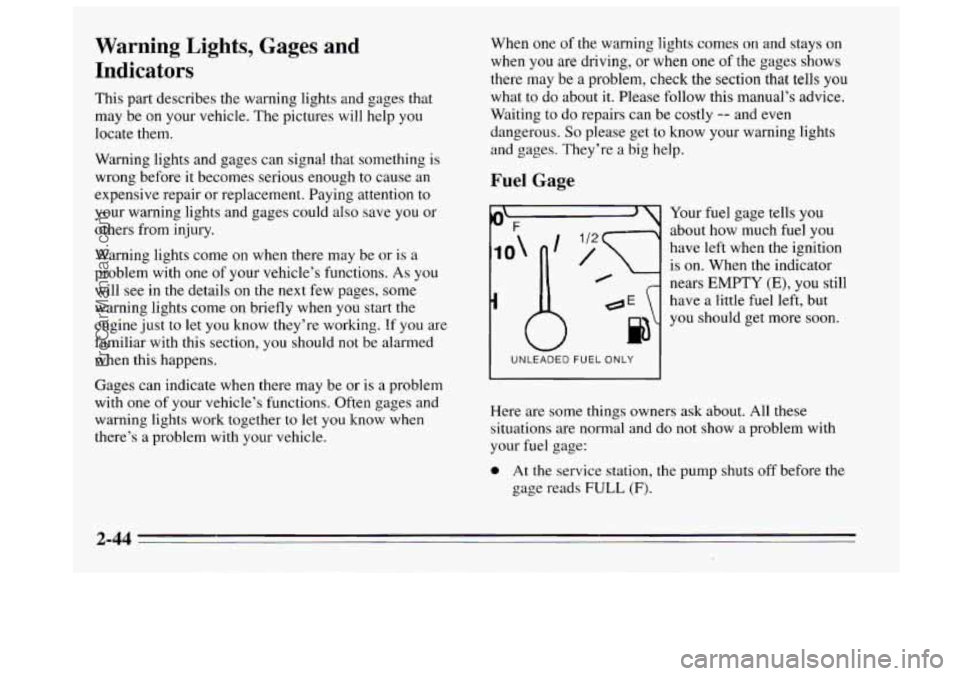
Your fuel gage tells you
about how much fuel you
have left when the ignition
is on. When the indicator
nears
EMPTY (E), you still
have a little fuel left, but
you should get more soon.
Here are some things owners ask about. All these
situations are normal and do not show
a problem with
your fuel gage:
0 At the service station, the pump shuts off before the
gage reads
FULL (F).
2-44
ProCarManuals.com