radio BUICK REGAL 1995 User Guide
[x] Cancel search | Manufacturer: BUICK, Model Year: 1995, Model line: REGAL, Model: BUICK REGAL 1995Pages: 340, PDF Size: 17.16 MB
Page 130 of 340
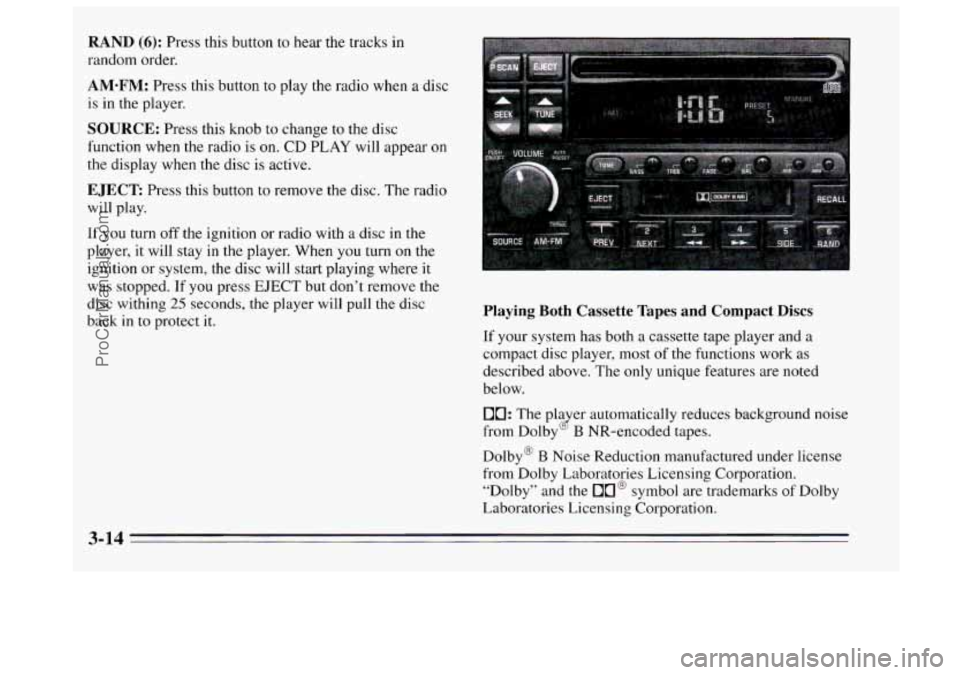
RAND (6): Press this button to hear the tracks in
random order.
AM-FM: Press this button to play the radio when a disc
is
in the player.
SOURCE: Press this knob to change to the disc
function when
the radio is on. CD PLAY will appear on
the display when the disc is active.
EJECT: Press this button to remove the disc. The radio
will play.
If
you turn off the ignition or radio with a disc in the
player, it will stay in the player. When you turn
on the
ignition or system, the disc will start playing where
it
was stopped. If you press EJECT but don’t remove the
disc withing
25 seconds, the player will pull the disc
back
in to protect it. Playing Both Cassette Tapes and Compact Discs
If your system has both a cassette tape player and a
compact disc player, most of the functions work as
described above. The only unique features are noted
below.
10: The pla er automatically reduces background noise
from Dolby
B NR-encoded tapes. (2
Dolby@ B Noise Reduction manufactured under license
from Dolby Laboratories Licensing Corporation. “Dolby” and the
On@ symbol are trademarks of Dolby
Laboratories Licensing Corporation.
3-14
ProCarManuals.com
Page 131 of 340
AUTO PRESET Press it and the system will set the 12
strongest
FM or the 6 strongest AM stations on your
preset buttons. To return to
the stations you manually
set, press the AUTO PRESET button again. (This button
performs
the same function as AUTO SET described
above.)
EJECT The system has two EJECT buttons. Press the
button near the CD slot to remove a disc. Press the button
near the tape slot to remove a tape. The radio will play.
SOURCE: Press this knob to change to the tape or disc
function when the radio
is on. If both a tape and a disc are
installed, the system
will first go to tape play; TAPE will
appear on the display. If SOURCE is pressed again, the
system
will go to disc play; CD will appear on the display.
THEFTLOCK TM
Your system has this feature if it shows Theftlock on its
face. THEFTLOCK
is a theft-deterrent feature that can
be used or ignored.
If you ignore it, your system will
play normally.
If you use it, your system can’t be turned
on if it is stolen because it locks anytime battery power
is removed.
To unlock it, a code must be entered.
These instructions will tell you how to enter a code into
your system. They also
tell you how to unlock the
system with your code and how to shut off the
THEFTLOCK system.
Entering a Code
1. Write down any number from 000 to 1999. This is
your code.
2. Turn the ignition to ACC or RUN.
3. Turn the radio off.
4. Press the I and 4 preset buttons at the same time and
hold
until “- - - ” shows on the display.
You
now have only I5 seconds between each of the
following steps.
5. Press MIN and “000” will appear on the display.
6. Press MIN again and hold until the last two digits of
your code appear.
7. Press and hold HRS until the first digit or digits of
your code appear.
8. Press AM-FM after you make sure the code matches
the one you wrote down. “rEP” will appear on the
display, meaning you should repeat steps
5 through 7.
9. After you repeat the steps, press AM-FM. SEC
should appear on the display, meaning your system is
secured. If your ignition is off, THEFTLOCK will
flash
in the display.
Store
the paper with your code written on it in a safe place.
3-15
ProCarManuals.com
Page 133 of 340
Understanding Radio Reception
FM Stereo FM Stereo will give you the best sound, but FM signals
will reach only about
10 to 40 miles ( 16 to 65 km). Tall
buildings or hills can interfere with FM signals, causing
the sound to come and go.
AM
The range for most
AM stations is greater than for FM.
especially at night. The longer range, however, can
cause stations
to interfere with each other. AM can also
pick up noise from things like storms and power lines.
To lower this noise, try reducing the treble level.
Tips About Your Audio System
Hearing damage from loud noise is almost undetectable
unt.il it is too late. Your hearing can adapt to higher
volumes
of sound. Sound that seems normal can be loud
and harmful to your hearing. Take precautions by
adjusting the volume control on your radio to a safe
sound level before your hearing adapts to it.
To help avoid hearing loss or damage:
0 Adjust the volume control to the lowest setting.
0 Increase volume slowly until you hear cornfortably
and clearly.
NOTICE:
Before you add any sound equipment to your
vehicle
-- like a tape player, CB radio, mobile
telephone or two-way radio
-- be sure you can
add what you want.
If you can, it's very
important to do it properly. Added sound
equipment may interfere with the operation
of
your vehicle's engine, Delco" radio or other
systems, and even damage them. And, your
vehicle's systems may interfere with the
operation
of sound equipment that has been
added improperly.
So, before adding sound equipment, check with
your dealer and be sure
to check Federal rules
covering mobile radio and telephone units.
3-17
ProCarManuals.com
Page 134 of 340
Care of Your Cassette Tape Player
A tape player that is not cleaned regularly is subject to
reduced sound quality, ruining the cassette, or damaging
the mechanism. Tape cassettes that are
not properly
stored in their plastic cases away from contaminants,
direct sunlight, and extreme heat may not operate
properly and could cause premature failure of the tape
player.
Your tape player should be cleaned with every
50 hours
of use to provide optimum performance. Your radio may
display Cln to indicate that
you have used your tape
player for
50 hours without resetting the tape clean
timer. If you notice a reduction in sound quality,
regardless
of when the tape player was last cleaned, try
playing a different cassette to see if the tape or the tape
player is at fault.
Tf the second cassette results in no
improvement
in sound quality, try cleaning the tape
player.
Proper tape player cleaning should be done with a
scrubbing action, nonabrasive cleaner cassette. This is a
wet-type cleaning system that uses
a cleaning cassette
with pads which scrub the tape head as the hubs of the
cleaner cassette turn.
To properly clean your tape player,
follow
the instructions with the cleaning cassette. If you
use this type of cleaner, the radio may display an error
and eject the cartridge. This is normal and is the result of an
added feature
in the tape player that detects broken
tapes. If an error occurs, you
will need to insert the
cleaning cassette at least three times to thoroughly clean
the tape player.
You may prefer to use a non-scrubbing action, wet-type
cleaner. This type
of cleaner uses a fabric belt to clean
the tape head. This type of cleaner cassette will not
cause an error,
but it may not clean the tape player as
thoroughly as the scrubbing type cleaner.
A scrubbing action cleaner is available through your
dealer
(GM Part No. 12344600).
Cassettes are subject to wear and the sound quality may
degrade over time. Always verify that the cassette tape
is in good condition and the tape player is clean before
obtaining service on your tape player.
Care of Your Compact Discs
Handle discs carefully. Store them in their original cases
or other protective cases and away from direct sunlight
and dust.
If the surface of a disc is soiled, dampen a
clean, soft cloth
in a mild, neutral detergent solution and
clean
it, wiping from the center to the edge.
Be sure never
to touch the signal surface when handling
discs. Pick up discs
by grasping the outer edges or the
edge of the hole and the outer edge.
ProCarManuals.com
Page 135 of 340
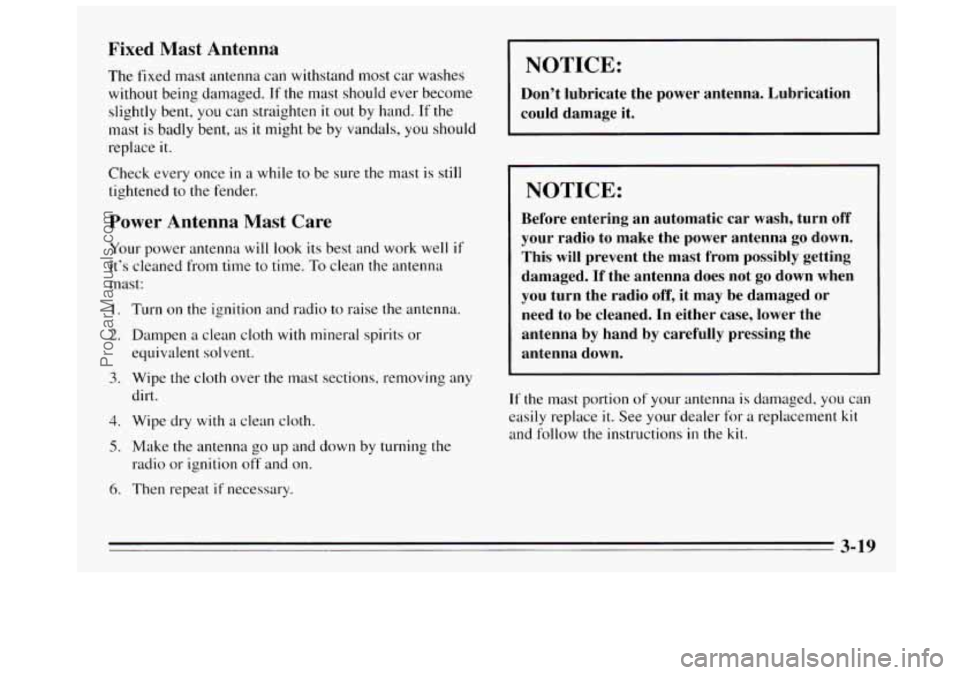
Fixed Mast Antenna
The fixed mast antenna can withstand most car washes
without being damaged.
If the mast should ever become
slightly bent, you can straighten
it out by hand. If the
mast is badly bent,
as it might be by vandals, you should
replace
it.
Check every once in a while to be sure the mast is still
tightened to the fender.
Power Antenna Mast Care
Your power antenna will look its best and work well if
it’s cleaned from time to time, To clean the antenna
mast:
1.
2.
3.
4.
5.
6.
Turn on the ignition and radio to raise the antenna.
Dampen a clean cloth with mineral spirits or
equivalent solvent.
Wipe the cloth over the mast sections, removing any
dirt.
Wipe dry
with a clean cloth.
Make the antenna
go up and down by turning the
radio or ignition
off and on.
Then repeat
if necessary.
NOTICE:
Don’t lubricate the power antenna. Lubrication
could damage it.
NOTICE:
Before entering an automatic car wash, turn off
your radio to make the power antenna go down.
This will prevent the mast from possibly getting
damaged.
If the antenna does not go down when
you turn the radio off, it may be damaged or
need
to be cleaned. In either case, lower the
antenna by hand by carefully pressing the
antenna down.
If the mast portion of your antenna
is damaged, you can
easily replace
it. See your dealer for a replacement kit
and follow the instructions in the kit.
ProCarManuals.com
Page 136 of 340
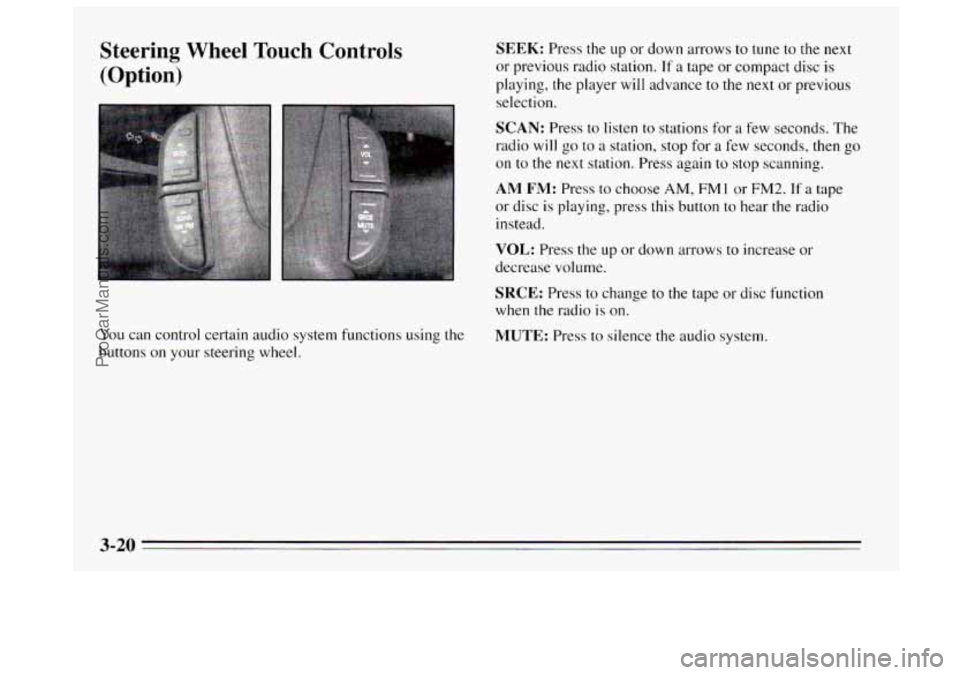
Steering Wheel Touch Controls
(Option)
You can control certain audio system functions using the
buttons on your steering wheel.
SEEK: Press the up or down arrows to tune to the next
or previous radio station.
If a tape or compact disc is
playing, the player will advance to the next or previous
selection.
SCAN: Press to listen to stations for a few seconds. The
radio will go
to a station, stop for a few seconds, then go
on to the next station. Press
again to stop scanning.
AM FM: Press to choose AM, FM1 or FM2. If a tape
or disc
is playing, press this button to hear the radio
instead.
VOL: Press the up or down arrows to increase or
decrease volume.
SRCE: Press to change to the tape or disc function
when the radio is on.
MUTE: Press to silence the audio system.
3-20
ProCarManuals.com
Page 177 of 340
2. Get the vehicles close enough so the jumper cables
can reach,
but be sure the vehicles aren’t touching
each other.
If they are, it could cause a ground
connection
you don’t want. You wouldn’t be able to
start your Buick, and the bad grounding could
damage the electrical systems.
You could be injured
if the vehicles roll. Set the
parking brake firmly on each vehicle. Put an
automatic transaxle
in PARK (P) or a manual
transaxle
in NEUTRAL (N).
3. Turn off the ignition on both vehicles. Turn off all
iamps that aren’t needed, and radios. This will avoid
sparks and help save both batteries. And
it could
save your radio!
NOTICE:
If you leave your radio on, it could be badly
damaged. The repairs wouldn’t be covered
by
your warranty.
4. Open the hoods and locate the batteries.
A CAUTION:
An electric fan can start up even when the engine
is not running and can injure you. Keep hands,
clothing and tools away from any underhood
electric fan.
5. Find the positive (+) and negative (-) terminals on
each battery. Your Buick has a remote positive
(+)
jump starting terminal. The terminal is on the same
side of
the engine compartment as your battery. You
should
always use the remote positive (+) terminal
instead of the positive
(+) terminal on your battery.
To uncover the remote positive
(+) terminal, lift the
red plastic cap.
3-3
ProCarManuals.com
Page 256 of 340
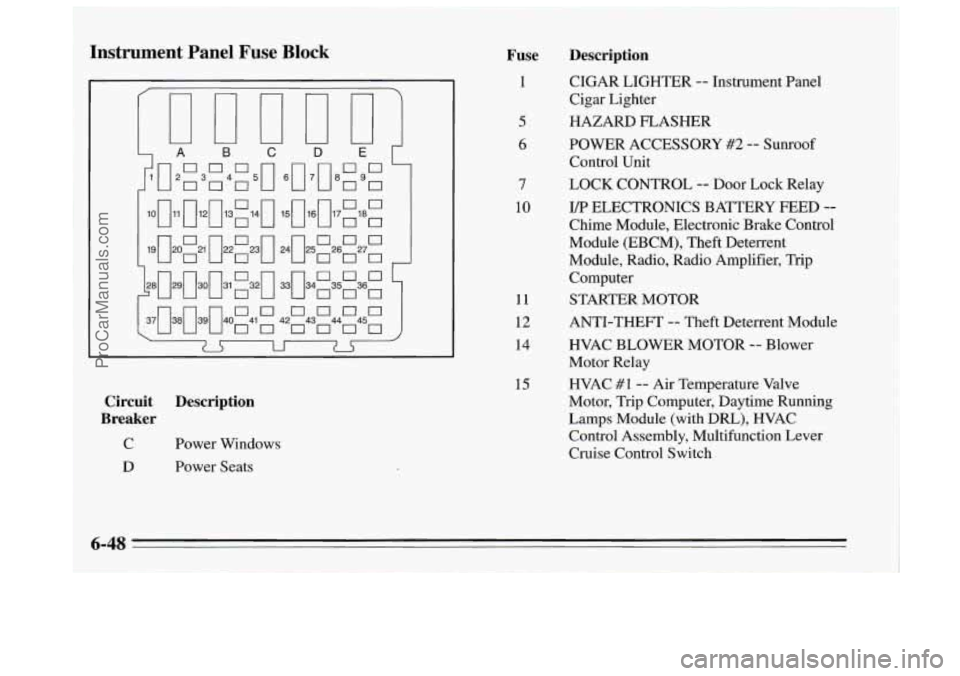
Instrument Panel Fuse Block Fuse
1
5
6
7
10
11
12
14
15
Circuit Description
Breaker
C Power Windows
Description
CIGAR LIGHTER -- Instrument Panel
Cigar Lighter
HAZARD FLASHER
POWER ACCESSORY
#2 -- Sunroof
Control Unit
LOCK CONTROL
-- Door Lock Relay
I/p ELECTRONICS BATTERY FEED --
Chime Module, Electronic Brake Control
Module (EBCM), Theft Deterrent
Module, Radio, Radio Amplifier,
Trip
Computer
STARTER MOTOR
ANTI-THEFT
-- Theft Deterrent Module
HVAC BLOWER MOTOR
-- Blower
Motor Relay
HVAC
#1 -- Air Temperature Valve
Motor,
Trip Computer, Daytime Running
Lamps Module (with
DRL), HVAC
Control Assembly, Multifunction Lever
Cruise Control Switch
D Power Seats
6-48
ProCarManuals.com
Page 257 of 340
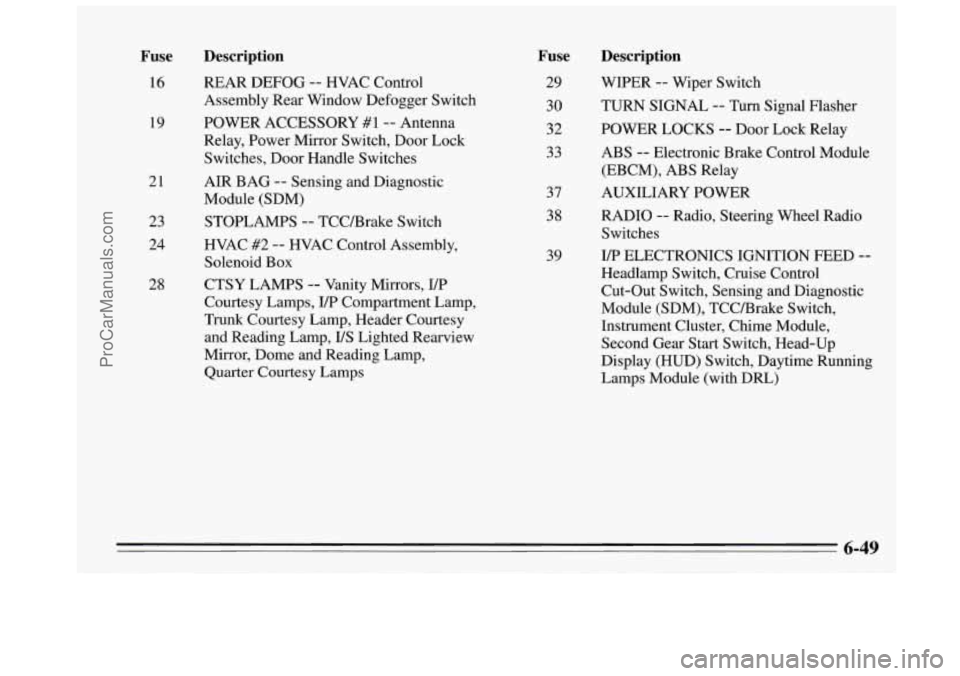
r use
16
19
21
23
24 2s
Description
REAR DEFOG -- HVAC Control
Assembly Rear Window Defogger Switch
POWER ACCESSORY
#1-- Antenna
Relay, Power Mirror Switch, Door Lock
Switches, Door Handle Switches
AIR BAG
-- Sensing and Diagnostic
Module (SDM)
STOPLAMPS
-- TCCBrake Switch
HVAC #2
-- HVAC Control Assembly,
Solenoid Box
CTSY LAMPS
-- Vanity Mirrors, I/P
Courtesy Lamps, UP Compartment Lamp,
Trunk Courtesy Lamp, Header Courtesy
and Reading Lamp,
US Lighted Rearview
Mirror, Dome and Reading Lamp,
Quarter Courtesy Lamps
Fuse
29
30
32
33
37
3s
39
Description
WIPER -- Wiper Switch
TURN SIGNAL
-- Turn Signal Flasher
POWER LOCKS
-- Door Lock Relay
ABS -- Electronic Brake Control Module
(EBCM), ABS Relay
AUXILIARY POWER
RADIO
-- Radio, Steering Wheel Radio
Switches
I/P ELECTRONICS IGNITION FEED --
Headlamp Switch, Cruise Control
Cut-Out Switch, Sensing and Diagnostic
Module (SDM), TCCBrake Switch,
Instrument Cluster, Chime Module,
Second Gear Start Switch, Head-Up
Display (HUD) Switch, Daytime Running
Lamps Module (with DRL)
6-49
I
ProCarManuals.com
Page 260 of 340
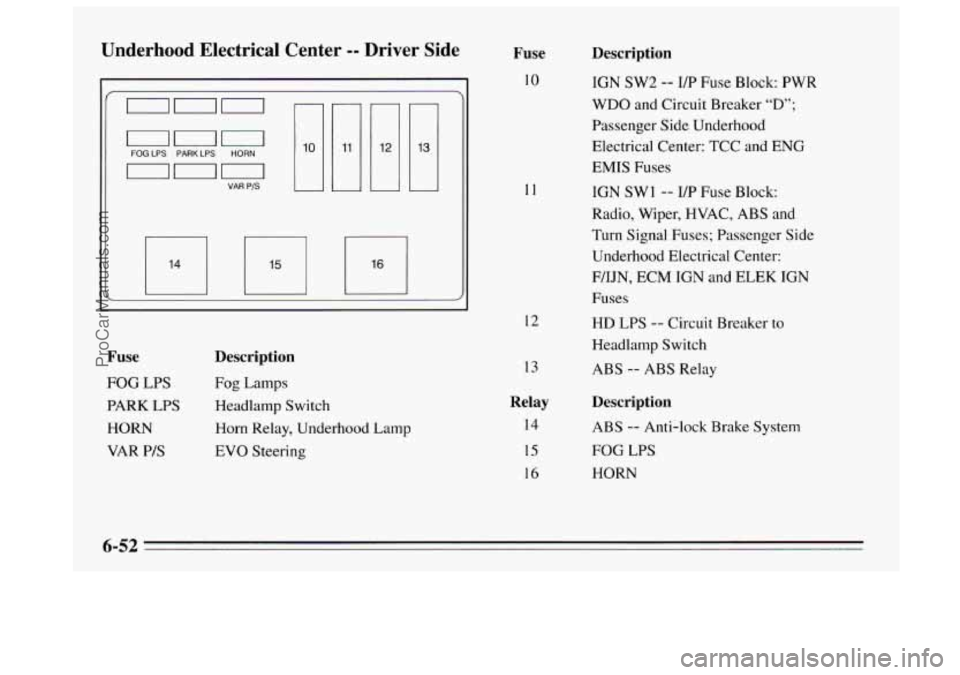
Underhood Electrical Center -- Driver Side
000 FOG LPS PARKLPS HORN
VAR PIS u
12
Fuse
FOG LPS
PARK LPS
HORN
VAR
P/S
uescription
Fog Lamps
Headlamp Switch
Horn Relay, Underhood Lamp
EVO Steering
Fuse
10
11
12
13
Relay
14
15
16
Description
IGN SW2 -- UP Fuse Block: PWR
WDO and Circuit Breaker “D”;
Passenger Side Underhood
Electrical Center:
TCC and ENG
EMIS Fuses
IGN
SW 1 -- UP Fuse Block:
Radio, Wiper, HVAC, ABS and
Turn Signal Fuses; Passenge.r Side
Underhood Electrical Center:
F/IJN,
ECM IGN and ELEK IGN
Fuses
HD LPS -- Circuit Breaker to
Headlamp Switch
ABS
-- ABS Relay
Description
ABS -- Anti-lock Brake System
FOG LPS
HORN
6-52
ProCarManuals.com