index BUICK REGAL 1995 Owner's Guide
[x] Cancel search | Manufacturer: BUICK, Model Year: 1995, Model line: REGAL, Model: BUICK REGAL 1995Pages: 340, PDF Size: 17.16 MB
Page 144 of 340
Avoid needless heavy braking. Some people drive
in spurts -- heavy acceleration followed by heavy
braking
-- rather than keeping pace with traffic. This is a
mistake. Your brakes may not have time to cool between
hard stops. Your brakes will wear out much fidster
if YOLI
do a lot of heavy braking. If you keep pace with the
traffic and allow realistic following distances, you will
eliminate a lot of unnecessary braking. That means
better braking and longer brake life.
If your engine ever stops while you’re driving, brake
normally but don’t pump your brakes. If
you do, the
pedal may get harder to push down. If your engine
stops, you will still have some power brake assist. But
you will use it when you brake. Once the power assist is
used up,
it may take longer to stop and the brake pedal
will be harder to push.
Anti-Lock Brakes (ABS)
Your Buick has an advanced electronic braking system
that will help prevent
a braking skid.
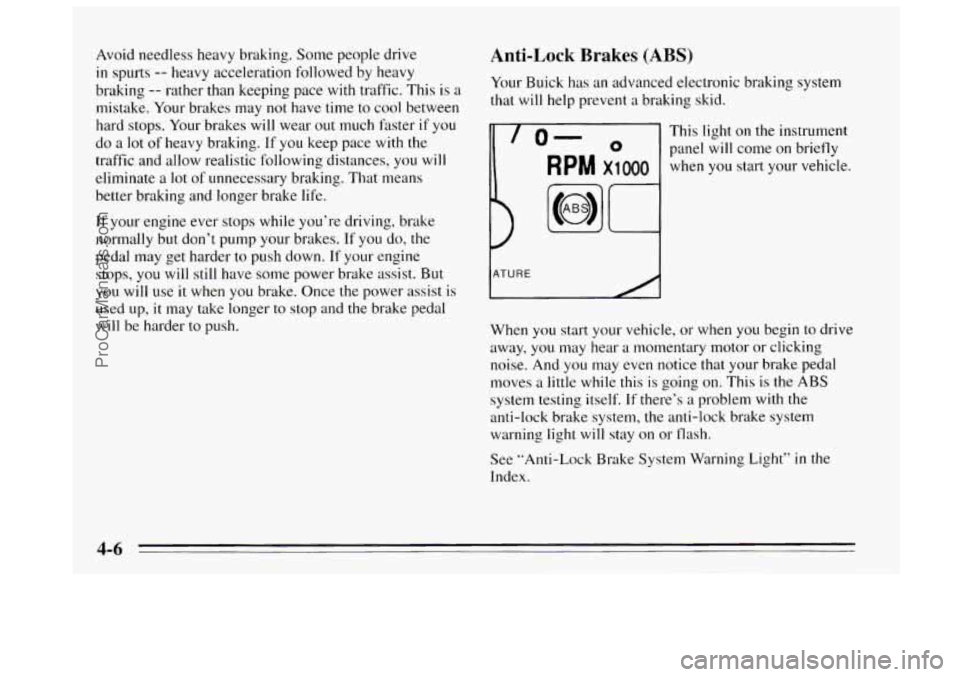
This light on the instrument
panel
will come on briefly
when you start your vehicle.
When you start your vehicle, or when
you begin to drive
away, you may hear
a momentary motor or clicking
noise. And
you may even notice that your brake pedal
moves
a little while this is going on. This is the ABS
system testing itself.
If there’s a problem with the
anti-lock brake system, the anti-lock brake system
warning light
will stay on or flash.
See ”Anti-Lock Brake System Warning Light”
in the
Index.
4-6
ProCarManuals.com
Page 146 of 340
Remember: Anti-lock doesn’t change the time you need
to get your foot up to the brake pedal. If you get too
close to the vehicle in front of you, you won’t have time
to apply your brakes
if that vehicle suddenly slows or
stops. Always leave enough room up ahead
to stop, even
though you have anti-lock brakes.
To Use Anti-Lock
Don’t pump the brakes. Just hold the brake pedal down
and let anti-lock work for you. You may feel the system
working, or
you may notice some noise, but this is
normal. When your anti-lock system is adjusting brake
pressure to help avoid a braking skid, the
LOW TRAC
light will come on. See “Anti-Lock Brake System
Active Light”
in the Index.
Braking in Emergencies
Use your anti-lock braking system when you need to.
With anti-lock,
you can steer and brake at the same
time. In many emergencies, steering can help
you more
than even the very best braking.
Steering
Power Steering
If you lose power steering assist because the engine
stops or the system is not functioning, you can steer but
it will take much more effort.
Steering Tips
Driving on Curves
It’s important to take curves at a reasonable speed.
A lot of the “driver lost control” accidents mentioned on
the news happen on curves. Here’s why:
Experienced driver or beginner, each
of us is subject to
the same laws of physics when driving on curves. The
traction
of the tires against the road surface makes it
possible for the vehicle to change its path when you turn
the front wheels. If there’s no traction, inertia will keep
the vehicle going
in the same direction. If you’ve ever
tried to steer
a vehicle on wet ice, you’ll understand this.
The traction you can get in a curve depends on the
condition
of your tires and the road surface, the angle at
which the curve
is banked, and your speed. While
you’re
in a curve, speed is the one factor you can
control.
ProCarManuals.com
Page 154 of 340
Driving too fast through large water puddles or even
going through some car washes can cause problems, too.
The water may affect your brakes. Try to avoid puddles.
But if you can’t, try to slow down before you
hit them.
I . .. . .
Hydroplaning
Hydroplaning is dangerous. So much water can build LIP
under your tires that they can actually ride on the water.
This can happen
if the road is wet enough and you’re
going fast enough. When your vehicle
is hydroplaning,
it has
little or no contact with the road. Hydroplaning doesn’t happen often.
But it can if your
tires haven’t much tread or
if the pressure in one or
more is low. It can happen
if a lot of water is standing on
the road. If you can see reflections from trees, telephone
poles, or other vehicles, and raindrops “dimple” the
water’s surface, there could be hydroplaning.
Hydroplaning usually happens at higher speeds. There
just isn’t
a hard and fast rule about hydroplaning. The
best advice is to
slow down when it is raining.
Some Other Rainy Weather Tips
0
0
0
Turn on your low-beam headlamps -- not just your
parking
lamps -- to help make you more visible to
others.
Besides slowing down, allow some extra following
distance. And be especially careful when you
pass
another vehicle. Allow yourself more clear room
ahead, and be prepared
to have your view restricted
by road spray.
Have good tires
with proper tread depth. (See
“Tires”
in the Index.)
ProCarManuals.com
Page 161 of 340
Driving on Snow or Ice
Most of the time, those places where your tires meet the
road probably have good traction.
However,
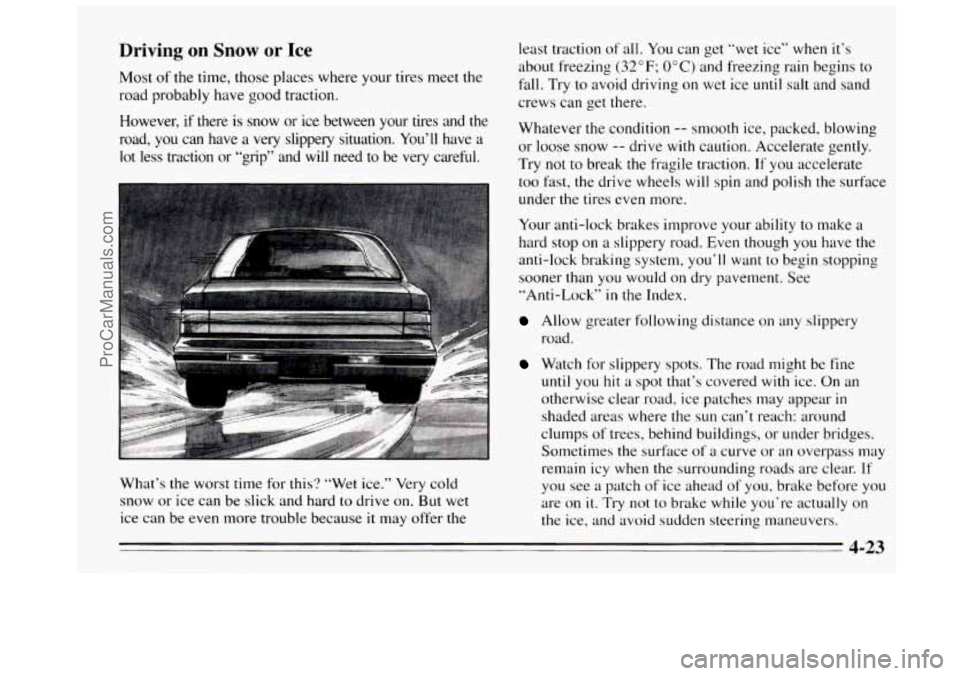
if there is snow or ice between your tires and the
road, you can have a very slippery situation. You’ll have a
lot less traction or “grip” and will need to be very careful.
What’s
the worst time for this‘? “Wet ice.” Very cold
snow or ice can be slick and hard
to drive on. But wet
ice can be even more trouble because
it may offer the least traction
of all. You can
get “wet ice” when it’s
about freezing
(32” F; 0” C) and freezing rain begins to
fall. Try to avoid driving
on wet ice until salt and sand
crews can get there.
Whatever the condition
-- smooth ice, packed, blowing
or loose snow
-- drive with caution. Accelerate gently.
Try not to break the fragile traction.
If you accelerate
too fast, the drive wheels
will spin and polish the surface
under the tires even more.
Your anti-lock brakes improve your ability to make a
hard stop on a slippery road. Even though you have the
anti-lock braking system, you’ll want to begin stopping
sooner than you would
on dry pavement. See
“Anti-Lock”
in the Index.
Allow greater following distance on any slippery
road.
Watch for slippery spots. The road might be fine
until you hit a spot that’s covered with ice. On an
otherwise clear road, ice patches may appear
in
shaded areas where the sun can’t reach: around
clumps of trees, behind buildings, or under bridges.
Sometimes the surface
of a curve or an overpass may
remain icy when the surrounding roads are clear. If
you see
a patch of ice ahead of you, brake before you
are on
it. Try not to brake while you’re actually on
the ice, and avoid sudden steering maneuvers.
4-23
ProCarManuals.com
Page 168 of 340
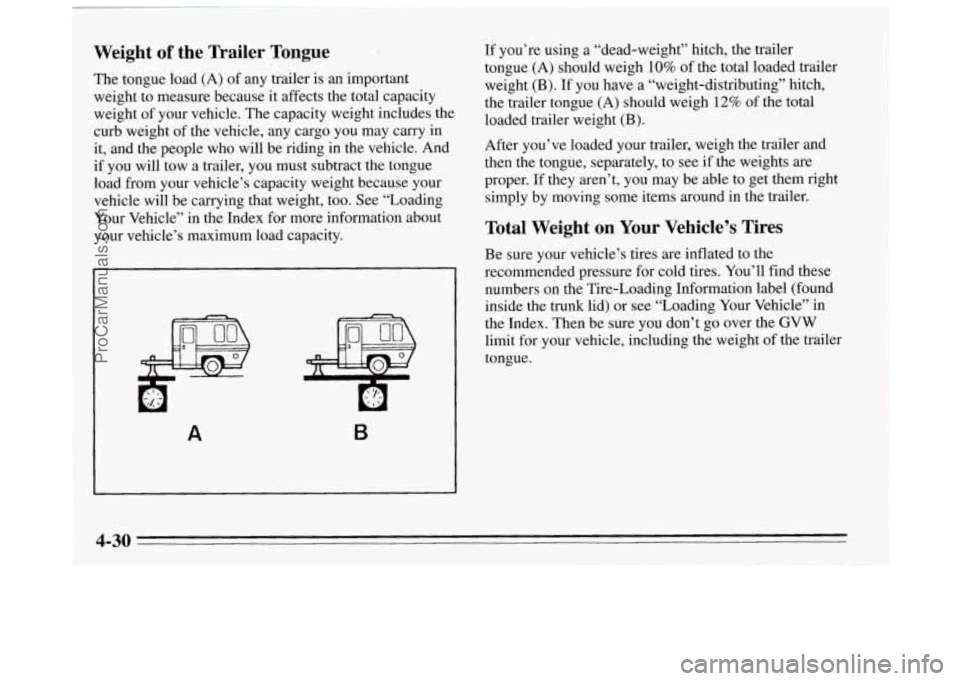
Weight of the Trailer Tongue
The tongue load (A) of any trailer is an important
weight to measure because it affects the total capacity
weight of your vehicle. The capacity weight includes the
curb weight of the vehicle, any cargo you may carry in
it, and the people who will be riding in the vehicle. And
if you will tow a trailer, you must subtract the tongue
load from your vehicle’s capacity weight because your
vehicle will be carrying that weight, too. See “Loading
Your Vehicle” in the Index for more information about
your vehicle’s maximum load capacity.
A B
If you’re using a “dead-weight” hitch, the trailer
tongue (A) should weigh
10% of the total loaded trailer
weight
(B). If you have a “weight-distributing” hitch,
the trailer tongue
(A) should weigh 12% of the total
loaded trailer weight (B).
After you’ve loaded your trailer, weigh the trailer and
then the tongue, separately, to see if the weights
are
proper. If they aren’t, you may be able to get them right
simply by moving some items around in the trailer.
Total Weight on Your Vehicle’s Tires
Be sure your vehicle’s tires are inflated to the
recommended pressure for cold tires. You’ll find these
numbers on the Tire-Loading Information label (found
inside the trunk lid) or see “Loading Your Vehicle” in
the Index. Then be sure you don’t go over the
GVW
limit for your vehicle, including the weight of the trailer
tongue.
4-30
ProCarManuals.com
Page 169 of 340
Hitches Safety Chains
It’s
important to have the correct hitch equipment.
Crosswinds, large trucks going by, and rough roads are a
few reasons why you’ll need the right hitch. Here are
some rules to follow:
0
0
Will you have to make any holes in the body of your
vehicle when you install
a trailer hitch? If you do,
then be sure to seal the holes later when you remove
the hitch.
If you don’t seal them, deadly carbon
monoxide (CO) from your exhaust can get
into your
vehicle (see “Carbon Monoxide”
in the Index). Dirt
and water can, too.
The bumpers on your vehicle are not intended for
hitches.
Do not attach rental hitches or other
bumper-type hitches to them. Use only
a
frame-mounted hitch that does not attach to the
bumper. You
should always attach chains between your vehicle
and your trailer. Cross the safety chains under the tongue
of the trailer
so that the tongue will not drop to the road
if
it becomes separated from the hitch. Instructions
about safety chains may be provided by the hitch
manufacturer or
by the trailer manufacturer. Follow the
manufxturer’s recommendation for attaching safety
chains and do not attach them to
the bumper. Always
leave just enough slack
so you can turn with your rig.
And, never allow safety chains
to drag on the ground.
Trailer Brakes
If your trailer weighs more than 1,000 pounds (450 kg)
loaded, then
it needs its own brakes -- and they must be
adequate. Be sure to read and follow the instructions for
the trailer brakes
so you’ll be able to install, adjust and
maintain them properly. Because you have anti-lock
brakes, do not try to tap into your vehicle’s brake
system. If
you do, both brake systems won’t work well,
or at
all.
4-31
ProCarManuals.com
Page 172 of 340
Parking on Hills
You really should not park your vehicle, with a trailer
attached, on
a hill. If something goes wrong, your rig
could start to move. People can be injured, and both
your vehicle and
the trailer can be damaged.
But
if you ever have to park your rig on a hill, here’s
how
to do it:
1. Apply your regular brakes, but don’t shift into
PARK
(P) yet.
2. Have someone place chocks under the trailer wheels.
3. When the wheel chocks are in place, release the
regular brakes until the chocks absorb the load.
4. Reapply the regular brakes. Then apply your parking
brake, and then
shift to PARK (P).
5. Release the regular brakes.
When You Are Ready to Leave After
Parking on a
Hill
I. Apply your regular brakes and hold the pedal down
while you:
Start your engine;
0 Shift into a gear; and
0 Release the parking brake.
2. Let up on the brake pedal.
3. Drive slowly
until the trailer is clear of the chocks.
4. Stop and have someone pick up and store the chocks.
Maintenance When Trailer Towing
Your vehicle will need service more often when you’re
pulling a trailer. See the Maintenance Schedule for more
on this. Things that are especially important
in trailer
operation are automatic transaxle fluid (don’t overfill),
engine oil, belt, cooling system, and brake adjustment.
Each of these is covered in this manual, and
the Index
will help you find them quickly. If you’re trailering, it’s
a good idea to review these sections before you start
your trip.
Check periodically to see that all hitch nuts and bolts are
tight.
4-34
ProCarManuals.com
Page 188 of 340
Engine Overheating
You will find a coolant temperature gage and a warning
light about
a hot engine on your instrument panel. See
“Engine Coolant Temperature Gage” and “Engine
Coolant Temperature Warning Light”
in the Index. You
also have a low coolant light on your instwrnent panel.
See “Low Coolant Light”
in the Ilrdex.
If Steam Is Coming From Your Engine
A CAUTION:
Steam from an overheated engine can burn you
badly, even if you just open the hood. Stay away
from the engine
if you see or hear steam corning
from it. Just turn
it off and get everyone away
from the vehicle until it cools down. Wait until
there is no sign of steam
or coolant before
opening the hood.
If you keep driving when your engine is
overheated, the liquids in it can catch fire. You or
others could be badly burned. Stop your engine
if
it overheats, and get out of the vehicle until the
engine is cool.
ProCarManuals.com
Page 192 of 340
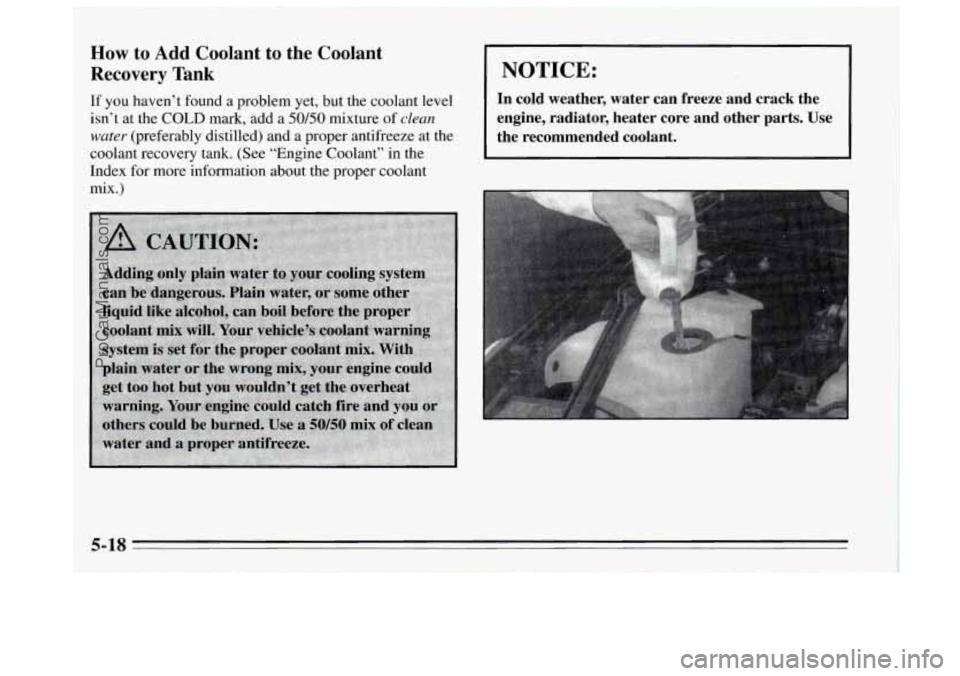
How to Add Coolant to the Coolant
Recovery Tank
If you haven’t found a problem yet, but the coolant level
isn’t at the
COLD mark, add a 50/50 mixture of clean
water (preferably distilled) and a proper antifreeze at the
coolant recovery tank. (See “Engine Coolant” in the
Index for more information about the proper coolant
mix.)
NOTICE:
In cold weather, water can freeze and crack the
engine, radiator, heater core and other parts. Use
the recommended coolant.
5-18
ProCarManuals.com
Page 205 of 340
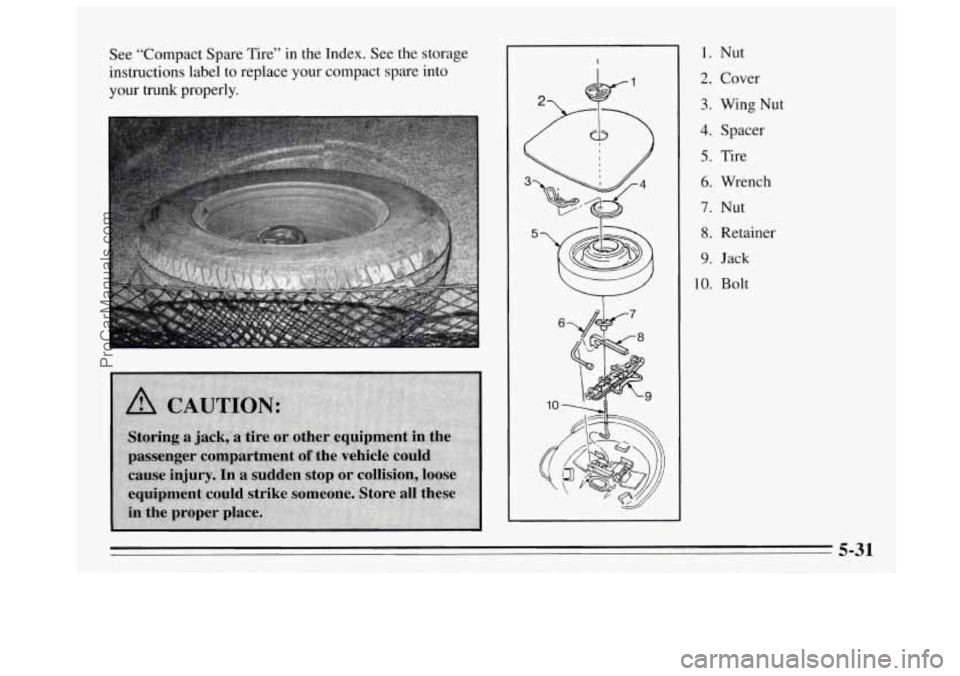
See “Compact Spare Tire” in the Index. See the storage
instructions label to replace your compact spare into
your trunk properly. I
27 *’
1.
2.
3
4
5.
6.
7.
8.
9.
10.
Nut
Cover
Wing Nut
Spacer
Tire
Wrench Nut
Retainer
Jack
Bolt
5-31
ProCarManuals.com