index BUICK REGAL 1995 Workshop Manual
[x] Cancel search | Manufacturer: BUICK, Model Year: 1995, Model line: REGAL, Model: BUICK REGAL 1995Pages: 340, PDF Size: 17.16 MB
Page 230 of 340
What to Add
Refer to the Maintenance Schedule to determine what
kind of fluid
to use. See “Recommended Fluids and
Lubricants” in the Index.
NOTICE:
When adding power steering fluid or making a
complete fluid change, always use the proper
fluid. Failure to use the proper fluid can cause
leaks and damage hoses and seals.
Windshield Washer Fluid
What to Use
When you need windshield washer fluid, be sure to read
the manufacturer’s instructions before use.
If you will be
operating your vehicle in an area where the temperature
may fall below freezing, use
a fluid that has sufficient
protection against freezing.
To Add
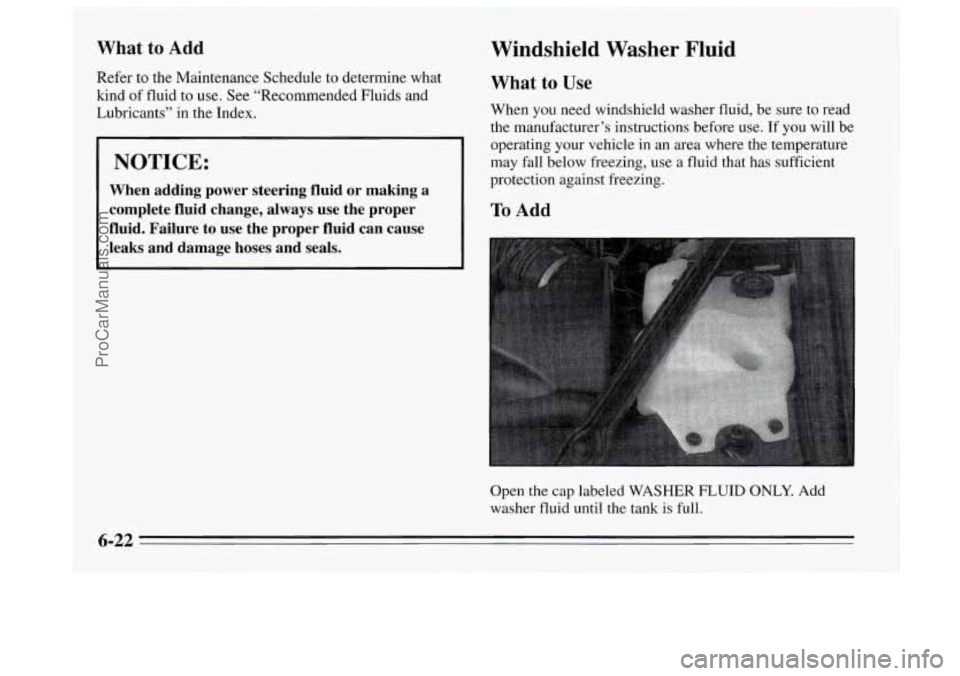
Open the cap labeled WASHER FLUID ONLY. Add
washer fluid until the tank is full.
6-22
ProCarManuals.com
Page 232 of 340
should have your brake system fixed, since a leak means
that sooner or later your brakes won’t work well, or
won’t work at all.
So, it isn’t a good idea to “top off’
your brake fluid. Adding brake fluid won’t correct a
leak. If you add fluid when your linings are worn, then
you’ll have too much fluid when you get new brake
linings. You should add (or remove) brake fluid, as
necessary, only when work is done on the brake
hydraulic system.
When your brake fluid falls to a low level, your brake
warning light will come on. See “Brake System Warning
Light” in the Index. What to Add
When you do need brake fluid, use only DOT-3 brake
fluid -- such as Delco Supreme ll@ (GM Part No.
1052535). Use new brake fluid from a sealed container
only, and always clean the brake fluid reservoir cap
before removing it.
NOTICE:
0
0
Don’t let someone put in the wrong kind of
fluid. For example, just
a few drops of
mineral-based oil, such
as engine oil, in
your brake system can damage brake system parts
so badly that they’ll have to be
replaced.
Brake fluid can damage paint,
so be careful
not to spill brake fluid on your vehicle.
If
you do, wash it off immediately. See
“Appearance Care’’ in the Index.
6-24
ProCarManuals.com
Page 235 of 340
Halogen Bulbs Bulb Replacement
In this section you’ll find directions for changing the
bulbs in some of the lamps on your Buick. See
“Replacement Bulbs” in the Index
to find the type of
bulb you should use.
Headlamps
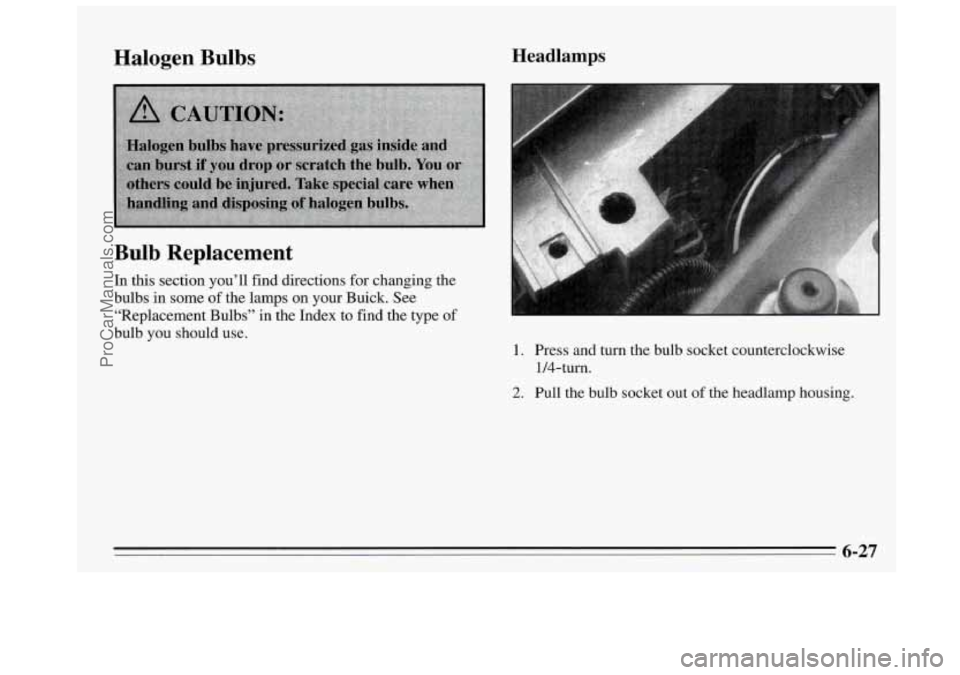
1. Press and turn the bulb socket counterclockwise 1/4-t~rn.
2. Pull the bulb socket out of the headlamp housing.
6-27
ProCarManuals.com
Page 240 of 340
Tire Inspection and Rotation
Tires should be inspected every 6,000 to 8,000 miles
(I 0 000 to 13 000 km) for any signs of unusual wear.
If unusual wear is present, rotate your tires as soon as
possible and check wheel alignment. Also check for
damaged tires or wheels. See “When
it’s Time ,for New
Tires” and “Wheel Replacement” later
in this section for
more information.
The purpose of regular rotation is to achieve more
uniform wear for all tires on the vehicle. The first
rotation is the most important. See “Scheduled
Maintenance Services”
in the Index for scheduled
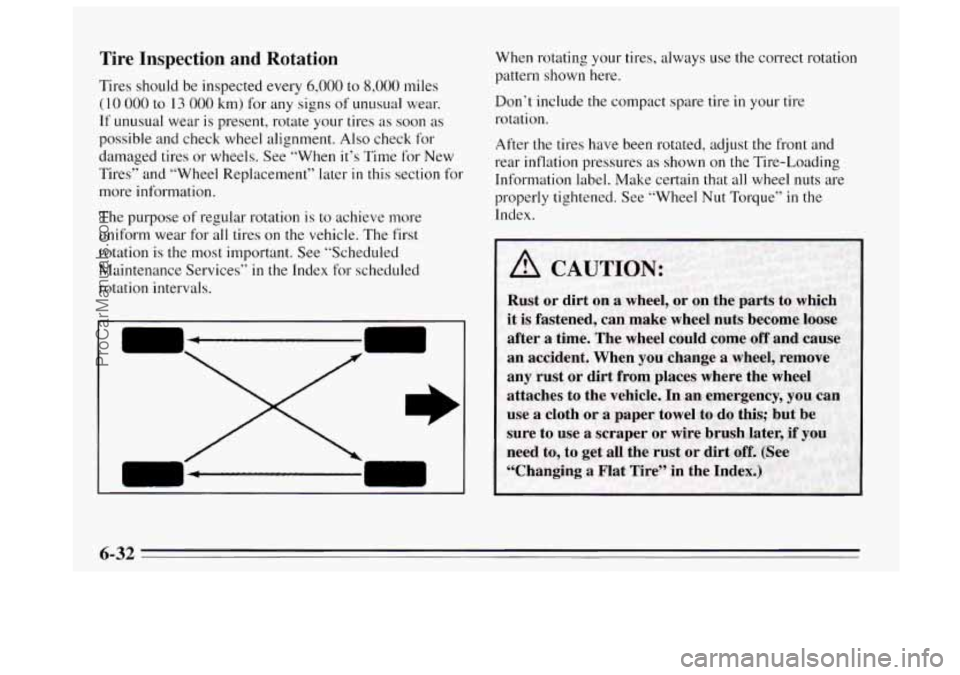
rotation intervals. When
rotating your tires, always use the correct rotation
pattern shown here.
Don’t include the compact spare tire
in your tire
rotation.
After the tires have been rotated, adjust the front and
rear inflation pressures
as shown on the Tire-Loading
Information label. Make certain that all wheel nuts are
properly tightened. See “Wheel
Nut Torque” in the
Index.
6-32
ProCarManuals.com
Page 250 of 340
Weatherstrips
Silicone grease on weatherstrips will make them last
longer, seal better, and not stick or squeak. Apply
silicone grease with
a clean cloth at least every six
months. During very cold, damp weather more frequent
application may be required. (See “Recommended
Fluids and Lubricants”
in the Index.)
Cleaning the Outside of Your Buick
The paint finish on your vehicle provides beauty, depth
of color, gloss retention and durability.
Washing Your Vehicle
The best way to preserve your vehicle’s finish is to keep it
clean by washing it often with lukewarm or cold water.
Don’t wash your vehicle in the direct rays
of the sun.
Don’t use strong soaps or chemical detergents. Use
liquid hand, dish or car washing (mild detergent) soaps.
Don’t use cleaning agents that are petroleum based,
or
that contain acid or abrasives. All cleaning agents
should be flushed promptly and not allowed to dry on
the surface, or they could stain. Dry
the finish with a
soft, clean chamois or a 100% cotton towel to avoid
surface scratches and water spotting.
High pressure car washes may cause water to enter your
vehicle.
Finish Care
Occasional waxing or mild polishing of your Buick by
hand may be necessary to remove residue from the paint
finish. You can get GM approved cleaning products
from your dealer. (See “Appearance Care and Materials”
in the Index.)
Your Buick has
a “basecoat/clearcoat” paint finish. The
clearcoat gives more depth and gloss to the colored
basecoat. Always use waxes and polishes that are
non-abrasive and made for
a basecoatklearcoat paint
finish.
I NOTICE:
Machine compounding or aggressive polishing on
a basecoatklearcoat paint finish may dull the
finish or leave swirl marks.
Foreign materials such as calcium chloride and other
salts, ice melting agents, road oil and tar, tree sap, bird
droppings, chemicals from industrial chimneys, etc. can
damage your vehicle’s finish
if they remain on painted
surfaces. Wash the vehicle
as soon as possible. If
necessary, use non-abrasive cleaners that are marked
safe for painted surfaces to remove foreign matter.
6-42
ProCarManuals.com
Page 255 of 340
Add-on Electrical Equipment Fuses and Circuit Breakers
NOTICE:
Don’t add anything electrical to your Buick unless
you check with your dealer first. Some electrical
equipment can damage your vehicle and the
damage wouldn’t be covered by your warranty.
Some add-on electrical equipment can keep other
components from working as they should.
Your vehicle has an air bag system. Before attempting to
add anything electrical to your Buick, see “Servicing
Your Air Bag-Equipped Buick”
in the Index. The wiring
circuits
in your vehicle are protected from
short circuits by
a combination of fuses, circuit breakers,
and fusible thermal links in the wiring itself. This
greatly reduces the chance of fires caused
by electrical
problems.
Some fuses are
in a fuse
block on the passenger
side of the instrument panel.
Pull off
the cover labeled
FUSES to expose the fuses.
Additional fuses are
in the underhood electrical centers
on the right and left sides of the engine compartment.
Look at the silver-colored band inside the fuse. If the
band is broken or melted, replace the fuse. Be sure
you
replace a bad fuse with a new one of the identical size
and rating.
6-47
ProCarManuals.com
Page 270 of 340
How This Section is Organized
The remainder of this section is divided into five parts:
“Part A: Scheduled Maintenance Services” shows
what
to have done and how often. Some of these
services can be complex,
so unless you are technically
qualified and have the necessary equipment, you should
let your dealer’s service department or another qualified
service center do these jobs.
If you are skilled enough
to do some work on your
vehicle, you will probably want to get the service
information
GM publishes. You will find a list of
publications and how to get them in this manual. See
“Service Publications”
in the Index.
“Part B: Owner Checks and Services” tells you what
should be checked whenever you stop for fuel. It also
explains what you can easily do to help keep your
vehicle in good condition.
“Part C: Periodic Maintenance Inspections” explains
important inspections that your Buick dealer’s service
department or another qualified service center should
perform.
“Part D: Recommended Fluids and Lubricants” lists
some products
GM recommends to help keep your
vehicle properly maintained. These products, or their
equivalents, should be used whether you do
the work
yourself or have it done.
“Part E: Maintenance Record” provides a place for
you to record the maintenance performed on your
vehicle. Whenever any maintenance
is performed, be
sure to write
it down in this part. This will help you
determine when your next maintenance should be done.
In addition, it is a good idea
to keep your maintenance
receipts. They may be needed to qualify your vehicle for
warranty repairs.
7-2
ProCarManuals.com
Page 271 of 340
Part A: Scheduled Maintenance
Services
Using Your Maintenance Schedule
We at General Motors want to help you keep your
vehicle in good working condition. But we don’t know
exactly how you’ll drive it. You may drive very short
distances only a few times a week. Or you may drive
long distances all the time in very hot, dusty weather.
You may use your vehicle in making deliveries.
Or you
may drive it to work, to do errands or in many other
ways.
Because of all the different ways people use their GM
vehicles, maintenance needs vary. You may even need
more frequent checks and replacements than you’ll find
in the schedules in this section.
So please read this
section and note how you drive.
If you have any
questions on how to keep your vehicle in good
condition, see your Buick dealer.
This part tells you the maintenance services you should
have done and when you should schedule them.
If you
go to your dealer for your service needs, you’ll know
that GM-trained and supported service people will
perform the work using genuine GM parts. The
proper fluids and lubricants to use
are listed in
Part
D. Make sure whoever services your vehicle uses
these. All parts should be replaced and all necessary
repairs done before you or anyone else drives the
vehicle.
These schedules are for vehxles that:
0
0
0
carry passengers and cargo within recommended
limits. You will find these limits
on your vehicle’s
Tire-Loading Information label. See “Loading Your
Vehicle” in the Index.
are driven on reasonable road surfaces within legal
driving limits.
use the recommended unleaded fuel. See “Fuel” in
the Index.
Selecting the Right Schedule
First you’ll need to decide which of the two schedules is
right for your vehicle. Here’s how to decide which
schedule to follow:
7-3
ProCarManuals.com
Page 275 of 340
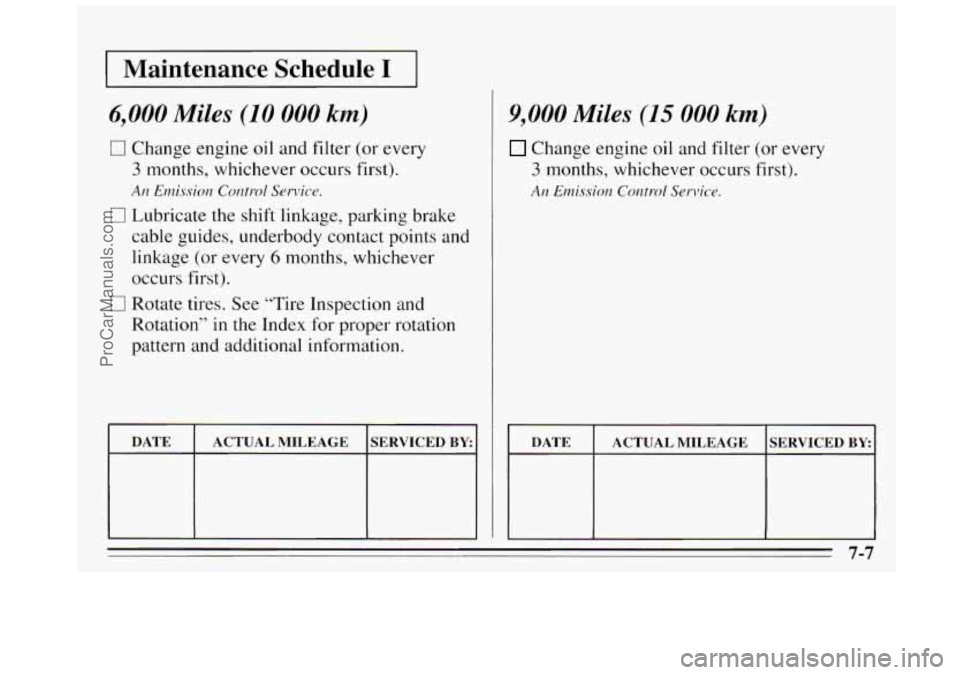
I Maintenance Schedule I I
6,000 Miles (10 000 km)
0 Change engine oil and filter (or every
3 months, whichever occurs first).
An Emission Control Service.
0 Lubricate the shift linkage, parking brake
cable guides, underbody contact points and
linkage (or every
6 months, whichever
occurs first).
0 Rotate tires. See “Tire Inspection and
Rotation”
in the Index for proper rotation
pattern and additional information.
DATE SERVICED BY: ACTUAL MILEAGE
9,000 Miles (15 000 km)
Change engine oil and filter (or e JerT
3 months, whichever occurs first).
I DATE I ACTUALMILEAGE I SERVICED BY: I
- 7-7
ProCarManuals.com
Page 277 of 340
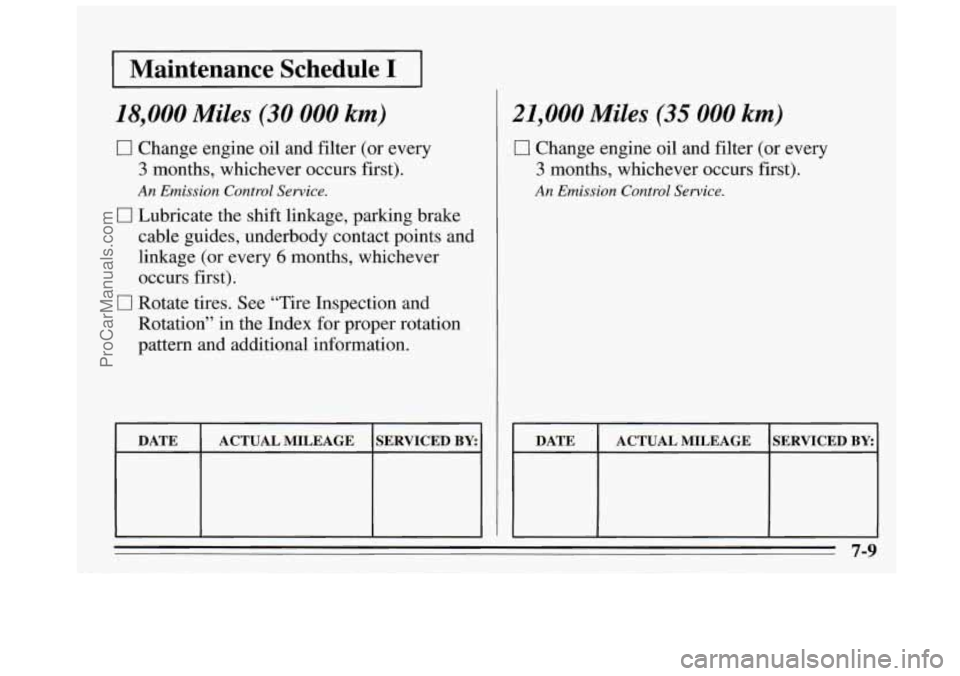
I Maintenance Schedule I I
18,000 Miles (30 000 km)
0 Change engine oil and filter (or every
3 months, whichever occurs first).
An Emission Control Service.
0 Lubricate the shift linkage, parking brake
cable guides, underbody contact points and
linkage (or every
6 months, whichever
occurs first).
0 Rotate tires. See “Tire Inspection and
Rotation’’ in the Index for proper rotation
pattern and additional information.
DATE
ACTUAL MILEAGE
L
SERVICED BY I
1 L
21,000 Miles (35 000 km)
0 Change engine oil and filter (or every
3 months, whichever occurs first).
An Emission Control Service.
DATE
SERVICED BY ACTUAL MILEAGE
1 I I
7-9
ProCarManuals.com