belt BUICK REGAL 1995 Service Manual
[x] Cancel search | Manufacturer: BUICK, Model Year: 1995, Model line: REGAL, Model: BUICK REGAL 1995Pages: 340, PDF Size: 17.16 MB
Page 61 of 340
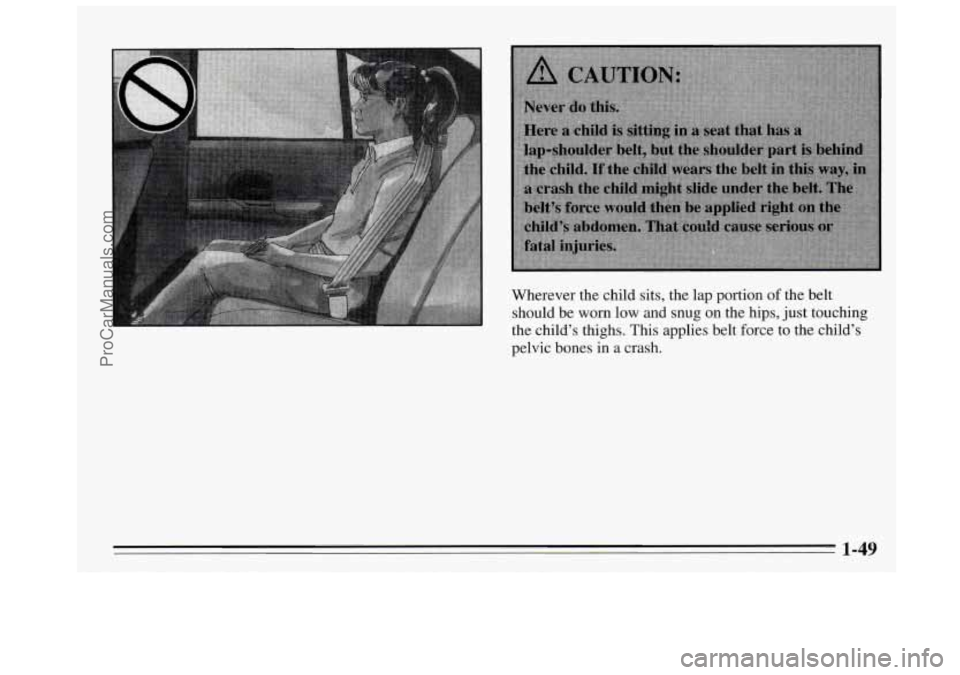
Wherever the child sits, the lap portion of the belt
should be
worn low and snug on the hips, just touching
the child’s thighs. This applies belt force to the child’s
pelvic bones in
a crash.
1-49
ProCarManuals.com
Page 62 of 340
Safety Belt Extender
If the vehicle’s safety belt will fasten around you, you
should use it.
But if a safety belt isn’t long enough to fasten, your
dealer will order you an extender. It’s free. When
you go
in to order it, take the heaviest coat you will wear, so the
extender will be long enough for
you. The extender will
be just for you, and just for the seat
in your vehicle that
you choose. Don’t let someone else use
it, and use it
only for the seat it is made to
fit. To wear it, just attach it
to the regular safety belt.
Checking Your Restraint Systems
Now and then, make sure all your belts, buckles, latch
plates, retractors, anchorages and reminder systems are
working properly. Look for any other loose or damaged
restraint system parts. If you see anything that might
keep
a restraint system from doing its job, have it
repaired.
Torn or frayed belts may not protect you in
a crash.
They can rip apart under impact forces.
Tf a belt is torn
or frayed, get a new one right away.
Replacing Seat and Restraint System
Parts After a Crash
If you’ve had a crash, do you need new belts?
After a very minor collision, nothing may be necessary.
But if the belts were stretched, as they would be
if worn
during
a more severe crash, then you need new belts.
If belts are cut or damaged, replace them. Collision
damage also may mean you will need to have safety belt
or seat parts repaired or replaced. New parts and repairs
may be necessary even if the belt wasn’t being used at
the time
of the collision.
1-50
ProCarManuals.com
Page 107 of 340
0 It takes a little more or less fuel to fill up than the
gage indicated. For example, the gage may have
indicated the tank was half full, but it actually took
a little more or less than half the tank’s capacity to
fill it.
0 The gage moves a little when you turn a corner or
Low Fuel Light
speed up.
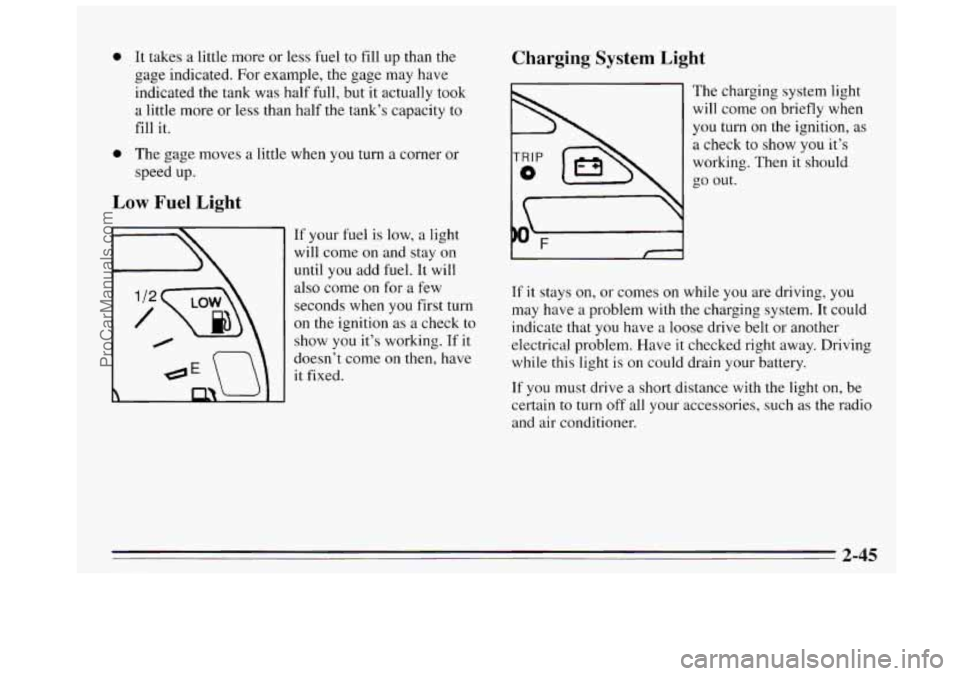
If your fuel is low, a light
will come on and stay on
until you add fuel. It will
also come on for a few
seconds when
you first turn
on the ignition as a check to
show you it’s working.
If it
doesn’t come on then, have
it fixed.
Charging System Light
The charging system light
will come on briefly when
you turn on the ignition, as
a check
to show you it’s
worlung. Then it should
g0
Out.
If it stays on, or comes on while you are driving, you
may have a problem with
the charging system. It could
indicate that
you have a loose drive belt or another
electrical problem. Have it checked right away. Driving
while this light is on could drain your battery.
If you must drive a short distance with the light on, be
certain
to turn off all your accessories, such as the radio
and air conditioner.
2-45
ProCarManuals.com
Page 108 of 340

Safety Belt Reminder Light
b3
8
When the key is turned to
RUN or START, a chime
will come
on for about eight
seconds to remind people to
fasten their safety belts,
unless the driver’s safety belt
is already buckled.
The safety belt light will also come on and stay
on
until the driver’s belt is buckled.
Air Bag Readiness Light
There is an air bag readiness light on the instrument
panel, which shows AIR BAG. The system checks the
air bag’s electrical system for malfunctions. The light
tells
you if there is an electrical problem. The system
check includes the air bag sensors and modules, the
wiring and the diagnostic module. For more information
on the air bag system, see “Air Bag” in the Index.
10: I
You will see this light flash
for a few seconds when you
turn your ignition to RUN
or START. Then the light
AIR BAG 4 3 should go out. This means
the system is ready.
-8 10 :
If the air bag readiness light doesn’t come on when you
start your vehicle, or stays on, or comes on when you
are driving, your air bag system may not work properly.
Have your vehicle serviced right away.
2-46
ProCarManuals.com
Page 134 of 340
Care of Your Cassette Tape Player
A tape player that is not cleaned regularly is subject to
reduced sound quality, ruining the cassette, or damaging
the mechanism. Tape cassettes that are
not properly
stored in their plastic cases away from contaminants,
direct sunlight, and extreme heat may not operate
properly and could cause premature failure of the tape
player.
Your tape player should be cleaned with every
50 hours
of use to provide optimum performance. Your radio may
display Cln to indicate that
you have used your tape
player for
50 hours without resetting the tape clean
timer. If you notice a reduction in sound quality,
regardless
of when the tape player was last cleaned, try
playing a different cassette to see if the tape or the tape
player is at fault.
Tf the second cassette results in no
improvement
in sound quality, try cleaning the tape
player.
Proper tape player cleaning should be done with a
scrubbing action, nonabrasive cleaner cassette. This is a
wet-type cleaning system that uses
a cleaning cassette
with pads which scrub the tape head as the hubs of the
cleaner cassette turn.
To properly clean your tape player,
follow
the instructions with the cleaning cassette. If you
use this type of cleaner, the radio may display an error
and eject the cartridge. This is normal and is the result of an
added feature
in the tape player that detects broken
tapes. If an error occurs, you
will need to insert the
cleaning cassette at least three times to thoroughly clean
the tape player.
You may prefer to use a non-scrubbing action, wet-type
cleaner. This type
of cleaner uses a fabric belt to clean
the tape head. This type of cleaner cassette will not
cause an error,
but it may not clean the tape player as
thoroughly as the scrubbing type cleaner.
A scrubbing action cleaner is available through your
dealer
(GM Part No. 12344600).
Cassettes are subject to wear and the sound quality may
degrade over time. Always verify that the cassette tape
is in good condition and the tape player is clean before
obtaining service on your tape player.
Care of Your Compact Discs
Handle discs carefully. Store them in their original cases
or other protective cases and away from direct sunlight
and dust.
If the surface of a disc is soiled, dampen a
clean, soft cloth
in a mild, neutral detergent solution and
clean
it, wiping from the center to the edge.
Be sure never
to touch the signal surface when handling
discs. Pick up discs
by grasping the outer edges or the
edge of the hole and the outer edge.
ProCarManuals.com
Page 139 of 340
Section 4 Your Driving and the Road
Here you’ll find information about driving on different
kinds
of roads and in varying weather conditions. We’ve
also included many other useful tips on driving.
Defensive Driving
The best advice anyone can give about driving is: Drive
defensively.
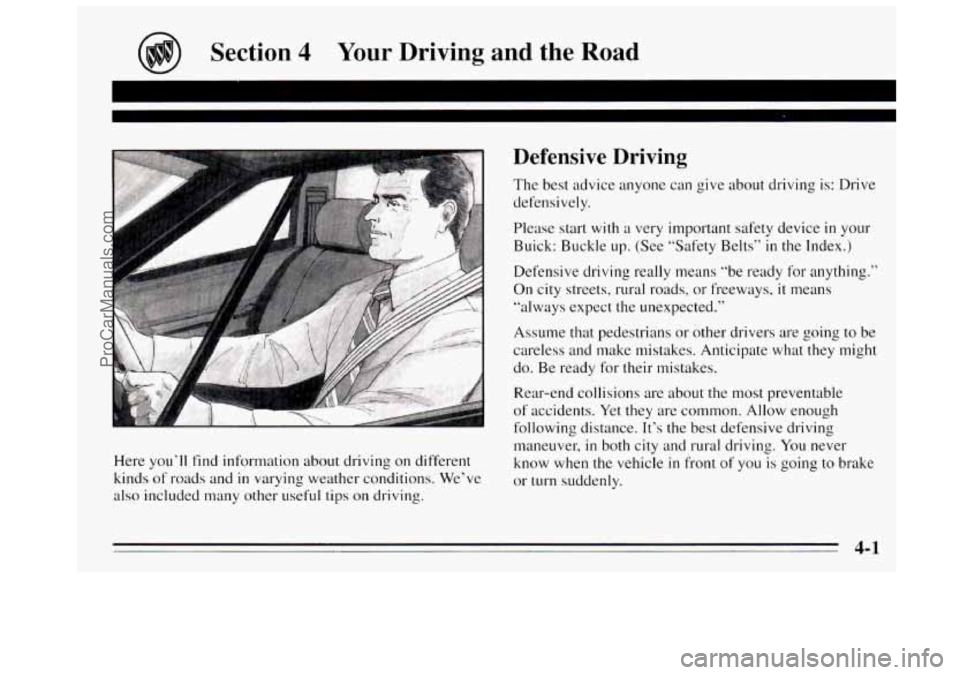
Please start
with a very important safety device in your
Buick: Buckle up. (See “Safety Belts”
in the Index.)
Defensive driving really means “be ready for anything.”
On city streets, rural roads, or freeways,
it means
“always expect the unexpected.”
Assume that pedestrians or other drivers are going to be
careless and make mistakes. Anticipate what they might
do. Be ready for their mistakes.
Rear-end collisions are about the most preventable
of accidents. Yet they are common. Allow enough
following distance. It’s the best defensive driving
maneuver,
in both city and rural driving. You never
know when the vehicle
in front of you is going to brake
or turn suddenly.
4-1
ProCarManuals.com
Page 148 of 340
An emergency like this requires close attention and a
quick decision.
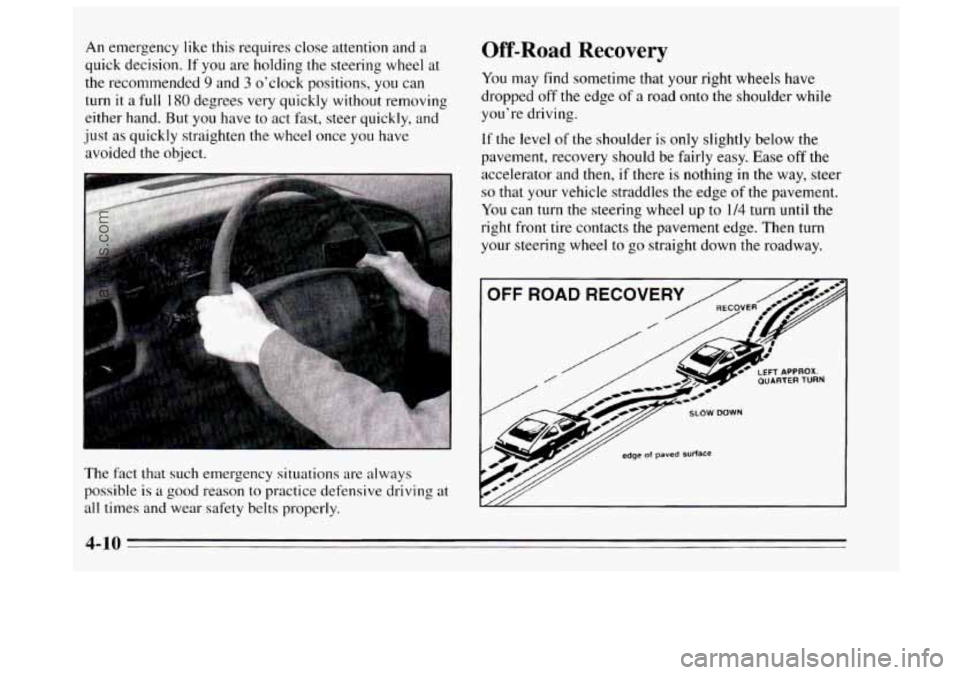
If you are holding the steering wheel at
the recommended
9 and 3 o’clock positions, you can
turn it
a full 180 degrees very quickly without removing
either hand. But you have
to act fast, steer quickly, and
just as quickly straighten the wheel once
you have
avoided the object.
The fact that such emergency situations are always
possible is a
good reason to practice defensive driving at
all times and wear safety belts properly.
Off-Road Recovery
You may find sometime that your right wheels have
dropped
off the edge of a road onto the shoulder while
you’re driving.
If the level of the shoulder is only slightly below the
pavement, recovery should be fairly easy. Ease off the
accelerator and then, if there is nothing in the way, steer
so that your vehicle straddles the edge of the pavement.
You can turn the steering wheel up
to 114 turn until the
right front tire contacts the pavement edge. Then turn
your steering wheel to go straight down the roadway.
OFF ROAD RECOVERY
SLOW DOWN
edge of paved surface
4-10
ProCarManuals.com
Page 172 of 340
Parking on Hills
You really should not park your vehicle, with a trailer
attached, on
a hill. If something goes wrong, your rig
could start to move. People can be injured, and both
your vehicle and
the trailer can be damaged.
But
if you ever have to park your rig on a hill, here’s
how
to do it:
1. Apply your regular brakes, but don’t shift into
PARK
(P) yet.
2. Have someone place chocks under the trailer wheels.
3. When the wheel chocks are in place, release the
regular brakes until the chocks absorb the load.
4. Reapply the regular brakes. Then apply your parking
brake, and then
shift to PARK (P).
5. Release the regular brakes.
When You Are Ready to Leave After
Parking on a
Hill
I. Apply your regular brakes and hold the pedal down
while you:
Start your engine;
0 Shift into a gear; and
0 Release the parking brake.
2. Let up on the brake pedal.
3. Drive slowly
until the trailer is clear of the chocks.
4. Stop and have someone pick up and store the chocks.
Maintenance When Trailer Towing
Your vehicle will need service more often when you’re
pulling a trailer. See the Maintenance Schedule for more
on this. Things that are especially important
in trailer
operation are automatic transaxle fluid (don’t overfill),
engine oil, belt, cooling system, and brake adjustment.
Each of these is covered in this manual, and
the Index
will help you find them quickly. If you’re trailering, it’s
a good idea to review these sections before you start
your trip.
Check periodically to see that all hitch nuts and bolts are
tight.
4-34
ProCarManuals.com
Page 241 of 340
When it’s Time for New Tires
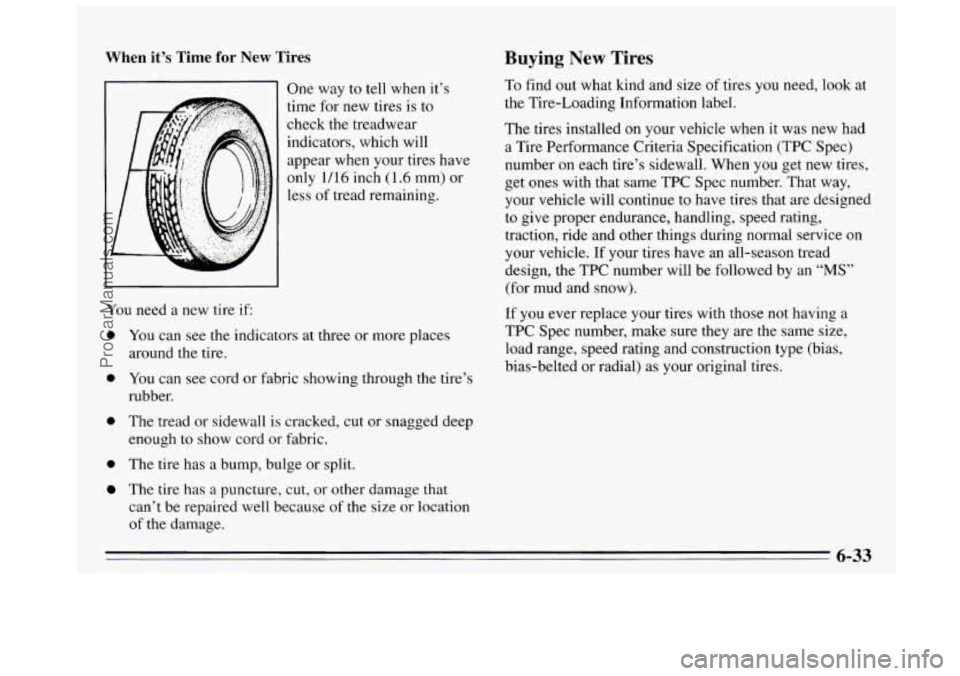
One way to tell when it’s
time for new tires is to
check the treadwear
indicators, which will
appear when your tires have
only 1/16 inch (1.6 mm) or
less
of tread remaining.
You need a new tire if:
0 You can see the indicators at three or more places
around the tire.
0 You can see cord or fabric showing through the tire’s
rubber.
0 The tread or sidewall is cracked, cut or snagged deep
enough
to show cord or fabric.
0 The tire has a bump, bulge or split.
The tire has a puncture, cut, or other damage that
can’t be repaired well because of the size or location
of the damage.
Buying New Tires
To find out what kind and size of tires you need, look at
the Tire-Loading Information label.
The tires installed on your vehicle when it was new had
a Tire Performance Criteria Specification (TPC Spec)
number on each tire’s sidewall. When you get new tires,
get
ones with that same TPC Spec number. That way,
your vehicle will continue to have tires that are designed
to give proper endurance, handling, speed rating,
traction, ride and other things during normal service on
your vehicle. If your tires have an all-season tread
design, the TPC number will be followed by an
“MS”
(for mud and snow).
If you ever replace your tires with those not having a
TPC Spec number, make sure they are the same size,
load range, speed rating and construction type (bias,
bias-belted or radial) as your original tires.
6-33
ProCarManuals.com
Page 249 of 340
Cleaning the Top of the Instrument Panel
Use only mild soap and water to clean the top surfaces
of the instrument panel. Sprays containing silicones or
waxes may cause annoying reflections
in the windshield
and even make it difficult to see through the windshield
under certain conditions.
Care of Safety Belts
Keep belts clean and dry.
Glass
Glass should be cleaned often. GM Glass Cleaner (GM
Part No. 1050427) or a liquid household glass cleaner
will remove
aormal. tobacco smoke and dust films.
Don’t use abrasive cleaners on glass, because they may
cause scratches. Avoid placing decals
on the inside rear
window, since they may have to be scraped off later. If
abrasive cleaners are used
on the inside of the rear
window, an electric defogger element may be damaged.
Any temporary license should
not be attached across the
defogger grid.
Cleaning the Outside of the
Windshield and Wiper Blades
If the windshield is not clear after using the windshield
washer,
or if the wiper blade chatters when running, wax
or other material may be on the blade or windshield.
Clean
the outside of the windshield with GM
Windshield Cleaner, Bon-Ami Powder@ (GM Part
No. 105001 I ). The windshield is clean if beads do not
form when
you rinse it with water.
Clean
the blade by wiping vigorously with a cloth
soaked in full strength windshield washer solvent. Then
rinse the blade with water.
Wiper blades should be checked on
a regular basis and
replaced when worn.
6-41
ProCarManuals.com