change time BUICK REGAL 1995 Owners Manual
[x] Cancel search | Manufacturer: BUICK, Model Year: 1995, Model line: REGAL, Model: BUICK REGAL 1995Pages: 340, PDF Size: 17.16 MB
Page 4 of 340
GmRAL MOTORS, GM and the GM Emblem,
BUICK, and
the BUICK Emblem are registered
tradernarks of General h4otot.s Corporation.
This manual includes the latest information at the time
it
was printed. We reserve the right to make changes in the
product after that time without further notice.
For
vehicles first sold in Canada, substitute the name
“General Motors of Canada Limited” for Buick
Motor
Division whene.ver it appears in this manual.
Please keep this manual
in your Buick, so it will be there
if you ever need it when you’re on the road. If you sell
the vehicle, please leave this manual
in it so the new
owner can use it.
Litho in U.S.A.
Part No. 2564 I820 A Second Edition
II II I WE SUPPORT VOLUNTARY TECHNICIAN CERTIFICATION THROUGH I
I AUTOMOTIVE
us:Icn31 In;l It t.-’fO~
SERVICE EXCELLENCE
I We support vo
~ technician cerl ‘luntary
:ification.
For Canadian Owners Who Prefer a
French Language Manual:
Aux Drouriktaires
canadiens: VOLIS pouvez vous procurer
un exemplaire de ce guide en franqais chez votre
concessionaire ou au
DGN Marketing Services Ltd.,
IS00 Bonhill Rd., Mississauga, Ontario LST 1C7.
@Copyright General Motors Corporation
1994
All Rights Reserved
ii
ProCarManuals.com
Page 68 of 340
Matching Transmitter(s) To Your Vehicle
Each key chain transmitter is coded to prevent another
transmitter from unlocking your vehicle.
If a transmitter
is lost or stolen,
a replacement can be purchased through
your dealer. Remember to bring any remaining
transmitters with you when you
go to your dealer. When
the dealer matches the replacement transmitter
to your
vehicle, the remaining transmitters must also be
matched. Once the new transmitter is coded, the lost
transmitter will not unlock your vehicle.
You can match a transmitter to as many different
vehicles
as you own, provided they are equipped with
exactly the same model system. (General Motors offers
several different models of these systems on their
vehicles.) Each vehicle can have only two transmitters
matched to it.
See your dealer to match transmitters to another vehicle.
Battery Replacement
Under normal use, the batteries in your key chain
transmitter should last about two years.
You can tell the batteries are weak if the transmitter
won’t work at the normal range
in any location. If you
have to get close to your vehicle before the transmitter
works, it’s probably time to change the batteries. To
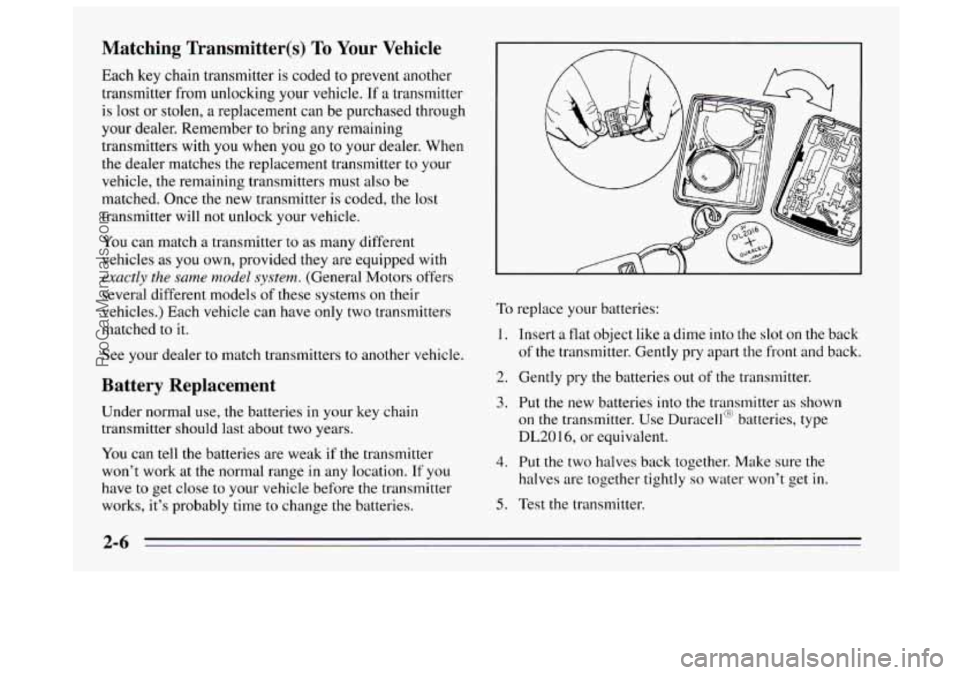
replace your batteries:
1. Insert a flat object like a dime into the slot on the back
of the transmitter. Gently pry apart the front and back.
2. Gently pry the batteries out of the transmitter.
3. Put the new batteries into the transmitter as shown
on
the transmitter. Use Duracell@ batteries, type
DL201 6, or equivalent.
4. Put the two halves back together. Make sure the
halves are together tightly so water won’t get in.
5. Test the transmitter.
ProCarManuals.com
Page 74 of 340
NOTICE:
Don’t try to shift to PARK (P) if your Buick is
moving.
If you do, you could damage the
transaxle. Shift to
PARK (P) only when your
vehicle is stopped.
To start your 3.1 Liter engine:
1. Without pushing the accelerator pedal, turn your
ignition key to START. When
the engine starts, let
go of the key. The idle speed will go down as your
engine gets warm.
NOTICE:
Holding your key in START for longer man
15 seconds at a time will cause your battery to be
drained much sooner. And the excessive heat can
damage your starter motor.
2. If your engine won’t start (or starts but then stops),
it could be flooded with too much gasoline. Try
pushing your accelerator pedal all the way
to the
floor and holding it there as you hold the key in
START for about three seconds. If the vehicle starts
briefly but t.hen stops again, do the same thing, but
this time keep the pedal down for
five or six seconds.
This clears the extra gasoline
from the engine.
~
NOTICE:
Your engine is designed to work with the
electronics in
your vehicle. If you add electrical
parts
or accessories, you could change the way
the fuel injection system operates. Before adding
electrical equipment, check with your dealer.
If
you don’t, your engine might not perform
properly.
If you ever have to have your vehicle towed, see
the part
of this manual that tells how to do it
without damaging your vehicle. See “Towing
Your Vehicle” in the Index.
2-12
ProCarManuals.com
Page 75 of 340
To start your 3.8 Liter engine:
I. Without pushing the accelerator pedal, turn your
ignition
key to START. When the engine starts, let
go
of the key. The idle speed will go down as your
engine gets warm.
I NOTICE:
Holding your key in START for longer than
15 seconds at a time will cause your battery to be
drained much sooner. And the excessive heat can
damage your starter motor.
2. If it doesn’t start right away, hold your key in
START for about three to five seconds at a time until
your engine starts. Wait about
15 seconds between
each try
to help avoid draining your battery.
3. If your engine still won’t start (or starts but then
stops), it could be flooded with too much gasoline.
Try pushing your accelerator pedal
all the way to the
floor and holding
it there as you hold the key in
START for about three seconds. If the vehicle starts
brietly but then stops again, do the
same thing, but
this time keep the pedal down for
five or six seconds.
This clears the extra gasoline from the engine. After
waiting about 15 seconds, repeat the normal starting
procedure.
NOTICE:
Your engine is designed to work with the
electronics in your vehicle.
If you add electrical
parts or accessories, you could change the way
the fuel injection system operates. Before adding
electrical equipment, check with
your dealer. If
you don’t, your engine might not perform
properly.
If you ever have to have your vehicle towed, see
the part of this manual that tells how to do it
without damaging your vehicle. See “Towing
Your Vehicle” in the Index.
2-13
ProCarManuals.com
Page 94 of 340

Instrument Panel Lamps
You can brighten or dim the instrument panel lamps by
moving the PANEL
LAMPS dial. If you turn the dial
past
HI, your courtesy or interior lamps will conle on.
Daytime Running Lamps (Canada Only)
Daytime Running Lamps (DRL) can make it easier for
others to see the front of your vehicle during the day.
DRL can be helpful in many different driving
conditions, but they can be especially helpful
in the
short periods after dawn and before sunset.
A light sensor on top of the instrument panel makes the
DRL work,
so be sure it isn’t covered,
The
DRL system will make your low-beam headlamps
come on at a reduced brightness when: When the DRL
are
on, only your low-bearn headlamps
will be on. The taillamps, sidemarker and other lamps
won‘t be
on. Your instrument panel won’t be lit up either.
When it’s dark enough outside, your low-beam
headlamps will change to
full brightness. The other lamps
that come
on with your headlamps will also come on.
When it’s bright enough outside, the regular lamps
will
go off, and your low-beam headlamps change to the
reduced brightness of DRL.
To idle your vehicle with the DRL off, set the parking brake
while the ignition is
in OFF or LOCK. Then start your vehicle.
The
DIU will stay off until you release the parking brake.
As with any vehicle, you should turn on the regular
headlamp system any time you need it.
0 The ignition is on,
0 The headlamp switch is off, and
0 The parking brake is released.
2-32
ProCarManuals.com
Page 122 of 340
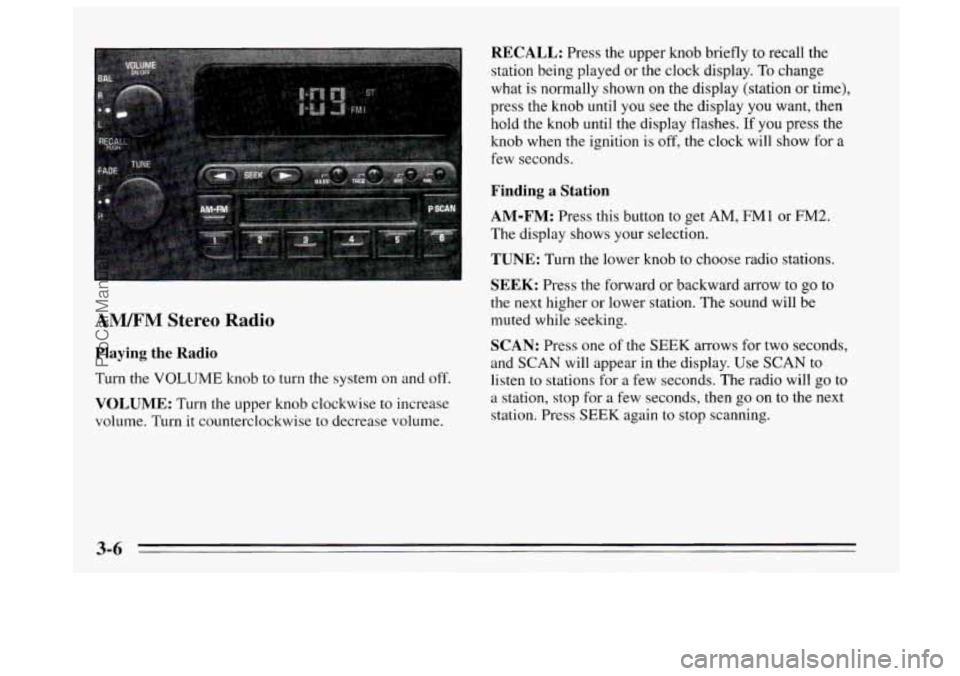
AM/FM Stereo Radio
Playing the Radio
Turn the VOLUME knob to turn the system on and off.
VOLUME: Turn the upper knob clockwise to increase
volume. Turn it counterclockwise to decrease volume.
RECALL: Press the upper knob briefly to recall the
station being played or the clock display.
To change
what is normally shown
on the display (station or time),
press the knob until you see the display
you want, then
hold the knob until the display flashes. If you press the
knob when
the ignition is off, the clock will show for a
few seconds.
Finding a Station
AM-FM:
Press this button to get AM, FMI or FM2.
The display
shows your selection.
TUNE: Turn the lower knob to choose radio stations.
SEEK: Press the forward or backward arrow to go to
the
next higher or lower station. The sound will be
muted while seeking.
SCAN: Press one of the SEEK arrows for two seconds,
and SCAN will appear in the display. Use SCAN to listen to stations for
a few seconds. The radio will go to
a station, stop for a few seconds, then
go on to the next
station. Press SEEK again to stop scanning.
3-6
ProCarManuals.com
Page 125 of 340

44 (3): Press this button to reverse the tape rapidly.
Press it again to return to playing speed. The radio will
play while the tape reverses.
bb (4): Press this button to advance quickly to another
part of the tape. Press the button again to return
to playing
speed. The radio will play while the tape advances.
SIDE (5): Press this button to change the side of the
tape that is playing.
on (6): Press this button to reduce background noise.
The display will show either
OFF or ON for a few
seconds when you press the butt.on.
Dolby@
B Noise Reduction manufactured under license
from Dolby Laboratories Licensing Corporation.
“Dolby” and the
on@ symbol are trademarks of Dolby
Laboratories Licensing Corporation.
EJECT: Press this button to remove the tape. The radio
will play.
Cln: This message may appear on the display. If it does,
your cassette tape player needs to be cleaned. It will still
play tapes, but you should clean
it as soon as possible to
prevent damage
to your tapes and player. See “Care of
Your Cassette Tape Player” in the Index. After you clean
the player, press and hold EJECT for five seconds to
reset the Cln indicator.
“- - -” will appear in the display
to show the indicator was reset.
AM/FM Stereo Radios with Automatic Tone
Control
If your Buick has a radio with Automatic Tone Control,
the instructions below will explain how to use the radio.
To find out if your radio has Automatic Tone Control,
look for a
TONE button. If the system has one, you have
Automatic Tone Control. If not, see the systems
explained earlier
in this section.
Playing the Radio
Press the VOLUME knob to turn the system on and off.
VOLUME: Turn this knob clockwise to increase
volume. Turn
it counterclockwise to decrease volume.
RECALL: Press this button briefly to recall the station
being played or the clock display. To change what is
normally shown on the display (station or time), press
the button until you see the display
you want, then hold
the button
until the display flashes. If you press the
button when the ignition
is off, the clock will show for a
few seconds.
Finding a Station
AM-FM:
Press this button to get AM, FMl or FM2.
The display shows your selection.
3-9
ProCarManuals.com
Page 129 of 340
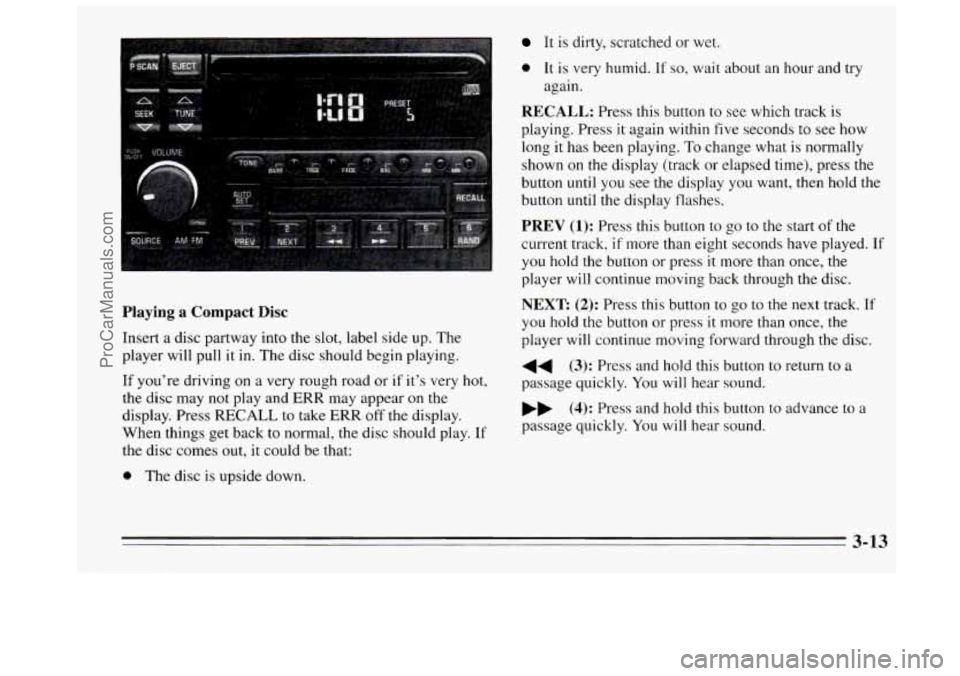
Playing a Compact Disc
Insert a disc partway into the slot, label side up. The
player will pull it in. The disc should begin playing.
If you’re driving on
a very rough road or if it’s very hot,
the disc may not play and
ERR may appear on the
display. Press RECALL to take ERR off the display.
When things get back to normal, the disc should play.
If
the disc comes out, it could be that:
0 The disc is upside down.
It is dirty, scratched or wet.
0 It is very humid. If so, wait about an hour and try
again.
RECALL: Press this button to see which track is
playing. Press it again within five seconds
to see how
long it has been playing. To change what is normally
shown on the display
(track or elapsed time), press the
button until you see the display you want, then hold the
button until the display flashes.
PREV (1): Press this button to go to the start of the
current track, if more than eight seconds have played. If
you hold the button or press it more than once, the
player will continue moving back through the disc.
NEXT (2): Press this button to go to the next track. If
you hold the button or press it more than once, the
player will continue moving forward through the disc.
44 (3): Press and hold this button to return to a
passage quickly. You will hear sound.
bb (4): Press and hold this button to advance to a
passage quickly.
You will hear sound.
3-13
ProCarManuals.com
Page 131 of 340
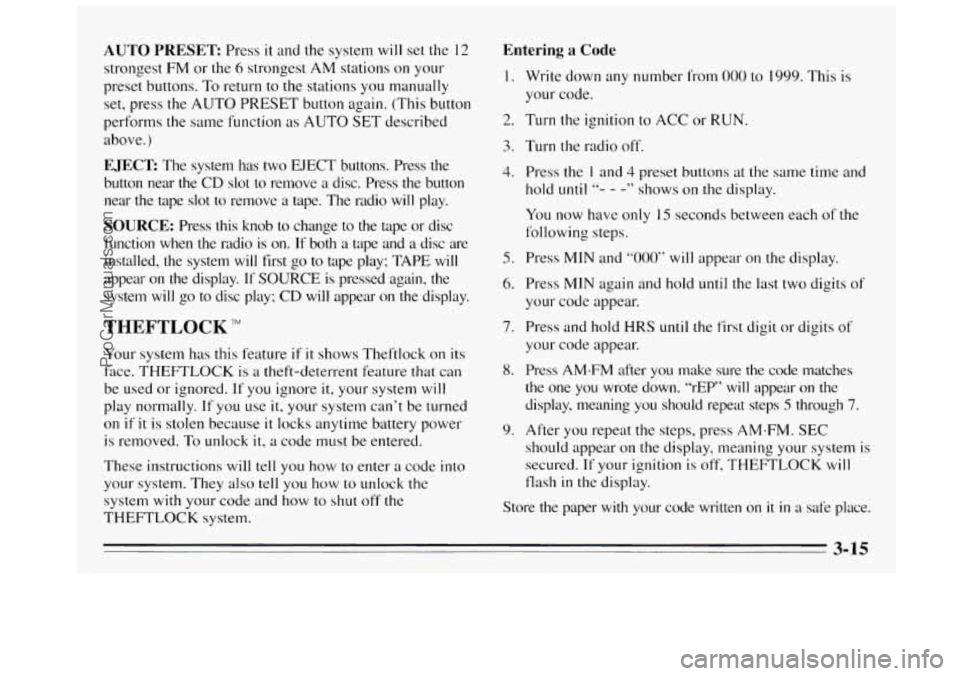
AUTO PRESET Press it and the system will set the 12
strongest
FM or the 6 strongest AM stations on your
preset buttons. To return to
the stations you manually
set, press the AUTO PRESET button again. (This button
performs
the same function as AUTO SET described
above.)
EJECT The system has two EJECT buttons. Press the
button near the CD slot to remove a disc. Press the button
near the tape slot to remove a tape. The radio will play.
SOURCE: Press this knob to change to the tape or disc
function when the radio
is on. If both a tape and a disc are
installed, the system
will first go to tape play; TAPE will
appear on the display. If SOURCE is pressed again, the
system
will go to disc play; CD will appear on the display.
THEFTLOCK TM
Your system has this feature if it shows Theftlock on its
face. THEFTLOCK
is a theft-deterrent feature that can
be used or ignored.
If you ignore it, your system will
play normally.
If you use it, your system can’t be turned
on if it is stolen because it locks anytime battery power
is removed.
To unlock it, a code must be entered.
These instructions will tell you how to enter a code into
your system. They also
tell you how to unlock the
system with your code and how to shut off the
THEFTLOCK system.
Entering a Code
1. Write down any number from 000 to 1999. This is
your code.
2. Turn the ignition to ACC or RUN.
3. Turn the radio off.
4. Press the I and 4 preset buttons at the same time and
hold
until “- - - ” shows on the display.
You
now have only I5 seconds between each of the
following steps.
5. Press MIN and “000” will appear on the display.
6. Press MIN again and hold until the last two digits of
your code appear.
7. Press and hold HRS until the first digit or digits of
your code appear.
8. Press AM-FM after you make sure the code matches
the one you wrote down. “rEP” will appear on the
display, meaning you should repeat steps
5 through 7.
9. After you repeat the steps, press AM-FM. SEC
should appear on the display, meaning your system is
secured. If your ignition is off, THEFTLOCK will
flash
in the display.
Store
the paper with your code written on it in a safe place.
3-15
ProCarManuals.com
Page 146 of 340
Remember: Anti-lock doesn’t change the time you need
to get your foot up to the brake pedal. If you get too
close to the vehicle in front of you, you won’t have time
to apply your brakes
if that vehicle suddenly slows or
stops. Always leave enough room up ahead
to stop, even
though you have anti-lock brakes.
To Use Anti-Lock
Don’t pump the brakes. Just hold the brake pedal down
and let anti-lock work for you. You may feel the system
working, or
you may notice some noise, but this is
normal. When your anti-lock system is adjusting brake
pressure to help avoid a braking skid, the
LOW TRAC
light will come on. See “Anti-Lock Brake System
Active Light”
in the Index.
Braking in Emergencies
Use your anti-lock braking system when you need to.
With anti-lock,
you can steer and brake at the same
time. In many emergencies, steering can help
you more
than even the very best braking.
Steering
Power Steering
If you lose power steering assist because the engine
stops or the system is not functioning, you can steer but
it will take much more effort.
Steering Tips
Driving on Curves
It’s important to take curves at a reasonable speed.
A lot of the “driver lost control” accidents mentioned on
the news happen on curves. Here’s why:
Experienced driver or beginner, each
of us is subject to
the same laws of physics when driving on curves. The
traction
of the tires against the road surface makes it
possible for the vehicle to change its path when you turn
the front wheels. If there’s no traction, inertia will keep
the vehicle going
in the same direction. If you’ve ever
tried to steer
a vehicle on wet ice, you’ll understand this.
The traction you can get in a curve depends on the
condition
of your tires and the road surface, the angle at
which the curve
is banked, and your speed. While
you’re
in a curve, speed is the one factor you can
control.
ProCarManuals.com