oil change BUICK REGAL 1995 Owners Manual
[x] Cancel search | Manufacturer: BUICK, Model Year: 1995, Model line: REGAL, Model: BUICK REGAL 1995Pages: 340, PDF Size: 17.16 MB
Page 218 of 340
What Kind of Oil to Use
Oils of the proper quality for your vehicle can be
identified by looking for the “Starburst” symbol. The
“Starburst” symbol indicates that the oil has been
certified by the American Petroleum Institute (API), and
is preferred for use in your gasoline engine.
If you change your own oil,
be sure you use oil that has
the “Starburst” symbol on
the front of the oil
container.
If you have your
oil changed for you, be sure
the oil put into your engine
is American Petroleum
Institute certified for
gasoline engines.
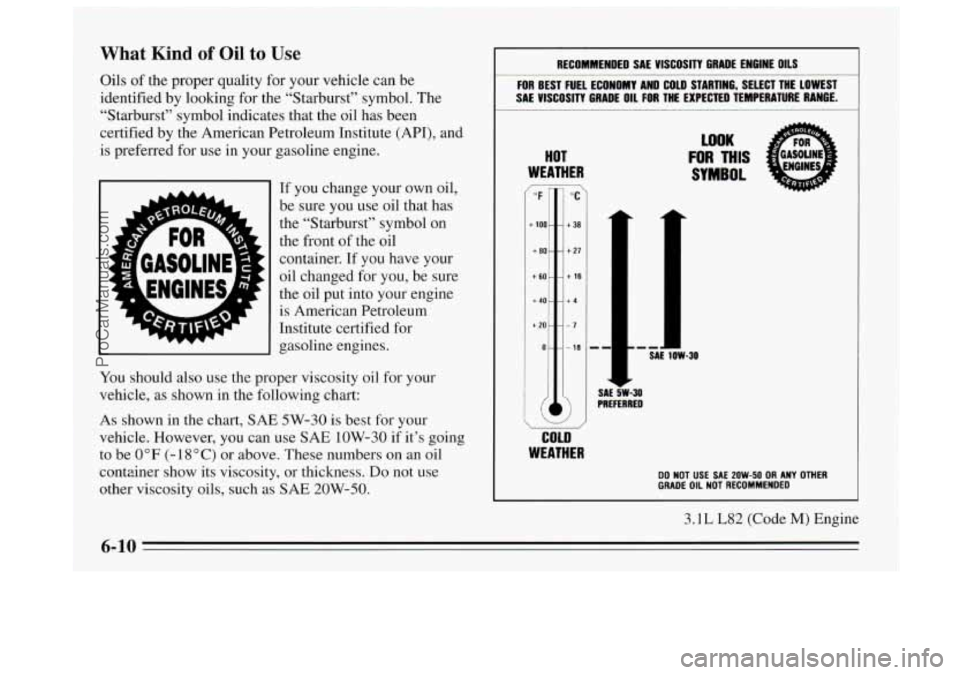
You should also use the proper viscosity oil for your
vehicle, as shown in the following chart:
As shown in the chart, SAE 5W-30 is best for your
vehicle. However, you can use SAE 1OW-30 if it’s going
to be
0°F (- 18°C) or above. These numbers on an oil
container show its viscosity, or thickness.
Do not use
other viscosity oils, such as SAE
20W-50.
RECOMMENDED SAE VISCOSITY GRADE ENGINE OILS ~~~~~ ~ ~ ~~ ~~~
FOR BEST FUEL ECONOMY AND COLD STARTING, SELECT THE LOWEST
SAE VISCOSITY GRADE OIL
FOR THE EXPECTED TEMPERATURE RANGE.
HOT
WEATHER
COLD
WEATHER
FOR THIS
LOOK
SYMBOL @&
SAE 1OW-30
r
RED
DO NOT USE SAE 2OW-50 OR ANY OTHER
GRADE OIL NOT RECOMMENDED
3.1L L82 (Code M) Engine
6-10
~
ProCarManuals.com
Page 219 of 340
RECOMMENDED SAE VISCOSITY GRADE ENGINE OILS
FOR BEST FUEL ECONOMY AND COLD STARTING, SELECT THE LOWEST
SAL VISCOSITY GRADE
OIL FOR THE EXPECTED TEMPERATURE RANGE. -
HOT
WEATHER
- "F "C
-100- - +38
+BO- - +27
+60--+16
+40--+4
+20---7
0---18
SAL SW-30
LOOK
FOR THIS
SYMBOL
SAE 1OW-30 PREFERRE0 above 0°F (-18OC)
COLD
WEATHER
DO NOT USE SAE 2OW-50 OR ANY OTHER
GRADE OIL NOT RECOMMENDED
3.8L L27 (Code L) Engine
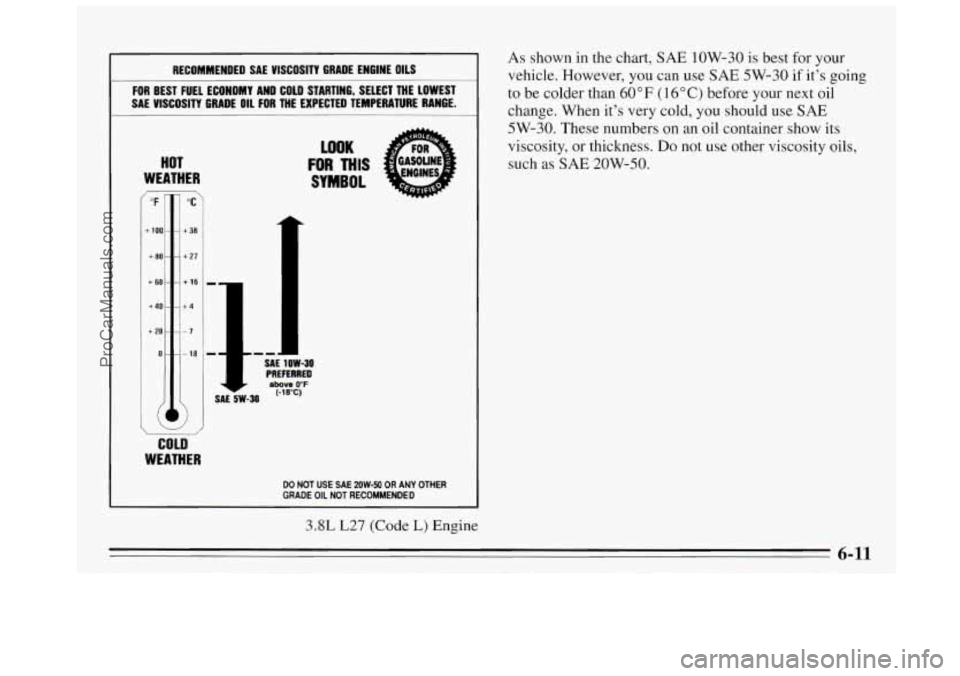
As shown in the chart, SAE 1OW-30 is best for your
vehicle. However, you can use
SAE 5W-30 if it's going
to be colder than
60°F ( 16" C) before your next oil
change. When it's very cold, you should use
SAE
5W-30. These numbers on an oil container show its
viscosity, or thickness.
Do not use other viscosity oils,
such as
SAE 20W-50.
6-11
ProCarManuals.com
Page 220 of 340
When to Change Engine Oil
See if any one of these is true for you: NOTICE:
Use only engine oil with the American Petroleum
Institute Certified For Gasoline Engines
“Starburst” symbol. Failure to use the proper oil
can result
in engine damage not covered by your
warranty.
Most trips are less than 5 to 10 miles (8 to 16 km).
This
is particularly important when outside
temperatures are below freezing.
Most trips include extensive idling (such as frequent
driving
in stop-and-go traffic).
GM Goodwrench@ oil (in Canada, GM Engine Oil)
meets all the requirements for your vehicle.
Engine Oil Additives
Don’t add anything to your oil. Your Buick dealer is
ready to advise if you think something should be added.
Most trips are through dusty areas.
You frequently tow a trailer or use a carrier on top of
your vehicle.
Tf any one of these is true for your vehicle, then you
need to change your oil and filter every
3,000 miles
(5 000 km) or 3 months -- whichever comes first.
If none of them is true, change the oil and filter every
7,500 miles (12 500 km) or 12 months -- whichever
comes first.
6-12
ProCarManuals.com
Page 221 of 340
Engine Coolant Heater
An engine coolant heater can be a big help if you have
to park outside in very cold weather,
0 OF (- 1 8 O C) or
colder. If your vehicle has this option, see “Engine
Coolant Heater” in
the Index.
What to Do with Used Oil
Did you know that used engine oil contains certain
elements that may be unhealthy for your skin and could
even cause cancer? Don’t
let used oil stay on your skin
for very long. Clean your skin and nails with soap and
water, or a good hand cleaner. Wash or properly throw
away clothing
or rags containing used engine oil. (See
the manufacturer’s warnings about the use and disposal
of oil products.)
Used oil can be a real threat
to the environment. If you
change your own oil, be sure to drain all free-flowing oil
from
the filter before disposal. Don’t ever dispose of oil
by putting it in the trash, pouring it on the ground, into
sewers, or into streams or bodies
of water. Instead,
recycle it by taking
it to a place that collects used oil. if
you have a problem properly disposing of your used oil,
ask your dealer, a service station or a local recycling
center for help.
Air Cleaner
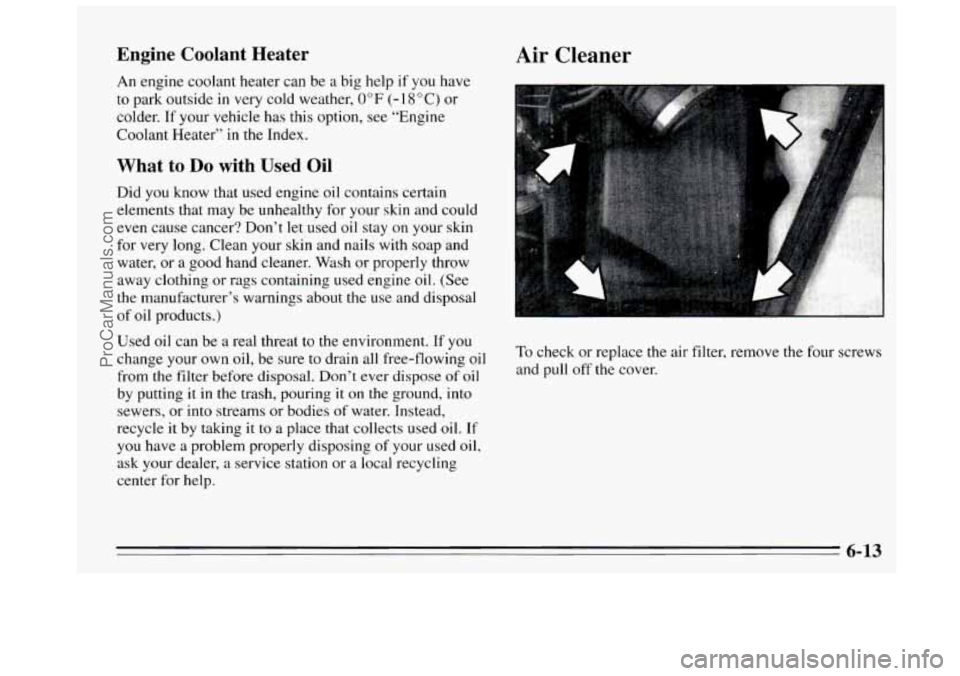
To check or replace the air filter, remove the four screws
and pull off the cover.
6-13
ProCarManuals.com
Page 223 of 340
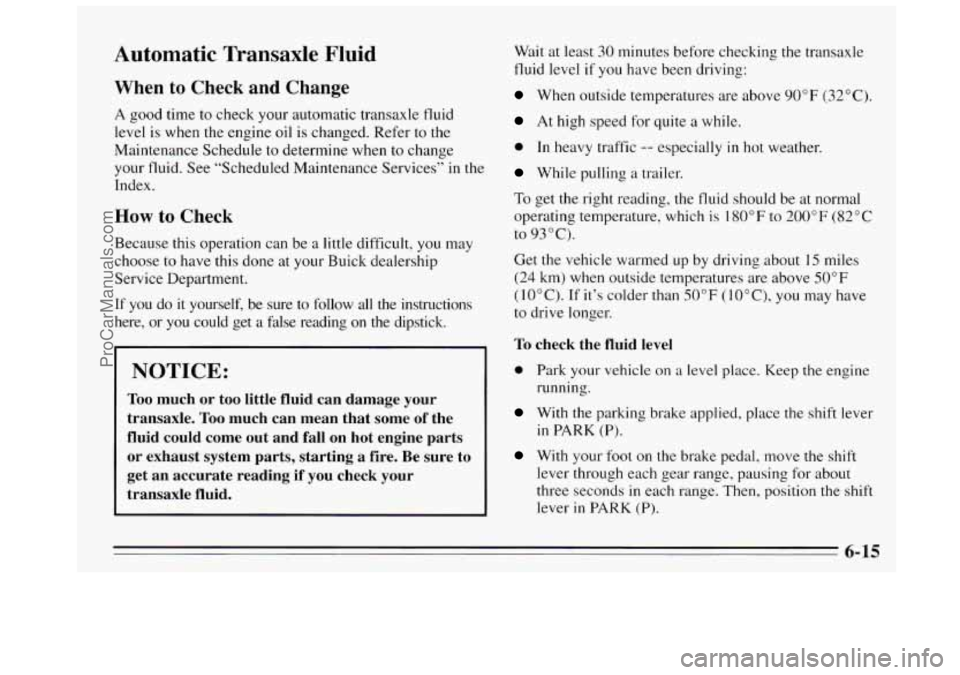
Automatic Transaxle Fluid
When to Check and Change
A good time to check your automatic transaxle fluid
level is when the engine oil is changed. Refer to the
Maintenance Schedule
to determine when to change
your fluid. See “Scheduled Maintenance Services” in
the
Index.
How to Check
Because this operation can be a little difficult, you may
choose to have this done at your Buick dealership
Service Department.
If you do it yourself, be sure
to follow all the instructions
here, or you could get
a false reading on the dipstick.
NOTICE:
Too much or too little fluid can damage your
transaxle.
Too much can mean that some of the
fluid could come out and fall on hot engine parts or exhaust system parts, starting a fire. Be sure to
get an accurate reading if you check your
transaxle fluid.
Wait at least 30 minutes before checking the transaxle
fluid level
if you have been driving:
When outside temperatures are above 90°F (32°C).
At high speed for quite a while.
0 In heavy traffic -- especially in hot weather.
While pulling a trailer.
To get the right reading, the fluid should be at normal
operating temperature, which is
180°F to 200°F (82°C
to
93 ” C).
Get the vehicle warmed up by driving about 15 miles
(24
km) when outside temperatures are above 50°F
(10°C). If it’s colder than 50°F (IOOC), you may have
to drive longer.
To check the fluid level
0 Park your vehicle on a level place. Keep the engine
running.
With the parking brake applied, place the shift lever
in PARK (P).
With your foot on the brake pedal, move the shift
lever through each gear range, pausing for about
three seconds
in each range. Then, position the shift
lever
in PARK (P).
6-15
ProCarManuals.com
Page 263 of 340
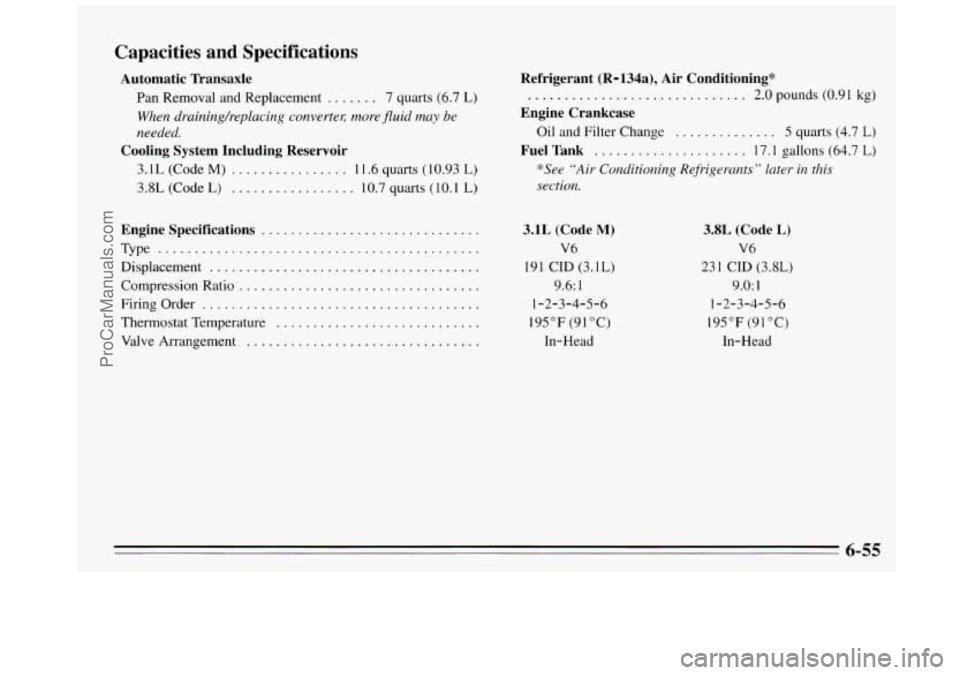
Capacities and Specifications
Automatic Transaxle
Pan Removal and Replacement ....... 7 quarts (6.7 L)
When drainingheplacing converteq more fluid muy be
needed.
Cooling System Including Reservoir
3. IL (Code M) ................ 11.6 quarts (10.93 L)
3.8L (Code L) ................. 10.7 quarts (10.1 L)
Engine Specifications ..............................
Type ............................................
Displacement .....................................
Compression Ratio .................................
Firing Order ......................................
Thermostat Temperature ............................
ValveArrangement ................................
Refrigerant (R-l34a), Air Conditioning*
Engine Crankcase Oil
and Filter Change .............. 5 quarts (4.7 L)
Fuel Tank ..................... 17.1 gallons (64.7 L)
*See “Air Conditioning Rejrigerunts” later irz this
section.
.............................. 2.0 pounds (0.91 kg)
3.1L (Code M)
V6
191 CID (3.1L)
9.6:
1
1-2-3-4-5-6
195°F (91OC)
In-Head
3.8L (Code L)
V6
231 CID (3.8L)
9.0: I
1-2-3-4-5-6
195°F (91
“C)
In-Head
6-55
ProCarManuals.com
Page 269 of 340
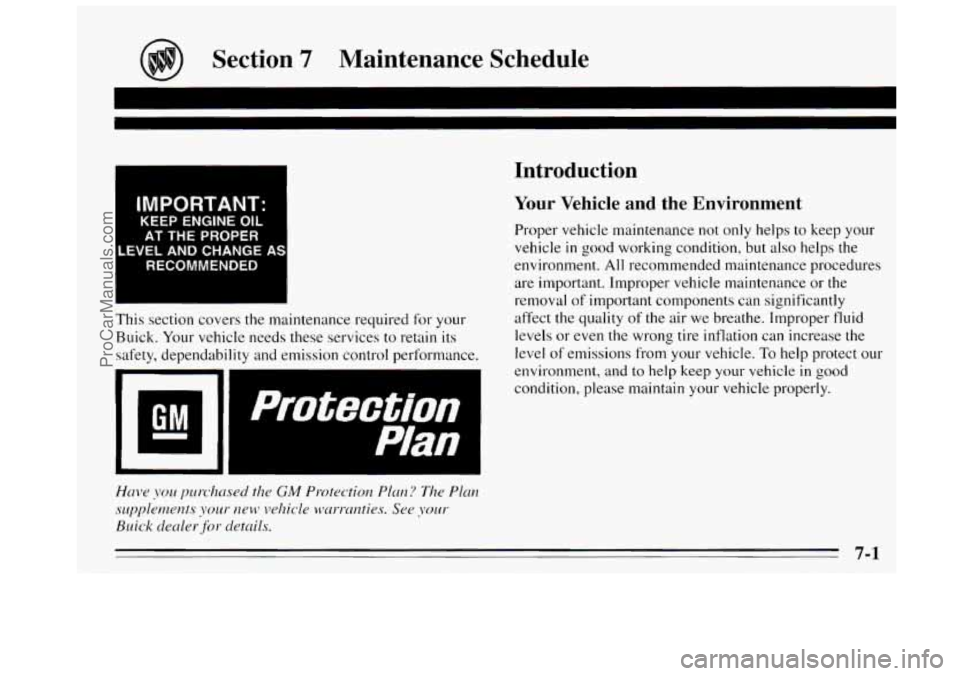
Section 7 Maintenance Schedule
IMPORTANT:
KEEP ENGINE OIL
AT THE PROPER
.EVEL AND CHANGE AI
RECOMMENDED
This section covers the maintenance required for your
Buick. Your vehicle needs these services
to retain its
safety, dependability
and emission control performance.
Protection
Plan
ui
Introduction
Your Vehicle and the Environment
Proper vehicle maintenance not only helps to keep your
vehicle
in good working condition, but also helps the
environment. All recommended maintenance procedures
are important. Improper vehicle maintenance or the
removal
of important components can significantly
affect the quality
of the air we breathe. Improper fluid
levels or
even the wrong tire inflation can increase the
level of emissions from your vehicle. To help protect our
environment, and to help keep
your vehicle in good
condition, please maintain your vehicle properly.
ProCarManuals.com
Page 272 of 340
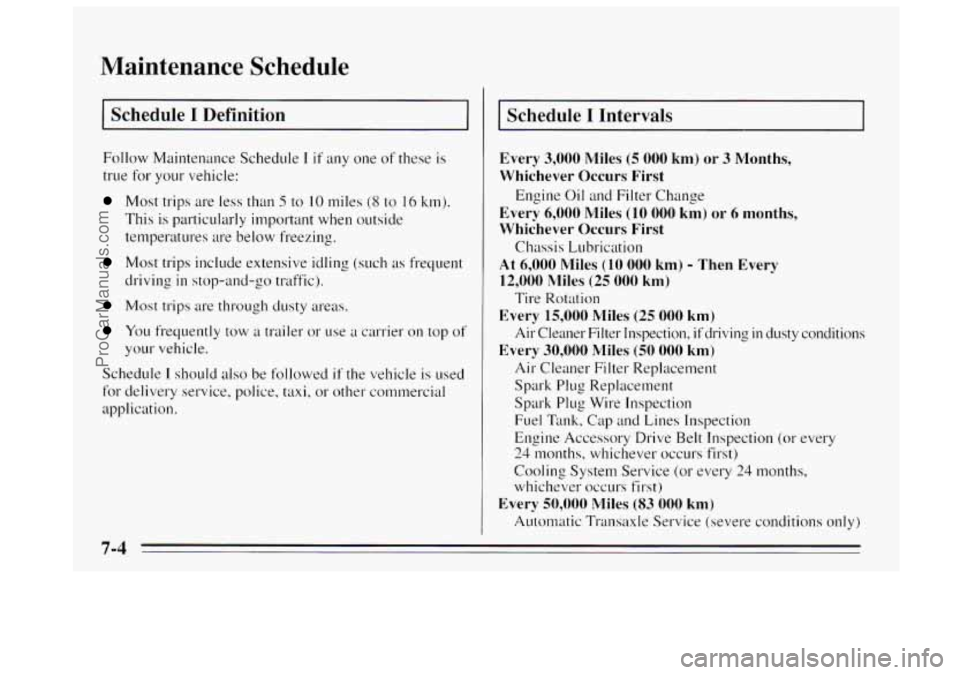
Maintenance Schedule
I Schedule I Definition I
Follow Maintenance Schedule I if any one of these is
true for your vehicle:
Most trips are less than 5 to IO miles (8 to 16 kin).
This is particularly important when outside
temperatures are below freezing.
Most trips include extensive idling (such as frequent
driving
in stop-and-go traffic).
Most trips are through dusty areas.
You frequently tow a trailer or use a can-ier on top of
your vehicle.
Schedule
1 should also be followed if the vehicle is used
for delivery service, police, taxi, or other commercial
application.
Schedule I Intervals
Every 3,000 Miles (5 000 knl) or 3 Months,
Whichever Occurs First
Every 6,000 Miles (10 000 km) or
6 months,
Whichever Occurs First
Chassis Lubrication
At 6,000 Miles ( 10 000 km) - Then Every
12,000 Miles
(25 000 km)
Tire Rotation
Every 15,000 Miles (25 000 km)
Air Cleaner Filter Inspection, if driving in dusty conditions
Every 30,000 Miles (50 000 kin)
Air Cleaner Filter Replacement
Spark Plug Replacement
Spark Plug Wire Inspection
Fuel Tank, Cap and Lines Inspection
Engine Accessory Drive Belt Inspection
(or every
24 months, whichever occurs first)
Cooling System Service
(or every 24 months,
whichever occurs first)
Automatic T~-ansaxle Service (severe conditions only)
Engine
Oil and Filter Change
Every 50,000 Miles (83 000 km)
7-4
ProCarManuals.com
Page 273 of 340
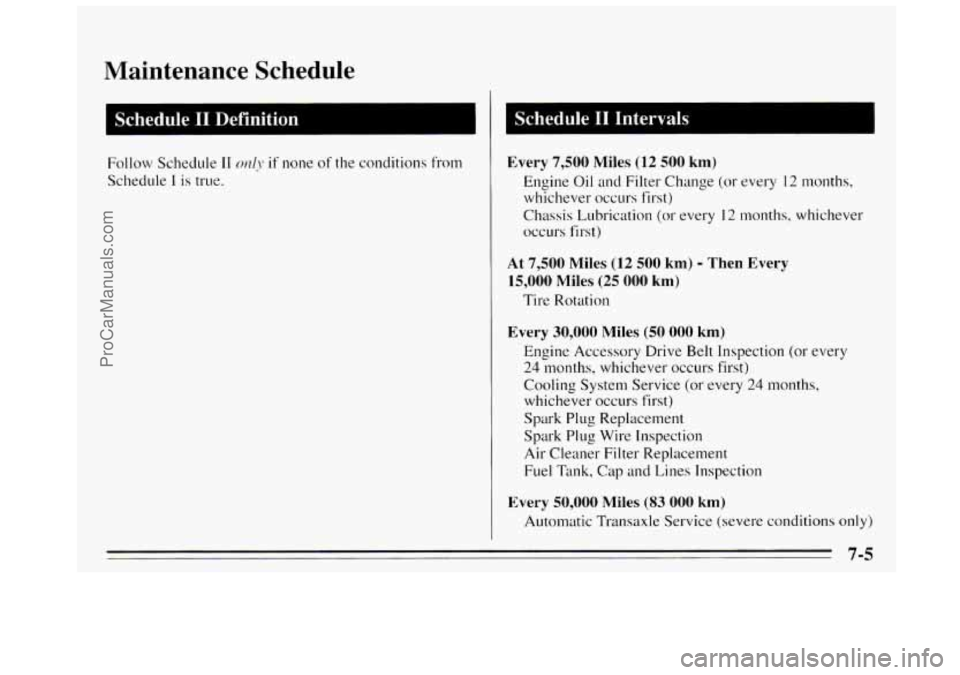
Maintenance Schedule
Follow Schedule I1 od~? if none of the conditions from
Schedule
I is true.
Every 7,500 Miles (12 500 km)
Engine Oil and Filter Change (or every 12 nmnths,
whichever occurs first)
Chassis Lubrication
(or every 12 months, whichever
occurs first)
At 7,500 Miles (12 500 km) - Then Every
15,000 Miles
(25 000 km)
Tire Rotation
Every 30,000 Miles (50 000 km)
Engine Accessory Drive Belt Inspection (or every
24 months, whichever occurs first)
Cooling System Service (or every 24 months,
whichever occurs first)
Spark Plug Replacement
Spark
Plug Wire Inspection
Air Cleaner Filter Replacement
Fuel Tank, Cap and Lines Inspection
Every 50,000 Miles (83 000 km)
Automatic Transaxle Service (severe conditions only)
7-5
ProCarManuals.com
Page 274 of 340
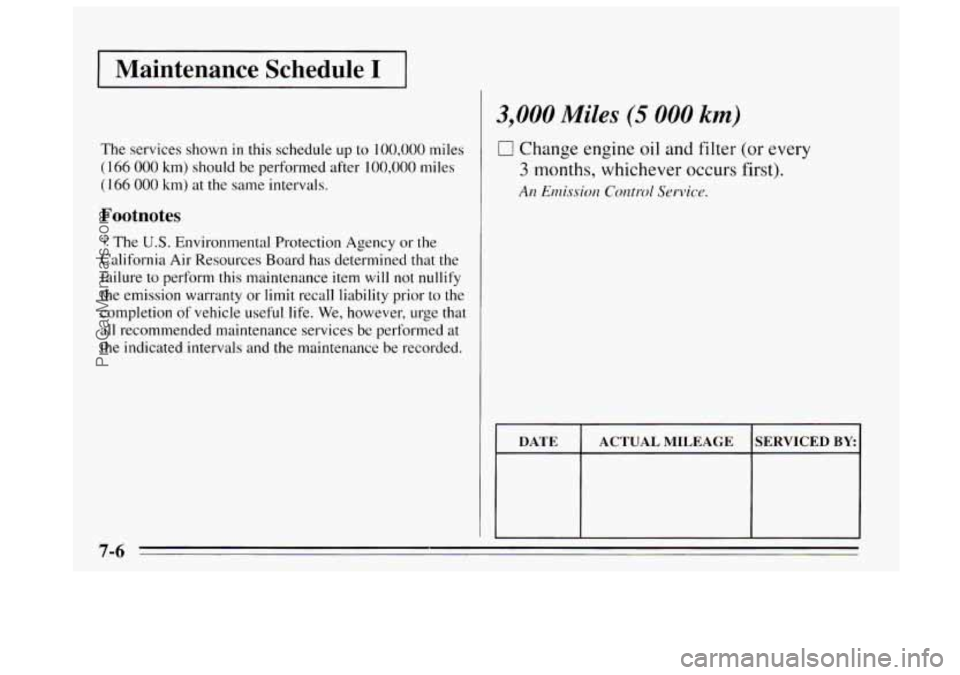
Maintenance Schedule I
3,000 Miles (5 000 km)
The services shown in this schedule up to 100,000 miles
(166 000 km) should be performed after 100,000 miles
(1 66 000 km) at the same intervals.
Footnotes
I* The U.S. Environmental Protection Agency or the
California Air Resources Board has determined that the
failure to perform this maintenance item will not
nullify
the emission warranty or limit recall liability prior to the
completion
of vehicle useful Me. We, however, urge that
all recommended maintenance services be performed at
the indicated intervals and
the maintenance be recorded.
0 Change engine oil and filter (or every
3 months, whichever occurs first).
An Etnissiorz Cmttrol Service.
DATE SERVICED BY ACTUAL MILEAGE
ProCarManuals.com