radiator BUICK REGAL 1996 User Guide
[x] Cancel search | Manufacturer: BUICK, Model Year: 1996, Model line: REGAL, Model: BUICK REGAL 1996Pages: 356, PDF Size: 17.97 MB
Page 242 of 356
How to Add Fluid
Refer to the Maintenance Schedule to determine what
kind
of transaxle fluid to use. See “Recommended
Fluids and Lubricants’’
in the Index.
If the fluid level is low, add
only enough of the proper
fluid to bring the level into the cross-hatched area on
the dipstick.
1.
2.
0
0
Pull out the dipstick.
Using
a long-neck funnel, add enough fluid at the
dipstick hole to bring
it to the proper level. It doesn’t
take much fluid, generally less than a pint
(0.5 L).
Don t overfill. We recommend you use only fluid
labeled DEXRONO-111, because fluid with that label
is made especially for your automatic transaxle.
Damage caused by fluid other than DEXRON@-I11
is not covered by your new vehicle warranty.
After adding fluid, recheck the fluid level
as
described under “How to Check.”
When
the correct fluid level is obtained, push the
dipstick back in all the way.
Engine Coolant
The cooling system in your vehicle is filled with new
DEX-COOL
TM (orange-colored, silicate-free) engine
coolant. This coolant
is designed to remain in your
vehicle for
5 years or 100,000 miles (166 000 km),
whichever occurs first.
The following explains your cooling system and how to
add coolant when
it is low. If you have a problem with
engine overheating or
if you need to add coolant to your
radiator, see “Engine Overheating” in the Index.
A 50/50 mixture of water and the proper coolant for
your Buick will:
Give freezing protection down to
-34°F (-37°C).
Give boiling protection up
to’ 265 “F ( 129” C).
Protect against rust and corrosion.
Help keep the proper engine temperature.
Let the warning lights and gages work as
they should.
ProCarManuals.com
Page 243 of 356
NOTICE:
When adding coolant it is important that you use
DEX-COOL TM (orange-colored, silicate-free)
coolant meeting
GM Specification 6277M.
If silicated coolant is added to the system,
premature engine, heater core or radiator corrosion may result. In addition, the engine
coolant will require change sooner
-- at
30,000 miles (50 000 km) or 24 months whichever
occurs first
.
What to Use
Use a mixture
of one-half clean water (preferably
distilled) and one-half
DEX-COOL TM (orange-colored,
silicate-free) antifreeze that meets GM Specification
6277M, which won’t damage aluminum parts. Use
GM Engine Coolant Supplement (sealer) (GM Part
No. 3634621) with any complete coolant change. If you
use this mixture, you don’t need to add anything else.
CAUTION
-
Adding only plain water to your cooling system
can be dangerous. Plain water, or some other
liquid like alcohol, can boil before the proper
coolant mix will. Your vehicle’s coolant warning
system is set for the proper coolant mix. With
plain water or the wrong mix, your engine could
get too hot but you wouldn’t get the overheat
warning.
Your engine could catch fire and you or
others could be burned. Use a 50/50 mix of clean
water and
DEX-COOL TM (orange-colored,
silicate-free) antifreeze.
6-21
ProCarManuals.com
Page 244 of 356
NOTICE:
If you use an improper coolant mix, your engine
could overheat and be badly damaged. The
repair cost wouldn’t be covered by your
warranty. Too
much water in the mix can freeze
and crack the engine, radiator, heater core and
other parts.
If you have to add coolant more than four times a year,
have your dealer check your cooling system.
I NOTICE:
If you use the proper coolant, you don’t have to
add extra inhibitors or additives which claim to
improve the system. These can be harmful.
-1
:king Coolant
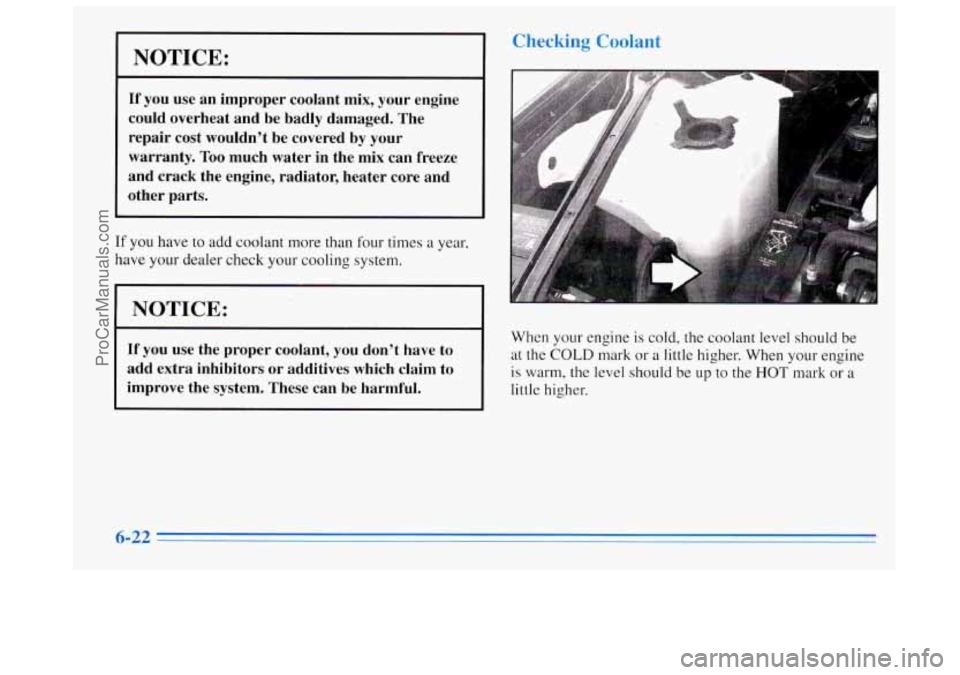
When your engine is cold, the coolant level should be
at the
COLD mark or a little higher. When your engine
is warm, the level should be up to the HOT mark or a
little higher.
ProCarManuals.com
Page 245 of 356
LOW
COOLANT
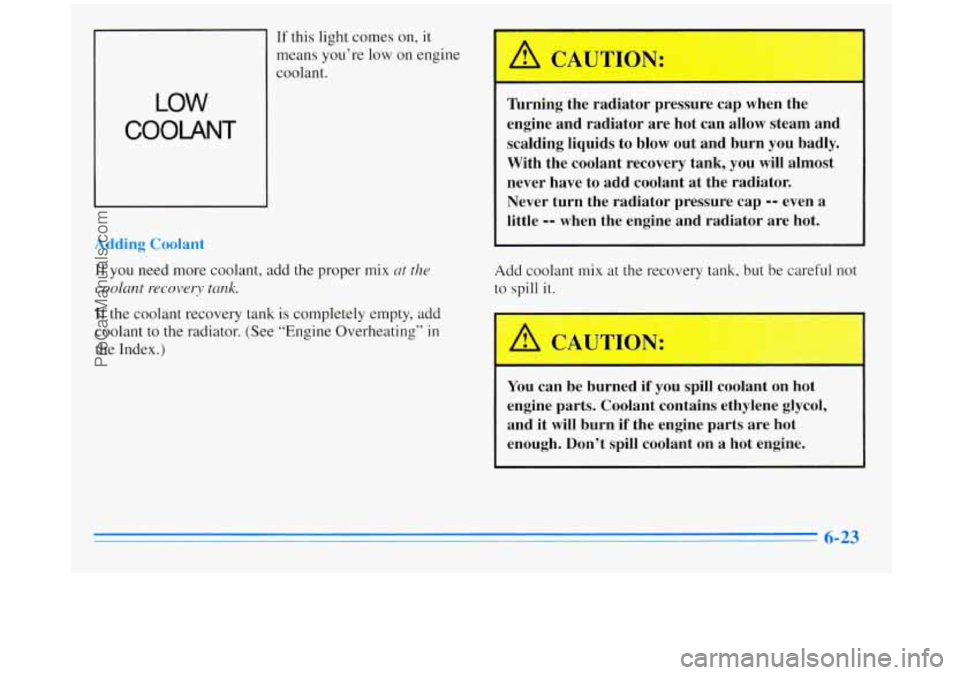
If this light comes on, it
means you’re low on engine
coolant.
Addinq Coolar A
If you need more coolant, add the proper mix at the
coolant recovery tank.
If the coolant recovery tank is completely empty, add
coolant to the radiator. (See “Engine Overheating” in
the Index.)
I
Turning the radiator pressure cap when the
engine and radiator are hot can allow steam and
scalding liquids to blow out and burn you badly.
With the coolant recovery tank, you will almost
never have to add coolant at the radiator.
Never turn the radiator pressure cap
-- even a
little -- when the engine and radiator are hot.
Add coolant mix at
the recovery tank, but be careful not
to spill
it.
I
You can be burned if you spill coolant on hot
engine parts. Coolant contains ethylene glycol,
and it will burn
if the engine parts are hot
enough. Don’t spill coolant on
a hot engine.
ProCarManuals.com
Page 246 of 356
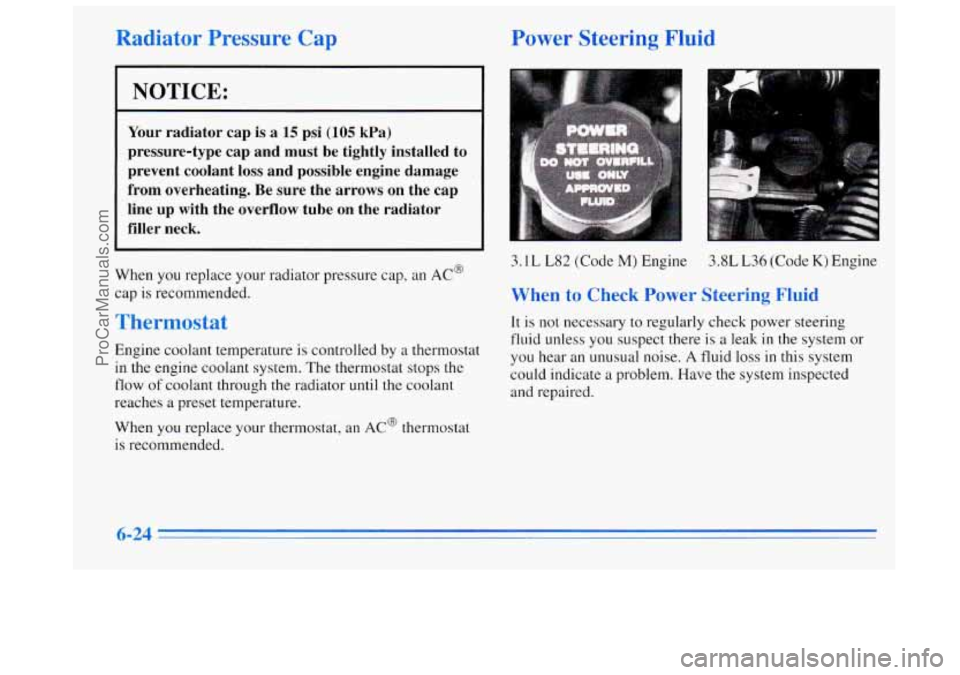
Radiator Pressure Cap
NOTICE:
Your radiator cap is a 15 psi (105 kPa)
pressure-type cap and must be tightly installed to
prevent coolant loss and possible engine damage
from overheating. Be sure the arrows on the cap
line up with the overflow tube on the radiator filler neck.
When you replace your radiator pressure cap, an AC@
cap is recommended.
Thermostat
Engine coolant temperature is controlled by a thermostat
in the engine coolant system. The thermostat stops the
flow of coolant through the radiator until the coolant
reaches
a preset temperature.
When
you replace your thermostat, an AC@ thermostat
is recommended.
Power Steering Fluid
3.lL L82 (Code M) Engine 3.8L L36 (Code K) Engine
When to Check Power Steering Fluid
It is not necessary to regularly check power steering
fluid unless
you suspect there is a leak in the system or
you hear an unusual noise.
A fluid loss in this system
could indicate a problem. Have the system inspected
and repaired.
6-24
ProCarManuals.com
Page 248 of 356
Windshield 'Washer Fluid
What to Use
When you need windshield washer fluid, be sure to read
the manufacturer's instructions before use.
If you will be
operating your vehicle in an area where the temperature
may fall below freezing,
use a fluid that has sufficient
protection against freezing.
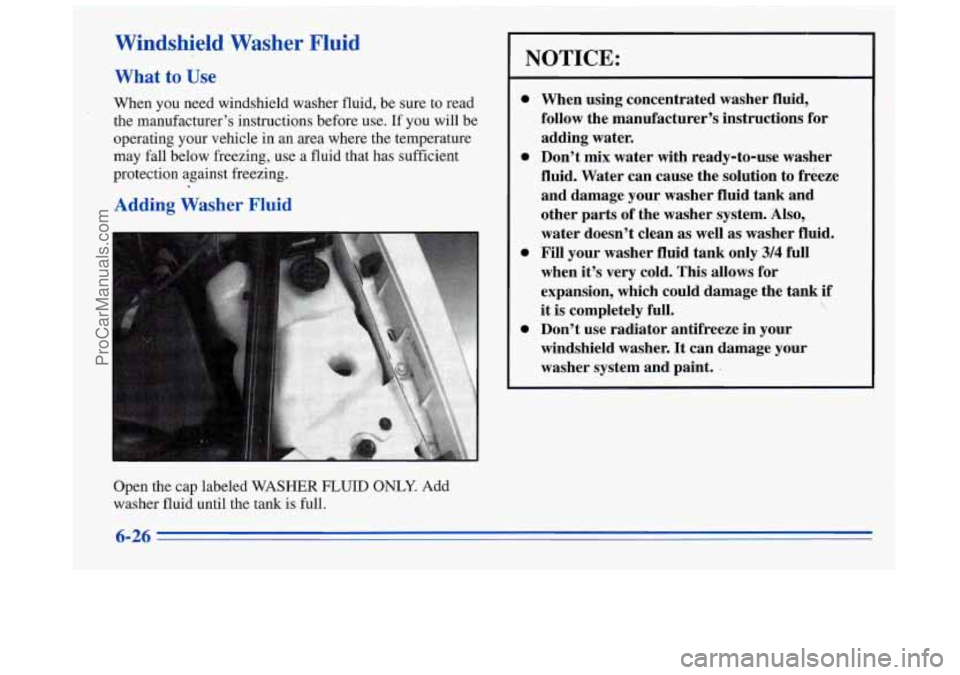
Adding Washer Fluid
NOTICE:
0
0
0
0
When using concentrated washer fluid,
follow the manufacturer's instructions for
adding water.
Don't
mix water with ready-to-use washer
fluid. Water can cause the solution to freeze
and damage your washer fluid tank and
other parts of the washer system. Also,
water doesn't clean
as well as washer fluid.
Fill your washer fluid tank only
3/4 full
when it's very cold. This allows for
expansion, which could damage the tank if
it is completely full.
Don't use radiator antifreeze in your
windshield washer. It can damage your
washer system and paint.
.
Open the cap labeled WASHER FLUID ONLY. Add
washer fluid until the tank is full.
6-26
ProCarManuals.com
Page 285 of 356
Normal Maintenance Replacement Parts
Air Cleaner Filter All Engines ........... A 1208C
Battery
3.1L (Code M) ..................... 525 CCA
3.8L (Code
K) ...................... 690 CCA
Engine Oil Filter
PCV Valve
All Engines ........................... PF47
All Engines
........................ CV892C
Radiator Cap
All Engines ........................... RC27
RKE Batteries ........... Duracell Type DL 2016
(2) or equivalent
Spark Plugs
3.1L (Code M) ............... AC Type 41 -940
Gap: 0.060” (1.52 mm)
3.8L (Code K) ................ AC Type 41-921
Gap:
0.060” (1.52 mm)
Air Conditioning Refrigerants
Not all air conditioning refrigerants are the same.
If the air conditioning system in your vehicle needs
refrigerant, be sure the proper refrigerant is used.
If you’re not sure, ask your Buick dealer.
6-63
ProCarManuals.com
Page 311 of 356
I Short TripKity Maintenance Schedule
100,000 Miles (144 000 km)
0 Drain, flush and refill cooling system
(or every
60 months since last service
whichever occurs first). See “Engine
Coolant” in the Index for what to use. ‘7
Inspect hoses. Clean radiator, condenser,
pressure cap and neck. Pressure test cooling
system and pressure cap.
AI? E1nission Control
Service.
j-
0 Inspect spark plug wires. An Em.ission
0 Replace spark plugs. An Emission
Control Service.
Control Service.
0 Change automatic transaxle fluid and filter
if the vehicle is mainly driven under one or
more of these conditions:
- In heavy city traffic where the outside
temperature regularly reaches
90 OF
(32°C) or higher.
- In hilly or mountainous terrain.
- When doing frequent trailer towing.
- Uses such as found in taxi, police or
delivery service.
If you do not use your vehicle under any of these
conditions, the.fluid andfilter do
not require changing.
I DATE I ACTUAL MILEAGE ISERVICED RE I
7-25
ProCarManuals.com
Page 320 of 356
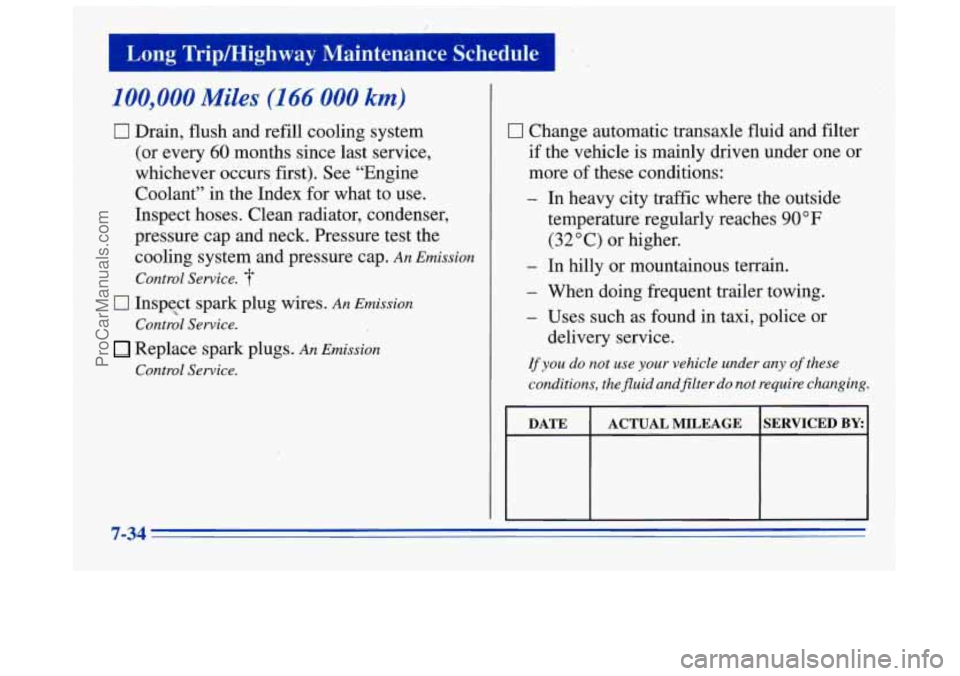
I Long Tripmighway Maintenance Schedule
100,000 Miles (1 66 000 km)
0 Drain, flush and refill cooling system
(or every
60 months since last service,
whichever occurs first).’ See “Engine
Coolant’’ in the Index for what to use.
Inspect hoses. Clean radiator, condenser,
pressure cap and neck. Pressure test the
cooling system and pressure cap.
An Emission
Control Service.
3-
0 Inspect P spark plug wires. An Emission
Replace spark plugs. An Emission
Control Service.
Control Service.
17 Change automatic transaxle
fluid and filter
if the vehicle is mainly driven under one or
more of these conditions:
- In heavy city traffic where the outside
temperature regularly reaches
90 OF
(32 O C) or higher.
- In hilly or mountainous terrain.
- When doing frequent trailer towing.
- Uses such as found in taxi, police or
delivery service.
If you do not use your vehicle under any of these
conditions, the fluid andfilter do not require changing.
7-34
ProCarManuals.com
Page 325 of 356
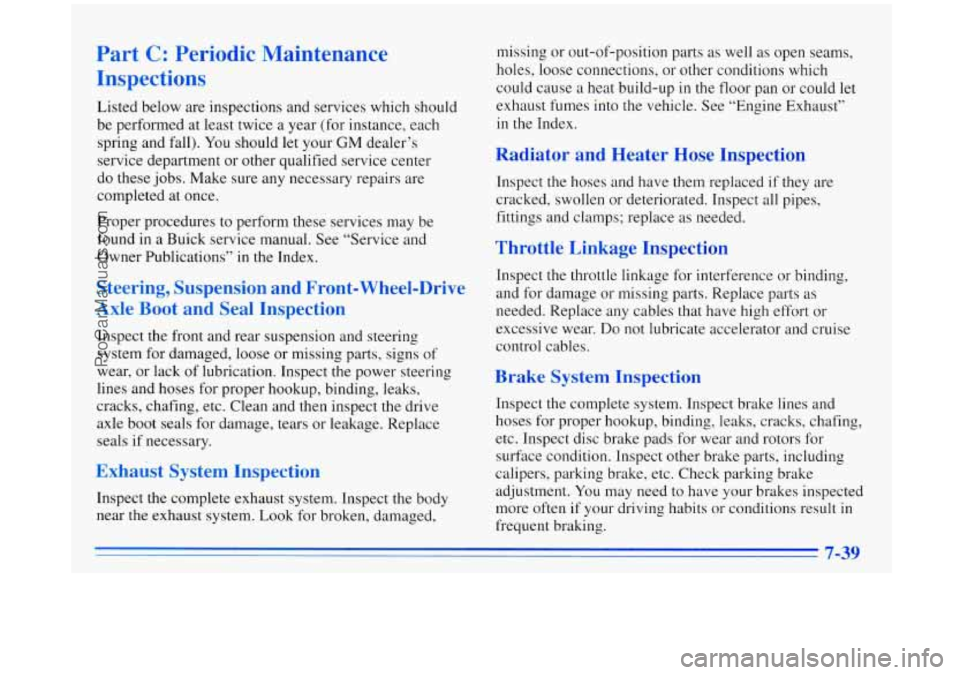
Part C: Periodic Maintenance
Inspections
Listed below are inspections and services which should
be performed at least twice
a year (for instance, each
spring and fall). You should let your GM dealer’s
service department or other qualified service center
do these jobs. Make sure any necessary repairs are
completed at once.
Proper procedures to perform these services may be
found in a Buick service manual. See “Service and
Owner Publications’’ in the Index.
Steering, Suspension and Front- Wheel-Drive
Axle Boot and Seal Inspection
Inspect the front and rear suspension and steering
system for damaged, loose or missing parts, signs of
wear, or lack of lubrication. Inspect the power steering
lines and hoses for proper hookup, binding, leaks,
cracks, chafing, etc. Clean and then inspect
the drive
axle boot seals for damage, tears or leakage. Replace
seals if necessary.
Exhaust System Inspection
mspect the complete exhaust system. Inspect the body
near the exhaust system. Look for broken, damaged, missing
or out-of-position parts as well
as open seams,
holes,
loose connections, or other conditions which
could cause
a heat build-up in the floor pan or could let
exhaust fumes into the vehicle. See “Engine Exhaust”
in the Index.
Radiator and Heater Hose Inspection
Inspect the hoses and have them replaced if they are
cracked? swollen or deteriorated. Inspect
all pipes,
fittings and clamps; replace
as needed.
Throttle Linkage Inspection
Inspect the throttle linkage for interference or binding,
and for damage
or missing parts. Replace parts as
needed. Replace any cables that have high effort or
excessive wear.
Do not lubricate accelerator and cruise
control cables.
Brake System Inspection
Inspect the complete system. Inspect brake lines and
hoses for proper hookup, binding, leaks, cracks, chafing,
etc. Inspect disc brake pads for wear and rotors for
surface condition. Inspect other brake parts, including
calipers, parking brake, etc. Check parking brake
adjustment. You may need to have your brakes inspected
more often if your driving habits or conditions result in
frequent braking.
7-39
ProCarManuals.com